|
시장보고서
상품코드
1521530
냉동 및 냉장 컨테이너 운송 : 시장 점유율 분석, 산업 동향 및 통계, 성장 예측(2024-2029년)Refrigerated Container Shipping - Market Share Analysis, Industry Trends & Statistics, Growth Forecasts (2024 - 2029) |
||||||
 Mordor Intelligence
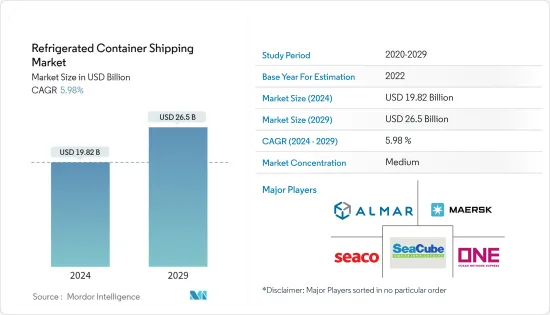
냉동 및 냉장 컨테이너 운송 시장 규모는 2024년 198억 2,000만 달러로 추정되며, 2029년에는 265억 달러에 달할 것으로 예상되며, 예측 기간(2024-2029년) 동안 5.98%의 CAGR로 성장할 것으로 예상됩니다.
주요 하이라이트
- 냉동 및 냉장 컨테이너 운송 시장에서 신선식품에 대한 수요가 증가하고 있지만, E-Commerce의 증가와 추적 기술의 발전도 영향을 미치고 있습니다. 또한 항공 운송의 부족으로 인한 수요도 증가하고 있지만, 냉장 화물 운송은 기술 향상으로 대응할 수 있습니다.
- 리퍼 운송은 건식 운송만큼 COVID-19의 영향을 받지 않습니다. 전 세계 대정전은 소비자에게 시간이 있고, 주택 개조에 대한 관심이 높으며, 홈 오피스를 정비하는 것이 시급하다는 것을 의미했습니다. 이는 건식 운송 물류에 큰 타격을 입혔습니다. 신선식품에 대한 수요는 비교적 안정적이며, 육류, 감귤류, 이국적인 과일에 대한 식욕이 높아져 2023년 상반기에는 전년 동기 대비 4.8% 증가했습니다. 예를 들어 델몬트 신선식품의 경우 총이익이 40% 증가했고 이익률은 33.3% 증가했습니다.
- 리퍼 운송은 우선적 선적의 혜택을 누리고 있으며, 냉장 제품 운송 시 병목현상 발생이 줄어들고 있으며, 2023년에는 노동력과 공간의 제약을 극복해야 하는 과제가 남아있지만 리퍼 선사에 좋은 조짐을 보이고 있습니다.
냉동 및 냉장 컨테이너 운송 시장 동향
의약품 시장 수요 증가
- 제약 산업은 가장 중요한 산업 중 하나입니다. 전 세계 예방접종 수요의 약 62%를 충족시키고, 세계 최대 제네릭 의약품 공급업체로 전 세계 총 공급량의 20%를 차지합니다. 이 산업은 수천 년 전에 설립되었지만 최근 몇 년 동안 크게 확장되었습니다.
- 기술 개발은 제약 물류 산업을 이끄는 큰 흐름입니다. 시장에서의 입지를 유지하기 위해 주요 제약 물류 기업들은 클라우드 기반 공급망 운영, IoT 기술 등 새로운 기술을 개발하고 있습니다.
- Cardinal Health는 2022년 4월 개인보호장비(PPE) 8만 팔레트 보관 및 배송을 위해 미화 5,780만 달러 규모의 계약을 체결했습니다. 미국 보건복지부(HHS)의 한 부서인 전략적 국가비축(SNS)을 지원하기 위한 것이었습니다.
- 최근 조사에 따르면, 15개 리퍼항로 분석에 따르면 2021년 3분기에는 50%의 증가를 보였으며, 드라이 컨테이너 운임은 4배 이상 증가하였다고 합니다. 또한 FESCO 운송 그룹은 2022년 7월에 Dalreftrans 자회사 확장 전략에 따라 2022년 여름이 끝날 때까지 리퍼 컨테이너 선단을 4,000 개로 확장 할 계획이었습니다. 이처럼 의약품 운송 및 물류 수요의 증가는 리퍼 컨테이너의 사용을 촉진하고 있습니다.
무역 경로의 증가
- 무역 루트는 상업용 화물이 통과하는 데 사용되는 도로와 정거장의 물류 네트워크입니다. 이를 통해 상품이 멀리 떨어진 시장에서 번창 할 수 있습니다. 하나의 무역 경로에는 경제 및 비 상업적 운송 경로의 소규모 네트워크로 연결될 수있는 장거리 간선 도로가 포함됩니다. 해상 운송량과 무역 경로의 수가 계속 증가함에 따라 리퍼 컨테이너에 대한 수요가 높아질 것으로 예상됩니다.
- 선호되는 운송 방법인 해상 운송 카테고리는 냉동 컨테이너 시장에서 가장 큰 점유율을 차지하고 있으며 향후 몇 년 동안 그 우위를 유지할 것으로 예상되며, 2024년까지 해상 냉장 무역은 총 1억 2,400 만 톤에 달할 것으로 예상되며 연간 3.7%의 성장률을 반영합니다. 반면 건화물은 식품 공급망의 "광범위한 탄력성"으로 인해 연간 2.2% 증가에 그칠 것으로 보입니다.
- 다양한 충격이 세계 경제를 짓누르는 가운데 세계 무역은 2022년 하반기에 추진력을 잃고 2023년에도 침체가 지속될 것으로 보이며, WTO 전문가들은 2022년 세계 상품 교역량 증가율을 3.5%로 예상해 2022년 4월의 3.0%를 상회할 것으로 예상했습니다. 그러나 2023년 성장률은 1.0%로 이전 전망치인 3.4%보다 크게 낮아질 것으로 예상했습니다.
- 리퍼 물류의 인기가 높아지는 것은 소위 신흥국의 경제 발전뿐만 아니라 기존 시장의 행동 변화 때문이기도 합니다. 예를 들어, 식물성 식단이 인기를 끌면서 아보카도와 같은 상품이 라틴아메리카에서 유럽, 중국, 북미로 수출되고 있습니다. 이러한 변화는 맞춤형 물류 솔루션에 대한 수요를 창출합니다. 리퍼 컨테이너가 바로 그 솔루션입니다.
냉동 및 냉장 컨테이너 운송 산업 개요
냉동/냉장 컨테이너 운송 시장은 매우 세분화된 경쟁 시장이며, 모든 국가와 지역에 국내외 플레이어가 혼재되어 있습니다. 주요 업체로는 A.P. Moller-Maersk, Seaco Srl, SeaCube Container Leasing Ltd. 등이 있습니다. 시장 성장을 이끄는 주요 요인은 무역 경로의 증가, 처방 제품에 대한 수요, E-Commerce 산업의 확대, 실시간 추적 기술의 도입 등입니다.
또한, 바지선은 강과 운하를 통해 벌크 상품을 이동하는 데 자주 사용됩니다. 업계에 따르면 예측 기간 동안 가장 빠르게 성장할 분야는 제약 부문입니다. 이는 생물학적 제제, 세포 치료제, 백신, 혈액제제에 대한 수요가 증가함에 따라 온도 조절이 가능한 보관 및 운송이 필요하기 때문입니다. 최근 몇 년 동안 해상 냉장 신선식품의 지원으로 세계 무역이 증가할 것으로 예상됩니다.
기타 혜택:
- 엑셀 형식의 시장 예측(ME) 시트
- 3개월간의 애널리스트 지원
목차
제1장 소개
- 조사 성과
- 조사 가정
- 조사 범위
제2장 조사 방법
제3장 주요 요약
제4장 시장 역학
- 시장 개요
- 시장 성장 촉진요인
- 무역 관계 확대
- 신선품 수요 증가
- 시장 성장 억제요인
- 화물 도난
- 유지비 급등
- 시장 기회
- 기술의 진보
- 에너지 효율적 냉동
- 밸류체인/공급망 분석
- Porter's Five Forces 분석
- 공급 기업의 교섭력
- 구매자/소비자의 협상력
- 신규 참여업체의 위협
- 대체품의 위협
- 경쟁 기업 간의 경쟁 강도
- COVID-19가 시장에 미치는 영향
제5장 시장 세분화
- 수송 방식별
- 해상 운송
- 도로
- 철도
- 용도별
- 청과물
- 육제품
- 유제품
- 백신 및 생물학적 제제
- 의약품
- 화학제품
- 기타 용도
- 지역별
- 북미
- 유럽
- 아시아태평양
- 중동 및 아프리카
- 세계 기타 지역
제6장 경쟁 상황
- 시장 집중 개요
- 기업 개요
- A.P. Moller-Maersk A/S
- Singamas Container Holdings Ltd.
- China International Marine Containers(Group) Co. Ltd.
- Seaco Srl
- Triton International Ltd.
- MSC Mediterranean Shipping Company S.A.
- Hapag-Lloyd AG
- Ocean Network Express Pte. Ltd.
- ZIM Integrated Shipping Services Ltd.
- SeaCube Container Leasing Ltd.
- BSL Containers Ltd.
- Almar Container Group*
- 기타 기업
제7장 시장 전망
제8장 부록
ksm 24.07.31The Refrigerated Container Shipping Market size is estimated at USD 19.82 billion in 2024, and is expected to reach USD 26.5 billion by 2029, growing at a CAGR of 5.98% during the forecast period (2024-2029).
Key Highlights
- The refrigerated container shipping market is observing a rise in demand for perishable goods, though the rise in e-commerce and advances in tracking technology are also creating an impact. There is also increased demand resulting from a lack of air transportation, which refrigerated cargo shipping can accommodate due to improvements in technology.
- Reefer shipping had not suffered nearly as much from the impact of COVID-19 as dry shipping. Global lockdowns meant consumers had more time, more interest in home improvements, and a pressing need to kit out home offices. It hit dry shipping logistics hard. The demand for fresh foods remained relatively steady, with an increase of 4.8% year over year in the first half of 2023 as a result of increased appetite for meat, citrus, and exotic fruits. Fresh Del Monte Produce, for example, enjoyed a gross profit increase of 40% and a profit margin increase of 33.3%.
- Reefer shipping benefits from prioritized stowing, making it less likely to experience bottlenecks when shipping refrigerated items. It bodes well for reefer shipping companies in 2023, though there are still challenges with labor and space constraints to overcome.
Refrigerated Container Shipping Market Trends
Rising demand for pharmaceutical market
- The pharmaceutical industry is one of the most important. It satisfies about 62% of worldwide vaccination demand and is the largest global provider of generic pharmaceuticals, accounting for 20% of total global supply by volume. Although this industry was established for millennia, it saw a substantial expansion in recent years.
- Technological developments are a major trend that is gaining traction in the pharmaceutical logistics industry. To maintain their market position, major pharmaceutical logistics businesses are developing new technologies such as cloud-based supply chain operations, IoT technology, and others.
- Cardinal Health was awarded a contract worth USD 57.8 million in April 2022 for the storage and distribution of 80,000 pallets of personal protective equipment (PPE). It was to support the Strategic National Stockpile (SNS), a division of the US Department of Health and Human Services (HHS).
- According to recent research, there was a 50% increase in the third quarter of 2021 based on an analysis of 15 reefer trade routes, while dry container freight charges more than quadrupled in 2021. In addition, under the company's Dalreftrans subsidiary expansion strategy, FESCO Transportation Group intended to extend its fleet of reefer containers to 4,000 units by the end of summer 2022 in July 2022. Thus, an increase in the need for pharmaceutical product transportation and logistics is driving the use of reefer containers.
Increase in number of trade routes
- A trade route is a logistical network of roads and stoppages used for commercial goods transit. It enables commodities to prosper in distant marketplaces. One trade route includes long-distance arteries that may be linked to smaller networks of economic and non-commercial transportation routes. As the amount of marine traffic and the number of trade routes continue to grow, reefer containers are projected to be in high demand.
- Supported transportation method, the seaways category, holds the largest share of the reefer container market and is projected to maintain its dominance in the next years. By 2024, seaborne refrigerated trade will total 124 million tonnes, reflecting a 3.7% annual growth rate. Dry cargo, on the other hand, will only rise at a 2.2% yearly rate, owing to the "broader resilience" of the food supply chain.
- As various shocks weigh on the global economy, global commerce lost impetus in the second half of 2022 and will remain weak in 2023. WTO experts expected a 3.5% growth in global goods trade volumes in 2022, up from 3.0% in April 2022. However, they predicted a 1.0% growth in 2023, a significant decrease from the earlier prediction of 3.4%.
- The growing popularity of reefer logistics is due not just to economic advances in so-called developing nations but also to changes in the behavior of established markets. Plant-based diets, for example, grew in popularity, and goods such as avocados are exported from Latin America to Europe, China, and North America. This shift generates a need for customized logistical solutions. Reefer containers are the solution.
Refrigerated Container Shipping Industry Overview
The refrigerated container shipping market is highly fragmented and competitive, with a mix of domestic and international players existing in all countries and regions. Some of the major players are A.P. Moller-Maersk, Seaco Srl, SeaCube Container Leasing Ltd., etc. The primary reasons driving the market growth include an increase in the number of trade routes, demand for prescription products, the expansion of the e-commerce industry, and the introduction of real-time tracking technologies.
Furthermore, barges are frequently utilized to move bulk commodities on rivers and canals. According to the industry, the pharmaceutical sector will expand the quickest throughout the predicted period. It is due to an increase in demand for biologics, cell treatments, vaccines, and blood products, all of which require temperature-controlled storage and shipping. It is predicted to increase global trade by supporting refrigerated perishables at sea in recent years.
Additional Benefits:
- The market estimate (ME) sheet in Excel format
- 3 months of analyst support
TABLE OF CONTENTS
1 INTRODUCTION
- 1.1 Study Deliverables
- 1.2 Study Assumptions
- 1.3 Scope of the Study
2 RESEARCH METHODOLOGY
3 EXECUTIVE SUMMARY
4 MARKET DYNAMICS
- 4.1 Market Overview
- 4.2 Market Drivers
- 4.2.1 Growing trade relations
- 4.2.2 Increased demand for perishable goods
- 4.3 Market Restraints
- 4.3.1 Cargo theft
- 4.3.2 High cost of maintainig
- 4.4 Market opportunities
- 4.4.1 Advancements in technology
- 4.4.2 energy-efficient refrigeration
- 4.5 Value Chain / Supply Chain Analysis
- 4.6 Porter's Five Forces Analysis
- 4.6.1 Bargaining Power of Suppliers
- 4.6.2 Bargaining Power of Buyers/Consumers
- 4.6.3 Threat of New Entrants
- 4.6.4 Threat of Substitute Products
- 4.6.5 Intensity of Competitive Rivalry
- 4.7 Impact of Covid-19 on the market
5 MARKET SEGMENTATION
- 5.1 By Transportation Mode
- 5.1.1 Seaways
- 5.1.2 Roadways
- 5.1.3 Railways
- 5.2 By Application
- 5.2.1 Fruits and Vegetables
- 5.2.2 Meat Products
- 5.2.3 Dairy Products
- 5.2.4 Vaccines and Biologicals
- 5.2.5 Pharmaceuticals
- 5.2.6 Chemicals
- 5.2.7 Other Applications
- 5.3 By Region
- 5.3.1 North America
- 5.3.2 Europe
- 5.3.3 Asia Pacific
- 5.3.4 Middle East, and Africa
- 5.3.5 Rest of the World
6 COMPETITIVE LANDSCAPE
- 6.1 Market Concentration Overview
- 6.2 Company Profiles
- 6.2.1 A.P. Moller - Maersk A/S
- 6.2.2 Singamas Container Holdings Ltd.
- 6.2.3 China International Marine Containers (Group) Co. Ltd.
- 6.2.4 Seaco Srl
- 6.2.5 Triton International Ltd.
- 6.2.6 MSC Mediterranean Shipping Company S.A.
- 6.2.7 Hapag-Lloyd AG
- 6.2.8 Ocean Network Express Pte. Ltd.
- 6.2.9 ZIM Integrated Shipping Services Ltd.
- 6.2.10 SeaCube Container Leasing Ltd.
- 6.2.11 BSL Containers Ltd.
- 6.2.12 Almar Container Group*
- 6.3 Other Companies