
|
시장보고서
상품코드
1939026
운송용 컨테이너 : 시장 점유율 분석, 업계 동향과 통계, 성장 예측(2026-2031년)Shipping Containers - Market Share Analysis, Industry Trends & Statistics, Growth Forecasts (2026 - 2031) |
||||||
 Mordor Intelligence
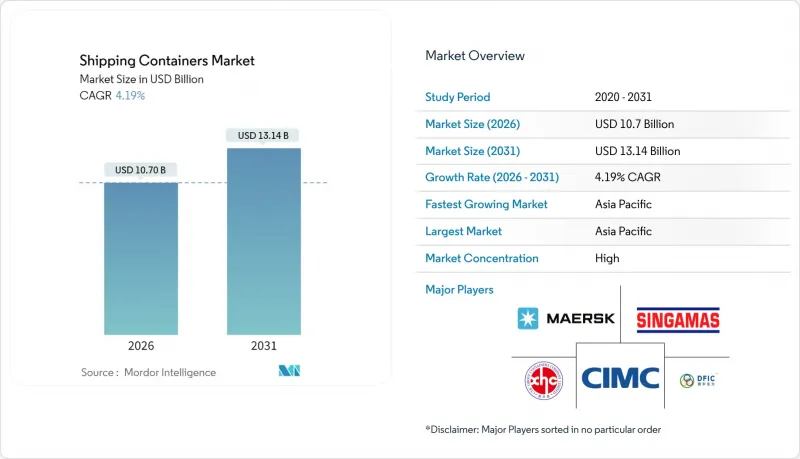
2026년 운송용 컨테이너 시장 규모는 107억 달러로 추정되며, 2025년 102억 7,000만 달러에서 성장하며, 2031년에는 131억 4,000만 달러에 달할 것으로 예측됩니다. 2026-2031년에는 CAGR 4.19%로 성장할 전망입니다.
E-Commerce 이동, 의약품 콜드체인 확대, 복합운송의 효율성 향상으로 안정적인 구조적 수요가 창출되고 있습니다. 세계 무역량의 90%를 처리하는 컨테이너 운송의 역할이 이러한 성장을 지원하고 있으며, 디지털 추적 툴와 스마트한 설계를 통해 운영자는 항만 체류 시간을 단축하고 자산 회전율을 개선하고 있습니다. 지속가능성 목표는 더 가벼운 복합소재로의 소재 혁신을 촉진하고 있으며, 운송업체 간 제휴 재편은 더 큰 규모의 기술 활용 선단을 중심으로 운송 역량 배치 전략을 재구성하고 있습니다. 지정학적 혼란은 단기적인 변동 요인으로 작용하는 한편, 다양한 무역 루트의 중요성과 역동적인 루트 설정의 필요성을 더욱 강화시키고 있습니다.
세계 운송 컨테이너 시장 동향 및 인사이트
폭발적으로 성장하고 있는 크로스보더 EC는 24시간내 처리 시간을 요구
E-Commerce의 확대로 인해 더 빈번하고 소량의 화물 운송이 증가하면서 선박의 적재 능력보다 항만의 처리 속도가 더 중요하게 여겨지고 있습니다. 해운회사는 고빈도 항로에 추가 설비를 투입하고, 항만은 1교대 내에 선박의 하역을 완료할 수 있는 자동 크레인에 투자하고 있습니다. 스마트 추적 기술을 통해 화주는 입항 전 통관 절차를 미리 완료하고 철도 슬롯을 예약할 수 있게 되었습니다. 이러한 업무 효율화의 진전은 재고 주기를 단축하고 표준 건식 컨테이너에 대한 선호도를 강화합니다. 무역량 변동에도 높은 가동률을 유지하고 있습니다. 온라인 마켓플레이스가 신흥 경제국에 침투하는 가운데, 운송 컨테이너 시장은 다양한 무역 경로에서 지속적인 기반 수요를 누리고 있습니다.
세계 콜드체인 보급 가속화, 첨단 리퍼 컨테이너 수주 증가
제약회사들은 온도 관리를 유지하면서 비용과 배출량을 줄이기 위해 장거리 운송을 항공에서 해상 운송으로 전환하고 있습니다. 현대의 리퍼 컨테이너는 ±0.5℃의 정확도를 유지하며, 실시간으로 편차를 감지하는 텔레메트리를 통합하여 항해 도중에 시정 조치를 취할 수 있습니다. 신선식품 수출업체들도 비슷한 기술을 채택하여 부패를 최소화하면서 먼 곳의 소비자에게 전달합니다. 듀얼 연료 냉동 유닛을 제공하는 제조업체는 에너지 소비를 줄이고 저 GWP 규제에 대응하여 컨테이너 당 높은 가격을 실현하고 있습니다. 식품 EC가 새로운 시장으로 확대되면서 첨단 냉동 컨테이너에 대한 수요는 일반 화물 성장률을 계속 상회하고 있습니다.
팬데믹 이후 컨테이너 공급과잉으로 가동률 하락에 대한 우려
2021-2023년까지 기록적인 신규 건설로 인해 일시적인 공급과잉이 발생하여 임대료가 하락하고, 사업자들은 신규 발주를 지연시키고 있습니다. 교역이 둔화되면 게이트웨이 항구에 유휴 재고가 쌓이고, 창고는 보관료를 낮추어 리포지셔닝 업무를 유치할 수밖에 없습니다. 제조업체들은 생산 교대 근무를 줄이고, 수요가 안정적인 특수 설계로 생산 능력을 전환하여 대응하고 있습니다. 이 조정은 노후화된 선대의 폐선이 진행되고 무역이 정상화되면 해소될 것으로 보입니다.
부문 분석
하이큐브 컨테이너는 13%의 추가 헤드룸으로 EC 소포, 경량 가전제품 등의 용적 적재량을 극대화할 수 있으며, 수요가 증가하고 있습니다. 2025년에는 40피트 규격이 매출의 52.21%를 차지하며 해상 운송에서 꾸준한 인기를 끌었으며, 40피트 하이큐브 유닛은 2031년까지 연평균 복합 성장률(CAGR) 5.43%로 확대될 것으로 예측됩니다. 하이큐브 컨테이너 시장 규모는 중량 제한을 초과하지 않고 용량 확대를 원하는 화주들의 요구를 반영하고 있습니다.
항만 인프라의 개선으로 적재 높이 증가가 가능해짐에 따라 터미널 운영사는 이러한 유닛을 효율적으로 처리하기 위해 리프트 높이가 확장된 리치 스태커를 도입하고 있습니다. 물류 통합 기업은 철도 화물차 배정과 창고 간 상호 운용을 효율화하기 위해 40피트 규격의 표준화를 추진하고 있습니다. 트라이톤 컨테이너는 재배치 비용 절감을 위해 유연한 픽업 옵션을 갖춘 하이큐브 리스를 제공함으로써 채택을 촉진하고 있습니다. 전반적으로 화주들이 부피 효율성과 포장의 집약화에 초점을 맞추면서 주요 무역 통로에서 하이큐브 컨테이너에 대한 수요가 지속적으로 증가하고 있습니다.
2025년 운송량에서 드라이 컨테이너가 차지하는 비중은 72.32%에 달하고, 세계 상품 유통의 중추적 역할을 할 것으로 예측됩니다. 한편, 냉장 컨테이너는 신선식품 수출업체와 제약기업의 해상운송 확대에 따라 2031년까지 연평균 복합 성장률(CAGR) 6.18%를 나타낼 것으로 예측됩니다. 냉장 컨테이너는 현재 운송 컨테이너 시장에서 프리미엄 부문을 차지하고 있으며, 드라이 컨테이너의 2-3배에 달하는 임대료를 책정하고 있습니다.
기술 혁신으로는 가변속 압축기 및 태양광 보조 전원 모듈을 도입하여 대기시 에너지 소비를 줄였습니다. 의약품 운송업체는 온도 프로브와 도어 센서의 이중화를 요구하고 있으며, 이상 발생시 수 초 이내에 경보를 발령하는 사양이 제조업체 간 차별화 요소로 작용하고 있습니다. 또한 온도 관리가 필요한 화물을 항공 운송에서 해상 운송으로 전환함으로써 관련 배출량을 최대 80%까지 줄일 수 있으므로 리퍼 컨테이너는 탈탄소화의 혜택을 누리고 있습니다.
지역별 분석
아시아태평양은 2025년 59.88%의 매출로 컨테이너 시장을 주도할 것으로 예상되며, 2031년까지 연평균 5.46%의 성장률을 보일 것으로 예측됩니다. 중국은 제조 거점으로서의 우위를 유지하는 반면, 동남아시아에서는 기업의 조달처 다변화에 따라 수요가 증가하고 있습니다. 말레이시아와 인도의 메가 항만 프로젝트는 연간 2,500만 TEU 이상의 처리 능력을 추가하여 지역 화물 처리량을 지원하고 전체 피더 네트워크의 컨테이너 수요를 자극하고 있습니다. 통화 안정성과 지원적인 무역 협정 또한 지역 리스 풀을 통한 선대 확장을 촉진하고 있습니다.
북미에서는 전자제품과 자동차 조립을 소비시장과 가까운 지역으로 옮기는 니어쇼어링의 혜택을 누리고 있습니다. 미국 항만 당국은 수십억 달러 규모의 준설 및 선석 전기화 계획을 승인하여 멕시코 및 캐나다 게이트웨이와의 경쟁력을 강화하고 있습니다. 중서부 전역의 철도 복합운송망 구축으로 대서양과 태평양을 8일 이내로 연결하는 비용 효율적인 육상 운송 경로가 개설되어 적층형 컨테이너 설계의 채택을 촉진하고 있습니다.
유럽 컨테이너 운송시장은 지정학적 긴장으로 인해 아시아-유럽 항로가 아프리카 항로로 전환되면서 운송시간은 길어지지만 지중해 허브 기항이 증가하면서 성장이 양극화되는 양상을 보이고 있습니다. 런던 게이트웨이 항만과 로테르담 마스프랙트 항구의 자동화 투자로 크레인 시간당 처리량이 증가하여 컨테이너 단가가 상승하는 효과가 나타나고 있습니다. 엄격한 환경 규제로 인해 노후 중량 컨테이너의 퇴출이 가속화되고 있으며, 재생 철강재를 사용한 유닛으로의 전환이 진행되고 있습니다. 이로 인해 무역량 증가세가 둔화되고 있음에도 불구하고 컨테이너 교체 수요를 지원하고 있습니다.
기타 특전:
- 엑셀 형식 시장 예측(ME) 시트
- 애널리스트의 3개월간 지원
자주 묻는 질문
목차
제1장 서론
제2장 조사 방법
제3장 개요
제4장 시장 구도
제5장 시장 규모와 성장 예측
제6장 경쟁 구도
제7장 시장 기회와 향후 전망
KSA 26.03.05Shipping Containers market size in 2026 is estimated at USD 10.7 billion, growing from 2025 value of USD 10.27 billion with 2031 projections showing USD 13.14 billion, growing at 4.19% CAGR over 2026-2031.
E-commerce fulfillment, pharmaceutical cold-chain expansion, and rising intermodal efficiency provide stable, structural demand. Containerization's role in handling 90% of global trade underpins this growth, while digital tracking tools and smarter designs help operators shorten port stays and boost asset turnover. Sustainability targets are pushing material innovation toward lighter composites, and alliance restructuring among carriers is reshaping capacity deployment strategies in favor of larger, technology-enabled fleets. Geopolitical disruptions add short-term volatility but also reinforce the importance of diversified trade lanes and dynamic routing.
Global Shipping Containers Market Trends and Insights
Explosive Growth of Cross-Border E-Commerce Creating 24-Hour Turnaround Expectations
E-commerce expansion drives more frequent, smaller shipments, shifting focus from vessel capacity toward port velocity. Carriers commit additional equipment to high-frequency loops, while ports invest in automated cranes that clear vessels inside one shift. Smart tracking allows shippers to pre-clear customs and book rail slots before docking. These operational gains shorten inventory cycles and reinforce preference for standard dry boxes, keeping utilization high even when trade volumes fluctuate. As online marketplaces penetrate emerging economies, the shipping container market sees sustained baseline demand across diverse trade lanes.
Worldwide Cold-Chain Penetration Accelerates Advanced Reefer Orders
Pharmaceutical producers are migrating long-haul shipments from air to ocean to cut costs and emissions without compromising temperature control. Modern reefers maintain +-0.5 °C accuracy and integrate telemetry that flags deviations in real time, allowing corrective actions mid-voyage. Fresh grocery exporters adopt similar technology to reach distant consumers with minimal spoilage. Manufacturers offering dual-fuel refrigeration units reduce energy consumption and meet low-GWP regulations, enabling higher price realisation per box. As grocery e-commerce extends to new markets, advanced reefer demand continues to outpace general cargo growth.
Post-Pandemic Oversupply of Boxes Eroding Utilization Rates
Record new builds made during 2021-2023 create a temporary surplus, pushing lease rates down and prompting operators to delay fresh orders. Idle inventories accumulate in gateway ports when trade softens, forcing depots to lower storage fees to attract repositioning business. Manufacturers adapt by trimming production shifts and redirecting capacity toward specialized designs with steadier demand. The correction is expected to resolve once scrappage catches up with ageing fleets and trade normalizes.
Other drivers and restraints analyzed in the detailed report include:
- Direct-to-Consumer Brands Demanding Bespoke, Logo-Printed Containers
- Corporate ESG Mandates Pushing Reusable Container Adoption
- Volatility in Hot-Rolled Coil Steel Prices Creating Budget Uncertainty
For complete list of drivers and restraints, kindly check the Table Of Contents.
Segment Analysis
High-cube offerings are capturing incremental demand because their 13% extra headroom maximizes volumetric loads such as e-commerce parcels and lightweight consumer electronics. 40-ft formats generated 52.21% revenue in 2025, demonstrating entrenched popularity for ocean freight, whereas 40-ft high-cube units are forecast to grow at 5.43% CAGR to 2031. The shipping container market size for high-cube units reflects shipper preference for greater capacity without breaching weight restrictions.
Port infrastructure upgrades accommodate taller stacks, and terminal operators add reach-stackers with extended lifting heights to handle these units efficiently. Logistics integrators promote standardization on the 40-ft profile to streamline rail wagon allocation and depot interchange. Triton Containers markets high-cube leases with flexible pick-up options to reduce repositioning, reinforcing adoption. Overall, shipper focus on cubic efficiency and consolidation of packaging drives continued high-cube traction across primary trade corridors.
Dry storage boxes accounted for 72.32% of 2025 shipments, underscoring their status as the backbone of global commodity flows. In contrast, reefer units record a 6.18% CAGR to 2031 as fresh produce exporters and drug makers scale ocean routes. Refrigerated boxes currently represent the premium slice of the shipping container market, commanding rental rates two to three times higher than dry units.
Technology upgrades include variable-speed compressors and solar-assisted power modules that cut energy draw during idle periods. Pharmaceutical shippers require redundant temperature probes and door sensors that trigger alerts within seconds of deviation, driving differentiation among manufacturers. Reefers also benefit from decarbonization, as shifting temperature-sensitive goods from air to sea avoids up to 80% of related emissions.
The Shipping Container Market is Segmented by Size (20-Ft (TEU), 40-Ft (FEU) and More), by Container Type (Dry Storage (Standard), Refrigerated, and More), by Material (Corten Steel, Stainless Steel and More), End-Use Industry (Consumer Goods & Retail and More), by Mode of Transport (Maritime Deep-Sea and More), by Geography (North America, South America, and More). The Market Forecasts are Provided in Terms of Value (USD).
Geography Analysis
Asia-Pacific dominated the shipping containers market with 59.88% revenue in 2025 and is set to grow at a 5.46% CAGR to 2031. China retains manufacturing leadership, yet Southeast Asia captures incremental volumes as firms diversify sourcing. Malaysian and Indian mega-port projects add more than 25 million TEU of annual capacity, anchoring regional throughput and stimulating container demand across feeder networks. Currency stability and supportive trade agreements also encourage regional leasing pools to expand their fleets.
North America benefits from nearshoring that shifts electronics and automotive assembly closer to consumption markets. United States port authorities approve multi-billion-dollar dredging and berth electrification programs, enhancing competitiveness against Mexican and Canadian gateways. The rail intermodal build-out across the Midwest unlocks cost-effective land bridges that connect Atlantic and Pacific basins in under eight days, driving uptake of stack-train compatible container designs.
Europe records mixed growth shipping container market as geopolitical tensions divert Asia-Europe sailings around Africa, extending transit times but also directing additional calls to Mediterranean hubs. Investments in automation at London Gateway and Rotterdam Maasvlakte raise throughput per crane hour, cushioning cost-per-box metrics. Stringent environmental regulations accelerate the retirement of older, heavier boxes in favor of recycled-content steel units, supporting replacement demand despite subdued trade volume growth.
- China International Marine Containers (CIMC)
- Dong Fang International Containers
- CXIC Group (CSSC)
- Maersk Container Industry A/S
- Singamas Container Holdings
- W&K Container
- Sea Box Inc.
- TLS Offshore Containers
- Storstac Inc.
- CARU Containers B.V.
- China Eastern Containers
- Valisons & Co.
- YMC Container Solutions
- American Intermodal Container Manufacturing
- Triton International
- Textainer Group Holdings
- Florens Container Services
- CAI International
- Touax Group
- UES International
Additional Benefits:
- The market estimate (ME) sheet in Excel format
- 3 months of analyst support
TABLE OF CONTENTS
1 Introduction
- 1.1 Study Assumptions & Market Definition
- 1.2 Scope of the Study
2 Research Methodology
3 Executive Summary
4 Market Landscape
- 4.1 Market Overview
- 4.2 Market Drivers
- 4.2.1 Explosive growth of cross-border e-commerce creating 24-hour turnaround expectations for standard dry containers.
- 4.2.2 Worldwide cold-chain penetration of fresh grocery and meal-kit delivery accelerating orders for advanced reefer boxes.
- 4.2.3 Direct-to-consumer (D2C) brands demanding bespoke, logo-printed containers to double as mobile pop-up stores and fulfilment hubs.
- 4.2.4 Corporate ESG mandates pushing shippers toward reusable, multimodal containers over single-use pallet wrap, lifting replacement demand.
- 4.2.5 Adoption of IoT-enabled -smart- boxes providing real-time location & condition data, raising shipper's willingness to pay for premium units.
- 4.2.6 Subscription-based and modular housing concepts spurring second-life conversions of retired shipping containers.
- 4.3 Market Restraints
- 4.3.1 Post-pandemic oversupply of boxes eroding utilisation rates and discouraging new-build investment.
- 4.3.2 Volatility in hot-rolled coil steel prices creating budget uncertainty for container purchasers.
- 4.3.3 Stricter cradle-to-grave regulations and extended-producer-responsibility (EPR) rules inflating lifetime ownership costs.
- 4.3.4 Rapid emergence of foldable and collapsible container alternatives cannibalising demand for conventional rigid boxes.
- 4.4 Value / Supply-Chain Analysis
- 4.5 Regulatory & Technological Outlook
- 4.6 Porter's Five Forces
- 4.6.1 Threat of New Entrants
- 4.6.2 Bargaining Power of Buyers
- 4.6.3 Bargaining Power of Suppliers
- 4.6.4 Threat of Substitutes
- 4.6.5 Intensity of Competitive Rivalry
- 4.7 Pricing Analysis - Standard vs. Special Containers
- 4.8 Spotlight: Intermodal & Rail Uptake
- 4.9 Global Container Leasing Landscape
- 4.10 Impact of Geopolitical Events on the Market
5 Market Size & Growth Forecasts (Value, Volume)
- 5.1 By Size
- 5.1.1 20-ft (TEU)
- 5.1.2 40-ft (FEU)
- 5.1.3 40-ft High-Cube,
- 5.1.4 Others ( >45-ft, etc)
- 5.2 By Container Type
- 5.2.1 Dry Storage (Standard)
- 5.2.2 Refrigerated (Reefer)
- 5.2.3 Tank (ISO Tank, Cryogenic)
- 5.2.4 Flat-Rack & Open-Top
- 5.2.5 Special Purpose (Side-Door, Tunnel, Insulated, Collapsible)
- 5.3 By Material
- 5.3.1 Corten Steel
- 5.3.2 Stainless Steel
- 5.3.3 Aluminium Alloy
- 5.3.4 FRP & Composite
- 5.3.5 Others
- 5.4 By End-Use Industry
- 5.4.1 Consumer Goods & Retail
- 5.4.2 Food & Beverage
- 5.4.3 Industrial Machinery & Automotive
- 5.4.4 Chemicals & Petroleum
- 5.4.5 Pharmaceuticals & Healthcare
- 5.4.6 Others
- 5.5 By Mode of Transport
- 5.5.1 Maritime Deep-Sea
- 5.5.2 Short-Sea & Coastal
- 5.5.3 Rail Intermodal
- 5.5.4 Road Inland Haulage & Off-Site Storage
- 5.6 By Geography
- 5.6.1 North America
- 5.6.1.1 United States
- 5.6.1.2 Canada
- 5.6.1.3 Mexico
- 5.6.2 South America
- 5.6.2.1 Brazil
- 5.6.2.2 Peru
- 5.6.2.3 Chile
- 5.6.2.4 Argentina
- 5.6.2.5 Rest of South America
- 5.6.3 Asia-Pacific
- 5.6.3.1 China
- 5.6.3.2 India
- 5.6.3.3 Japan
- 5.6.3.4 Australia
- 5.6.3.5 South Korea
- 5.6.3.6 South East Asia (Singapore, Malaysia, Thailand, Indonesia, Vietnam, and Philippines)
- 5.6.3.7 Rest of Asia-Pacific
- 5.6.4 Europe
- 5.6.4.1 United Kingdom
- 5.6.4.2 Germany
- 5.6.4.3 France
- 5.6.4.4 Spain
- 5.6.4.5 Italy
- 5.6.4.6 BENELUX (Belgium, Netherlands, and Luxembourg)
- 5.6.4.7 NORDICS (Denmark, Finland, Iceland, Norway, and Sweden)
- 5.6.4.8 Rest of Europe
- 5.6.5 Middle East And Africa
- 5.6.5.1 United Arab Emirates
- 5.6.5.2 Saudi Arabia
- 5.6.5.3 South Africa
- 5.6.5.4 Nigeria
- 5.6.5.5 Rest of Middle East And Africa
- 5.6.1 North America
6 Competitive Landscape
- 6.1 Market Concentration
- 6.2 Strategic Moves (M&A, Capacity Expansion, Leasing Deals)
- 6.3 Market Share Analysis
- 6.4 Company Profiles (includes Global-level Overview, Market-level Overview, Core Segments, Financials, Strategic Information, Market Rank/Share, Products & Services, Recent Developments)
- 6.4.1 China International Marine Containers (CIMC)
- 6.4.2 Dong Fang International Containers
- 6.4.3 CXIC Group (CSSC)
- 6.4.4 Maersk Container Industry A/S
- 6.4.5 Singamas Container Holdings
- 6.4.6 W&K Container
- 6.4.7 Sea Box Inc.
- 6.4.8 TLS Offshore Containers
- 6.4.9 Storstac Inc.
- 6.4.10 CARU Containers B.V.
- 6.4.11 China Eastern Containers
- 6.4.12 Valisons & Co.
- 6.4.13 YMC Container Solutions
- 6.4.14 American Intermodal Container Manufacturing
- 6.4.15 Triton International
- 6.4.16 Textainer Group Holdings
- 6.4.17 Florens Container Services
- 6.4.18 CAI International
- 6.4.19 Touax Group
- 6.4.20 UES International
7 Market Opportunities & Future Outlook
- 7.1 White-Space & Unmet-Need Assessment