|
시장보고서
상품코드
1626893
유럽의 탄소섬유 - 시장 점유율 분석, 산업 동향 및 통계, 성장 예측(2025-2030년)Europe Carbon Fiber - Market Share Analysis, Industry Trends & Statistics, Growth Forecasts (2025 - 2030) |
||||||
 Mordor Intelligence
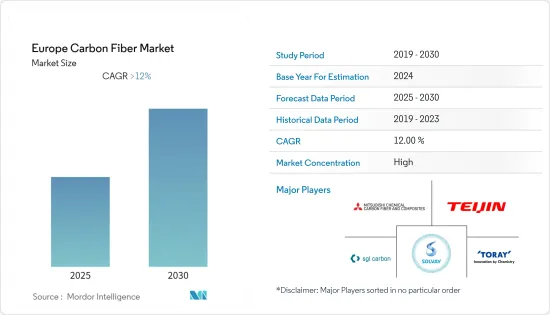
유럽의 탄소섬유 시장은 예측 기간 동안 12% 이상의 CAGR을 나타낼 것으로 예상됩니다.

주요 하이라이트
- 시장 성장의 주요 요인은 저연비, 경량 자동차에 대한 수요 증가와 항공우주 및 방위 산업의 최근 발전입니다.
- 그러나 재생 탄소섬유 공급망의 안전성과 대체품의 가용성이 시장 조사를 억제하는 요인으로 작용하고 있습니다.
- 재생 탄소섬유의 인기 증가, 탄소섬유의 원료로 리그닌의 사용 증가, 풍력에너지 부문에서의 사용 증가는 예측 기간 동안 조사 대상 시장에 기회가 될 것으로 보입니다.
- 독일이 가장 큰 시장 점유율을 차지하고 있으며, 예측 기간 동안에도 우위를 유지할 것으로 예상됩니다.
유럽의 탄소섬유 시장 동향
항공우주 및 방위 산업이 시장을 독식합니다.
- 탄소섬유는 아크릴 수지나 석유-석탄 피치를 섬유화하여 일정한 열처리를 거쳐 만든 미세한 흑연 결정구조를 가진 섬유질 탄소 소재 원료입니다. 탄소섬유는 강철의 약 10배의 강도를 가지고 있으며, 무게는 강철의 절반 이하입니다. 또한 강성도 높습니다.
- 탄소섬유의 우수한 물리적, 기계적 특성으로는 경량성, 내구성, 금속 하이브리드 구성, 내식성, 내화학성, 내충격성, 내열성 등이 있으며, 신뢰성이 높고 연비가 우수하여 항공우주 및 방위 분야에서 최고의 선택이 되고 있습니다. 이러한 우수한 특성 덕분입니다.
- 탄소섬유 강화 폴리머(CFRP)는 항공우주 산업에서 사용되는 다양한 부품에 사용되며, CFRP는 항공우주 산업에 경량 부품을 제공하고 항공기 브레이크에 경량 복합재료 및 고성능 단열재의 충전재로 사용됩니다.
- 코로나19로 힘든 시기를 겪은 후, 유럽 항공우주 및 방위산업은 시장에서 강력한 수익을 올리며 어려운 시기를 극복하고 회복력을 입증했습니다. 유럽항공우주-안보-방위산업협회(ASD)에 따르면, 이 단체는 2050년까지 이산화탄소 순배출량 제로를 달성할 계획입니다.
- ASD의 보고서에 따르면 2021년 총 매출액은 전년 대비 10% 증가한 약 2,380억 유로(2,820억 달러)에 달할 것으로 추정됩니다. 총 매출에 가장 큰 기여를 한 것은 민간 항공으로 총 매출의 약 45%를 차지합니다.
- 보잉에 따르면 2022-2041년 세계 서비스 시장에서 유럽이 차지하는 비중은 24%에 달하고, 8,500억 달러에 달할 것으로 예상했습니다. 또한 이 지역의 총 항공기 수는 2041년 약 9,360대에 달할 것으로 예상됩니다.
- 독일항공우주산업협회(BDLI)도 연례 보고서에서 항공우주 및 방위산업 관련 주요 수치를 제공했습니다. 2021년 회계연도에는 3140억 유로(미화 약 370억 달러)의 매출을 기록했습니다. 주요 점유율은 민간 항공이 약 220억 유로(미화 약 260억 달러)를 차지합니다. 이 나라의 민간 항공 시장은 코로나19가 산업에 미치는 영향으로 지난해에 비해 큰 폭의 업그레이드를 보이지 않을 것으로 보입니다.
- 또한, 독일은 유럽우주국(ESA)에 가장 큰 기여를 하는 국가로 2022년 35억 유로(약 41억 4,000만 달러), 프랑스는 32억 5,000만 유로(약 38억 5,000만 달러)로 그 뒤를 잇고 있습니다.
- 항공우주 및 방위산업 시장 확대에 따라 탄소섬유에 대한 소비 수요도 증가하여 예측 기간 동안 시장을 견인할 것으로 보입니다.
독일, 시장을 독점
- 항공기 산업의 주요 제조 거점 중 하나인 독일에는 장비 제조업체, 재료 및 부품 공급업체, 엔진 제조업체, 시스템 통합사업자 등 다양한 부문의 제조업체가 모여 있습니다.
- 바이에른주, 브레멘, 바덴뷔르템베르크, 메클렌부르크포어포메른을 중심으로 항공기 내장재, MRO(정비, 수리, 점검), 경량 구조물 및 소재 등의 생산기지가 다수 존재합니다.
- 독일항공우주산업협회(BDLI)에 따르면 2021년도 독일 국내 총 매출액은 314억 유로(약 370억 달러)에 달할 전망입니다. 민간 항공의 매출 점유율이 가장 높으며 약 220억 유로(약 260억 달러)에 달할 전망입니다. 세계에서 6번째로 많은 민간 항공기가 독일에서 조립되어 독일에서 납품되고 있습니다.
- 독일 자동차 산업 협회는 보고서에서 2022-2026년 사이에 독일 자동차 산업에 2,200억 유로(약 2,603억 달러)의 투자가 이루어질 것이라고 밝혔습니다.
- OICA는 연례 보고서에서 2021년 자동차(자동차 및 LCV만 해당) 생산량이 330만 대에 달할 것이라고 발표했습니다. 이처럼 항공기 및 자동차 생산량 증가에 따라 탄소섬유 소비량은 예측 기간 동안 증가할 것입니다.
- 전체적으로 다양한 최종 사용자 산업 수요 증가가 예측 기간 동안 이 나라 시장을 견인할 것으로 예상됩니다.
유럽의 탄소섬유산업 개요
유럽의 탄소섬유 시장은 고도로 통합되어 있습니다. 주요 기업으로는 Mitsubishi Chemical Carbon Fiber and Composites Inc., SGL Carbon, Solvay, TEIJIN LIMITED, TORAY INDUSTRIES, INC. 등이 있습니다.
기타 혜택
- 엑셀 형식 시장 예측(ME) 시트
- 3개월간의 애널리스트 지원
목차
제1장 서론
- 조사의 전제조건
- 조사 범위
제2장 조사 방법
제3장 주요 요약
제4장 시장 역학
- 성장 촉진요인
- 성장 억제요인
- 산업 밸류체인 분석
- Porter의 Five Forces 분석
- 공급 기업의 교섭력
- 소비자의 교섭력
- 신규 진출업체의 위협
- 대체품의 위협
- 경쟁 정도
제5장 시장 세분화(시장 규모(금액·수량))
- 원료
- 폴리 아크릴로니트릴(PAN)
- 석유 피치 및 레이온
- 유형
- 버진섬유(VCF)
- 재생섬유(RCF)
- 용도
- 복합재료
- 섬유 제품
- 마이크로 전극
- 촉매
- 최종사용자 산업
- 항공우주 및 방위
- 대체 에너지
- 자동차
- 건설 인프라
- 스포츠 용품
- 기타
- 지역
- 독일
- 영국
- 이탈리아
- 프랑스
- 스페인
- 기타 유럽
제6장 경쟁 구도
- 인수합병(M&A)/합작투자(JV)/협업/협정
- 시장 점유율(%) 분석**/순위 분석
- 주요 기업의 전략
- 기업 개요
- Airborne International BV
- Fairmat
- Hexcel Corporation
- HYOSUNG ADVANCED MATERIALS
- Mitsubishi Chemical Carbon Fiber and Composites Inc.
- Nippon Graphite Fiber Co., Ltd.
- SGL Carbon
- Solvay
- TEIJIN LIMITED
- TORAY INDUSTRIES, INC.
제7장 시장 기회와 향후 동향
LSH 25.01.21The Europe Carbon Fiber Market is expected to register a CAGR of greater than 12% during the forecast period.
The COVID-19 pandemic significantly impacted the worldwide automobile and aerospace industries, considering a temporary halt in end-user operations owing to government-imposed lockdowns in many parts of the world. In the post-pandemic scenario, however, the industry recovered and is anticipated to grow significantly over the next few years.
Key Highlights
- The major factors driving the market's growth are the increasing demand for fuel-efficient and lightweight vehicles and recent advancements in the aerospace and defense industry.
- However, supply chain security for recycled carbon fiber and substitutes' availability was restraining the market studied.
- The increasing popularity of recycled carbon fiber, the emphasis on using lignin as raw material for carbon fiber, and the increasing application in the wind energy sector are likely to act as opportunities for the market studied over the forecast period.
- Germany accounted for the largest market share and is expected to remain dominant during the forecast period.
Europe Carbon Fiber Market Trends
Aerospace and Defense Industry to Dominate the Market
- Carbon fiber is a fibrous carbon material with a micro graphite crystal structure made by fibrillation of acrylic resin or from oil/coal pitch and then given certain heat treatment. Carbon fiber is almost ten times stronger than steel and less than half its weight. It also exhibits high rigidity.
- Carbon fiber's excellent physical and mechanical qualities, which include its light weight, durability, metal-hybrid compositions, resistance to corrosion and chemical deterioration, impact resistance, and temperature resistance, make it a reliable, fuel-efficient, and top choice in the aerospace and defense sectors. It is due to thanks to these exceptional qualities.
- Carbon Fiber Reinforced Polymer (CFRP) is used in the different parts used in the aerospace industry. The CFRP provides lightweight components for the industry and is used in aircraft brakes as the filler for lightweight composite materials and high-performance insulation material.
- After going through a tough COVID-19 period, the European aerospace and defense industry demonstrated its resilience by rebounding from the tough period with strong revenue generated in the market. According to the Aerospace, Security, and Defence Industries Association of Europe (ASD), the organization plans to achieve the challenge of being the net zero emission of CO2 by 2050.
- The report by ASD also stated that the total turnover for the year 2021 was estimated to be around EUR 238 billion (USD 282 billion), an increase of 10% compared to the previous year. The major contributor to overall turnover is civil aeronautics which holds a share of about 45% of the total turnover.
- According to Boeing, Europe will have a share of 24% across the global services market value, accounting for USD 850 billion of the total market share for 2022-2041. The total number of fleets in the region is also expected to reach about 9,360 in 2041.
- The German Aerospace Industries Association (BDLI) also provided key figures related to the Aerospace and Defense Industry in its annual report. The country saw a total sale of EUR 31.4 billion (~USD 37 billion) during the financial year 2021. The major share is civil aviation, which accounts for about EUR 22 billion (~USD 26 billion). The country's civil aviation market had never seen a major upgrade compared to last year due to the COVID-19 effect on the industry.
- Moreover, Germany is the largest contributor to the European Space Agency (ESA), with a contribution of EUR 3.5 billion (~USD 4.14 billion) in the year 2022, followed by France, which had a contribution of EUR 3.25 billion (~USD 3.85 billion).
- With the increasing market for the aerospace and defense industry, the demand for carbon fiber consumption is also expected to enhance and thus drive the market forward for the forecast period.
Germany to Dominate the Market
- Germany, one of the leading manufacturing bases for the aircraft industry, is home to manufacturers from different segments, such as equipment manufacturers, material and component suppliers, engine producers, and whole system integrators.
- The country hosts many production bases for interior aircraft components, MRO (maintenance, repair, and overhaul), and lightweight construction and materials, largely in Bavaria, Bremen, Baden-Wurttemberg, and Mecklenburg-Vorpommern.
- According to the German Aerospace Industries Association (BDLI), the country saw total sales of EUR 31.4 billion (~USD 37 billion) during the financial year 2021. Civil aviation observed the highest market share of sales, around EUR 22 billion (~USD 26 billion). Every sixth commercial aircraft worldwide is assembled in and delivered from Germany.
- The German Association of Automotive Industry stated in its report that there will be an investment of EUR 220 billion (~USD 260.3 billion) in the German automotive industry between 2022-2026.
- OICA also published in its yearly report that there was a production of 3.3 million units of automobiles (cars and LCVs only) in the year 2021. Thus, with the increased production of aircraft and automobiles production, carbon fiber consumption will increase during the forecast period.
- Overall, the growing demand from various end-user industries is projected to drive the market in the country during the forecast period.
Europe Carbon Fiber Industry Overview
The carbon fiber market in Europe is highly consolidated. The major companies include (not in particular order) Mitsubishi Chemical Carbon Fiber and Composites Inc., SGL Carbon, Solvay, TEIJIN LIMITED, and TORAY INDUSTRIES, INC., among others.
Additional Benefits:
- The market estimate (ME) sheet in Excel format
- 3 months of analyst support
TABLE OF CONTENTS
1 INTRODUCTION
- 1.1 Study Assumptions
- 1.2 Scope of the Study
2 RESEARCH METHODOLOGY
3 EXECUTIVE SUMMARY
4 MARKET DYNAMICS
- 4.1 Drivers
- 4.1.1 Increasing Demand for Fuel-efficient and Lightweight Vehicles
- 4.1.2 Recent Advancements in the Aerospace and Defense Sector
- 4.2 Restraints
- 4.2.1 Supply Chain Security for Recycled Carbon Fiber
- 4.2.2 Availability of Substitutes
- 4.3 Industry Value-Chain Analysis
- 4.4 Porter's Five Forces Analysis
- 4.4.1 Bargaining Power of Suppliers
- 4.4.2 Bargaining Power of Consumers
- 4.4.3 Threat of New Entrants
- 4.4.4 Threat of Substitute Products and Services
- 4.4.5 Degree of Competition
5 MARKET SEGMENTATION (Market Size in Value and Volume)
- 5.1 Raw Material
- 5.1.1 Polyacrtlonitrile (PAN)
- 5.1.2 Petroleum Pitch and Rayon
- 5.2 Type
- 5.2.1 Virgin Fiber (VCF)
- 5.2.2 Recycled Fiber (RCF)
- 5.3 Application
- 5.3.1 Composite Materials
- 5.3.2 Textiles
- 5.3.3 Microelectrodes
- 5.3.4 Catalysis
- 5.4 End-user Industry
- 5.4.1 Aerospace & Defense
- 5.4.2 Alternative Energy
- 5.4.3 Automotive
- 5.4.4 Construction & Infrastructure
- 5.4.5 Sporting Goods
- 5.4.6 Other End-user Industries
- 5.5 Geography
- 5.5.1 Germany
- 5.5.2 United Kingdom
- 5.5.3 Italy
- 5.5.4 France
- 5.5.5 Spain
- 5.5.6 Rest of Europe
6 COMPETITIVE LANDSCAPE
- 6.1 Mergers & Acquisitions, Joint Ventures, Collaborations, and Agreements
- 6.2 Market Share (%) Analysis**/Ranking Analysis
- 6.3 Strategies Adopted by Leading Players
- 6.4 Company Profiles
- 6.4.1 Airborne International BV
- 6.4.2 Fairmat
- 6.4.3 Hexcel Corporation
- 6.4.4 HYOSUNG ADVANCED MATERIALS
- 6.4.5 Mitsubishi Chemical Carbon Fiber and Composites Inc.
- 6.4.6 Nippon Graphite Fiber Co., Ltd.
- 6.4.7 SGL Carbon
- 6.4.8 Solvay
- 6.4.9 TEIJIN LIMITED
- 6.4.10 TORAY INDUSTRIES, INC.
7 MARKET OPPORTUNITIES AND FUTURE TRENDS
- 7.1 Increasing Popularity of Recycled Carbon Fibre
- 7.2 Emphasis on Usage of Lignin as Raw Material for Carbon Fiber
- 7.3 Increasing Application in Wind Energy Sector