


|
시장보고서
상품코드
1627219
북미의 음료 포장 : 시장 점유율 분석, 산업 동향, 성장 예측(2025-2030년)North America Beverage Packaging - Market Share Analysis, Industry Trends & Statistics, Growth Forecasts (2025 - 2030) |
||||||
 Mordor Intelligence
■ 보고서에 따라 최신 정보로 업데이트하여 보내드립니다. 배송일정은 문의해 주시기 바랍니다.
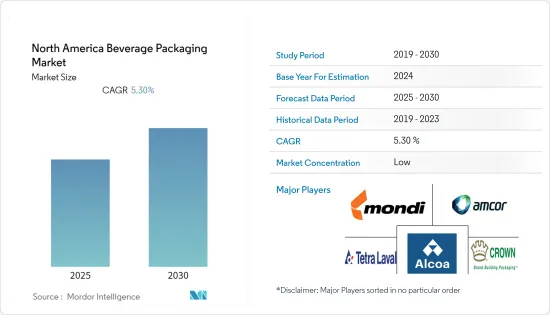
북미의 음료 포장 시장은 예측 기간 중 CAGR 5.3%를 기록할 전망
주요 하이라이트
- 기술 혁신, 지속가능성에 대한 관심, 매력적인 경제성은 지난 20년간 미국에서 음료 포장의 괄목할 만한 성장의 이유입니다. 소비자들이 포장을 바라보는 시각과 포장에 대한 인식이 변화하고 있습니다. 지속가능성에 대한 관심이 높아지면서 전통적인 경질 포장 솔루션은 혁신적이고 지속가능한 연포장으로 대체되고 있습니다. 고객 친화적인 포장과 제품 보호에 대한 시장의 요구가 증가함에 따라 연포장이 실행 가능하고 비용 효율적인 대안으로 부상할 것으로 예상됩니다.
- 탄산음료, 에너지 음료, 주스 등 수요가 증가함에 따라 PET병과 금속캔이 선호되는 소재가 되고 있습니다. 반면, 재활용 가능한 특성을 가진 유리는 제조 및 재활용 비용 증가가 문제점으로 지적되고 있습니다. 최근 음료 포장의 지속가능성 동향과 관련하여 유리에 대한 선호도가 높아지고 있습니다.
- 또한 플라스틱은 제조, 내구성 및 물류 비용 절감으로 인해 전 세계 음료 제조업체가 수년 동안 선호하는 포장 옵션이었기 때문에 지속가능한 포장으로의 전환은 이러한 포장 제조업체와 보틀링 회사가 이 지역에서 새로운 재료 사용을 약속하고 약속하는 원동력이 되고 있습니다. 약속하는 원동력이 되고 있습니다.
- 예를 들어 코카콜라는 2030년까지 사용량만큼의 페트병을 재활용하기로 약속했습니다. 이를 위해 코카콜라는 전 세계 NGO와 파트너십을 맺고 수거 개선을 지원하고 있습니다. 또한 네슬레는 2020년 1월 현재 재생 플라스틱 포장재 사용을 위해 21억 달러를 기부했습니다.
- 벤더 측면에서는 음료 제조업체 수요 증가를 보완하기 위해 금속, 유리, rPET 분야에서 용량 증설을 볼 수 있습니다. 예를 들어 2020년 2월 현재 Ball Corporation은 2021년까지 미국 금속캔 생산을 확대할 계획입니다. 2021년 말까지 최소 80억개 이상의 생산 능력을 추가하겠다는 이전 약속에 따라 애리조나 주와 미국 북동부 지역에서 특수 음료수 캔을 생산할 예정입니다.
북미 음료 포장 시장 동향
E-Commerce가 시장 점유율을 견인할 전망
- 많은 기업이 아직 E-Commerce를 위해 포장을 최적화하지 않았고, 물류센터에서 소비자에게 제품을 배송할 때 과대포장이 일반적이기 때문에 E-Commerce가 큰 점유율을 차지하면 시장에 긍정적인 영향을 미칠 것으로 예상됩니다. 배송은 일반적으로 배송을 위해 개별 패키지로 나뉘어져 있으므로 이러한 소매 체인의 복잡성으로 인해 더 많은 낭비, 에너지 소비 및 오염을 유발하고 있습니다.
- 또한 음료 포장재는 방수 소재, 경량 소재, 더 나은 치수 및 무게 이점과 같은 성능을 제공하여 이 지역의 E-Commerce 제공 업체에게 매력적입니다.
- Business Insider의 보도에 따르면 E-Commerce는 사실상 소매 성장을 주도하고 있으며, 음료 포장에 미치는 영향은이 지역에서 발전 할 수 있습니다. 미국 소매 업계는 월마트, 크로거, 알버트슨과 같은 기존 식품 소매업체로 인해 경쟁이 치열해 미국 시장의 성장을 주도하고 있습니다.
- 또한 미국에 본사를 둔 월마트는 세계 최대 소매업체이자 최대 규모입니다. 세계 10대 소매업체 중 5곳이 미국에 기반을 두고 있으며, 미국을 주요 소매 산업으로 삼고 있습니다.
- 또한 음료 포장 제품에 대한 수요는 일반적으로 이 지역의 밀레니얼 세대 고객이 주도하고 있습니다. 그들은 1회용 음료와 이동 중에도 마실 수 있는 음료를 열렬히 선호하기 때문입니다. 이러한 제품은 일반적으로 휴대가 간편하고 내구성이 뛰어나며 가볍도록 설계되었으며, 소프트 포장은 이러한 제품을 포장하는 유명한 선택이 되었습니다.
알코올 음료가 가장 큰 시장 점유율을 차지
- 알코올 음료에는 와인, 맥주, 증류주 등이 있으며, 병, 통, 상자, 캔 등의 포장 형태가 있습니다. 알코올성 음료의 경우, 스틸 와인의 세계 소비가 둔화됨에 따라 포장 형식에 대한 와인 산업의 큰 전환이 관찰되고 있습니다. 이에 따라 미국에 본사를 둔 와이너리들은 비용 절감과 젊은 소비자들에게 어필하기 위해 포장 혁신을 추진하게 되었습니다.
- 따라서 휴대성과 편의성이 와인 포장 혁신의 중요한 원동력이 되어 Bota Box와 Black Box는 테트라팩, 백 인 박스 와인, 카톤과 같은 대체 패키지를 활용하게 되었습니다. 실리콘밸리 은행의 State Of Wine Industry Report 2020에 따르면 국내 캔 와인은 전체 점유율이 0.5%임에도 불구하고 2019년에 80%의 성장을 기록했습니다.
- 또한 캔 와인은 다른 알코올성 음료의 싱글 서빙 옵션에 대한 발자국을 늘리고 있습니다. 여기서 375ml 및 500ml 유리 포맷에 비해 캔의 소형화 경제성은 변함이 없습니다. 예를 들어 100-200ml와 같은 소형 병과 캔은 전 세계 맥주 용량의 90%를 차지합니다.
- 한편, 맥주 포장은 매우 다양합니다. 포장 형태에 대한 선호도는 지역마다 다르며, 지역 법률, 규제, 취향, 문화 및 기타 원동력이 포장 상황에 영향을 미칩니다.
- 또한 COVID-19의 확산과 미국 전역의 알코올 음료에 대한 수요가 급증함에 따라 여러 포장업체들이 재고 부족에 시달리고 있다고 보고했습니다. 예를 들어 미국에서는 COVID-19 팬데믹으로 인한 온프레미스 셧다운으로 인해 생맥주 판매가 중단된 바 있습니다. 이에 따라 각 수제 맥주 제조업체는 산화되기 전에 통에 남은 맥주를 팔아 치우기 위해 주문형으로 충전 및 밀봉되는 32온스 캔에 눈을 돌렸습니다. 이로 인해 현재 보유 생산을위한 포장에 대한 수요가 증가했습니다. 폐쇄 시나리오에서 포장 제조업체는 자체적으로 노동력을 줄여서 운영할 수 있다고 보고하여 공급 주도적 인 문제를 일으켰습니다.
북미 음료 포장 산업 개요
북미 음료 포장 시장은 지배적인 기업이 적고 신규 진출기업이 적기 때문에 경쟁이 완만합니다. 각 기업은 시장 점유율을 유지하기 위해 기술 혁신을 계속하고 전략적 파트너십을 맺고 있습니다.
- 2021년 4월 - Amcor Ltd는 연포장용 고품질 소량 디지털 인쇄 사업부인 ePac Flexible Packaging에 대한 전략적 투자를 발표합니다. 투자 금액은 1,000만-1,500만 달러로, ePac Holdings LLC의 소액주주 지분과 하나 이상의 ePac 프랜차이즈 사이트에 대한 자금 지원을 포함합니다.
- 2020년 11월 - Transcontinental은 30% PCR(Post-Consumer Recycled) 재활용 수축 필름 'Intergrite'를 출시했습니다. 이 새로운 포장 필름은 오하이오, 버지니아, 메릴랜드, 웨스트 버지니아, 인디애나, 사우스 캐롤라, 노스 캐롤라, 노스 캐롤라, 아칸소, 테네시, 켄터키, 미시시피, 델라웨어 등 일부 Sam's and BJ's Club Store의 선반에 진열된 스파클링 워터의 인쇄된 케이스 랩에 적용됩니다.
기타 혜택 :
- 엑셀 형식의 시장 예측(ME) 시트
- 3개월간의 애널리스트 지원
목차
제1장 서론
- 조사의 전제조건과 시장 정의
- 시장의 범위
제2장 조사 방법
제3장 개요
제4장 시장 인사이트
- 시장 개요
- 업계의 매력 - Porter's Five Forces 분석
- 공급 기업의 교섭력
- 소비자의 교섭력
- 신규 진출업체의 위협
- 대체품의 위협
- 경쟁 기업 간 경쟁 관계
- 주요 규제와 친환경
- 업계 밸류체인 분석
- 시장에 대한 COVID-19의 영향
제5장 시장 역학
- 시장 성장 촉진요인
- E-Commerce 산업의 성장
- 시장 성장 억제요인
- 플라스틱에 대한 환경 문제
제6장 시장 세분화
- 재료별
- 유리
- 플라스틱
- 판지
- 금속
- 제품 유형별
- 캔
- 보틀
- 파우치
- 카톤
- 기타 제품 유형
- 용도별
- 탄산음료·과일 음료
- 주류(맥주, 와인, 증류주)
- 생수
- 우유
- 에너지 & 스포츠 드링크
- 기타 용도
- 국가별
- 미국
- 캐나다
제7장 경쟁 구도
- 기업 개요
- Amcor Limited
- Mondi Group
- Tetra Laval International S.A.
- Crown Holdings, Inc.
- Alcoa Inc.
- Berry Global Inc.
- Saint Gobain S.A.
- Reynolds Group Holdings Limited
- Rexam PLC
- Owens Illinois Inc.
- Graham Packaging Company
- Westrock Company
- Ball Corporation
제8장 시장 전망
KSA 25.01.22The North America Beverage Packaging Market is expected to register a CAGR of 5.3% during the forecast period.
Key Highlights
- Technological innovation, sustainability trepidations, and attractive economics are the reasons for the remarkable growth of beverage packaging in the last two decades in the United States. The way consumers view and interact with packages is altering. Due to the rising focus on sustainability, traditional rigid packaging solutions are being substituted by innovative, more sustainable, flexible packaging. The growing market demand for customer-friendly packages and heightened product protection is expected to boost flexible packaging as a viable and cost-effective substitute.
- The growing demand for carbonated drinks, energy drinks, and juices, among others, indicates rising PET bottles and metal cans as preferred materials for the same. On the other hand, with its recyclable properties, Glass has been challenged by increased costs of production and recycling. The preference for the same has been growing recently concerning sustainability trends across beverage packaging.
- Moreover, as plastic has been a long-standing and preferred packaging option by global beverage manufacturers, due to the reduced manufacturing, durability, and logistics costs, the transition towards sustainable packaging has driven these packaging manufacturers and bottling companies to pledge and commit usage of newer materials for the same in the region.
- For instance, Coca-Cola shared its commitment towards recycling as many plastic bottles as it uses by 2030. For the same, the company has been partnering with NGOs globally to help improve collection. Then, as of January 2020, Nestle committed USD 2.1 billion towards using recycled plastic packaging.
- On the vendor front, increased capacities across the metal, glass, and rPET have been observed to complement the increasing demand rising from beverage manufacturers. For instance, as of February 2020, Ball Corporation is expected to expand United States Metal Can to increase production by 2021. Its specialty beverage can would commence operations in Arizona and the northeastern US, in line with its previous commitment to add at least 8 billion units of capacity by the end of 2021.
North America Beverage Packaging Market Trends
E-commerce is Expected to Drive the Market Share
- The significant share contributed by e-commerce is expected to positively impact the market as many companies have not yet optimized packaging for e-commerce, and overpacking is common while shipping products from a distribution center to a consumer. Because shipments are usually broken down into individual packages for delivery, this causes additional wastage, energy consumption, and pollution due to the increasing complexity of this retail chain.
- Moreover, Beverage packaging offers performance features, such as waterproof and lightweight materials and better dimensional weight benefits, which are attractive to e-commerce providers in the region.
- As business insider reports, e-commerce is driving retail growth virtually, and its influence on beverage packaging may develop in the region. The retail industry in the US is highly competitive due to established food retailers such as Walmart, Kroger, and Albertsons, thereby driving the growth of the country's market.
- Moreover, based out of the United States, Walmart is the largest global retailer and the largest. Five of the top 10 largest retail companies globally are based out of the United States, making the country the primary retail industry.
- Also, the demand for beverage packaging products is generally driven by millennial customers in the region, as they have an ardent preference for single-serving and on-the-go beverages. These products are generally designed to be portable, durable, and lightweight; flexible packaging stands as a famous option to pack such products.
Alcoholic Beverages Accounts For the Largest Market Share
- The categorization of alcoholic beverages includes wine, beer, spirits, etc., being packaged using formats such as bottles, kegs, cartons, and cans, to name a few. When it comes to Alcoholic beverages, there has been a significant transitioning of the wine industry concerning packaging format has been observed, as the global consumption across still wine has been slowing down. This has led the Unites States-based wineries to drive packaging innovations to cut costs and appeal to younger consumers.
- Therefore, portability and convenience became significant drivers in wine packaging innovation, leading Bota Box and Black Box to leverage alternative packagings, such as tetra packs and bag-in-box wine and cartons. According to the State Of Wine Industry Report 2020 by Silicon Valley Bank, canned wine in the country has recorded an 80% growth in 2019, despite the 0.5% as an overall share.
- Moreover, Cans have been observed increasing footprints across other alcoholic single-serve options. Here, the economies of smaller sizes remain the same for cans for 375- and 500-milliliter glass formats. For instance, small-sized bottles and cans, such as 100-200 milliliters, hold 90% of beer volume globally.
- Beer's packaging, on the other hand, is highly diverse. The format packaging type preference has been driven by different regions where local laws, regulations, tastes, culture, and other drivers influence the packaging landscape.
- Further, with the COVID-19 outbreak and an upsurge in demand for alcoholic beverages across the United States, multiple packagers have reported running on low stocks. For instance, the draft beer sales stopped flowing in the United States due to on-premise shutdowns caused by efforts in the wake of novel coronavirus disease COVID-19. Therefore, allied craft brewers turned to 32 oz. Cans filled and sealed on demand to sell out leftover beer in kegs before oxidization. This has led to an increased demand for packaging towards current production in hand. Amidst the lockdown scenarios, packaging manufacturers have themselves reported operability with a reduced workforce, creating a supply-driven challenge.
North America Beverage Packaging Industry Overview
The North America Beverage Packaging Market is moderately competitive with few dominant and few new entrants. The companies keep on innovating and entering into strategic partnerships to retain their market share.
- April 2021 - Amcor Ltd is pleased to announce a strategic investment in ePac Flexible Packaging, a high-quality, short-run length digital printing segment for flexible packaging. The investment will range between USD 10 to USD 15 million, including a minority ownership interest in ePac Holdings LLC and funding for one or more ePac franchise sites.
- November 2020 - Transcontinental Inc. launched the Intergritite, a 30% post-consumer recycled (PCR) collation shrink film. The new packaging film is applicable for Sparkling Water printed case wrap appearing on select Sam's and BJ's Club Store shelves in countries like Ohio, Virginia, Maryland, West Virginia, Indiana, South Carolina, North Carolina, Arkansas, Tennessee, Kentucky, Mississippi, and Delaware.
Additional Benefits:
- The market estimate (ME) sheet in Excel format
- 3 months of analyst support
TABLE OF CONTENTS
1 INTRODUCTION
- 1.1 Study Assumptions and Market Definition
- 1.2 Scope of the Market
2 RESEARCH METHODOLOGY
3 EXECUTIVE SUMMARY
4 MARKET INSIGHTS
- 4.1 Market Overview
- 4.2 Industry Attractiveness - Porter's Five Force Analysis
- 4.2.1 Bargaining Power of Suppliers
- 4.2.2 Bargaining Power of Consumers
- 4.2.3 Threat of New Entrants
- 4.2.4 Threat of Substitute Products
- 4.2.5 Competitive Rivalry within the Industry
- 4.3 Key Regulations and Environmental considerations
- 4.4 Industry Value Chain Analysis
- 4.5 Impact of Covid-19 on the market
5 MARKET DYNAMICS
- 5.1 Market Drivers
- 5.1.1 Growing e-commerce industry
- 5.2 Market Restraints
- 5.2.1 Environmental concerns against plastic
6 MARKET SEGMENTATION
- 6.1 By Material
- 6.1.1 Glass
- 6.1.2 Plastic
- 6.1.3 Paperboard
- 6.1.4 Metal
- 6.2 By Product Type
- 6.2.1 Cans
- 6.2.2 Bottles
- 6.2.3 Pouches
- 6.2.4 Cartons
- 6.2.5 Other Product Types
- 6.3 By Application Type
- 6.3.1 Carbonated Soft Drinks & Fruit Beverages
- 6.3.2 Alcoholic (Beer, Wine & Distilled Spirits)
- 6.3.3 Bottled Water
- 6.3.4 Milk
- 6.3.5 Energy & Sport Drinks
- 6.3.6 Other Applications
- 6.4 By Country
- 6.4.1 United States
- 6.4.2 Canada
7 COMPETITIVE LANDSCAPE
- 7.1 Company Profiles
- 7.1.1 Amcor Limited
- 7.1.2 Mondi Group
- 7.1.3 Tetra Laval International S.A.
- 7.1.4 Crown Holdings, Inc.
- 7.1.5 Alcoa Inc.
- 7.1.6 Berry Global Inc.
- 7.1.7 Saint Gobain S.A.
- 7.1.8 Reynolds Group Holdings Limited
- 7.1.9 Rexam PLC
- 7.1.10 Owens Illinois Inc.
- 7.1.11 Graham Packaging Company
- 7.1.12 Westrock Company
- 7.1.13 Ball Corporation
8 MARKET OUTLOOK







샘플 요청 목록