
|
시장보고서
상품코드
2120393
텍스트 분석 : 시장 점유율 분석, 업계 동향 및 통계, 성장 예측(2026-2031년)Text Analytics - Market Share Analysis, Industry Trends & Statistics, Growth Forecasts (2026 - 2031) |
||||||
 Mordor Intelligence
Mordor Intelligence에 의하면, 텍스트 분석 시장은 2026년에 188억 1,000만 달러에 이르고, 2031년까지 511억 7,000만 달러까지 확대되며 2026년부터 2031년에 걸쳐 CAGR 22.16%로 성장할 전망입니다.
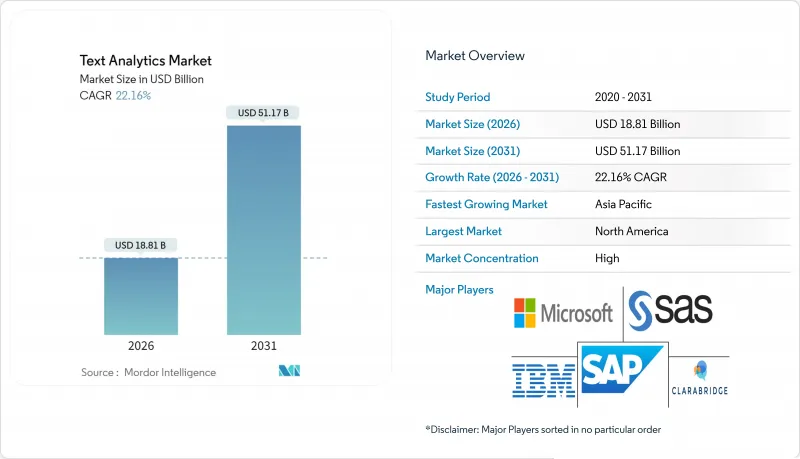
본 보고서에서는 업계를 ‘구축 형태(On-Premise 및 클라우드)’, ‘용도(리스크 관리, 부정 관리, 비즈니스 인텔리전스 등)’, ‘최종 사용자 산업(은행, 금융서비스 및 보험(BFSI), 헬스케어, 에너지·유틸리티 등)’, 그리고 ‘지역’별로 분류하고 있습니다. 시장 예측은 금액(달러) 기준으로 제시되어 있습니다.
세계의 텍스트 분석 시장 동향 및 인사이트
대규모 언어 모델(LLM)의 기업용 텍스트 분석 통합
기업들은 조항 추출, 뉘앙스 감지, 대화 요약을 자동화하기 위해 대규모 언어 모델(LLM)을 실제 워크플로우에 통합했습니다. 마이크로소프트가 2025년에 Azure AI Language 내에서 출시한 GPT-4는 기존 트랜스포머에 비해 라벨링된 데이터 요구 사항을 40% 줄여, 조달 부서 및 법무 부서의 주석 작성에 소요되는 예산을 절감했습니다. Oracle은 자사의 클라우드 스택에 생성형 문서 이해 기능을 추가하여, 고객이 수천 건에 달하는 계약서에서 지불 조건이나 배상 책임 한도를 몇 분 만에 추출할 수 있도록 했습니다. 이러한 이점에는 편향이나 환각의 위험이 따르기 때문에 조직에서는 ‘휴먼-인-더-루프(Human-in-the-Loop)’ 방식의 검증 단계를 도입하는 사례가 늘고 있습니다. 위험 완화에 드는 비용은 있겠지만, 경제적 이점은 매우 크며, 맥킨지의 추산에 따르면 생성형 AI는 모든 기능을 통틀어 연간 2.6-4조 4,000억 달러의 가치를 창출할 가능성이 있습니다.
기업 전반에 걸친 비정형 텍스트 데이터의 급증
고객 리뷰, 헬프데스크 메모, 안전 기록, 규제 당국에 제출하는 서류 등이 수작업으로 팀이 읽어들이는 속도를 능가하는 속도로 기업의 저장소로 유입되고 있습니다. 2025년 중반 링크드인(LinkedIn)의 조사에 따르면, 기업들은 2024년 대비 55% 더 많은 비정형 텍스트를 저장했으며, 그 증가율은 정형 데이터의 성장률의 4배에 달할 전망입니다. 이러한 정보의 홍수로 인해 자동 분석은 단순한 최적화 수단이 아닌 필수 요건이 되었습니다. 현재 각 벤더들은 생명과학 및 석유 및 가스 등의 분야를 위해 사전 학습된 엔티티 카탈로그를 번들로 제공하여, 전문 사용자의 투자 회수 기간을 단축하고 있습니다. 그러나 용어집이 진화함에 따라 모델에 드리프트가 발생하기 쉬워져, 지속적인 재학습 서비스에 대한 수요가 높아지고 있습니다.
데이터 개인정보 보호 및 규정 준수 관련 우려
데이터 보호 제도의 파편화로 인해 규정 준수 측면에서 사일로화가 발생하고 있습니다. EU의 GDPR(EU 개인정보보호규정)에 따르면 전 세계 매출액의 최대 4%에 해당하는 벌금이 부과될 수 있습니다. 2023년에는 Meta가 불법 데이터 전송으로 12억 유로(13억 달러)를, 틱톡(TikTok)은 아동 데이터 처리 부실로 3억 4,500만 유로(3억 7,800만 달러)를 각각 지불한 사건으로 인해, 경영진은 텍스트 데이터 흐름에 대한 경각심을 높이고 있습니다. 캘리포니아주의 2023년 소비자 개인정보 보호법 개정안에 따라 주민에게는 자동화된 의사 결정에 대한 옵트아웃 권리가 인정되었으며, 옵트인 및 옵트아웃 기록에 대한 이중 처리 절차가 의무화되었습니다. EU의 AI 법에서는 감정 및 정서 인식이 고위험으로 분류되어 있으며, 도입 일정에 적합성 평가가 추가되었습니다. 규정 준수 비용은 사내 법무 담당자가 없는 중소기업에게 가장 큰 부담이 되고 있어, 감사 대응이 가능한 SaaS 플랫폼 도입을 촉진하고 있습니다.
부문 분석
조직들이 모델 드리프트와 도메인별 미세 조정에 어려움을 겪는 가운데, 서비스 분야는 연평균 성장률(CAGR) 23.06%의 잠재력을 보여 주며 소프트웨어 분야의 성장을 상회했습니다. 2025년에도 소프트웨어는 텍스트 분석 시장의 61.43%를 차지했으며, 그 범위는 NLP 엔진, 감정 점수 산출 도구, 사전 학습된 트랜스포머에 이릅니다. 그러나 언어적 변동 증가와 규제 감사의 강화로 인해 지속적인 재학습이 필수화되고 있으며, 예산은 관리형 서비스 및 어노테이션 아웃소싱으로 이동하고 있습니다.
각 벤더사는 성과 기반 계약이나 추출된 엔티티 단위, 혹은 요약 페이지 단위의 과금 방식 등으로 대응하고 있으며, 이를 통해 구매자의 위험을 억제하고 있습니다. 그러나 독자적인 사양의 스키마는 기업을 단일 공급자에 묶어둘 가능성이 있어, 오픈소스 형식을 요구하는 목소리가 높아지고 있습니다. 소프트웨어 벤더의 경우, 저비용 API와 프리미엄 컨설팅을 결합함으로써 이익률 압박에 대한 헤지 수단이 됩니다.
2025년 지출 중 On-Premise 도입이 59.89%를 차지했지만, 하이브리드 환경의 성숙에 따라 클라우드 점유율은 연평균 성장률(CAGR) 22.99%로 확대되고 있습니다. 2025년 예비 조사에 따르면, 클라우드로의 전환을 통해 하드웨어 업데이트가 불필요해지고 업데이트된 모델에 즉시 액세스할 수 있게 됨에 따라 총 소유 비용(TCO)이 40-50% 절감될 것으로 추산됩니다. 현재의 추세가 지속된다면, 2029년까지 클라우드 도입이 On-Premise 도입을 넘어설 것으로 예측됩니다.
하이브리드 설계에서는 퍼블릭 클라우드상의 텍스트를 익명화하면서, 개인을 식별할 수 있는 정보는 On-Premise에 보관하기 때문에 데이터 보관 장소와 관련된 규정 위반을 우려하는 은행이나 병원의 불안을 해소하고 있습니다. EU 데이터법은 데이터 마이그레이션권을 강화하고, 서비스 제공업체에 개방형 내보내기 형식 지원을 의무화함으로써 상호 운용성을 둘러싼 경쟁을 촉발하고 있습니다. 엣지 배포는 틈새 분야이긴 하지만, 공장 게이트웨이나 자율주행차가 오프라인에서 로그를 분석할 수 있게 하여 지연 시간을 줄여줍니다. 주요 과제는 모델 동기화이며, 지방 시설의 경우 업데이트가 한 달에 한 번만 이루어지는 경우가 있어 모델의 편차가 누적될 가능성이 있습니다.
지역별 분석
2025년, 북미는 전 세계 매출의 42.33%를 차지했으며, 기술, 금융, 소매 업계의 조기 도입이 이를 주도했습니다. 이 지역의 벤더들은 텍스트 분석 기능을 보다 광범위한 AI 포트폴리오에 통합하여 문서당 가격을 낮추고 있습니다. 규제상의 역풍, 특히 캘리포니아주의 개인정보 보호 개정법에 따라 설명 가능성 툴킷에 대한 투자가 활발해지고 있습니다.
아시아태평양은 세계 최고 수준인 연평균 성장률(CAGR) 23.57%를 나타낼 것으로 전망됩니다. 중국의 2025년 지침은 산업계 및 정부를 대상으로 국산 대규모 언어 모델(LLM)을 장려하고 국내 호스팅을 의무화함으로써, 전 세계 모델 생태계가 분열되는 결과를 초래했습니다. 일본 디지털청은 지자체 서비스의 디지털화를 추진하고 있어, 일본어를 지원하는 챗봇에 대한 수요를 창출하고 있습니다. 한편, 인도의 대형 IT 서비스 기업들은 힌디어, 타밀어, 벵골어를 아우르는 다국어 분석 솔루션을 해외에 전개하고 있습니다. 이러한 성장이 지속된다면, 아시아태평양의 텍스트 분석 시장 규모는 2031년까지 150억 달러를 넘어설 것으로 전망됩니다.
유럽에서는 텍스트 데이터 분석이 필요한 ESG 보고 의무화를 배경으로 꾸준한 보급이 진행되고 있습니다. EU의 AI 법에서는 적합성 평가가 도입되어 진입 장벽이 높아지고 있지만, 규제를 준수하고 설명 가능한 플랫폼에 대한 수요를 뒷받침하고 있습니다. 남미 시장은 클라우드 인프라 격차와 환율 변동의 영향으로 여전히 발전 단계에 있습니다. 중동 및 아프리카에서는 아랍에미리트(UAE)와 사우디아라비아의 정부계 펀드가 시민 서비스 포털에 자연어 처리(NLP)를 접목한 스마트시티 프로젝트에 자금을 지원하고 있습니다.
기타 혜택 :
- 엑셀 형식 시장 예측(ME) 시트
- 3개월간의 애널리스트 지원
자주 묻는 질문
목차
제1장 서론
제2장 조사 방법
제3장 주요 요약
제4장 시장 구도
제5장 시장 규모 및 성장 예측
제6장 경쟁 구도
제7장 시장 기회 및 향후 전망
KTH 26.09.10According to Mordor Intelligence, the text analytics market reached USD 18.81 billion in 2026 and is forecast to climb to USD 51.17 billion by 2031, advancing at a 22.16% CAGR during 2026-2031.
This report Segments the Industry Into by Deployment (On-Premise, and Cloud), by Application (Risk Management, Fraud Management, Business Intelligence, and More), by End-User Industry (BFSI, Healthcare, Energy and Utility, and More), and by Geography. The Market Forecasts are Provided in Terms of Value (USD).
Global Text Analytics Market Trends and Insights
Integration of Large Language Models into Enterprise Text Analytics
Enterprises plugged large language models (LLMs) into production workflows to automate clause extraction, nuance detection, and conversational summarization. Microsoft's 2025 release of GPT-4 inside Azure AI Language cut labeled-data requirements by 40% compared with prior transformers, trimming annotation budgets for procurement and legal teams. Oracle added generative document understanding to its cloud stack, letting customers surface payment terms and liability caps across thousands of contracts in minutes. These gains arrive with bias and hallucination risks, so organizations increasingly deploy human-in-the-loop validation layers. Despite mitigation costs, the economic upside is significant; McKinsey estimates generative AI could unlock USD 2.6-4.4 trillion in annual value across functions.
Proliferation of Unstructured Text Data Across Enterprises
Customer reviews, help-desk notes, safety logs, and regulatory filings pour into corporate repositories faster than manual teams can read them. A mid-2025 LinkedIn survey found that enterprises stored 55% more unstructured text than in 2024, exceeding structured-data growth by a factor of four. This flood makes automated parsing a necessity rather than an optimization. Vendors now bundle pre-trained entity catalogs for domains such as life sciences and oil and gas, accelerating time-to-benefit for specialized users. However, as vocabularies evolve, models face drift, reinforcing demand for continuous retraining services.
Data Privacy and Compliance Concerns
Fragmented data-protection regimes create compliance silos. The EU GDPR authorizes fines up to 4% of global revenue; Meta paid EUR 1.2 billion (USD 1.3 billion) in 2023 for unlawful transfers, while TikTok incurred EUR 345 million (USD 378 million) for child-data lapses, raising executive sensitivity to textual-data flows. California's 2023 Consumer Privacy amendments grant residents the right to opt out of automated decision-making, forcing dual pipelines for opted-in and opted-out records. The EU AI Act classifies sentiment and emotion recognition as high risk, layering conformity assessments onto deployment timelines. Compliance costs land heaviest on SMEs that lack in-house counsel, motivating uptake of audit-ready SaaS platforms.
Other drivers and restraints analyzed in the detailed report include:
- Growing Demand for Social Media Analytics
- Rising Adoption of Predictive Analytics for Customer Insights
- High Carbon Footprint of Deep-Learning Text Analytics Workloads
For complete list of drivers and restraints, kindly check the Table Of Contents.
Segment Analysis
Services claimed 23.06% CAGR potential, outstripping software growth as organizations grapple with model drift and domain fine-tuning. In 2025, software still held 61.43% of text analytics market share, spanning NLP engines, sentiment scorers, and pretrained transformers. Yet rising linguistic variation and regulatory audits make continuous retraining a must, steering budgets toward managed services and annotation outsourcing.
Vendors respond with outcome-based contracts, cost per extracted entity, or per summarized page, that cap risk for buyers. However, proprietary schemas can lock enterprises into a single provider, prompting calls for open-source formats. For software vendors, bundling low-cost APIs with premium consulting offers a hedge against margin squeeze.
On-premises installations controlled 59.89% of 2025 spend, yet the cloud slice is growing at a 22.99% CAGR as hybrid patterns mature. A 2025 preliminary study calculated that shifting to the cloud cut the total cost of ownership 40-50% by eliminating hardware refresh and granting instant access to updated models. Cloud deployments are projected to overtake on-premises deployments by 2029 if current momentum holds.
Hybrid designs anonymize text in public clouds while retaining personally identifiable information on-premises, appeasing bankers and hospitals that fear data-residency breaches. The EU Data Act bolsters portability rights, forcing providers to support open export formats and sparking a race for interoperability. Edge deployments, though niche, enable factory gateways and autonomous vehicles to parse logs offline, cutting latency. The primary hurdle is model sync; rural facilities may update only monthly, letting drift accumulate.
Complete Report Scope:
- By Component
- Software
- Services
- By Deployment Model
- On-premise
- Cloud
- By Analytics Type
- Sentiment Analysis
- Predictive Analytics
- Speech Analytics
- Other Analytics Types
- By Application
- Risk Management
- Fraud Management
- Business Intelligence
- Social Media Analysis
- Customer Care Services
- Governance, Risk and Compliance Management
- Other Applications
- By End-User Industry
- BFSI
- Healthcare
- Energy and Utilities
- Retail and E-commerce
- Government and Defense
- IT and Telecom
- Other End-User Industries
- By Enterprise Size
- Large Enterprises
- Small and Medium Enterprises (SMEs)
- By Geography
- North America
- United States
- Canada
- Mexico
- South America
- Brazil
- Argentina
- Rest of South America
- Europe
- United Kingdom
- Germany
- France
- Italy
- Spain
- Rest of Europe
- Asia-Pacific
- China
- Japan
- India
- South Korea
- ASEAN
- Oceania
- Rest of Asia-Pacific
- Middle East and Africa
- Middle East
- Saudi Arabia
- United Arab Emirates
- Turkey
- Rest of Middle East
- Africa
- South Africa
- Nigeria
- Egypt
- Rest of Africa
- Middle East
- North America
Geography Analysis
North America accounted for 42.33% of global revenue in 2025, anchored by early adoption across tech, finance, and retail. Vendors in the region bundle text analytics into wider AI portfolios, driving down per-document pricing. Regulatory headwinds, notably the California privacy amendments, spark investment in explainability toolkits.
Asia-Pacific is projected to post a 23.57% CAGR, the fastest worldwide. China's 2025 guidelines promoted sovereign LLMs for industry and government, mandating domestic hosting and splintering the global model ecosystem. Japan's Digital Agency digitizes municipal services, spawning demand for Japanese-language chatbots, while India's IT services giants export multilingual analytics covering Hindi, Tamil, and Bengali. The text analytics market size in Asia-Pacific is poised to exceed USD 15 billion by 2031 if growth holds.
Europe shows steady uptake, driven by ESG-reporting mandates that require textual data parsing. The EU AI Act introduces conformity assessments, raising entry barriers but fueling demand for compliant, explainable platforms. South America's market remains nascent, hampered by cloud-infrastructure gaps and currency volatility. In the Middle East and Africa, sovereign wealth funds in the United Arab Emirates and Saudi Arabia bankroll smart-city projects that embed NLP into citizen-service portals.
- IBM Corporation
- Microsoft Corporation
- SAP SE
- SAS Institute Inc.
- Lexalytics Inc.
- Luminoso Technologies Inc.
- Clarabridge Inc.
- Micro Focus International plc
- OpenText Corporation
- RapidMiner Inc.
- Infegy Inc.
- Medallia Inc.
- Google LLC
- Amazon Web Services, Inc.
- Oracle Corporation
- Qualtrics International Inc.
- Snowflake Inc.
- Altair Engineering Inc.
- Databricks Inc.
- Sinequa
- Yext Inc.
- KNIME AG
Additional Benefits:
- The market estimate (ME) sheet in Excel format
- 3 months of analyst support
TABLE OF CONTENTS
1 INTRODUCTION
- 1.1 Study Assumptions and Market Definition
- 1.2 Scope of the Study
2 RESEARCH METHODOLOGY
3 EXECUTIVE SUMMARY
4 MARKET LANDSCAPE
- 4.1 Market Overview
- 4.2 Market Drivers
- 4.2.1 Growing Demand for Social Media Analytics
- 4.2.2 Rising Adoption of Predictive Analytics for Customer Insights
- 4.2.3 Proliferation of Unstructured Text Data Across Enterprises
- 4.2.4 Integration of Large Language Models into Enterprise Text Analytics
- 4.2.5 Expansion of Real-Time Text Analytics in Edge IoT Devices
- 4.2.6 Regulatory Mandates for ESG Disclosure Requiring Textual Data Parsing
- 4.3 Market Restraints
- 4.3.1 Lack of Skilled Personnel and Awareness
- 4.3.2 Data Privacy and Compliance Concerns
- 4.3.3 High Carbon Footprint of Deep-Learning Text Analytics Workloads
- 4.3.4 Increasing Cost of High-Quality Multilingual Training Data
- 4.4 Industry Value Chain Analysis
- 4.5 Regulatory Landscape
- 4.6 Technological Outlook
- 4.7 Porter's Five Forces Analysis
- 4.7.1 Bargaining Power of Suppliers
- 4.7.2 Bargaining Power of Buyers
- 4.7.3 Threat of New Entrants
- 4.7.4 Threat of Substitute Products
- 4.7.5 Intensity of Competitive Rivalry
- 4.8 Impact of Macroeconomic Factors on the Market
5 MARKET SIZE AND GROWTH FORECASTS (VALUE)
- 5.1 By Component
- 5.1.1 Software
- 5.1.2 Services
- 5.2 By Deployment Model
- 5.2.1 On-premise
- 5.2.2 Cloud
- 5.3 By Analytics Type
- 5.3.1 Sentiment Analysis
- 5.3.2 Predictive Analytics
- 5.3.3 Speech Analytics
- 5.3.4 Other Analytics Types
- 5.4 By Application
- 5.4.1 Risk Management
- 5.4.2 Fraud Management
- 5.4.3 Business Intelligence
- 5.4.4 Social Media Analysis
- 5.4.5 Customer Care Services
- 5.4.6 Governance, Risk and Compliance Management
- 5.4.7 Other Applications
- 5.5 By End-User Industry
- 5.5.1 BFSI
- 5.5.2 Healthcare
- 5.5.3 Energy and Utilities
- 5.5.4 Retail and E-commerce
- 5.5.5 Government and Defense
- 5.5.6 IT and Telecom
- 5.5.7 Other End-User Industries
- 5.6 By Enterprise Size
- 5.6.1 Large Enterprises
- 5.6.2 Small and Medium Enterprises (SMEs)
- 5.7 By Geography
- 5.7.1 North America
- 5.7.1.1 United States
- 5.7.1.2 Canada
- 5.7.1.3 Mexico
- 5.7.2 South America
- 5.7.2.1 Brazil
- 5.7.2.2 Argentina
- 5.7.2.3 Rest of South America
- 5.7.3 Europe
- 5.7.3.1 United Kingdom
- 5.7.3.2 Germany
- 5.7.3.3 France
- 5.7.3.4 Italy
- 5.7.3.5 Spain
- 5.7.3.6 Rest of Europe
- 5.7.4 Asia-Pacific
- 5.7.4.1 China
- 5.7.4.2 Japan
- 5.7.4.3 India
- 5.7.4.4 South Korea
- 5.7.4.5 ASEAN
- 5.7.4.6 Oceania
- 5.7.4.7 Rest of Asia-Pacific
- 5.7.5 Middle East and Africa
- 5.7.5.1 Middle East
- 5.7.5.1.1 Saudi Arabia
- 5.7.5.1.2 United Arab Emirates
- 5.7.5.1.3 Turkey
- 5.7.5.1.4 Rest of Middle East
- 5.7.5.2 Africa
- 5.7.5.2.1 South Africa
- 5.7.5.2.2 Nigeria
- 5.7.5.2.3 Egypt
- 5.7.5.2.4 Rest of Africa
- 5.7.5.1 Middle East
- 5.7.1 North America
6 COMPETITIVE LANDSCAPE
- 6.1 Market Concentration
- 6.2 Strategic Moves
- 6.3 Market Share Analysis
- 6.4 Company Profiles (Includes Global Level Overview, Market Level Overview, Core Segments, Financials as Available, Strategic Information, Market Rank/Share for Key Companies, Products and Services, and Recent Developments)
- 6.4.1 IBM Corporation
- 6.4.2 Microsoft Corporation
- 6.4.3 SAP SE
- 6.4.4 SAS Institute Inc.
- 6.4.5 Lexalytics Inc.
- 6.4.6 Luminoso Technologies Inc.
- 6.4.7 Clarabridge Inc.
- 6.4.8 Micro Focus International plc
- 6.4.9 OpenText Corporation
- 6.4.10 RapidMiner Inc.
- 6.4.11 Infegy Inc.
- 6.4.12 Medallia Inc.
- 6.4.13 Google LLC
- 6.4.14 Amazon Web Services, Inc.
- 6.4.15 Oracle Corporation
- 6.4.16 Qualtrics International Inc.
- 6.4.17 Snowflake Inc.
- 6.4.18 Altair Engineering Inc.
- 6.4.19 Databricks Inc.
- 6.4.20 Sinequa
- 6.4.21 Yext Inc.
- 6.4.22 KNIME AG
7 MARKET OPPORTUNITIES AND FUTURE OUTLOOK
- 7.1 White-Space and Unmet-Need Assessment