|
시장보고서
상품코드
1851462
엘라스토머 시장 : 점유율 분석, 산업 동향, 통계, 성장 예측(2025-2030년)Elastomers - Market Share Analysis, Industry Trends & Statistics, Growth Forecasts (2025 - 2030) |
||||||
 Mordor Intelligence
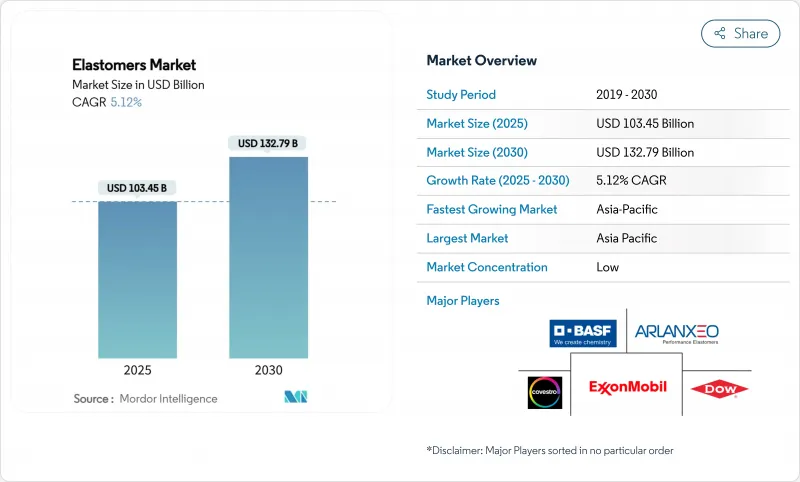
엘라스토머 시장 규모는 2025년에 1,034억 5,000만 달러, 2030년에는 1,327억 9,000만 달러에 이르고, 예측 기간(2025-2030년)의 CAGR은 5.12%를 나타낼 전망입니다.

엘라스토머 시장의 성장 궤도는 자동차 플랫폼의 경량화를 실현하고, 전기자동차의 항속 거리를 연장하고, 내구성을 희생하지 않고 서큘러 이코노미의 기대에 부응하는 재료의 능력과 연결되어 있습니다. 열가소성 등급은 표준 플라스틱 설비로 용융 가공할 수 있어 사이클 타임을 단축하고 스크랩율을 낮추는 클로즈드 루프의 재분쇄 스트림을 가능하게 하기 위해 기존의 고무를 대체하고 있습니다. 아시아태평양의 급속한 도시화와 에너지 효율적인 건물의 추진으로 건설 수요가 증가하고 있습니다. 한편, 의료기기 제조업체는 PVC 튜브에서 멸균에 견디는 생체적합성 TPE로의 이동을 가속화하고 있습니다.
세계 엘라스토머 시장 동향과 통찰
자동차 경량화 및 EV 부품 수요 증가
전기자동차 제조업체는 배터리 하우징, 서스펜션 부츠 및 유체 처리 라인에서 킬로그램을 줄이고 항속 거리를 직접 늘리기 위해 고급 엘라스토머를 사용합니다. 하이트렐 TPC LCF와 같은 소재는 기존 폴리머에 비해 이산화탄소 배출량을 50% 삭감하여 저온 충격 하에서도 유연성을 유지합니다. 상용차의 소유자는 헤비 듀티 팩에도 같은 요구를 느끼고 있으며, 고온 가스켓이나 방진재의 다년간 프로그램에 연료를 공급하고 있습니다. 세계 경차 판매가 부진한 해에도 OEM은 R&D 예산을 경량 실링 솔루션으로 돌려 엘라스토머 시장에 반순환적인 상승을 가져왔습니다. Cooper Standard의 Fortrex 플랫폼은 수명을 연장하면서 EPDM에 비해 53%의 질량 절감을 실현하여 이 동향을 부각하고 있습니다. 엘라스토머의 오버몰드 부품은 급속 충전 중 열 사이클을 견딜 필요가 있기 때문에 충전소 제조업체가 수요를 늘리고 있습니다.
아시아태평양의 건설 및 인프라 확대
중국, 인도, 동남아시아의 고층 프로젝트와 거대한 운송 회랑에서는 엘라스토머 실란트를 사용하여 지진 하중 하에서도 건물 외벽의 무결성을 유지하는 무브먼트 조인트, 글레이징 시스템, 방수막을 실현하고 있습니다. 정부의 녹색 빌딩 기준은 낮은 VOC로 에너지 절약 재료를 사용하도록 장려하고 있으며 고성능 TPE 및 PU 실란트가 기본 사양입니다. 코베스트로가 최근 대만에서 실시한 주조 폴리우레탄 엘라스토머의 생산 능력 증강은 자동화 공장 및 풍력 터빈 부품에 사용되는 기기를 대상으로 하며 지역의 자급 자족을 강화하고 있습니다. 스마트 시티에 투자하면 자외선에 안정적인 엘라스토머 스킨을 필요로 하는 센서 하우징과 대기질 모니터의 인계가 증가합니다. 계약자는 선적 지연을 피하기 위해 현지에서 컴파운드된 등급을 선호하기 때문에 세계 공급업체는 엘라스토머 시장에서 최종 시장과 협력할 수 있는 이유를 제공합니다..
불안정한 원유 가격과 원료 가격
BASF와 같은 제조업체는 마진을 유지하기 위해 주요 디올에 파운드 당 8-10 센트의 추가 요금을 부과했습니다. 공급이 급박하기 때문에 컨버터 각 사는 재고의 밸런스를 주의깊게 취할 필요에 강요되고 있어 바이오 베이스의 원료에 조달을 시프트하는 곳도 있지만, 그 양은 여전히 한정되어 있습니다. 이러한 변동은 예산 편성을 방해하고 자본 투자를 연기시킬 수 있기 때문에 엘라스토머 시장의 단기 확장을 저해할 수 있습니다.
부문 분석
열가소성 엘라스토머는 엘라스토머 시장의 81.56%를 차지할 뿐만 아니라 OEM이 재활용 목표를 달성하는 데 도움이 되는 폐쇄 루프 재가공성으로 인해 2030년까지 연평균 복합 성장률(CAGR)이 가장 빠른 5.35%로 성장을 지속하고, 있습니다. 이러한 이점은 주요 자동차용 윈도우 씰, 와이어 하네스용 그로밋, 웨어러블 밴드가 성형 사이클을 단축하기 위해 가교 고무 대신 TPE를 사용하는 경우가 많다는 것을 의미합니다.
열경화성 엘라스토머는 터보차저 호스나 유전용 패커 등 온도가 150℃를 넘는 장소에서 발판을 유지합니다. 그러나 이러한 틈새 분야에서도 TPE의 외층과 가황 코어를 혼합한 하이브리드 컨셉이 내약품성과 재활용성을 양립시키고 있습니다. 따라서 연구 투자의 핵심은 핵제, 블록 공중합체 설계, 피로 수명을 손상시키지 않고 TPE의 사용 온도를 180℃ 이상으로 끌어올리는 촉매 시스템입니다. 이러한 진보는 엘라스토머 시장에 추가 수익을 가져올 때와 동시에 가공업자가 인수 의무에 대응하는 데 도움이 될 것으로 기대됩니다.
엘라스토머 보고서는 제품 유형(열가소성 엘라스토머 및 열경화성 엘라스토머), 최종 사용자 산업(자동차, 운송, 전기, 전자, 의료 및 의료, 산업용 기계 및 장비 등) 및 지역(아시아태평양, 북미, 유럽, 남미, 중동 및 아프리카)으로 구분됩니다. 시장 예측은 금액(달러)으로 제공됩니다.
지역별 분석
아시아태평양은 엘라스토머 시장의 42.34%를 차지했고, CAGR 6.56%로 다른 지역을 압도하고 있습니다. 중국은 여전히 중심적인 존재로 탄성중합체를 고속철도용 개스킷, 가전제품용 씰, 장강델타를 따라 타이어공장에 공급하고 있습니다. 인도의 국영공업단지는 자본 설비에 사용되는 진동 감쇠 마운트 수요를 높여 동남아시아의 전자기기 클러스터는 스마트폰이나 태블릿용 내열성 오버몰드 컴파운드를 소비하고 있습니다.
북미는 경자동차, 의료기기, 셰일가스 인프라의 통합 공급망을 통해 엘라스토머 시장을 지원하고 있습니다. 국내 EV 배터리 공장에 대한 정책적 인센티브는 셀의 하우징을 밀폐하는 난연성 TPE 개스킷의 조달을 강화하고 있습니다. 유럽은 지속가능성에 중점을 두고 있으며, ISCC PLUS의 매스밸런스 시스템에서 검증된 바이오 유래 EPDM과 TPE의 혼합물 채택을 추진하고 있습니다.
남미, 중동, 아프리카에서는 인프라 투자가 꾸준히 증가. 브라질의 폴리우레탄 생산량은 세계 4위로 걸프의 에너지 프로젝트에는 내 사워 가스성의 엘라스토머 씰이 필요합니다. 절대 규모는 작지만 공급망의 현지화가 진행됨에 따라 이러한 지역은 장기적인 상승 여지가 있습니다.
기타 혜택 :
- 엑셀 형식 시장 예측(ME) 시트
- 3개월간의 애널리스트 서포트
목차
제1장 서론
- 조사의 전제조건과 시장의 정의
- 조사 범위
제2장 조사 방법
제3장 주요 요약
제4장 시장 상황
- 시장 개요
- 시장 성장 촉진요인
- 자동차 부품의 경량화·EV화 수요 증가
- 아시아태평양의 건설 및 인프라 확대
- 플렉서블 가전에 있어서의 열가소성 엘라스토머(TPE)의 급속한 침투
- 의료용 PVC 프리 튜브 용도의 급증
- 순환형 리사이클 대응 열가소성(TPE) 등급의 출현
- 엘라스토머 필라멘트의 적층 제조 수요
- 시장 성장 억제요인
- 불안정한 원유 가격과 원료 가격
- 마이크로 플라스틱 규제와 타이어 마모 규제의 강화
- 바이오 베이스의 고온에서의 성능차 엘라스토머
- 특수 모노머공급 체인 집중도
- 밸류체인 분석
- Porter's Five Forces 분석
- 공급기업의 협상력
- 구매자의 협상력
- 신규 참가업체의 위협
- 대체품의 위협
- 경쟁도
제5장 시장 규모와 성장 예측
- 제품 유형별
- 열가소성 엘라스토머
- 열경화성 엘라스토머
- 최종 사용자 업계별
- 자동차·운수
- 전기 및 전자
- 의료 및 헬스케어
- 산업기계
- 소비재와 양말
- 접착제, 실란트, 코팅제
- 기타(건축 및 건설, 항공우주 및 방위 등)
- 지역별
- 아시아태평양
- 중국
- 인도
- 일본
- 한국
- 기타 아시아태평양
- 북미
- 미국
- 캐나다
- 멕시코
- 유럽
- 독일
- 영국
- 프랑스
- 이탈리아
- 기타 유럽
- 남미
- 브라질
- 아르헨티나
- 기타 남미
- 중동 및 아프리카
- 사우디아라비아
- 남아프리카
- 기타 중동 및 아프리카
- 아시아태평양
제6장 경쟁 구도
- 시장 집중도
- 전략적 동향
- 시장 점유율 분석
- 기업 프로파일
- Ace Elastomer Co., Ltd.
- Arkema
- ARLANXEO
- Avient Corporation
- BASF
- Covestro AG
- DingZing Advanced Materials Co., Ltd.
- Dow
- Exxon Mobil Corporation
- Firestone Building Products Company
- HEXPOL AB
- Huntsman Corporation
- KRAIBURG TPE GmbH
- Kuraray Co., Ltd.
- Lion Elastomers Co., Ltd
- Mitsui Chemicals, Inc.
- Sirmax SpA
- Suzhou Austin Novel Materials Co., Ltd.
- Teknor Apex, Inc.
- Trinseo LLC
- UBE Corporation
- Wanhua Chemical Group Co., Ltd.
제7장 시장 기회와 장래의 전망
SHW 25.11.21The Elastomers Market size is estimated at USD 103.45 billion in 2025, and is expected to reach USD 132.79 billion by 2030, at a CAGR of 5.12% during the forecast period (2025-2030).
The upward trajectory of the Elastomers market is tied to the material's ability to deliver weight reduction in automotive platforms, extend electric-vehicle range, and meet circular-economy expectations without sacrificing durability. Thermoplastic grades are displacing conventional rubbers because they melt-process on standard plastics equipment, cut cycle times, and enable closed-loop re-grind streams that lower scrap rates. Rapid urbanization in Asia Pacific and the push for energy-efficient buildings keep construction demand elevated, while medical device makers accelerate the shift away from PVC tubing toward biocompatible TPEs that survive sterilization.
Global Elastomers Market Trends and Insights
Growing Demand for Lightweighting and EV Parts in Automotive
Electric-vehicle makers rely on advanced elastomers to shave kilograms from battery housings, suspension boots, and fluid-handling lines, which directly boosts driving range. Materials such as Hytrel TPC LCF cut carbon footprints by 50% compared with incumbent polymers, yet keep flexibility under low-temperature shock. Commercial fleet owners echo the same need in heavy-duty packs, fueling multi-year programs for high-temperature gaskets and vibration isolators. Even in a year when global light-vehicle sales slipped, OEMs funneled research and development budgets toward lightweight sealing solutions, creating a counter-cyclical lift for the Elastomers market. Cooper Standard's Fortrex platform highlights the trend with a 53% mass reduction versus EPDM while extending service life. Charging-station manufacturers add to demand because elastomeric over-mold parts must tolerate thermal cycling during fast charging.
Expansion of Construction and Infrastructure in Asia-Pacific
High-rise projects and mega-transport corridors across China, India, and Southeast Asia use elastomeric sealants to enable movement joints, glazing systems, and waterproof membranes that maintain building envelope integrity under seismic loads. Government green-building codes reward the use of low-VOC, energy-saving materials, turning high-performance TPE and PU sealants into default specifications. Covestro's recent capacity ramp-up in Taiwan for cast polyurethane elastomers is aimed at equipment used in automated factories and wind-turbine components, reinforcing regional self-sufficiency. Smart-city investments generate incremental pulls from sensor housings and air-quality monitors that require UV-stable elastomer skins. Contractors favor locally compounded grades to avoid shipping delays, giving global suppliers a reason to co-locate with end-markets in the Elastomers market.
Volatile Crude Oil and Feedstock Prices
Producers such as BASF implemented 8-10 cents per pound surcharges on key diols to maintain margins. Tight supply obliges converters to balance inventories carefully, and some shift sourcing to bio-based feedstocks, although volumes remain limited. The volatility clouds budgeting and can postpone capital expenditure, dampening near-term expansion of the Elastomers market.
Other drivers and restraints analyzed in the detailed report include:
- Rapid Penetration of Thermoplastic Elastomers in Flexible Consumer Electronics
- Surge in Medical-Grade PVC-Free Tubing Applications
- Stricter Micro-Plastic and Tire-Wear Regulations
For complete list of drivers and restraints, kindly check the Table Of Contents.
Segment Analysis
Thermoplastic elastomers not only own 81.56% share of the Elastomers market but also log the fastest 5.35% CAGR to 2030, thanks to closed-loop reprocessability that helps OEMs hit recycling targets. This dominance means every major automotive window seal, wire harness grommet, and wearable band increasingly relies on TPE, often replacing cross-linked rubber to shorten molding cycles.
Thermoset elastomers maintain footholds where temperatures exceed 150 °C, for instance, in turbocharger hoses and oil-field packers. Yet even in these niches, hybrid concepts mix TPE outer layers with vulcanized cores to marry chemical resistance with recyclability. Research investment, therefore, centers on nucleating agents, block-copolymer design, and catalyst systems that lift the service temperature of TPE beyond 180 °C without eroding fatigue life. Such advances are expected to channel additional revenue into the Elastomers market while helping processors meet take-back mandates.
The Elastomers Report is Segmented by Product Type (Thermoplastic Elastomers and Thermoset Elastomers), End-User Industry (Automotive and Transportation, Electrical and Electronics, Medical and Healthcare, Industrial Machinery and Equipment, and More), and Geography (Asia-Pacific, North America, Europe, South America, and Middle-East and Africa). The Market Forecasts are Provided in Terms of Value (USD).
Geography Analysis
Asia Pacific captures 42.34% of the Elastomers market and outpaces all other regions with a 6.56% CAGR. China remains the centerpiece, channeling elastomers into high-speed rail gaskets, appliance seals, and tire plants clustered along the Yangtze River Delta. India's state-sponsored industrial corridors likewise lift demand for vibration-dampening mounts used in capital equipment, while Southeast Asia's electronics clusters consume heat-resistant over-mold compounds for smartphones and tablets.
North America sustains the Elastomers market through its integrated supply chain for light vehicles, medical devices, and shale-gas infrastructure. Policy incentives for domestic EV battery plants intensify the procurement of flame-retardant TPE gaskets that seal cell enclosures. Europe pivots heavily toward sustainability, driving the adoption of bio-attributed EPDM and TPE blends verified under ISCC PLUS mass-balance systems.
South America, the Middle-East, and Africa post steady gains in infrastructure spending. Brazil's polyurethane output ranks fourth globally, while Gulf energy projects need sour-gas-resistant elastomer seals. Although smaller in absolute terms, these regions provide long-run upside as supply-chain localization continues.
- Ace Elastomer Co., Ltd.
- Arkema
- ARLANXEO
- Avient Corporation
- BASF
- Covestro AG
- DingZing Advanced Materials Co., Ltd.
- Dow
- Exxon Mobil Corporation
- Firestone Building Products Company
- HEXPOL AB
- Huntsman Corporation
- KRAIBURG TPE GmbH
- Kuraray Co., Ltd.
- Lion Elastomers Co., Ltd
- Mitsui Chemicals, Inc.
- Sirmax S.p.A
- Suzhou Austin Novel Materials Co., Ltd.
- Teknor Apex, Inc.
- Trinseo LLC
- UBE Corporation
- Wanhua Chemical Group Co., Ltd.
Additional Benefits:
- The market estimate (ME) sheet in Excel format
- 3 months of analyst support
TABLE OF CONTENTS
1 Introduction
- 1.1 Study Assumptions and Market Definition
- 1.2 Scope of the Study
2 Research Methodology
3 Executive Summary
4 Market Landscape
- 4.1 Market Overview
- 4.2 Market Drivers
- 4.2.1 Growing demand for lightweighting and EV parts in automotive
- 4.2.2 Expansion of construction and infrastructure in Asia Pacific
- 4.2.3 Rapid penetration of Thermoplastic Elastomers (TPEs) in flexible consumer electronics
- 4.2.4 Surge in medical?grade PVC-free tubing applications
- 4.2.5 Emergence of recycling-compatible circular Thermoplastic Elastomers (TPE )grades
- 4.2.6 Additive manufacturing demand for elastomeric filaments
- 4.3 Market Restraints
- 4.3.1 Volatile crude oil and feedstock prices
- 4.3.2 Stricter micro-plastic and tire-wear regulations
- 4.3.3 Performance gap of bio-based elastomers at high-temperature
- 4.3.4 Supply-chain concentration of specialty monomers
- 4.4 Value Chain Analysis
- 4.5 Porter's Five Forces Analysis
- 4.5.1 Bargaining Power of Suppliers
- 4.5.2 Bargaining Power of Buyers
- 4.5.3 Threat of New Entrants
- 4.5.4 Threat of Substitutes
- 4.5.5 Degree of Competition
5 Market Size and Growth Forecasts
- 5.1 By Product Type
- 5.1.1 Thermoplastic Elastomers
- 5.1.2 Thermoset Elastomers
- 5.2 By End-user Industry
- 5.2.1 Automotive and Transportation
- 5.2.2 Electrical and Electronics
- 5.2.3 Medical and Healthcare
- 5.2.4 Industrial Machinery and Equipment
- 5.2.5 Consumer Goods and Footwear
- 5.2.6 Adhesives, Sealants and Coatings
- 5.2.7 Others (Building and Construction, Aerospace and Defense, etc)
- 5.3 By Geography
- 5.3.1 Asia-Pacific
- 5.3.1.1 China
- 5.3.1.2 India
- 5.3.1.3 Japan
- 5.3.1.4 South Korea
- 5.3.1.5 Rest of Asia-Pacific
- 5.3.2 North America
- 5.3.2.1 United States
- 5.3.2.2 Canada
- 5.3.2.3 Mexico
- 5.3.3 Europe
- 5.3.3.1 Germany
- 5.3.3.2 United Kingdom
- 5.3.3.3 France
- 5.3.3.4 Italy
- 5.3.3.5 Rest of Europe
- 5.3.4 South America
- 5.3.4.1 Brazil
- 5.3.4.2 Argentina
- 5.3.4.3 Rest of South America
- 5.3.5 Middle-East and Africa
- 5.3.5.1 Saudi Arabia
- 5.3.5.2 South Africa
- 5.3.5.3 Rest of Middle-East and Africa
- 5.3.1 Asia-Pacific
6 Competitive Landscape
- 6.1 Market Concentration
- 6.2 Strategic Moves
- 6.3 Market Share Analysis
- 6.4 Company Profiles (includes Global level Overview, Market level overview, Core Segments, Financials as available, Strategic Information, Market Rank/Share for key companies, Products and Services, and Recent Developments)
- 6.4.1 Ace Elastomer Co., Ltd.
- 6.4.2 Arkema
- 6.4.3 ARLANXEO
- 6.4.4 Avient Corporation
- 6.4.5 BASF
- 6.4.6 Covestro AG
- 6.4.7 DingZing Advanced Materials Co., Ltd.
- 6.4.8 Dow
- 6.4.9 Exxon Mobil Corporation
- 6.4.10 Firestone Building Products Company
- 6.4.11 HEXPOL AB
- 6.4.12 Huntsman Corporation
- 6.4.13 KRAIBURG TPE GmbH
- 6.4.14 Kuraray Co., Ltd.
- 6.4.15 Lion Elastomers Co., Ltd
- 6.4.16 Mitsui Chemicals, Inc.
- 6.4.17 Sirmax S.p.A
- 6.4.18 Suzhou Austin Novel Materials Co., Ltd.
- 6.4.19 Teknor Apex, Inc.
- 6.4.20 Trinseo LLC
- 6.4.21 UBE Corporation
- 6.4.22 Wanhua Chemical Group Co., Ltd.
7 Market Opportunities and Future Outlook
- 7.1 White-space and Unmet-need Assessment
- 7.2 Shifting Focus toward the Development of Bio-based Products