|
시장보고서
상품코드
1640649
유럽의 의약품 수탁 제조 : 시장 점유율 분석, 산업 동향 및 통계, 성장 예측(2025-2030년)Europe Pharmaceutical Contract Manufacturing - Market Share Analysis, Industry Trends & Statistics, Growth Forecasts (2025 - 2030) |
||||||
 Mordor Intelligence
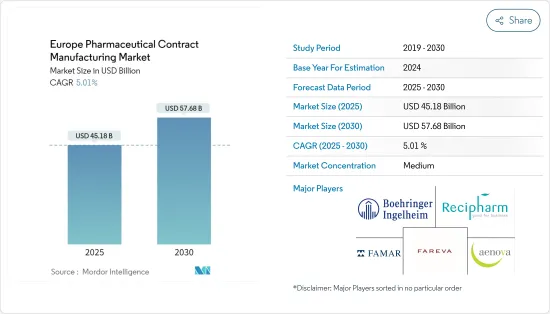
유럽의 의약품 수탁 제조 시장 규모는 2025년에 451억 8,000만 달러로 추정됩니다. 예측 기간(2025-2030년)의 CAGR은 5.01%로, 2030년에는 576억 8,000만 달러에 달할 것으로 예상됩니다.
주요 하이라이트
- 생산을 외주함으로써 제약 회사는 R&D, 마케팅, 판매 등의 핵심 역량에 집중할 수 있습니다. 계약 제조업체는 전문 지식, 최첨단 장비 및 비용 효율적인 운영을 제공함으로써 제약 회사는 시장 출시 시간을 단축하고 생산 능력을 향상시키고 운영 비용을 줄일 수 있습니다. 이러한 이점은 제약 회사가 제조 위탁을 선택하는 것을 뒷받침합니다.
- 또한 제약회사는 연구개발비를 늘리고 있습니다. R&D 비용의 수준은 제약 회사의 의약품에 대한 헌신을 보여주는 중요한 지표입니다. 그 결과, 의약품 연구개발에 대한 정부 투자 증가는 연구활동을 강화하고, 의약품 수탁 제조업자를 통해 제품을 시장에 공급 가능한 형태로 전환하는 것을 개선하며, 시장 성장을 가속할 것으로 예상됩니다. 예를 들어, 유럽제약단체연합회(EFPIA)와 미국 R&D 제약공업협회(PhRMA)에 따르면 유럽에서의 의약품 연구개발비의 연간 성장률은 2014-2018년의 3.7%에서 2019-2023년에는 6.7%로 증가했습니다.
- 그러나 유럽에서는 제약 산업이 제조 공정 관리를 유지하는 것을 선호하는 것이 시장 성장을 제한하고 있습니다. 아웃소싱으로 인한 비용 절감과 업무 효율화에도 불구하고 기업은 중요한 제조 측면 관리를 포기하고 싶지 않습니다. 이 망설임의 주요 원인은 지적 재산권 보호, 품질 기준 및 공급망의 신뢰성에 대한 우려입니다.
- 영국의 수탁 제조업체는 영국의 EU 이탈이 정치적 영향을 미치는 문제에 직면하고 있습니다. 영국/EU에 본사를 둔 CMO는 두 가지 규제 프레임워크 하에서 다양한 제품의 엄격한 시험 프로토콜을 준수해야 합니다. 정부는 영국 경제를 전통적인 금융 서비스와 신용 주도 지출에 대한 의존으로부터 다각화하기 위해 수출 확대를 추진하고 있습니다. 그 결과, 생산 능력이 제한된 제약회사가 제조업무의 일부를 외주하려고 할 가능성이 있어 CMO 수요가 높아집니다.
- 팬데믹은 조사한 시장에 다양한 영향을 미치고, 이 지역에서의 성장을 더욱 촉진했습니다. 이는 주로 백신, 치료제, 개인보호구 수요가 증가하고 제조능력이 타이트했기 때문입니다. 그 결과 수탁 제조업체는 수요를 충족시키기 위해 생산을 확대했습니다. 그러나 공급망의 혼란, 노동력 부족, 규제상의 과제 등이 장애가 됐습니다.
유럽의 의약품 수탁 제조 시장 동향
의약품(API) 부문이 시장에서 큰 점유율을 차지
- 인구의 고령화와 만성 질환 증가로 의약품 수요가 증가하고 있습니다. 또한 제네릭 의약품과 바이오시밀러의 개발에 주력하고 있는 것도 의약품 원약(API) 수요를 밀어 올리고 있습니다. 게다가 제약 부문에서 연구개발의 진행과 의료비 증가가 유럽 국가의 API 수요를 더욱 밀어 올리고 있습니다.
- API 수요 증가에 대응하기 위해, 제조업체 각사는 API 제조 능력의 증강을 향한 투자를 진행하고 있습니다. 2024년 6월, 에스테이브는 지로나의 셀라 공장에서 새로운 제조 장비를 건설하기 시작했으며, 2026년까지 1억 유로(1,407만 달러)의 투자를 계획하고 있습니다. 이 확장은 ESTEVE의 주요 산업 기지에서 의약품 약품(API)의 생산 능력을 강화하기 위한 것입니다. 이 프로젝트에는 새로운 생산 건물과 서비스 건물 건설, 최대 150 입방 미터의 반응 용적 설치가 포함됩니다. 그 결과, ESTEVE의 Celra 생산 능력은 45% 증가하여 회사의 세계 생산 능력에 추가로 15% 기여하게 됩니다. 지로나 공장에서의 이 개발은 제3자 고객(CMO)을 위한 유효성분을 개발·제조·판매하는 에스테이브의 사업에 있어서 큰 전진을 의미합니다.
- 기업은 의약품 제조를 강화하기 위해 인수 및 확장 전략을 적극적으로 추진하고 있으며, 이 분야의 성장을 이끌고 있습니다. 예를 들면, 2023년 1월, 아일랜드의 링 아스키디에 있는 원약 제조 공장이 노바티스로부터 다국적 개발·제조 수탁 기업의 스털링·파마·솔루션즈사에 인수되었습니다. 게다가 이 인수에는 노바티스와의 지속적인 공급계약도 포함되어 있어 심장병, 면역학, 종양학의 약용원약의 제조를 링아스키디에서 계속합니다. 이 시설은 스털링의 확장 API 생산 능력에 능력을 추가합니다. 재무 정보는 비공개로 간주되었습니다.
- 유럽의 원료 수입 증가는 제약 제조업체의 현저한 진보를 돋보이게합니다. 예를 들어, 시플라 리미티드는 2023년도 유럽 및 세계 시장에서 API로부터 수익의 약 39%를 얻었으며, 이 부문에 대한 회사의 전략적 중점화를 뒷받침하고 있습니다.
독일이 시장의 급성장을 견인할 것으로 예측
- 독일은 생산 능력과 시장 점유율 양면에서 서유럽 최고의 의약품 수탁 제조 시장으로서의 지위를 유지할 가능성이 높습니다. 이 지역은 고활성 의약품 성분(HPAPI)의 제조에 필수적인 고도로 숙련된 전문적인 노동력을 갖고 있기 때문에 제약 제조업체를 끌고 있습니다.
- 이 나라는 강력한 지적 재산권 보호와 조직 범죄에 대한 효과적인 조치로 유명합니다. 연간 성장률이 안정적인 것은 주로 독일 CMO의 확립된 전문 지식과 정부의 제약에 대한 지원 정책 때문입니다. 독일 의약품의 약 60%는 미국, 영국, 벨기에, 네덜란드, 스위스 등 주요 시장으로 수출됩니다. 또한 높은 생산성과 경쟁력 있는 세제가 독일 의약품 CMO 시장을 크게 견인하고 있습니다.
- 또한 성장 전략의 일환으로 새로운 지역을 대상으로 하는 기업도 늘고 있습니다. 예를 들어, 2023년 10월, 개발 및 제조 위탁 기관인 Vetter Pharma는 독일의 Ravensburg에 있는 세계 본사의 새로운 제조 시설에 2억 4,300만 달러를 투자한다고 발표했습니다. 이 건설은 무균 생산 능력을 강화하고 몇 가지 새로운 상업용 충전 라인을 도입하는 것을 목표로합니다. 첫 번째 클린룸은 2024년 말 설치되었습니다. 생산 시설 이외의 투자로는 분석 서비스를 위한 실험실 공간의 확장과 EU의 다른 기지에서 새로운 상업 생산 라인을 통한 충전 능력의 증대가 있습니다.
- BASF, B. Braun, Evonik, Vetter Pharma AG, Wacker, Corden Pharma, Merck 등 독일의 주요 제조업체와 서비스 제공업체는 이 나라의 의약품 부문에서 CMO 활동을 크게 강화하고 있으며 예측 기간 동안 시장 성장에 기여하고 있습니다.
유럽 의약품 수탁 제조 산업 개요
유럽 의약품 수탁 제조 시장은 통합되어 있으며 소수의 기업로 구성되어 있습니다. 시장 점유율에서 상위 기업은 시장을 독점하고 있습니다. 주요 기업은 Fareva Holdings SA, Recipharm AB, Boehringer Ingelheim Group, Aenova Group, Famar SA, Lonza Group 등입니다.
- 2024년 5월 제약회사인 EUROAPI는 세계 동물 건강기업과 CMO 계약을 체결했습니다. 이 제휴하에 EUROAPI는 고객에게 동물 의약품을 공급합니다. 계약 총액은 2025년부터 2029년까지 1억 3,000만 유로에서 1억 5,000만 유로로 추정됩니다.
- 2023년 11월 NorthEdge는 Torbay and Devon NHS Foundation Trust의 무균 주사제를 전문으로 하는 수탁 제조 및 라이선스 보유자인 Torbay Pharmaceuticals(Torbay)에 투자했습니다. 이 투자는 토베이의 국제 사업 확대의 다음 단계를 지원하기 위한 것입니다. 톨베이는 상업 규모의 무균 주사제 충전·마무리 서비스에 대한 수요 증가에 견인되어 급성장을 이루고 있습니다. 이 회사는 영국 내외의 건강 관리 기관 및 제약 회사에 제품을 공급하고 있습니다.
기타 혜택 :
- 엑셀 형식 시장 예측(ME) 시트
- 3개월간의 애널리스트 서포트
목차
제1장 서론
- 조사의 전제조건과 시장 정의
- 조사 범위
제2장 조사 방법
제3장 주요 요약
제4장 시장 인사이트
- 시장 개요
- 업계의 매력도 - Porter's Five Forces 분석
- 공급기업의 협상력
- 소비자의 협상력
- 신규 진입업자의 위협
- 경쟁 기업 간 경쟁 관계
- 대체품의 위협
- 산업 밸류체인 분석
- 산업정책
- 거시 경제 요인이 시장에 미치는 영향 평가
제5장 시장 인사이트
- 시장 성장 촉진요인
- 제약기업에 의한 아웃소싱량 증가
- R&D 투자 증가
- 시장 성장 억제요인
- 리드 타임과 물류 비용 증가
- 엄격한 규제 요건
- CMO의 수익성에 영향을 미치는 생산 능력 활용의 문제
제6장 기술 스냅샷
제7장 시장 세분화
- 서비스 유형별
- 원약(API) 제조
- 최종 제제(FDF) 개발·제조
- 고형 제제
- 액체 제형
- 주사제 제형
- 2차 포장
- 국가별
- 영국
- 독일
- 프랑스
- 이탈리아
- 기타 유럽
제8장 경쟁 구도
- 기업 프로파일
- Fareva Holdings SA
- Recipharm AB
- Boehringer Ingelheim Group
- Aenova Group
- Famar SA
- Lonza Group
- Cenexi-Laboratoires Thissen SA
- Almac Group
제9장 투자 분석
제10장 시장의 미래
KTH 25.02.19The Europe Pharmaceutical Contract Manufacturing Market size is estimated at USD 45.18 billion in 2025, and is expected to reach USD 57.68 billion by 2030, at a CAGR of 5.01% during the forecast period (2025-2030).
Key Highlights
- By outsourcing production, pharmaceutical companies can focus on core competencies like research and development, marketing, and sales. Contract manufacturers bring expertise, state-of-the-art facilities, and cost-effective operations, allowing pharma companies to accelerate time-to-market, increase production capacity, and reduce operational costs. These benefits are encouraging pharmaceutical firms to opt for contract manufacturing.
- Furthermore, pharmaceutical companies are increasing their R&D expenditures. The level of R&D spending is a crucial indicator of a pharmaceutical company's commitment to drug discovery. Consequently, increased government investments in pharmaceutical R&D are expected to enhance research activities, improve the conversion of products into market-ready forms through pharmaceutical contract manufacturers, and drive the market's growth. For instance, according to the European Federation of Pharmaceutical Industries and Associations (EFPIA) and Pharmaceutical Research and Manufacturers of America (PhRMA), the pharmaceutical research and development spending annual growth rate in Europe registered a growth rate of 6.7% in 2019-2023 increased from 3.7% in 2014-2018.
- However, in Europe, the pharmaceutical industry's preference for maintaining control over manufacturing processes is limiting the market's growth. Despite the cost savings and operational efficiencies that outsourcing offers, companies are reluctant to give up control over critical production aspects. This hesitation is primarily due to concerns about intellectual property protection, quality standards, and supply chain reliability.
- Contract-based manufacturers in the United Kingdom encounter challenges due to the political implications of the United Kingdom's departure from the EU. UK/EU-based CMOs must adhere to rigorous testing protocols for various products under two regulatory frameworks. The government is promoting increased exports to diversify the UK economy away from its traditional reliance on financial services and credit-driven spending. As a result, pharmaceutical companies with limited production capacities may seek to outsource parts of their manufacturing operations, thereby increasing the demand for CMOs.
- The pandemic had a varied impact on the market studied, further driving its growth in the region. This was primarily due to the increased demand for vaccines, therapeutics, and personal protective equipment, which strained manufacturing capacities. As a result, contract manufacturers expanded production to meet the demand. However, supply chain disruptions, labor shortages, and regulatory challenges posed some obstacles.
Europe Pharmaceutical Contract Manufacturing Market Trends
The Active Pharmaceutical Ingredient (API) Segment Holds a Major Share in the Market
- The aging population and the rising prevalence of chronic diseases are driving the increased demand for drugs. Also, the focus on developing generic drugs and biosimilars is boosting the demand for active pharmaceutical ingredients (APIs). Furthermore, ongoing research and development in the pharmaceutical sector, coupled with rising healthcare expenditures, are further driving API demand across European countries.
- In response to the increasing demand for APIs, manufacturers are witnessing investment in the expansion of API manufacturing with more capacity. In June 2024, ESTEVE commenced the construction of a new manufacturing unit at its Celra plant in Girona, with an investment plan of EUR 100 million (USD 14.07 million) by 2026. This expansion aims to enhance the production capacity of active pharmaceutical ingredients (API) at ESTEVE's primary industrial hub. The project includes the construction of new production and service buildings and the installation of reaction volumes totaling up to 150 cubic meters. Consequently, ESTEVE's Celra production capacity will increase by 45%, contributing an additional 15% to the company's global capacity. This development at the Girona plant represents a significant advancement in ESTEVE's business of developing, manufacturing, and selling active ingredients for third-party clients (CMO).
- Companies are actively pursuing acquisition and expansion strategies to bolster API manufacturing, driving growth in the sector. For instance, in January 2023, an active pharmaceutical ingredient (API) production plant in Ringaskiddy, Ireland, was acquired by Sterling Pharma Solutions, a multinational contract development and manufacturing company from Novartis. Additionally, the deal includes an ongoing supply agreement with Novartis to continue to manufacture several APIs for cardiology, immunology, and oncology medications at Ringaskiddy. The facility will add capacity to Sterling's expanding API manufacturing capabilities. Financial information was kept private.
- The increasing revenue from APIs in Europe highlights the significant advancements made by pharmaceutical manufacturers. For instance, in FY2023, Cipla Limited generated approximately 39% of its revenue from APIs in European and global markets, underscoring the company's strategic focus on this segment.
Germany is Projected to Drive the Market's Growth Rapidly
- Germany is likely to maintain its position as the premier pharmaceutical contract manufacturing market in Western Europe, both in capacity and market share. The region attracts pharmaceutical manufacturers due to its highly skilled and specialized workforce, which is essential for producing highly potent active pharmaceutical ingredients (HPAPIs).
- The country is renowned for its strong intellectual property protections and effective measures against organized crime. The steady annual growth rate is primarily due to the well-established expertise of German CMOs and the government's supportive policies for generics. Approximately 60% of Germany's pharmaceutical products are exported to major markets, including the United States, the United Kingdom, Belgium, the Netherlands, and Switzerland. Furthermore, high productivity levels and a competitive tax system significantly drive the pharmaceutical CMO market in Germany.
- Moreover, as part of their growth strategy, companies are increasingly targeting new regions. For instance, in October 2023, Vetter Pharma, a contract development and manufacturing organization, announced an investment of USD 243 million in a new production facility at its global headquarters in Ravensburg, Germany. This construction aims to enhance aseptic manufacturing capacity and introduce several new commercial filling lines. The initial cleanrooms are scheduled for installation by the end of 2024. Beyond the production facility, the investment includes expanding lab space for analytical services and increasing filling capacity with new commercial production lines at other EU locations.
- Leading German manufacturers and service providers, including BASF, B. Braun, Evonik, Vetter Pharma AG, Wacker, Corden Pharma, and Merck, are significantly enhancing CMO activities in the country's pharmaceutical sector, contributing to the market's growth during the forecast period.
Europe Pharmaceutical Contract Manufacturing Industry Overview
The European pharmaceutical contract manufacturing market is consolidated and consists of a few players. In terms of market share, top companies have control over the market. Major players include Fareva Holdings SA, Recipharm AB, Boehringer Ingelheim Group, Aenova Group, Famar SA, and Lonza Group.
- May 2024: EUROAPI, a pharmaceutical company, signed a CMO agreement with a global animal health company. Under this partnership, EUROAPI supplies veterinary products to its clients. The contract's total value is estimated to be between EUR 130 million and EUR 150 million from 2025 to 2029.
- November 2023: NorthEdge invested in Torbay Pharmaceuticals (Torbay), a contract manufacturer and license holder specializing in sterile injectables, from Torbay and Devon NHS Foundation Trust. This investment aims to support Torbay's next phase of international expansion. Torbay has experienced rapid growth, driven by increasing demand for commercial-scale sterile injectable fill/finish services. The company supplies healthcare organizations and pharmaceutical firms in the United Kingdom and internationally.
Additional Benefits:
- The market estimate (ME) sheet in Excel format
- 3 months of analyst support
TABLE OF CONTENTS
1 INTRODUCTION
- 1.1 Study Assumptions and Market Definition
- 1.2 Scope of the Study
2 RESEARCH METHODOLOGY
3 EXECUTIVE SUMMARY
4 MARKET INSIGHTS
- 4.1 Market Overview
- 4.2 Industry Attractiveness - Porter's Five Forces Analysis
- 4.2.1 Bargaining Power of Suppliers
- 4.2.2 Bargaining Power of Consumers
- 4.2.3 Threat of New Entrants
- 4.2.4 Intensity of Competitive Rivalry
- 4.2.5 Threat of Substitutes
- 4.3 Industry Value Chain Analysis
- 4.4 Industry Policies
- 4.5 Assessment of the Impact of Macro-economic Factors on the Market
5 MARKET INSIGHTS
- 5.1 Market Drivers
- 5.1.1 Increasing Outsourcing Volume by Pharmaceutical Companies
- 5.1.2 Increasing Investment in R&D
- 5.2 Market Restraints
- 5.2.1 Increasing Lead Time and Logistics Costs
- 5.2.2 Stringent Regulatory Requirements
- 5.2.3 Capacity Utilization Issues Affecting the Profitability of CMOs
6 TECHNOLOGY SNAPSHOT
7 MARKET SEGMENTATION
- 7.1 By Service Type
- 7.1.1 Active Pharmaceutical Ingredient (API) Manufacturing
- 7.1.2 Finished Dosage Formulation (FDF) Development and Manufacturing
- 7.1.2.1 Solid Dose Formulation
- 7.1.2.2 Liquid Dose Formulation
- 7.1.2.3 Injectable Dose Formulation
- 7.1.3 Secondary Packaging
- 7.2 By Country
- 7.2.1 United Kingdom
- 7.2.2 Germany
- 7.2.3 France
- 7.2.4 Italy
- 7.2.5 Rest of Europe
8 COMPETITIVE LANDSCAPE
- 8.1 Company Profiles
- 8.1.1 Fareva Holdings SA
- 8.1.2 Recipharm AB
- 8.1.3 Boehringer Ingelheim Group
- 8.1.4 Aenova Group
- 8.1.5 Famar SA
- 8.1.6 Lonza Group
- 8.1.7 Cenexi - Laboratoires Thissen SA
- 8.1.8 Almac Group