


|
시장보고서
상품코드
1683997
북미의 살충제 : 시장 점유율 분석, 산업 동향 및 통계, 성장 예측(2025-2030년)North America Insecticide - Market Share Analysis, Industry Trends & Statistics, Growth Forecasts (2025 - 2030) |
||||||
 Mordor Intelligence
■ 보고서에 따라 최신 정보로 업데이트하여 보내드립니다. 배송일정은 문의해 주시기 바랍니다.
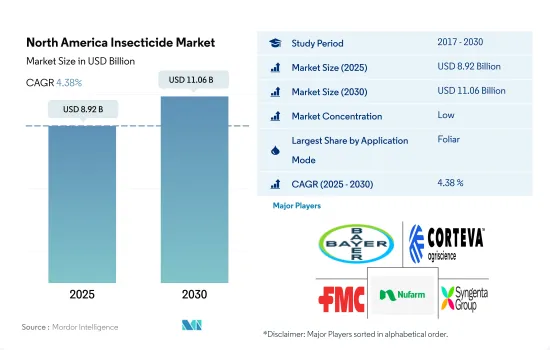
북미의 살충제 시장 규모는 2025년에 89억 2,000만 달러로 추정·예측되며, 2030년에는 110억 6,000만 달러에 달하며, 예측 기간(2025-2030년)의 CAGR은 4.38%로 성장할 것으로 예측됩니다.
해충 문제 증가가 시장 성장을 가속할 것으로 예상
- 북미 살충제 시장은 2022년 세계 살충제 시장 가치의 25.2%를 차지합니다. 북미 살충제 시장은 모든 부문에서 성장할 것으로 예상됩니다. 작물 보호에 대한 수요 증가와 농업 생산성 향상으로 2023-2029년 CAGR 4.8%를 나타낼 것으로 예상됩니다.
- 북미 살충제 시장에서는 해충 방제 효과가 높은 엽면 살충제가 2022년 41.2%로 가장 큰 비중을 차지했습니다.
- 화학 관개 분야는 2022년 북미 살충제 시장의 14.4%를 차지했습니다. 화학 관개 분야의 살충제 시장은 살충제의 정확하고 균일한 살포, 인건비 절감, 해충 방제 효과 향상 등 잠재적 이점에 의해 주도되고 있습니다.
- 종자 처리 방법은 이 지역에서 인기를 얻고 있으며, 예측 기간(2023-2029년) 동안 살충제 시장에서 4.8%의 연평균 복합 성장률(CAGR)로 가장 빠르게 성장하는 부문 중 하나가 될 것으로 예상됩니다. 종자 처리는 심기 전에 종자를 살충제로 코팅하여 초기 해충의 압력과 질병으로부터 신생 묘목을 보호합니다. 이는 해충 관리에 대한 효율적인 접근 방식이기 때문에 농가에 매력적인 선택이 될 수 있습니다.
- 토양 처리 분야의 살충제 시장은 2023-2029년 4.8%의 연평균 복합 성장률(CAGR)을 나타낼 것으로 예상됩니다. 토양 처리의 성장은 특정 해충으로부터 장기간 보호하고, 해충의 생애주기의 다양한 단계에 있는 해충을 대상으로 하여 더 나은 해충 관리를 촉진하는 등의 이점이 있기 때문인 것으로 추정됩니다.
해충 압력 증가, 재배 확대, 고품질 농산물에 대한 수요 증가가 시장 성장을 가속
- 북미는 2022년 세계 살충제 시장에서 24.0%의 점유율을 차지했습니다. 이 지역은 작물 보호 솔루션에 대한 수요 증가로 인해 상당한 성장세를 보이고 있습니다. 인구 증가, 식량 수요 증가, 농업 활동 확대, 해충으로부터 작물 보호에 대한 수요 증가 등의 요인이 시장을 주도하고 있습니다.
- 미국은 북미 살충제 시장의 지배적인 기업입니다. 미국은 세계에서 가장 크고 기술적으로 진보된 농업 부문 중 하나이며, 다양한 작물과 상품을 생산하고 있습니다. 그 결과, 유해한 해충과 해충으로부터 작물을 보호하기 위한 살충제에 대한 미국 수요는 큽니다.
- 멕시코는 예측 기간(2023-2029년) 동안 6.2%의 연평균 복합 성장률(CAGR)을 나타낼 것으로 예상되는 북미 살충제 시장에서 가장 빠르게 성장하는 국가입니다. 농업 활동의 확대, 다양한 작물, 기후 조건의 변화는 작물을 보호하고 최적의 수확량을 보장하기 위해 멕시코에서 살충제 사용을 촉진하고 있습니다.
- 캐나다는 예측 기간(2023-2029년) 동안 3.0%의 연평균 복합 성장률(CAGR)을 나타낼 것으로 예상됩니다. 대규모 재배 작물의 해충 압력 증가와 해충으로부터 작물을 보호해야 할 필요성이 증가함에 따라 캐나다 살충제 시장의 성장이 촉진될 것으로 예상됩니다.
- 기타 북미의 살충제 시장은 2022년 6,550만 달러로 평가되었습니다. 과일 및 채소 작물 분야가 시장 점유율 4.3%로 가장 큰 비중을 차지했습니다. 이 지역 시장은 해충으로부터 작물을 보호함으로써 얻을 수 있는 경제적 이익에 대한 인식이 높아짐에 따라 성장세를 보이고 있습니다. 그 결과, 북미 외 지역의 살충제 시장은 예측 기간(2023-2029년) 동안 4.7%의 연평균 복합 성장률(CAGR)을 나타낼 것으로 예상됩니다.
북미 살충제 시장 동향
해충으로부터 작물을 보호하여 수확량을 향상시키고자 하는 수요가 살충제 수요를 증가시킬 것으로 예상됩니다.
- 북미 국가 중 미국이 헥타르당 살충제 소비량이 가장 많으며, 2022년에는 791.7g을 기록했습니다. 이는 농작물 재배 면적이 넓고 지구 온난화 등의 요인으로 인해 기후 조건이 지속적으로 변화함에 따라 해충의 침입에 노출될 기회가 많아졌기 때문입니다. 기온 상승으로 인해 겨울철 해충의 생존율이 증가하고 있으며, 이는 주로 미국의 옥수수 이삭벌레와 면화 보리벌레의 사례에서 관찰되고 있습니다.
- 이러한 현상은 작물 수확량에 상당한 위험을 초래하며, 특히 미국에서 기본적으로 재배되는 식용 작물인 옥수수 재배에서 이러한 해충을 관리하는 데 중요한 문제가 되고 있습니다. 이러한 상황으로 인해 농지 1헥타르당 살충제 소비량이 증가하고 있습니다.
- 멕시코는 북미에서 두 번째로 많은 살충제를 소비하는 국가로 2022년에는 헥타르당 606g의 살충제를 소비했습니다. 멕시코의 살충제 사용량 증가는 해충의 침입 증가로 인한 작물 수확량 감소에 기인한 것으로 추정되며, FAO 통계청 자료에 따르면 멕시코에서 가장 많이 재배되는 작물 중 하나인 가지의 수확량은 2019년 헥타르당 793.0kg에서 2021년에는 785.0kg으로 감소하며 살충제의 소비량 감소로 연결되었습니다. 농작물 수확량 증가는 중국내 살충제 사용의 큰 원동력이 되고 있습니다.
- 미국과 캐나다에서 생산된 전체 옥수수 수확량 손실의 87.6%가 무척추동물 해충의 침입으로 인한 것으로 보고되고 있습니다. 이러한 요인들은 북미에서 살충제 사용을 촉진할 것으로 예상됩니다.
살충제 가격은 원료 가격의 변동에 따라 영향을 받을 수 있습니다.
- 2022년 시퍼메트린은 톤당 21,100달러로 평가되었습니다. 시퍼메트린이 농업에서 널리 사용되는 이유는 진딧물, 노린재, 총채벌레, 점박이응애, 분홍색응애, 조기점박이응애, 애벌레 등 다양한 곤충을 방제하는 능력이 뛰어나기 때문입니다. 그 효과가 입증되어 농작물을 해충으로부터 보호하고 수확량을 확보하고자 하는 농가 사이에서 인기가 높아지고 있습니다.
- 이미다클로프리드는 강력한 네오니코티노이드계 살충제이며, 효과적인 침투성과 지속성을 가지고 있습니다. 진딧물, 거북이, 깍지벌레, 깍지벌레, 거머리, 메뚜기, 메뚜기, 기타 농작물에 해를 끼치는 해충 등 다양한 곤충을 방제할 수 있습니다. 또한 종자처리제로도 사용되며, 특히 발아 및 생육 중인 식물을 위협하는 지중 해충에 대해 어린 묘목을 보호합니다. 이미다클로프리드 제품은 농축액과 고체 등 다양한 형태로 제공됩니다. 식물과의 호환성이 좋고 살포할 필요가 적어 농가 사이에서 인기를 얻고 있습니다. 이 활성 화합물의 가격은 2022년 톤당 1만 7,200달러로 기록되었습니다.
- 말라티온은 유기인계 살충제로 진딧물, 벼룩, 벼룩벌레, 꽃매미, 꽃매미, 기타 많은 작물의 해충을 방제하는 데 사용됩니다. 미국에서 널리 재배되고 말라티온을 자주 사용하는 작물은 방울토마토, 브로콜리, 오디, 크랜베리, 무화과, 무화과 등 5가지이며, 2022년 가격은 1톤당 1만 2,600달러로 평가되고 있습니다.
북미의 살충제 산업 개요
북미 살충제 시장은 세분화되어 있으며, 상위 5사에서 39.62%를 차지하고 있습니다. 이 시장의 주요 기업은 다음과 같습니다. Bayer AG, Corteva Agriscience, FMC Corporation, Nufarm Ltd and Syngenta Group(알파벳순).
기타 혜택
- 엑셀 형식의 시장 예측(ME) 시트
- 3개월의 애널리스트 지원
목차
제1장 개요와 주요 조사 결과
제2장 리포트 오퍼
제3장 서론
- 조사의 전제조건과 시장 정의
- 조사 범위
- 조사 방법
제4장 주요 산업 동향
- 1헥타르당 농약 소비량
- 유효 성분의 가격 분석
- 규제 프레임워크
- 캐나다
- 멕시코
- 미국
- 밸류체인과 유통 채널 분석
제5장 시장 세분화
- 사용 방법
- 화학 관개
- 엽면살포
- 훈증
- 종자 처리
- 토양 처리
- 작물 유형
- 상업 작물
- 과일·채소
- 곡물
- 두류·지방 종자
- 잔디·관상용
- 생산국
- 캐나다
- 멕시코
- 미국
- 기타 북미 지역
제6장 경쟁상황
- 주요 전략 동향
- 시장 점유율 분석
- 기업 상황
- 기업 개요(세계 레벨의 개요, 시장 레벨의 개요, 주요 사업 부문, 재무, 직원 수, 주요 정보, 시장 랭크, 시장 점유율, 제품·서비스, 최근 동향 분석 포함)
- ADAMA Agricultural Solutions Ltd.
- American Vanguard Corporation
- BASF SE
- Bayer AG
- Corteva Agriscience
- FMC Corporation
- Nufarm Ltd
- Sumitomo Chemical Co. Ltd
- Syngenta Group
- UPL Limited
제7장 CEO에 대한 주요 전략적 질문
제8장 부록
- 세계의 개요
- 개요
- Porter's Five Forces 프레임워크
- 세계의 밸류체인 분석
- 시장 역학(DROs)
- 정보원과 참고 문헌
- 도표
- 주요 인사이트
- 데이터 팩
- 용어집
The North America Insecticide Market size is estimated at 8.92 billion USD in 2025, and is expected to reach 11.06 billion USD by 2030, growing at a CAGR of 4.38% during the forecast period (2025-2030).
The rising pest challenges are expected to propel the growth of the market
- The North American insecticide market accounted for 25.2% of the market value of the global insecticide market in 2022. The North American insecticide market is expected to witness growth in all segments. It is anticipated to register a CAGR of 4.8% during 2023-2029 due to the rising demand for crop protection and improved agriculture productivity.
- Foliar applications held a significant value share in the insecticide market of North America, accounting for 41.2% in 2022 due to their effectiveness in controlling insect pests.
- The chemigation segment accounted for 14.4% of North America's insecticide market value in 2022. The insecticide market in the chemigation segment is driven by its potential benefits, including the precise and uniform application of insecticides, reduced labor costs, and enhanced pest control efficacy.
- The seed treatment method has been gaining popularity in the region, and it is expected to be one of the fastest-growing segments at a CAGR of 4.8% in the insecticide market during the forecast period (2023-2029). Seed treatment involves coating seeds with insecticides before planting, which provides protection to emerging seedlings from early pest pressures and diseases. It has become an attractive option for farmers due to its targeted and efficient approach to pest management.
- The insecticide market in the soil treatment segment is anticipated to register a CAGR of 4.8% during 2023-2029. The growth in soil treatment can be attributed to its advantages, such as providing long-lasting protection against certain pests and promoting better pest management by targeting insects at different stages of their life cycles.
Increasing pest pressure, expansion of cultivation, and rising demand for quality produce are driving the growth of the market
- North America accounted for a 24.0% share in 2022 of the global insecticide market. The region is witnessing significant growth due to the increasing demand for crop protection solutions. Factors such as growing population, rising food demand, expanding agricultural activities, and the increasing need to protect crops from insect pests are driving the market.
- The United States is a dominant player in the North American insecticide market. It has one of the largest and most technologically advanced agricultural sectors in the world, producing a wide range of crops and commodities. As a result, the US demand for insecticides to protect crops from damaging pests and insects has been substantial.
- Mexico is expected to register a CAGR of 6.2% during the forecast period (2023-2029), making it the fastest-growing country in the North American insecticide market. The growing agricultural activities, a diverse range of crops, and changing climatic conditions are driving the use of insecticides in Mexico to protect crops and ensure optimal yields.
- Canada is anticipated to register a CAGR of 3.0% during the forecast period (2023-2029). The rising pest pressure in significantly cultivated crops and the growing need to protect crops from insect pests are anticipated to fuel the growth of the Canadian insecticide market.
- The insecticide market in the Rest of North America was valued at USD 65.5 million in 2022. The fruit and vegetable crops segment dominated the market, with a 4.3% market share in the same year. The market in this regional segment is being driven by the growing awareness of the economic benefits of protecting crops from insect pests. As a result, the Rest of North America insecticide market is expected to register a CAGR of 4.7% during the forecast period (2023-2029).
North America Insecticide Market Trends
The need for improved yield by protecting the crops from pests is anticipated to boost the demand for insecticides
- Among the North American countries, the United States witnessed the largest consumption of insecticides per hectare, with 791.7 g in 2022, attributed to the large area under the cultivation of crops and increased exposure to insect pest infestations due to constantly changing climatic conditions due to factors like global warming. Rising temperatures have caused the increased survival of insect pests during the winter seasons, which is mainly observed in cases of corn earworm and cotton bollworm in the United States.
- This phenomenon has posed a notable risk to crop yields and presented a significant challenge in managing these pests, particularly in corn cultivation, which is a fundamentally grown food crop in the United States. These kinds of circumstances have increased the need for heavy insecticide consumption per hectare of cropland.
- Mexico is the second-largest consumer of insecticides in North America, and in 2022, the country consumed 606 g of insecticides per hectare. The increased usage of insecticides in the country may be attributed to the reduction in the harvested crop yield due to increased infestation of insect pests. According to the data provided by the FAO Statistics, the yield of eggplant, which is one of the most largely grown crops in Mexico, decreased from 793.0 kg per hectare in 2019 to 785.0 kg per hectare in 2021, leading to reduced insecticide consumption. The aim to increase the yield of the crops is majorly driving the usage of insecticides in the country.
- It was reported that 87.6% of the yield loss from the total corn produced in the United States and Canada was due to invertebrate pest infestation. These factors are anticipated to drive the usage of insecticides in North America.
The prices of insecticides may be impacted by the fluctuation of raw material prices
- In 2022, cypermethrin was valued at USD 21.1 thousand per metric ton. Its widespread utilization in agriculture owes to its proficiency in managing diverse insect varieties, such as aphids, beetles, spotted ball worms, pink ball worms, early spot borers, and hairy caterpillars. Its proven efficacy has elevated its popularity among farmers aiming to protect their crops from pests and secure a fruitful yield.
- Imidacloprid stands as a potent neonicotinoid insecticide, displaying effective systemic and enduring characteristics. It boasts the ability to manage a broad spectrum of insects, such as aphids, cane beetles, thrips, stink bugs, locusts, and an array of other crop-damaging pests. It is also used as a seed treatment that shields young plants from harm, especially against subterranean pests that can threaten germinating and growing plants. Imidacloprid products are available in various forms, such as liquid concentrates and solids. Owing to its compatibility with plants and minimal application needs, it has gained popularity among farmers. The pricing of this active compound was recorded at USD 17.2 thousand per metric ton in 2022.
- Malathion is an organophosphate insecticide that is used to control a wide variety of food and feed crops to control many types of insects such as aphids, fleas, leafhoppers, Japanese beetles, and other insect pests on a number of crops. Five crops that are extensively grown in the United States that use malathion frequently are cherry tomato, broccoli, mulberry, cranberry, and fig. It is valued at a price of USD 12.6 thousand per metric ton in 2022.
North America Insecticide Industry Overview
The North America Insecticide Market is fragmented, with the top five companies occupying 39.62%. The major players in this market are Bayer AG, Corteva Agriscience, FMC Corporation, Nufarm Ltd and Syngenta Group (sorted alphabetically).
Additional Benefits:
- The market estimate (ME) sheet in Excel format
- 3 months of analyst support
TABLE OF CONTENTS
1 EXECUTIVE SUMMARY & KEY FINDINGS
2 REPORT OFFERS
3 INTRODUCTION
- 3.1 Study Assumptions & Market Definition
- 3.2 Scope of the Study
- 3.3 Research Methodology
4 KEY INDUSTRY TRENDS
- 4.1 Consumption Of Pesticide Per Hectare
- 4.2 Pricing Analysis For Active Ingredients
- 4.3 Regulatory Framework
- 4.3.1 Canada
- 4.3.2 Mexico
- 4.3.3 United States
- 4.4 Value Chain & Distribution Channel Analysis
5 MARKET SEGMENTATION (includes market size in Value in USD and Volume, Forecasts up to 2030 and analysis of growth prospects)
- 5.1 Application Mode
- 5.1.1 Chemigation
- 5.1.2 Foliar
- 5.1.3 Fumigation
- 5.1.4 Seed Treatment
- 5.1.5 Soil Treatment
- 5.2 Crop Type
- 5.2.1 Commercial Crops
- 5.2.2 Fruits & Vegetables
- 5.2.3 Grains & Cereals
- 5.2.4 Pulses & Oilseeds
- 5.2.5 Turf & Ornamental
- 5.3 Country
- 5.3.1 Canada
- 5.3.2 Mexico
- 5.3.3 United States
- 5.3.4 Rest of North America
6 COMPETITIVE LANDSCAPE
- 6.1 Key Strategic Moves
- 6.2 Market Share Analysis
- 6.3 Company Landscape
- 6.4 Company Profiles (includes Global level Overview, Market level overview, Core Business Segments, Financials, Headcount, Key Information, Market Rank, Market Share, Products and Services, and analysis of Recent Developments)
- 6.4.1 ADAMA Agricultural Solutions Ltd.
- 6.4.2 American Vanguard Corporation
- 6.4.3 BASF SE
- 6.4.4 Bayer AG
- 6.4.5 Corteva Agriscience
- 6.4.6 FMC Corporation
- 6.4.7 Nufarm Ltd
- 6.4.8 Sumitomo Chemical Co. Ltd
- 6.4.9 Syngenta Group
- 6.4.10 UPL Limited
7 KEY STRATEGIC QUESTIONS FOR CROP PROTECTION CHEMICALS CEOS
8 APPENDIX
- 8.1 Global Overview
- 8.1.1 Overview
- 8.1.2 Porter's Five Forces Framework
- 8.1.3 Global Value Chain Analysis
- 8.1.4 Market Dynamics (DROs)
- 8.2 Sources & References
- 8.3 List of Tables & Figures
- 8.4 Primary Insights
- 8.5 Data Pack
- 8.6 Glossary of Terms










샘플 요청 목록