


|
시장보고서
상품코드
1686564
유럽의 유리 포장 : 시장 점유율 분석, 산업 동향, 통계, 성장 예측(2025-2030년)Europe Glass Packaging - Market Share Analysis, Industry Trends & Statistics, Growth Forecasts (2025 - 2030) |
||||||
 Mordor Intelligence
■ 보고서에 따라 최신 정보로 업데이트하여 보내드립니다. 배송일정은 문의해 주시기 바랍니다.
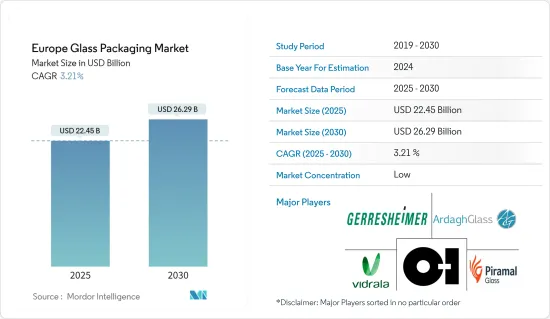
유럽의 유리 포장 시장 규모는 2025년에 224억 5,000만 달러, 2030년에는 262억 9,000만 달러에 달할 것으로 예측되며, 예측 기간(2025-2030년)의 CAGR은 3.21%를 나타낼 것으로 예상됩니다.
주요 하이라이트
- 유럽의 유리 산업은 음식, 화장품, 약국 및 향수 산업을 위한 유리 포장 제품을 제공합니다. 포장 재료로서 유리의 적합성은 시장 성장을 가속하는 중요한 요소입니다. 친환경 포장재를 사용하려는 경향이 강해지고 있는 것도 유리 패키징 시장 성장 촉진요인이 되고 있습니다.
- 안전하고 건강한 포장에 대한 소비자 수요 증가는 다양한 카테고리에서 유리 포장의 성장을 뒷받침하고 있습니다. 유리에 엠보싱, 성형 및 예술적 마무리를 추가하는 혁신적인 기술은 유리 패키징을 최종 사용자들에게 더욱 바람직하게 만듭니다. 또한 환경 친화적 인 제품에 대한 수요 증가 및 식품 및 식품 업계 수요 증가와 같은 요인도 시장 성장을 가속하고 있습니다.
- 이 지역의 지속가능성과 재활용성에 대한 새로운 규칙은 유리 포장의 성장을 뒷받침하는 현저한 요인입니다. 유럽연합의 포장 폐기물 규제(PPWR) 제안에서는 각 EU 회원국은 1인당 포장 폐기물을 2030년까지 5%, 2035년까지 10%, 2040년까지 15% 삭감하는 것이 요구되고 있어 이것이 재생 유리 수요를 더욱 밀어 올리고 있습니다.
- 유리는 와인, 증류주, 맥주와 같은 주요 알코올 음료의 포장 재료로서 계속 사용되고 있습니다. 유리는 식품, 물, 유제품 산업에서 두드러진 점유율을 얻었습니다. 이 배경에는 현지산, 유기, 자연 식품에 대한 새로운 소비 동향, 유리 패키징의 긍정적인 이미지, 환경, 건강, 미각 보존의 관점에서 바람직한 포장재로서 유리에 대한 소비자의 강한 신뢰가 있습니다.
- 이 지역의 유리 패키징 산업이 직면하고 있는 주요 과제 중 하나는 에너지 가격 상승으로 시장의 성장을 방해하고 있습니다. 유리 생산에는 에너지 집약적인 특성이 있기 때문에 제조업체가 이러한 비용 상승을 흡수하기가 어렵습니다. 게다가 러시아와 우크라이나의 분쟁이 계속되고 있기 때문에 영국의 유리 패키징 제조업체에게는 상황이 격화되어 에너지 비용의 상승으로 이어지고 있습니다. 그 결과, 이러한 에너지 가격의 상승이 생산 비용을 끌어 올려 유리 가격의 상승으로 이어지고 있습니다.
- 게다가, 일부 와인 제조업체는 공급 체인의 파쇄와 불활성 퍼니스를 위해 대체품으로 플라스틱으로 전환하고 있습니다. 예를 들어 영국에서는 알코올 음료 제조업체가 유리 패키지에서 종이 병으로 전환하는 움직임이 가속화되었습니다. 최근 대형 소매업체인 알디가 식품용 파우치를 갖춘 94% 재생판지로 만든 병 와인을 출시했습니다.
유럽의 유리 포장 시장 동향
음료 분야가 큰 시장 점유율을 차지
- 유럽의 음료 시장은 강력한 성장을 이루고 큰 시장 점유율을 확보할 전망입니다. 지속가능하고 편리한 음료 패키지에 대한 수요가 증가함에 따라 업계 전문가들은 유럽 음료 시장의 확대를 예측했습니다. 유럽 패키징 생산 및 제조 공정의 지속적인 발전은 업계의 환경 적합성을 향상시키고 있습니다. 패키징 기업은 에너지와 물 소비를 줄이고 이산화탄소 배출량을 줄이는 재활용 재료로 제품을 생산함으로써 지속 가능한 실천에 점점 더 많은 노력을 기울이고 있습니다.
- 매력적인 디자인과 매력적인 색 구성표를 갖춘 혁신적이고 가벼운 제품을 낮은 생산 비용으로 생산하는 것은 성장을 가속하는 중요한 요인이 되고 있습니다. 유명한 음료 제조업체도 유리 포장의 채용을 늘리고 있으며, 이는 유럽에서 음료 부문의 점유율에 박차를 가하고 있습니다. 예를 들어, 2023년 9월, 코카콜라 HBC는 오스트리아의 에델스타르 공장에 고속 리터너블 유리 보틀링 라인(RGB)을 신설했습니다. 코카콜라 HBC에 의한 1,200만 유로(1,299만 달러)의 투자는 포장의 실제 순환 경제를 가능하게 하는 음료 회사 및 소매업체를 위한 기금의 일환으로 오스트리아 정부로부터 400만 유로(433만 달러)의 보조금에 의해 지원되었습니다.
- 수출이 증가함에 따라 와인 등 알코올 음료의 생산이 늘어나고 있는 것이 유리 패키징 수요를 더욱 끌어 올리고 있습니다. 예를 들어, 유럽 위원회에 따르면 EU의 와인 생산량은 2022년 1억 5,290만 헥타르에서 2023년에는 1억 5,900만 헥토리터에 이릅니다. 유엔 무역위원회(UN Comtrade)에 따르면, 2023년 유럽의 와인 최대 수출국은 프랑스와 이탈리아에서 각각 127억 8,940만 달러와 84억 320만 달러였습니다.
- 심각화되는 플라스틱 오염에 대응하기 위해, 이 지역의 음료 제조업체는 음료 제품 수요가 급속히 성장하고 있기 때문에 리필 가능한 유리병으로의 전환을 진행하고 있습니다. 예를 들어, 코카콜라는 2023년 8월 플라스틱 오염 감소에 대한 헌신을 완수하기 위해 고객에게 코크 제로 유리병을 직접 배송, 회수 및 재사용하는 새로운 시스템을 시작했습니다. 이 음료는 택배 서비스 우유 및 모어와 제휴하여 영국 가정에 배부됩니다. 이 시도는 2023년 6월 5일에 시작되어 런던 남부와 잉글랜드 남부 중심부에서 여름 동안 계속될 예정이었습니다.
상당한 시장 성장이 기대되는 폴란드
- 폴란드는 예측 기간 동안 동유럽에서 가장 두드러진 포장 성장을 이룰 것으로 예상됩니다. 유리병의 개발은 병 식수, 주스, 에너지 음료, 프리미엄 음료에 의해 촉진될 것으로 예상됩니다.
- 폴란드의 유리 포장 시장에서 M&A의 동향은 경쟁력과 시장 점유율을 강화하기 위해 기업 간의 통합 경향을 보여줍니다. 이러한 통합은 효율성 향상, 혁신, 잠재적인 가격 역학으로 이어져 폴란드의 유리 포장 시장 상황을 형성할 것으로 보입니다. 예를 들어, 2024년 4월, 캠팩 그룹과 BA Glass는 캠퍼스 폴란드의 유리 사업을 BA Glass에 매각한다고 발표했습니다. 그 결과, 오르제제의 유리 공장은 BA Glass에 양도되어 폴란드에서의 사업의 일부가 되었습니다.
- 폴란드의 유리 산업은 제조 능력을 다양화하고 있습니다. 폴란드의 유리 산업에서는 용기용 유리 제조에 대량의 유리 모래가 사용됩니다. 이러한 제도로의 전환을 시작하기 위해, 폴란드 정부는 2022년에 유리병과 플라스틱병의 보증금 의무화 도입 준비를 시작했습니다. 보증금 제도에는 최대 1.5리터의 재사용 가능한 유리병도 포함됩니다. 폴란드는 유리병이 주요 포장재료이며 다른 유형의 포장재료가 차지하는 비율이 적은 음료산업에서 강력한 성과를 유지할 것으로 예상됩니다.
- 이 업계에서 사업을 전개하는 기업은 국내 사업 확대를 통해 새로운 솔루션 혁신에 주력하고 있습니다. 예를 들어, 2023년 1월 Ardagh Glass Packaging은 폴란드에서 지속 가능한 유리로를 설계했습니다. 이 새로운 퍼니스는 가스, 전기 및 물 사용량을 여러 가지 지속 가능한 방법으로 최소화하는 반면 낮은 배출 수준을 획득하고 유지할 수 있습니다. 이 회사에 따르면 가스, 전기 및 물의 사용은 열 회수, 터보 압축기, 물 회수 및 폐쇄 루프 냉각 절차에 의해 최소화됩니다. 이 유리 제조업체는 배출량을 줄이고 환경에 미치는 영향을 높이는 것이 유리 산업에 매우 중요한 목표라고 말합니다. 대기업의 이러한 혁신은 예측 기간 동안 시장 성장을 가속할 것으로 예상됩니다.
- 또한 일본에서는 유리 패키징을 사용하는 음료 및 기타 제품의 수출이 크게 증가하고 있습니다. 예를 들어 UN Comtrade에 따르면 2023년 폴란드 음료, 증류주, 식초 수출액은 거의 평평한 약 16억 유로입니다. 이러한 수출 증가로 인해 폴란드에서는 유리 포장 제품에 대한 수요가 더욱 높아질 것으로 예상됩니다.
유럽의 유리 포장 산업 개요
유럽의 유리 포장 시장은 경쟁이 치열하고 많은 지역 기업들이 큰 점유율을 차지하고 있습니다. 이 회사들은 시장 점유율과 수익성을 높이기 위해 전략적 이니셔티브를 활용합니다.
- 2024년 7월, 유명한 음식 및 음료용 유리 패키징 제조업체인 벨라리아는 이탈리아 비들라라의 유리 사업을 인수했습니다. 기업 가치 2억 3,000만 유로(2억 4,890만 달러)의 이 거래에는 코르시코에 본사를 둔 공장이 포함되었습니다. 이 공장은 최근 개조 된 2개의 퍼니스를 갖추고 있으며 연간 생산 능력 225 킬로톤의 현대 생산 능력을 특징으로합니다. 식품, 맥주, 증류주 시장에서 적극적으로 사업을 전개하고 있습니다.
- 2024년 5월, 게레스하이머 AG의 간접 자회사인 게레스하이머 글래스는 보르미올리 파마 그룹의 지주회사인 브리츠 룩스코 사르을 인수하는 계약을 체결했습니다. 이 인수로 겔레스하이머는 남유럽을 중심으로 한 유럽에서의 생산 거점이 증가하여 유럽에서의 사업 기반이 강화되었습니다. 또한 제약 및 바이오테크놀러지 업계를 선도하는 풀 서비스 제공업체 및 세계 파트너로서 시장 지위도 강화됩니다.
- 2023년 9월 OI는 고급 엠보싱 커스터마이징 패키징을 제공하기 시작했습니다. OI: Expressions Signature'를 통해 OI는 가변 데이터 인쇄를 사용하여 장식용 유리병을 제조하는 최초의 유리 제조업체가 되었습니다.
기타 혜택 :
- 엑셀 형식 시장 예측(ME) 시트
- 3개월간의 애널리스트 및 지원
목차
제1장 서론
- 조사의 전제조건과 시장 정의
- 조사 범위
제2장 조사 방법
제3장 주요 요약
제4장 시장 인사이트
- 시장 개요
- 산업 밸류체인 분석
- 업계의 매력도 - Porter's Five Forces 분석
- 구매자의 협상력
- 공급기업의 협상력
- 신규 참가업체의 위협
- 대체품의 위협
- 경쟁 기업간 경쟁 관계의 강도
- 마이크로 경제 요인이 시장에 미치는 영향 평가
제5장 시장 역학
- 시장 성장 촉진요인
- 엄격한 규제에 의한 지속 가능한 포장으로의 급속한 변화
- 음료나 화장품 등의 최종 사용자 산업에 있어서의 프리미엄 유리 패키징의 채용 확대
- 시장의 과제
- 시장 성장의 과제가 되는 대체 포장 형태
제6장 시장 세분화
- 제품 유형별
- 병
- 앰풀
- 바이알
- 주사기
- 항아리
- 최종 사용자 산업별
- 음료
- 주류
- 맥주
- 청량음료
- 기타 음료
- 식품
- 화장품
- 의약품
- 음료
- 국가별
- 영국
- 독일
- 프랑스
- 이탈리아
- 스페인
- 폴란드
- 네덜란드
- 기타 유럽
제7장 경쟁 구도
- 기업 프로파일
- Owens-Illinois Inc.
- Origin Pharma Packaging
- Verallia
- Vidrala SA
- Vetropack Holding Ltd
- Vitro SAB de CV
- APG Europe
- Saverglass Group
- Wiegand-Glass GmBH
- Crestani SRL
- Verescene France SASU
- Stolzle Glass Group
- Ardagh Packaging Group PLC
- SGD Pharma SA
- Beatson Clark PLC
- Stevanato Group
- Gerresheimer AG
- BA Vidro SA(BA Glass BV)
- Glassworks International Limited
- Gaasch Packaging(UK) Ltd
제8장 투자 분석
제9장 시장의 미래
SHW 25.04.01The Europe Glass Packaging Market size is estimated at USD 22.45 billion in 2025, and is expected to reach USD 26.29 billion by 2030, at a CAGR of 3.21% during the forecast period (2025-2030).
Key Highlights
- The European glass industry offers glass packaging products for the food and beverage, cosmetics, pharmacy, and perfumery industries. The compatibility of glass as a packaging material is a significant factor propelling the market's growth. The growing inclination toward using environment-friendly packaging material is another driver for the glass packaging market.
- Increasing consumer demand for safe and healthier packaging is helping glass packaging grow in different categories. Innovative technologies for embossing, shaping, and adding artistic finishes to glass make glass packaging more desirable among end users. Furthermore, factors such as the increasing demand for eco-friendly products and the rising demand from the food and beverage industry are stimulating the market's growth.
- The new rules for sustainability and recyclability in the region are also prominent factors pushing the growth of glass packaging. The European Union's Packaging and Packaging Waste Regulation (PPWR) proposals outline that each EU Member State could be required to reduce its packaging waste per capita by as much as 5% by 2030, 10% by 2035, and 15% by 2040, which is further driving the demand for recycled glass.
- Glass continues to be the reference packaging material for leading alcoholic beverages such as wines, spirits, and beer. It is gaining a prominent share in the food, water, and dairy industries. This is due to new consumption trends for local, organic, and natural food, the positive image of glass packaging, and strong consumer trust in glass as the preferred packaging for environmental, health, and taste preservation reasons.
- One of the primary challenges facing the glass packaging industry in the region is the surge in energy prices, which is hindering market growth. The energy-intensive nature of glass production makes it difficult for manufacturers to absorb these rising costs. Additionally, the ongoing conflict between Russia and Ukraine has intensified the situation for glass packaging producers in the United Kingdom, leading to soaring energy expenses. As a result, these escalating energy prices have driven up production costs, thereby increasing the price of glass.
- Furthermore, several wine manufacturers have switched to plastic as an alternative due to disrupted supply chains and inactive furnaces. For instance, the trend of alcoholic beverage companies in the United Kingdom replacing glass packaging with bottles made of paper has picked up pace. Recently, Aldi, a leading retailer, recently introduced wine in bottles made from 94% recycled paperboard, featuring a food-grade pouch.
Europe Glass Packaging Market Trends
Beverages Segment to Hold a Significant Market Share
- The European beverages market is poised for robust growth and is expected to secure a significant market share. As demand for sustainable and convenient beverage packaging increases, industry experts anticipate an expansion in the European beverages market. Continuous advancements in Europe's packaging production and manufacturing processes are enhancing the industry's environmental friendliness. Packaging companies are increasingly focusing on sustainable practices by producing products from recycled materials, which consume less energy and water while reducing carbon emissions.
- Creating innovative, lightweight products with appealing designs and appealing color schemes at lower production costs has continued to be a key growth facilitator. Prominent beverage companies are also raising the adoption of glass packaging, which adds to the beverage segment's share in Europe. For instance, in September 2023, Coca-Cola HBC established a new, high-speed returnable glass bottling line (RGB) at the Edelstal plant in Austria. An investment of EUR 12 million (USD 12.99 million) from Coca-Cola HBC was supported by a grant of EUR 4 million (USD 4.33 million) from the Austrian government as part of its fund for beverage companies and retailers to enable an actual circular economy for packaging.
- The growth in the production of alcoholic beverages, such as wine, along with a rise in exports, is further boosting demand for glass packaging. For instance, according to the European Commission, wine production in the European Union reached 159 million hectoliters in 2023 from 152.9 million hectoliters in 2022. As per the UN Comtrade, France and Italy were the largest exporters of wine in Europe in 2023, with values of USD 12,789.4 million and USD 8,403.2 million, respectively.
- In response to the escalating plastic pollution, beverage manufacturers in the region are increasingly transitioning to refillable glass bottles due to the rapidly growing demand for beverage products. For instance, in August 2023, to fulfill its commitment to reducing plastic pollution, Coca-Cola launched a new system for delivering, collecting, and reusing glass bottles of Coke Zero directly with customers. The beverage is being distributed to homes in the United Kingdom in partnership with delivery service Milk & More. The trial began on June 5, 2023, and was to continue throughout the summer in south London and central southern England.
Poland Expected to Witness Significant Market Growth
- Poland is anticipated to experience the most significant growth in packaging in Eastern Europe during the forecast period. The development of glass bottles is expected to be fueled by bottled water, juice, energy drinks, and premium beverages.
- The rising mergers and acquisitions in the Polish glass packaging market indicate a consolidation trend among companies to enhance competitiveness and market share. This consolidation is likely to lead to increased efficiency, innovation, and potential pricing dynamics, shaping the landscape of the Polish glass packaging market. For instance, in April 2024, CANPACK Group and BA Glass announced the finalization of the sale of CANPACK's Glass operations in Poland to BA Glass. Consequently, the glass plant in Orzesze was transferred to BA Glass and became part of its operations in Poland.
- The Polish glass industry has diversified its manufacturing capabilities. In the Polish glass industry, significant amounts of glass sand are used to produce container glass. To initiate the country's transition to such a system, the Polish government began preparing the introduction of a mandatory deposit for glass and plastic bottles in 2022. The deposit system included reusable glass bottles of up to 1.5 liters. Poland is expected to remain a strong performer in the beverages industry, where glass bottles may be the primary packaging material, with a small share held by other packaging types.
- Companies operating in the industry are focused on innovating new solutions through expansions in the country. For instance, in January 2023, Ardagh Glass Packaging designed a sustainable glass furnace in Poland. The new furnace can gain and maintain lower emission levels while gas, electricity, and water usage will be minimized via multiple sustainable methods. According to the firm, gas, electricity, and water usage will be minimized via heat recovery, turbo compressors, water recovery, and a closed-loop cooling procedure. The glass manufacturer stated that reducing emissions and enhancing the effect on the environment is a crucial goal for the glass industry. Such technological innovations by major companies are expected to fuel market growth during the forecast period.
- Moreover, the country has witnessed significant growth in the export of beverages and other products that use glass packaging. For instance, according to UN Comtrade, in 2023, the value generated from the export of beverages, spirits, and vinegar in Poland remained nearly unchanged at around EUR 1.6 billion. This growth in exports is anticipated to further create demand for glass packaging products in Poland.
Europe Glass Packaging Industry Overview
The European glass packaging market is highly competitive, with many regional players holding significant shares in the market. These companies are leveraging strategic initiatives to increase market share and profitability.
- In July 2024, Verallia, a prominent producer of glass packaging for food and beverage products, acquired Vidrala's glass business in Italy. The transaction, valued at an enterprise value of EUR 230 million (USD 248.9 million), included a Corsico-based plant. This facility, equipped with two recently renovated furnaces, features modern production capabilities with an annual capacity of 225 kilotons. It actively operates in the food, beer, and spirits markets.
- In May 2024, Gerresheimer Glas, an indirect subsidiary of Gerresheimer AG, signed an agreement to acquire Blitz LuxCo Sarl, the holding company of Bormioli Pharma Group. This acquisition enhances Gerresheimer's European footprint with additional production sites, particularly in Southern Europe. It also strengthens its market position as a leading full-service provider and global partner for the pharmaceutical and biotech industries.
- In September 2023, O-I launched an advanced, embossed, customized packaging offering. With its O-I: Expressions Signature, O-I became the first glass manufacturer to produce decorated glass bottles using variable data printing.
Additional Benefits:
- The market estimate (ME) sheet in Excel format
- 3 months of analyst support
TABLE OF CONTENTS
1 INTRODUCTION
- 1.1 Study Assumptions and Market Definition
- 1.2 Scope of the Study
2 RESEARCH METHODOLOGY
3 EXECUTIVE SUMMARY
4 MARKET INSIGHTS
- 4.1 Market Overview
- 4.2 Industry Value Chain Analysis
- 4.3 Industry Attractiveness - Porter's Five Forces Analysis
- 4.3.1 Bargaining Power of Buyers
- 4.3.2 Bargaining Power of Suppliers
- 4.3.3 Threat of New Entrants
- 4.3.4 Threat of Substitute Products
- 4.3.5 Intensity of Competitive Rivalry
- 4.4 Assessment of the Impact of Microeconomic Factors on the Market
5 MARKET DYNAMICS
- 5.1 Market Drivers
- 5.1.1 Rapid Shift Toward Sustainable Packaging Due to Stringent Regulations
- 5.1.2 Growing Adoption of Premium Glass Packaging in End-user Industries, such as Beverages and Cosmetics
- 5.2 Market Challenge
- 5.2.1 Alternative Forms of Packaging Challenging the Market's Growth
6 MARKET SEGMENTATION
- 6.1 By Product Type
- 6.1.1 Bottles
- 6.1.2 Ampoules
- 6.1.3 Vials
- 6.1.4 Syringes
- 6.1.5 Jars
- 6.2 By End-user Industry
- 6.2.1 Beverage
- 6.2.1.1 Liquor
- 6.2.1.2 Beer
- 6.2.1.3 Soft Drinks
- 6.2.1.4 Other Beverages
- 6.2.2 Food
- 6.2.3 Cosmetics
- 6.2.4 Pharmaceuticals
- 6.2.1 Beverage
- 6.3 By Country
- 6.3.1 United Kingdom
- 6.3.2 Germany
- 6.3.3 France
- 6.3.4 Italy
- 6.3.5 Spain
- 6.3.6 Poland
- 6.3.7 Netherlands
- 6.3.8 Rest of Europe
7 COMPETITIVE LANDSCAPE
- 7.1 Company Profiles
- 7.1.1 Owens-Illinois Inc.
- 7.1.2 Origin Pharma Packaging
- 7.1.3 Verallia
- 7.1.4 Vidrala SA
- 7.1.5 Vetropack Holding Ltd
- 7.1.6 Vitro SAB de CV
- 7.1.7 APG Europe
- 7.1.8 Saverglass Group
- 7.1.9 Wiegand-Glass GmBH
- 7.1.10 Crestani SRL
- 7.1.11 Verescene France SASU
- 7.1.12 Stolzle Glass Group
- 7.1.13 Ardagh Packaging Group PLC
- 7.1.14 SGD Pharma SA
- 7.1.15 Beatson Clark PLC
- 7.1.16 Stevanato Group
- 7.1.17 Gerresheimer AG
- 7.1.18 BA Vidro SA (BA Glass BV)
- 7.1.19 Glassworks International Limited
- 7.1.20 Gaasch Packaging (UK) Ltd
8 INVESTMENT ANALYSIS
9 FUTURE OF THE MARKET








샘플 요청 목록