|
시장보고서
상품코드
1687722
중국의 바이오 비료 : 시장 점유율 분석, 산업 동향, 통계, 성장 예측(2025-2030년)China Biofertilizer - Market Share Analysis, Industry Trends & Statistics, Growth Forecasts (2025 - 2030) |
||||||
 Mordor Intelligence
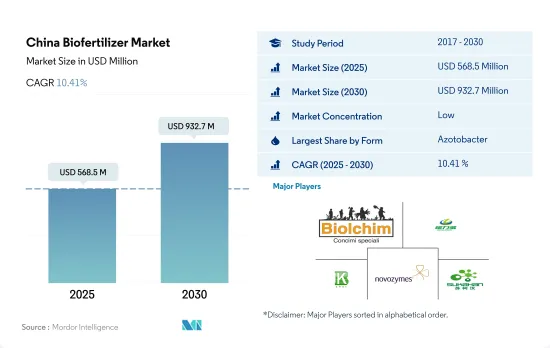
중국의 바이오비료 시장 규모는 2025년에 5억 6,850만 달러, 2030년에는 9억 3,270만 달러에 이를 것으로 예측되며, 예측기간(2025-2030년)의 CAGR은 10.41%를 나타낼 전망입니다.

- 바이오 비료는 살아있는 미생물로 토양의 영양분을 동원하거나 이용성을 높여 식물의 영양 상태를 개선합니다. 바이오 비료는 대기 중의 질소를 고정하고, 고정된 대영양소와 미량 영양소를 동원하거나, 토양 중의 불용성 인을 식물이 이용 가능한 형태로 변환함으로써 장기적인 토양 비옥도와 지속가능성에 중요한 역할을 하는 유기농업의 필수 요소입니다.
- 중국의 바이오비료 시장에서는 아조토박터가 가장 소비되고 있는 바이오비료이며, 2022년 시장 규모는 1억 3,710만 달러로 31.3%의 점유율로 시장을 독점하고, 균근균, 아조스피리람, 리조븀, 인산 가용화 세균이 각각 22%, 22.0%, 11.6%, 11.2%의 점유율로 그 뒤를 이었습니다.
- 2021년 시점에서 중국은 "18년 연속 곡물 풍작"을 달성했습니다. 그러나 이러한 성취는 만성 농업 비료의 과도한 사용과 같은 문제에 의해 달성되었습니다. 중국은 국제적으로 인정되는 단위 면적당 농업 비료의 상한을 초과합니다. 세계의 주요 농업 생산국으로서 중국은 2015년 2020년까지 '비료 증가율 제로, 비료 사용량 삭감 제로'를 달성하기 위한 비료 삭감 및 효율화 이니셔티브를 제안했습니다. 중국은 2015년부터 2020년까지 12.8%의 비료 삭감을 달성했습니다. 이 이니셔티브는 2017년부터 2022년 사이 중국 농업 부문의 바이오 비료 소비량을 7.0% 증가시켰습니다.
- 중국에서는 유기농 식품 수요가 계속 증가하고 있기 때문에 유기농업도 증가하고 있습니다. 2017년부터 2022년까지 유기 재배 면적의 29.6%가 증가했습니다. 유기 재배 면적 증가와 정부의 대처에 의해 2023년부터 2029년 사이에 중국의 바이오 비료 시장의 가치는 78.8% 증가할 것으로 예상됩니다.
중국 바이오 비료 시장 동향
농약의 사용량이 제로가 되어, 유기 제품의 수출이 증가하고, 유기 재배가 촉진되고 있습니다.
- FiBL과 IFOAM의 최신 보고서에 따르면 중국의 유기농 식품 시장은 연간 25.0%로 성장하고 있습니다. 관행농법에서 유기농법으로의 전환은 중국에서 매년 29억 1,000만 달러의 농산식품이 수출되고 있다는 점을 감안하면 중국 내에서 보다 지속가능한 식량시스템으로의 변화입니다.
- 중국에서 유기농지의 면적이 급증한 이유는 소득 증가와 식품안전의 중요성이 높아짐에 따라 더 많은 사람들이 유기농 제품을 구매하게 되었기 때문입니다. 지난 3년간 중국의 유기 재배 면적은 10% 증가하여 2020년에는 240만 ha에 이릅니다. 게다가 유기생산을 촉진하기 위한 국가정책이 채택되어 '깨끗한 물과 무성한 산은 바꿀 수 없는 자산이다', '녹색개발'이라는 슬로건이 제창되었습니다.
- 중국의 유기농업은 주로 수출지향입니다. 수출 품목도 수입 품목도 곡물, 콩, 과일, 야채 등입니다. 중국의 동북3성(요녕성, 길림성, 흑룡강성)은 생산고, 생산량, 면적면에서 전국 최대의 유기생산을 지지하고 있습니다. 중국 북부(산동성 및 랴오닝성 등)에 있는 유기농원의 대부분은 유기농 야채와 과일을 인근 도시에 공급하고 있습니다. 또한 일본, 한국, 유럽, 미국에 수출하는 제품도 있습니다.
- 토양 오염으로 이어지는 합성 비료와 농약의 과도한 사용으로 인한 토양 독성에 대한 우려가 커짐에 따라 중국에서는 지속 가능한 농업 관행과 유기농 식품 생산에 대한 수요가 증가하고 있습니다. 이러한 재배 방법의 변화는 완만하지만 증가 추세에 있으며, 농작물의 영양 보호 제품에 대한 수요도 증가하고 있습니다.
유기농 제품에 대한 수요가 증가함에 따라 중국 소비자의 약 73%가 유기농 식품을 원합니다.
- 중국의 유기 식품 시장은 급속히 개척되고 있으며, 중국 소비자의 유기 식품에 대한 잠재 수요는 막대합니다. 그 배경에는 보다 부유한 중간층 증가와 건강에 미치는 영향에 대한 의식이 높아집니다. 2021년 중국의 유기농 식품 매출은 약 775억 4,000만 달러에 달했습니다.
- 식품의 안전성보다 유기농 식품을 우대하는 정부의 다양한 법률과 기존 식품보다 유기농 식품을 선호하는 고객의 기호에 따라 유기농 식품 수요가 상당히 확대되고 있습니다. 중국의 유기농 야채 가격은 관행 농산물의 3배에서 15배인 반면, 유기 야채 가격은 일반적으로 관행 농산물의 5배에서 10배입니다. 그러나 가격 요인이 장벽이 되더라도 부유한 가정과 건강에 문제가 있는 개인은 예산을 늘리고 싶어하고 중국 소비자의 약 73%가 유기농 식품에 추가 요금을 지불하기를 원합니다.
- 중국 정부는 유기농 식품 분야에서 자립을 서서히 목표로 하고 있습니다. 예를 들어, 농민들이 화학 비료의 사용을 줄이고 바이오 대체품으로 전환하도록 장려함으로써 경제는 점차 녹색 농업으로 향하고 있습니다. 2020년에 열린 중국 체인 스토어 프랜차이즈 협회(CCFA)의 조사에서는 지속 가능한 식품 생산 개념을 이해하는 선진 도시의 중국인의 유기 의식이 83%에 달한다고 발표되었습니다. 중국의 유기식품부문은 아직 꽤 작아 국내외 소비자 수요를 충족하기에는 멀지 않은 것으로 2021년 국내 매출이 4.01% 증가한다는 점을 감안하면 중국의 유기식품은 국내 시장에서도 해외 시장에서도 거대한 가능성을 갖고 있다고 할 수 있습니다.
중국 바이오 비료 산업 개요
중국의 바이오비료 시장은 세분화되어 상위 5개사에서 3.08%를 차지하고 있습니다. 이 시장 주요 기업은 다음과 같습니다. Biolchim SpA, Genliduo Bio-tech Corporation Ltd, Kiwa Bio-Tech, Novozymes and Shandong Sukahan Bio-Technology(sorted alphabetically).
기타 혜택
- 엑셀 형식 시장 예측(ME) 시트
- 3개월의 애널리스트 서포트
목차
제1장 주요 요약과 주요 조사 결과
제2장 보고서 제안
제3장 소개
- 조사의 전제조건과 시장 정의
- 조사 범위
- 조사 방법
제4장 주요 산업 동향
- 유기 재배 면적
- 1인당 유기농 제품에 대한 지출
- 규제 프레임워크
- 중국
- 밸류체인과 유통채널 분석
제5장 시장 세분화
- 형태
- 아조스피리람
- 아조토박터
- 균근균
- 인산 가용균
- 근립균
- 기타 바이오 비료
- 작물 유형
- 환금작물
- 원예작물
- 밭작물
제6장 경쟁 구도
- 주요 전략적 움직임
- 시장 점유율 분석
- 기업 상황
- 기업 프로파일.
- Atlantica Agricola
- Binzhou Jingyang Biological Fertilizer Co. Ltd
- Biolchim SpA
- Dora Agri-Tech
- Genliduo Bio-tech Corporation Ltd
- Kiwa Bio-Tech
- Novozymes
- Shandong Sukahan Bio-Technology Co. Ltd
- Sustane Natural Fertilizer Inc.
- Symborg Inc.
제7장 CEO에 대한 주요 전략적 질문
제8장 부록
- 세계 개요
- 개요
- Five Forces 분석 프레임워크
- 세계의 밸류체인 분석
- 시장 역학(DROs)
- 정보원과 참고문헌
- 도표 일람
- 주요 인사이트
- 데이터 팩
- 용어집
The China Biofertilizer Market size is estimated at 568.5 million USD in 2025, and is expected to reach 932.7 million USD by 2030, growing at a CAGR of 10.41% during the forecast period (2025-2030).
- Biofertilizers are living microorganisms that improve plant nutrition by mobilizing or increasing nutrient availability in soils. Biofertilizers are essential components of organic farming that play an important role in long-term soil fertility and sustainability by fixing atmospheric nitrogen, mobilizing fixed macro and micronutrients, or converting insoluble phosphorous in the soil into forms available to plants.
- In the Chinese biofertilizer market, Azotobacter is the most consumed biofertilizer, dominating the market with a share of 31.3%, valued at USD 137.1 million, followed by Mycorrhiza, Azospirillum, Rhizobium, and phosphate-solubilizing bacteria with shares of 22%, 22.0%, 11.6%, and 11.2%, respectively, in 2022.
- As of 2021, China achieved its "eighteenth consecutive bumper grain harvest." However, this achievement was accomplished by problems such as the chronic overuse of agricultural fertilizers. China exceeds the internationally accepted upper limit of agricultural fertilizer per unit area. As a major global agricultural producer, China proposed a fertilizer reduction and efficiency initiative in 2015 to achieve "zero fertilizer growth rate and zero fertilizer use reduction" by 2020. China achieved a fertilizer reduction of 12.8% from 2015 to 2020. This initiative increased the consumption value of biofertilizers in the Chinese agricultural sector by 7.0% during 2017-2022.
- Organic farming is also increasing in China as the demand for organic food continues to rise. From 2017 to 2022, 29.6% of organic acreage increased. Increasing organic acreage and government initiatives are expected to boost the value of the Chinese biofertilizers market by 78.8% between 2023 and 2029.
China Biofertilizer Market Trends
Country's zero growth in pesticides use and increasing exports under organic products driving the organic cultivation.
- According to the latest reports by FiBL and the IFOAM, the market for organic food in China is growing at an annual rate of 25.0%. The shift from conventional to organic is a transformation toward a more sustainable food system within China, given the USD 2.91 billion of agri-food commodities exported from China each year.
- The size of organic farmland increased rapidly in China because more people started buying organic products due to increased incomes and the increasing importance of food safety. In the last three years, China's organic planting area increased by 10%, reaching 2.4 million ha in 2020. In addition, national policies have been adopted to promote organic production, advocating the slogans that state, "lucid waters and lush mountains are invaluable assets" and "green development".
- Organic farming in China is majorly export-oriented. The products that are both exported and imported include cereals, soybeans, fruits, and vegetables. China's three northeastern provinces (Liaoning, Jilin, and Heilongjiang) support the largest organic production nationally in terms of output, volume, and area. Most organic farms located in the northern part of China (e.g., Shandong and Liaoning) supply organic vegetables and fruits to nearby cities. In addition, they export some products to Japan, South Korea, Europe, and the United States.
- With the increasing concerns of soil toxicity due to the overuse of synthetic fertilizers and pesticides that lead to soil contamination, the demand for sustainable agriculture practices and organic food production is on the rise in China. This moderately slow yet increasing shift in cultivation practices has also subsequently increased the demand for crop nutrition and protection products.
The growing demand for organic products, approximately 73% of Chinese consumers are willing to have organic food
- China's organic food market is developing rapidly, and the potential demand for organic food among Chinese consumers is enormous. This is due to the growth of the wealthier middle classes and a greater awareness of the health implications. In 2021, organic food sales in China amounted to about USD 77.54 billion.
- Due to various government laws that favor organic food over food safety and customer preferences for organic food over conventional food, the demand for organic food items has considerably expanded. While prices of organic vegetables in China range from 3 to 15 times the cost of conventional produce, prices for organic vegetables are generally between 5 and 10 times that of their conventional counterparts. However, despite the price factor being a barrier, wealthy families and individuals with health problems are eager to increase their budget, with approximately 73% of Chinese consumers willing to pay extra for organic foods.
- The Chinese government is slowly aiming to become self-reliant in the organic food sector. For instance, the economy is slowly moving toward a green agriculture practice by encouraging farmers to scale back the use of chemical fertilizers and switch to bio-based alternatives. The China Chain Store and Franchise Association (CCFA) research in 2020 declared that organic awareness among the Chinese population in developed cities was at 83% when it came to an understanding of the concept of sustainable food production. Although China's organic food sector is still quite small and falls far short of satisfying domestic and international consumer demand, it can be stated that organic food in China has enormous potential in both the domestic and foreign markets, considering the rise in domestic sales by 4.01% in 2021.
China Biofertilizer Industry Overview
The China Biofertilizer Market is fragmented, with the top five companies occupying 3.08%. The major players in this market are Biolchim SpA, Genliduo Bio-tech Corporation Ltd, Kiwa Bio-Tech, Novozymes and Shandong Sukahan Bio-Technology Co. Ltd (sorted alphabetically).
Additional Benefits:
- The market estimate (ME) sheet in Excel format
- 3 months of analyst support
TABLE OF CONTENTS
1 EXECUTIVE SUMMARY & KEY FINDINGS
2 REPORT OFFERS
3 INTRODUCTION
- 3.1 Study Assumptions & Market Definition
- 3.2 Scope of the Study
- 3.3 Research Methodology
4 KEY INDUSTRY TRENDS
- 4.1 Area Under Organic Cultivation
- 4.2 Per Capita Spending On Organic Products
- 4.3 Regulatory Framework
- 4.3.1 China
- 4.4 Value Chain & Distribution Channel Analysis
5 MARKET SEGMENTATION (includes market size in Value in USD and Volume, Forecasts up to 2030 and analysis of growth prospects)
- 5.1 Form
- 5.1.1 Azospirillum
- 5.1.2 Azotobacter
- 5.1.3 Mycorrhiza
- 5.1.4 Phosphate Solubilizing Bacteria
- 5.1.5 Rhizobium
- 5.1.6 Other Biofertilizers
- 5.2 Crop Type
- 5.2.1 Cash Crops
- 5.2.2 Horticultural Crops
- 5.2.3 Row Crops
6 COMPETITIVE LANDSCAPE
- 6.1 Key Strategic Moves
- 6.2 Market Share Analysis
- 6.3 Company Landscape
- 6.4 Company Profiles (includes Global Level Overview, Market Level Overview, Core Business Segments, Financials, Headcount, Key Information, Market Rank, Market Share, Products and Services, and Analysis of Recent Developments).
- 6.4.1 Atlantica Agricola
- 6.4.2 Binzhou Jingyang Biological Fertilizer Co. Ltd
- 6.4.3 Biolchim SpA
- 6.4.4 Dora Agri-Tech
- 6.4.5 Genliduo Bio-tech Corporation Ltd
- 6.4.6 Kiwa Bio-Tech
- 6.4.7 Novozymes
- 6.4.8 Shandong Sukahan Bio-Technology Co. Ltd
- 6.4.9 Sustane Natural Fertilizer Inc.
- 6.4.10 Symborg Inc.
7 KEY STRATEGIC QUESTIONS FOR AGRICULTURAL BIOLOGICALS CEOS
8 APPENDIX
- 8.1 Global Overview
- 8.1.1 Overview
- 8.1.2 Porter's Five Forces Framework
- 8.1.3 Global Value Chain Analysis
- 8.1.4 Market Dynamics (DROs)
- 8.2 Sources & References
- 8.3 List of Tables & Figures
- 8.4 Primary Insights
- 8.5 Data Pack
- 8.6 Glossary of Terms