
|
시장보고서
상품코드
1910886
유럽의 건설기계 렌탈 시장 : 점유율 분석, 업계 동향, 통계, 성장 예측(2026-2031년)Europe Construction Machinery Rental - Market Share Analysis, Industry Trends & Statistics, Growth Forecasts (2026 - 2031) |
||||||
 Mordor Intelligence
유럽의 건설기계 렌탈 시장은 2025년 351억 5,000만 달러에서 2026년에는 366억 4,000만 달러로 성장해 2026년부터 2031년에 걸쳐 CAGR 4.25%를 나타낼 전망입니다. 2031년까지 451억 1,000만 달러에 달할 것으로 예상됩니다.
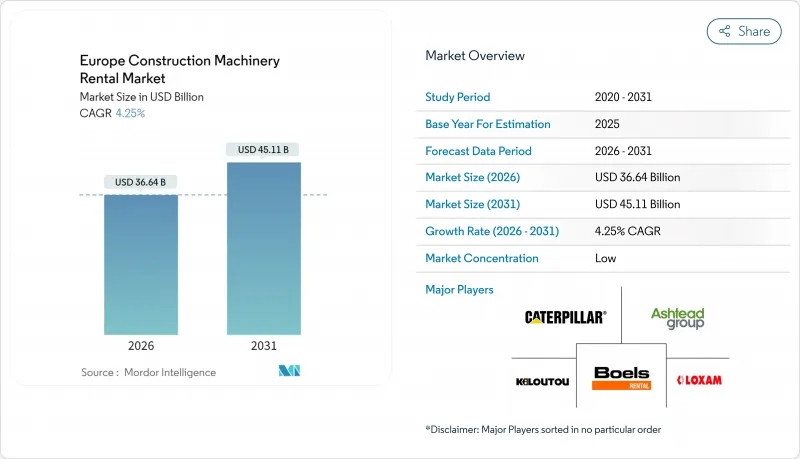
이러한 꾸준한 성장은 대여기계에 대한 견조한 수요, 서비스로서의 장비(EaaS) 계약 확대 및 배출가스 규제와 관련된 지역 전체의 함대 갱신을 반영합니다. 유럽의 건설기계 렌탈 시장은 EU 지원 인프라 자극 전략, 급속한 전기화 의무화, 지속 가능한 함대 자본 비용을 줄이는 ESG 연동 대출의 혜택을 받고 있습니다. 사업자는 텔레매틱스를 활용한 가동률 향상을 우선하는 한편, 정부는 그린 수송 회랑이나 디지털 접속 프로젝트에 의해 수요를 강화하고 있습니다. OEM 제조업체가 직접 렌탈 부문을 설립해 전통적인 렌탈 대기업이 유럽 전역에서의 인수를 가속화하고 디지털 마켓플레이스가 계약자의 검색·거래 비용을 삭감하는 가운데 경쟁 격화가 진행되고 있습니다.
유럽의 건설기계 렌탈 시장 동향 및 인사이트
급증하는 EU 인프라 자극책(2025년 이후)
유럽투자은행은 2030년까지 기후 변화 대책에 합치한 인프라 정비에 1조 1,000억 유로를 충당할 방침을 굳히고 있어 수송·디지털 회랑에 있어서 프로젝트 착공에 수반해, 굴삭기, 포장기, 타워크레인의 렌탈 수요가 지속적으로 증가하고 있습니다. 독일은 인프라와 디지털 능력의 현대화를 대담하게 추진 중입니다. 향후 수년간 교통망의 업그레이드와 디지털 변혁의 가속을 향해, 다액의 투자가 확보되고 있어, 특수한 토목 차량에 대한 수요가 태어나고 있습니다. 과거의 사이클과 달리, 현재의 예산 배분에서는 재생에너지와 광섬유 전개가 중시되고 있으며, 렌탈 회사는 케이블 쟁기나 풍력 터빈 설치용 크레인 등 틈새 기계의 확보를 강요하고 있습니다. 공급 핍박으로 인해 가동률이 상승하고 단기적인 가격이 상승하고 있습니다. 경기 자극책에 의한 파급 효과는 교통 거점 주변의 민간 주택이나 상업시설 건설에도 퍼지고 있습니다.
가속 차량 전동화의 의무화
유럽 위원회의 'Fit for 55' 패키지는 2030년까지 배출량을 55% 삭감하는 것이 요구되고 있으며, 렌탈 기업은 디젤에서 배터리·수소 구동 시스템으로의 전환을 강요받고 있습니다. JCB의 수소 엔진 프로그램(현재 11개국에서 시험 운용 중)은 OEM 대응책의 예입니다. 스웨덴과 노르웨이의 선행 도입 기업은 보조금을 이용하여 높은 구매 가격을 회수하고, 제로 에미션 존에의 진입을 목표로 하는 계약자에게 할증 요금을 전가하고 있습니다. 이 의무화는 충전 저장소, 기술자 재훈련, 디지털 감시 시스템에 대한 병행 투자를 촉진하고 자본 집약도를 높이면서 라이프사이클 비용을 절감합니다.
비도로 이동 기계 스테이지 V 도입의 부조화
비도로 이동기계 스테이지 V 규정은 2019년에 시행되었지만, 벌칙의 엄격함은 회원국에 따라 다르며, 임대 함대 사업자는 이중 규정 준수 기준을 준수해야 합니다. 국경을 넘어 사업을 전개하는 기업은 각 유닛이 가장 엄격한 지역의 기준을 충족하도록 급증하는 물류 비용과 개조 비용을 부담하고 있습니다.
부문 분석
2025년 시점에서 유럽의 건설기계 렌탈 시장에서 토목 기계의 점유율은 41.88%를 차지했고, 이 카테고리는 2031년까지 연평균 복합 성장률(CAGR) 4.55%를 나타낼 것으로 예측되고 있습니다. 특히 크롤러식 굴삭기는 대형 토목공사를 주도하고, 휠식 모델은 도시의 이동을 지지하고 있습니다. 스키드 스티어 로더는 컴팩트한 기동성이 요구되는 리노베이션 프로젝트로 수요가 높아지고 있습니다. 모터 그레이더와 도저는 동유럽에서 고속도로 네트워크의 확장 수요를 지원합니다. 또한, 굴착·정지 분야에 있어서 유럽의 건설기계 렌탈 시장 규모는 2027년의 도입을 예정하는 히타치 제작소의 1.7톤급 배터리식 굴삭기 등, 전동화 파일럿 사업의 초점이기도 합니다.
건설업자가 성능을 저해하지 않고 도심부의 배출규제에 대응하려고 하고 있는 가운데, 이 분야의 전동화 페이스는 가속하고 있습니다. OEM 제조업체는 충전에 의한 가동 정지 시간을 경감하기 위해 교환식 배터리 팩의 실험을 진행하고, 렌탈 회사는 가동률 유지를 위해 이동식 충전기를 도입하고 있습니다. 대기업 대여 회사는 부가가치가 높은 통합 솔루션을 제공하기 위해 토목 기계 패키지와 현장 전원 공급 장치를 판매하고 있습니다.
유압 시스템은 확실한 신뢰성과 광범위한 서비스 네트워크를 통해 2025년 유럽의 건설기계 렌탈 시장 규모의 77.95% 점유율을 유지했습니다. 그러나 순수한 전기 구동 시스템은 북유럽 국가의 보조금과 확대되는 도시 지역의 저 배출 지역에 밀려 11.85%의 연평균 복합 성장률(CAGR)을 기록했습니다. 디젤 전기 하이브리드는 원격지에서의 항속 거리 불안 없이 연료 절약을 실현하는 과도적인 선택을 제공합니다.
유럽의 건설기계 렌탈 시장에서는 기종별 도입 곡선에 차이가 있습니다. 컴팩트 굴삭기와 시저 리프트는 배터리 에너지 밀도 향상으로 풀 전환 가동이 가능해지면서 빠르게 이행이 진행되고 있습니다. 대형 기계는 차세대 고체 배터리 및 수소 연료전지를 기다리고 있으며 JCB의 지속적인 테스트 운영이 장기적인 잠재력을 시사합니다. 렌탈 기업은 디젤과 전기 구동 시스템을 전환할 수 있는 모듈식 플릿을 도입하여 리스크 헤지를 도모하고 있습니다.
기타 혜택 :
- 엑셀 형식 시장 예측(ME) 시트
- 애널리스트 서포트(3개월간)
자주 묻는 질문
목차
제1장 서론
- 조사 전제조건과 시장 정의
- 조사 범위
제2장 조사 방법
제3장 주요 요약
제4장 시장 상황
- 시장 개요
- 시장 성장 촉진요인
- EU 인프라 자극책의 급증(2025년 이후)
- 가속하는 플릿 전동화 의무화
- ESG 연동형 금융에 의한 설비 투자 비용(CAPEX)의 삭감
- 서비스로서의 기기 모델로의 이행
- EU 택소노미의 탄소 함량 보고서에 초점
- 제로 아이들링 운용을 실현하는 현장 설치형 모듈러 전원 유닛
- 시장 성장 억제요인
- 비도로 이동기계(NRMM) 스테이지 V 도입에 있어서 부조화
- 오퍼레이터 인력 부족에 의한 인건비 상승
- 디젤 자산의 진부화에 의한 2차 시장공급 과잉
- 레거시 차량군에서의 텔레메트리 개조의 고비용
- 가치/공급망 분석
- 규제 상황
- 기술 전망
- Porter's Five Forces
- 신규 참가업체의 위협
- 구매자의 협상력
- 공급기업의 협상력
- 대체품의 위협
- 경쟁 기업 간 경쟁 관계
제5장 시장 규모와 성장 예측(금액, 백만 달러)
- 기계 유형별
- 토공 기계
- 굴삭기
- 크롤러식
- 휠식
- 로더
- 스키드 스티어
- 휠식
- 백호
- 모터 그레이더
- 도저
- 굴삭기
- 리프팅 및 자재 취급
- 크레인
- 이동식 크레인
- 타워 크레인
- 텔레스코픽 핸들러
- 공중 작업 플랫폼
- 크레인
- 도로 건설기계
- 포장기
- 도로 롤러
- 아스팔트 믹서
- 기타 기계 유형
- 토공 기계
- 구동 유형별
- 유압식
- 디젤-전기 하이브리드
- 완전 전기식
- 수소 연료전지
- 용도별
- 건설
- 주택용
- 상업용
- 산업용
- 인프라 건설
- 도로 및 고속도로
- 철도
- 공항
- 에너지 인프라
- 광산 및 채석
- 재난 및 긴급 구호
- 기타 용도
- 건설
- 적재량별
- 경차량(3톤 미만)
- 중형(3-10톤)
- 대형(10-30톤)
- 초대형(30톤 이상)
- 국가별
- 독일
- 영국
- 프랑스
- 이탈리아
- 스페인
- 네덜란드
- 스웨덴
- 폴란드
- 러시아
- 기타 유럽
제6장 경쟁 구도
- 시장 집중도
- 전략적 동향
- 시장 점유율 분석
- 기업 프로파일
- Loxam Group
- Ashtead Group(Sunbelt Rentals)
- Kiloutou Group
- Boels Rental
- Cramo(Renta Group)
- Zeppelin Rental
- Ahern Rentals
- Ramirent
- Ardent Hire Solutions
- Mateco
- Caterpillar Inc.
- Deere & Company
- Komatsu Ltd
- Hitachi Construction Machinery
- Liebherr Group
- JCB
- Manitou Group
- MECALAC
- Wacker Neuson
- Yanmar CE
제7장 시장 기회와 향후 전망
KTH 26.01.26The European construction machinery rental market is expected to grow from USD 35.15 billion in 2025 to USD 36.64 billion in 2026 and is forecast to reach USD 45.11 billion by 2031 at 4.25% CAGR over 2026-2031.
This steady climb reflects resilient demand for rented machinery, expanding equipment-as-a-service agreements, and emission-driven fleet renewal across the region. The European construction equipment rental market benefits from EU-backed infrastructure stimulus, rapid electrification mandates, and ESG-linked lending that lowers capital costs for sustainable fleets. Operators prioritize telematics-enabled utilization gains, while governments reinforce demand with green transport corridors and digital connectivity projects. Competitive intensity is growing as OEMs form direct rental units, traditional rental giants accelerate pan-European acquisitions, and digital marketplaces shrink search and transaction costs for contractors.
Europe Construction Machinery Rental Market Trends and Insights
Surging EU Infrastructure Stimulus (Post-2025)
The European Investment Bank has earmarked EUR 1.1 trillion for climate-aligned infrastructure through 2030, triggering a sustained uptick in rentals of excavators, pavers, and tower cranes as projects break ground across transport and digital corridors . Germany is making a bold push to modernize its infrastructure and digital capabilities. A substantial investment commitment has been set aside to upgrade transport networks and accelerate digital transformation over the coming years, creating demand for specialized earthmoving fleets. Unlike past cycles, current allocations stress renewable energy and fiber rollout, forcing rental companies to secure niche machinery such as cable plows and wind-turbine erection cranes. Supply tightness amplifies utilization rates and elevates short-term pricing. Stimulus-driven linkages also ripple into private housing and commercial builds around upgraded transit hubs.
Accelerated Fleet Electrification Mandates
The European Commission's Fit for 55 package requires a 55% emissions cut by 2030, pressuring rental firms to pivot from diesel to battery and hydrogen powertrains . JCB's hydrogen engine program, now trialed in 11 countries, exemplifies OEM response. Early adopters in Sweden and Norway leverage subsidies to recoup higher purchase prices and pass premium rates to contractors looking to enter zero-emission zones. The mandate stimulates parallel investment in charging depots, technician retraining, and digital monitoring systems, raising capital intensity yet lowering lifecycle costs.
Disharmony in NRMM Stage V Adoption
Non-Road Mobile Machinery Stage V rules entered force in 2019 yet penalty rigor differs by member state, compelling rental fleets to juggle dual compliance standards. Companies operating across borders incur surging logistics and refitting costs to ensure each unit meets the strictest locale.
Other drivers and restraints analyzed in the detailed report include:
- ESG-Linked Financing Lowering CAPEX
- EU Taxonomy Focus on Embodied-Carbon Reporting
- Secondary Market Glut from Diesel Obsolescence
For complete list of drivers and restraints, kindly check the Table Of Contents.
Segment Analysis
Earthmoving equipment accounted for 41.88% of the European construction equipment rental market share in 2025, and this category is forecast to grow at a 4.55% CAGR through 2031. Excavators, particularly crawler variants, dominate heavy civil works while wheeled models support urban mobility. Skid-steer loaders gain traction in refurbishment projects that demand compact maneuverability. Motor graders and dozers sustain demand from Eastern Europe's expanding highway corridors. The European construction equipment rental market size within earthmoving is also a focal point for electrification pilots such as Hitachi's 1.7-ton battery excavator slated for 2027 rollout.
The segment's electrification cadence accelerates as contractors seek to meet city-center emission caps without compromising performance. OEMs experiment with swappable battery packs to mitigate charging downtime, and rental houses deploy mobile chargers to keep utilization high. Tier-one rental firms bundle earthmoving packages with on-site power units to capture higher value from integrated offerings.
Hydraulic systems retained 77.95% share of the European construction equipment rental market size in 2025 because of their proven reliability and wide service network. Yet purely electric drives are posting a 11.85% CAGR, aided by Nordic subsidies and expanding urban low-emission zones. Diesel-electric hybrids offer a transitional path, providing fuel savings without range anxiety on remote sites.
The European construction equipment rental market registers divergent adoption curves by equipment class. Compact excavators and scissor lifts shift first as battery energy density now supports full-shift operation. Heavier equipment awaits next-generation solid-state batteries or hydrogen fuel cells, where JCB's ongoing trials signal longer-term promise. Rental firms hedge by procuring modular fleets that can swap between diesel and electric drivelines.
The Europe Construction Machinery Rental Market Report is Segmented by Machinery Type (Earthmoving, and More), Drive Type (Hydraulic, Diesel-Electric Hybrid, and More), Application (Building Construction, and More), End-User Industry (Construction Contractors, and More), Payload Capacity (Light-Duty, Medium-Duty, and Heavy-Duty), and Country. The Market Forecasts are Provided in Terms of Value (USD).
List of Companies Covered in this Report:
- Loxam Group
- Ashtead Group (Sunbelt Rentals)
- Kiloutou Group
- Boels Rental
- Cramo (Renta Group)
- Zeppelin Rental
- Ahern Rentals
- Ramirent
- Ardent Hire Solutions
- Mateco
- Caterpillar Inc.
- Deere & Company
- Komatsu Ltd
- Hitachi Construction Machinery
- Liebherr Group
- JCB
- Manitou Group
- MECALAC
- Wacker Neuson
- Yanmar CE
Additional Benefits:
- The market estimate (ME) sheet in Excel format
- 3 months of analyst support
TABLE OF CONTENTS
1 Introduction
- 1.1 Study Assumptions & Market Definition
- 1.2 Scope of the Study
2 Research Methodology
3 Executive Summary
4 Market Landscape
- 4.1 Market Overview
- 4.2 Market Drivers
- 4.2.1 Surging EU Infrastructure Stimulus (Post-2025)
- 4.2.2 Accelerated Fleet Electrification Mandates
- 4.2.3 ESG-Linked Financing Lowering CAPEX
- 4.2.4 Shift Toward Equipment-as-a-Service Models
- 4.2.5 EU Taxonomy Focus on Embodied-Carbon Reporting
- 4.2.6 On-Site Modular Power Units Enabling Zero-Idle Use
- 4.3 Market Restraints
- 4.3.1 Disharmony in NRMM Stage V Adoption
- 4.3.2 Operator Talent Shortage Inflating Labor Costs
- 4.3.3 Secondary Market Glut from Diesel Asset Obsolescence
- 4.3.4 High Telemetry Retrofit Cost for Legacy Fleets
- 4.4 Value / Supply-Chain Analysis
- 4.5 Regulatory Landscape
- 4.6 Technological Outlook
- 4.7 Porter's Five Forces
- 4.7.1 Threat of New Entrants
- 4.7.2 Bargaining Power of Buyers
- 4.7.3 Bargaining Power of Suppliers
- 4.7.4 Threat of Substitutes
- 4.7.5 Intensity of Competitive Rivalry
5 Market Size and Growth Forecasts (Value, USD Million)
- 5.1 By Machinery Type
- 5.1.1 Earthmoving Machinery
- 5.1.1.1 Excavators
- 5.1.1.1.1 Crawler
- 5.1.1.1.2 Wheeled
- 5.1.1.2 Loaders
- 5.1.1.2.1 Skid-Steer
- 5.1.1.2.2 Wheel
- 5.1.1.2.3 Backhoe
- 5.1.1.3 Motor Graders
- 5.1.1.4 Dozers
- 5.1.1.1 Excavators
- 5.1.2 Lifting and Material-Handling
- 5.1.2.1 Cranes
- 5.1.2.1.1 Mobile Cranes
- 5.1.2.1.2 Tower Cranes
- 5.1.2.2 Telescopic Handlers
- 5.1.2.3 Aerial Work Platforms
- 5.1.2.1 Cranes
- 5.1.3 Road Construction Equipment
- 5.1.3.1 Pavers
- 5.1.3.2 Road Rollers
- 5.1.3.3 Asphalt Mixers
- 5.1.4 Other Machinery Types
- 5.1.1 Earthmoving Machinery
- 5.2 By Drive Type
- 5.2.1 Hydraulic
- 5.2.2 Diesel-Electric Hybrid
- 5.2.3 Fully Electric
- 5.2.4 Hydrogen Fuel Cell
- 5.3 By Application
- 5.3.1 Building Construction
- 5.3.1.1 Residential
- 5.3.1.2 Commercial
- 5.3.1.3 Industrial
- 5.3.2 Infrastructure Construction
- 5.3.2.1 Road and Highway
- 5.3.2.2 Rail
- 5.3.2.3 Airport
- 5.3.2.4 Energy Infrastructure
- 5.3.3 Mining and Quarrying
- 5.3.4 Disaster and Emergency Relief
- 5.3.5 Other Applications
- 5.3.1 Building Construction
- 5.4 By Payload Capacity
- 5.4.1 Light-Duty (Below 3 tons)
- 5.4.2 Medium-Duty (3-10 tons)
- 5.4.3 Heavy-Duty (10-30 tons)
- 5.4.4 Super Heavy-Duty (Above 30 tons)
- 5.5 By Country
- 5.5.1 Germany
- 5.5.2 United Kingdom
- 5.5.3 France
- 5.5.4 Italy
- 5.5.5 Spain
- 5.5.6 Netherlands
- 5.5.7 Sweden
- 5.5.8 Poland
- 5.5.9 Russia
- 5.5.10 Rest of Europe
6 Competitive Landscape
- 6.1 Market Concentration
- 6.2 Strategic Moves
- 6.3 Market Share Analysis
- 6.4 Company Profiles (Includes Global level Overview, Market level overview, Core Segments, Financials as available, Strategic Information, Market Rank/Share, Products & Services, Recent Developments)
- 6.4.1 Loxam Group
- 6.4.2 Ashtead Group (Sunbelt Rentals)
- 6.4.3 Kiloutou Group
- 6.4.4 Boels Rental
- 6.4.5 Cramo (Renta Group)
- 6.4.6 Zeppelin Rental
- 6.4.7 Ahern Rentals
- 6.4.8 Ramirent
- 6.4.9 Ardent Hire Solutions
- 6.4.10 Mateco
- 6.4.11 Caterpillar Inc.
- 6.4.12 Deere & Company
- 6.4.13 Komatsu Ltd
- 6.4.14 Hitachi Construction Machinery
- 6.4.15 Liebherr Group
- 6.4.16 JCB
- 6.4.17 Manitou Group
- 6.4.18 MECALAC
- 6.4.19 Wacker Neuson
- 6.4.20 Yanmar CE