|
시장보고서
상품코드
1693660
전기 경상용차 : 시장 점유율 분석, 산업 동향 및 통계, 성장 예측(2025-2030년)Electric Light Commercial Vehicles - Market Share Analysis, Industry Trends & Statistics, Growth Forecasts (2025 - 2030) |
||||||
 Mordor Intelligence
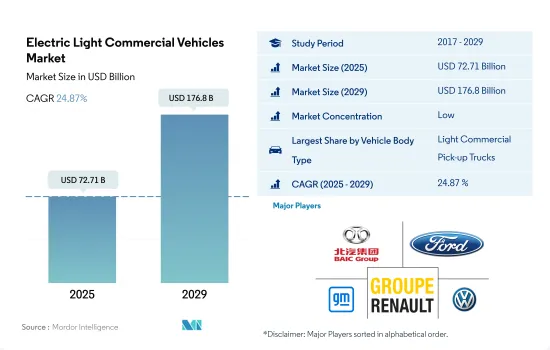
전기 경상용차 시장 규모는 2025년에 727억 1,000만 달러로 추정되고, 2029년에는 1,768억 달러에 이를것으로 예측되며, 예측 기간(2025-2029년)의 CAGR은 24.87%를 나타낼 것으로 예측됩니다.
인터넷과 스마트폰 접속 증가에 힘입어 전 세계적으로 온라인 소매 및 전자상거래가 급증하면서 전 세계적으로 경상용차 구매가 증가하고 있습니다.
- 전자상거래 및 물류 산업은 전 세계 전기 경상용차 시장의 주요 동력입니다. 인터넷 및 스마트폰 접속 증가에 힘입어 전 세계적으로 온라인 소매 및 전자상거래가 급증하면서 전 세계적으로 경상용차 구매가 증가하고 있습니다.
- 코로나19 팬데믹으로 인해 온라인 판매가 활성화되면서 글로벌 전자상거래 시장의 매출과 사용자 기반이 모두 크게 증가했습니다. 이러한 추세는 인터넷 쇼핑이 더욱 활성화됨에 따라 계속될 것으로 예상됩니다. 전 세계 전자상거래 시장은 2020년에 급격한 성장을 보였으며, 이는 내년에도 이어져 2021년에는 26조 7,000억 달러의 매출을 기록할 것으로 예상됩니다.
- 유럽, 미국, 중국을 비롯한 주요 경제권에서 전자상거래 및 물류 산업이 견고한 성장세를 보이며 현대화된 유통망에 대한 필요성이 대두되고 있습니다. 다임러, 닛산, 포드, 르노와 같은 유명 경상용차 제조업체들은 전자상거래 판매가 크게 증가하면서 물류 산업에 힘을 실어주고 있습니다. 전통적으로 픽업트럭과 밴은 전자상거래 물류 및 소비자 배송에 가장 많이 사용되는 차량으로, 전 세계 경상용차 시장을 더욱 강화했습니다.
자동차 산업에서 청정에너지에 대한 수요 증가와 전기차 도입을 촉진하는 정책은 전 세계적으로 전기 상용차의 주요 원동력입니다.
- 최근 몇 년 동안 전 세계 여러 정부가 전기차 도입을 촉진하기 위한 정책을 적극적으로 시행하고 있습니다.
- 자동차 산업에서 청정에너지에 대한 수요 증가는 시장 성장의 핵심 동력입니다. 주요 OEM 업체들은 전기자동차에 대한 전략을 재편하고 있습니다. 예를 들어, 2022년 3월 기아자동차는 2027년까지 두 가지 모델을 출시할 예정인 전기 픽업트럭 부문에 진출할 계획을 발표했습니다. 이 모델 중 하나는 테슬라 사이버트럭, 포드 F-150 라이트닝, 리비안 R1T, GMC 허머 EV와 같은 기존 라이벌과 직접 경쟁하게 될 것입니다. 마찬가지로 2022년 3월, 포드는 2024년까지 4종의 새로운 상용 전기차 라인업을 도입할 계획이라고 발표했습니다.
- 인터넷과 스마트폰 보급률이 높은 북미는 전자상거래 기업이 소매 전자상거래 시장을 공략할 수 있는 수익성 높은 기회를 제공합니다. 이러한 디지털 환경은 전자상거래 업체들의 광범위한 비즈니스 확장을 촉진할 뿐만 아니라 글로벌 전기 경상용차 시장과 트럭 부문을 견인하는 데 중추적인 역할을 하고 있습니다.
세계의 전기 경상용차 시장 동향
세계적인 수요 증가와 정부 지원으로 전기자동차 시장 성장 촉진
- 전기자동차(EV)는 에너지 효율성을 높이고 온실가스 및 오염 배출을 줄일 수 있는 잠재력에 힘입어 자동차 산업에서 필수 불가결한 존재가 되었습니다. 이러한 급증은 주로 환경에 대한 관심이 높아지고 정부의 지원 이니셔티브에 기인합니다. 특히 전 세계 전기차 판매량은 2021년에 비해 2022년에 10.82%의 견고한 성장세를 보였습니다.
- 런던 경찰청 및 소방청과 같은 선도적인 제조업체와 기관들은 전기 모빌리티 전략을 적극적으로 추진하고 있습니다. 예를 들어, 이들은 2025년까지 무공해 차량 목표를 설정하고 2030년까지 밴의 40%를 전기화하고 2040년까지 완전 전기화를 달성한다는 목표를 세웠습니다.
- 아시이평양과 유럽은 배터리 기술 및 차량 전기화의 발전에 힘입어 전기차 생산을 주도할 것으로 보입니다. 2020년 5월, 기아자동차 유럽은 전기화로의 전략적 전환을 알리는 '플랜 S'를 발표했습니다. 이 결정은 유럽에서 기아자동차의 전기차 판매량이 기록적으로 증가한 이후 내려진 것입니다. 기아는 2025년까지 승용차, SUV, MPV 등 다양한 부문에 걸쳐 11개의 전기차 모델을 전 세계에 출시한다는 야심찬 계획을 세우고 있습니다.
전기 경상용차 산업 개요
전기 경상용차 시장은 세분화되어 있으며 상위 5개 기업이 22.60%를 점유하고 있습니다. 이 시장의 주요 업체는 BAIC Motor Corporation Ltd., Ford Motor Company, General Motors Company, Groupe Renault 및 Volkswagen AG(알파벳 순 정렬)입니다.
기타 혜택
- 엑셀 형식 시장 예측(ME) 시트
- 3개월의 애널리스트 지원
목차
제1장 주요 요약과 주요 조사 결과
제2장 보고서 제안
제3장 소개
- 조사의 전제조건과 시장 정의
- 조사 범위
- 조사 방법
제4장 주요 산업 동향
- 인구
- 아프리카
- 아시이평양
- 유럽
- 중동
- 북미
- 남미
- 1인당 GDP
- 아프리카
- 아시이평양
- 유럽
- 중동
- 북미
- 남미
- 자동차 구입을 위한 소비 지출(CVP)
- 아프리카
- 아시이평양
- 유럽
- 중동
- 북미
- 남미
- 인플레이션율
- 아프리카
- 아시이평양
- 유럽
- 중동
- 북미
- 남미
- 자동차 대출 금리
- 전기화의 영향
- EV 충전소
- 배터리 팩 가격
- 아프리카
- 아시이평양
- 유럽
- 중동
- 북미
- 남미
- Xev 신모델 발표
- 물류, 성능 및 인덱스
- 아프리카
- 아시이평양
- 유럽
- 중동
- 북미
- 남미
- 연료 가격
- 제조업체별 생산 통계
- 규제 프레임워크
- 밸류체인과 유통채널 분석
제5장 시장 세분화
- 차량 구성
- 경상용차
- 연료 카테고리
- BEV
- FCEV
- HEV
- PHEV
- 지역
- 아프리카
- 남아프리카
- 아프리카
- 아시이평양
- 호주
- 중국
- 인도
- 인도네시아
- 일본
- 말레이시아
- 한국
- 태국
- 아시이평양의 기타 국가
- 유럽
- 오스트리아
- 벨기에
- 체코 공화국
- 덴마크
- 에스토니아
- 프랑스
- 독일
- 아일랜드
- 이탈리아
- 라트비아
- 리투아니아
- 노르웨이
- 폴란드
- 러시아
- 스페인
- 스웨덴
- 영국
- 기타 유럽
- 중동
- 사우디아라비아
- 기타 중동
- 북미
- 캐나다
- 멕시코
- 미국
- 북미 남은
- 남미
- 아르헨티나
- 브라질
- 기타 남미
- 아프리카
제6장 경쟁 구도
- 주요 전략 동향
- 시장 점유율 분석
- 기업 상황
- 기업 프로파일
- BAIC Motor Corporation Ltd.
- BYD Auto Co. Ltd.
- Daimler AG(Mercedes-Benz AG)
- Dongfeng Motor Corporation
- Ford Motor Company
- General Motors Company
- Groupe Renault
- Nissan Motor Co. Ltd.
- Rivian Automotive Inc.
- Volkswagen AG
제7장 CEO에 대한 주요 전략적 질문
제8장 부록
- 세계 개요
- 개요
- Five Forces 분석 프레임워크
- 세계의 밸류체인 분석
- 시장 역학(DROs)
- 출처 및 참고문헌
- 도표 일람
- 주요 인사이트
- 데이터 팩
- 용어집
The Electric Light Commercial Vehicles Market size is estimated at 72.71 billion USD in 2025, and is expected to reach 176.8 billion USD by 2029, growing at a CAGR of 24.87% during the forecast period (2025-2029).
The surge in online retail and e-commerce worldwide, fueled by increased internet and smartphone access, is leading to a rise in light commercial vehicle purchases globally
- The e-commerce and logistics industries are the primary drivers of the global electric light commercial vehicles market. The surge in online retail and e-commerce worldwide, fueled by increased internet and smartphone access, is leading to a rise in light commercial vehicle purchases globally. In 2021, global light commercial vehicle production reached 18,593.85 thousand units, up from 17,217.99 thousand units in the previous year.
- The COVID-19 pandemic propelled online sales, resulting in a significant boost in both revenue and user base for the global e-commerce market. This trend is expected to continue as internet shopping gains further traction. The global e-commerce market witnessed a rapid expansion in 2020, which continued over the next year, generating USD 26.7 trillion in revenue in 2021. The number and proportion of online shoppers have been steadily rising worldwide, with the largest surge seen in 2020, driven by the pandemic-induced shift to online shopping.
- The e-commerce and logistics industries are experiencing robust growth in major economies, including Europe, the United States, and China, driving the need for modernized distribution networks. Prominent light commercial vehicle manufacturers, such as Daimler, Nissan, Ford, and Renault, have witnessed a significant uptick in e-commerce sales, bolstering the logistics industry. Traditionally, pickup trucks and vans have been the go-to vehicles for e-commerce logistics and consumer deliveries, further bolstering the global light commercial vehicle market.
The rising demand for clean energy in the automotive industry and policies to promote the adoption of EVs are the key drivers for electric commercial vehicles globally
- Several governments worldwide have proactively implemented policies to promote the adoption of electric vehicles in recent years. Notably, China, India, France, and the United Kingdom have set targets to phase out the petrol and diesel vehicle industries by 2040.
- The rising demand for clean energy in the automotive industry is a key driver for the market's growth. Major OEMs are reshaping their strategies for electric vehicles. For example, in March 2022, Kia Motors unveiled plans to enter the electric pickup truck segment, with two models slated for release by 2027. One of these models will directly compete with established rivals like the Tesla Cybertruck, Ford F-150 Lightning, Rivian R1T, and GMC Hummer EV. Similarly, in March 2022, Ford announced its intention to introduce a new lineup of four commercial electric vehicles by 2024. This lineup included the all-new Transit Custom one-tonne van and Tourneo Custom multi-purpose vehicle launched in 2023, followed by the next-generation Transit Courier van and Tourneo Courier multi-purpose vehicle in 2024.
- North America, with its high internet and smartphone penetration, presents lucrative opportunities for e-commerce companies to tap into the retail e-commerce market. This digital landscape not only facilitates broader business expansion for e-commerce players but also plays a pivotal role in driving the global electric light commercial vehicles market as well as its truck segment. Consequently, automakers are ramping up their R&D investments in the truck segment, further fueling the growth of electric trucks.
Global Electric Light Commercial Vehicles Market Trends
The rising global demand and government support propel electric vehicle market growth
- Electric vehicles (EVs) have become indispensable in the automotive industry, driven by their potential to enhance energy efficiency and reduce greenhouse gas and pollution emissions. This surge is primarily attributed to growing environmental concerns and supportive government initiatives. Notably, global EV sales witnessed a robust 10.82% growth in 2022 compared to 2021. Projections indicate that annual sales of electric passenger cars will surpass 5 million by the end of 2025, accounting for approximately 15% of total vehicle sales.
- Leading manufacturers and organizations, like the London Metropolitan Police & Fire Service, have been actively pursuing their electric mobility strategies. For instance, they have set a target of a zero-emission fleet by 2025, with a goal of electrifying 40% of their vans by 2030 and achieving full electrification by 2040. Similar trends are expected globally, with the period from 2024 to 2030 witnessing a surge in demand and sales of electric vehicles.
- Asia-Pacific and Europe are poised to dominate electric vehicle production, driven by their advancements in battery technology and vehicle electrification. In May 2020, Kia Motors Europe unveiled its "Plan S," signaling a strategic shift toward electrification. This decision came on the heels of record-breaking sales of Kia's EVs in Europe. Kia has ambitious plans to introduce 11 EV models globally by 2025, spanning various segments like passenger vehicles, SUVs, and MPVs. The company aims to achieve annual global EV sales of 500,000 by 2026.
Electric Light Commercial Vehicles Industry Overview
The Electric Light Commercial Vehicles Market is fragmented, with the top five companies occupying 22.60%. The major players in this market are BAIC Motor Corporation Ltd., Ford Motor Company, General Motors Company, Groupe Renault and Volkswagen AG (sorted alphabetically).
Additional Benefits:
- The market estimate (ME) sheet in Excel format
- 3 months of analyst support
TABLE OF CONTENTS
1 EXECUTIVE SUMMARY & KEY FINDINGS
2 REPORT OFFERS
3 INTRODUCTION
- 3.1 Study Assumptions & Market Definition
- 3.2 Scope of the Study
- 3.3 Research Methodology
4 KEY INDUSTRY TRENDS
- 4.1 Population
- 4.1.1 Africa
- 4.1.2 Asia-Pacific
- 4.1.3 Europe
- 4.1.4 Middle East
- 4.1.5 North America
- 4.1.6 South America
- 4.2 GDP Per Capita
- 4.2.1 Africa
- 4.2.2 Asia-Pacific
- 4.2.3 Europe
- 4.2.4 Middle East
- 4.2.5 North America
- 4.2.6 South America
- 4.3 Consumer Spending For Vehicle Purchase (cvp)
- 4.3.1 Africa
- 4.3.2 Asia-Pacific
- 4.3.3 Europe
- 4.3.4 Middle East
- 4.3.5 North America
- 4.3.6 South America
- 4.4 Inflation
- 4.4.1 Africa
- 4.4.2 Asia-Pacific
- 4.4.3 Europe
- 4.4.4 Middle East
- 4.4.5 North America
- 4.4.6 South America
- 4.5 Interest Rate For Auto Loans
- 4.6 Impact Of Electrification
- 4.7 EV Charging Station
- 4.8 Battery Pack Price
- 4.8.1 Africa
- 4.8.2 Asia-Pacific
- 4.8.3 Europe
- 4.8.4 Middle East
- 4.8.5 North America
- 4.8.6 South America
- 4.9 New Xev Models Announced
- 4.10 Logistics Performance Index
- 4.10.1 Africa
- 4.10.2 Asia-Pacific
- 4.10.3 Europe
- 4.10.4 Middle East
- 4.10.5 North America
- 4.10.6 South America
- 4.11 Fuel Price
- 4.12 Oem-wise Production Statistics
- 4.13 Regulatory Framework
- 4.14 Value Chain & Distribution Channel Analysis
5 MARKET SEGMENTATION (includes market size in Value in USD and Volume, Forecasts up to 2029 and analysis of growth prospects)
- 5.1 Vehicle Configuration
- 5.1.1 Light Commercial Vehicles
- 5.2 Fuel Category
- 5.2.1 BEV
- 5.2.2 FCEV
- 5.2.3 HEV
- 5.2.4 PHEV
- 5.3 Region
- 5.3.1 Africa
- 5.3.1.1 South Africa
- 5.3.1.2 Rest-of-Africa
- 5.3.2 Asia-Pacific
- 5.3.2.1 Australia
- 5.3.2.2 China
- 5.3.2.3 India
- 5.3.2.4 Indonesia
- 5.3.2.5 Japan
- 5.3.2.6 Malaysia
- 5.3.2.7 South Korea
- 5.3.2.8 Thailand
- 5.3.2.9 Rest-of-APAC
- 5.3.3 Europe
- 5.3.3.1 Austria
- 5.3.3.2 Belgium
- 5.3.3.3 Czech Republic
- 5.3.3.4 Denmark
- 5.3.3.5 Estonia
- 5.3.3.6 France
- 5.3.3.7 Germany
- 5.3.3.8 Ireland
- 5.3.3.9 Italy
- 5.3.3.10 Latvia
- 5.3.3.11 Lithuania
- 5.3.3.12 Norway
- 5.3.3.13 Poland
- 5.3.3.14 Russia
- 5.3.3.15 Spain
- 5.3.3.16 Sweden
- 5.3.3.17 UK
- 5.3.3.18 Rest-of-Europe
- 5.3.4 Middle East
- 5.3.4.1 Saudi Arabia
- 5.3.4.2 Rest-of-Middle East
- 5.3.5 North America
- 5.3.5.1 Canada
- 5.3.5.2 Mexico
- 5.3.5.3 US
- 5.3.5.4 Rest-of-North America
- 5.3.6 South America
- 5.3.6.1 Argentina
- 5.3.6.2 Brazil
- 5.3.6.3 Rest-of-South America
- 5.3.1 Africa
6 COMPETITIVE LANDSCAPE
- 6.1 Key Strategic Moves
- 6.2 Market Share Analysis
- 6.3 Company Landscape
- 6.4 Company Profiles
- 6.4.1 BAIC Motor Corporation Ltd.
- 6.4.2 BYD Auto Co. Ltd.
- 6.4.3 Daimler AG (Mercedes-Benz AG)
- 6.4.4 Dongfeng Motor Corporation
- 6.4.5 Ford Motor Company
- 6.4.6 General Motors Company
- 6.4.7 Groupe Renault
- 6.4.8 Nissan Motor Co. Ltd.
- 6.4.9 Rivian Automotive Inc.
- 6.4.10 Volkswagen AG
7 KEY STRATEGIC QUESTIONS FOR VEHICLES CEOS
8 APPENDIX
- 8.1 Global Overview
- 8.1.1 Overview
- 8.1.2 Porter's Five Forces Framework
- 8.1.3 Global Value Chain Analysis
- 8.1.4 Market Dynamics (DROs)
- 8.2 Sources & References
- 8.3 List of Tables & Figures
- 8.4 Primary Insights
- 8.5 Data Pack
- 8.6 Glossary of Terms