


|
시장보고서
상품코드
1693757
유럽의 바이오 비료 시장 : 시장 점유율 분석, 산업 동향, 성장 예측(2025-2030년)Europe Biofertilizer - Market Share Analysis, Industry Trends & Statistics, Growth Forecasts (2025 - 2030) |
||||||
 Mordor Intelligence
■ 보고서에 따라 최신 정보로 업데이트하여 보내드립니다. 배송일정은 문의해 주시기 바랍니다.
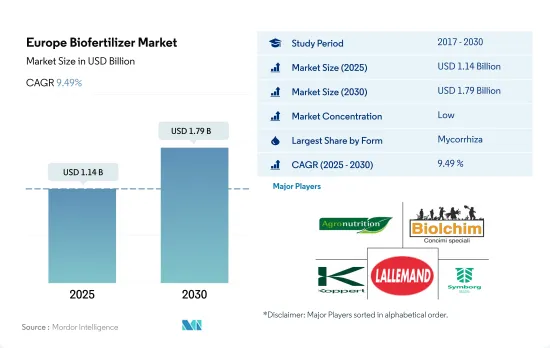
유럽의 바이오 비료 시장 규모는 2025년에 11억 4,000만 달러로 추정되고, 2030년에는 17억 9,000만 달러에 이를 전망이며, 예측 기간(2025-2030년) 중 CAGR 9.49%를 보일 것으로 예측됩니다.
- 바이오 비료는 살아있는 미생물이며, 토양 중의 양분 이용 가능성을 동원 또는 증가시킴으로써 식물의 영양을 강화할 수 있습니다. 농업에서 바이오 비료로 사용되는 가장 흔한 미생물은 균근균, 아조스피릴람, 아조토박타, 리조비움, 인산가용화세균 등입니다.
- 이 바이오 비료 중 균근균은 유럽에서 가장 많이 사용되고 있으며, 2022년 시장 점유율은 62.8%, 금액은 5억 4,950만 달러였습니다. 균근균은 식물의 근계와 공생 관계를 구축하는 균류입니다. 균근균은 식물 뿌리의 표면적을 늘리고 영양분 흡수를 촉진합니다.
- 균립균은 식물과 공생 관계에 있는 가장 중요한 질소 고정 세균으로, 콩과 식물의 근립에 서식하고 있습니다. 근립균은 이 지역에서 두 번째로 소비량이 많은 바이오 비료로 2022년에는 13.2%의 점유율을 차지합니다.
- 근립균의 미생물 활동에 의해 다양한 콩과 작물로 연간 1헥타르당 40-250kg의 질소가 고정되는 것을 알고 있습니다. EU는 콩과 작물의 재배 면적을 확대함으로써 지속가능한 식물성 단백질 생산으로의 이행을 계획하고 있습니다. 이 움직임은 근균 시장을 견인할 가능성이 있습니다.
- 아조스피리람과 아조토박터는 자유생활성의 질소 고정 세균으로, 대기중의 질소를 고정해, 비공생적으로 식물에 이용할 수 있도록 할 수 있습니다. 생물 질소 고정은 토양 비옥도와 작물 생산성에 공헌합니다. 식량 생산에 대한 수요가 증가하고 있기 때문에 유럽에서의 아조토박타의 이용은 확대될 것으로 예상되고 있습니다.
- 유럽의 바이오 비료 시장은 주로 독일, 프랑스, 이탈리아 등의 국가에서 유기재배 식품에 대한 수요가 증가하고 있는 것을 배경으로, 최근 큰 성장을 이루고 있습니다. 2017-2022년 이 지역의 유기농 면적은 490만 헥타르에서 730만 헥타르로 증가했고, 바이오 비료 시장은 28.1% 증가했습니다.
- 유럽에서 유기농법의 성장을 지원하기 위해 유럽위원회는 2021년 가맹국의 유기재배면적을 2030년까지 이 지역의 농지면적의 25.0%로 확대하는 행동계획을 발표하였습니다. 이에 따라 역내 정부는 유기농업 종사자에 대한 보조금을 지급하고 농업 예산을 유기농법 추진에 돌리고 있습니다.
- 예를 들어 2022년 독일 정부는 354억 6,000만 달러의 예산으로 유기농업 종사자에 대한 보조금을 계획하고, 이탈리아 정부는 유기농업 추진을 위한 국가전략계획을 통해 35억 4, 000만 달러를 투자했습니다. 이탈리아는 2027년까지 농지의 25.0%를 유기농업으로 전환하는 것을 목표로 하고 있어, 유럽 위원회가 설정한 목표보다 3년 빠릅니다.
- 시장소비 면에서는 2022년 식물 바이오 비료 점유율은 프랑스가 21.1%로 유럽 최대 시장이며, 이어 이탈리아가 15.8%, 스페인이 10.5%였습니다.
- 유럽의 바이오 비료 시장의 성장은 유기농법의 인기가 높아지고 보다 지속가능한 농법으로의 이행을 추진하는 정부의 이니셔티브 고조로 앞으로도 계속될 것으로 예측됩니다.
유럽의 바이오 비료 시장 동향
유럽의 그린딜은 유기 재배 증가에 크게 기여하고 있으며, 이탈리아는 유기 재배의 최대 면적을 차지하고 있습니다.
- 유럽 국가에서는 유기농업의 추진이 진행되고 있어 유기재배로 분류되는 토지의 양은 지난 10년간 대폭 증가하고 있습니다. 2021년 3월 유럽위원회는 2030년까지 농지의 25%를 유기농업으로 만들겠다는 유럽 그린딜 목표를 달성하기 위해 유기행동계획을 시작했습니다. 오스트리아, 이탈리아, 스페인, 독일은 유럽의 유기농 주요 국가 중 하나입니다. 이탈리아는 농지 면적의 15.0%를 유기농으로 재배하고 있으며 EU 평균인 7.5%를 웃돌고 있습니다.
- 2021년에는 EU의 유기 재배지가 1,470만 헥타르로 기록되었습니다. 농업 생산 면적은, 경지 작물(주로 곡물, 근채류, 신선 야채), 영속적 초지, 영속적 작물의 3개의 주요한 이용 유형으로 나눌 수 있습니다. 2021년 유기경지 면적은 650만 헥타르로 EU 전체 유기농업 면적의 46%에 해당했습니다.
- EU에서 곡물, 오일 씨앗, 단백질 작물, 콩류의 유기 재배 면적은 2017-2021년 32.6% 증가하여 160만 헥타르를 초과했습니다. 130만 헥타르에서 생산되는 다년생 작물은 2020년에는 유기농 재배지의 15%를 차지했습니다. 올리브, 포도, 아몬드, 감귤류는 이 그룹에 속하는 작물의 몇 가지 예입니다. 스페인, 이탈리아, 그리스는 유기농 올리브의 중요한 재배국이며, 최근에는 각각 197,000 헥타르, 179,000 헥타르, 47,000 헥타르입니다. 올리브도 포도도 국내외에 수요가 있는 특산품으로 가공할 수 있기 때문에 유럽의 농업에 있어서 매우 중요합니다. 이 지역의 유기농 면적 증가는 유럽의 유기농 산업을 강화할 것으로 예상됩니다.
이 지역의 유기 제품에 대한 수요 증가와 1인당 지출 증가
- 유럽의 소비자는 자연재료나 자연제법으로 만들어진 상품을 점점 구입하게 되고 있습니다. 유기 식품이 유럽 연합 전체의 농업 생산에 차지하는 비율은 아직 미미하지만, 더 이상 틈새 산업이 아닙니다. 유럽연합은 유기농 상품의 단일 시장으로는 국제적으로 두 번째로 크고, 1인당 연간 평균 지출액은 74.8달러입니다. 유럽의 유기농 식품에 대한 1인당 지출은 지난 10년간 두 배로 증가했습니다. 2020년에는 스위스와 덴마크의 소비자가 유기농 식품에 가장 많이 지출했습니다(각각 1인당 494.09달러와 453.90달러).
- 세계의 유기 무역 데이터에 따르면 독일은 유럽 최대의 유기농 식품 시장으로 미국에 이어 세계 2위 시장 규모를 자랑하며 2021년 시장 규모는 63억 달러, 1인당 소비액은 75.6달러였습니다. 이 나라는 세계 유기농 식품 수요의 10.0%를 차지하고 2021-2026년 2.7%의 CAGR로 추이할 것으로 추정됩니다.
- 프랑스의 유기농 식품 시장은 강력한 성장을 보였으며, 2021년 소매 매출은 12.6% 증가했습니다. 세계 유기농 무역 데이터에 따르면, 이 나라의 유기농 식품에 대한 1인당 지출액은 2021년에 88.8달러를 기록했습니다. 2018년 Agence BIO/Spirit Insight Barometer가 기록한 바와 같이 프랑스인의 88%가 유기농 제품을 소비한 적이 있다고 선언했습니다. 건강, 환경, 동물 복지의 보호가 프랑스에서 유기농 식품을 소비하는 주요 이유입니다. 유기농 시장은 스페인, 네덜란드, 스웨덴을 포함한 다른 몇몇 국가에서도 유기농 스토어의 개점과 함께 성장하기 시작하고 있습니다. 유기농 식품 매출은 코로나19 대유행 중과 그 이후로 늘었습니다. 소비자들이 건강 문제에 관심을 갖기 시작하면서 기존 방법으로 재배된 식품의 악영향을 알게 되었기 때문입니다.
유럽의 바이오 비료 산업 개요
유럽의 바이오 비료 시장은 부문화되어 있으며 상위 5개사에서 1.29%를 차지하고 있습니다. 이 시장의 주요 기업은 Agronutrition, Biolchim SPA, Koppert Biological Systems Inc., Lallemand Inc., Symborg, Inc. 등입니다.
기타 혜택
- 엑셀 형식 시장 예측(ME) 시트
- 3개월의 애널리스트 서포트
목차
제1장 주요 요약 및 주요 조사 결과
제2장 보고서 제안
제3장 서문
- 조사의 전제조건 및 시장 정의
- 조사 범위
- 조사 방법
제4장 주요 산업 동향
- 유기 재배 면적
- 1인당 유기농 제품에 지출
- 규제 프레임워크
- 프랑스
- 독일
- 이탈리아
- 네덜란드
- 러시아
- 스페인
- 튀르키예
- 영국
- 밸류체인 및 유통 채널 분석
제5장 시장 세분화
- 형태별
- 아조스피리람
- 아조토박터
- 균근균
- 인산 가용균
- 근립균
- 기타 바이오 비료
- 작물 유형별
- 환금작물
- 원예작물
- 밭작물
- 국가별
- 프랑스
- 독일
- 이탈리아
- 네덜란드
- 러시아
- 스페인
- 튀르키예
- 영국
- 기타 유럽
제6장 경쟁 구도
- 주요 전략 동향
- 시장 점유율 분석
- 기업 상황
- 기업 프로파일
- Agronutrition
- Andermatt Group AG
- Atlantica Agricola
- Biolchim SPA
- Bionema
- Ficosterra
- Koppert Biological Systems Inc.
- Lallemand Inc.
- Sustane Natural Fertilizer Inc.
- Symborg, Inc.
제7장 CEO에 대한 주요 전략적 질문
제8장 부록
- 세계 개요
- 개요
- Porter's Five Forces 분석 프레임워크
- 세계의 밸류체인 분석
- 시장 역학(DROs)
- 정보원 및 참고문헌
- 도표 일람
- 주요 인사이트
- 데이터 팩
- 용어집
The Europe Biofertilizer Market size is estimated at 1.14 billion USD in 2025, and is expected to reach 1.79 billion USD by 2030, growing at a CAGR of 9.49% during the forecast period (2025-2030).
- Biofertilizers are living microorganisms that can enhance plant nutrition by either mobilizing or increasing nutrient availability in soils. The most common microorganisms used as biofertilizers in agriculture include mycorrhiza, Azospirillum, Azotobacter, Rhizobium, and phosphate-solubilizing bacteria.
- Among these biofertilizers, mycorrhiza is most predominantly used in Europe and accounted for a market share of 62.8% in 2022, with a value of USD 549.5 million. Mycorrhiza is a fungus that establishes a symbiotic relationship with the plant root system. It increases the root surface area of plants, enhancing their nutrient uptake.
- Rhizobium is the most important nitrogen-fixing bacterium that exists in a symbiotic relationship with plants and lives in the root nodules of leguminous plants. Rhizobium is the second most consumed biofertilizer in the region, accounting for a share of 13.2% in 2022.
- It has been found that 40-250 kg of nitrogen per hectare per year is fixed in different legume crops by the microbial activities of Rhizobium. The European Union is planning to transition toward sustainable plant protein production by expanding the area under leguminous crop cultivation. This move may potentially drive the Rhizobium segment of the market.
- Azospirillum and Azotobacter are free-living, nitrogen-fixing bacteria that can fix atmospheric nitrogen and make it available to plants in a non-symbiotic manner. Biological nitrogen fixation contributes to soil fertility and crop productivity. Due to the increasing demand for food production, the use of Azotobacter in the European region is anticipated to grow.
- The European biofertilizer market has experienced significant growth in recent years, primarily driven by the increasing demand for organically grown food in countries like Germany, France, and Italy. From 2017 to 2022, the region's organically cultivated area grew from 4.9 million hectares to 7.3 million hectares, resulting in a 28.1% increase in the biofertilizer market.
- To support the growth of organic farming practices in Europe, in 2021, the European Commission unveiled an action plan to increase the organic area in member countries to occupy 25.0% of the region's agricultural land area by 2030. In response, governments across the region are providing subsidies to organic farmers and diverting agricultural budgets toward promoting organic farming practices.
- For example, in 2022, the German government planned to subsidize organic farmers with a budget of USD 35.46 billion, while the Italian government invested USD 3.54 billion through the National Strategic Plan to promote organic agriculture. Italy aims to convert 25.0% of its agricultural land to organic farming by 2027, three years ahead of the target set by the European Commission.
- In terms of market consumption, France was the largest market in Europe for plant biofertilizers, accounting for a 21.1% share in 2022, followed by Italy and Spain accounting for 15.8% and 10.5%, respectively.
- The growth of the European biofertilizer market is expected to continue due to the increasing popularity of organic farming practices and rising government initiatives driving the transition toward more sustainable agricultural practices.
Europe Biofertilizer Market Trends
European Green Deal is majorly contributing for increasing organic cultivation, Italy majorly holding largest area under organic
- European countries are increasingly promoting organic farming, and the amount of land categorized as organic has significantly increased over the last 10 years. In March 2021, the European Commission launched an organic action plan to achieve the European Green Deal target of ensuring that 25% of agricultural land is under organic farming by 2030. Austria, Italy, Spain, and Germany are among the leading countries for organic cultivation in the European region. Italy has 15.0% of its agricultural area under organic farming, which is higher than the EU average of 7.5%.
- In 2021, organic land in the European Union was recorded at 14.7 million hectares. The agricultural production area is divided into three main types of use: arable land crops (mainly cereals, root crops, and fresh vegetables), permanent grassland, and permanent crops. The area of organic arable land was 6.5 million hectares in 2021, the equivalent of 46% of the European Union's total organic agricultural area.
- The organic cultivation area of cereals, oilseeds, protein crops, and pulses in the European Union increased by 32.6% between 2017 and 2021, amounting to more than 1.6 million hectares. With 1.3 million hectares in production, perennial crops accounted for 15% of the organic land in 2020. Olives, grapes, almonds, and citrus fruits are a few examples of crops in this group. Spain, Italy, and Greece are significant growers of organic olive trees, with 197,000, 179,000, and 47,000 hectares, respectively, in recent years. Both olives and grapes are crucial for the European agricultural industry because they can be turned into specialty products that are in demand locally and globally. The increasing organic acreage in the region is expected to strengthen the organic agricultural industry in Europe.
Growing demand and rising the per capita spending on organic products in the region
- European consumers are increasingly purchasing goods made using natural materials and methods. Even though organic food still only makes up a fraction of the European Union's overall agricultural production, it is no longer a niche industry. The European Union represents the second-largest single market for organic goods internationally, with an average per capita spending of USD 74.8 annually. The per capita spending on organic food in Europe has doubled in the last decade. In 2020, Swiss and Danish consumers spent the most on organic food (USD 494.09 and USD 453.90 per capita, respectively.
- Germany is the largest organic food market in Europe and the second largest market in the world after the United States, with a market size of USD 6.3 billion in 2021 and a per capita consumption of USD 75.6, as per Global Organic Trade data. The country accounted for 10.0% of the global organic food demand and is estimated to record a CAGR of 2.7% between 2021 and 2026.
- The organic food market in France witnessed strong growth, with a 12.6% rise in retail sales in 2021. The country's per capita spending on organic food was recorded at USD 88.8 in 2021, as per Global Organic Trade data. In 2018, as recorded by the Agence BIO/Spirit Insight Barometer, 88% of French people declared having consumed organic products. The preservation of health, environment, and animal welfare are the primary justifications for consuming organic foods in France. The organic market has begun to grow in several other nations, including Spain, the Netherlands, and Sweden, with the opening of organic stores. Organic food sales grew during and post the COVID-19 pandemic as consumers began paying more attention to health issues and learned the adverse effects of conventionally grown food.
Europe Biofertilizer Industry Overview
The Europe Biofertilizer Market is fragmented, with the top five companies occupying 1.29%. The major players in this market are Agronutrition, Biolchim SPA, Koppert Biological Systems Inc., Lallemand Inc. and Symborg, Inc. (sorted alphabetically).
Additional Benefits:
- The market estimate (ME) sheet in Excel format
- 3 months of analyst support
TABLE OF CONTENTS
1 EXECUTIVE SUMMARY & KEY FINDINGS
2 REPORT OFFERS
3 INTRODUCTION
- 3.1 Study Assumptions & Market Definition
- 3.2 Scope of the Study
- 3.3 Research Methodology
4 KEY INDUSTRY TRENDS
- 4.1 Area Under Organic Cultivation
- 4.2 Per Capita Spending On Organic Products
- 4.3 Regulatory Framework
- 4.3.1 France
- 4.3.2 Germany
- 4.3.3 Italy
- 4.3.4 Netherlands
- 4.3.5 Russia
- 4.3.6 Spain
- 4.3.7 Turkey
- 4.3.8 United Kingdom
- 4.4 Value Chain & Distribution Channel Analysis
5 MARKET SEGMENTATION (includes market size in Value in USD and Volume, Forecasts up to 2030 and analysis of growth prospects)
- 5.1 Form
- 5.1.1 Azospirillum
- 5.1.2 Azotobacter
- 5.1.3 Mycorrhiza
- 5.1.4 Phosphate Solubilizing Bacteria
- 5.1.5 Rhizobium
- 5.1.6 Other Biofertilizers
- 5.2 Crop Type
- 5.2.1 Cash Crops
- 5.2.2 Horticultural Crops
- 5.2.3 Row Crops
- 5.3 Country
- 5.3.1 France
- 5.3.2 Germany
- 5.3.3 Italy
- 5.3.4 Netherlands
- 5.3.5 Russia
- 5.3.6 Spain
- 5.3.7 Turkey
- 5.3.8 United Kingdom
- 5.3.9 Rest of Europe
6 COMPETITIVE LANDSCAPE
- 6.1 Key Strategic Moves
- 6.2 Market Share Analysis
- 6.3 Company Landscape
- 6.4 Company Profiles (includes Global Level Overview, Market Level Overview, Core Business Segments, Financials, Headcount, Key Information, Market Rank, Market Share, Products and Services, and Analysis of Recent Developments).
- 6.4.1 Agronutrition
- 6.4.2 Andermatt Group AG
- 6.4.3 Atlantica Agricola
- 6.4.4 Biolchim SPA
- 6.4.5 Bionema
- 6.4.6 Ficosterra
- 6.4.7 Koppert Biological Systems Inc.
- 6.4.8 Lallemand Inc.
- 6.4.9 Sustane Natural Fertilizer Inc.
- 6.4.10 Symborg, Inc.
7 KEY STRATEGIC QUESTIONS FOR AGRICULTURAL BIOLOGICALS CEOS
8 APPENDIX
- 8.1 Global Overview
- 8.1.1 Overview
- 8.1.2 Porter's Five Forces Framework
- 8.1.3 Global Value Chain Analysis
- 8.1.4 Market Dynamics (DROs)
- 8.2 Sources & References
- 8.3 List of Tables & Figures
- 8.4 Primary Insights
- 8.5 Data Pack
- 8.6 Glossary of Terms







샘플 요청 목록