
|
시장보고서
상품코드
1836489
이탈리아의 약물전달 기기 : 시장 점유율 분석, 산업 동향, 통계, 성장 예측(2025-2030년)Italy Drug Delivery Devices - Market Share Analysis, Industry Trends & Statistics, Growth Forecasts (2025 - 2030) |
||||||
 Mordor Intelligence
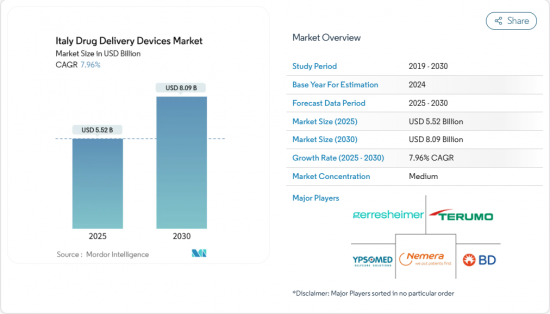
이탈리아의 약물전달 기기 시장은 2025년에 55억 2,000만 달러가 되고, CAGR 7.96%의 안정된 성장을 반영해, 2030년에는 80억 9,000만 달러에 이를 것으로 예상되고 있습니다.
이 나라의 급속한 고령화, 당뇨병이나 만성 폐색성 폐질환(COPD) 등 만성질환의 높은 유병률 상승, 병원 치료보다 자기 투여가 선호되는 정책 전환 등이 성장의 기반이 되고 있습니다. 2024년 1월 이후 이탈리아 의약품청(AIFA)의 규제 합리화로 혁신적인 제품 승인주기가 단축되는 반면, 연결 기술에 대한 투자는 치료 순응도와 실시간 모니터링을 향상시켰습니다. 동시에 전문 약국과 지역 밀착형 유통 모델이 대병원 이외에의 액세스를 확대해 이탈리아 약물전달 기기 시장 전체의 흡수를 가속화하고 있습니다.
이탈리아의 약물전달 기기 시장 동향과 인사이트
프리필드 주사 펜 채용 확대
보다 짧은 4mm 바늘과 32G 게이지 수요는 조직 외상을 줄이고 치료 순응도를 향상시키기 위해 높아졌으며, 이는 이탈리아 대사 비만 학회(SIMDO)의 국가 가이드라인에 의해 강조된 우선순위입니다. 차세대 연결 펜은 투여 데이터를 자동으로 기록하고 스마트폰 앱과 동기화하여 당뇨병 치료의 정보 격차를 제거합니다. 그러나, 의료 종사자의 훈련이 제한되어 있기 때문에 도입에는 아직 편차가 있어, 대상을 좁힌 교육이나 가치 실증 프로그램의 여지가 남아 있습니다.
생물학적 제제의 자가 투여를 뒷받침하는 전문 약국 확대
이탈리아에서는 병원에 직접 공급(DD), 병원 대리 판매(DPC), 제휴 채널 등 분산형 유통 접근법으로 복잡한 생물학적 제제에 대한 환자의 접근이 3차 의료기관 이외에도 확산되고 있습니다. 유행시에 시험적으로 도입된 분석 모델은 더 많은 의약품을 지역 대리점을 통해 판매하고 비용 관리를 유지하면서 이동 시간과 병원 병목 현상을 줄일 가능성을 보여줍니다.
느린 상환 승인
희소질환용 의약품의 평균 상환기간은 413일로 법정 목표인 100일을 크게 넘고 있으며, 선진적인 약물전달의 전개가 늦어지고 있습니다. 지역 추종을 통해 제품이 환자에게 도착하는 데 하루부터 773일이 걸릴 수 있으며 지역 간 불공평성이 두드러집니다.
부문 분석
주사제형은 당뇨병이나 자가면역요법의 처방에서 확립된 역할을 하기 때문에 2024년에는 이탈리아 약물전달 시장 점유율의 48.74%를 차지했습니다. 4mm, 32G 인슐린 펜 바늘과 같은 지속적인 개선은 내약성을 향상시키고 이 부문의 광범위한 사용자 기반을 유지합니다. 높은 점도의 생물 제제는 또한 우수한 내파손성을 가진 유리 주사기의 혜택을 받고 있습니다. 이와 병행하여, 이식형은 2030년까지의 CAGR이 9.12%를 나타낼 것으로 예측되고 있어 이탈리아의 약물전달 시장에서 가장 빠른 페이스로 추이하고 있습니다. 로즈 벵골을 배합한 3D 인쇄 폴리비닐알코올 매트릭스 등의 진보에 의해 항암제의 지속적 방출이 최대 90일간 가능하게 됩니다. 흡입 기기는 낮은 GWP 추진제로 축발을 옮기고 있으며, 경피, 점안 및 비강 플랫폼은 체류 시간을 연장하는 새로운 중합체로부터 이익을 얻고 있습니다. 이러한 혁신을 총칭하여 이탈리아의 약물전달 기기 시장 규모는 모달리티 수준에서 장기적으로 확대되고 있습니다.
2024년 이탈리아 약물전달 기기 시장 규모의 61.22%를 주사제가 차지하고 임상 프로토콜의 정착과 펌프와 지속 포도당 모니터를 연동시킨 자동 인슐린 딜리버리 시스템의 가속에 의해 지원되었습니다. CAGR 8.64%로 확대되는 흡입 경로는 새로운 HFA-152a 추진제를 사용한 트리플 조합 pMDI에 의해 추진됩니다. 경피, 뺨, 눈, 코에 대한 접근법은 생체이용률을 높이는 마이크로니들 어레이와 점착성 겔의 혜택을 받지만 무균성과 안정성 문제에 직면하고 있습니다.
기타 혜택
- 엑셀 형식 시장 예측(ME) 시트
- 3개월간의 애널리스트 지원
목차
제1장 서론
- 조사 전제조건과 시장 정의
- 조사 범위
제2장 조사 방법
제3장 주요 요약
제4장 시장 상황
- 시장 개요
- 시장 성장 촉진요인
- 프리필드 주사 펜의 채용 확대
- 생물학적 제제의 자가 투여를 뒷받침하는 전문 약국의 확대
- 스마트하고 커넥티드인 약물전달 기기의 기술적 진보와 채용 증가
- 만성질환의 고부담과 고령화
- 재택 의료 환경와 자기 투여의 확대
- 보험 상환과 바이오시밀러 펜 및 프레필의 보급을 지원
- 시장 성장 억제요인
- 안전성에 대한 우려와 침침 사고
- 일회용 플라스틱의 컴플라이언스 비용 및 기타 컴플라이언스 문제
- 높은 개발·제조 비용
- 자가주사에 대한 문화적 저항이 치료 순응도에 영향
- 가치/공급망 분석
- 규제와 기술적 전망
- Porter's Five Forces 분석
- 공급기업의 협상력
- 구매자의 협상력
- 신규 참가업체의 위협
- 대체품의 위협
- 경쟁 기업 간 경쟁 관계의 강도
제5장 시장 규모 및 성장 예측(금액-달러)
- 기기 유형별
- 주사 투여 기기
- 흡입 전달 기기
- 주입 펌프
- 경피 패치
- 이식형 약물전달 시스템
- 안구 삽입물 및 투여 임플란트
- 비강 및 구강 점막 투여 기기
- 투여 경로별
- 주사제
- 흡입제
- 경피제
- 구강 점막제(구강 내 및 설하)
- 안구제
- 비강제
- 용도별
- 암
- 심혈관 질환
- 당뇨병
- 감염성 질환
- 기타 용도
- 최종 사용자별
- 병원
- 외래 수술 센터(ASC)
- 재택 의료 환경
- 기타 최종 사용자
제6장 경쟁 구도
- 시장 집중도
- 전략적 동향
- 시장 점유율 분석
- 기업 프로파일
- BD(Becton, Dickinson and Company)
- Gerresheimer AG
- Ypsomed AG
- Nemera
- Terumo Corporation
- Pfizer Inc.
- Novartis AG
- F. Hoffmann-La Roche Ltd
- Novo Nordisk A/S
- Baxter International Inc.
- Teva Pharmaceutical Industries Ltd
- Insulet Corporation
- Tandem Diabetes Care
- West Pharmaceutical Services Inc.
- AptarGroup Inc.
- B. Braun Melsungen AG
- Owen Mumford Ltd.
- Elcam Medical
제7장 시장 기회와 전망
KTH 25.11.04The Italy drug delivery devices market stood at USD 5.52 billion in 2025 and is forecast to reach USD 8.09 billion by 2030, reflecting a steady 7.96% CAGR.
Growth is anchored in the country's rapidly aging population, the high and rising prevalence of chronic diseases such as diabetes and COPD, and a policy shift that favors self-administration over hospital-based care. Regulatory streamlining by the Italian Medicines Agency (AIFA) since January 2024 has shortened approval cycles for innovative products, while investment in connected technologies is improving adherence and real-time monitoring. At the same time, specialty pharmacies and community-based distribution models are extending access beyond large hospitals, accelerating uptake across the Italy drug delivery devices market.
Italy Drug Delivery Devices Market Trends and Insights
Growing Adoption of Pre-Filled Injectable Pens
Demand for shorter 4 mm needles and 32 G gauges is rising because they lessen tissue trauma and improve adherence, a priority underscored by national guidelines from the Italian Society of Metabolism and Obesity (SIMDO). Next-generation connected pens automatically log dose data and sync to smartphone apps, closing information gaps in diabetes care. However, uptake remains uneven due to limited provider training, leaving space for targeted education and value-demonstration programs.
Expansion of Specialty Pharmacies Boosting Biologic Self-Administration
Italy's decentralized distribution approach-direct hospital supply (DD), distribution on behalf of hospitals (DPC), and affiliated channels-has widened patient access to complex biologics outside tertiary centers. Analytics models piloted during the pandemic show potential to redirect a larger drug volume through community outlets, cutting travel time and hospital bottlenecks while maintaining cost control.
Slow Reimbursement Approval
Average reimbursement time for orphan products remains 413 days, far exceeding the 100-day statutory target and slowing roll-out of advanced drug delivery devices. Regional follow-through can add between 1 day and 773 days before products reach patients, creating pronounced territorial inequity.
Other drivers and restraints analyzed in the detailed report include:
- Technological Advancement and Increasing Adoption of Smart and Connected Drug Delivery Devices
- High Burden of Chronic Diseases and Aging Population
- High Development and Manufacturing Cost
For complete list of drivers and restraints, kindly check the Table Of Contents.
Segment Analysis
Injectable formats generated 48.74% of Italy drug delivery devices market share in 2024 due to their established role in diabetes and autoimmune therapy regimens. Continuous refinement-such as 4 mm, 32 G insulin pen needles-improves tolerability and maintains the segment's broad user base. High-viscosity biologics are also benefiting from glass syringes engineered for superior break-resistance. In parallel, implantables are projected to post a 9.12% CAGR to 2030, marking the fastest trajectory within the Italy drug delivery devices market. Advances like 3-D printed polyvinyl alcohol matrices loaded with Rose Bengal enable sustained anticancer drug release for up to 90 days. Inhalation devices are pivoting to low-GWP propellants, while transdermal, ocular, and nasal platforms gain from novel polymers that extend residence time. Collectively, these innovations reinforce the long-term expansion of the Italy drug delivery devices market size at the modality level.
Injectables accounted for 61.22% of the Italy drug delivery devices market size in 2024, upheld by entrenched clinical protocols and the acceleration of automated insulin delivery systems that link pumps with continuous glucose monitors.Smart algorithms raise time-in-range and ease the burden of frequent dose decisions. Inhalation routes, expanding at a 8.64% CAGR, are propelled by triple combination pMDIs using the new HFA-152a propellant, which matches legacy efficacy while cutting global-warming potential by 90%. Transdermal, buccal, ocular, and nasal approaches are benefiting from micro-needle arrays and muco-adhesive gels that boost bioavailability yet face sterility and stability challenges.
Italy Drug Delivery Devices Market Report is Segmented by Device Type (Injectable Delivery Devices, Inhalation Delivery Devices, Infusion Pumps, and More), Route of Administration (Injectable, Inhalational, Transdermal Patches, Oral Mucosal and More), Application (Cancer, Cardiovascular, Diabetes and More), End User (Hospitals, Ambulatory Surgical Centers, and More). The Market and Forecasts are Provided in Terms of Value (USD).
List of Companies Covered in this Report:
- Beckton Dickinson
- Gerresheimer
- Ypsomed
- Nemera
- Terumo
- Pfizer
- Novartis
- Roche
- Novo Nordisk
- Baxter
- Teva Pharmaceutical Industries
- Insulet
- Tandem Diabetes Care
- West Pharmaceutical Services
- AptarGroup Inc.
- B. Braun
- Owen Mumford
- Elcam Medical
Additional Benefits:
- The market estimate (ME) sheet in Excel format
- 3 months of analyst support
TABLE OF CONTENTS
1 Introduction
- 1.1 Study Assumptions and Market Definition
- 1.2 Scope of the Study
2 Research Methodology
3 Executive Summary
4 Market Landscape
- 4.1 Market Overview
- 4.2 Market Drivers
- 4.2.1 Growing adoption of pre-filled injectable pens
- 4.2.2 Expansion of specialty pharmacies boosting biologic self-administration
- 4.2.3 Technological Advancement and Increasing Adoption of Smart and Connected Drug Delivery Devices
- 4.2.4 High Burden of Chronic Diseases and Aging Population
- 4.2.5 Expansion of Home-Care & Self-Administration
- 4.2.6 Supporting Reimbursement and Biosimilar Pen and Prefill Uptake
- 4.3 Market Restraints
- 4.3.1 Safety Concerns and Needlestick-injuries
- 4.3.2 Single-Use-Plastic Compliance Costs and Other Compliance Issues
- 4.3.3 High Development and Manufacturing Cost
- 4.3.4 Cultural Reluctance Toward Self-Injection Impacting Adherence
- 4.4 Value / Supply-Chain Analysis
- 4.5 Regulatory and Technological Outlook
- 4.6 Porter's Five Forces Analysis
- 4.6.1 Bargaining Power of Suppliers
- 4.6.2 Bargaining Power of Buyers
- 4.6.3 Threat of New Entrants
- 4.6.4 Threat of Substitutes
- 4.6.5 Intensity of Competitive Rivalry
5 Market Size and Growth Forecasts (Value-USD)
- 5.1 By Device Type
- 5.1.1 Injectable Delivery Devices
- 5.1.2 Inhalation Delivery Devices
- 5.1.3 Infusion Pumps
- 5.1.4 Transdermal Patches
- 5.1.5 Implantable Drug Delivery Systems
- 5.1.6 Ocular Inserts & Delivery Implants
- 5.1.7 Nasal & Buccal Delivery Devices
- 5.2 By Route of Administration
- 5.2.1 Injectable
- 5.2.2 Inhalation
- 5.2.3 Transdermal
- 5.2.4 Oral Mucosal (Buccal & Sublingual)
- 5.2.5 Ocular
- 5.2.6 Nasal
- 5.3 By Application
- 5.3.1 Cancer
- 5.3.2 Cardiovascular
- 5.3.3 Diabetes
- 5.3.4 Infectious Diseases
- 5.3.5 Other Applications
- 5.4 By End User
- 5.4.1 Hospitals
- 5.4.2 Ambulatory Surgical Centers
- 5.4.3 Home-care Settings
- 5.4.4 Other End Users
6 Competitive Landscape
- 6.1 Market Concentration
- 6.2 Strategic Moves
- 6.3 Market Share Analysis
- 6.4 Company profiles (includes Global level Overview, Market level overview, Core Segments, Financials as available, Strategic Information, Market Rank/Share for key companies, Products and Services, and Recent Developments)
- 6.4.1 BD (Becton, Dickinson and Company)
- 6.4.2 Gerresheimer AG
- 6.4.3 Ypsomed AG
- 6.4.4 Nemera
- 6.4.5 Terumo Corporation
- 6.4.6 Pfizer Inc.
- 6.4.7 Novartis AG
- 6.4.8 F. Hoffmann-La Roche Ltd
- 6.4.9 Novo Nordisk A/S
- 6.4.10 Baxter International Inc.
- 6.4.11 Teva Pharmaceutical Industries Ltd
- 6.4.12 Insulet Corporation
- 6.4.13 Tandem Diabetes Care
- 6.4.14 West Pharmaceutical Services Inc.
- 6.4.15 AptarGroup Inc.
- 6.4.16 B. Braun Melsungen AG
- 6.4.17 Owen Mumford Ltd.
- 6.4.18 Elcam Medical
7 Market Opportunities and Future Outlook
- 7.1 White-Space and Unmet-Need Assessment