|
시장보고서
상품코드
1846215
중국의 건설기계 : 시장 점유율 분석, 산업 동향, 통계, 성장 예측(2025-2030년)China Construction Equipment - Market Share Analysis, Industry Trends & Statistics, Growth Forecasts (2025 - 2030) |
||||||
 Mordor Intelligence
중국의 건설기계 시장은 2025년에 561억 8,000만 달러로 추정되고, CAGR 6.21%를 나타내 2030년에는 758억 7,000만 달러로 확대될 것으로 예측됩니다.
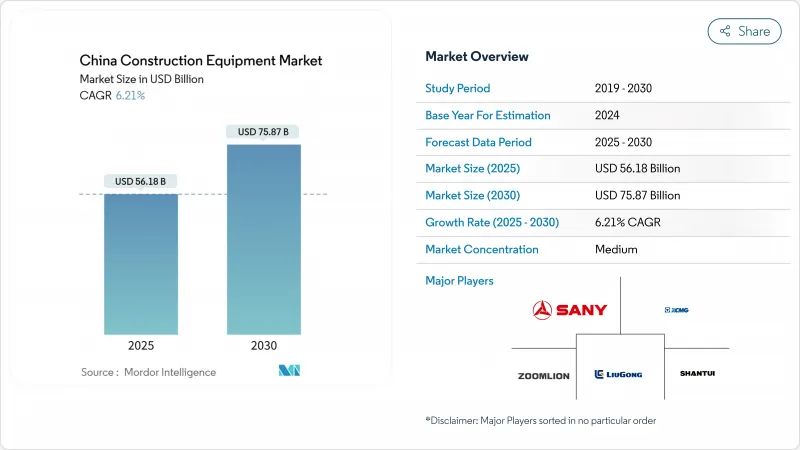
철도, 고속도로, 도시교통망에 대한 공공 부문의 지속적인 지출은 전기기계와 스마트기계에 대한 강력한 정책적 뒷받침과 함께 주택부동산 활동이 식어가는 중에서도 수요를 지지하고 있습니다. 2025년에 5,900억 위안이 투입되는 18만km의 국철 건설 등의 대규모 프로젝트는 수주를 호조로 유지해, 대용량의 토목·양중 기계를 지지하고 있습니다. 동시에 디젤과의 비용 격차가 줄어들고 보조금이 자본 지출을 상쇄하기 때문에 전기는 테스트 프로젝트에서 대규모 배포로 전환하고 있습니다. 해외 출하 대수가 국내 출하 대수를 웃도는 것으로, 중국의 상대방 상표 제품 제조업체(OEM)가 해외의 인프라 사이클에 의존하는 것으로, 국내의 경기 감속과의 밸런스를 취할 수 있는 것을 나타내고 있습니다.
중국의 건설기계 시장 동향과 인사이트
정부 인프라 투자와 일대일로 구상
나가에 델타 지역만으로도 2024년 철도 건설에 1,400억 위안이 할당되어 전년 1,253억 위안을 상회하는 과거 최고를 기록했습니다. 국가개발개혁위원회의 2025년 설비갱신 정책은 산업, 에너지, 운수, 농업 분야에 걸쳐 지원을 확대하고, 하이엔드, 지능, 녹색기술을 중시하고, 대출이자 보급을 강화하여 대출 비용을 절감합니다. 인프라 프로젝트는 일반적으로 예측 가능한 교환 패턴으로 3-5년의 설비 라이프사이클을 필요로 하기 때문에 이 정책 틀은 기존의 건설 사이클을 넘어 지속적인 수요를 창출합니다. 일대일로(The Belt and Road) 이니셔티브의 국제 차원은 국내 제조업체의 수출 기회를 증폭시키고, 2022년에는 중국 굴삭기 수출의 70%가 BRI 국가를 향해 국내 생산 규모가 경쟁력 있는 국제 가격 설정을 가능하게 하는 선순환을 만들어 냈습니다. 2030년까지 고속철도 6만km를 포함한 18만km로 확대되는 철도망에는 터널 굴착, 교량건설, 궤도부설을 위한 특수 건설기계가 필요하며, 중국 업체들은 국내 프로젝트 경험을 통해 기술적 우위성을 키워온 분야입니다.
설비 근대화와 전화정책
정부의 설비 근대화 지령은 신규 건설 활동과는 무관하게 갱신 수요를 만들어내고, 공업 정보화부의 2024년 주요 기술 설비 지도 카탈로그는 선진 건설 기기를 우선했습니다. 전기 건설기계의 도입은 직접 보조금과 운영 비용의 우위에 의해 가속화되고 있으며, 중국 제조 업체는 특정 응용 분야에서 전기 및 디젤 방식의 비용 동등을 달성하고 총 소유 비용의 계산을 근본적으로 바꾸고 있습니다. 그린 기술 추진 요람(2024년판)'에는 7개의 섹터에 걸친 112개의 첨단 기술이 게재되어 있으며, 건설 기기는 에너지 효율과 환경 보호의 범주로 크게 다루어지고 있습니다. 사업자가 최신 기술을 이용하면서 자본 지출을 최소한으로 억제하려고 하는 가운데, Equipment-as-a-service 모델이 지지를 모으고 있어 설치·해체의 통합 서비스가 안전 컴플라이언스와 업무 효율을 향상시키고 있습니다. 이 정책은 프리미엄 전기기기와 스마트기기가 높은 이득을 얻는 한편, 기존의 디젤기기가 가격압력에 직면하는 2층 시장을 만들어 내고 강력한 연구개발능력과 기술 포트폴리오를 가진 제조업체에 이익을 가져다 줍니다.
부동산 부문의 배달 및 건설 감속
부동산 부문의 딜리버리지 프로세스는 개발자가 새로운 프로젝트 착공과 장비 구매를 줄이기 때문에 일시적인 수요 혼란을 일으키며 특히 소형 기계 및 주택 건설기계 부문에 영향을 미칩니다. 그러나 정부의 도시 재개발 계획과 저렴한 주택 프로그램이 대체 수요원이 되어 주요 도시는 투기적인 개발보다 인프라 정비나 공공시설 건설을 우선하고 있습니다. 안정적인 경영을 유지하는 국유기업과 재정적 제약에 직면하는 민간 개발자 간에 시장 개척의 차별화가 태어나 건설회사의 자본요건을 경감하는 설비리스와 유연한 자금조달 모델의 기회가 창출됩니다.
부문 분석
굴삭기와 같은 토목 기계는 2024년 중국 건설기계 시장 점유율의 55.28%를 차지하며 토공, 채광, 지하철 터널 공사 프로젝트에서 그 역할을 확고히 했습니다. 한편, 보조금과 배터리 비용의 저하로 인해 디젤의 평생 비용의 우위성이 손상되어 전동 굴삭기의 2030년까지의 CAGR은 12.15%를 나타낼 전망입니다. 지게차, 텔레스코픽 핸들러, 고소 작업 차량은 전자상거래 완성과 관련된 창고 자동화를 통해 안정적인 견인력을 얻습니다. 도로 건설기계는 17만 7,000km 규모의 전국 고속도로 네트워크의 유지 보수 사이클을 통해 혜택을 누리며 자율 주행 롤러 및 포장공은 주목할만한 고속도로 업그레이드의 주요 기능이 되었습니다.
기술의 융합은 미래의 충돌을 정의합니다. 굴삭기는 현재 표준 텔레매틱스, 반자율 드릴링 알고리즘 및 어태치먼트 교체 시간을 단축하는 공장 설치 퀵 커플러로 출하되고 있습니다. 콘크리트 믹서와 펌프는 IoT 센서를 통합하여 슬럼프 품질과 배차 물류를 최적화하여 밀집된 도시 중심부에서 정시 타설을 보장합니다. 중국의 건설기계 시장 규모는 굴삭기만으로도 2030년까지 370억 달러에 가까워질 것으로 예측되고 있으며, 독자적인 배터리 팩과 제어 소프트웨어에 투자하는 OEM에 스케일 메리트를 가져오고 있습니다. 상호 운용 표준이 성숙함에 따라 개방형 아키텍처 컨트롤러가 있는 부품 공급업체가 협상력을 얻고 밸류체인이 소프트웨어 중심 생태계로 재구성됩니다.
2024년 판매량의 92.64%는 내연기관(디젤)이었으며, 이는 확립된 급유 인프라, 긴 듀티 사이클 및 낮은 초기 가격에 의해 지원되었습니다. 그러나 풀 전동 옵션은 2030년까지의 CAGR이 37.85%가 되어 결정적인 단계적 변화를 나타냅니다. 베이징, 상하이, 심천의 제로 방출 의무화로 인해 지자체 공사에서 디젤 차량의 신규 구매가 제한되어 있기 때문에 배터리 전기 모델의 중국 건설기계 시장 규모는 2030년까지 80억 달러 이상에 달할 것으로 보입니다. 하이브리드 드라이브 트레인은 빈번한 공회전과 함께 부하 사이클에서 연료 소비를 20-25% 줄이는 교량 솔루션을 제공합니다.
비용 패리티는 배터리 밀도, 충전 물류 및 재판매 가격에 달려 있습니다. OEM의 금융 부문은 현재 충전소과 태양광 발전 마이크로그리드를 장비 임대에 통합하고 있으며 계약자는 프로젝트의 서비스 수명에 걸쳐 킬로와트 가격을 보장합니다. 한편, 각 주의 송전망 운영회사는 변화외의 시간대에 아이들 상태의 기계용 배터리를 수익화하는 차량 투 그리드 방식을 시험적으로 도입하여 보조적인 수익원을 추가하고 있습니다. 디젤의 역할은 극단적인 온도차가 있는 광산이나 송전망에의 액세스가 없는 변경의 일대일로(Belt and Road) 회랑에서 눈에 띄는 것으로 보입니다. 그럼에도 불구하고 소음과 배기가스 규제가 가장 엄격한 대도시 토목 공사 분야에서는 디젤 점유율이 가장 급속히 떨어질 것으로 보입니다.
기타 혜택 :
- 엑셀 형식 시장 예측(ME) 시트
- 3개월의 애널리스트 지원
목차
제1장 서론
- 조사 전제조건과 시장 정의
- 조사 범위
제2장 조사 방법
제3장 주요 요약
제4장 시장 상황
- 시장 개요
- 시장 성장 촉진요인
- 정부의 「신인프라 2025-30」 파이프라인
- 탄소 중립 의무화가 전기 기계에 박차
- OEM에 의한 수출 촉진이 국내의 스케일 메리트를 실현
- 일대일로에 의한 부품 제조업체에의 백 오더
- 하이브리드 자동차가 유리한 지방의 탄소 신용 시장
- 디지털 기기 렌탈 플랫폼이 중소기업 수요를 환기
- 시장 성장 억제요인
- 부동산 불황의 장기화
- 과잉생산 능력에 의한 국내 가격 경쟁
- 중소기업의 계약자에 대한 신용공여의 엄격화
- 전자기기용 인버터와 BMS 칩의 부족
- 가치/공급망 분석
- 규제 상황
- 기술적 전망
- Porter's Five Forces
- 신규 참가업체의 위협
- 구매자의 협상력
- 공급기업의 협상력
- 대체품의 위협
- 경쟁 기업 간 경쟁 관계
제5장 시장 규모와 성장 예측
- 기계 유형별
- 토공 기계
- 굴삭기
- 로더
- 도저
- 자재 취급 기계
- 크레인
- 지게차
- 텔레스코픽 핸들러
- 도로 건설기계
- 모터 그레이더
- 롤러/컴팩터
- 포장기
- 콘크리트 장비
- 콘크리트 믹서
- 콘크리트 펌프
- 토공 기계
- 구동 유형별
- 내연식(디젤)
- 하이브리드
- 완전 전기식
- 판매 채널별
- OEM 직접 판매
- 공인 대리점 판매
- 용도별
- 빌딩 건설
- 인프라 건설
- 에너지 및 천연 자원
- 기타
제6장 경쟁 구도
- 시장의 집중도
- 전략적인 동향
- 시장 점유율 분석
- 기업 프로파일
- Sany Group
- Xuzhou Construction Machinery Group Co., Ltd.(XCMG)
- Caterpillar Inc.
- Zoomlion Heavy Industry
- LiuGong Machinery
- Komatsu Ltd.
- Hitachi Construction Machinery
- AB Volvo(Volvo CE)
- Liebherr Group
- Shantui Construction Machinery
- Tadano Ltd.
- JC Bamford Excavators Limited
- Doosan Bobcat Ltd.
- Hyundai Construction Equipment Ltd.
- Yanmar Holdings Co. Ltd.
- Terex Corporation
- China Railway Construction Heavy Industry Co., Ltd.
제7장 시장 기회와 전망
KTH 25.11.07The China construction equipment market is estimated at USD 56.18 billion in 2025 and is forecast to advance to USD 75.87 billion by 2030, reflecting a 6.21% CAGR.
Sustained public-sector spending on railway, highway, and urban transit links, paired with a strong policy push for electric and smart machinery, underpins demand even as residential real-estate activity cools. Large-scale projects such as the 180,000 km national railway build-out, for which CNY 590 billion was earmarked in 2025, keep order books healthy and favor high-capacity earth-moving and lifting equipment. At the same time, electrification is moving from pilot projects to scaled deployment as cost parity with diesel narrows and subsidies offset capital outlays. Export momentum offers an additional cushion: overseas shipments have overtaken domestic deliveries, signaling that Chinese original-equipment manufacturers (OEMs) can lean on foreign infrastructure cycles to balance local slowdowns.
China Construction Equipment Market Trends and Insights
Government Infrastructure Investment and Belt Road Initiative
China's infrastructure investment surge represents the primary growth catalyst, with the Yangtze River Delta region alone allocating CNY 140 billion for railway construction in 2024, marking a record high that surpasses the previous year's CNY 125.3 billion. The National Development and Reform Commission's 2025 equipment update policy expands support across industrial, energy, transportation, and agricultural sectors, emphasizing high-end, intelligent, and green technologies with enhanced loan interest subsidies to reduce financing costs. This policy framework creates sustained demand beyond traditional construction cycles, as infrastructure projects typically require 3-5 year equipment lifecycles with predictable replacement patterns. The Belt and Road Initiative's international dimension amplifies domestic manufacturers' export opportunities, with 70% of Chinese excavator exports directed to BRI countries in 2022, creating a virtuous cycle where domestic production scale enables competitive international pricing. Railway network expansion to 180,000 km by 2030, including 60,000 km of high-speed rail, necessitates specialized construction equipment for tunneling, bridge construction, and track laying, segments where Chinese manufacturers have developed technological advantages through domestic project experience.
Equipment Modernization and Electrification Policies
The government's equipment modernization mandate creates replacement demand independent of new construction activity, with the Ministry of Industry and Information Technology's 2024 Major Technological Equipment Guidance Catalog prioritizing advanced construction machinery. Electric construction equipment adoption accelerates through direct subsidies and operational cost advantages, with Chinese manufacturers achieving cost parity between electric and diesel versions in certain applications, fundamentally altering total cost of ownership calculations. The Green Technology Promotion Directory (2024 Edition) includes 112 advanced technologies across seven sectors, with construction equipment featuring prominently in energy-efficient and environmental protection categories. Equipment-as-a-service models gain traction as operators seek to minimize capital expenditure while accessing latest technology, with integrated installation-dismantling services improving safety compliance and operational efficiency. The policy creates a two-tier market where premium electric and smart equipment commands higher margins while conventional diesel equipment faces pricing pressure, benefiting manufacturers with strong R&D capabilities and technology portfolios.
Real Estate Sector Deleveraging and Construction Slowdown
The real estate sector's deleveraging process creates temporary demand disruption as developers reduce new project starts and equipment purchases, particularly affecting compact machinery and residential construction equipment segments. However, government urban renewal initiatives and affordable housing programs provide alternative demand sources, with major cities prioritizing infrastructure upgrades and public facility construction over speculative development. Market differentiation emerges between state-owned enterprises maintaining stable operations and private developers facing financial constraints, creating opportunities for equipment leasing and flexible financing models that reduce capital requirements for construction firms.
Other drivers and restraints analyzed in the detailed report include:
- Export Market Expansion and International Competitiveness
- Digitalization and Smart Construction Technology Adoption
- Trade Tensions and Tariff Barriers in International Markets
For complete list of drivers and restraints, kindly check the Table Of Contents.
Segment Analysis
Earth-moving machinery such as excavators controlled 55.28% of China construction equipment market share in 2024, cementing their role across earthwork, mining and metro tunnelling projects. Rising infrastructure outlays and export demand keep delivery volumes elevated, while electric excavators record a 12.15% CAGR to 2030 as subsidies and falling battery costs erode diesel's lifetime cost advantage. Forklifts, telescopic handlers and aerial platforms gain steady traction from warehouse automation linked to e-commerce fulfilment. Road-building machines benefit from maintenance cycles for an expanding 177,000 km national highway grid, with autonomous rollers and pavers proving headline features on high-profile expressway upgrades.
Technology convergence defines future competition. Excavators now ship with standard telematics, semi-autonomous dig algorithms, and factory-installed quick couplers that cut attachment changeover time. Concrete mixers and pumps integrate IoT sensors to optimize slump quality and dispatch logistics, ensuring on-time pours in dense urban cores. China construction equipment market size for excavators alone is projected to approach USD 37 billion by 2030, providing scale economies for OEMs investing in proprietary battery packs and control software. As interoperability standards mature, component suppliers with open-architecture controllers will gain bargaining power, reshaping the value chain toward software-centric ecosystems.
Internal Combustion Engine (Diesel) still powered 92.64% of units sold in 2024, supported by established fueling infrastructure, long duty cycles, and lower upfront pricing. However, full-electric options post a 37.85% CAGR through 2030, signaling a decisive phase-change. The China construction equipment market size for battery-electric models is set to cross USD 8 billion by 2030, thanks to zero-emission mandates in Beijing, Shanghai, and Shenzhen that restrict new diesel purchases for municipal works. Hybrid drivetrains offer a bridge solution, trimming fuel burn by 20-25% on duty cycles involving frequent idling.
Cost parity hinges on battery density, charging logistics, and resale values. OEM finance arms now bundle charging depots and solar-powered micro-grids into equipment leases, giving contractors guaranteed kilowatt-hour pricing over project lifetimes. Meanwhile, state grid operators trial vehicle-to-grid schemes that monetize idle machinery batteries during off-shift hours, adding an ancillary revenue stream. Diesel's role will remain pronounced in extreme-temperature mines and remote Belt and Road corridors without grid access. Still, its share will erode fastest in metropolitan civil works segments where noise and emissions rules bite hardest.
The China Construction Equipment Market Report is Segmented by Machinery Type (Earth-Moving Machinery, Material-Handling Machinery, and More), Drive Type (Internal-Combustion, Hybrid, and More), Sales Channel (OEM Direct Sales, and Authorized Dealer Sales), and Application (Building Construction, Infrastructure Construction, and More). The Market Forecasts are Provided in Terms of Value (USD).
List of Companies Covered in this Report:
- Sany Group
- Xuzhou Construction Machinery Group Co., Ltd. (XCMG)
- Caterpillar Inc.
- Zoomlion Heavy Industry
- LiuGong Machinery
- Komatsu Ltd.
- Hitachi Construction Machinery
- AB Volvo (Volvo CE)
- Liebherr Group
- Shantui Construction Machinery
- Tadano Ltd.
- J.C. Bamford Excavators Limited
- Doosan Bobcat Ltd.
- Hyundai Construction Equipment Ltd.
- Yanmar Holdings Co. Ltd.
- Terex Corporation
- China Railway Construction Heavy Industry Co., Ltd.
Additional Benefits:
- The market estimate (ME) sheet in Excel format
- 3 months of analyst support
TABLE OF CONTENTS
1 Introduction
- 1.1 Study Assumptions and Market Definition
- 1.2 Scope of the Study
2 Research Methodology
3 Executive Summary
4 Market Landscape
- 4.1 Market Overview
- 4.2 Market Drivers
- 4.2.1 Govt. 'New Infrastructure 2025-30' pipeline
- 4.2.2 Carbon-neutral mandate spurring electric machinery
- 4.2.3 OEM export push enables domestic economies of scale
- 4.2.4 Belt and Road back-orders for component suppliers
- 4.2.5 Provincial carbon-credit markets favouring hybrids
- 4.2.6 Digital equipment-rental platforms unlocking SME demand
- 4.3 Market Restraints
- 4.3.1 Prolonged real-estate downturn
- 4.3.2 Domestic price wars from over-capacity
- 4.3.3 Tight credit to SME contractors
- 4.3.4 Inverter and BMS chip shortages for e-equipment
- 4.4 Value / Supply-Chain Analysis
- 4.5 Regulatory Landscape
- 4.6 Technological Outlook
- 4.7 Porter's Five Forces
- 4.7.1 Threat of New Entrants
- 4.7.2 Bargaining Power of Buyers
- 4.7.3 Bargaining Power of Suppliers
- 4.7.4 Threat of Substitutes
- 4.7.5 Competitive Rivalry
5 Market Size and Growth Forecasts (Value (USD))
- 5.1 By Machinery Type
- 5.1.1 Earth-moving Machinery
- 5.1.1.1 Excavators
- 5.1.1.2 Loaders
- 5.1.1.3 Dozers
- 5.1.2 Material-Handling Machinery
- 5.1.2.1 Cranes
- 5.1.2.2 Fork-lifts
- 5.1.2.3 Telescopic Handlers
- 5.1.3 Road-Construction Machinery
- 5.1.3.1 Motor Graders
- 5.1.3.2 Rollers/Compactors
- 5.1.3.3 Pavers
- 5.1.4 Concrete Equipment
- 5.1.4.1 Concrete Mixers
- 5.1.4.2 Concrete Pumps
- 5.1.1 Earth-moving Machinery
- 5.2 By Drive Type
- 5.2.1 Internal-Combustion (Diesel)
- 5.2.2 Hybrid
- 5.2.3 Full-Electric
- 5.3 By Sales Channel
- 5.3.1 OEM Direct Sales
- 5.3.2 Authorized Dealer Sales
- 5.4 By Application
- 5.4.1 Building Construction
- 5.4.2 Infrastructure Construction
- 5.4.3 Energy and Natural Resources
- 5.4.4 Others
6 Competitive Landscape
- 6.1 Market Concentration
- 6.2 Strategic Moves
- 6.3 Market Share Analysis
- 6.4 Company Profiles (Includes Global level Overview, Market level overview, Core Segments, Financials as available, Strategic Information, Market Rank/Share for key companies, Products and Services, and Recent Developments)
- 6.4.1 Sany Group
- 6.4.2 Xuzhou Construction Machinery Group Co., Ltd. (XCMG)
- 6.4.3 Caterpillar Inc.
- 6.4.4 Zoomlion Heavy Industry
- 6.4.5 LiuGong Machinery
- 6.4.6 Komatsu Ltd.
- 6.4.7 Hitachi Construction Machinery
- 6.4.8 AB Volvo (Volvo CE)
- 6.4.9 Liebherr Group
- 6.4.10 Shantui Construction Machinery
- 6.4.11 Tadano Ltd.
- 6.4.12 J.C. Bamford Excavators Limited
- 6.4.13 Doosan Bobcat Ltd.
- 6.4.14 Hyundai Construction Equipment Ltd.
- 6.4.15 Yanmar Holdings Co. Ltd.
- 6.4.16 Terex Corporation
- 6.4.17 China Railway Construction Heavy Industry Co., Ltd.
7 Market Opportunities and Future Outlook
- 7.1 White-space and Unmet-Need Assessment