
|
시장보고서
상품코드
1850082
VaaS(Video as a Service) 시장 : 점유율 분석, 산업 동향, 통계, 성장 예측(2025-2030년)VaaS - Market Share Analysis, Industry Trends & Statistics, Growth Forecasts (2025 - 2030) |
||||||
 Mordor Intelligence
세계의 VaaS(Video as a Service) 시장은 2024년 75억 달러였고, 2025년부터 2030년까지 14.1%의 연평균 복합 성장률(CAGR)로 성장하여 2030년에는 144억 9,000만 달러에 이를 것으로 예측됩니다.

클라우드 대역폭의 안정적인 가격 설정, 5G 보급의 확대, 설비 투자보다 구독 과금을 선호하는 구매층에 의해 채용이 계속 확대되고 있습니다. 재무 책임자는 IT 예산이 급박하더라도 현금 흐름을 원활하게 하는 예측 가능한 영업 비용으로 클라우드 비디오 지출을 평가하는 경향이 커지고 있습니다. 아시아태평양은 데이터센터의 새로운 용량과 광범위한 5G 독립형 배포를 배경으로 가속화하고 있습니다. 투자자는 지속적인 수익과 컴플라이언스 지원 기능을 결합한 공급업체를 평가하고 암호화, 감사 로깅 및 소버린 배포 템플릿에 중점을 둔 로드맵을 장려합니다. 이산화탄소 감축 의무화와 하이브리드 워크 리노베이션 프로그램은 장비 예산에 대한 수요를 확대하고 VaaS(Video as a Service) 시장의 궤도를 더욱 강화합니다.
세계의 VaaS 시장 동향과 통찰
자본 지출에서 영업 지출로의 전환
2024년을 통해 기업은 예산을 전유 브릿지에서 종량 과금의 클라우드 비디오로 변경합니다. 미국 일류 통신사는 동영상 포트폴리오의 1/4을 서비스 모델로 전환함으로써 연간 감가상각비를 2자리 줄이고 영업 무료 현금흐름을 증가시켰다고 보고했습니다. 감가상각비 절감은 대개 대역폭 업그레이드의 자금원이 되어 이용을 증가시키는 자체 강화형 플라이휠을 형성합니다. 재무 부문은 거시적인 역풍이 불고있을 때 VaaS 지출을 완화하는 월별 요금의 가시성을 높이 평가합니다. 공급업체는 사용자별 라이선싱 계층을 단순화하여 대응하여 조달 복잡성을 줄입니다. 조기 도입 기업은 클라우드 플랫폼이 버전 관리를 흡수하므로 스위치가 수명 주기 지원 오버헤드를 줄이는지 확인합니다.
고객 용도에 동영상 API 포함
유럽의 한 보험 회사는 실시간 보험 계약 데이터를 템플릿화된 장면에 통합하는 API 게이트웨이를 사용하여 2025년에 40,000개의 개인화된 업데이트 비디오를 제공했습니다. 마케팅 부문이 직접적인 이해관계자가 되었기 때문에 이전에는 IT 주도였던 구매 사이클이 가속화되고 있습니다. 동영상의 고객 관계 관리 데이터 통합은 지속적인 캠페인을 가속화하고 동적 업셀 프롬프트를 지원합니다. API의 성숙도가 높아짐에 따라 보험 회사는 동의 획득 및 클릭 연결을 재생 옆에 통합하여 컴플라이언스 루프를 강화합니다. 이 방법을 사용하면 컨텐츠 길이를 계약 복잡도에 맞게 조정할 수 있으므로 호스팅 비용도 줄일 수 있습니다.
소블린 데이터 거주 요건
호주 은행 그룹은 2025년에 모든 회의 기록을 로컬로 호스팅된 인스턴스로 마이그레이션하여 업데이트된 건전성 기준을 충족했습니다. 트래픽 라우팅을 지오펜스로 구분하여 운영을 지원하고 지역 교차 모니터링을 위한 도구의 필요성을 높입니다. 공급업체는 여러 관할 구역의 규정 준수 템플릿을 유지해야 하며 엔지니어링 오버헤드가 증가합니다. 데이터 처리 계약의 협상은 규제 대상 산업에서 판매주기를 늘립니다. 일부 구매자는 하이브리드 클라우드 모델을 채택하고 로컬 제어와 세계 탄력성의 균형을 맞추기 때문에 배포 아키텍처가 복잡해집니다.
부문 분석
2024년 VaaS 시장 점유율은 용도 관리 스위트가 가장 크고 세계 매출의 34%를 차지했습니다. 기업은 회의 오케스트레이션, 캘린더 통합, 실시간 보안 관리를 기본 요구 사항으로 삼고 있습니다. 로우코드 커넥터는 인사팀이 IT 티켓 없이 온보딩 세션을 스케줄할 수 있게 하여 사용자 기반을 확대하고 테넌트당 분량을 증가시킵니다. 공급업체는 참가자의 참여를 반응 이모티콘의 빈도까지 추적하는 회의 라이프사이클을 시각화하여 차별화를 도모하고 있습니다.
그러나 컨텐츠 관리 플랫폼은 2030년까지 연평균 복합 성장률(CAGR)이 16.5%로 다른 카테고리를 초과할 것으로 예측됩니다. 구매자는 메타데이터, 챕터 및 컴플라이언스 태깅을 핵심으로 간주합니다. 개발 회사는 직원 포털에 재생 위젯을 삽입하는 소프트웨어 개발 키트를 통해 이러한 기능을 공개합니다. 컨텐츠 중심 모듈의 VaaS(Video as a Service) 시장 규모는 보존 정책이 ESG의 아카이브 의무에 수렴함에 따라 확대될 것으로 예측됩니다. 디바이스 관리 서브모듈은 현재 에너지 지표를 표시하고 지속가능성 팀이 엔드포인트별 전력 소비를 추적할 수 있도록 하고 있으며 플랫폼 업데이트에 대한 대화를 기업의 기후 변화 목표와 연결하는 부가가치가 되고 있습니다.
기업용 컴퓨팅 엔드포인트는 2024년에도 VaaS(Video as a Service) 시장 규모의 55%를 차지했습니다. 데스크톱 및 노트북 클라이언트는 싱글 사인온과 정책 시행을 통합하고 규제와 정책에 대응합니다. 풍부한 화면 공유 기능과 키보드 접근성 기능은 지식 근로자의 참여도를 높게 유지합니다. 벤더는 오픈 플랜 오피스용으로 백그라운드 노이즈 억제 기능을 개선하여 비트 레이트를 올리지 않고 명료도를 향상시킵니다.
모바일 디바이스는 2025년부터 2030년까지 연평균 복합 성장률(CAGR) 18%로 가장 신규 사용자를 늘립니다. 플래그쉽 단말기는 실시간 깊이 매핑을 통한 시네마틱 모드를 지원하며 마케팅 팀이 회사의 모든 최신 정보를 모바일 워크플로에서 제작할 수 있습니다. 이 시프트는 동영상 제작 타임라인을 몇 주에서 몇 시간으로 단축합니다. 5G가 교외까지 커버하게 되면 모바일의 VaaS(Video as a service) 시장 점유율이 확대되고 현장 직원의 신뢰성에 대한 망설임이 없어질 것으로 예측됩니다. 방 규모에서는 지능형 오디오 조닝을 갖춘 천장 장착형 360도 카메라에 수요가 모여 원격지 참가자의 음성 픽업이 균등해집니다.
VaaS 시장은 플랫폼(용도 관리, 디바이스 관리 등), 디바이스(모빌리티 디바이스, 엔터프라이즈 컴퓨팅, 룸 기반 엔드포인트), 서비스(관리, 전문), 배포 모델(퍼블릭 클라우드, 프라이빗 클라우드, 하이브리드 클라우드), 최종 사용자 산업(정부, 방위, BFSI 등), 지역별로 구분됩니다. 시장 예측은 금액(달러)으로 제공됩니다.
지역 분석
북미는 클라우드의 높은 성숙도, 경상 수익형 소프트웨어에 대한 자본 시장의 왕성한 투자 의욕, AI 컨텐츠 거버넌스의 초기 도입에 힘입어 2024년 세계 매출의 38%를 차지해 주도권을 유지했습니다. 미국 기업은 음성 분석을 이그제큐티브 브리핑 라이브러리에 통합했으며 캐나다 이중 언어 규정은 자동 번역 수요에 박차를 가하고 있습니다. 정부 출자의 광대역 보조금으로 지방 대역폭이 유지되고 소규모 지자체에도 동영상 전달 범위가 넓어지고 있습니다. 또한 이 지역에서 가장 빠른 엣지 컴퓨팅 오프로드가 시도되어 IoT 비디오 애널리틱스의 중앙 클라우드 홉이 줄어들고 있습니다.
아시아태평양은 2030년까지 CAGR 17%로 예측되고 있으며, 이는 전 지역 중 가장 빠릅니다. 싱가포르는 2024년 150MW의 코로케이션 용량을 새로 추가했으며, 서울은 5G 독립형 커버리지를 두 배로 늘려 지역 SaaS 확장을 가능하게 했습니다. ASEAN 기업의 대부분은 레거시 PBX의 단계를 완전히 건너뛰고 있기 때문에 처음으로 비디오를 도입하는 경우는 네이티브 클라우드 베이스가 됩니다. 언어 다양성은 앱 내 자막의 현지화를 촉진하여 광범위한 언어 팩을 가진 공급자의 경쟁력을 강화했습니다. 인도네시아와 필리핀에서 시작된 에지 노드는 퍼스트 마일 지터를 줄이고 열도의 사용자 경험을 개선했습니다.
유럽에서는 엄격한 데이터 보호법과 적극적인 탈탄소화 목표가 여전히 존재합니다. 독일의 한 자동차 그룹은 2024년에 8,000편의 도시간 항공편을 동영상으로 대체하여 스코프 3 배출 강도를 4% 줄였습니다. 배출 감사원은 출장 회피의 대리 증거로 VaaS 대시보드를 수락하고 비디오 예산을 ESG 프레임워크에 고정합니다. 소버린 클라우드의 선호도는 공급업체의 지원 수요를 여러 하위 지역에 걸쳐 세분화합니다. 유럽의 디지털 시장법은 개방형 상호 운용성을 추진하고 공급자에게 표준 기반 코덱과 인증 플러그인을 채택하도록 촉구합니다.
기타 혜택:
- 엑셀 형식 시장 예측(ME) 시트
- 3개월간의 애널리스트 서포트
목차
제1장 서론
- 조사의 전제조건과 시장의 정의
- 조사 범위
제2장 조사 방법
제3장 주요 요약
제4장 시장 상황
- 시장 개요
- 시장 성장 촉진요인
- CAPEX의 높은 비디오 인프라에서 OPEX 친화적인 클라우드 구독으로의 기업 전환이 증가
- 고객용 앱(은행, 소매, 원격 의료)에서 임베디드 비디오 API의 소비가 급증
- 북미와 아시아의 저지연 5G 네트워크가 UHD VaaS 보급을 가속
- 하이브리드 근무 의무화에 의해 세계 1000사에서 멀티 카메라 룸의 업그레이드 촉진
- AI를 활용한 비디오 컨텐츠 관리로 규제 산업의 컴플라이언스와 검색성을 강화
- 유럽에서는 이산화탄소 삭감 목표가 높아짐에 따라 여행보다 클라우드 비디오가 선호
- 시장 성장 억제요인
- 정부기관 및 BFSI 업계에서 주권 데이터 보관에 관한 근심스러운 우려
- 신흥 아프리카 및 카리브해 시장에서 고대역폭 비용이 HD 비디오 품질을 제한
- 주요 통신 및 제조 기업에서의 복잡한 레거시 시스템 통합
- 크로스 보더 영상 전달에서 지적 재산권과 컨텐츠 라이선스의 위험
- 규제 전망
- 기술의 전망
- Porter's Five Forces 분석
- 구매자의 협상력
- 공급기업의 협상력
- 신규 참가업체의 위협
- 대체품의 위협
- 경쟁 기업간 경쟁 관계
- 거시 경제 동향의 영향 평가
제5장 시장 규모와 성장 예측
- 플랫폼별
- 용도 관리
- 디바이스 관리
- 네트워크 관리
- 비디오 컨텐츠 관리
- 디바이스별
- 모빌리티 디바이스
- 엔터프라이즈 컴퓨팅
- 룸 기반 엔드포인트
- 서비스별
- 관리
- 전문
- 전개 모델별
- 퍼블릭 클라우드
- 프라이빗 클라우드
- 하이브리드 클라우드
- 최종 사용자 업계별
- 정부 및 방위
- BFSI
- 헬스케어 및 생명과학
- IT 및 통신
- 미디어 및 엔터테인먼트
- 제조업
- 교육
- 소매업 및 전자상거래
- 기타 최종 사용자 산업
- 지역별
- 북미
- 미국
- 캐나다
- 멕시코
- 남미
- 브라질
- 아르헨티나
- 기타 남미
- 유럽
- 독일
- 영국
- 프랑스
- 이탈리아
- 스페인
- 기타 유럽
- 아시아태평양
- 중국
- 일본
- 한국
- 인도
- 호주
- 뉴질랜드
- 기타 아시아태평양
- 중동 및 아프리카
- 아랍에미리트(UAE)
- 사우디아라비아
- 남아프리카
- 기타 중동 및 아프리카
- 북미
제6장 경쟁 구도
- 전략적 개발
- 벤더 포지셔닝 분석
- 기업 프로파일
- Cisco Systems Inc.
- Zoom Video Communications Inc.
- Microsoft Corporation
- Google LLC
- Huawei Technologies Co. Ltd.
- Adobe Inc.
- Poly(HP Inc.)
- Avaya LLC
- Brightcove Inc.
- Symphony Communication Services
- Pexip AS
- LogMeIn Inc.(GoTo)
- Agora.io
- RingCentral Inc.
- 8x8 Inc.
- Amazon Web Services(Amazon Chime)
- Orange Business Services
- Vonage
- Tata Communications Ltd.
- Kaltura Inc.
- Genesys Telecommunications Labs
제7장 시장 기회와 장래의 전망
JHS 25.11.17The video as a service market stood at USD 7.5 billion in 2024 and is projected to reach USD 14.49 billion by 2030, advancing at a 14.1% CAGR between 2025 and 2030.
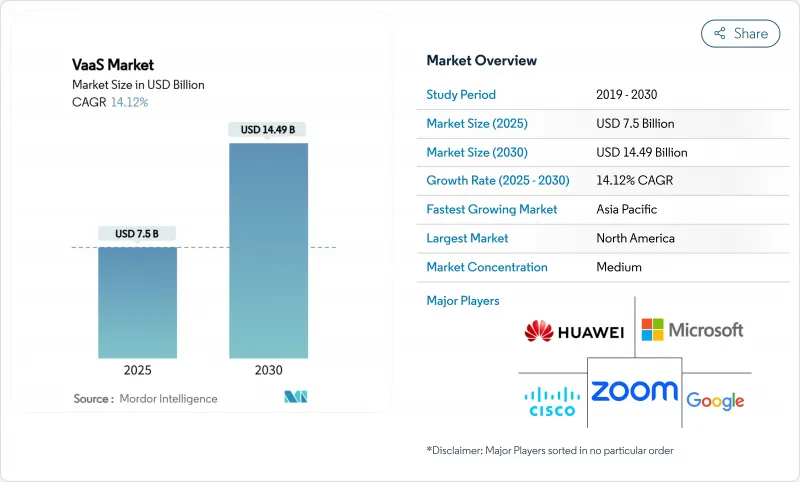
Stable cloud bandwidth pricing, deeper 5G penetration, and buyers' preference for subscription billing over capital investment continue to widen adoption. Finance chiefs increasingly tag cloud video spending as a predictable operating cost, which smooths cash flows even when IT budgets tighten. Asia-Pacific is accelerating on the back of new data-centre capacity and extensive 5G standalone roll-outs. Investors reward vendors that pair recurring revenue with compliance-ready features, prompting road maps that emphasise encryption, audit logging, and sovereign deployment templates. Heightened carbon-reduction mandates and hybrid-work retrofit programmes extend demand into facilities budgets, further reinforcing the video as a service market trajectory.
Global VaaS Market Trends and Insights
Shift from Capital Expenditure to Operating Expenditure
Enterprises redirected budgets from proprietary bridges to pay-per-use cloud video throughout 2024. A tier-one US telco reported that moving one-quarter of its video portfolio to a service model cut annual depreciation by double digits and lifted operating free cash flow. Depreciation relief often funds bandwidth upgrades, forming a self-reinforcing flywheel that multiplies usage. Finance units appreciate monthly fee visibility, which cushions VaaS spending during macro headwinds. Vendors respond by simplifying per-user licensing tiers, reducing procurement complexity. Early adopters confirm that the switch trims lifecycle support overhead because cloud platforms absorb version management.
Embedded Video APIs in Customer Applications
A European insurer distributed 40,000 personalised renewal videos in 2025 using an API gateway that pulls real-time policy data into templated scenes. Marketing departments, now direct stakeholders, accelerate purchase cycles that were previously IT-led. Integration of customer relationship management data inside video accelerates retention campaigns and supports dynamic upsell prompts. As API maturity grows, insurers embed consent capture and click-through next to playback, tightening compliance loops. This approach also shrinks hosting costs because content length can be tailored to policy complexity, reducing storage minutes per customer while boosting engagement.
Sovereign Data-Residency Requirements
An Australian banking group migrated all meeting recordings to a locally hosted instance in 2025 to align with updated prudential standards. Geo-fenced traffic routing fragments support operations and raise tooling needs for cross-region monitoring. Vendors must maintain compliance templates for multiple jurisdictions, increasing engineering overhead. Negotiating data-processing agreements lengthens sales cycles in regulated verticals. Some buyers adopt hybrid-cloud models to balance local control with global elasticity, complicating deployment architectures.
Other drivers and restraints analyzed in the detailed report include:
- Low-Latency 5G and Edge Acceleration
- Hybrid-Work Mandates Driving Room Upgrades
- Bandwidth Constraints in Emerging Economies
For complete list of drivers and restraints, kindly check the Table Of Contents.
Segment Analysis
Application-management suites accounted for the largest video as a service market share in 2024, accounting for 34% of global revenue. Enterprises rank meeting orchestration, calendar integration, and real-time security controls as baseline requirements. Low-code connectors allow human resources teams to schedule onboarding sessions without IT tickets, widening user bases and lifting per-tenant minute volumes. Vendors differentiate in meeting-lifecycle visualisations that trace attendee engagement down to reaction-emoji frequency.
Content-management platforms, however, are forecast to outpace other categories with a 16.5% CAGR to 2030. Buyers increasingly view metadata, chaptering, and compliance tagging as core. Providers expose these functions through software development kits that insert playback widgets in employee portals. The video as a service market size for content-centric modules is anticipated to expand as retention policies converge with ESG archiving mandates. Device-management submodules now surface energy metrics, letting sustainability teams track per-endpoint power draw, a value add that ties platform renewal conversations to corporate climate goals.
Enterprise computing endpoints still captured 55% of the video as a service market size in 2024. Desktop and laptop clients integrate single sign-on and policy enforcement, supporting regulated industries. Rich screen-share functions and keyboard accessibility features keep knowledge-worker engagement high. Vendors refine background-noise suppression tuned for open-plan offices, improving clarity without raising bitrate.
Mobile devices will add the most net new users at an 18% CAGR between 2025 and 2030. Flagship handsets now support cinematic mode with real-time depth mapping, encouraging marketing teams to produce internal updates entirely on mobile workflows. This shift compresses video production timelines from weeks to hours. The video as a service market share for mobile is expected to broaden once 5G coverage blankets suburban zones, removing reliability hesitation among field staff. At the room scale, demand coalesces around ceiling-mounted 360-degree cameras with intelligent audio zoning, equalising voice pickup for remote participants.
Video As A Service Market is Segmented by Platform (Application Management, Device Management, and More), Device (Mobility Devices, Enterprise Computing, Room-Based Endpoints), Service (Managed, Professional), Deployment Model (Public Cloud, Private Cloud, Hybrid Cloud), End-User Industry (Government and Defense, BFSI, and More), Geography. The Market Forecasts are Provided in Terms of Value (USD).
Geography Analysis
North America preserved leadership with 38% of global revenue in 2024, underpinned by high cloud maturity, robust capital-market appetite for recurring-revenue software, and early AI content-governance deployments. US enterprises integrate speech analytics with executive briefing libraries, while Canadian bilingual regulations spur automatic translation demand. Government-funded broadband grants sustain rural bandwidth, extending video reach into smaller municipalities. The region is also early to trial edge-compute offload, reducing central-cloud hops for IoT video analytics.
Asia-Pacific is projected to post a 17% CAGR to 2030, the fastest among all territories. Singapore added 150 MW of new colocation capacity in 2024, and Seoul doubled 5G standalone coverage, enabling regional SaaS expansion. Many ASEAN enterprises skipped legacy PBX stages altogether, so first-time video roll-outs are natively cloud-based. Linguistic diversity drives in-app caption localisation, creating competitive differentiation for providers with broad language packs. Edge nodes launched in Indonesia and the Philippines trim first-mile jitter, improving experience parity for archipelagic users.
Europe remains defined by stringent data-protection statutes and aggressive decarbonisation goals. A German automotive group replaced 8 000 inter-city flights with video in 2024, lowering Scope 3 emissions intensity by 4%. Emissions auditors accept VaaS dashboards as proxy evidence for avoided travel, anchoring video budgets inside ESG frameworks. Sovereign-cloud preferences fragment vendor support demands across multiple sub-regions. The bloc's Digital Markets Act pushes for open interoperability, nudging providers to adopt standards-based codecs and authentication plugins.
- Cisco Systems Inc.
- Zoom Video Communications Inc.
- Microsoft Corporation
- Google LLC
- Huawei Technologies Co. Ltd.
- Adobe Inc.
- Poly (HP Inc.)
- Avaya LLC
- Brightcove Inc.
- Symphony Communication Services
- Pexip AS
- LogMeIn Inc. (GoTo)
- Agora.io
- RingCentral Inc.
- 8x8 Inc.
- Amazon Web Services (Amazon Chime)
- Orange Business Services
- Vonage
- Tata Communications Ltd.
- Kaltura Inc.
- Genesys Telecommunications Labs
Additional Benefits:
- The market estimate (ME) sheet in Excel format
- 3 months of analyst support
TABLE OF CONTENTS
1 INTRODUCTION
- 1.1 Study Assumptions and Market Definition
- 1.2 Scope of the Study
2 RESEARCH METHODOLOGY
3 EXECUTIVE SUMMARY
4 MARKET LANDSCAPE
- 4.1 Market Overview
- 4.2 Market Drivers
- 4.2.1 Growing Corporate Shift from CAPEX-Heavy Video Infrastructure to OPEX-Friendly Cloud Subscriptions
- 4.2.2 Surging Consumption of Embedded Video APIs in Customer-Facing Apps (Banking, Retail, Tele-health)
- 4.2.3 Proliferation of Low-Latency 5G Networks in North America and Asia Accelerating UHD VaaS Adoption
- 4.2.4 Hybrid-Work Mandates Triggering Multi-Camera Room Upgrades Across Global 1000 Firms
- 4.2.5 AI-Powered Video Content Management Enhancing Compliance and Searchability for Regulated Industries
- 4.2.6 Rising Carbon-Reduction Targets Driving Preference for Cloud Video over Travel in Europe
- 4.3 Market Restraints
- 4.3.1 Persistent Concerns over Sovereign Data Residency in Government and BFSI Verticals
- 4.3.2 High Bandwidth Costs in Emerging African and Caribbean Markets Limiting HD Video Quality
- 4.3.3 Complex Legacy System Integration in Large Telecom and Manufacturing Enterprises
- 4.3.4 Intellectual-Property and Content-Licensing Risks in Cross-Border Video Distribution
- 4.4 Regulatory Outlook
- 4.5 Technological Outlook
- 4.6 Porter's Five Forces Analysis
- 4.6.1 Bargaining Power of Buyers
- 4.6.2 Bargaining Power of Suppliers
- 4.6.3 Threat of New Entrants
- 4.6.4 Threat of Substitutes
- 4.6.5 Intensity of Competitive Rivalry
- 4.7 Assessment of Impact of Macro-Economic Trends
5 MARKET SIZE AND GROWTH FORECASTS (VALUE)
- 5.1 By Platform
- 5.1.1 Application Management
- 5.1.2 Device Management
- 5.1.3 Network Management
- 5.1.4 Video Content Management
- 5.2 By Device
- 5.2.1 Mobility Devices
- 5.2.2 Enterprise Computing
- 5.2.3 Room-based Endpoints
- 5.3 By Service
- 5.3.1 Managed
- 5.3.2 Professional
- 5.4 By Deployment Model
- 5.4.1 Public Cloud
- 5.4.2 Private Cloud
- 5.4.3 Hybrid Cloud
- 5.5 By End-user Industry
- 5.5.1 Government and Defense
- 5.5.2 BFSI
- 5.5.3 Healthcare and Life Sciences
- 5.5.4 IT and Telecom
- 5.5.5 Media and Entertainment
- 5.5.6 Manufacturing
- 5.5.7 Education
- 5.5.8 Retail and E-Commerce
- 5.5.9 Other End-user Industries
- 5.6 By Geography
- 5.6.1 North America
- 5.6.1.1 United States
- 5.6.1.2 Canada
- 5.6.1.3 Mexico
- 5.6.2 South America
- 5.6.2.1 Brazil
- 5.6.2.2 Argentina
- 5.6.2.3 Rest of South America
- 5.6.3 Europe
- 5.6.3.1 Germany
- 5.6.3.2 United Kingdom
- 5.6.3.3 France
- 5.6.3.4 Italy
- 5.6.3.5 Spain
- 5.6.3.6 Rest of Europe
- 5.6.4 Asia-Pacific
- 5.6.4.1 China
- 5.6.4.2 Japan
- 5.6.4.3 South Korea
- 5.6.4.4 India
- 5.6.4.5 Australia
- 5.6.4.6 New Zealand
- 5.6.4.7 Rest of Asia-Pacific
- 5.6.5 Middle East and Africa
- 5.6.5.1 United Arab Emirates
- 5.6.5.2 Saudi Arabia
- 5.6.5.3 South Africa
- 5.6.5.4 Rest of Middle East and Africa
- 5.6.1 North America
6 COMPETITIVE LANDSCAPE
- 6.1 Strategic Developments
- 6.2 Vendor Positioning Analysis
- 6.3 Company Profiles (includes Global level Overview, Market level overview, Core Segments, Financials as available, Strategic Information, Products and Services, and Recent Developments)
- 6.3.1 Cisco Systems Inc.
- 6.3.2 Zoom Video Communications Inc.
- 6.3.3 Microsoft Corporation
- 6.3.4 Google LLC
- 6.3.5 Huawei Technologies Co. Ltd.
- 6.3.6 Adobe Inc.
- 6.3.7 Poly (HP Inc.)
- 6.3.8 Avaya LLC
- 6.3.9 Brightcove Inc.
- 6.3.10 Symphony Communication Services
- 6.3.11 Pexip AS
- 6.3.12 LogMeIn Inc. (GoTo)
- 6.3.13 Agora.io
- 6.3.14 RingCentral Inc.
- 6.3.15 8x8 Inc.
- 6.3.16 Amazon Web Services (Amazon Chime)
- 6.3.17 Orange Business Services
- 6.3.18 Vonage
- 6.3.19 Tata Communications Ltd.
- 6.3.20 Kaltura Inc.
- 6.3.21 Genesys Telecommunications Labs
7 MARKET OPPORTUNITIES AND FUTURE OUTLOOK
- 7.1 White-space and Unmet-Need Assessment