|
시장보고서
상품코드
1850164
상처 관리 기기 시장 : 점유율 분석, 산업 동향, 통계, 성장 예측(2025-2030년)Wound Care Management Devices - Market Share Analysis, Industry Trends & Statistics, Growth Forecasts (2025 - 2030) |
||||||
 Mordor Intelligence
상처 관리 기기 시장 규모는 2025년에 195억 4,000만 달러, 2030년에는 252억 3,000만 달러에 이르고, CAGR 5.23%를 보일 것으로 예측됩니다.
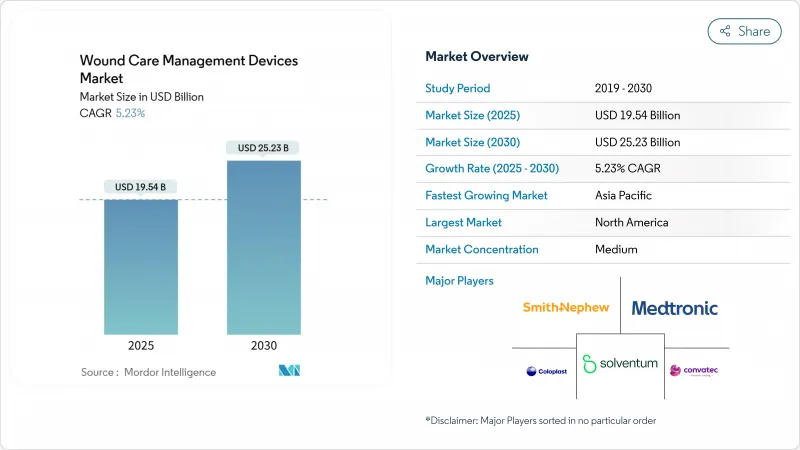
인구의 고령화, 당뇨병의 유병률의 상승, 수술의 꾸준한 성장이 지속적인 수요의 순풍이 되고 있습니다. 병원은 재입원을 억제하기 위해 음압상처치료(NPWT)나 스마트드레싱에 투자하고 있으며, 소매점은 재택치료를 가능하게 하는 시판품을 확충하고 있습니다. 조류 유래의 지혈 겔과 생체 공학적 조직 매트릭스와 같은 획기적인 제품은 치유 기간을 단축하고 장기적인 비용을 절감합니다. 미국과 유럽 연합(EU)에서는 Class I 액체 유대창고 및 기타 저위험기구에 대한 규제가 신속하게 이루어지게 되어 상품화가 가속화되고 있습니다. 시장의 기존 기업은 AI 전문가와 제휴해 드레싱재나 펌프에 실시간의 화상 처리와 의사결정 지원을 짜넣는 것으로 대응하고 있습니다.
세계 상처 관리 기기 시장 동향과 통찰
만성 및 당뇨병 상처 발생률 증가
당뇨병성 발 궤양은 현재 당뇨병 환자의 15%에 영향을 미치고 있으며, 병원은 고급 드레싱재와 지속적인 포도당 모니터링을 조합한 집학적 프로그램을 채택하는 경향이 있습니다. 시간 게이트의 중간 적외선 음향 센서는 심부 선택적 포도당 측정을 가능하게 하며, 임상가는 합병증이 발생하기 전에 치료를 조정할 수 있습니다. 조기 개입 전략은 입원 일수를 단축하고 절단 위험을 낮추고 있습니다. 지불자는 드레싱재, 센서, 원격 의료 후속을 커버하는 일괄 지불으로, 이러한 성과에 보답하고 있습니다. 그 때문에 제조업체 각 사는 드레싱재에 전자 기기를 짜넣어 수분, pH, 온도 데이터를 송신해, 만성기 의료 프로토콜에 따른 기기 설계를 실시하게 되어 있습니다.
세계 수술 건수 증가
2025년에는 세계적인 대기 수술과 외상 수술이 회복되어 고도 폐쇄 스트립, 조직 실란트, NPWT 캐니스터에 대한 수요가 증가했습니다. 두피를 대상으로 한 모스 현미경 수술의 임상시험에서 핀치 그래프트는 두 번째 인텐션 프로토콜과 비교하여 치유 시간을 단축하는 것으로 확인되었습니다. 외래수술센터(ASC)는 처리 능력이 확대됨에 따라 당일 퇴원 모델에 적합한 컴팩트한 NPWT 펌프를 도입하고 있습니다. 초음파 가이드 아래 Debreadman은 감염 위험을 피하고 실시간 영상 진단은 미국 대규모 병원에서 재입원 벌금을 줄이는 데 도움이되었습니다. 이러한 결과는 예산이 급박했음에도 불구하고 조달팀이 폐쇄 포트폴리오를 새롭게 하는 것을 뒷받침합니다.
신흥 시장의 한정 상환
동남아시아와 라틴아메리카에서는 많은 공공 보험 회사들이 여전히 기본적인 거즈만을 다루고 있기 때문에 NPWT와 생체공학적 피부 대체물의 도입이 지연되고 있습니다. 지방 클리닉에서는 종종 공급망 격차에 직면하여 접근이 더욱 제한됩니다. 각국 정부는 당뇨병성 발 궤양을 위한 첨단 드레싱재를, 1차적인 드레싱재를 사용할 수 없는 경우에 상환하는 단계적인 혜택 패키지를 시험적으로 도입하고 있지만, 예산의 상한은 여전히 엄격합니다. 국내에서 폴리우레탄 폼을 조달하고 현장에서 캐니스터를 채우는 현지 조립업체가 가격 장벽을 낮추고 있지만 임상의의 훈련은 늦었습니다. 민간 파트너십은 합리적인 가격의 격차를 메우기 위해 성과 기반의 자금 조달과 장치를 번들하기 시작했습니다.
부문 분석
상처 케어 분야는 2024년 매출의 62.43%를 차지했습니다. 이것은 임상의가 복잡한 경우에 항균성 폼, 하이드로 파이버, 휴대용 NPWT 시스템을 선호하고 사용했기 때문입니다. 이 이점은 상처 관리 기기 시장이 감염 위험을 줄이고 육아 형성을 지원하는 제품으로 축 다리를 옮기고 있음을 뒷받침합니다. 상처 폐쇄 용품(스테이플, 접착제, 흡수성 가시 봉합사 포함)은 2030년까지 연평균 복합 성장률(CAGR) 전망에서 5.87%를 기록하여 정형외과와 심혈관의 수량 증가에 지지되었습니다. 전통적인 거즈는 급성기가 적은 환경에서는 중요성을 유지하고 있지만, 수술 후 상처에는 은이나 PHMB를 스며들게 한 드레싱 재료에 점유율을 양보합니다.
드레싱재에 AI칩을 탑재한 제조업체는 습기의 자동 경고나 항균제의 임베디드 투여를 가능하게 해, 욕창 예방을 위한 병원 프로토콜에 대응하고 있습니다. 한편, 외용생물제제는 병원약국에서 외래수액센터로 이행하여 사용범위가 확대됩니다. 상처 관리 기기 시장에서는 스마트 센서층과 하이드로겔 약제 저장소를 조합한 콤비네이션 제품을 볼 수 있어 새로 발행된 번들 CPT 코드에 의한 상환을 지원하고 있습니다. 재료 과학과 디지털 모니터링을 연계시키는 공급업체의 협상력은 그룹 구매 조직의 입찰로 우위를 차지합니다.
만성 상처는 2024년 매출의 58.34%를 차지하며 당뇨병성 발궤양, 욕창, 정맥성 허벅지 궤양의 자원 강도를 반영합니다. 이러한 적응증은 장기 치료가 필요하고 재입원 감소가 감사에서 확인되면 지불자는 고급 드레싱 재료를 승인합니다. 외상과 수술 후 절개를 포함한 급성 상처는 세계 수술률 상승으로 CAGR 5.92%로 확대되고 있습니다. 화상 센터는 이식의 필요성을 줄이기 위해 생합성 피부 대체물과 결합된 효소 디브리더를 사용합니다.
전자 차트에 내장된 예측 알고리즘은 궤양 위험이 있는 환자에게 경고를 제공하여 오플로딩 신발과 습도 관리 양식의 조기 적용을 촉구합니다. 욕창 프로토콜은 현재 매트리스 에어셀을 조정하여 하중을 재분배하는 표면 센서를 채택하고 있습니다. 당뇨병성 궤양의 관리에는 관류 장애를 검출하는 핸드헬드 이미지 분광계가 유효하며, 임상의는 케어 경로의 초기 단계에서 혈관 개입을 실시하게 됩니다. 이러한 워크플로우의 변화는 상처 관리 기기 시장의 프리미엄 제품 수요를 강화합니다.
지역 분석
북미가 상처 관리 기기 시장을 선도해 2024년 시장 매출의 40.12%를 차지합니다. 정교한 보험 모델이 하이 엔드 드레싱, NPWT, 바이오 엔지니어링 조직에 자금을 제공하기 때문입니다. 미국에서는 밸류 기반 계약을 통한 일괄 결제가 신속한 폐쇄와 합병증의 감소를 보상하기 때문에 병원은 차세대 하이드로겔과 센서가 있는 형태의 평가판을 장려하고 있습니다. 식품의약국은 위험이 낮은 액체 붕대를 510(k) 클리어런스 대상에서 제외하여 소비자용 제품의 출시 기간을 단축하고 있습니다. 캐나다의 단일 지불 제도가 재택 케어 NPWT 파일럿 사업에 투자해, 2025년까지 외래 진료의 부담을 18% 삭감. 멕시코에서는 수술 시설의 정비가 진행되어 중가격대의 클로저 스트립과 폴리우레탄 필름의 입찰이 개시됩니다.
유럽은 성숙하면서도 혁신의 수용 태세가 갖추어져 있습니다. 각국의 의료 시스템은 치유 사이클의 단축을 나타내는 증거가 있으면 센서 부착 드레싱 재료를 커버하는 만성 상처 번들에 자금을 제공합니다. 독일의 병원은 새로운 욕창 보고 의무에 대응하기 위해 AI 가이드와 함께 영상 진단을 채택하고 장비 교체를 촉구하고 있습니다. 영국에서는 휴대용 이미지 태블릿을 활용한 지역 간호사 주도의 당뇨병 발 프로그램을 전개. 한편, 남유럽에서는 EU 의료기기규제(MDR) 문서에 적합한 비용 효율적인 하이드로겔을 추구하고 중견 공급업체에 틈새를 창출하고 있습니다.
아시아태평양은 2030년까지 연평균 복합 성장률(CAGR)이 6.12%로 상처 관리 기기 시장에서 가장 기세가 많은 지역입니다. 중국의 집중 일괄 조달 방식에는 NPWT 펌프가 포함되어 있으며, 가격 상한을 충족하기 위해 캐니스터와 폼 드레싱의 현지 생산이 추진되고 있습니다. 일본에서는 재택 케어용 드레싱재나 센서 패치에 환불을 실시하는 고령화 대책이 우선되어, 취약한 피부에 적합한 초박형 실리콘 접착제의 기술 혁신이 촉진됩니다. 인도의 주보험제도는 당뇨병성 발궤양을 위한 첨단적인 드레싱재를 제3차 의료시설에서 보험 적용하기 시작하여 제2급 도시에 침투하는 리셀러망의 기폭제가 되고 있습니다. 동남아시아에서는 민간병원이 원격피부과 포털을 갖춘 상처전문클리닉을 개설하여 차별화를 도모해 지역시장으로의 리치를 넓히고 있습니다.
기타 혜택 :
- 엑셀 형식 시장 예측(ME) 시트
- 3개월간의 애널리스트 서포트
목차
제1장 서론
- 조사의 전제조건과 시장의 정의
- 조사 범위
제2장 조사 방법
제3장 주요 요약
제4장 시장 상황
- 시장 개요
- 시장 성장 촉진요인
- 만성 상처 및 당뇨병성 상처의 발생률 상승
- 세계 수술 건수 증가
- 지속적인 제품과 재료의 혁신
- 재택 케어와 일회용 NPWT 기기로의 이행
- AI를 활용한 상처 영상화와 의사결정 지원
- 성과에 근거한 진료 보수 개혁
- 시장 성장 억제요인
- 신흥 시장에서의 제한적 환급
- 첨단 치료의 고액의 총비용
- 일회용 제품의 환경 부하
- 숙련된 상처 케어 간호사의 부족
- 규제 상황
- 기술의 전망
- Porter's Five Forces 분석
- 신규 참가업체의 위협
- 구매자의 협상력
- 공급기업의 협상력
- 대체품의 위협
- 경쟁 기업간 경쟁 관계
제5장 시장 규모와 성장 예측
- 제품별
- 상처 케어
- 드레싱
- 전통적인 거즈와 테이프에 의한 붕대
- 고급 드레싱
- 상처 케어 기기
- 음압 폐쇄 요법(NPWT)
- 산소·고압 시스템
- 전기자극장치
- 기타 상처 케어 기기
- 국소 약
- 기타 상처 케어 제품
- 상처 폐쇄
- 봉합사
- 외과용 스테이플러
- 조직 접착제, 스트립, 실란트, 접착제
- 상처 케어
- 상처유형별
- 만성 상처
- 당뇨병성 발궤양
- 욕창
- 정맥성 다리 궤양
- 기타 만성 상처
- 급성 상처
- 외과적 상처/외상
- 화상
- 기타 급성 상처
- 만성 상처
- 최종 사용자별
- 병원 및 전문 상처 클리닉
- 장기 간병 시설
- 재택치료 환경
- 구입 방법별
- 기관 조달
- 소매/OTC 채널
- 지역별
- 북미
- 미국
- 캐나다
- 멕시코
- 유럽
- 독일
- 영국
- 프랑스
- 이탈리아
- 스페인
- 기타 유럽
- 아시아태평양
- 중국
- 일본
- 인도
- 호주
- 한국
- 기타 아시아태평양
- 중동 및 아프리카
- GCC
- 남아프리카
- 기타 중동 및 아프리카
- 남미
- 브라질
- 아르헨티나
- 기타 남미
- 북미
제6장 경쟁 구도
- 시장 집중도
- 시장 점유율 분석
- 기업 프로파일
- Solventum
- Smith & Nephew
- ConvaTec Group
- Molnlycke Health Care
- Cardinal Health
- Coloplast
- Paul Hartmann AG
- Medtronic
- B. Braun SE
- Integra LifeSciences
- Essity Medical
- Johnson & Johnson(Ethicon)
- Baxter International
- Organogenesis
- Kinetic Concepts
- Medela AG
- Medline Industries
- Lohmann & Rauscher
- Teleflex Medical
- Devon Medical
제7장 시장 기회와 장래의 전망
SHW 25.11.07The wound care management devices market size stands at USD 19.54 billion in 2025 and is forecast to reach USD 25.23 billion by 2030, advancing at a 5.23% CAGR.
Aging populations, the rising prevalence of diabetes, and steady growth in surgical procedures provide persistent demand tailwinds . Hospitals are investing in negative-pressure wound therapy (NPWT) and smart dressings to curb readmissions, while retailers expand over-the-counter offerings that empower home-based treatment. Breakthroughs such as algae-derived hemostatic gels and bioengineered tissue matrices are shortening healing times and lowering long-term costs. Regulatory pathways in the United States and the European Union now fast-track class-I liquid bandages and other low-risk devices, accelerating commercialization. Market incumbents respond by forging alliances with AI specialists to embed real-time imaging and decision support into dressings and pumps.
Global Wound Care Management Devices Market Trends and Insights
Rising Incidence of Chronic & Diabetic Wounds
Diabetic foot ulcers now affect 15% of patients living with diabetes, driving hospitals to adopt multidisciplinary programs that pair advanced dressings with continuous glucose monitoring. Time-gated mid-infrared optoacoustic sensors enable depth-selective glucose readings, allowing clinicians to adjust therapy before complications arise. Early intervention strategies are shrinking hospitalization days and lowering amputation risks. Payers reward these outcomes with bundled payments that cover dressings, sensors, and telehealth follow-ups. Manufacturers are therefore integrating electronics into dressings to transmit moisture, pH, and temperature data, aligning device design with chronic-care protocols.
Escalating Global Surgical Volumes
Worldwide elective and trauma procedures rebounded in 2025, increasing demand for advanced closure strips, tissue sealants, and NPWT canisters. Mohs micrographic surgery trials on the scalp confirmed that pinch grafting reduces healing times versus second-intention protocols . As ambulatory surgical centers scale throughput, they deploy compact NPWT pumps that fit same-day discharge models. Ultrasound-guided debridement heads off infection risk, and real-time imaging helped cut readmission penalties at high-volume hospitals in the United States. These results encourage procurement teams to refresh closure portfolios despite budget pressures.
Limited Reimbursement in Emerging Markets
Many public insurers in Southeast Asia and Latin America still cover only basic gauze, delaying uptake of NPWT or bioengineered skin substitutes. Rural clinics often face supply-chain gaps that further limit access. Governments are piloting tiered benefit packages that reimburse advanced dressings for diabetic foot ulcers when primary dressings fail, but budget ceilings remain tight. Local assemblers that source polyurethane foams domestically and fill canisters onsite lower price barriers, yet clinician training lags. Public-private partnerships are beginning to bundle devices with outcome-based financing to bridge the affordability gap.
Other drivers and restraints analyzed in the detailed report include:
- Continuous Product & Material Innovations
- Shift Toward Home-Care & Single-Use NPWT Devices
- High Total Cost of Advanced Therapies
For complete list of drivers and restraints, kindly check the Table Of Contents.
Segment Analysis
The wound care segment held 62.43% of 2024 revenue as clinicians favored antimicrobial foams, hydrofibers, and portable NPWT systems for complex cases. This dominance underscores how the wound care management devices market continues pivoting toward products that cut infection risk and support granulation. Wound closure items-including staples, adhesives, and absorbable barbed sutures-recorded a 5.87% CAGR outlook through 2030, buoyed by growing orthopedics and cardiovascular volumes. Traditional gauze retains relevance in low-acuity settings but yields share to dressings imbued with silver or PHMB for postoperative wounds.
Manufacturers integrating AI chips into dressings enable automatic moisture alerts and dosing of embedded antimicrobials, meeting hospital protocols for pressure-injury prevention. Meanwhile, topical biologics migrate from hospital pharmacies to outpatient infusion centers, expanding reach. The wound care management devices market is seeing combination products that pair a smart sensor layer with a hydrogel drug reservoir, supporting reimbursement under newly issued bundled CPT codes. Suppliers that align material science with digital monitoring gain bargaining power in tenders set by group purchasing organizations.
Chronic wounds controlled 58.34% of 2024 revenue, reflecting the resource intensity of diabetic foot ulcers, pressure injuries, and venous leg ulcers. These indications demand prolonged therapy, and payers approve high-end dressings when audits confirm reduced readmissions. Acute wounds, including trauma and post-operative incisions, are expanding at a 5.92% CAGR thanks to rising global surgery rates. Burn centers adopt enzymatic debriders paired with biosynthetic skin substitutes to reduce grafting needs.
Predictive algorithms embedded in electronic health records flag patients at ulcer risk, prompting early application of off-loading shoes and moisture-managing foams. Pressure-injury protocols now employ surface sensors that adjust mattress air cells to redistribute load. Diabetic ulcer management benefits from handheld imaging spectrometers that detect perfusion deficits, steering clinicians toward vascular interventions earlier in the care pathway. Such workflow changes reinforce premium product demand within the wound care management devices market.
The Wound Care Management Devices Market is Segmented by Product (Wound Care [Dressings, Wound-Care Devices, and More] and Wound Closure), Wound Type (Chronic Wounds and Acute Wounds), End User (Hospitals & Specialty Wound Clinics and More), Mode of Purchase (Institutional Procurement and Retail / OTC Channel), and Geography (North America, and More). The Market and Forecasts are Provided in Terms of Value (USD).
Geography Analysis
North America leads the wound care management devices market, generating 40.12% of the market revenue in 2024. As sophisticated insurance models fund high-end dressings, NPWT, and bioengineered tissues. In the United States, bundled payments under value-based contracts reward quicker closure and fewer complications, encouraging hospitals to trial next-generation hydrogels and sensor-enabled foams. The Food and Drug Administration exempts low-risk liquid bandages from 510(k) clearance, shortening launch times for consumer-oriented products. Canada's single-payer system invests in home-care NPWT pilots that cut outpatient clinic load by 18% in 2025. Mexico continues upgrading surgical facilities, opening bids for mid-priced closure strips and polyurethane films.
Europe remains a mature yet innovation-receptive arena. National health systems fund chronic wound bundles that cover sensor-enabled dressings when evidence shows shorter healing cycles. Germany's hospitals adopt AI-guided imaging to comply with new pressure-injury reporting mandates, stimulating device replacement. The United Kingdom rolls out community nurse-led diabetic foot programs supported by portable imaging tablets. Meanwhile, Southern Europe pursues cost-effective hydrogels that still meet EU Medical Device Regulation (MDR) documentation, creating niches for mid-range suppliers.
Asia-Pacific registers the fastest momentum for the wound care management devices market, registering a CAGR of 6.12% through 2030, fueled by healthcare infrastructure expansion and growing elective surgery capacity. China's centralized bulk-procurement schemes now include NPWT pumps, driving local manufacture of canisters and foam dressings to meet price caps. Japan prioritizes aging-in-place policies that reimburse home-care dressings and sensor patches, fostering innovation in ultra-thin silicone adhesives suited to fragile skin. India's state insurance programs begin covering advanced dressings for diabetic foot ulcers in tertiary centers, catalyzing distributor networks that penetrate tier-2 cities. Throughout Southeast Asia, private hospitals differentiate through specialty wound clinics equipped with tele-dermatology portals, widening regional market reach.
- Solventum
- Smiths Group
- Convatec
- Molnlycke Health Care
- Cardinal Health
- Coloplast
- Hartmann Group
- Medtronic
- B. Braun
- Integra LifeSciences
- Essity Medical
- Johnson & Johnson
- Baxter
- Organogenesis
- Kinetic Concepts
- Medela
- Medline Industries
- Lohmann & Rauscher
- Teleflex Medical
- Devon Medical
Additional Benefits:
- The market estimate (ME) sheet in Excel format
- 3 months of analyst support
TABLE OF CONTENTS
1 Introduction
- 1.1 Study Assumptions & Market Definition
- 1.2 Scope of the Study
2 Research Methodology
3 Executive Summary
4 Market Landscape
- 4.1 Market Overview
- 4.2 Market Drivers
- 4.2.1 Rising incidence of chronic & diabetic wounds
- 4.2.2 Escalating global surgical volumes
- 4.2.3 Continuous product & material innovations
- 4.2.4 Shift toward home-care & single-use NPWT devices
- 4.2.5 AI-enabled wound imaging & decision support
- 4.2.6 Outcome-based reimbursement reforms
- 4.3 Market Restraints
- 4.3.1 Limited reimbursement in emerging markets
- 4.3.2 High total cost of advanced therapies
- 4.3.3 Environmental burden of single-use disposables
- 4.3.4 Shortage of skilled wound-care nurses
- 4.4 Regulatory Landscape
- 4.5 Technological Outlook
- 4.6 Porters Five Forces Analysis
- 4.6.1 Threat of New Entrants
- 4.6.2 Bargaining Power of Buyers
- 4.6.3 Bargaining Power of Suppliers
- 4.6.4 Threat of Substitutes
- 4.6.5 Competitive Rivalry
5 Market Size & Growth Forecasts (Value, USD)
- 5.1 By Product
- 5.1.1 Wound Care
- 5.1.1.1 Dressings
- 5.1.1.1.1 Traditional Gauze & Tape Dressings
- 5.1.1.1.2 Advanced Dressings
- 5.1.1.2 Wound-Care Devices
- 5.1.1.2.1 Negative Pressure Wound Therapy (NPWT)
- 5.1.1.2.2 Oxygen & Hyperbaric Systems
- 5.1.1.2.3 Electrical Stimulation Devices
- 5.1.1.2.4 Other Wound Care Devices
- 5.1.1.3 Topical Agents
- 5.1.1.4 Other Wound Care Products
- 5.1.2 Wound Closure
- 5.1.2.1 Sutures
- 5.1.2.2 Surgical Staplers
- 5.1.2.3 Tissue Adhesives, Strips, Sealants & Glues
- 5.1.1 Wound Care
- 5.2 By Wound Type
- 5.2.1 Chronic Wounds
- 5.2.1.1 Diabetic Foot Ulcer
- 5.2.1.2 Pressure Ulcer
- 5.2.1.3 Venous Leg Ulcer
- 5.2.1.4 Other Chronic Wounds
- 5.2.2 Acute Wounds
- 5.2.2.1 Surgical/Traumatic Wounds
- 5.2.2.2 Burns
- 5.2.2.3 Other Acute Wounds
- 5.2.1 Chronic Wounds
- 5.3 By End User
- 5.3.1 Hospitals & Specialty Wound Clinics
- 5.3.2 Long-term Care Facilities
- 5.3.3 Home-Healthcare Settings
- 5.4 By Mode of Purchase
- 5.4.1 Institutional Procurement
- 5.4.2 Retail / OTC Channel
- 5.5 By Geography
- 5.5.1 North America
- 5.5.1.1 United States
- 5.5.1.2 Canada
- 5.5.1.3 Mexico
- 5.5.2 Europe
- 5.5.2.1 Germany
- 5.5.2.2 United Kingdom
- 5.5.2.3 France
- 5.5.2.4 Italy
- 5.5.2.5 Spain
- 5.5.2.6 Rest of Europe
- 5.5.3 Asia-Pacific
- 5.5.3.1 China
- 5.5.3.2 Japan
- 5.5.3.3 India
- 5.5.3.4 Australia
- 5.5.3.5 South Korea
- 5.5.3.6 Rest of Asia-Pacific
- 5.5.4 Middle East and Africa
- 5.5.4.1 GCC
- 5.5.4.2 South Africa
- 5.5.4.3 Rest of Middle East and Africa
- 5.5.5 South America
- 5.5.5.1 Brazil
- 5.5.5.2 Argentina
- 5.5.5.3 Rest of South America
- 5.5.1 North America
6 Competitive Landscape
- 6.1 Market Concentration
- 6.2 Market Share Analysis
- 6.3 Company Profiles (includes Global level Overview, Market level overview, Core Segments, Financials as available, Strategic Information, Market Rank/Share for key companies, Products & Services, and Recent Developments)
- 6.3.1 Solventum
- 6.3.2 Smith & Nephew
- 6.3.3 ConvaTec Group
- 6.3.4 Molnlycke Health Care
- 6.3.5 Cardinal Health
- 6.3.6 Coloplast
- 6.3.7 Paul Hartmann AG
- 6.3.8 Medtronic
- 6.3.9 B. Braun SE
- 6.3.10 Integra LifeSciences
- 6.3.11 Essity Medical
- 6.3.12 Johnson & Johnson (Ethicon)
- 6.3.13 Baxter International
- 6.3.14 Organogenesis
- 6.3.15 Kinetic Concepts
- 6.3.16 Medela AG
- 6.3.17 Medline Industries
- 6.3.18 Lohmann & Rauscher
- 6.3.19 Teleflex Medical
- 6.3.20 Devon Medical
7 Market Opportunities & Future Outlook
- 7.1 White-space & Unmet-need Assessment