
|
시장보고서
상품코드
1907261
프랑스의 상처 관리 기기 : 시장 점유율 분석, 업계 동향과 통계, 성장 예측(2026-2031년)France Wound Care Management Devices - Market Share Analysis, Industry Trends & Statistics, Growth Forecasts (2026 - 2031) |
||||||
 Mordor Intelligence
프랑스의 상처 관리 기기 시장은 2025년 8억 1,000만 달러로 평가되었고, 2026년 8억 5,000만 달러에서 2031년까지 10억 9,000만 달러에 이를 것으로 예측됩니다.
예측기간(2026-2031년)의 CAGR은 5.08%를 나타낼 것으로 예상됩니다.
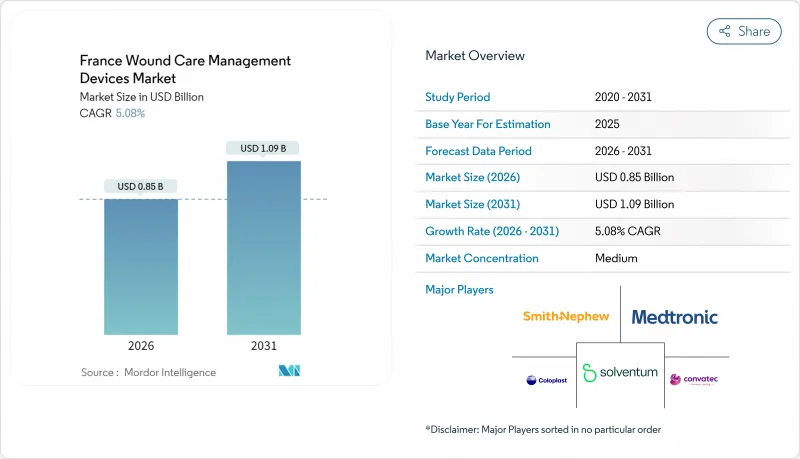
2023년 국가 보건 계정에 부담을 준 24억 유로의 공공병원 적자에도 불구하고 시장 확대는 지속되고 있습니다. 성장은 가정에서 시행되는 음압 상처 치료(NPWT)에 대한 비용을 보상하고 원격의료를 표준 치료 경로에 통합하는 ‘가정 내 입원(Hospitalisation a Domicile)’ 체계에 기반합니다. 만성 질환 유병률 증가, 특히 400만 명의 제2형 당뇨병 환자로 인해 치유 시간을 단축하는 첨단 드레싱 수요가 급증하고 있습니다. 당일 퇴원 수술이 전국 수술 건수의 37.7%에 달하면서 외과적 시술량도 증가해 상처 봉합 장치 판매량이 늘고 있습니다. 한편, 인공지능 플랫폼이 월 60만 건 이상의 상처 평가를 지원하며 임상 현장에서 디지털 기술이 빠르게 도입되고 있음을 보여줍니다.
프랑스의 상처 관리 기기 시장 동향 및 분석
만성 상처와 당뇨병성 궤양의 증례 증가
프랑스에는 400만 명 이상의 제2형 당뇨병 환자가 보고되어, 평생 19%에서 34%에 달하는 발 궤양 위험에 노출된 대규모 집단을 형성합니다. 월평균 치료 비용은 외래 치료 시 697유로, 입원 치료 시 1,556유로에 달해 합병증 예방을 위한 생체활성 드레싱 도입에 강력한 유인 요인이 되고 있습니다. 임상적 긴급성은 조기 개입을 유도하는 AI 기반 영상 플랫폼의 병원 도입을 촉진합니다. 스위프트 메디컬의 도구만으로도 매월 60만 건 이상의 평가를 처리합니다. 이에 따라 포도당 반응형 스마트 붕대와 일회용 NPWT 시스템은 시범 운영에서 일상적 진료로 빠르게 전환되며, 프랑스 상처 관리 기기 시장의 지속적인 물량 성장을 이끌고 있습니다.
고령화 인구 증가
2050년까지 노년층이 전체 인구의 30%를 차지하며 조직 회복을 지연시키는 동반 질환 유병률을 높일 전망입니다. 현재 프랑스 제2형 당뇨병 환자의 11.2%가 말초동맥질환을 앓고 있어 궤양 관리의 복잡성을 가중시키고 있습니다. 정책 입안자들은 고령화 대비 프로그램과 재택 간호 지원 자금으로 대응하며, 이는 첨단 NPWT에 대한 HaD(병원 외 치료) 환급 제도와 연계됩니다. CICAT 네트워크를 통한 원격 추적 관리는 만성 상처의 75%를 개선하고 입원률을 72% 감소시켜 원격 개입 모델의 유효성을 입증했습니다. 이에 따라 의료기기 제조사들은 비임상 환경에서 고령 사용자의 요구를 충족시키기 위해 인체공학 및 연결성에 주력하고 있습니다.
고급 상처 관리 제품의 높은 비용
2023년 공공 병원은 24억 유로의 적자를 기록했으며, 이는 임상적 가치에도 불구하고 구매 관리자들이 프리미엄 제품을 면밀히 검토하도록 촉발했습니다. AI 기반 드레싱과 생체전기 랩은 예산을 압박하는 가격표를 달고 있으며, 특히 인력 부족으로 중환자실 병상의 27%가 이미 간헐적 폐쇄에 직면한 농촌 지역 병원에서 더욱 그렇습니다. 따라서 공급업체 전략은 가치 기반 계약과 초기 비용 장벽을 완화하면서도 마진을 보호하는 저은(低銀) 또는 수산화마그네슘 항균 대체제로 전환되고 있습니다.
부문 분석
상처 관리 제품은 2025년 매출의 63.98%를 차지하며, 프랑스의 급성 및 만성 적응증 전반에 걸쳐 필수적인 역할을 반영했습니다. 이러한 우위 덕분에 프랑스 상처 관리 기기 시장은 검증된 거즈 형식을 대체하지 않으면서도 pH 센서, 미세유체 채널 및 항균 나노입자를 통합한 스마트 드레싱을 확장할 수 있습니다. Smith+Nephew와 Paul Hartmann은 실리콘 초흡수성 제품군을 확장하는 한편, 국내 중견 기업들은 적용 편의성과 HaD(고도 의료) 보험 적용을 결합한 일회용 NPWT 키트를 출시하고 있습니다. 반면, 상처 봉합 기기는 생분해성 스테이플과 피부 접착제가 필요한 외래 수술 및 로봇 봉합 플랫폼의 수요에 힘입어 2031년까지 연평균 5.74%의 높은 성장률을 기록할 전망입니다. 국소 제제와 생물학적 제제는 점유율이 낮지만, ILP100-Topical과 같은 프로바이오틱스 함유 젤에 대한 연구는 향후 시장 다각화를 시사합니다. 원격 진단 플랫폼은 이제 드레싱 선택을 머신러닝 기반 상처 평가와 연계하여 병원 구매자 사이에서 단위 가치와 충성도 모두를 높이고 있습니다.
프랑스의 상처 관리 기기 시장 규모는 새로운 생체활성 제형이 더 빠른 규제 승인 경로를 확보함에 따라 꾸준히 상승할 것으로 전망됩니다. 기업들이 클라우드 연결 스캐너를 제품 번들에 통합하여 임상의에게 진료 현장의 지침을 제공하고, 차세대 제품 출시의 기반이 되는 풍부한 데이터 루프를 확보함에 따라 경쟁적 우위는 더욱 확대되고 있습니다. 빈번한 드레싱 교체로 반복 판매가 보장되고, NPWT 소모품이 내구성 있는 펌프를 중심으로 수명 주기 수익을 연장함에 따라 마진은 여전히 견고합니다. 이에 따라 주요 공급업체들은 이중 성장 경로를 목표로 삼고 있습니다. 3차 병원을 위한 고급 스마트 소재와 인력이 부족한 농촌 의료 환경을 위한 비용 효율적인 거즈 혁신 제품입니다.
2025년 매출의 58.83%를 차지한 만성 상처 부문은 당뇨병성 족부 궤양과 욕창이 프랑스 의료비 지불자에게 주는 부담을 부각시킨다. 이 부문은 저산소성 사지의 조직 재생을 위한 전기치료 랩이나 산소 확산 드레싱 같은 맞춤형 치료법에 의존합니다. 만성 상처 관련 프랑스 상처 관리 기기 시장 점유율은 1차 치료 실패 시 정교한 제품 사용을 의무화하는 임상 프로토콜로 방어됩니다. 기기 선택은 종종 삼출물 수준과 미생물 부하를 계층화하는 AI 영상 점수에 영향을 받아, 처방자가 고급 폼이나 항균성 알지네이트 층을 선택하도록 유도합니다. HaD NPWT(고압 산소 치료)에 대한 새로운 보험 적용 패키지는 과거 장기간 입원이 필요했던 궤양의 가정 내 관리를 지원함으로써 판매를 더욱 공고히 합니다.
급성 상처는 규모는 작지만, 당일 수술 건수가 증가함에 따라 2031년까지 5.67%의 연평균 성장률(CAGR)을 보일 전망입니다. 이 분야에서는 필름 드레싱과 시아노아크릴레이트 접착제가 주류를 이루지만, 로봇 및 복강경 절개 부위에 맞춰 설계된 흡수성 하이드로파이버 매트릭스에 빠르게 자리를 내주고 있습니다. 화상 및 외상 사례는 감염 위험을 의료진에게 경고하는 통합 온도 센서가 장착된 하이드로겔 드레싱에 대한 수요를 창출합니다. 프랑스 급성 상처 관리 장치 시장 규모는 민간 출시 전 가혹한 환경에서 혁신 기술을 시험하는 군수 조달 계약의 혜택도 받고 있습니다. 이러한 역학이 종합적으로 작용하여 만성적 복잡성이 기본 수요를 유지하는 한편 급성 수요 확장이 점진적 성장을 더하는 균형 잡힌 수요 전망을 창출합니다.
기타 혜택 :
- 엑셀 형식 시장 예측(ME) 시트
- 3개월간의 애널리스트 지원
자주 묻는 질문
목차
제1장 서론
- 조사의 전제조건과 시장 정의
- 조사 범위
제2장 조사 방법
제3장 주요 요약
제4장 시장 상황
- 시장 개요
- 시장 성장 촉진요인
- 만성 상처 및 당뇨병성 궤양의 증례 증가
- 고령화 인구 증가
- 수술 절차 증가
- 첨단 드레싱 및 NPWT 기술 발전
- 입원 재택치료(HaD) 보험 적용 NPWT 확대
- ARS가 승인한 원격 상처 관리 플랫폼
- 시장 성장 억제요인
- 고급 상처 관리 제품의 높은 비용
- 엄격한 상환 상한
- 프랑스 농촌 지역의 전문 상처 관리 간호사 부족
- 친환경 설계/일회용 플라스틱 규제로 인한 준수 비용 증가
- 규제 상황
- 기술의 전망
- Porter's Five Forces 분석
- 신규 참가업체의 위협
- 구매자의 협상력
- 공급기업의 협상력
- 대체품의 위협
- 경쟁 기업간 경쟁 관계
제5장 시장 규모와 성장 예측
- 제품별
- 상처 관리
- 드레싱
- 기존 거즈, 테이프 드레싱
- 첨단 상처 피복재
- 상처 관리 기기
- 음압상처치료(NPWT)
- 산소 요법 및 고압 산소 요법 시스템
- 전기 자극 기기
- 기타 상처 관리 기기
- 국소 제제
- 기타
- 드레싱
- 상처 봉합
- 봉합사
- 수술용 스테이플러
- 조직 접착제, 스트립, 실란트 및 접착제
- 상처 관리
- 상처 유형별
- 만성 상처
- 당뇨병성 족부 궤양
- 욕창
- 정맥성 허벅지 궤양
- 기타 만성 상처
- 급성 상처
- 수술 상처, 외상성 상처
- 화상
- 기타 급성 상처
- 만성 상처
- 최종 사용자별
- 병원 및 전문 상처 클리닉
- 장기 요양 시설
- 재택치료 환경
- 구입 방법별
- 기관 조달
- 소매/OTC 채널
제6장 경쟁 구도
- 시장 집중도
- 시장 점유율 분석
- 기업 프로파일
- Solventum
- Smith & Nephew plc
- Paul Hartmann AG
- Urgo Medical(Laboratoires Urgo)
- Molnlycke Health Care AB
- B. Braun SE
- Coloplast A/S
- Cardinal Health Inc.
- ConvaTec Group plc
- Medtronic plc
- Integra LifeSciences
- Lohmann & Rauscher
- Johnson & Johnson
- Baxter International Inc.
- BSN medical(Essity)
- Laboratoires Genevrier
- Hollister Incorporated
- Systagenix Wound Management
- Medline Industries
- Derma Sciences(Integra)
제7장 시장 기회와 장래의 전망
HBR 26.02.04The France wound care management devices market was valued at USD 0.81 billion in 2025 and estimated to grow from USD 0.85 billion in 2026 to reach USD 1.09 billion by 2031, at a CAGR of 5.08% during the forecast period (2026-2031).
Expansion continues despite a EUR 2.4 billion public-hospital deficit that weighed on national health accounts in 2023. Growth rests on the country's Hospitalisation a Domicile framework, which reimburses negative-pressure wound therapy (NPWT) delivered at home and embeds telehealth into standard care pathways. Rising chronic-disease prevalence, notably 4 million residents with type 2 diabetes, intensifies demand for advanced dressings that shorten healing times. Surgical volumes are also lifting unit sales of wound closure devices as same-day discharge procedures reach 37.7% of national surgery output. Meanwhile, artificial-intelligence platforms now support over 600,000 wound evaluations per month, signalling swift digital adoption in clinical settings .
France Wound Care Management Devices Market Trends and Insights
Increasing cases of chronic wounds and diabetic ulcers
France reports more than 4 million type 2 diabetes patients, exposing a large cohort to foot-ulcer risk that ranges between 19% and 34% across their lifetime. Average monthly treatment costs reach EUR 697 for outpatient care and EUR 1,556 for hospital management, creating strong incentives to adopt bioactive dressings that prevent complications. Clinical urgency drives hospitals to deploy AI-enabled imaging platforms that guide early intervention; Swift Medical's tool alone processes more than 600,000 assessments every month. Glucose-responsive smart bandages and single-use NPWT systems therefore move quickly from pilot testing to routine practice, positioning the France wound care management devices market for sustained volume growth.
Rising geriatric population
Older adults will form 30% of the country's population by 2050, lifting prevalence of comorbidities that slow tissue repair. Peripheral arterial disease now affects 11.2% of French type 2 diabetes patients, adding complexity to ulcer management . Policy makers respond with dependency-prevention programs and funding for home-based care, which dovetail with HaD reimbursement for advanced NPWT. Tele-follow-up through the CICAT network improved 75% of chronic wounds while cutting hospitalisations by 72%, validating remote intervention models. Device makers therefore focus on ergonomics and connectivity to meet the needs of ageing users in non-clinical settings.
High cost of advanced wound care products
Public hospitals posted a EUR 2.4 billion deficit in 2023, prompting procurement managers to scrutinise premium products despite their clinical merit. AI-enabled dressings and bioelectrical wraps carry price tags that strain budgets, especially in rural units where 27% of intensive-care beds already face intermittent closure due to staff gaps. Vendor strategies therefore pivot to value-based contracts and low-silver or magnesium-hydroxide antimicrobial substitutes that protect margins while easing upfront cost barriers.
Other drivers and restraints analyzed in the detailed report include:
- Increase in surgical procedures
- Technological advances in advanced dressings and NPWT
- Stringent reimbursement ceilings
For complete list of drivers and restraints, kindly check the Table Of Contents.
Segment Analysis
Wound care products represented 63.98% of 2025 revenue, reflecting their indispensable role across French acute and chronic indications. This dominance lets the France wound care management devices market scale smart dressings that incorporate pH sensors, microfluidic channels and antimicrobial nanoparticles without displacing tried-and-true gauze formats. Smith+Nephew and Paul Hartmann expand silicone super-absorbent portfolios, while domestic mid-caps introduce single-use NPWT kits that marry ease of application with HaD reimbursement. In contrast, wound closure devices post a brisk 5.74% CAGR to 2031, fuelled by ambulatory surgery and robotic stitching platforms that demand bio-resorbable staples and skin adhesives. Although topical agents and biologics hold smaller shares, research into probiotic-laced gels such as ILP100-Topical suggests further diversification ahead. Remote-diagnostic platforms now link dressing selection to machine-learning wound scoring, raising both unit value and stickiness among hospital buyers.
The France wound care management devices market size attached to wound care products is projected to climb steadily as new bioactive formulations secure faster regulatory clearance pathways. Competitive moats widen where firms integrate cloud-linked scanners into product bundles, giving clinicians point-of-care guidance and giving companies richer data loops that underpin next-generation launches. Margins remain robust because frequent dressing changes lock in repeat sales, while NPWT consumables extend lifecycle revenue around a durable pump. As a result, leading suppliers target dual growth tracks: up-market smart materials for tertiary hospitals and cost-sensitive gauze innovations for sparsely staffed rural care settings.
Chronic wounds accounted for 58.83% of revenue in 2025, underscoring the burden diabetic foot ulcers and pressure sores place on French payers. This segment relies on customised therapies such as electroceutical wraps and oxygen-diffusion dressings that regenerate tissue in hypoxic limbs. The France wound care management devices market share linked to chronic wounds is defended by clinical protocols that mandate sophisticated products after first-line measures fail. Device selection is often influenced by AI imaging scores that stratify exudate level and microbial load, steering prescribers toward advanced foams or antimicrobial alginate layers. New reimbursement bundles for HaD NPWT further anchor sales by supporting at-home management for ulcers that once required prolonged inpatient stays.
Acute wounds, though smaller, display a 5.67% CAGR through 2031 as day-case surgery volumes climb. Here, film dressings and cyanoacrylate glues dominate but rapidly give ground to absorbent hydro-fiber matrices designed for robotic and laparoscopic incision profiles. Burns and trauma cases introduce demand for hydrogel dressings with integrated temperature sensors that alert clinicians to infection risk. The France wound care management devices market size for acute wounds also benefits from military procurement contracts that test innovations in austere settings before civilian rollout. Collectively, these dynamics produce a balanced demand outlook in which chronic complexity sustains baseline volumes while acute expansion adds incremental growth.
The France Wound Care Management Devices Market is Segmented by Product (Wound Care [Dressings, Wound-Care Devices, and More] and Wound Closure [Sutures, Surgical Staplers, and More]), Wound Type (Chronic Wounds and Acute Wounds), End User (Hospitals & Specialty Wound Clinics and More), and Mode of Purchase (Institutional Procurement and Retail / OTC Channel). The Market and Forecasts are Provided in Terms of Value (USD).
List of Companies Covered in this Report:
- Solventum
- Smiths Group
- Hartmann Group
- Urgo Medical (Laboratoires Urgo)
- Molnlycke Health Care
- B. Braun
- Coloplast
- Cardinal Health
- ConvaTec Group plc
- Medtronic
- Integra LifeSciences
- Lohmann & Rauscher
- Johnson & Johnson
- Baxter
- BSN medical (Essity)
- Laboratoires Genevrier
- Hollister
- Systagenix Wound Management
- Medline Industries
- Derma Sciences (Integra)
Additional Benefits:
- The market estimate (ME) sheet in Excel format
- 3 months of analyst support
TABLE OF CONTENTS
1 Introduction
- 1.1 Study Assumptions & Market Definition
- 1.2 Scope of the Study
2 Research Methodology
3 Executive Summary
4 Market Landscape
- 4.1 Market Overview
- 4.2 Market Drivers
- 4.2.1 Increasing cases of chronic wounds & diabetic ulcers
- 4.2.2 Rising geriatric population
- 4.2.3 Increase in surgical procedures
- 4.2.4 Technological advances in advanced dressings & NPWT
- 4.2.5 Expansion of Hospitalisation Domicile (HaD) reimbursed NPWT
- 4.2.6 Tele-wound-care platforms endorsed by ARS
- 4.3 Market Restraints
- 4.3.1 High cost of advanced wound care products
- 4.3.2 Stringent reimbursement ceilings
- 4.3.3 Shortage of specialised wound-care nurses in rural France
- 4.3.4 Eco-design / single-use-plastic rules raising compliance costs
- 4.4 Regulatory Landscape
- 4.5 Technological Outlook
- 4.6 Porters Five Forces Analysis
- 4.6.1 Threat of New Entrants
- 4.6.2 Bargaining Power of Buyers
- 4.6.3 Bargaining Power of Suppliers
- 4.6.4 Threat of Substitutes
- 4.6.5 Intensity of Competitive Rivalry
5 Market Size & Growth Forecasts (Value, USD)
- 5.1 By Product
- 5.1.1 Wound Care
- 5.1.1.1 Dressings
- 5.1.1.1.1 Traditional Gauze & Tape Dressings
- 5.1.1.1.2 Advanced Dressings
- 5.1.1.2 Wound-Care Devices
- 5.1.1.2.1 Negative Pressure Wound Therapy (NPWT)
- 5.1.1.2.2 Oxygen & Hyperbaric Systems
- 5.1.1.2.3 Electrical Stimulation Devices
- 5.1.1.2.4 Other Wound Care Devices
- 5.1.1.3 Topical Agents
- 5.1.1.4 Other Wound Care Products
- 5.1.1.1 Dressings
- 5.1.2 Wound Closure
- 5.1.2.1 Sutures
- 5.1.2.2 Surgical Staplers
- 5.1.2.3 Tissue Adhesives, Strips, Sealants & Glues
- 5.1.1 Wound Care
- 5.2 By Wound Type
- 5.2.1 Chronic Wounds
- 5.2.1.1 Diabetic Foot Ulcer
- 5.2.1.2 Pressure Ulcer
- 5.2.1.3 Venous Leg Ulcer
- 5.2.1.4 Other Chronic Wounds
- 5.2.2 Acute Wounds
- 5.2.2.1 Surgical/Traumatic Wounds
- 5.2.2.2 Burns
- 5.2.2.3 Other Acute Wounds
- 5.2.1 Chronic Wounds
- 5.3 By End User
- 5.3.1 Hospitals & Specialty Wound Clinics
- 5.3.2 Long-term Care Facilities
- 5.3.3 Home-Healthcare Settings
- 5.4 By Mode of Purchase
- 5.4.1 Institutional Procurement
- 5.4.2 Retail / OTC Channel
6 Competitive Landscape
- 6.1 Market Concentration
- 6.2 Market Share Analysis
- 6.3 Company Profiles (includes Global level Overview, Market level overview, Core Segments, Financials as available, Strategic Information, Market Rank/Share for key companies, Products & Services, and Recent Developments)
- 6.3.1 Solventum
- 6.3.2 Smith & Nephew plc
- 6.3.3 Paul Hartmann AG
- 6.3.4 Urgo Medical (Laboratoires Urgo)
- 6.3.5 Molnlycke Health Care AB
- 6.3.6 B. Braun SE
- 6.3.7 Coloplast A/S
- 6.3.8 Cardinal Health Inc.
- 6.3.9 ConvaTec Group plc
- 6.3.10 Medtronic plc
- 6.3.11 Integra LifeSciences
- 6.3.12 Lohmann & Rauscher
- 6.3.13 Johnson & Johnson
- 6.3.14 Baxter International Inc.
- 6.3.15 BSN medical (Essity)
- 6.3.16 Laboratoires Genevrier
- 6.3.17 Hollister Incorporated
- 6.3.18 Systagenix Wound Management
- 6.3.19 Medline Industries
- 6.3.20 Derma Sciences (Integra)
7 Market Opportunities & Future Outlook
- 7.1 White-space & Unmet-need Assessment