|
시장보고서
상품코드
1850977
전기자동차 파워트레인 시장 : 시장 점유율 분석, 산업 동향, 통계, 성장 예측(2025-2030년)Electric Vehicle Powertrain - Market Share Analysis, Industry Trends & Statistics, Growth Forecasts (2025 - 2030) |
||||||
 Mordor Intelligence
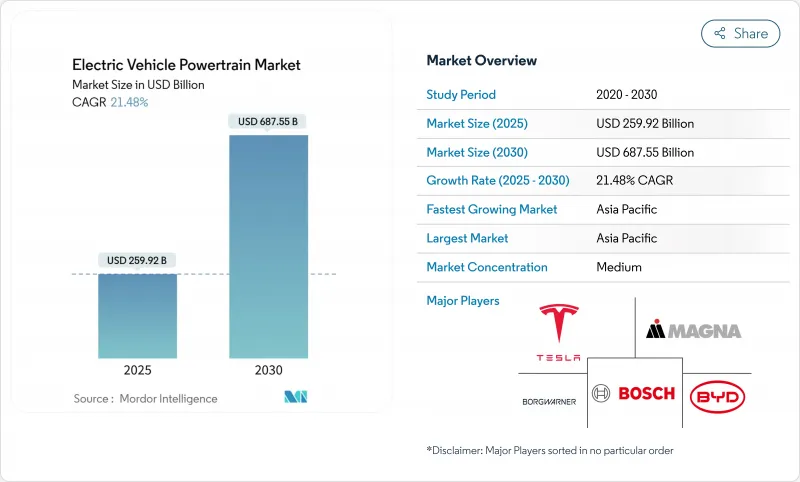
전기자동차 파워트레인 시장 규모는 2025년에 2,599억 2,000만 달러로 추정되고, 2030년에는 6,875억 5,000만 달러에 달할 것으로 예측되며, CAGR 21.48%로 성장할 전망입니다.
연소 엔진의 단계적 폐지가 가속화되고 배터리 팩 가격이 1kWh당 115달러로 꾸준히 떨어지고 800V 아키텍처 채용이 급속히 진행되고 있는 것이 이 확대를 뒷받침하고 있습니다. 와이드 밴드갭 반도체는 인버터 효율을 96% 이상으로 끌어올리며, 셀 투 팩 엔지니어링은 무게와 비용을 모두 절감합니다. 북미와 유럽이 강력한 현지화 인센티브를 전개하는 가운데, 아시아태평양은 배터리, 모터, 일렉트로닉스의 통합 클러스터로 공급망을 선도하고 있습니다.
세계의 전기자동차 파워트레인 시장 동향 및 인사이트
세계 EV 판매량 급증
전기자동차의 등록 대수는 2024년에 1,700만 대를 넘었고, 플러그인 쉐어는 세계의 경차 판매 대수의 20%를 넘었으며, 모터, 인버터, 배터리 팩 수요를 밀어 올립니다. 중국이 1,100만 대를 달성한 것만으로도 각 공급업체의 대수계획은 변경되어 유럽의 인센티브는 거시적인 역풍에도 불구하고 2자리 성장을 유지했습니다. 신형 EV는 1대 당 약 80kg의 고품위 구리와 상당한 희토류 함량을 필요로 하기 때문에 부품 제조업체는 생산 능력 증강과 연동하여 장기 공급 계약을 늘려 왔습니다. 배터리 수요는 2024년에는 1TWh를 초과했지만, 거의 절반이 인산철 리튬이기 때문에 OEM은 이 화학의 비용 우위를 살리기 위해 팩 형식을 재설계하고 있습니다. 양적 확대는 전체 시스템의 비용을 낮추지만, 2030년까지 가격 전망을 고정하는 장기 계약을 둘러싼 공급업체의 경쟁은 치열해집니다.
엄격한 꼬리 파이프 규정 및 ZEV 규정
유럽연합(EU)은 2035년까지 신형 연소식 자동차의 판매를 금지하고 미국에서는 캘리포니아 주 선진 클린카 II 규제가 같은 기한을 시행합니다. 유사한 제로 방출 규제는 캐나다, 한국, 라틴아메리카의 여러 시장에도 파급되고 있으며, 자동차 제조업체는 전기화를 늦추는 여지를 잃고 있습니다. 레거시 내연 플랫폼에 대한 컴플라이언스 비용은 최신 e-파워트레인을 출시하는 데 필요한 추가 비용보다 높으며 연구개발 예산은 통합 e-액슬 솔루션과 차세대 인버터로 향하고 있습니다. OEM은 규제를 앞당기기 위해 기존 5년 사이클을 3년 사이클로 압축하고 새로 고쳐야 하기 때문에 이미 클린시트의 전기 설계에 숙련된 공급업체가 플랫폼 조달 라운드에서 협상력을 얻게 됩니다.
신흥 시장에서의 DC-급속 충전 격차
22개 개발도상국을 합쳐도 공공 충전기가 14,100기밖에 설치되지 않았고, 이 수준이 차량전화를 억제해 소비자의 신뢰감을 약화시키고 있습니다. 400V 네트워크용으로 조정된 파워트레인은 충분한 항속거리를 제공하지만, 고출력 충전기를 필요로 하는 800V 하드웨어의 효율 상승을 충분히 즐길 수 없습니다. 투자 부족의 원인은 취약한 전력망과 제한된 민간 자금입니다. 따라서 자동차 제조업체는 지역 인프라 사정에 맞게 드라이브 트레인 구성을 조정할 필요가 있으며, 대부분의 경우 더 큰 배터리 팩과 차량 탑재 발전기를 선택하지만, 이는 차체 중량을 증가시켜 에너지 효율 향상을 둔화시킵니다.
부문 분석
배터리 팩은 2024년 매출의 38.32%를 차지하였고, 전기자동차 파워트레인 시장의 유일한 가장 큰 요소가 되었지만, 와이드 밴드갭 디바이스가 보다 빠른 스위칭을 실현함에 따라 파워 일렉트로닉스 블록의 CAGR은 29.42%로 보다 빠르게 성장하고 있습니다. 팩의 평균 용량은 2024년에 승용차용으로 62kWh로 증가하여 열경로 개선과 통합 구조 설계 수요를 뒷받침하는 수준입니다. 실리콘 카바이드 인버터는 최고 효율 97%에 달하여 고속도로에서의 전력 손실을 2자리 줄이고 배터리 질량을 늘리지 않고 항속 거리를 늘립니다. 드라이브 유닛 공급업체는 영구 자석 모터에 헤어핀 권선과 컴팩트한 감속 기어를 중첩하여 드라이브 트레인의 노이즈를 줄이면서 보다 미세한 토크 제어를 가능하게 합니다. 차량 1대 당 부가가치를 높임으로써 2자리 마진을 기대할 수 있는 e-액슬 번들 제품을 추구하는 인버터, 모터, 기어박스 공급업체의 합병에 박차가 걸립니다. 동시에 열 관리 전문가는 배터리 모듈 및 전력 전자 장치를 단일 루프로 냉각하는 멀티 채널 콜드 플레이트 어셈블리를 도입하여 시스템 무게를 15% 줄입니다.
통합형 DC-DC 컨버터는 온보드 충전기와 공통 냉각 플레이트를 공유하여 컴팩트한 크로스오버 모델의 후드 아래 공간 요구 사항을 줄입니다. 모터 제조업체는 구리 로터 유도 및 스위치 드릴럭턴스 토폴로지를 사용한 영구 자석 프리 설계를 늘려 디스프로슘과 네오디뮴에 대한 의존을 줄이고 있습니다. Tier 1 대기업이 국내 및 중국의 칩 제조업자와 2028년 자동차 발매를 향해 차세대 1200V SiC 다이를 확보하기 위한 다년 공급 계약을 발표했습니다. 공급업체의 수직 통합이 진행됨에 따라 게이트 드라이브 알고리즘과 히트 스프레더 레이아웃을 둘러싼 지적 재산권 쟁탈전이 격화하고 있습니다.
배터리 전기자동차는 2024년에 71.24%의 점유율을 획득하였고, CAGR 24.80%로 추이할 것으로 예측되고 있습니다. 이는 시장이 플러그인 하이브리드 및 항속거리 연장 아키텍처에서 축발을 옮기고 있음을 뒷받침합니다. BEV 전용 스케이트 보드 플랫폼은 배선을 30kg 줄이고 배터리 팩을 스트레스가 많은 섀시 구성원으로 통합하여 조립을 간소화합니다. 중국, EU, 미국 12주의 규제 신용 제도로 자동차 제조업체는 하이브리드 차량에 비해 BEV 1대 당 USD 3,000-5,000의 실질적인 가격 우위를 얻을 수 있어 BEV 채용이 확대되고 있습니다. 독일, 프랑스, 노르웨이에 급속 충전기가 설치되어 사회적 신뢰가 높아져 소형 팩의 컴팩트 부문 BEV가 가능하게 되었습니다. 자동차 제조업체는 셀 투 팩 전략과 셀 투 섀시 전략을 채택하여 모듈의 케이싱을 벗겨 체적 에너지 밀도를 최대 20% 향상시켜 간접적으로 열 관리에 대한 지출을 밀어 올리고 있습니다.
연료전지 전기자동차는 판매 대수의 1% 미만에 그치고 있지만 수소 연료 공급 네트워크가 집적되는 캘리포니아주, 일본, 한국의 대형 물류 회랑에서는 대규모 연구개발이 진행되고 있습니다. 예측 기간 동안 BEV는 도시 버스, 지자체 차량, 라이드 헤일 사업자에서 마일드 하이브리드와 기존 파워트레인에서 점유율을 빼앗아 총 소유 비용 절감을 중심으로 최적화를 도모합니다. 컴포넌트 공급업체는 400V와 800V 사이를 전환할 수 있는 확장 가능한 인버터 제품군을 제공하여 BEV와 PHEV 플랫폼 모두에 설계 변경 없이 대응하며 소프트웨어 정의 파워트레인 컨트롤러는 과도 아키텍처를 위한 듀얼 트랙션 소스를 처리합니다.
지역 분석
아시아태평양은 2024년 전기자동차 파워트레인 시장의 57.66%를 차지하였고, 중국이 라틴아메리카와 동유럽에 고가격의 전동 크로스오버를 수출하기 때문에 2030년까지 연평균 복합 성장률(CAGR) 26.64%로 성장할 것으로 예측됩니다. 중국 배터리 챔피언은 세계 점유율의 37.9%를 차지했으며, 이 지역의 스케일 메리트를 살려 팩 가격을 1kWh당 90달러로 밀어 올리고 있습니다. 인도의 생산 연동 인센티브 프로그램은 국내 부가가치의 최대 15%에 해당하는 보조금을 지급하고 모터, 컨트롤러, 인산철 리튬 전지의 현지 조립에 박차를 가하고 있습니다. 일본은 파워 디바이스의 노하우를 활용해 SiC MOSFET을 세계에 출하하고, 한국은 고니켈 NCM 캐소드를 유럽의 기가팩토리에 공급하고 있습니다.
북미는 생산량은 뒤떨어지지만, 2022년 중반 이후 배터리, 모터, 인버터 공장 전체에서 2,500억 달러의 투자가 발표되고 있으며, 그 혜택을 받고 있습니다. 인플레이션 삭감법의 클린카 크레딧은 2025년 북미 배터리 부품 가치의 60%를 요구하고 있으며, 한국과 일본 공급업체는 켄터키주, 테네시주, 퀘벡주에 양극 활물질 공장을 건설하도록 촉구하고 있습니다. 멕시코는 미국과 유럽 공장에 수출되는 저비용 전자 모터의 허브로 상승합니다. 캐나다의 풍부한 광물 자원은 2030년까지 캐나다 대륙의 리튬 수요의 절반을 공급하는 것을 목표로 하는 정극 정제 벤처를 지원합니다.
유럽은 불균등한 기세와 싸우고 있습니다. 독일과 프랑스는 2자리 BEV 보급률을 유지하고 있지만, 영국은 2024년 전기차 생산 대수가 20% 후퇴했습니다. EU의 Fit-for-55 패키지와 CO2 플릿 의무화는 장기적인 수요를 유지하며, ZF와 같은 공급업체는 2024년 10월 버밍엄 근처에 800V 테스트 랩을 개설했습니다. 동유럽 국가들은 경쟁력 있는 인건비를 무기로 최종 조립 공장을 유치하여 ICE 컴포넌트의 축소에 따른 갭을 메우고 있습니다. 한편 중동 및 아프리카는 아직 발전도상이지만 사우디아라비아와 아랍 에미리트의 배터리 셀 제조에 자금을 제공하는 걸프 정부 펀드에 힘입어 소규모이면서 연간 40%의 성장을 이루고 있습니다.
기타 혜택 :
- 엑셀 형식 시장 예측(ME) 시트
- 3개월간의 애널리스트 서포트
목차
제1장 서론
- 조사의 전제조건 및 시장 정의
- 조사 범위
제2장 조사 방법
제3장 주요 요약
제4장 시장 상황
- 시장 개요
- 시장 성장 촉진요인
- 세계의 EV 판매 대수 급증
- 엄격한 배기관 및 ZEV 규제
- 고 니켈 전지 화학에서의 급속한 비용 저하
- OEM의 800 볼트 아키텍처로의 전환
- 전동 드라이브 제조의 현지화 인센티브
- e-Axle 번들의 Tier 1 수직 통합
- 시장 성장 억제요인
- 신흥 시장에서의 공공의 DC 급속 충전의 갭
- 중요한 광물 공급의 불안정성
- 열폭주 안전성 및 보증 비용 노출
- 제조 거점에서의 고전압 인력 부족
- 밸류체인 및 공급망 분석
- 규제 상황
- 기술의 전망
- Porter's Five Forces
- 신규 참가업체의 위협
- 구매자의 협상력
- 공급기업의 협상력
- 대체품의 위협
- 경쟁 기업 간 경쟁 관계
제5장 시장 규모 및 성장 예측
- 컴포넌트별
- 전기 모터
- 영구자석 동기
- 유도
- 스위치 드릴랙턴스
- 변속기 및 e-액슬 시스템
- 싱글 스피드
- 멀티 스피드
- 파워 일렉트로닉스
- 인버터
- DC-DC 컨버터
- 온보드 충전기
- 배터리 팩
- 열 관리 시스템
- 고전압 케이블 및 컨트롤러
- 전기 모터
- 추진 유형별
- 배터리 전기자동차(BEV)
- 플러그인 하이브리드 전기자동차(PHEV)
- 연료전지 전기자동차(FCEV)
- 차량 클래스별
- 승용차
- 소형 상용차
- 대형 상용차
- 이륜차 및 삼륜차
- 오프로드 차량
- 전압 아키텍처별
- 400V 이하의 시스템
- 800V 시스템
- 800V 이상의 시스템
- 판매 채널별
- OEM 장착 파워트레인
- 애프터마켓 개조 키트
- 지역별
- 북미
- 미국
- 캐나다
- 기타 북미
- 남미
- 브라질
- 아르헨티나
- 기타 남미
- 유럽
- 독일
- 영국
- 프랑스
- 이탈리아
- 스페인
- 네덜란드
- 기타 유럽
- 아시아태평양
- 중국
- 일본
- 인도
- 한국
- 태국
- 베트남
- 기타 아시아태평양
- 중동 및 아프리카
- 사우디아라비아
- 아랍에미리트(UAE)
- 튀르키예
- 남아프리카
- 이집트
- 기타 중동 및 아프리카
- 북미
제6장 경쟁 구도
- 시장 집중도
- 전략적 동향
- 시장 점유율 분석
- 기업 프로파일
- Tesla, Inc.
- BYD Co. Ltd.
- Bosch Mobility(Robert Bosch GmbH)
- Magna International Inc.
- BorgWarner Inc.
- ZF Friedrichshafen AG
- Dana Incorporated
- GKN Automotive
- Hitachi Astemo, Ltd.
- Mitsubishi Electric Corporation
- AVL List GmbH
- Cummins Inc.
- Siemens AG(eMobility)
- Nidec Corporation
- Continental AG
- Valeo SA
- Vitesco Technologies Group AG
- AISIN Corporation
- Denso Corporation
- Schaeffler AG
- Hyundai Mobis Co., Ltd.
제7장 시장 기회 및 향후 전망
AJY 25.11.19The electric vehicle powertrain market size stands at USD 259.92 billion in 2025 and is projected to reach USD 687.55 billion by 2030, translating into a 21.48% CAGR.
Accelerated phase-outs of combustion engines, steady battery-pack price drops to USD 115 per kWh, and rapid adoption of 800-V architectures propel this expansion. Wide-bandgap semiconductors push inverter efficiency above 96%, while cell-to-pack engineering trims both weight and cost. Asia-Pacific leads the supply chain with integrated battery, motor, and electronics clusters, even as North America and Europe deploy powerful localization incentives.
Global Electric Vehicle Powertrain Market Trends and Insights
Surging Global EV Sales Volumes
Electric-vehicle registrations crossed 17 million units in 2024, lifting plug-in share above 20% of world light-vehicle sales and boosting demand for motors, inverters and battery packs that are three times more semiconductor-intensive than comparable combustion drivetrains. China's 11 million-unit tally alone reshaped volume planning for every supplier, while Europe's incentives preserved double-digit growth despite macro headwinds. Each new EV requires around 80 kg of high-grade copper and significant rare-earth content, so component makers have ramped long-term supply contracts in tandem with capacity additions. Battery demand topped 1 TWh in 2024; with almost half now lithium iron phosphate, OEMs are redesigning pack formats to exploit the chemistry's cost edge. Volume scale pushes total system costs down, yet intensifies supplier competition for long-run contracts that lock in price visibility through 2030.
Stringent Tail-Pipe & ZEV Regulations
The European Union will prohibit sales of new combustion cars by 2035, and California's Advanced Clean Cars II rule enforces the same deadline in the United States . Similar zero-emission mandates cascade across Canada, South Korea and several Latin American markets, stripping automakers of any remaining latitude to delay electrification. Compliance costs for legacy internal-combustion platforms are now higher than the incremental spend required to launch a modern e-powertrain, redirecting R&D budgets toward integrated e-axle solutions and next-generation inverters. Suppliers already proficient in clean-sheet electric designs therefore gain bargaining power in platform sourcing rounds, because OEMs must compress traditional five-year cycles into three-year refreshes to stay ahead of regulation.
Public DC-Fast-Charging Gap in Emerging Markets
Twenty-two developing nations together host barely 14,100 public chargers, a level that deters fleet electrification and weakens consumer confidence . Powertrains tuned for 400-V networks offer sufficient range but miss the full efficiency upside of 800-V hardware that requires higher-powered chargers. The investment deficit stems from fragile utility grids and limited private-sector financing. Vehicle makers must therefore tailor drivetrain configurations to local infrastructure realities, often opting for larger battery packs or onboard generators, which inflate curb weight and blunt energy efficiency gains.
Other drivers and restraints analyzed in the detailed report include:
- Rapid Cost Decline in High-Nickel Battery Chemistries
- OEM Shift to 800-Volt Architectures
- Critical-Mineral Supply Volatility
For complete list of drivers and restraints, kindly check the Table Of Contents.
Segment Analysis
Battery packs contributed 38.32% revenue in 2024, making them the single largest element of the electric vehicle powertrain market, yet the power-electronics block is growing faster at 29.42% CAGR as wide-bandgap devices unlock higher switching speeds. Average pack capacity rose to 62 kWh in 2024 for passenger cars, a level that pushes demand for improved thermal paths and integrated structural designs. Silicon-carbide inverters now reach 97% peak efficiency, slicing highway power losses by double digits and extending vehicle range without adding battery mass. Drive-unit suppliers layer permanent-magnet motors with hairpin windings and compact reduction gears, allowing finer torque control while shaving drivetrain noise. Higher-value content per vehicle spurs a wave of mergers among inverter, motor, and gearbox suppliers that pursue e-axle bundles promising double-digit margins. Concurrently, thermal-management specialists introduce multi-channel cold-plate assemblies that cool battery modules and power electronics from a single loop, saving 15% system weight.
Integrated DC-DC converters share common cooling plates with on-board chargers, shrinking under-hood space requirements in compact crossover models. Motor suppliers increase permanent-magnet free designs that use copper-rotor induction or switched-reluctance topologies to reduce dependence on dysprosium and neodymium. Tier-1 giants announce multi-year supply accords with domestic and Chinese chip fabricators to secure next-generation 1,200-V SiC dies for 2028 vehicle launches. As suppliers vertically integrate, intellectual-property battles intensify around gate-drive algorithms and heat-spreader layouts that deliver the last two points of efficiency.
Battery electric vehicles captured 71.24% of share in 2024 and are forecast to clip along at 24.80% CAGR, confirming the market's pivot away from plug-in hybrids and range-extended architectures. Dedicated BEV skateboard platforms shave 30 kg of wiring and simplify assembly by integrating the battery pack as a stressed chassis member. Regulatory credit regimes in China, the European Union, and twelve U.S. states give carmakers an effective price advantage of USD 3,000-USD 5,000 per BEV compared with hybrid equivalents, widening BEV adoption. Fast-charger build-outs across Germany, France, and Norway raise public confidence, enabling compact-segment BEVs with smaller packs, which in turn shift component demand toward higher power-density inverters. Automakers employ cell-to-pack and cell-to-chassis strategies to strip module casings and increase volumetric energy density by up to 20%, indirectly boosting thermal-management spending.
Fuel-cell electric vehicles remain below 1% of unit volume yet draw significant R&D within heavy-duty logistics corridors in California, Japan, and South Korea, where hydrogen fueling networks cluster. Over the forecast horizon, BEVs siphon share from mild-hybrid and conventional powertrains in urban buses, municipal fleets and ride-hail operators that optimize around lower total cost of ownership. Component suppliers respond with scalable inverter families that toggle between 400 V and 800 V to serve both BEV and PHEV platforms without redesign, while software-defined powertrain controllers handle dual traction sources for transitional architectures.
The Electric Vehicle Powertrain Market Report is Segmented by Component (Battery Pack, Power Electronics, and More), Propulsion Type (Battery Electric Vehicle (BEV) and More), Vehicle Class (Passenger Cars, Light Commercial Vehicles, and More), Voltage Architecture (800 V Systems and More), Sales Channel (OEM-Fitted Powertrains and More) and Geography. The Market Forecasts are Provided in Terms of Value (USD).
Geography Analysis
Asia-Pacific commanded 57.66% of the electric vehicle powertrain market in 2024 and is projected to grow at 26.64% CAGR through 2030 as China exports value-priced electric crossovers to Latin America and Eastern Europe. Chinese battery champions held 37.9% global share, giving the region scale advantages that drive pack prices toward USD 90 per kWh. India's Production-Linked Incentive program disburses subsidies equal to up to 15% of domestic value added, spurring local assembly of motors, controllers and lithium iron phosphate cells. Japan leverages power-device know-how to ship SiC MOSFETs worldwide, while South Korea supplies high-nickel NCM cathodes to European gigafactories.
North America trails in volume but benefits from USD 250 billion of announced investment across batteries, motors and inverter fabs since mid-2022. The Inflation Reduction Act's clean-vehicle credit requires 60% North-American battery-component value in 2025, prompting Korean and Japanese suppliers to build cathode-active-material plants in Kentucky, Tennessee and Quebec. Mexico rises as a low-cost e-motor hub exporting to both U.S. and European plants. Canada's mineral wealth underpins cathode refining ventures that aim to supply half of the continent's lithium needs by 2030.
Europe wrestles with uneven momentum: Germany and France sustain double-digit BEV penetration, yet the United Kingdom saw a 20% retreat in electric-vehicle output during 2024 due to stalled incentives and battery-capacity shortfalls. The European Union's Fit-for-55 package and CO2 fleet mandates keep long-term demand intact, driving suppliers such as ZF to open an 800 V testing lab near Birmingham in October 2024. Eastern European countries pitch competitive labor costs to attract final-assembly plants, filling the gap left by ICE component contraction. Meanwhile, Middle East and Africa remain nascent but post 40% annual growth from a small base, aided by Gulf sovereign-wealth funds that bankroll battery-cell manufacturing in Saudi Arabia and the United Arab Emirates.
- Tesla, Inc.
- BYD Co. Ltd.
- Bosch Mobility (Robert Bosch GmbH)
- Magna International Inc.
- BorgWarner Inc.
- ZF Friedrichshafen AG
- Dana Incorporated
- GKN Automotive
- Hitachi Astemo, Ltd.
- Mitsubishi Electric Corporation
- AVL List GmbH
- Cummins Inc.
- Siemens AG (eMobility)
- Nidec Corporation
- Continental AG
- Valeo SA
- Vitesco Technologies Group AG
- AISIN Corporation
- Denso Corporation
- Schaeffler AG
- Hyundai Mobis Co., Ltd.
Additional Benefits:
- The market estimate (ME) sheet in Excel format
- 3 months of analyst support
TABLE OF CONTENTS
1 Introduction
- 1.1 Study Assumptions & Market Definition
- 1.2 Scope of the Study
2 Research Methodology
3 Executive Summary
4 Market Landscape
- 4.1 Market Overview
- 4.2 Market Drivers
- 4.2.1 Surging global EV sales volumes
- 4.2.2 Stringent tail-pipe & ZEV regulations
- 4.2.3 Rapid cost decline in high-nickel battery chemistries
- 4.2.4 OEM shift to 800-volt architectures
- 4.2.5 Localization incentives for e-drive manufacturing
- 4.2.6 Tier-1 vertical integration of e-Axle bundles
- 4.3 Market Restraints
- 4.3.1 Public DC-fast-charging gap in emerging markets
- 4.3.2 Critical-mineral supply volatility
- 4.3.3 Thermal-runaway safety & warranty-cost exposure
- 4.3.4 High-voltage talent shortage in manufacturing hubs
- 4.4 Value / Supply-Chain Analysis
- 4.5 Regulatory Landscape
- 4.6 Technological Outlook
- 4.7 Porter's Five Forces
- 4.7.1 Threat of New Entrants
- 4.7.2 Bargaining Power of Buyers
- 4.7.3 Bargaining Power of Suppliers
- 4.7.4 Threat of Substitutes
- 4.7.5 Intensity of Competitive Rivalry
5 Market Size & Growth Forecasts (Value, USD)
- 5.1 By Component
- 5.1.1 Electric Motors
- 5.1.1.1 Permanent-Magnet Synchronous
- 5.1.1.2 Induction
- 5.1.1.3 Switched-Reluctance
- 5.1.2 Transmission / e-Axle Systems
- 5.1.2.1 Single-Speed
- 5.1.2.2 Multi-Speed
- 5.1.3 Power Electronics
- 5.1.3.1 Inverters
- 5.1.3.2 DC-DC Converters
- 5.1.3.3 On-Board Chargers
- 5.1.4 Battery Pack
- 5.1.5 Thermal Management Systems
- 5.1.6 High-Voltage Cabling & Controllers
- 5.1.1 Electric Motors
- 5.2 By Propulsion Type
- 5.2.1 Battery Electric Vehicle (BEV)
- 5.2.2 Plug-in Hybrid Electric Vehicle (PHEV)
- 5.2.3 Fuel-Cell Electric Vehicle (FCEV)
- 5.3 By Vehicle Class
- 5.3.1 Passenger Cars
- 5.3.2 Light Commercial Vehicles
- 5.3.3 Heavy Commercial Vehicles
- 5.3.4 Two and Three-Wheelers
- 5.3.5 Off-Highway Vehicles
- 5.4 By Voltage Architecture
- 5.4.1 Less than equal to 400 V Systems
- 5.4.2 800 V Systems
- 5.4.3 Above 800 V Systems
- 5.5 By Sales Channel
- 5.5.1 OEM-Fitted Powertrains
- 5.5.2 Aftermarket Retrofit Kits
- 5.6 By Geography
- 5.6.1 North America
- 5.6.1.1 United States
- 5.6.1.2 Canada
- 5.6.1.3 Rest of North America
- 5.6.2 South America
- 5.6.2.1 Brazil
- 5.6.2.2 Argentina
- 5.6.2.3 Rest of South America
- 5.6.3 Europe
- 5.6.3.1 Germany
- 5.6.3.2 United Kingdom
- 5.6.3.3 France
- 5.6.3.4 Italy
- 5.6.3.5 Spain
- 5.6.3.6 Netherlands
- 5.6.3.7 Rest of Europe
- 5.6.4 Asia-Pacific
- 5.6.4.1 China
- 5.6.4.2 Japan
- 5.6.4.3 India
- 5.6.4.4 South Korea
- 5.6.4.5 Thailand
- 5.6.4.6 Vietnam
- 5.6.4.7 Rest of Asia-Pacific
- 5.6.5 Middle East and Africa
- 5.6.5.1 Saudi Arabia
- 5.6.5.2 United Arab Emirates
- 5.6.5.3 Turkey
- 5.6.5.4 South Africa
- 5.6.5.5 Egypt
- 5.6.5.6 Rest of Middle East and Africa
- 5.6.1 North America
6 Competitive Landscape
- 6.1 Market Concentration
- 6.2 Strategic Moves
- 6.3 Market Share Analysis
- 6.4 Company Profiles (includes Global-level Overview, Market-level Overview, Core Segments, Financials, Strategic Information, Market Rank/Share, Products & Services, Recent Developments)
- 6.4.1 Tesla, Inc.
- 6.4.2 BYD Co. Ltd.
- 6.4.3 Bosch Mobility (Robert Bosch GmbH)
- 6.4.4 Magna International Inc.
- 6.4.5 BorgWarner Inc.
- 6.4.6 ZF Friedrichshafen AG
- 6.4.7 Dana Incorporated
- 6.4.8 GKN Automotive
- 6.4.9 Hitachi Astemo, Ltd.
- 6.4.10 Mitsubishi Electric Corporation
- 6.4.11 AVL List GmbH
- 6.4.12 Cummins Inc.
- 6.4.13 Siemens AG (eMobility)
- 6.4.14 Nidec Corporation
- 6.4.15 Continental AG
- 6.4.16 Valeo SA
- 6.4.17 Vitesco Technologies Group AG
- 6.4.18 AISIN Corporation
- 6.4.19 Denso Corporation
- 6.4.20 Schaeffler AG
- 6.4.21 Hyundai Mobis Co., Ltd.
7 Market Opportunities & Future Outlook
- 7.1 White-Space & Unmet-Need Assessment