
|
시장보고서
상품코드
1851015
엣지 컴퓨팅 시장 : 시장 점유율 분석, 산업 동향, 통계, 성장 예측(2025-2030년)Edge Computing - Market Share Analysis, Industry Trends & Statistics, Growth Forecasts (2025 - 2030) |
||||||
 Mordor Intelligence
엣지 컴퓨팅 시장의 규모는 2025년에 2,278억 달러로 추정되며, 2030년에는 4,241억 5,000만 달러에 이를 것으로 예상되고, CAGR은 13.24%로 추이할 전망입니다.

네트워크 엣지에서의 데이터 무게 증가, 5G 무선 액세스 네트워크 배포 및 세계 데이터 주권 의무화로 인해 집중적인 클라우드에서 시간 제약이 있는 처리를 마이그레이션함으로써 기업 아키텍처가 재정의되고 있습니다. 하드웨어 공급업체는 실시간 AI 추론 진입 장벽을 낮추는 ASIC과 SoC 가격 하락으로 혜택을 누리며, 통신 사업자는 ETSI 4단계 사양에 따른 MEC(Multi-Access Edge Compute) 서비스를 통해 새로운 수익원을 개척합니다. 제조, 에너지 및 이동성 분야의 기업은 대기 시간을 최소화하고 기밀 데이터를 보호하며 운영 내결함성을 향상시키기 위해 엣지 노드를 채택합니다. 동시에 클라우드 하이퍼스케일러는 관리 서비스를 고객 자산으로 확장하여 분산 워크로드의 통합 관측과 수명 주기 관리를 가능하게 합니다.
세계의 엣지 컴퓨팅 시장의 동향과 인사이트
초저지연 이용 사례를 촉진하는 5G 배포
세계 5G 배포는 자율주행 차량, 원격 수술, 몰입형 유지보수 용도에 필요한 밀리초 이하의 대기 시간을 가능하게 합니다. Verizon과 NVIDIA는 사설 5G 네트워크에서 실시간 AI 서비스를 시험적으로 시작하고 엄격한 왕복 지연 예산을 충족하기 위해 기지국에 엣지 노드를 고정합니다. 하이퍼스케일러는 현재 통신 교환기에 마이크로데이터센터를 코로케이션하고 있으며 개발자는 컨테이너를 사용자에게 접근시킬 수 있습니다. ETSI MEC 4단계 프로파일은 공통 API를 작성하고 운영자가 워크로드 이식성을 보장하면서 차별화된 지연 계층을 수익화하는 데 도움이 됩니다. 투자주기는 정부가 지방의 5G 커버리지에 자금을 제공하고 밀집한 도시의 회랑을 넘어 엣지 구동형 서비스를 확장하는 정책과 일치합니다.
IoT 엔드포인트 급증 및 데이터 그라비티
산업 현장에는 수천 개의 센서가 설치되어 매일 수테라바이트의 데이터가 흐르고 있습니다. 제조업체의 89%는 실시간 품질 관리를 위해 AI 추론을 로컬 게이트웨이로 전환하려는 의도를 보이고 있습니다. 엣지 네이티브 아키텍처는 대역폭 비용을 줄이고 대량의 데이터를 요악 전까지 현장에서 유지함으로써 클라우드에 대한 연결 요금을 회피합니다. TCS 클레버 에너지와 같은 플랫폼은 로컬 추론을 사용하여 비정상 플래그를 지정하고 즉시 시정 조치를 시행합니다. IoT 디바이스는 경량의 GPU와 NPU를 통합하므로 비전 모델을 자율적으로 실행할 수 있으며 모니터링 작업을 위해 백홀 회선을 해제할 수 있습니다.
분산 노드에서 사이버 공격 표면 확대
모든 게이트웨이, 센서 및 마이크로데이터센터가 잠재적인 침입 지점이 되어 IT/OT 네트워크에 전개될 가능성이 높아집니다. 산업 운영자는 제로 트러스트 펌웨어, 하드웨어 트러스트 트러스트 및 TPM 백드 인증을 도입하고 있지만, 레거시 디바이스에는 보안 부팅 시퀀싱가 없는 경우가 많습니다. 엣지 노드가 보호된 데이터센터를 떠나 공장 바닥과 도로 옆의 캐비닛에 배치되면 물리적 변조 위험이 증가합니다. 로컬로 실행되는 실시간 포렌식 도구가 부족하여 인시던트 응답에 지장을 주고 침해에 대응하는 평균 시간이 길어지고 있습니다.
부문 분석
하드웨어는 2024년 엣지 컴퓨팅 시장의 45.2%를 차지하였으며, 이는 러기드 서버, 가속기 및 현장 배포 가능한 스토리지에 필요한 선행 투자를 반영합니다. 하드웨어의 엣지 컴퓨팅 시장의 규모는 2025년 1,028억 달러에 이를 전망이며, ASIC 가격 하락에 따라 견조한 성장이 예상됩니다. 소프트웨어 플랫폼은 오케스트레이션 스택에 AI 모델의 라이프사이클 관리와 원격 관측 기능이 추가되었기 때문에 수익에서는 뒤쳐져 있지만 혁신성에서는 선도하고 있으며 CAGR은 최고 13.7%를 기록했습니다. 서비스 부문의 매출은 완만하지만 레거시 PLC의 통합과 브라운필드 산업용지 내의 실시간 운영 체제에 대한 대응 등에 필수적입니다.
칩 제조업체 간의 치열한 경쟁은 단가를 낮추고 산업용 온도 범위를 견디는 저전력 AI 추론 카드의 대량 도입을 가능하게 합니다. 인텔의 18A 로드맵은 트랜시버 밀도를 향상시켜 지능형 게이트웨이의 결정론적 처리량을 향상시킵니다. 동시에 어드밴텍과 남라가 제공하는 Zero Touch Deployment Framework는 노드 프로비저닝을 자동화하여 통합 비용을 절감하고 하드웨어를 감싸는 관리 서비스의 향후 성장을 제안합니다.
2024년 엣지 컴퓨팅 시장에서는 On-Premise 솔루션이 67.2%를 차지하였습니다. 하이브리드 클라우드의 엣지는 CAGR 14.9%로 급성장할 전망이며, 기업은 하이퍼스케일 클라우드에서의 중앙 모델 트레이닝과 팩토리 셀에서의 분산 추론을 채용합니다. 엔터프라이즈는 워크로드 계층화를 시험적으로 도입하고 실시간 추론을 현지에서 수행하며 긴급한 분석은 야간에 지역 내 가용 영역에 백홀합니다.
에어 갭이 있는 크루즈 선박 결제 시스템은 위성 회선에 장애가 발생하더라도 운영을 계속하는 On-Premise의 탄력성을 보여줍니다. 반대로 Microsoft의 Armada에 대한 투자는 클라우드와 엣지에 걸친 통합 제어 평면이 장기적으로 이득이라는 하이퍼스케일러의 확신을 반영합니다. 공급업체는 현재 클라우드 콘솔에 사전 등록된 어플라이언스를 출하하고 있으며 단일 사이트 POC에서 여러 국가의 거점으로 마찰없이 확장할 수 있습니다.
엣지 컴퓨팅 시장은 컴포넌트별(하드웨어, 소프트웨어, 서비스), 배치별(On-Premise, 클라우드), 최종 사용자 산업별(제조 및 산업, 에너지 및 유틸리티, 기타), 용도별(산업용 IoT, 예측 유지 보수, 기타), 조직 규모별(대기업, 중소기업), 지역별로 분류되어 있습니다. 시장 예측은 금액(달러)으로 제공됩니다.
지역별 분석
북미는 2024년에 엣지 컴퓨팅 시장의 24.8%를 차지하였고 견조한 5G 전개, 광대한 하이퍼스케일러의 설치 면적, 반도체 생산에의 공적 자금 투입이 그 요인이 되고 있습니다. 바이든 정권은 국내 엣지 하드웨어 능력을 강화하는 마이크로 일렉트로닉스 프로그램에 2억 6,900만 달러를 할당했습니다. 미국에서는 유틸리티에서 프라이빗 LTE와 견고한 MEC 노드를 도입하여 그리드 운영을 근대화하고 있으며, 2025년까지 기업에서 생성된 데이터의 75%는 소스에 머물거나 소스 가까이에 머무를 것으로 예측되고 있습니다. 캐나다도 이에 이어 WAN 대기 시간을 줄인 자율적인 채광과 에너지 워크플로를 목표로 하고 있습니다.
아시아태평양은 2030년까지 연평균 복합 성장률(CAGR)이 15.1%로 가장 급성장할 것으로 예상되는 지역입니다. 중국의 '새로운 인프라' 정책은 제조 클러스터 근처에 엣지 데이터센터를 구축하도록 장려했으며, 화웨이는 2024년 수익의 20.8%를 AI, 자동차, 클라우드 서비스에 걸친 R&D에 투자했습니다. 인도의 스마트 시티 프로그램은 엣지 대응 모니터링과 교통 최적화를 통합하고 있으며, 일본의 선도적인 자동화 회사는 결정론적 이더넷과 TSN을 생산 라인에 통합하고 있습니다. 지역사업자들은 적극적인 파이버 부설을 활용하여 엣지 어그리게이트를 메트로 코어에 백홀하여 몰입형 게임과 텔레프레즌스 지터를 최소화하고 있습니다.
기타 혜택
- 엑셀 형식 시장 예측(ME) 시트
- 3개월간의 애널리스트 서포트
목차
제1장 서론
- 조사의 전제조건과 시장의 정의
- 조사 범위
제2장 조사 방법
제3장 주요 요약
제4장 시장 상황
- 시장 개요
- 시장 성장 촉진요인
- 초저지연의 이용 사례를 촉진하는 5G의 전개
- 엣지에서의 IoT 엔드포인트와 데이터 중력의 급증
- 데이터 주권에 관한 규제(EU 데이터법 등)
- 엣지 추론 가속기의 ASIC/SoC 비용 저하
- 마이크로 데이터센터를 견인하는 에너지 효율 목표(ESG)
- 커스텀 엣지 실리콘을 가능하게 하는 RISC-V와 칩렛 아키텍처의 대두
- 시장 성장 억제요인
- 분산 노드에서 사이버 공격 표면의 확대
- 이종 엣지 스택의 도입과 관리에 있어서의 기술 격차
- 상호운용성과 규격의 단편화(MEC, Open-RAN, LF Edge)
- 브라운필드 공업용 리노베이션의 낮은 ROI
- 공급망 분석
- 기술의 전망
- 규제 상황
- Porter's Five Forces 분석
- 공급기업의 협상력
- 구매자의 협상력
- 신규 참가업체의 위협
- 대체품의 위협
- 경쟁 기업간 경쟁 관계
- 시장에 주는 거시경제 요인의 평가
제5장 시장 규모와 성장 예측
- 컴포넌트별
- 하드웨어
- 소프트웨어
- 서비스
- 전개 모드별
- On-Premise
- 클라우드
- 최종 사용자 업계별
- 제조업과 공업
- 에너지 및 유틸리티
- 헬스케어 및 생명과학
- 소매 및 전자상거래
- BFSI
- IT 및 통신
- 기타
- 용도별
- 산업용 IoT와 예측 유지 보수
- 비디오 분석 및 모니터링
- 자율주행차와 드론
- 기타
- 기업 규모별
- 대기업
- 중소기업
- 지역별
- 북미
- 미국
- 캐나다
- 멕시코
- 남미
- 브라질
- 아르헨티나
- 기타 남미
- 유럽
- 독일
- 영국
- 프랑스
- 이탈리아
- 스페인
- 러시아
- 기타 유럽
- 아시아태평양
- 중국
- 일본
- 인도
- 한국
- 호주 및 뉴질랜드
- 동남아시아
- 기타 아시아태평양
- 중동 및 아프리카
- 중동
- 사우디아라비아
- 아랍에미리트(UAE)
- 튀르키예
- 기타 중동
- 아프리카
- 남아프리카
- 나이지리아
- 이집트
- 기타 아프리카
- 북미
제6장 경쟁 구도
- 시장 집중도
- 전략적 동향
- 시장 점유율 분석
- 기업 프로파일
- Amazon Web Services(AWS)
- Microsoft Corporation
- Cisco Systems Inc.
- Huawei Technologies Co. Ltd.
- IBM Corporation
- Hewlett Packard Enterprise(HPE)
- Dell Technologies Inc.
- Google LLC(Alphabet Inc.)
- Intel Corporation
- NVIDIA Corporation
- Juniper Networks Inc.
- Advantech Co. Ltd.
- ADLINK Technology Inc.
- Schneider Electric SE
- Siemens AG
- Capgemini Engineering
- EdgeIQ(MachineShop Inc.)
- Vapor IO Inc.
- Litmus Automation
- FogHorn Systems
- Lumen Technologies Inc.
제7장 시장 기회와 미래 전망
CSM 25.11.20The edge computing market size is estimated at USD 227.80 billion in 2025 and is on track to reach USD 424.15 billion by 2030, advancing at a 13.24% CAGR.
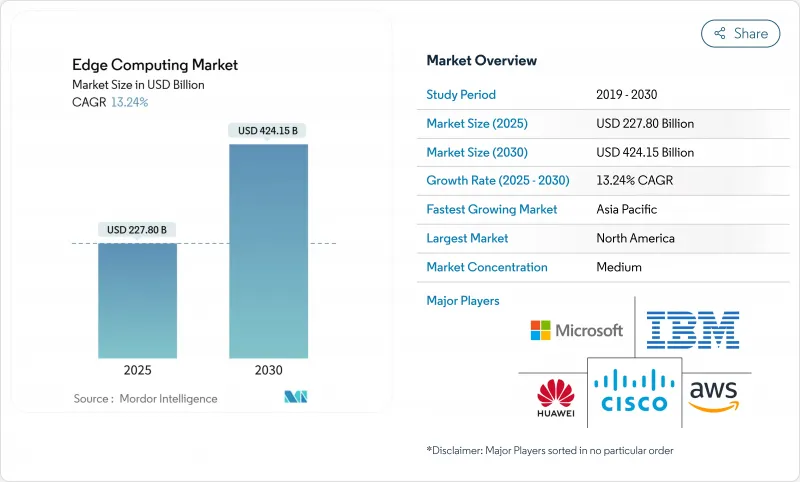
Intensifying data-gravity at the network edge, the roll-out of 5G radio access networks, and global data-sovereignty mandates are redefining enterprise architecture by shifting time-sensitive processing away from centralized clouds. Hardware vendors benefit from falling ASIC and SoC prices that lower entry barriers for real-time AI inference, while telecom operators carve new revenue streams through multi-access edge compute (MEC) services aligned with ETSI Phase 4 specifications. Enterprises in manufacturing, energy, and mobility adopt edge nodes to minimize latency, protect sensitive data, and improve operational resilience. At the same time, cloud hyperscalers extend managed services to customer premises, enabling unified observability and lifecycle management of distributed workloads
Global Edge Computing Market Trends and Insights
5G Roll-out Catalyzing Ultra-Low-Latency Use-Cases
Global 5G deployments enable sub-millisecond latency that autonomous vehicles, telesurgery, and immersive maintenance applications require. Verizon and NVIDIA have begun piloting real-time AI services on private 5G networks, anchoring edge nodes at base stations to meet stringent round-trip delay budgets. Hyperscalers now colocate micro-data-centres at telecom exchanges, allowing developers to push containers closer to users. ETSI MEC Phase 4 profiles create common APIs, helping operators monetize differentiated latency tiers while ensuring workload portabilit.The investment cycle aligns with governments funding rural 5G coverage, extending edge-powered services beyond dense urban corridors.
Proliferation of IoT Endpoints and Data Gravity
Industrial sites deploy thousands of sensors that stream terabytes daily, making centralized analytics both costly and sluggish. Manufacturers report 89% intent to shift AI inference to local gateways for real-time quality control. Edge-native architectures cut bandwidth expenses and avoid cloud egress charges by keeping high-volume data onsite until summarized. Platforms such as TCS Clever Energy use local inference to flag anomalies and trigger immediate corrective action. As IoT devices integrate lightweight GPUs and NPUs, they can execute vision models autonomously, freeing backhaul links for supervisory tasks.
Cyber-Attack Surface Expansion at Distributed Nodes
Every gateway, sensor, and micro-data-centre becomes a potential ingress point, raising the probability of lateral movement across converged IT/OT networks. Industrial operators deploy zero-trust firmware, hardware root-of-trust, and TPM-backed attestation, yet retrofitted legacy devices often lack secure boot sequences. Physical tampering risk climbs as edge nodes leave protected data-centre premises and reside on factory floors or in roadside cabinets. The scarcity of real-time forensics tools that run locally hampers incident response, extending mean-time-to-contain breaches.
Other drivers and restraints analyzed in the detailed report include:
- Regulatory Data-Sovereignty Mandates
- Declining ASIC/SoC Costs for Edge Inference Accelerators
- Skills Gap in Deploying and Managing Heterogeneous Edge Stacks
For complete list of drivers and restraints, kindly check the Table Of Contents.
Segment Analysis
Hardware accounted for 45.2% of the edge computing market in 2024, reflecting the up-front capital required for ruggedized servers, accelerators, and field-deployable storage. The edge computing market size for hardware reached USD 102.8 billion in 2025 and is expected to grow steadily as ASIC prices fall. Software platforms trail in revenue but lead in innovation, posting the highest 13.7% CAGR as orchestration stacks add AI model lifecycle management and remote observability. Services revenue remains modest yet essential, addressing integration of legacy PLCs and real-time operating systems within brownfield industrial sites.
Intense competition among chipmakers compresses unit costs, enabling high-volume deployment of low-power AI inference cards that withstand industrial temperature ranges. Intel's 18A roadmap improves transceiver density, boosting deterministic throughput in intelligent gateways. Simultaneously, zero-touch deployment frameworks from Advantech and Namla lower integration costs by automating node provisioning, signalling future growth for managed services that wrap around hardware.
On-premises solutions retained 67.2% of the edge computing market in 2024, driven by data locality and deterministic latency requirements. Hybrid-cloud edges grow rapidly at 14.9% CAGR as enterprises adopt central model training in hyperscale clouds with distributed inference at factory cells. Enterprises pilot workload tiering, where real-time inference runs locally, and non-urgent analytics backhaul to regional availability zones overnight.
Air-gapped cruise-ship payment systems illustrate on-premises resilience, continuing operation when satellite links fail. Conversely, Microsoft's investment in Armada reflects hyperscaler conviction that unified control planes spanning cloud and edge will win long term. Vendors now ship appliances pre-registered with cloud consoles, enabling frictionless expansion from single-site POCs to multi-country estates
Edge Computing Market is Segment by Component (Hardware, Software, Services), Deployment (On Premise, Cloud), End User Industry (Manufacturing and Industrial, Energy and Utilities, and More), Application (Industrial IoT and Predictive Maintenance, and More), Organization Size (Large Enterprise, Small and Medium Enterprise), and by Geography. The Market Forecasts are Provided in Terms of Value (USD).
Geography Analysis
North America held 24.8% of the edge computing market in 2024, anchored by robust 5G deployment, a vast hyperscaler footprint, and public funding for semiconductor production. The Biden administration allocated USD 269 million to micro-electronics programs that strengthen domestic edge hardware capacity. Utilities in the United States deploy private LTE coupled with ruggedized MEC nodes to modernize grid operations, and 75% of enterprise-generated data is forecast to remain at or near the source by 2025 Canada follows, targeting autonomous mining and energy workflows that cannot tolerate WAN latency.
Asia Pacific is the fastest-growing region at a 15.1% CAGR through 2030. China's "new infrastructure" policy incentivizes edge data-centre buildouts close to manufacturing clusters, and Huawei invested 20.8% of its 2024 revenue back into research and development that spans AI, automotive, and cloud services. India's smart-city programs integrate edge-enabled surveillance and traffic optimization, while Japan's automation giants embed deterministic Ethernet and TSN in production lines. Regional telcos leverage aggressive fiber roll-outs to backhaul edge aggregates to metro cores, minimizing jitter for immersive gaming and telepresence.
- Amazon Web Services (AWS)
- Microsoft Corporation
- Cisco Systems Inc.
- Huawei Technologies Co. Ltd.
- IBM Corporation
- Hewlett Packard Enterprise (HPE)
- Dell Technologies Inc.
- Google LLC (Alphabet Inc.)
- Intel Corporation
- NVIDIA Corporation
- Juniper Networks Inc.
- Advantech Co. Ltd.
- ADLINK Technology Inc.
- Schneider Electric SE
- Siemens AG
- Capgemini Engineering
- EdgeIQ (MachineShop Inc.)
- Vapor IO Inc.
- Litmus Automation
- FogHorn Systems
- Lumen Technologies Inc.
Additional Benefits:
- The market estimate (ME) sheet in Excel format
- 3 months of analyst support
TABLE OF CONTENTS
1 INTRODUCTION
- 1.1 Study Assumptions and Market Definition
- 1.2 Scope of the Study
2 RESEARCH METHODOLOGY
3 EXECUTIVE SUMMARY
4 MARKET LANDSCAPE
- 4.1 Market Overview
- 4.2 Market Drivers
- 4.2.1 5G roll-out catalysing ultra-low-latency use-cases
- 4.2.2 Proliferation of IoT endpoints and data gravity at the edge
- 4.2.3 Regulatory data-sovereignty mandates (e.g., EU Data Act)
- 4.2.4 Declining ASIC/SoC costs for edge inference accelerators
- 4.2.5 Energy-efficiency targets driving micro-data-centres (ESG)
- 4.2.6 Rise of RISC-V and chiplet architectures enabling custom edge silicon
- 4.3 Market Restraints
- 4.3.1 Cyber-attack surface expansion at distributed nodes
- 4.3.2 Skills gap in deploying and managing heterogeneous edge stacks
- 4.3.3 Inter-operability and standards fragmentation (MEC, Open-RAN, LF Edge)
- 4.3.4 Inefficient ROI for brown-field industrial retro-fits
- 4.4 Supply-Chain Analysis
- 4.5 Technological Outlook
- 4.6 Regulatory Landscape
- 4.7 Porter's Five Force Analysis
- 4.7.1 Bargaining Power of Suppliers
- 4.7.2 Bargaining Power of Buyers
- 4.7.3 Threat of New Entrants
- 4.7.4 Threat of Substitutes
- 4.7.5 Intensity of Competitive Rivalry
- 4.8 Assesment of Macroeconomic Factors on the market
5 MARKET SIZE AND GROWTH FORECASTS (VALUE)
- 5.1 By Component
- 5.1.1 Hardware
- 5.1.2 Software
- 5.1.3 Services
- 5.2 By Deployment Mode
- 5.2.1 On-Premise
- 5.2.2 Cloud
- 5.3 By End-user Industry
- 5.3.1 Manufacturing and Industrial
- 5.3.2 Energy and Utilities
- 5.3.3 Healthcare and Life Sciences
- 5.3.4 Retail and E-commerce
- 5.3.5 BFSI
- 5.3.6 Telecommunications and IT
- 5.3.7 Others
- 5.4 By Application
- 5.4.1 Industrial IoT and Predictive Maintenance
- 5.4.2 Video Analytics and Surveillance
- 5.4.3 Autonomous Vehicles and Drones
- 5.4.4 Others
- 5.5 By Organisation Size
- 5.5.1 Large Enterprises
- 5.5.2 Small and Medium Enterprises
- 5.6 By Geography
- 5.6.1 North America
- 5.6.1.1 United States
- 5.6.1.2 Canada
- 5.6.1.3 Mexico
- 5.6.2 South America
- 5.6.2.1 Brazil
- 5.6.2.2 Argentina
- 5.6.2.3 Rest of South America
- 5.6.3 Europe
- 5.6.3.1 Germany
- 5.6.3.2 United Kingdom
- 5.6.3.3 France
- 5.6.3.4 Italy
- 5.6.3.5 Spain
- 5.6.3.6 Russia
- 5.6.3.7 Rest of Europe
- 5.6.4 APAC
- 5.6.4.1 China
- 5.6.4.2 Japan
- 5.6.4.3 India
- 5.6.4.4 South Korea
- 5.6.4.5 Australia and New Zealand
- 5.6.4.6 Southeast Asia
- 5.6.4.7 Rest of APAC
- 5.6.5 Middle East and Africa
- 5.6.5.1 Middle East
- 5.6.5.1.1 Saudi Arabia
- 5.6.5.1.2 United Arab Emirates
- 5.6.5.1.3 Turkey
- 5.6.5.1.4 Rest of Middle East
- 5.6.5.2 Africa
- 5.6.5.2.1 South Africa
- 5.6.5.2.2 Nigeria
- 5.6.5.2.3 Egypt
- 5.6.5.2.4 Rest of Africa
- 5.6.1 North America
6 COMPETITIVE LANDSCAPE
- 6.1 Market Concentration
- 6.2 Strategic Moves
- 6.3 Market Share Analysis
- 6.4 Company Profiles (includes Global level Overview, Market level overview, Core Segments, Financials, Strategic Information, Market Rank/Share, Products and Services, Recent Developments)
- 6.4.1 Amazon Web Services (AWS)
- 6.4.2 Microsoft Corporation
- 6.4.3 Cisco Systems Inc.
- 6.4.4 Huawei Technologies Co. Ltd.
- 6.4.5 IBM Corporation
- 6.4.6 Hewlett Packard Enterprise (HPE)
- 6.4.7 Dell Technologies Inc.
- 6.4.8 Google LLC (Alphabet Inc.)
- 6.4.9 Intel Corporation
- 6.4.10 NVIDIA Corporation
- 6.4.11 Juniper Networks Inc.
- 6.4.12 Advantech Co. Ltd.
- 6.4.13 ADLINK Technology Inc.
- 6.4.14 Schneider Electric SE
- 6.4.15 Siemens AG
- 6.4.16 Capgemini Engineering
- 6.4.17 EdgeIQ (MachineShop Inc.)
- 6.4.18 Vapor IO Inc.
- 6.4.19 Litmus Automation
- 6.4.20 FogHorn Systems
- 6.4.21 Lumen Technologies Inc.
7 MARKET OPPORTUNITIES AND FUTURE OUTLOOK
- 7.1 White-space and Unmet-need Assessment