|
시장보고서
상품코드
1851055
중국의 폐기물 관리 시장 : 시장 점유율 분석, 산업 동향, 통계, 성장 예측(2025-2030년)China Waste Management - Market Share Analysis, Industry Trends & Statistics, Growth Forecasts (2025 - 2030) |
||||||
 Mordor Intelligence
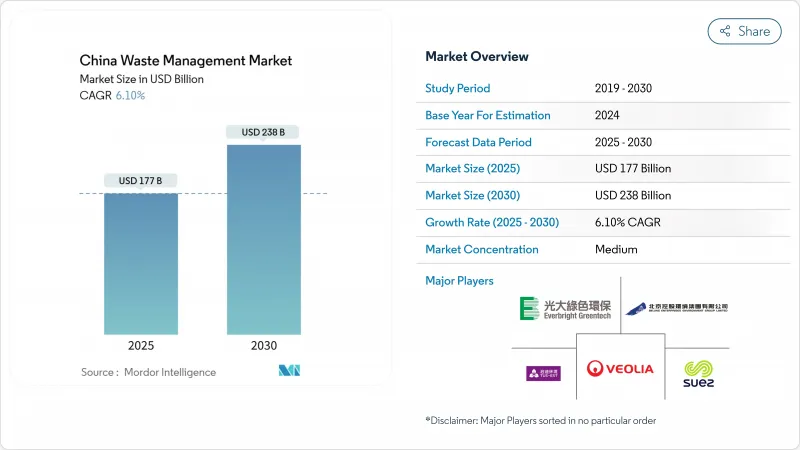
중국의 폐기물 관리 시장은 2025년에 1,770억 달러로 예상되며, 2030년에는 2,380억 달러에 이르고, CAGR 6.10%를 나타낼 것으로 예측됩니다.
아름다운 중국의 청사진과 국가의 탄소 중립 공정표에 담긴 정책 헌신이 폐기물의 흐름을 수익원으로 바꾸고 있습니다. 제2급 도시와 제3급 도시의 도시화, 기업의 ESG 지령, 민간과 정부의 환경 파트너십에 대한 자본 시장의 의욕은 통합 솔루션에 대한 꾸준한 수요를 강화하고 있습니다. 제로 웨이스트 시티 프로그램을 통해 도입된 표준화된 틀은 프로젝트의 융통성을 향상시키고 있으며, AI를 활용한 루트 계획과 블록체인에 의한 폐기물 추적 등의 디지털 기술은 운영 실적을 강화하고 있습니다. 국내 사업자에 의한 동남아시아와 중동으로의 국제 전개는 순수한 지자체 서비스 모델에서 수출 지향적이고 기술이 풍부한 자원 회수 산업으로의 전환을 밝히고 있습니다.
중국의 폐기물 관리 시장의 동향과 인사이트
고정 가격 임베디드 제도에 의해 지원되는 폐기물 발전용량 확대
1,010개가 넘는 소각 플랜트가 세계 생산 능력의 거의 절반을 차지하고 있지만, 원료 공급이 치우쳐 있기 때문에 그 대부분이 설계 부하 이하로 가동하고 있습니다. 2025년 개혁에서는 고정 가격 임베디드 제도가 시장기반의 가격설정으로 전환되고 동시에 녹색전력증서가 통합됩니다. 열효율 70.9%를 달성한 시설의 투자회수기간은 4.8년 가까이 되어 한정된 보조금으로 채산을 할 수 있게 됩니다. 과잉 설비는 중국 기업이 베트남과 걸프 국가에 투자하는 원동력이며 턴키 플랜트와 O&M의 전문 지식을 수출하고 있습니다.
도시화로 2급 및 3급 도시에서 MSW 양의 급증
급속한 인구 이동은 인프라가 따라잡는 것보다 빠르게 도시 고형 폐기물 배출량을 증가시키고 있습니다. 2024년 국가개발개혁위원회(National Development and Reform Commission)의 보고서에서는 농촌에서의 회수율이 90%에 달하는 것으로 확인되었지만, 도시화가 진행되는 지구에서는 여전히 용량 부족에 직면하고 있습니다. 스마트 휴지통과 모듈식 릴레이 스테이션을 결합한 확장 가능하고 자산이 적은 시스템에 대한 수요가 증가하고 있습니다. 2030년까지 모든 도시에서 폐기물을 100% 안전하게 처리하고자 하는 국가 목표에 힘입어 중부 및 남부 도시는 폐기물과 전력의 이중 솔루션으로 폐기물 발전을 채택하고 있습니다. 기술 공급업체는 장비와 디지털 O&M 서비스를 번들로 묶은 계약에서 이익을 얻어 배포 사이클을 가속화하고 선행 투자 위험을 줄입니다.
PPP 지불을 제한하는 지방 자치 단체의 재정 제약
예산 압박은 중형 도시가 PPP 연금을 보장하는 능력을 제한하고 프로젝트 실행을 지연시키고 카운터 파티 위험을 증가시킵니다. 개발자는 자치 단체의 현금 지출을 줄이면서도 서비스 수준을 유지하는 자산 라이트 서비스 모델과 수익 공유 약정으로 대응하고 있습니다. 또한 그린 본드와 탄소 크레딧을 통합한 복합 금융 차량이 자금 갭을 메우기 위해 상승하고 있습니다.
부문 분석
주택 폐기물은 2024년 중국 폐기물 관리 시장의 40.8%를 차지하여 수집 네트워크 계획의 핵심 역할을 굳혔습니다. 지속적인 도시의 가구 형성과 소비 지출 증가는 휴지통에서 트럭으로의 운반량을 증가시키고, 지자체는 IoT 대응 스마트 휴지통의 도입을 강요합니다. 이 스마트 휴지통은 80%가 가득 찬 경우에만 수집을 시작하여 루트 효율을 30% 향상시킵니다. 전자상거래 포장 및 식품배송 동향에 추진되는 전자상거래 폐기물은 2030년까지의 CAGR이 11.6%로 전체 배출원 중 가장 빠른 성장을 기록할 것으로 예측됩니다. 광동성과 장쑤성의 소매업용 풀필먼트 센터는 골판지의 포장과 플라스틱의 파쇄를 전용으로 하는 제3자 사업자와 이미 계약하고 있으며, 폐기물 스트림의 집중에 추종하는 형태로 서비스의 전문화가 진행되고 있음을 보여주고 있습니다.
강화된 주택분류규칙에서는 현관처에서 재활용품, 식품, 유해폐기물, 잔류폐기물을 분별하는 4분류가 의무화되어 있습니다. 이 규제를 뒷받침하는 색상별 구분 컨테이너 플릿과 이송 스테이션에서 분별 정확성을 확인하는 AI 비전 시스템에 대한 수요가 높아지고 있습니다. 도시 지역의 PPP는 수집, 아웃리치, 데이터 보고를 하나의 계약으로 결합하여 민간 기업에게 수년간의 수익 가시성을 제공합니다. 병행하여 산업 클러스터는 전 과정에서 매니페스트 추적성을 제공하는 인증 처리기에 유해 폐기물 관리를 위탁하여 가정 폐기물 이외의 서비스 범위를 확대하고 있습니다.
중국의 폐기물 관리 시장 보고서는 배출원별(주택, 상업, 기타), 서비스 유형별(처분/처리, 기타), 폐기물 유형별(도시 고형 폐기물, 산업 유해 폐기물 등), 지역별(중국 동부, 북부, 기타)으로 분류됩니다. 이 보고서는 위의 모든 부문에 대해 시장 규모 및 예측(달러)을 제공합니다.
기타 혜택
- 엑셀 형식 시장 예측(ME) 시트
- 3개월간의 애널리스트 서포트
목차
제1장 서론
- 조사의 전제조건과 시장의 정의
- 조사 범위
제2장 조사 방법
제3장 주요 요약
제4장 시장 상황
- 시장 개요
- 시장 성장 촉진요인
- 도시화가 견인하는 2급 및 3급 도시에 있어서의 MSW량의 급증
- 웨이스트 제로 도시 파일럿 프로그램이 전국적으로 확대
- 고정 가격 임베디드 제도가 뒷받침하는 폐기물 발전용량 확대
- 산업폐기물 아웃소싱을 추진하는 기업의 ESG 지침
- 전자상거래 포장 폐기물과 일회용 플라스틱 금지 시행
- 환경 PPP에 대한 자본 시장 선호 자본 비용 저하
- 시장 성장 억제요인
- PPP 지불을 제한하는 지방 자치 단체의 재정 제약
- 밀집 지역에서의 소각로 입지에 대한 지역사회의 반대
- 중소기업의 위험물 매니페스트 제도에 부적합한
- 세분화된 재활용 물류가 역수송 비용을 팽창시킨다
- 가치/공급망 분석
- 규제 전망
- 기술의 전망
- 업계의 매력 - Porter's Five Forces 분석
- 구매자의 협상력
- 공급기업의 협상력
- 신규 참가업체의 위협
- 대체품의 위협
- 경쟁 기업간 경쟁 관계
- 중국의 폐기물 처리에 있어서의 물류 지원과 발전
- 중국의 폐기물 관리에 있어서의 신흥 기업의 전략
- 효과적인 폐기물 처리에 있어서의 기술 혁신
제5장 시장 규모와 성장 예측
- 배출원별
- 주택
- 상업(소매, 오피스 등)
- 산업
- 의료(건강?의약품)
- 건설·해체
- 기타(시설, 농업 등)
- 서비스 유형별
- 수집, 수송, 선별, 분별
- 폐기/처리
- 매립
- 재활용·자원 회수
- 소각·폐기물 발전
- 기타(화학처리, 퇴비화 등)
- 기타(컨설팅, 감사·트레이닝 등)
- 폐기물 유형별
- 도시 고형 폐기물
- 산업유해폐기물
- 전자폐기물
- 플라스틱 폐기물
- 의료 폐기물
- 건설·해체 폐기물
- 농업 폐기물
- 기타 특수 폐기물(방사성 폐기물 등)
- 지역별
- 중국 동부
- 중국 북부
- 중국중부
- 중국 남부
- 기타
제6장 경쟁 구도
- 시장 집중도
- 전략적 동향
- 시장 점유율 분석
- 기업 프로파일
- Veolia Environment SA(Veolia China)
- China Everbright Environment Group Ltd.
- Suez SA(SUEZ NWS)
- Beijing Enterprises Environment Group Ltd.
- Tus-Sound Environmental Resources Co., Ltd.
- Capital Environment Holdings Ltd.
- Canvest Environmental Protection Group Co., Ltd.
- Grandblue Environment Co., Ltd.
- Dynagreen Environmental Protection Group Co., Ltd.
- Shanghai Environment Group Co., Ltd.
- Shenzhen Energy Environmental Co., Ltd.
- China Jinjiang Environment Holding Co., Ltd.
- Weiming Environmental Protection Co., Ltd.
- CITIC Envirotech Ltd.
- Sound Global Ltd.
- Guangxi Bossco Environmental Protection Co., Ltd.
- Hangzhou Jinjiang Group Co., Ltd.
- Anhui Shengyun Environment-Protection Group Co., Ltd.
- C&G Environmental Protection Holdings Ltd.
- Resou Resources Recovery Co., Ltd.
제7장 시장 기회와 미래 전망
목차
제1장 서론
- 조사의 전제조건과 시장의 정의
- 조사 범위
제2장 조사 방법
제3장 주요 요약
제4장 시장 상황
- 시장 개요
- 시장 성장 촉진요인
- 도시화가 견인하는 2급 및 3급 도시에 있어서의 MSW량의 급증
- 쓰레기 제로 도시 파일럿·프로그램이 전국에 확대
- 고정가격임베디드제도가 뒷받침하는 폐기물 발전용량 확대
- 산업폐기물 아웃소싱을 추진하는 기업의 ESG 지령
- 전자상거래 포장 폐기물과 일회용 플라스틱 금지 시행
- 환경 PPP에 대한 자본 시장 선호 자본 비용 저하
- 시장 성장 억제요인
- PPP 지불을 제한하는 지방 자치 단체의 재정 제약
- 밀집주에서의 소각로 입지에의 지역사회의 반대
- 위험물 매니페스트 제도에 부적합한 중소기업
- 세분화된 재활용 물류가 역수송 비용을 팽창시킴
- 가치/공급망 분석
- 규제 전망
- 기술의 전망
- 업계의 매력 - Porter's Five Forces 분석
- 구매자의 협상력
- 공급기업의 협상력
- 신규 참가업체의 위협
- 대체품의 위협
- 경쟁 기업간 경쟁 관계
- 중국의 폐기물 처리에 있어서의 물류 지원과 발전
- 중국의 폐기물 관리에 있어서의 신흥 기업의 전략
- 효과적인 폐기물 처리에 있어서의 기술 혁신
제5장 시장 규모와 성장 예측
- 배출원별
- 주택
- 상업(소매, 오피스 등)
- 산업
- 의료(건강 및 의약품)
- 건설 및 철거
- 기타(시설, 농업 등)
- 서비스 유형별
- 수집, 수송, 선별, 분별
- 폐기/처리
- 매립
- 재활용 및 자원 회수
- 소각 및 폐기물 발전
- 기타(화학치료, 퇴비화 등)
- 기타(컨설팅, 감사 및 트레이닝 등)
- 폐기물 유형별
- 도시 고형 폐기물
- 산업 유해 폐기물
- 전자 폐기물
- 플라스틱 폐기물
- 의료 폐기물
- 건설 및 철거 폐기물
- 농업 폐기물
- 기타 특수 폐기물(방사성 폐기물 등)
- 지역별
- 중국 동부
- 중국 북부
- 중국 중부
- 중국 남부
- 기타
제6장 경쟁 구도
- 시장 집중도
- 전략적 동향
- 시장 점유율 분석
- 기업 프로파일
- Veolia Environment SA(Veolia China)
- China Everbright Environment Group Ltd.
- Suez SA(SUEZ NWS)
- Beijing Enterprises Environment Group Ltd.
- Tus-Sound Environmental Resources Co., Ltd.
- Capital Environment Holdings Ltd.
- Canvest Environmental Protection Group Co., Ltd.
- Grandblue Environment Co., Ltd.
- Dynagreen Environmental Protection Group Co., Ltd.
- Shanghai Environment Group Co., Ltd.
- Shenzhen Energy Environmental Co., Ltd.
- China Jinjiang Environment Holding Co., Ltd.
- Weiming Environmental Protection Co., Ltd.
- CITIC Envirotech Ltd.
- Sound Global Ltd.
- Guangxi Bossco Environmental Protection Co., Ltd.
- Hangzhou Jinjiang Group Co., Ltd.
- Anhui Shengyun Environment-Protection Group Co., Ltd.
- C&G Environmental Protection Holdings Ltd.
- Resou Resources Recovery Co., Ltd.
제7장 시장 기회와 미래 전망
CSM 25.11.20The China Waste Management Market is valued at USD 177 billion in 2025 and is projected to reach USD 238 billion by 2030, advancing at a 6.10% CAGR.
Policy commitments embedded in the Beautiful China blueprint and the national carbon-neutrality timetable are converting waste streams into revenue sources, as shown by waste-to-energy plants that now account for almost half of global installed capacity. Urbanization in tier-2 and tier-3 cities, corporate ESG mandates, and capital-market appetite for environmental public-private partnerships are reinforcing steady demand for integrated solutions. Standardized frameworks introduced through the zero-waste city program are improving project bankability, while digital technologies such as AI-enabled route planning and blockchain waste tracking strengthen operational performance. International expansion by domestic operators into Southeast Asia and the Middle East reveals a shift from a purely municipal service model toward an export-oriented, technology-rich resource recovery industry.
China Waste Management Market Trends and Insights
Expansion of Waste-to-Energy Capacity Backed by Feed-in Tariffs
More than 1,010 incineration plants form almost half of global capacity, yet many run below design load because of uneven feedstock supply. The 2025 reform moves feed-in tariffs toward market-based pricing while integrating green electricity certificates. Facilities achieving 70.9% thermal efficiency show payback periods near 4.8 years, enabling profitability with limited subsidies. Overcapacity is driving Chinese firms to invest in Vietnam and the Gulf states, exporting turnkey plants and O&M expertise.
Urbanization-driven MSW Volume Surge in Tier-2 and Tier-3 Cities
Rapid migration is lifting municipal solid waste output faster than infrastructure can keep pace. The 2024 National Development and Reform Commission report confirms 90% rural collection coverage, yet urbanizing districts still face capacity shortfalls. Demand is rising for scalable, asset-light systems that combine smart bins with modular transfer stations. Central and Southern cities are adopting waste-to-energy as a dual solution for waste and electricity, supported by a national goal of 100% safe disposal in all urban areas by 2030. Technology suppliers benefit from contracts that bundle equipment with digital O&M services, accelerating deployment cycles and reducing upfront capital risks.
Local-Government Fiscal Constraints Limiting PPP Payments
Budget pressures restrict the ability of mid-sized cities to guarantee PPP annuities, delaying project execution and raising counterparty risk. Developers respond with asset-light service models and revenue-sharing arrangements that reduce municipal cash outlay yet preserve service standards. Blended-finance vehicles incorporating green bonds and carbon credits are emerging to close funding gaps.
Other drivers and restraints analyzed in the detailed report include:
- Corporate ESG Mandates Driving Industrial Waste Outsourcing
- Zero-Waste City Program Scaling Nationwide
- Community Opposition to Incinerator Siting in Dense Provinces
For complete list of drivers and restraints, kindly check the Table Of Contents.
Segment Analysis
Residential waste contributed 40.8% of the Chinese waste management market in 2024, cementing its role as the backbone for collection network planning. Continuous urban household formation and rising consumer spending push bin-to-truck volumes upward, compelling municipalities to deploy IoT-enabled smart bins that trigger pickups only when 80% full, lifting route efficiency by 30%. Commercial waste, propelled by e-commerce packaging and food delivery trends, is forecast to register an 11.6% CAGR to 2030, the fastest among all sources. Retail fulfillment centers in Guangdong and Jiangsu have already contracted third-party operators for dedicated cardboard baling and plastics shredding, illustrating how service specialization follows waste-stream concentration.
Enhanced residential segregation rules require four-stream sorting that separates recyclables, food, hazardous, and residual waste at the doorstep. This regulatory push spurs demand for color-coded container fleets and AI vision systems that verify sorting accuracy at transfer stations. Urban neighborhood PPPs bundle collection, outreach, and data reporting under single contracts, creating multi-year revenue visibility for private firms. In parallel, industrial clusters outsource hazardous waste management to certified handlers offering cradle-to-grave manifest traceability, expanding service scope beyond household waste.
The Chinese Waste Management Market Report is Segmented by Source (Residential, Commercial, and More), by Service Type (Disposal/Treatment and More), by Waste Type (Municipal Solid Waste, Industrial Hazardous Waste, and More), and by Region (Eastern China, Northern China, and More). The Report Offers Market Size and Forecasts in Value (USD) for all the Above Segments.
List of Companies Covered in this Report:
- Veolia Environment SA (Veolia China)
- China Everbright Environment Group Ltd.
- Suez SA (SUEZ NWS)
- Beijing Enterprises Environment Group Ltd.
- Tus-Sound Environmental Resources Co., Ltd.
- Capital Environment Holdings Ltd.
- Canvest Environmental Protection Group Co., Ltd.
- Grandblue Environment Co., Ltd.
- Dynagreen Environmental Protection Group Co., Ltd.
- Shanghai Environment Group Co., Ltd.
- Shenzhen Energy Environmental Co., Ltd.
- China Jinjiang Environment Holding Co., Ltd.
- Weiming Environmental Protection Co., Ltd.
- CITIC Envirotech Ltd.
- Sound Global Ltd.
- Guangxi Bossco Environmental Protection Co., Ltd.
- Hangzhou Jinjiang Group Co., Ltd.
- Anhui Shengyun Environment-Protection Group Co., Ltd.
- C&G Environmental Protection Holdings Ltd.
- Resou Resources Recovery Co., Ltd.
Additional Benefits:
- The market estimate (ME) sheet in Excel format
- 3 months of analyst support
TABLE OF CONTENTS
1 Introduction
- 1.1 Study Assumptions & Market Definition
- 1.2 Scope of the Study
2 Research Methodology
3 Executive Summary
4 Market Landscape
- 4.1 Market Overview
- 4.2 Market Drivers
- 4.2.1 Urbanization-Driven MSW Volume Surge in Tier-2 & Tier-3 Cities
- 4.2.2 Zero-Waste City Pilot Program Scaling Nationwide
- 4.2.3 Expansion of Waste-to-Energy Capacity Backed by Feed-in Tariffs
- 4.2.4 Corporate ESG Mandates Driving Industrial Waste Outsourcing
- 4.2.5 E-commerce Packaging Waste & Single-Use Plastic Ban Enforcement
- 4.2.6 Capital-Market Preference for Environmental PPPs Lowering Cost of Capital
- 4.3 Market Restraints
- 4.3.1 Local-Government Fiscal Constraints Limiting PPP Payments
- 4.3.2 Community Opposition to Incinerator Siting in Dense Provinces
- 4.3.3 SME Non-Compliance with Hazardous-Waste Manifest System
- 4.3.4 Fragmented Recycling Logistics Inflating Reverse-Haul Costs
- 4.4 Value / Supply-Chain Analysis
- 4.5 Regulatory Outlook
- 4.6 Technological Outlook
- 4.7 Industry Attractiveness - Porter's Five Forces
- 4.7.1 Bargaining Power of Buyers
- 4.7.2 Bargaining Power of Suppliers
- 4.7.3 Threat of New Entrants
- 4.7.4 Threat of Substitutes
- 4.7.5 Competitive Rivalry
- 4.8 Logistics Support & Development in Chinese Waste Management
- 4.9 Strategies of Rising Start-ups in Chinese Waste Management
- 4.10 Technological Innovation in Effective Waste Management
5 Market Size & Growth Forecasts (Value, In USD Billion)
- 5.1 By Source
- 5.1.1 Residential
- 5.1.2 Commercial (Retail, Office, etc.)
- 5.1.3 Industrial
- 5.1.4 Medical (Health and Pharmaceutical)
- 5.1.5 Construction & Demolition
- 5.1.6 Others (Institutional, Agricultural, etc.)
- 5.2 By Service Type
- 5.2.1 Collection, Trasportation, Sorting & Seggregation
- 5.2.2 Disposal / Treatment
- 5.2.2.1 Landfill
- 5.2.2.2 Recycling & Resource Recovery
- 5.2.2.3 Incineration & Waste-to-Energy
- 5.2.2.4 Others (Chemical Treatment, Composting, etc.)
- 5.2.3 Others (Consulting, Audit & Training, etc.)
- 5.3 By Waste Type
- 5.3.1 Municipal Solid Waste
- 5.3.2 Industrial Hazardous Waste
- 5.3.3 E-waste
- 5.3.4 Plastic Waste
- 5.3.5 Biomedical Waste
- 5.3.6 Construction & Demolition Waste
- 5.3.7 Agricultural Waste
- 5.3.8 Other Specialized Waste (Radio Active, etc.)
- 5.4 By Region
- 5.4.1 Eastern China
- 5.4.2 Northern China
- 5.4.3 Central China
- 5.4.4 Southern China
- 5.4.5 Others
6 Competitive Landscape
- 6.1 Market Concentration
- 6.2 Strategic Moves
- 6.3 Market Share Analysis
- 6.4 Company Profiles {(includes Global-level Overview, Market-level Overview, Core Segments, Financials as available, Strategic Information, Products & Services, and Recent Developments)}
- 6.4.1 Veolia Environment SA (Veolia China)
- 6.4.2 China Everbright Environment Group Ltd.
- 6.4.3 Suez SA (SUEZ NWS)
- 6.4.4 Beijing Enterprises Environment Group Ltd.
- 6.4.5 Tus-Sound Environmental Resources Co., Ltd.
- 6.4.6 Capital Environment Holdings Ltd.
- 6.4.7 Canvest Environmental Protection Group Co., Ltd.
- 6.4.8 Grandblue Environment Co., Ltd.
- 6.4.9 Dynagreen Environmental Protection Group Co., Ltd.
- 6.4.10 Shanghai Environment Group Co., Ltd.
- 6.4.11 Shenzhen Energy Environmental Co., Ltd.
- 6.4.12 China Jinjiang Environment Holding Co., Ltd.
- 6.4.13 Weiming Environmental Protection Co., Ltd.
- 6.4.14 CITIC Envirotech Ltd.
- 6.4.15 Sound Global Ltd.
- 6.4.16 Guangxi Bossco Environmental Protection Co., Ltd.
- 6.4.17 Hangzhou Jinjiang Group Co., Ltd.
- 6.4.18 Anhui Shengyun Environment-Protection Group Co., Ltd.
- 6.4.19 C&G Environmental Protection Holdings Ltd.
- 6.4.20 Resou Resources Recovery Co., Ltd.
7 Market Opportunities & Future Outlook
- 7.1 White-Space & Unmet-Need Assessment