|
시장보고서
상품코드
1851440
아디핀산 시장 : 점유율 분석, 산업 동향, 통계, 성장 예측(2025-2030년)Adipic Acid - Market Share Analysis, Industry Trends & Statistics, Growth Forecasts (2025 - 2030) |
||||||
 Mordor Intelligence
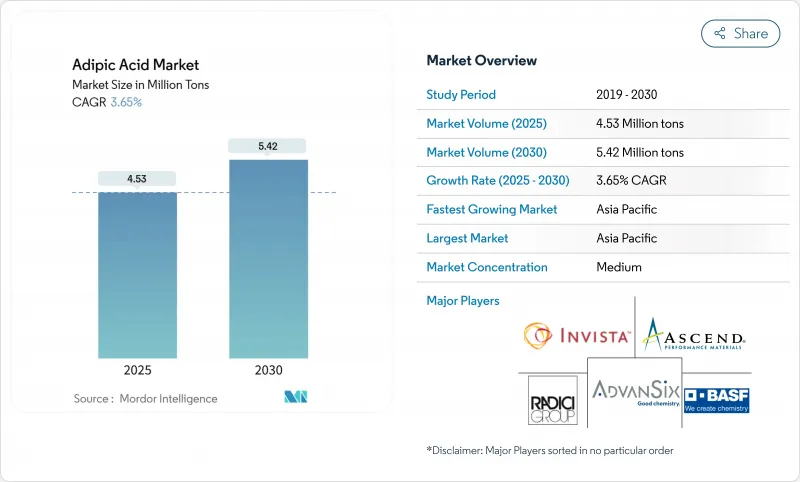
아디핀산 시장 규모는 2025년에 453만 톤, 예측기간(2025-2030년)의 CAGR은 3.65%를 나타내고, 2030년에는 542만 톤에 달할 것으로 예측됩니다.
배출 가스 규제, 자동차 경량화, 바이오 발효 경로의 매력이 이 궤도를 형성하는 매우 중요한 힘이 되고 있습니다. 아시아태평양이 여전히 생산과 소비의 중심지인 반면, 북미와 유럽은 강화되는 정책 목표를 달성할 수 있는 저배출 기술을 개발하고 있습니다. 발효의 파괴적인 발전은 질산산화와의 비용 격차를 줄이고 있으며, 통합 나일론 66 능력에 대한 전략적 자본 유입은 다운스트림 수요에 대한 자신감을 보여줍니다. 그러나 규제의 추풍과 최종 시장의 다양화로 아디핀산 시장은 명확한 성장 궤도에 있습니다.
세계 아디핀산 시장 동향과 통찰
E-모빌리티용 경량 부품에 있어서의 나일론 66 수요 급증
전기자동차 제조업체는 차량 질량 감소 및 항속 거리 연장을 위해 나일론 66을 채택하여 아디핀산 기반 중간체의 소비가 증가하고 있습니다. 상하이의 나일론 66 생산량을 40만 톤으로 두배로 늘리는 인비스타 프로젝트에서는 아디포니트릴 원료 근처에서 생산하기 때문에 물류 비용이 낮아 공급망이 단축됩니다. 프랑스에 위치한 BASF의 26만 톤의 헥사메틸렌디아민 유닛은 중요한 단량체의 지역적 자급률을 확대합니다. 배터리의 열 관리 모듈과 구조 모듈은 같은 정도의 무게로 금속이 제공할 수 없는 내열성을 나일론 66에 의존하고 있습니다. 최근 중국의 아디포니트릴 공장에서 예기치 않은 가동 중단이 발생하여 공급 취약성이 부각되었습니다.
EV용 배터리 케이싱 금속에서 플라스틱으로 이동
자동차 제조업체는 금속 배터리 커버를 경량화와 설계 유연성 향상을 양립시킨 폴리머 솔루션으로 전환하고 있습니다. 아디핀산으로부터 유래된 폴리우레탄 폼은 현재 방열하면서 케이싱을 단열하고 있으며 코베스트로의 ISCC 인증 원료는 업계의 지속가능성 전환을 보여줍니다. 미국 자동차 제조업체가 2023년에 소비하는 폴리우레탄 페인트는 1억 4,200만 파운드이며, 아디핀산 공급업체에게 단기적인 수익 증가를 기대할 수 있는 규모입니다. 플라스틱은 복잡한 모양을 허용하고 배터리 팩 아키텍처를 간소화합니다. 고기능 폴리머의 프리미엄 가격은 원재료 비용 상승을 상쇄하고 아디핀산 시장을 안정시키는 생산 능력 증진을 촉진합니다.
사이클로헥사논 원료 가격 변동성
사이클로헥사논은 전환 비용의 약 3분의 2를 차지하기 때문에 가격 변동은 마진을 빠르게 압박합니다. 업스트림의 다양화가 제한되어 있기 때문에 계획 밖의 가동 중지와 지정학적 충격이 밸류체인에 파급됩니다. 물류 및 에너지 비용 상승은 전체 생산의 경제성을 더욱 불안정하게 하고 장기 계약을 복잡하게 만듭니다. 수직 통합과 바이오 아로마틱스와 같은 대체 원료는 회복 전략으로 주목 받고 있습니다. 그러나 원료주기가 예측 불가능한 상황에서는 가와카미 인수를 위한 자본 확보가 어렵습니다.
부문 분석
2024년 아디핀산 시장 점유율은 시클로헥사논이 55.19%를 차지하여 질산산화에 있어서 역할의 정착이 확인되었습니다. 시클로헥사논과 관련된 아디핀산 시장 규모는 세계 생산량의 약 절반에 해당하며 안정적인 공급망의 중요성을 강화하고 있습니다. 그러나 사이클로헥사논은 아산화질소 배출을 줄이는 환경 친화적인 산화 촉매의 도입으로 CAGR 4.94%로 성장하고 있습니다. 과산화수소를 사용한 촉매 설계는 전환율 92.3%, 아디핀산에 대한 선택률 29.4%를 달성하여 대폭적인 효율 향상을 나타내고 있습니다. 93%의 효율로 수소 가스를 공생성하는 패러다이크 효율이 높은 전극 촉매는 새로운 수익원을 제공하여 탈탄소화 목표에 부합합니다.
리그닌을 가치화하는 바이오 방향족 개념은 원유에서 유래한 중간체를 사슬에서 완전히 제거할 수 있습니다. Pseudomonas putida의 개선된 균주는 리그닌 단편으로부터 2.5g/L의 아디핀산을 생산하여 미래의 바이오리파이너리 사이드 스트림으로의 통합을 시사하고 있습니다. 라이프사이클 평가는 석유화학 루트에 비해 CO2를 58% 줄이고 에너지 수요를 23% 삭감하는 것을 제안하고 있으며, 이러한 경로는 진화하는 탄소가격제도 하에서 컴플라이언스 툴로 자리매김하고 있습니다. 생산량은 아직 적지만, 상업화에 성공하면 아디핀산 시장에서 원료의 경제성을 바꿀 수 있다고 생각됩니다.
질산산화는 성숙한 기술과 셍크 캐피탈에 의해 2024년 아디핀산 시장의 91.45%를 차지했습니다. 이 공정과 관련된 아디핀산 시장 규모는 스케일 메리트에 의한 혜택을 받고 있지만, 아산화질소의 배출에 관한 정사를 견디고 있습니다. 텍사스의 규제는 NOx를 톤당 2.5파운드로 제한하고 있으며 지역 규정 준수 부담의 크기를 보여줍니다.
바이오 발효는 CAGR 5.04%의 기세밖에 없는데도 포도당과 자일로스를 원료로 하는 상업적인 시도가 진행되고 있습니다. 탄소 비용이 내부화되면, 특히 재생에너지에 잉여가 있는 지역에서는 경제적 평가가 가까워집니다. 옥수수 에탄올 플랜트와의 공동 위치는 원료와 유틸리티를 확보하고 변동 비용을 추가로 압축할 수 있습니다. 경쟁 시나리오는 발효가 고정비를 기존 자산 수준 이하로 낮추는 데 필요한 규모를 달성할 수 있는지 여부에 달려 있습니다.
아디핀산 시장 보고서는 원료(시클로헥산올, 시클로헥사논), 제조 공정(질산산화, 바이오 발효), 최종 제품(나일론 66 섬유, 나일론 66 엔지니어링 수지, 기타), 용도(가소제, 불포화 폴리에스테르 수지, 기타), 최종 사용자 산업(자동차, 전기 및 전자, 기타), 지역(아시아태평양,북미, 유럽 등)으로 분류됩니다.
지역 분석
아시아태평양은 2024년 세계 판매량의 47.14%를 차지했고 중국이 생산 능력을 확대하고 인도가 석유화학 투자를 구자라트 회랑으로 돌리는 가운데 CAGR이 가장 빠른 5.19%입니다. 촉매 파괴 장치의 급속한 도입으로 중국과 구미 생산자 사이의 탄소 격차가 줄어들기 시작했습니다.
북미는 식품 등급과 고순도 등급의 아디핀산의 아성입니다. 어센드 퍼포먼스 머티리얼즈(Ascend Performance Materials)와 어드밴스익스(AdvanSix)는 셰일가스의 경제성과 엄격한 미국의 배출규제의 혜택을 받아 완벽하게 통합된 체인을 운영하고 있습니다. 중서부에 집중하는 발효 조종사는 옥수수 원료와 풍력 회랑에서 재생 가능 전력을 활용합니다.
유럽에서는 순환성에 중점을 둔 정책을 통해 다운스트림 수지 플랜트와 업스트림 단량체를 결합하여 물류 배출을 최소화하는 통합 자산으로 자본을 향하고 있습니다. BASF의 프랑스에서 헥사 메틸렌 디아민에 대한 투자는 지속가능성을 공급 아키텍처에 통합 한 허브 모델의 예입니다. 남미와 중동, 아프리카는 인프라 정비에 새로운 관심을 보이고 있지만 정치적, 경제적 변동이 대규모 투자를 지연시키는 장애물이 되고 있습니다. 이러한 역학은 아디핀산 시장의 세계 공급 패턴을 계속 형성하는 지역적 계층 구조를 보여줍니다.
기타 혜택 :
- 엑셀 형식 시장 예측(ME) 시트
- 3개월간의 애널리스트 서포트
목차
제1장 서론
- 조사의 전제조건과 시장의 정의
- 조사 범위
제2장 조사 방법
제3장 주요 요약
제4장 시장 상황
- 시장 개요
- 시장 성장 촉진요인
- e-모빌리티용 경량 부품으로 나일론 66 수요가 급증
- EV용 전지 케이싱의 금속으로부터 플라스틱으로 전환
- 에너지 효율이 높은 건설용 폼의 성장
- 섬유 필라멘트의 생산 능력 확대
- 퇴비화 가능한 필름용 바이오 베이스의 아디핀산의 출현
- 시장 성장 억제요인
- 사이클로헥사논 원료 가격의 변동성
- 바이오 발효 경로의 스케일업 과제
- 질산 공급망의 지정학적 위험
- 밸류체인 분석
- Porter's Five Forces
- 공급기업의 협상력
- 구매자의 협상력
- 신규 참가업체의 위협
- 대체품의 위협
- 경쟁도
제5장 시장 규모와 성장 예측(금액 및 수량)
- 원재료별
- 사이클로헥산올
- 사이클로헥사논
- 생산 공정별
- 질산 산화
- 바이오 발효
- 최종제품별
- 나일론 66 섬유
- 나일론 66 엔지니어링 수지
- 폴리우레탄
- 아디페이트 에스터
- 기타 최종 제품
- 용도별
- 가소제
- 불포화 폴리에스테르 수지
- 습식 종이 수지
- 코팅
- 합성 윤활유
- 식품 첨가물
- 기타 용도
- 최종 사용자 업계별
- 자동차
- 전기 및 전자
- 섬유
- 식음료
- 퍼스널케어
- 의약품
- 기타 최종 사용자 업계
- 지역별
- 아시아태평양
- 중국
- 인도
- 일본
- 한국
- 기타 아시아태평양
- 북미
- 미국
- 캐나다
- 멕시코
- 유럽
- 독일
- 영국
- 이탈리아
- 프랑스
- 기타 유럽
- 남미
- 브라질
- 아르헨티나
- 기타 남미
- 중동 및 아프리카
- 사우디아라비아
- 남아프리카
- 기타 중동 및 아프리카
- 아시아태평양
제6장 경쟁 구도
- 시장 집중도
- 전략적 동향
- 시장 점유율 분석
- 기업 프로파일
- AdvanSix Inc.
- Asahi Kasei Corp.
- Ascend Performance Materials
- BASF SE
- CJ CheilJedang
- Domo Chemicals
- Huafeng Group
- INVISTA
- Lanxess AG
- Radici Partecipazioni SpA
- Shandong Hualu-Hengsheng Chemical
- Shenma Industrial
- Solvay SA
- Sumitomo Chemical Co., Ltd.
- Tangshan Zhonghao Chemical
- TORAY INDUSTRIES, INC.
제7장 시장 기회와 장래의 전망
SHW 25.11.21The Adipic Acid Market size is estimated at 4.53 million tons in 2025, and is expected to reach 5.42 million tons by 2030, at a CAGR of 3.65% during the forecast period (2025-2030).
Emission regulations, automotive light-weighting, and the appeal of bio-fermentation pathways are the pivotal forces shaping this trajectory. Asia-Pacific remains the production and consumption epicenter, while North America and Europe advance low-emission technologies that can meet tightening policy targets. Disruptive strides in fermentation are narrowing cost gaps with nitric-acid oxidation, and strategic capital flows into integrated nylon 66 capacity signal confidence in downstream demand. Feedstock volatility and scale-up risks temper optimism, yet regulatory tailwinds and end-market diversification keep the adipic acid market on a clear growth path.
Global Adipic Acid Market Trends and Insights
Surging Demand for Nylon 66 in E-Mobility Lightweight Parts
Electric vehicle manufacturers are embracing nylon 66 to reduce vehicle mass and extend driving range, which elevates consumption of adipic acid-based intermediates. INVISTA's project to double Shanghai nylon 66 output to 400,000 tons places production close to adiponitrile feedstock, lowering logistics costs and shortening supply chains. BASF's 260,000-ton hexamethylenediamine unit in France expands regional self-sufficiency for critical monomers. Battery thermal-management and structural modules rely on nylon 66 for heat resistance that metals cannot offer at comparable weight. Recent unplanned outages at adiponitrile plants in China highlighted supply vulnerability and prompted producers to integrate upstream operations for risk mitigation.
Shift from Metal to Plastics in EV Battery Casings
Automakers are converting metal battery covers to polymer solutions that combine weight savings with enhanced design flexibility. Polyurethane foams derived from adipic acid now insulate casings while dissipating heat, and Covestro's ISCC+ certified raw materials illustrate the industry's sustainability pivot. United States automotive producers consumed 142 million lb of polyurethane coatings in 2023, a scale that underscores the near-term revenue upside for adipic acid suppliers. Complex geometries are achievable through plastics, enabling streamlined battery pack architectures. Premium pricing for high-performance polymers offsets higher raw-material costs and encourages capacity additions that stabilize the adipic acid market.
Volatility in Cyclohexanone Feedstock Prices
Cyclohexanone accounts for roughly two-thirds of conversion costs; hence, price swings rapidly compress margins. Limited upstream diversification means unplanned outages or geopolitical shocks ripple through the value chain. Rising logistics and energy costs further destabilize total production economics, complicating long-term contracts. Vertical integration or alternative feedstocks such as bio-aromatics are gaining attention as resilience strategies. However, securing capital for upstream acquisitions is challenging when feedstock cycles remain unpredictable.
Other drivers and restraints analyzed in the detailed report include:
- Growth of Energy-Efficient Construction Foams
- Expansion of Textile Filament Capacity
- Scale-Up Challenges for Bio-Fermentation Pathways
For complete list of drivers and restraints, kindly check the Table Of Contents.
Segment Analysis
Cyclohexanone controlled 55.19% adipic acid market share in 2024, confirming its entrenched role in nitric-acid oxidation. The adipic acid market size tied to cyclohexanone represents roughly half of global output, reinforcing the importance of stable supply chains. Cyclohexanol, however, is rising at 4.94% CAGR as producers deploy greener oxidation catalysts that slash nitrous oxide emissions. Catalyst designs featuring hydrogen peroxide achieve 92.3% conversion and 29.4% selectivity to adipic acid, reflecting substantial efficiency gains. Faradaic-efficient electrocatalysis that co-generates hydrogen gas at 93% efficiency presents an additional revenue stream and aligns with decarbonization targets.
Bio-aromatic concepts that valorize lignin can remove crude-derived intermediates from the chain altogether. Engineered Pseudomonas putida strains deliver 2.5 g/L adipic acid from lignin fragments and point toward future integration of biorefinery side-streams. Lifecycle assessments suggest a 58% CO2 reduction and 23% lower energy demand versus petrochemical routes, positioning such pathways as compliance tools under evolving carbon-pricing regimes. Although volumes remain small, successful commercialization could redraw raw-material economics within the adipic acid market.
Nitric-acid oxidation constituted 91.45% of the adipic acid market in 2024 due to mature technology and sunk capital. The adipic acid market size linked to this process benefits from economies of scale but endures scrutiny over nitrous oxide emissions. Texas regulations limit NOx to 2.5 lb per ton, illustrating regional compliance burdens.
Bio-fermentation, despite holding only 5.04% CAGR momentum, is gathering commercial trials that run on glucose and xylose. When carbon costs are internalized, economic parity edges closer, particularly in regions with renewable-energy surpluses. Co-location with corn-ethanol plants can secure feedstock and utilities, further compressing variable cost. The competitive narrative hinges on whether fermentation can achieve the scale needed to drop fixed costs below incumbent asset levels.
The Adipic Acid Market Report is Segmented by Raw Material (Cyclohexanol, Cyclohexanone), Production Process (Nitric-Acid Oxidation, Bio-Fermentation), End Product (Nylon 66 Fibers, Nylon 66 Engineering Resins, and More), Application (Plasticizers, Unsaturated Polyester Resins, and More), End-User Industry (Automotive, Electrical and Electronics, and More), and Geography (Asia-Pacific, North America, Europe, and More).
Geography Analysis
Asia-Pacific held 47.14% of global volume in 2024 and drives the fastest 5.19% CAGR as China scales capacity and India channels petrochemical investment into Gujarat corridors. Rapid adoption of catalytic destruction units has started to narrow the carbon gap between Chinese and Western producers.
North America remains a stronghold for food-grade and high-purity grades of adipic acid. Ascend Performance Materials and AdvanSix operate fully integrated chains that benefit from shale-gas economics and strict U.S. emission controls, which favor producers with demonstrated compliance records. Fermentation pilots clustered in the Midwest leverage corn feedstock and renewable electricity from wind corridors.
Europe's policy focus on circularity is driving capital toward integrated assets that couple downstream resin plants with upstream monomers to minimize logistics emissions. BASF's French hexamethylenediamine investment exemplifies a hub model that embeds sustainability into supply architecture. South America and the Middle East & Africa show emerging interest through infrastructure build-outs, yet political and economic volatility create hurdles that could delay large-scale investments. Together these dynamics illustrate a regionally stratified complexion that continues to shape global supply patterns in the adipic acid market.
- AdvanSix Inc.
- Asahi Kasei Corp.
- Ascend Performance Materials
- BASF SE
- CJ CheilJedang
- Domo Chemicals
- Huafeng Group
- INVISTA
- Lanxess AG
- Radici Partecipazioni SpA
- Shandong Hualu-Hengsheng Chemical
- Shenma Industrial
- Solvay SA
- Sumitomo Chemical Co., Ltd.
- Tangshan Zhonghao Chemical
- TORAY INDUSTRIES, INC.
Additional Benefits:
- The market estimate (ME) sheet in Excel format
- 3 months of analyst support
TABLE OF CONTENTS
1 Introduction
- 1.1 Study Assumptions and Market Definition
- 1.2 Scope of the Study
2 Research Methodology
3 Executive Summary
4 Market Landscape
- 4.1 Market Overview
- 4.2 Market Drivers
- 4.2.1 Surging demand for Nylon 66 in e-mobility lightweight parts
- 4.2.2 Shift from metal to plastics in EV battery casings
- 4.2.3 Growth of energy-efficient construction foams
- 4.2.4 Expansion of textile filament capacity
- 4.2.5 Emergence of bio-based adipic acid for compostable films
- 4.3 Market Restraints
- 4.3.1 Volatility in cyclohexanone feedstock prices
- 4.3.2 Scale-up challenges for bio-fermentation pathways
- 4.3.3 Geopolitical risk to nitric-acid supply chains
- 4.4 Value Chain Analysis
- 4.5 Porter's Five Forces
- 4.5.1 Bargaining Power of Suppliers
- 4.5.2 Bargaining Power of Buyers
- 4.5.3 Threat of New Entrants
- 4.5.4 Threat of Substitutes
- 4.5.5 Degree of Competition
5 Market Size and Growth Forecasts (Value and Volume)
- 5.1 By Raw Material
- 5.1.1 Cyclohexanol
- 5.1.2 Cyclohexanone
- 5.2 By Production Process
- 5.2.1 Nitric-acid Oxidation
- 5.2.2 Bio-fermentation
- 5.3 By End Product
- 5.3.1 Nylon 66 Fibers
- 5.3.2 Nylon 66 Engineering Resins
- 5.3.3 Polyurethanes
- 5.3.4 Adipate Esters
- 5.3.5 Other End Products
- 5.4 By Application
- 5.4.1 Plasticizers
- 5.4.2 Unsaturated Polyester Resins
- 5.4.3 Wet Paper Resins
- 5.4.4 Coatings
- 5.4.5 Synthetic Lubricants
- 5.4.6 Food Additives
- 5.4.7 Other Applications
- 5.5 By End-user Industry
- 5.5.1 Automotive
- 5.5.2 Electrical and Electronics
- 5.5.3 Textiles
- 5.5.4 Food and Beverage
- 5.5.5 Personal Care
- 5.5.6 Pharmaceuticals
- 5.5.7 Other End User Industries
- 5.6 By Geography
- 5.6.1 Asia-Pacific
- 5.6.1.1 China
- 5.6.1.2 India
- 5.6.1.3 Japan
- 5.6.1.4 South Korea
- 5.6.1.5 Rest of Asia-Pacific
- 5.6.2 North America
- 5.6.2.1 United States
- 5.6.2.2 Canada
- 5.6.2.3 Mexico
- 5.6.3 Europe
- 5.6.3.1 Germany
- 5.6.3.2 United Kingdom
- 5.6.3.3 Italy
- 5.6.3.4 France
- 5.6.3.5 Rest of Europe
- 5.6.4 South America
- 5.6.4.1 Brazil
- 5.6.4.2 Argentina
- 5.6.4.3 Rest of South America
- 5.6.5 Middle East and Africa
- 5.6.5.1 Saudi Arabia
- 5.6.5.2 South Africa
- 5.6.5.3 Rest of Middle East and Africa
- 5.6.1 Asia-Pacific
6 Competitive Landscape
- 6.1 Market Concentration
- 6.2 Strategic Moves
- 6.3 Market Share Analysis
- 6.4 Company Profiles (includes Global level Overview, Market level overview, Core Segments, Financials as available, Strategic Information, Market Rank/Share for key companies, Products and Services, and Recent Developments)
- 6.4.1 AdvanSix Inc.
- 6.4.2 Asahi Kasei Corp.
- 6.4.3 Ascend Performance Materials
- 6.4.4 BASF SE
- 6.4.5 CJ CheilJedang
- 6.4.6 Domo Chemicals
- 6.4.7 Huafeng Group
- 6.4.8 INVISTA
- 6.4.9 Lanxess AG
- 6.4.10 Radici Partecipazioni SpA
- 6.4.11 Shandong Hualu-Hengsheng Chemical
- 6.4.12 Shenma Industrial
- 6.4.13 Solvay SA
- 6.4.14 Sumitomo Chemical Co., Ltd.
- 6.4.15 Tangshan Zhonghao Chemical
- 6.4.16 TORAY INDUSTRIES, INC.
7 Market Opportunities and Future Outlook
- 7.1 White-space and Unmet-need Assessment