|
시장보고서
상품코드
1851454
가스 터빈 시장 : 점유율 분석, 산업 동향, 통계, 성장 예측(2025-2030년)Gas Turbine - Market Share Analysis, Industry Trends & Statistics, Growth Forecasts (2025 - 2030) |
||||||
 Mordor Intelligence
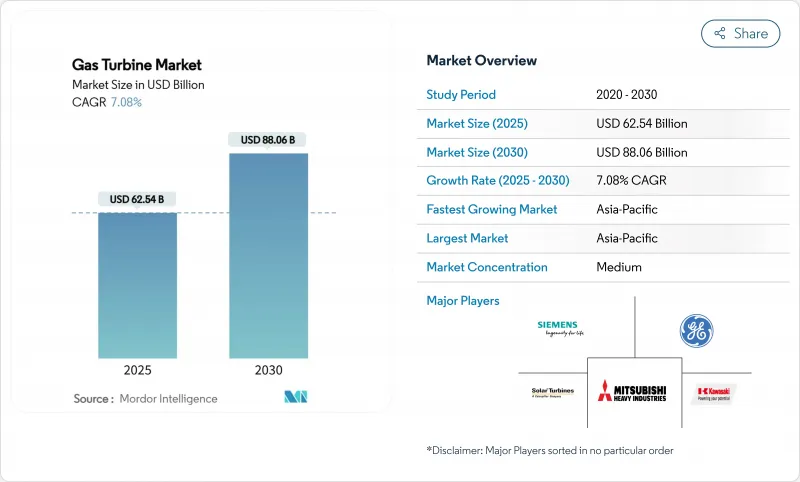
가스터빈 시장 규모는 2025년에 625억 4,000만 달러, 2030년에는 880억 6,000만 달러에 이르고, 예측기간(2025-2030년)의 CAGR은 7.08%를 나타낼 전망입니다.
이 기세는 에너지 안보에 대한 우려, 탄소 삭감 정책의 강화, 재생에너지 보급률의 상승에 따라 송전망을 안정화시키는 유연한 자산의 필요성에 기인하고 있습니다. 인공지능 워크로드에 따라 데이터센터의 전력 수요가 급증하고 있기 때문에 듀크에너지사 등의 전력회사는 신속한 시동과 효율적인 운전이 가능한 터빈을 추가로 확보할 필요가 있습니다. 제조업체 각 사는 수소 대응 설계, 콤바인드 사이클 효율의 향상, 설치 시간과 비용의 저감을 목적으로 한 모듈 건설 기술을 우선하고 있습니다. 초합금 핫가스 패스 부품 공급망에 대한 제약과 ESG 분류와 관련된 자금조달 장애물은 전반적인 전망을 완화하고 있지만 신규 수주잔고는 늦추지 않고 있습니다.
세계의 가스터빈 시장 동향과 통찰
아시아태평양의 석탄에서 가스로의 전환은 전력 회사의 주문을 가속화
석탄화력발전소가 배출규제 강화에 직면하고 있는 가운데 중국, 인도, 베트남의 전력회사는 수소혼소용으로 미리 설계된 고효율 터빈에 눈을 돌리고 있습니다. 중국이 대용량 수소유닛을 도입한 것은 청정연료와 분산형 전력을 결합하는 국가적인 의도를 나타내는 것입니다. 베트남은 이미 9HA.02 시스템을 도입하여 저탄소 베이스 로드를 확보하고 있습니다. 싱가포르는 2030년까지 수소 대응 유닛을 가동할 계획이며, 가스 터빈 시장이 재생에너지와 탈탄소화 목표의 교량을 하고 있음을 강조하고 있습니다. 지역 조달 파이프라인은 2030년까지 42GW 이상의 잠재 용량을 추가합니다.
동남아시아의 LNG 연계 섬 송전망이 모바일 에어로 파생 상품 수요 견인
시마야 경제는 계절적인 관광에 의존하고 있어 소규모 송전망에서 변동하는 자연 에너지를 관리해야 합니다. 휴대용 TM2500 패키지는 현재 몇 분 안에 34MW를 공급하고 물 없이 작동하며 유연한 피크 전력과 비상 전력을 공급합니다. 발전사업자는 연료로 부체식 LNG 저장을 이용하여 신속한 설치와 이전을 가능하게 합니다. 강화된 건식 낮은 NOx 연소는 배출 가스를 줄이고 다중 연료 기능은 공급 중단에 대한 탄력성을 지원합니다. 따라서 항공 파생 연료 공급업체는 동남아시아와 카리브해 국가의 일부에서 명확한 틈새 시장이 탄생하고 있다고 봅니다.
우크라이나 전쟁 후 가스 가격 변동이 EU 프로젝트를 억제
러시아에서 유럽으로의 파이프라인 유량이 80% 감소했기 때문에 스팟 가스 가격은 공전의 고가가 되어 심플 사이클 유닛의 프로젝트 자금 조달에 지장을 받았습니다. 개발자는 현재 장기 LNG 계약을 맺은 결합 사이클 발전소를 선호하고 있으며, 일부 피크 프로젝트는 배터리 스토리지로 전환하고 있습니다. 독일은 공급 확보를 위해 재기화 터미널을 가속화하고 있지만, 금융기관은 가격이 안정될 때까지 신중한 자세를 무너뜨리지 않았으며 EU 일부 국가에서는 가스 터빈 시장이 감속하고 있습니다.
부문 분석
120MW를 넘는 대형 프레임이 2024년 매출의 58%를 차지했고, 베이스 로드나 콤바인드 사이클에서의 고출력·고효율 설비에 대한 전력회사의 기호를 뒷받침하고 있습니다. 무거운 구조는 열 안정성이 우수하며 미래의 수소에 중요한 특성 인 점성이 높은 혼합 연료에도 견딜 수 있습니다. 이 클래스에 할당된 가스 터빈 시장 규모는 석탄 자산의 지속적인 배제를 고려하여 업계 전체의 속도로 꾸준히 확대될 것으로 예측됩니다.
31MW-120MW의 미드레인지 유닛이 CAGR 7.44%로 가장 빠르게 성장하고 있습니다. 효율과 순환 능력의 균형이 잡혀 자연 에너지 정착에 매력적입니다. 턴다운 비율 향상과 신속한 콜드 스타트는 햇빛과 풍력 프로파일이 불안정한 시장에 적합합니다. 가스터빈 시장은 데이터센터가 지역의 신뢰성을 확보하면서 변동하는 계산 부하에 대응할 수 있는 전용 미드레인지 플랜트를 도입함으로써 이익을 얻고 있습니다.
결합 사이클 구성은 MWh당 연료 비용과 CO2를 줄이는 64% 이상의 순 효율로 2024년 출하량의 75%를 차지했습니다. 모듈형 열회수형 증기 발생기와 같은 통합 발전으로 건설 기간이 단축되고 매력이 더욱 넓어지고 있습니다. 새로운 국가의 배출 규제에서는 탄소 포착 조항이 없는 단순 사이클 프로젝트가 생략되기 때문에 콤바인드 사이클 설계의 가스 터빈 시장 점유율은 확대되어야 합니다.
단순/오픈 사이클 세트는 특히 고속 램프 자산이 필요한 송전망에서 피킹 및 긴급 임무를 위해 중요성을 유지합니다. 열병합 발전소는 산업 호스트가 증기 출력을 강조하는 경우에도 번영합니다. 전체 공정 에너지 이용률이 80%에 달하는 가운데 코제너레이션은 중동과 동남아시아에서의 석유화학의 확대를 지원하고 있습니다.
가스 터빈 시장 보고서는 용량(30MW 미만, 31-120MW, 120MW 이상), 운전 사이클(콤바인드 사이클, 심플/오픈 사이클, 코제너레이션/CHP), 연료 유형(천연 가스, 액체 연료, 기타 연료 유형), 서비스(OEM, MRO), 최종 사용자 산업(전력, 석유 및 가스, 기타 최종 사용자 산업), 지역(북미, 유럽, 아시아태평양, 남미, 중동, 아프리카)으로 구분됩니다.
지역 분석
아시아태평양은 2024년 매출의 59.1%를 차지했고, 2030년까지의 CAGR은 7.96%를 나타낼 전망입니다. 산업의 확대와 함께 석탄에서 가스로의 전환은 중국, 인도, 베트남, 인도네시아의 성장을 지원합니다. 정부 정책은 중기 탈탄소화 단계로서 수소 대응 터빈을 지지하고 있으며 이 지역의 장비 수주를 강화하고 있습니다.
북미가 2위를 차지했습니다. 석탄화력발전소의 폐지, 노후화된 콤바인드 사이클 발전설비의 갱신, AI를 활용한 데이터센터에의 전력공급이 모두 수주량을 지원하고 있습니다. 독립 발전 사업자는 용량 지불 및 언시러리 서비스 수익을 얻기 위해 포트폴리오를 취득하고 자산 통합이 계속되고 있습니다.
유럽은 가스 가격 변동에 직면하고 있지만 여전히 예비 피킹 유닛과 백업 용량 시장에 투자하고 있습니다. 새로운 재기화 터미널과 전략적 LNG 계약은 연료 안정성을 회복하고 고속 셧다운 기능을 갖춘 심플 사이클 피커는 대규모 해상 풍력 발전의 증설을 보완할 준비가 되어 있습니다.
기타 혜택 :
- 엑셀 형식 시장 예측(ME) 시트
- 3개월간의 애널리스트 서포트
목차
제1장 서론
- 조사의 전제조건과 시장의 정의
- 조사 범위
제2장 조사 방법
제3장 주요 요약
제4장 시장 상황
- 시장 개요
- 시장 성장 촉진요인
- 동남아시아 섬 지역의 LNG 연계 전력망이 이동형 에어로더러티브 발전기 수요를 촉진
- 중동의 석유화학 열병합 발전 구축
- 카리브해 국가에서의 에어로 파생 상품 세트의 재해 구호 임대 급증
- 시장 성장 억제요인
- 우크라이나 전쟁 후 가스 가격 변동이 EU 프로젝트를 억제
- 피크 터빈을 구축하는 유틸리티 규모의 배터리 스토리지(미국/호주)
- EU 분류법에 있어서의 ESG 주도의 대출 규제
- 대형 프레임 고온 가스 경로 부품용 초합금 공급망 부족
- 공급망 분석
- 규제 상황
- 기술의 전망
- Porter's Five Forces 분석
- 공급기업의 협상력
- 소비자의 협상력
- 신규 참가업체의 위협
- 대체품의 위협
- 경쟁 기업간 경쟁 관계
제5장 시장 규모와 성장 예측
- 용량별
- 30MW 미만
- 31-120MW
- 120MW 이상
- 유형별
- 결합 주기
- 심플/오픈 사이클
- 열병합 발전/CHP
- 연료 유형별
- 천연가스
- 액체연료(경유/등유/LPG)
- 기타 연료 유형(수소, 바이오가스)
- 서비스별
- OEM
- 유지보수, 수리 및 점검(MRO)
- 최종 사용자 업계별
- 전력
- 석유 및 가스
- 기타 최종 사용자 산업(산업, 해양)
- 지역별
- 북미
- 미국
- 캐나다
- 멕시코
- 유럽
- 영국
- 독일
- 프랑스
- 이탈리아
- 스페인
- 러시아
- 기타 유럽
- 아시아태평양
- 중국
- 인도
- 일본
- 한국
- ASEAN 국가
- 기타 아시아태평양
- 남미
- 브라질
- 아르헨티나
- 칠레
- 기타 남미
- 중동 및 아프리카
- 사우디아라비아
- 아랍에미리트(UAE)
- 남아프리카
- 이집트
- 기타 중동 및 아프리카
- 북미
제6장 경쟁 구도
- 시장 집중도
- 전략적 움직임(M&A, 파트너십, PPA)
- 시장 점유율 분석(주요 기업의 시장 순위/점유율)
- 기업 프로파일
- General Electric Company
- Siemens Energy AG
- Mitsubishi Heavy Industries Ltd.
- Kawasaki Heavy Industries Ltd.
- Ansaldo Energia SpA
- MAN Energy Solutions SE
- Wartsila Oyj Abp
- Rolls-Royce Holdings plc
- Solar Turbines Incorporated
- Capstone Green Energy Corporation
- Doosan Skoda Power
- IHI Corporation
- Bharat Heavy Electricals Limited
- Harbin Electric Co. Ltd.
- Shanghai Electric Group Co. Ltd.
- OPRA Turbines BV
- Baker Hughes Company
- Vericor Power Systems LLC
- Zorya-Mashproekt
- Nanjing Turbine & Electric Machinery Group
제7장 시장 기회와 장래의 전망
SHW 25.11.21The Gas Turbine Market size is estimated at USD 62.54 billion in 2025, and is expected to reach USD 88.06 billion by 2030, at a CAGR of 7.08% during the forecast period (2025-2030).
Momentum comes from energy-security concerns, stricter carbon-reduction policies, and the need for flexible assets that stabilize grids with rising renewable penetration. Rapid growth in data-center electricity demand, spurred by artificial-intelligence workloads, is prompting utilities such as Duke Energy to secure additional turbines that can start quickly and run efficiently. Manufacturers prioritize hydrogen-ready designs, higher combined-cycle efficiencies, and modular construction techniques to lower installation times and cost. Supply-chain constraints for superalloy hot-gas-path parts and financing hurdles linked to ESG taxonomies temper the overall outlook yet have not slowed new-build backlogs.
Global Gas Turbine Market Trends and Insights
Asia-Pacific Coal-to-Gas Transition Accelerating Utility Orders
With coal fleets facing tighter emissions limits, utilities across China, India, and Vietnam are turning to high-efficiency turbines pre-engineered for hydrogen co-firing. China's rollout of a high-capacity hydrogen unit demonstrates national intent to pair clean fuel with dispatchable power. Vietnam is already installing 9HA.02 systems to secure a low-carbon baseload. Singapore plans to run hydrogen-ready units before 2030, highlighting how the gas turbine market bridges renewables and decarbonization goals. Regional procurement pipelines exceed 42 GW of potential capacity additions by 2030.
LNG-Linked Island Grids in Southeast Asia Driving Mobile Aeroderivative Demand
Island economies depend on seasonal tourism and must manage variable renewables on small grids. Portable TM2500 packages, now delivering 34 MW within minutes and operating without water, supply flexible peaking and emergency power. Operators tap floating LNG storage for fuel, enabling quick installation and relocation. Enhanced dry-low-NOx combustion trims emissions, while multi-fuel capability underpins resilience against supply disruptions. As such, aeroderivative suppliers see a distinct niche emerging across archipelagic Southeast Asia and certain Caribbean states.
Gas-Price Volatility Post-Ukraine War Curtailing EU Projects
Russian pipeline flows to Europe dropped 80%, sending spot gas prices to unprecedented highs and undermining project financing for simple-cycle units. Developers now prioritize combined-cycle plants with long-term LNG contracts, while some peaking projects pivot to battery storage. Germany accelerates regasification terminals to secure supply, yet lenders remain cautious until prices stabilize, slowing the gas turbine market in several EU states.
Other drivers and restraints analyzed in the detailed report include:
- Petro-Chemical Cogeneration Build-out in the Middle East
- Disaster-Relief Leasing Surge for Aeroderivative Sets in the Caribbean
- Utility-Scale Battery Storage Displacing Peaking Turbines
For complete list of drivers and restraints, kindly check the Table Of Contents.
Segment Analysis
Large frames exceeding 120 MW captured 58% of 2024 sales, confirming utility preference for high-output, high-efficiency equipment in baseload and combined-cycle duty. Their heavy construction favors thermal stability and endures more viscous fuel blends, a key trait for future hydrogen. The gas turbine market size allocated to this class is forecast to expand steadily at the overall industry pace, given persistent retirements of coal assets.
Mid-range units between 31 MW and 120 MW represent the fastest growing slice at 7.44% CAGR. They balance efficiency with cycling capability, making them attractive for renewables-firming. Enhanced turndown ratios and quick cold starts suit markets with volatile solar or wind profiles. The gas turbine market benefits as data centers deploy dedicated mid-range plants that can match variable computational loads while ensuring local reliability.
Combined-cycle configurations held 75% of 2024 shipments thanks to greater than 64% net efficiencies that cut fuel cost and CO2 per MWh. Integration advances, such as modular heat-recovery steam generators, lower construction timelines, further widening their appeal. The gas turbine market share for combined-cycle designs should increase as new national emissions rules discount simple-cycle projects without carbon-capture provisions.
Simple/open-cycle sets retain importance for peaking and emergency duty, especially in grids needing fast-ramp assets. Cogeneration plants also prosper where industrial hosts value steam output. With overall process-energy utilizations reaching 80%, cogeneration supports petrochemical expansion in the Middle East and Southeast Asia.
The Gas Turbine Market Report is Segmented by Capacity (Below 30 MW, 31 To 120 MW, Above 120 MW), Operating Cycle (Combined Cycle, Simple/Open Cycle, and Cogeneration/CHP), Fuel Type (Natural Gas, Liquid Fuels, and Other Fuel Types), Service (OEM and MRO), End-User Industry (Power, Oil and Gas, and Other End-User Industries), and Geography (North America, Europe, Asia-Pacific, South America, and Middle East and Africa).
Geography Analysis
Asia-Pacific generated 59.1% of 2024 revenue and is set for a 7.96% CAGR through 2030. Combined with industrial expansion, coal-to-gas switching underpins growth in China, India, Vietnam, and Indonesia. Government policies favor hydrogen-capable turbines as a medium-term decarbonization step, reinforcing regional equipment orders.
North America ranks second. Decommissioning coal plants, rejuvenating aging combined-cycle fleets, and powering AI-driven data centers all support volume. Asset consolidation continues with independent power producers acquiring portfolios to capture capacity payments and ancillary-service revenues.
Europe faces gas-price volatility, yet still invests in reserve peaking units and back-up capacity markets. New regasification terminals and strategic LNG contracts restore fuel security, while simple-cycle peakers equipped with fast-shutdown features stand ready to complement large offshore-wind additions.
- General Electric Company
- Siemens Energy AG
- Mitsubishi Heavy Industries Ltd.
- Kawasaki Heavy Industries Ltd.
- Ansaldo Energia SpA
- MAN Energy Solutions SE
- Wartsila Oyj Abp
- Rolls-Royce Holdings plc
- Solar Turbines Incorporated
- Capstone Green Energy Corporation
- Doosan Skoda Power
- IHI Corporation
- Bharat Heavy Electricals Limited
- Harbin Electric Co. Ltd.
- Shanghai Electric Group Co. Ltd.
- OPRA Turbines BV
- Baker Hughes Company
- Vericor Power Systems LLC
- Zorya-Mashproekt
- Nanjing Turbine & Electric Machinery Group
Additional Benefits:
- The market estimate (ME) sheet in Excel format
- 3 months of analyst support
TABLE OF CONTENTS
1 Introduction
- 1.1 Study Assumptions & Market Definition
- 1.2 Scope of the Study
2 Research Methodology
3 Executive Summary
4 Market Landscape
- 4.1 Market Overview
- 4.2 Market Drivers
- 4.2.1 LNG-linked Island Grids in SEA Driving Mobile Aeroderivative Demand
- 4.2.2 Petro-chemical Cogeneration Build-out in Middle East
- 4.2.3 Disaster-Relief Leasing Surge for Aeroderivative Sets in Caribbeans
- 4.3 Market Restraints
- 4.3.1 Gas-price Volatility Post-Ukraine War Curtailing EU Projects
- 4.3.2 Utility-scale Battery Storage Displacing Peaking Turbines (US/Australia)
- 4.3.3 ESG-driven Financing Restrictions under EU Taxonomy
- 4.3.4 Super-alloy Supply-Chain Shortages for Large-Frame Hot-gas-path Parts
- 4.4 Supply-Chain Analysis
- 4.5 Regulatory Landscape
- 4.6 Technological Outlook
- 4.7 Porter's Five Forces Analysis
- 4.7.1 Bargaining Power of Suppliers
- 4.7.2 Bargaining Power of Consumers
- 4.7.3 Threat of New Entrants
- 4.7.4 Threat of Substitute Products and Services
- 4.7.5 Intensity of Competitive Rivalry
5 Market Size & Growth Forecasts
- 5.1 By Capacity
- 5.1.1 Below 30 MW
- 5.1.2 31 to 120 MW
- 5.1.3 Above 120 MW
- 5.2 By Type
- 5.2.1 Combined Cycle
- 5.2.2 Simple/Open Cycle
- 5.2.3 Cogeneration/CHP
- 5.3 By Fuel Type
- 5.3.1 Natural Gas
- 5.3.2 Liquid Fuels (Diesel/Kerosene/LPG)
- 5.3.3 Other Fuel Types (Hydrogen, Biogas)
- 5.4 By Service
- 5.4.1 OEM
- 5.4.2 Maintenance, Repair and Overhaul (MRO)
- 5.5 By End-User Industry
- 5.5.1 Power
- 5.5.2 Oil and Gas
- 5.5.3 Other End-user Indutries (Industrial, Marine)
- 5.6 By Geography
- 5.6.1 North America
- 5.6.1.1 United States
- 5.6.1.2 Canada
- 5.6.1.3 Mexico
- 5.6.2 Europe
- 5.6.2.1 United Kingdom
- 5.6.2.2 Germany
- 5.6.2.3 France
- 5.6.2.4 Italy
- 5.6.2.5 Spain
- 5.6.2.6 Russia
- 5.6.2.7 Rest of Europe
- 5.6.3 Asia-Pacific
- 5.6.3.1 China
- 5.6.3.2 India
- 5.6.3.3 Japan
- 5.6.3.4 South Korea
- 5.6.3.5 ASEAN Countries
- 5.6.3.6 Rest of Asia-Pacific
- 5.6.4 South America
- 5.6.4.1 Brazil
- 5.6.4.2 Argentina
- 5.6.4.3 Chile
- 5.6.4.4 Rest of South America
- 5.6.5 Middle East and Africa
- 5.6.5.1 Saudi Arabia
- 5.6.5.2 United Arab Emirates
- 5.6.5.3 South Africa
- 5.6.5.4 Egypt
- 5.6.5.5 Rest of Middle East and Africa
- 5.6.1 North America
6 Competitive Landscape
- 6.1 Market Concentration
- 6.2 Strategic Moves (M&A, Partnerships, PPAs)
- 6.3 Market Share Analysis (Market Rank/Share for key companies)
- 6.4 Company Profiles (includes Global level Overview, Market level overview, Core Segments, Financials as available, Strategic Information, Products & Services, and Recent Developments)
- 6.4.1 General Electric Company
- 6.4.2 Siemens Energy AG
- 6.4.3 Mitsubishi Heavy Industries Ltd.
- 6.4.4 Kawasaki Heavy Industries Ltd.
- 6.4.5 Ansaldo Energia SpA
- 6.4.6 MAN Energy Solutions SE
- 6.4.7 Wartsila Oyj Abp
- 6.4.8 Rolls-Royce Holdings plc
- 6.4.9 Solar Turbines Incorporated
- 6.4.10 Capstone Green Energy Corporation
- 6.4.11 Doosan Skoda Power
- 6.4.12 IHI Corporation
- 6.4.13 Bharat Heavy Electricals Limited
- 6.4.14 Harbin Electric Co. Ltd.
- 6.4.15 Shanghai Electric Group Co. Ltd.
- 6.4.16 OPRA Turbines BV
- 6.4.17 Baker Hughes Company
- 6.4.18 Vericor Power Systems LLC
- 6.4.19 Zorya-Mashproekt
- 6.4.20 Nanjing Turbine & Electric Machinery Group
7 Market Opportunities & Future Outlook
- 7.1 White-space & Unmet-Need Assessment