
|
시장보고서
상품코드
1851539
자가면역질환 진단 : 시장 점유율 분석, 산업 동향, 통계, 성장 예측(2025-2030년)Autoimmune Disease Diagnostics - Market Share Analysis, Industry Trends & Statistics, Growth Forecasts (2025 - 2030) |
||||||
 Mordor Intelligence
자가면역질환 진단 시장 규모는 2025년에 61억 7,000만 달러로 추정되며, 예측 기간(2025-2030년)의 CAGR은 7.59%로, 2030년에는 89억 1,000만 달러에 달할 것으로 예상됩니다.
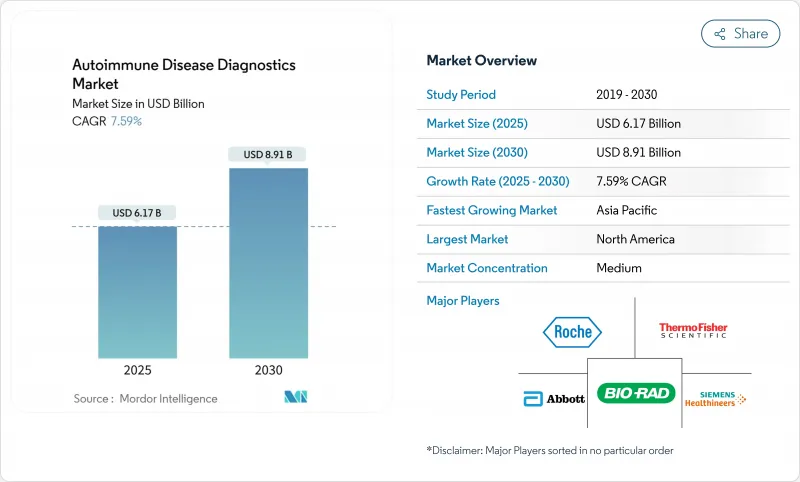
성장의 원동력이 되고 있는 것은 100을 넘는 질환의 발병률의 상승, AI를 활용한 자동화의 급속한 보급, 분석 심도를 깊게 하면서 검사 사이클을 단축하는 멀티플렉스 면역 검정 수요입니다. 자가면역질환 진단 시장은 또한 원시 분석 데이터를 임상적으로 실용적인 인사이트로 변환하고 과도한 검사 직원의 작업 부담을 줄이는 정보 플랫폼에 대한 왕성한 투자로부터 혜택을 누리고 있습니다. 북미는 조기 기술 도입과 종합적인 패널을 지원하는 보험 적용으로 세계 매출을 이끌고 있습니다. 한편 아시아태평양은 정부가 지금까지 충분한 서비스를 받지 못한 사람들에게도 보험상환을 확대함으로써 성장 속도를 높이고 있습니다. 임상의가 중복되는 증상을 구별하고 기관 전체의 질병 활동을 모니터링하기 위해 여러 분석 항목 프로파일이 필요하기 때문에 전신 질환은 검사 수요의 대부분을 견인합니다. 경쟁의 심각성은 여전히 완만합니다. 주요 공급업체는 실험실 처리량과 결과의 일관성을 높이는 자동화 및 의사결정 지원 소프트웨어와 분석 화학을 결합하여 점유율을 보호합니다.
세계의 자가면역질환 진단 시장 동향과 인사이트
자가면역질환의 유병률 상승
급증하는 이환율은 현재 세계 인구의 3-5%에 이르고 있으며, 15-39세의 청소년 사이에서 현저하게 증가하고 있습니다. 의료 시스템의 분석에 따르면 연간 검사 건수는 25-30% 증가하고 있으며, 검사실은 정밀도를 손상시키지 않고 대량의 검체를 처리할 수 있는 자동화된 검사대에 수동 워크플로우를 대체할 필요가 있다고 합니다. 경제 모델링은 종합적인 패널에 의한 조기 발견이 돌이킬 수 없는 조직 손상을 예방함으로써 평생 치료 비용을 절감한다는 것을 보여줍니다. 그러므로 자가면역질환 진단 시장은 안정적인 기준선 수요를 갖고 있으며 주기적인 건강관리 지출의 변동으로부터 벤더를 보호하고 있습니다. 미국의 주요 네트워크에서 EHR 주도의 집단 스크리닝 프로토콜은 예방 의료의 일환으로자가 면역 검사의 루틴화를 더욱 정상화합니다.
멀티플렉스 및 POC(Point-of-Care) 면역 측정으로의 이동은 진단 오디세이를 단축
한 번의 검사로 50개의 자가항체를 프로파일링할 수 있는 플랫폼은 시간당 최대 1,200개의 결과를 제공하며, 한 달에 걸쳐 연속 워크플로를 대체합니다. Photonic ring assay는 전혈을 이용한 12개 항목의 분석 패널을 15분 내에 완료하여 실험실 골드 표준과 91% 이상의 일치를 나타냅니다. 임상연구에서는 멀티플렉스법을 채용한 경우, 특히 혈청학적으로 불활발한 환자에 있어서, 전신성 홍반성 루푸스의 검출율이 19% 높아지는 것을 보고하고 있습니다. 단가는 기존 ELISA 방법보다 높게 유지되지만, 시약 비용의 감소와 소모품 실적의 간소화로 인해 차이가 줄어들고 있습니다. 실험실은 환자 샘플 저장, 납기 가속화 및 메뉴 확대로 인한 증수를 위해 멀티플렉스 아키텍처를 채택하고 있습니다.
결과가 나올 때까지의 시간이 느리고 여러 진단 검사 필요
전통적인 간접 면역형광법은 전체 패널을 완성하는 데 10-17일이 걸리며 연속 반사 검사가 필요한 경우 지연이 더욱 커집니다. 임상검사기사의 결원률은 상승세에 있으며, 2026년까지 13% 상승할 것으로 예측되고 있습니다. 지방 환자는 종종 전문의의 샘플링을 위해 200 마일 이상 이동하는 경우가 많으며 치료 시작을 연기하고 질병 진행을 가능하게하는 물류 지연이 발생합니다. 자동화는 이 문제를 완화하지만, 자본 지출은 중견 실험실이 즉시 업그레이드하는 것을 망설이고 레거시 워크플로를 계속 사용하게 됩니다.
부문 분석
전신성 자가면역질환은 감별 진단을 위해 광범위한 항체 패널을 필요로 하는 관절염, 전신성 홍반성 루푸스, 다발성 경화증 등 질병의 다장기에 걸친 성질을 반영하여 2024년 62.92%의 매출을 기록했습니다. 임상의가 장기계를 넘어 중복되는 병태를 해석하기 위해 다중 파라메트릭 프로파일을 도입하고 있기 때문입니다. 갑상선, 세리악, 1형 당뇨병의 검사가 1차 케어 클리닉의 친밀한 장소에서 실시할 수 있게 되었습니다. 전신 평가와 관련된 자가면역질환 진단 시장 규모는 치료 지침이 생물학적 제형 치료를 조정하기 위해 일상적인 질병 활동 모니터링을 통합함에 따라 꾸준히 확대될 것으로 예측됩니다. 동시에, 편중 칼프로텍틴 측정은 염증성 장질환의 작업을 정밀화하고, 자가면역병인과 기능장애를 구별하고, 소화기내과의사의 사이에서 채용이 퍼지고 있습니다.
2세대 T 세포 분석은 고전적인 혈청 검사에 없는 세포성 면역 마커를 확인함으로써 전신 루푸스의 검출을 강화하고 지금까지 간과된 서브페노유형을 밝혀줍니다. 다발성 경화증에서 신경 필라멘트 경쇄의 정량은자가 항체 패널과 통합되어 예후를 개선함으로써 다항목 분석 워크 플로우에 대한 수요가 증가하고 있습니다. 국소 영역에서는 항 tTG 항체를 검출하는 가정용 핑거 스틱 키트가 성장하여 보다 조기 세리악 개입을 가능하게 하여 소비자 주도의 검사 코호트를 확대하고 있습니다. 전반적으로, 전신 검사는 규모의 이점을 유지하지만, 국소 질환 패널은 1 차 케어 및 소매 의료 환경을 목표로하는 혁신적인 기업에 민첩하게 성장하는 틈새 분야입니다.
시약 및 분석 키트는 2024년 매출의 53.13%를 차지하고 모든 형태의 반복 검사를 추진하는 소모품 엔진을 지원했습니다. 자가면역질환 진단 시장은 새로운 검사 장비가 출시될 때마다 호환 가능한 키트의 새로운 설치 기반 수요를 생성하기 위해 검증된 화학물질에 대한 안정적인 견인력을 유지하고 있습니다. 그러나 소프트웨어와 인포매틱스는 CAGR 12.15%로 선행하고 있으며, 검사실이 기기 제어, 결과 해석, 품질 관리를 통합한 디지털 워크플로우로 축발을 옮기는 것을 반영하고 있습니다. 이러한 시스템은 인공지능을 활용하여 비전형적인 패턴으로 플래그를 지정하고 음성을 자동 검증하고 확정된 보고서를 전자 의료 기록에 푸시함으로써 벤치타임과 진료 보상 주기 지연을 줄입니다.
계측기는 ELISA, CLIA, 멀티플렉스 카트리지를 하나의 실적에 통합한 분석 장치에 의해 입증된 바와 같이 면역화학 라인의 통합을 위한 점진적인 발전을 계속하고 있습니다. 서비스 계약은 공급업체가 원격 교정, 숙련도 테스트 및 컴플라이언스 감사를 제공하고 내부에 전문 지식이 없는 소규모 실험실에 대응함으로써 확대되었습니다. 시약으로 인한 자가면역질환 진단 시장 규모는 여전히 뻣뻣합니다. 그러나 소프트웨어 마진은 더 높고 익지않는 검사량에 덜 묶이는 경상적인 수익 흐름을 창출합니다. 따라서 공급업체는 클라우드 대시보드를 키트 구매에 번들로 제공하여 장기적인 고객을 둘러싸고 있습니다.
지역 분석
북미는 2024년 매출의 38.45%를 차지했지만, 이는 성숙한 보험 프레임워크와 대량 검사를 효율화하는 AI 대응 해석 플랫폼의 조기 도입을 반영했습니다. 이 지역의 자가면역질환 진단 시장 규모는 명확한 임상적 유용성을 나타내는 멀티플렉스 패널에 대한 지불자의 보험상환이 증가함에 따라 꾸준히 상승을 계속하고 있습니다. 게다가 실험실에서 개발된 검사에 대한 연방규제가 명확해지면서 고처리량 분석장치에 대한 설비투자가 촉진되고 지금까지 인식되고 있던 컴플라이언스의 위험이 경감되고 있습니다.
유럽은 큰 점유율을 차지하며 연간 성장률은 완만하지만 일관성이 있습니다. European Autoimmunity Standardisation Initiative(유럽 자가면역 표준화 이니셔티브)와 같은 엄격한 인증 기준은 검사 시설을 프로토콜의 조화로 향하게 하여 결과의 비교 가능성을 높이는 국경을 넘은 기술 시험을 촉진하고 있습니다. 인구동태의 고령화는 북반구 위도지역에서 자가면역질환의 유병률이 증가함에 따라 일관된 기준 수요를 유지하고 있습니다. 국가 의료 서비스는 확대된 진단 메뉴를 상환 일정에 계속 통합하고 있지만, 예산 조사는 공급자에게 가격 압력이 되고 있습니다.
아시아태평양은 CAGR 9.98%로 가장 빠르게 성장하고 있으며, 적극적인 헬스케어 인프라의 정비와, 환자를 확대하는 정부 출자의 스크리닝 프로그램에 추진되고 있습니다. 지역별로는 중국, 일본, 인도가 선행하고 있으며, 민간 병원 체인은 뛰어난 자기 면역 센터를 병설함으로써 차별화를 도모하고 있습니다. 게다가 자가면역질환 진단 시장은 장비 비용을 낮추고 키트의 현지 생산을 장려하는 국내 제조 장려책에도 지원되고 있습니다. 한편, 중동 및 아프리카와 남미에는 새로운 비즈니스 기회가 도래하고 있습니다. 도시의 3차 병원에서는 자동화가 도입되어, 지방에서는 전문의와의 갭을 메우기 위해서 원격 진료와 조합한 휴대용 POC 키트가 이용되고 있습니다.
기타 혜택 :
- 엑셀 형식 시장 예측(ME) 시트
- 3개월의 애널리스트 지원
목차
제1장 서론
- 조사 전제조건과 시장 정의
- 조사 범위
제2장 조사 방법
제3장 주요 요약
제4장 시장 상황
- 시장 개요
- 시장 성장 촉진요인
- 자가면역질환 증가
- 멀티플렉스와 POC(Point-of-Care) 면역 측정으로의 변화가 진단 오디세이를 단축
- 정부 주도의 자가면역 스크리닝 프로그램
- IFA 슬라이드에 AI 기반 패턴 인식 통합으로 실험실 처리량 증대
- 자가면역 작업을 가능하게 하는 소비자 직접 유전자 검사의 확대
- 암 관련 종양 관련 증후군에서 자가 항체 패널의 채용 급증
- 시장 성장 억제요인
- 결과까지의 소요 시간의 지연과 복수 진단 검사의 필요성
- 신흥 시장에서 멀티플렉스 패널의 상환 범위는 한정적
- 지방에 있어서 숙련 면역 병리의의 부족
- 중규모 실험실용 완전 자동화 CLIA 플랫폼의 높은 자본 비용
- 규제 상황
- Porter's Five Forces 분석
- 신규 참가업체의 위협
- 구매자의 협상력
- 공급기업의 협상력
- 대체품의 위협
- 경쟁 기업 간 경쟁 관계
제5장 시장 규모와 성장 예측(단위 : 달러)
- 질환 유형별
- 전신성 자가면역질환
- 류마티스 관절염
- 건선
- 전신성 홍반성 루푸스(SLE)
- 다발성 경화증
- 기타 전신성 자가면역질환
- 국소성 자가면역질환
- 염증성 장 질환
- 1형 당뇨병
- 자가면역 갑상선 질환
- 기타 국소성 자가면역질환
- 전신성 자가면역질환
- 제품 및 서비스별
- 시약 및 분석 키트
- 기기/분석기
- 소프트웨어 및 정보학
- 서비스
- 검사 유형별
- 항핵항체(ANA) 검사
- 자가항체 검사
- 완전혈구수(CBC)
- C 반응성 단백질(CRP)
- 요검사
- 기타 검사
- 기술별
- 효소결합 면역흡착 분석법(ELISA)
- 화학발광 면역분석법(CLIA)
- 간접 면역형광법(IFA)
- 다중 분석 플랫폼
- 유세포 분석법
- 기타 기술
- 최종 사용자별
- 병원 및 임상 실험실
- 참조 검사실
- 학술 및 연구 기관
- 기타 최종 사용자
- 지역별
- 북미
- 미국
- 캐나다
- 멕시코
- 유럽
- 독일
- 영국
- 프랑스
- 이탈리아
- 스페인
- 기타 유럽
- 아시아태평양
- 중국
- 일본
- 인도
- 호주
- 한국
- 기타 아시아태평양
- 중동 및 아프리카
- GCC
- 남아프리카
- 기타 중동 및 아프리카
- 남미
- 브라질
- 아르헨티나
- 기타 남미
- 북미
제6장 경쟁 구도
- 시장 집중도
- 시장 점유율 분석
- 기업 프로파일
- Abbott Laboratories
- Thermo Fisher Scientific Inc.
- F. Hoffmann-La Roche AG
- Siemens Healthineers
- Bio-Rad Laboratories Inc.
- bioMerieux SA
- EUROIMMUN Medizinische Labordiagnostika AG
- Inova Diagnostics Inc.
- Grifols SA
- Trinity Biotech plc
- Becton, Dickinson and Company
- Danaher Corporation(Beckman Coulter)
- Hologic Inc.
- Exagen Inc.
- DiaSorin SpA
- Werfen(Instrumentation Laboratory)
- Shenzhen Mindray Bio-Medical Electronics Co., Ltd.
- R-Biopharm AG
- ZEUS Scientific, Inc.
- Myriad Genetics Inc.
제7장 시장 기회와 향후 전망
KTH 25.11.13The Autoimmune Disease Diagnostics Market size is estimated at USD 6.17 billion in 2025, and is expected to reach USD 8.91 billion by 2030, at a CAGR of 7.59% during the forecast period (2025-2030).
Growth is fueled by rising incidence across more than 100 distinct conditions, rapid uptake of AI-enabled automation, and demand for multiplex immunoassays that shorten testing cycles while increasing analytical depth. The autoimmune disease diagnostics market is also benefiting from robust investments in informatics platforms that convert raw assay data into clinically actionable insights, easing the workload of overstretched laboratory staff. North America heads global revenue owing to early technology adoption and insurance coverage that supports comprehensive panels, whereas Asia-Pacific is setting the pace for growth as governments extend reimbursement to previously underserved populations. Systemic conditions drive the bulk of test demand because clinicians require multi-analyte profiles to distinguish overlapping symptoms and monitor organ-wide disease activity. Competitive intensity remains moderate; the leading vendors protect share by pairing assay chemistry with automation and decision-support software that elevates laboratory throughput and result consistency.
Global Autoimmune Disease Diagnostics Market Trends and Insights
Rising Prevalence of Autoimmune Disorders
Surging incidence now affects 3-5% of the global population, with pronounced growth among adolescents aged 15-39 years. Health-system analyses show sustained annual testing volume increases of 25-30%, compelling laboratories to replace manual workflows with automated benches that can process larger sample loads without compromising accuracy. Economic modeling demonstrates that early detection via comprehensive panels lowers lifetime treatment costs by preventing irreversible tissue damage. The autoimmune disease diagnostics market therefore experiences consistent baseline demand, insulating vendors against cyclical healthcare spending shifts. EHR-driven population screening protocols in major U.S. networks further normalize routine autoimmune testing as part of preventive care.
Shift Toward Multiplex & Point-of-Care Immunoassays Shortening Diagnostic Odyssey
Platforms capable of profiling 50 autoantibodies in a single run deliver up to 1,200 results per hour, replacing serial workflows that once extended over months. Photonic ring assays now complete 12-analyte panels on whole blood in 15 minutes with greater than 91% concordance to laboratory gold standards. Clinical studies report 19% higher systemic lupus erythematosus detection when multiplex methods are employed, particularly in serologically inactive patients. Although unit pricing remains higher than legacy ELISA formats, declining reagent costs and streamlined consumable footprints are narrowing the gap. Laboratories are adopting multiplex architecture to conserve patient samples, accelerate turnaround, and capture incremental revenue through extended menus.
Slow Turnaround Time of Results and Need for Multiple Diagnostic Tests
Conventional indirect immunofluorescence still demands 10-17 days to complete full panels, a delay compounded when sequential reflex testing is required. Laboratory staffing shortages intensify bottlenecks; vacancy rates for medical technologists continue trending upward and are projected to climb 13% by 2026. Rural patients often travel over 200 miles for specialist sampling, adding logistical delays that can postpone therapy initiation and enable disease progression. Automation mitigates the issue yet capital outlays deter mid-tier labs from immediate upgrades, keeping legacy workflows in service.
Other drivers and restraints analyzed in the detailed report include:
- Government-Led Autoimmune Screening Programs
- Integration of AI-Guided Pattern Recognition in IFA Slides Boosting Lab Throughput
- Limited Reimbursement Coverage for Multiplex Panels in Emerging Markets
For complete list of drivers and restraints, kindly check the Table Of Contents.
Segment Analysis
Systemic autoimmune diseases generated 62.92% revenue in 2024, reflecting the multi-organ nature of conditions such as rheumatoid arthritis, systemic lupus erythematosus, and multiple sclerosis that require broad antibody panels for differential diagnosis. This segment alone captured the largest slice of the autoimmune disease diagnostics market, as clinicians deploy multiparametric profiles to parse overlapping presentations across organ systems. Localized autoimmune diseases, though smaller in volume, are scaling at a 9.6% CAGR thanks to portable devices that bring thyroid, celiac, and type 1 diabetes testing closer to primary-care clinics. The autoimmune disease diagnostics market size tied to systemic evaluations is projected to climb steadily as treatment guidelines embed routine disease-activity monitoring to tailor biologic therapy. Simultaneously, fecal calprotectin assays refine inflammatory bowel disease work-ups, disentangling autoimmune etiology from functional disorders and widening adoption among gastroenterologist.
Second-generation T-cell assays enhance systemic lupus detection by identifying cellular immunity markers absent in classic serology, revealing previously overlooked sub-phenotypes. In multiple sclerosis, neurofilament light chain quantification integrates with autoantibody panels to improve prognostication, sharpening demand for multi-analyte workflows. Growth on the localized front is tied to at-home finger-stick kits that detect anti-tTG antibodies, empowering earlier celiac intervention and enlarging the consumer-initiated testing cohort. Overall, systemic testing retains scale advantages, but localized disease panels represent an agile growth niche for innovators targeting primary-care and retail health settings.
Reagents and assay kits supplied 53.13% of 2024 revenue, anchoring the consumable engine that drives repeat testing across all modalities. The autoimmune disease diagnostics market maintains a steady pull for validated chemistries because every new instrument launch creates fresh installed-base demand for compatible kits. Yet software and informatics are racing ahead at a 12.15% CAGR, reflecting laboratories' pivot toward digital workflows that integrate instrument control, result interpretation, and quality management. Such systems leverage AI to flag atypical patterns, auto-validate negatives, and push finalized reports to electronic health records, trimming bench-time and reimbursement cycle delays.
Instrumentation continues its incremental progression toward consolidated immunochemistry lines, evidenced by analyzers combining ELISA, CLIA, and multiplex cartridges within a single footprint. Service contracts expand as vendors provide remote calibration, proficiency testing, and compliance audits, catering to small labs that lack in-house expertise. The autoimmune disease diagnostics market size attributed to reagents remains resilient; however, software margins are higher and create recurring revenue streams that are less tied to raw test volumes. Vendors are, therefore, bundling cloud dashboards with kit purchases to cement long-term customer lock-in.
The Autoimmune Disease Diagnostics Market is Segmented by Disease Type (Systemic Autoimmune Disease, and More), Product and Service (Reagents & Assay Kits, and More), Test Type (Antinuclear Antibody Tests, and More), Technology (Enzyme-Linked Immunosorbent Assay, and More), End User (Hospital, and More), and Geography (North America, Europe, Asia-Pacific, and More). The Market Forecasts are Provided in Terms of Value (USD).
Geography Analysis
North America generated 38.45% of 2024 revenue, reflecting mature insurance frameworks and early adoption of AI-enabled interpretation platforms that streamline large-volume testing runs. The autoimmune disease diagnostics market size in the region will continue rising steadily as payer policies increasingly reimburse multiplex panels that demonstrate clear clinical utility. Furthermore, federal regulatory clarity around laboratory-developed tests is fostering capital investments in high-throughput analyzers, reducing previously perceived compliance risks.
Europe contributes a significant share with consistent, if moderate, annual growth. Stringent accreditation norms such as the European Autoimmunity Standardisation Initiative push laboratories toward harmonized protocols and foster cross-border proficiency testing that elevates result comparability. Aging demographics, combined with heightened autoimmune prevalence in northern latitudes, maintain consistent baseline demand. National health services continue integrating expanded diagnostic menus into reimbursement schedules, though budgetary scrutiny keeps pricing pressure on suppliers.
Asia-Pacific is advancing fastest at a 9.98% CAGR, propelled by aggressive healthcare infrastructure upgrades and government-funded screening programs that enlarge the patient funnel. China, Japan, and India spearhead regional volume, with private hospital chains racing to differentiate via on-site autoimmunity centers of excellence. The autoimmune disease diagnostics market is additionally buoyed by domestic manufacturing incentives that lower instrument costs and encourage local kit production. Meanwhile, Middle East & Africa and South America present emerging opportunities: urban tertiary hospitals adopt automation, whereas rural outreach relies on portable point-of-care kits paired with teleconsultation to bridge specialist gaps.
- Abbott Laboratories
- Thermo Fisher Scientific
- Roche
- Siemens Healthineers
- Bio-Rad Laboratories
- bioMerieux
- EUROIMMUN Medizinische Labordiagnostika AG
- Inova Diagnostics
- Grifols
- Trinity Biotech plc
- Beckton Dickinson
- Danaher
- Hologic
- Exagen
- DiaSorin
- Werfen (Instrumentation Laboratory)
- Mindray
- R-Biopharm
- ZEUS Scientific, Inc.
- Myriad Genetics
Additional Benefits:
- The market estimate (ME) sheet in Excel format
- 3 months of analyst support
TABLE OF CONTENTS
1 Introduction
- 1.1 Study Assumptions & Market Definition
- 1.2 Scope of the Study
2 Research Methodology
3 Executive Summary
4 Market Landscape
- 4.1 Market Overview
- 4.2 Market Drivers
- 4.2.1 Rising Prevalence of Autoimmune Disorders
- 4.2.2 Shift Toward Multiplex & Point-of-Care Immunoassays Shortening Diagnostic Odyssey
- 4.2.3 Government-Led Autoimmune Screening Programs
- 4.2.4 Integration of AI-Guided Pattern Recognition in IFA Slides Boosting Lab Throughput
- 4.2.5 Expansion of Direct-to-Consumer Genetic Testing Enabling Self-initiated Autoimmunity Work-ups
- 4.2.6 Surging Adoption of Autoantibody Panels in Oncology-Linked Paraneoplastic Syndromes
- 4.3 Market Restraints
- 4.3.1 Slow Turnaround Time of Results and Need for Multiple Diagnostic Tests
- 4.3.2 Limited Reimbursement Coverage for Multiplex Panels in Emerging Markets
- 4.3.3 Shortage of Skilled Immunopathologists in Rural Areas
- 4.3.4 High Capital Cost of Fully Automated CLIA Platforms for Mid-size Labs
- 4.4 Regulatory Landscape
- 4.5 Porter's Five Forces Analysis
- 4.5.1 Threat of New Entrants
- 4.5.2 Bargaining Power of Buyers
- 4.5.3 Bargaining Power of Suppliers
- 4.5.4 Threat of Substitutes
- 4.5.5 Intensity of Competitive Rivalry
5 Market Size & Growth Forecasts (Value in USD)
- 5.1 By Disease Type
- 5.1.1 Systemic Autoimmune Diseases
- 5.1.1.1 Rheumatoid Arthritis
- 5.1.1.2 Psoriasis
- 5.1.1.3 Systemic Lupus Erythematosus (SLE)
- 5.1.1.4 Multiple Sclerosis
- 5.1.1.5 Other Systemic Autoimmune Diseases
- 5.1.2 Localized Autoimmune Diseases
- 5.1.2.1 Inflammatory Bowel Disease
- 5.1.2.2 Type 1 Diabetes
- 5.1.2.3 Autoimmune Thyroid Diseases
- 5.1.2.4 Other Localized Autoimmune Diseases
- 5.1.1 Systemic Autoimmune Diseases
- 5.2 By Product and Service
- 5.2.1 Reagents & Assay Kits
- 5.2.2 Instruments/Analyzers
- 5.2.3 Software & Informatics
- 5.2.4 Services
- 5.3 By Test Type
- 5.3.1 Antinuclear Antibody (ANA) Tests
- 5.3.2 Autoantibody Tests
- 5.3.3 Complete Blood Count (CBC)
- 5.3.4 C-reactive Protein (CRP)
- 5.3.5 Urinalysis
- 5.3.6 Other Tests
- 5.4 By Technology
- 5.4.1 Enzyme-linked Immunosorbent Assay (ELISA)
- 5.4.2 Chemiluminescence Immunoassay (CLIA)
- 5.4.3 Indirect Immunofluorescence (IFA)
- 5.4.4 Multiplex Assay Platforms
- 5.4.5 Flow Cytometry
- 5.4.6 Other Technologies
- 5.5 By End User
- 5.5.1 Hospital & Clinical Laboratories
- 5.5.2 Reference Laboratories
- 5.5.3 Academic & Research Institutes
- 5.5.4 Other End Users
- 5.6 By Geography
- 5.6.1 North America
- 5.6.1.1 United States
- 5.6.1.2 Canada
- 5.6.1.3 Mexico
- 5.6.2 Europe
- 5.6.2.1 Germany
- 5.6.2.2 United Kingdom
- 5.6.2.3 France
- 5.6.2.4 Italy
- 5.6.2.5 Spain
- 5.6.2.6 Rest of Europe
- 5.6.3 Asia-Pacific
- 5.6.3.1 China
- 5.6.3.2 Japan
- 5.6.3.3 India
- 5.6.3.4 Australia
- 5.6.3.5 South Korea
- 5.6.3.6 Rest of Asia-Pacific
- 5.6.4 Middle East & Africa
- 5.6.4.1 GCC
- 5.6.4.2 South Africa
- 5.6.4.3 Rest of Middle East & Africa
- 5.6.5 South America
- 5.6.5.1 Brazil
- 5.6.5.2 Argentina
- 5.6.5.3 Rest of South America
- 5.6.1 North America
6 Competitive Landscape
- 6.1 Market Concentration
- 6.2 Market Share Analysis
- 6.3 Company Profiles (includes Global level Overview, Market level overview, Core Segments, Financials as available, Strategic Information, Market Rank/Share for key companies, Products & Services, and Recent Developments)
- 6.3.1 Abbott Laboratories
- 6.3.2 Thermo Fisher Scientific Inc.
- 6.3.3 F. Hoffmann-La Roche AG
- 6.3.4 Siemens Healthineers
- 6.3.5 Bio-Rad Laboratories Inc.
- 6.3.6 bioMerieux SA
- 6.3.7 EUROIMMUN Medizinische Labordiagnostika AG
- 6.3.8 Inova Diagnostics Inc.
- 6.3.9 Grifols S.A.
- 6.3.10 Trinity Biotech plc
- 6.3.11 Becton, Dickinson and Company
- 6.3.12 Danaher Corporation (Beckman Coulter)
- 6.3.13 Hologic Inc.
- 6.3.14 Exagen Inc.
- 6.3.15 DiaSorin S.p.A.
- 6.3.16 Werfen (Instrumentation Laboratory)
- 6.3.17 Shenzhen Mindray Bio-Medical Electronics Co., Ltd.
- 6.3.18 R-Biopharm AG
- 6.3.19 ZEUS Scientific, Inc.
- 6.3.20 Myriad Genetics Inc.
7 Market Opportunities & Future Outlook
- 7.1 White-space & Unmet-need Assessment