|
시장보고서
상품코드
1851554
바이오 바닐린 : 세계 시장 점유율 분석, 산업 동향, 통계, 성장 예측(2025-2030년)Global Bio Vanillin - Market Share Analysis, Industry Trends & Statistics, Growth Forecasts (2025 - 2030) |
||||||
 Mordor Intelligence
세계의 바이오 바닐린 시장 규모는 2025년 3억 1,588만 달러로 평가되며, 예측 기간 동안 CAGR은 5.10%를 나타내, 2030년에는 4억 501만 달러에 이를 것으로 예상됩니다.

이 성장 궤도는 특히 미국 상무부가 중국의 바닐린 수입품에 190.20%의 반덤핑 관세를 부과하는 최종 결정을 내리는 등 규제면에서 큰 역풍이 불고 있음에도 불구하고 시장이 경직되어 있다는 것을 반영하고 있습니다. 코리네박테리움 글루타미쿰(Corynebacterium glutamicum)을 기반으로 한 시스템은 현재 리터당 22g의 바닐린을 생산하고 있습니다. 이 결과는 미생물 생산에서 지금까지의 벤치마크를 상당히 능가합니다. 바닐린의 세계 수요는 연간 2만 톤에 육박하고 천연 공급원은 2,000톤에 미치지 못하기 때문에 시장은 매우 중요한 기로에 서 있습니다. 생명 공학을 활용하는 방법은 이 큰 공급 갭을 메우는 독특한 태세를 갖추고 있습니다. 게다가 식음료 부문이 지속가능성 주도의 조달 방침을 받아들이고 있는 것과 천연표시의 주장에 대한 규제의 뒷받침이 함께 바이오 바닐린 시장의 확대를 조장하는 분위기를 만들어 내고 있습니다. 이러한 성장은 생산 비용과 지역 인지도의 차이와 같은 문제에 직면 해도 발생합니다.
세계의 바이오 바닐린 시장 동향과 인사이트
지속가능성에 견인되는 식음료 부문 수요
식품 및 식품 산업의 지속가능성에 대한 노력은 바닐린의 조달 전략을 근본적으로 바꾸고 있으며, 주요 제조업체들은 환경에서 측정 가능한 이점을 보여주는 바이오 대체품을 점점 더 우선시하고 있습니다. 볼레가드의 노르웨이 스프루스 소재를 사용한 목질계 바닐린 제조는 석유계 바닐린에 비해 CO2 배출량을 90% 줄이고 기업 환경 헌신에 공명하는 설득력 있는 지속가능성 벤치마크를 확립하고 있습니다. 바이오바닐린은 종합적인 환경 스튜어드십을 추구하는 기업을 위한 전략적 원료로 자리매김하고 있습니다.
천연 라벨 표시에 대한 규제 지원
주요 시장의 규제 프레임 워크는 석유 유래 합성 대체물을 배제하는 "천연"의 정확한 정의를 통해 생명 공학에 의해 제조 된 바닐린에 명확한 경쟁 우위를 가져옵니다. 미국 알코올·담배세무역국은 특정의 바이오테크놀러지 프로세스 유래의 바닐린을 천연 바닐린으로서 명확하게 인정하고 있어, 어드밴스드 바이오텍사나 애플 프레이버즈사와 같은 기업은 자사 제품에 천연을 구가해, 프리미엄 가격을 붙여 판매할 수 있습니다. 21CFR172.510에 근거한 FDA(미국 식품의약국)의 규제는 승인된 바이오기술적 방법으로 제조될 경우 바이오바닐린을 포함한 천연 향료 물질이 GRAS(Generally Recognized as Safe : 일반적으로 안전하다고 인정됨) 상태를 획득하기 위한 명확한 경로를 나타냅니다. 규제환경은 보다 높은 투명성과 추적성을 요구하는 방향으로 진화하고 있으며, 합성 대체품에 대해서는 추가적인 장벽이 되는 한편, 천연조달과 지속가능한 생산방법을 증명할 수 있는 생명공학에 의해 생산된 바닐린에 있어서는 명확한 경쟁우위성을 가져오고 있습니다.
높은 생산 비용
생명공학에 의해 생산된 바닐린과 합성 대체품 간의 상당한 비용차이는 시장 확대의 가장 큰 장벽이 되고, 상업적 실현성을 달성하기 위해서는 생산경제성을 신중하게 최적화해야 합니다. 현재의 생명공학을 통한 생산방법은 발효 인프라, 기질비용, 다운스트림 공정, 품질관리 요건과 관련된 고유한 비용 과제에 직면하고 있으며, 합성생산은 확립된 석유화학경로에 의해 회피되고 있습니다. 킬로그램당 700달러의 천연 바닐린과 15달러의 합성 바닐린 사이의 가격 차이는 46배의 비용 차이를 낳고, 시장에의 침투를 천연 표시가 충분한 가격 프리미엄을 가지는 고급 용도로 한정하고 있습니다. 비용 문제는 특수 설비, 숙련된 인력, 합성 생산 시설이 필요하지 않은 규제 준수 인프라가 필요함에 따라 더욱 심각해지고, 신규 시장 진출기업에 대한 추가 진입 장벽이 되고 있습니다.
부문 분석
분말형 바이오바닐린은 2024년에 71.37% 시장 점유율을 차지했지만, 이는 우수한 안정성 특성, 보존 기간의 연장, 정확한 투여와 안정한 향미 부여를 필요로 하는 다양한 식품 가공 용도에의 적합성을 반영했습니다. 분말 유형의 우위성은 액체 유형에 비해 산화나 흡습의 영향을 받기 어려운 것에 기인하고 있어, 장기 보존이 가능하고, 다양한 환경 조건하에서 안정된 제품 성능을 필요로 하는 제조자에게 적합한 선택지가 되고 있습니다.
액체 바이오바닐린은 시장 점유율이 작고, 즉각적인 용해성과 균질한 분포가 중요한 성능 요인인 음료 제조업체나 액체 식품 용도에서의 수요 증가에 견인되어 2030년까지 연평균 복합 성장률(CAGR) 8.94%로 가장 빠른 성장을 이룰 것으로 예측됩니다. 액체 제형은 신속한 향미 방출 및 생물학적 이용능력 향상을 필요로 하는 용도, 특히 바닐린의 항산화 특성이 향미 이외의 기능적 이점을 제공하는 의약품 및 영양 보충제로 지지를 모으고 있습니다.
지역 분석
유럽은 2024년에 32.67%의 점유율로 시장 리더를 유지했습니다. 엄격한 천연 향료 규제, 확립된 생명 공학 인프라, 바이오 바닐린 채택에 유리한 시장 조건을 만드는 고급 천연 성분에 대한 소비자 선호도가이를 지원합니다. 중동 및 아프리카은 식품가공산업 확대, 천연소재에 대한 소비자의 의식 증가, 고급제품 채용을 지원하는 가처분소득 증가로 2030년까지 연평균 복합 성장률(CAGR)이 7.92%로 가장 빠른 성장이 전망되고 있습니다.
북미 시장은 확립된 생명 공학 기업, 지원 규제 프레임워크, 클린 라벨 제품에 대한 소비자 수요로부터 혜택을 받아 식품, 의약품 및 개인 관리 응용 분야에서 바이오 바닐린 채용을 촉진합니다. 이 지역 시장 개척을 지원하고 있는 것은 바닐린 생산 능력 확대를 위해 약 1,500만 달러를 투자한 Borregaard사나, 농업 폐기물로부터 코스트 경쟁력이 있는 생산 방법을 개발하는 Spero Renewables사 등의 신흥 기업입니다.
아시아태평양 시장은 현재 시장 점유율에 한계가 있는 것, 식품 가공 활동의 활성화, 중간층의 인구 증가, 천연 소재에 대한 소비자의 기호의 진화에 의해 장기적으로는 유리한 시장 역학이 형성되어 큰 성장 기회가 있습니다. 지리적 다양화는 바이오 바닐린 시장의 침투와 성장 전략에 영향을 미치는 규제 환경, 소비자 선호, 산업 개척 수준이 지역에 따라 다르다는 것을 반영합니다.
기타 혜택
- 엑셀 형식 시장 예측(ME) 시트
- 3개월간의 애널리스트 지원
목차
제1장 서론
- 조사 상정과 시장 정의
- 조사 범위
제2장 조사 방법
제3장 주요 요약
제4장 시장 상황
- 시장 개요
- 시장 성장 촉진요인
- 식음료 부문의 지속가능성 주도형 수요
- 자연표시의 주장에 대한 규제상의 지원
- 식물 유래 및 채식 제품에 대한 소비자의 기호 증가
- 바이오테크놀러지 생산에 있어서 기술의 진보
- 합성 바닐린에 대한 수입 관세 상승
- 프리미엄 상품에 있어서 클린 라벨 동향의 확대
- 시장 성장 억제요인
- 높은 생산 비용
- 개발도상국에서의 인식 부족
- 규제 및 표시 준수 비용
- 대체 천연 향료와의 경쟁
- 공급망 분석
- 규제 전망
- Porter's Five Forces
- 신규 참가업체의 위협
- 구매자의 협상력/소비자
- 공급기업의 협상력
- 대체품의 위협
- 경쟁 기업 간 경쟁 관계
제5장 시장 규모와 성장 예측
- 형태별
- 분말
- 액체
- 순도 등급별
- 식품 등급
- 제약 등급
- 향료 등급
- 용도별
- 식음료
- 아이스크림
- 제빵 제품
- 음료
- 초콜릿 및 과자류
- 기타 식음료 용도
- 제약
- 향료 및 개인 위생용품
- 식음료
- 지역별
- 북미
- 미국
- 캐나다
- 멕시코
- 기타 북미
- 남미
- 브라질
- 아르헨티나
- 기타 남미
- 유럽
- 영국
- 독일
- 프랑스
- 이탈리아
- 러시아
- 기타 유럽
- 아시아태평양
- 중국
- 인도
- 일본
- 호주
- 기타 아시아태평양
- 중동 및 아프리카
- 사우디아라비아
- 남아프리카
- 기타 중동 및 아프리카
- 북미
제6장 경쟁 구도
- 전략적 동향
- 시장 랭킹 분석
- 기업 프로파일
- Kerry Group plc
- Givaudan SA
- Solvay SA
- Symrise AG
- Archer-Daniels-Midland Company
- Borregaard AS
- Europabio
- Advanced Biotech
- BASF SE
- Camlin Fine Sciences Ltd
- International Flavors & Fragrances
- Biosynth Ltd
- Oamic Ingredients USA
- Takasago International Corporation
- Axxence Aromatic GmbH
- Evolva Holding SA
- Ennolys by Lesaffre
- Xi'an Healthful Biotechnology Co.,Ltd
- Jeneil Biotech
- Niranbio Chemical
제7장 시장 기회와 향후 전망
KTH 25.11.21The global bio vanillin market size was valued at USD 315.88 million in 2025 and is projected to reach USD 405.01 million by 2030, registering a CAGR of 5.10% during the forecast period.
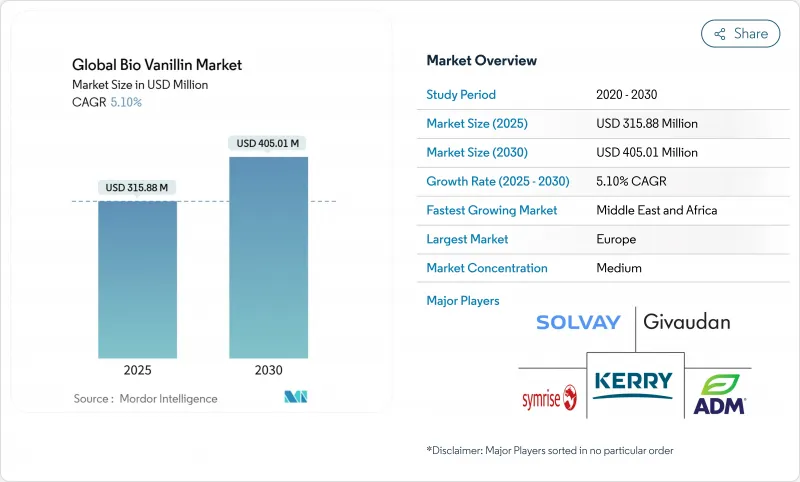
This growth trajectory reflects the market's resilience despite significant regulatory headwinds, particularly the U.S. Department of Commerce's final affirmative determination imposing antidumping duties of 190.20% on Chinese vanillin imports, which includes bio-sourced synthetic vanillin. Companies are achieving breakthrough yields in biotechnological production, with systems based on Corynebacterium glutamicum now producing 22 grams of vanillin per liter. This achievement significantly surpasses previous benchmarks in microbial production. As global demand for vanillin nears 20,000 tons annually, and natural sources fall short at under 2,000 tons, the market stands at a pivotal juncture. Biotechnological methods are uniquely poised to bridge this substantial supply gap. Furthermore, the food and beverage sector's embrace of sustainability-driven procurement policies, coupled with regulatory backing for natural labeling claims, creates a conducive atmosphere for the expansion of the bio vanillin market. This growth occurs even in the face of challenges like production costs and varying regional awareness.
Global Bio Vanillin Market Trends and Insights
Sustainability-Driven Demand from the Food and Beverage Sector
The food and beverage industry's commitment to sustainability is fundamentally reshaping vanillin procurement strategies, with major manufacturers increasingly prioritizing bio-based alternatives that demonstrate measurable environmental benefits. Borregaard's wood-based vanillin production from Norway Spruce achieves a 90% reduction in CO2 emissions compared to oil-based vanillin, establishing a compelling sustainability benchmark that resonates with corporate environmental commitments. The sustainability imperative extends beyond carbon footprint considerations to encompass water usage, waste generation, and renewable resource utilization, positioning bio vanillin as a strategic ingredient for companies pursuing comprehensive environmental stewardship.
Regulatory Support for "Natural" Label Claims
Regulatory frameworks across major markets are creating distinct competitive advantages for biotechnologically produced vanillin through precise definitions of "natural" that exclude petroleum-derived synthetic alternatives. The U.S. Alcohol and Tobacco Tax and Trade Bureau explicitly recognizes vanillin derived from specific biotechnological processes as natural vanillin, allowing companies like Advanced Biotech and Apple Flavors to market their products with natural labeling claims that command premium pricing. FDA (Food and Drug Administration) regulations under 21 CFR 172.510 provide clear pathways for natural flavoring substances, including bio vanillin, to achieve Generally Recognized as Safe (GRAS) status when produced through approved biotechnological methods. The regulatory environment is evolving toward greater transparency and traceability requirements, creating additional barriers for synthetic alternatives while providing clear competitive advantages for biotechnologically produced vanillin that can demonstrate natural sourcing and sustainable production methods.
High Production Cost
The substantial cost differential between biotechnologically produced vanillin and synthetic alternatives represents the most significant barrier to market expansion, with production economics requiring careful optimization to achieve commercial viability. Current biotechnological production methods face inherent cost challenges related to fermentation infrastructure, substrate costs, downstream processing, and quality control requirements that synthetic production avoids through established petrochemical pathways. The price gap between natural vanillin at USD 700 per kilogram and synthetic vanillin at USD 15 per kilogram creates a 46-fold cost differential that limits market penetration to premium applications where natural labeling commands sufficient price premiums. The cost challenge is compounded by the need for specialized equipment, skilled personnel, and regulatory compliance infrastructure that synthetic production facilities do not require, creating additional barriers to entry for new market participants.
Other drivers and restraints analyzed in the detailed report include:
- Growing Consumer Preference for Plant-Based and Vegan Products
- Technological Advancements in Biotechnological Production
- Lack of Awareness in Developing Countries
For complete list of drivers and restraints, kindly check the Table Of Contents.
Segment Analysis
Powder form bio vanillin commands 71.37% market share in 2024, reflecting its superior stability characteristics, extended shelf life, and compatibility with diverse food processing applications that require precise dosing and consistent flavor delivery. The powder segment's dominance stems from its reduced susceptibility to oxidation and moisture absorption compared to liquid alternatives, making it the preferred choice for manufacturers requiring long-term storage capabilities and consistent product performance across varying environmental conditions.
Liquid bio vanillin, despite representing a smaller market share, is projected to achieve the fastest growth at 8.94% CAGR through 2030, driven by increasing demand from beverage manufacturers and liquid food applications where immediate solubility and homogeneous distribution are critical performance factors. Liquid formulations are gaining traction in applications requiring rapid flavor release and enhanced bioavailability, particularly in pharmaceutical and nutraceutical products where vanillin's antioxidant properties provide functional benefits beyond flavoring.
The Bio Vanillin Market Report is Segmented by Form (Powder, and Liquid), Purity Grade (Food Grade, Pharma Grade, and Fragrance Grade), Application (Food and Beverage, Pharmaceutical, and Fragrance and Personal Care), and Geography (North America, Europe, Asia-Pacific, South America, and Middle East and Africa). The Market Forecasts are Provided in Terms of Value (USD).
Geography Analysis
Europe maintains market leadership with 32.67% share in 2024, supported by stringent natural flavoring regulations, established biotechnology infrastructure, and consumer preferences for premium natural ingredients that create favorable market conditions for bio vanillin adoption. The Middle East and Africa region is positioned for the fastest growth at 7.92% CAGR through 2030, driven by expanding food processing industries, increasing consumer awareness of natural ingredients, and growing disposable income that supports premium product adoption.
North American markets benefit from established biotechnology companies, supportive regulatory frameworks, and consumer demand for clean label products that drive bio vanillin adoption across food, pharmaceutical, and personal care applications. The region's market development is supported by companies like Borregaard, which has invested approximately USD 15 million to expand vanillin production capacity, and emerging players like Spero Renewables developing cost-competitive production methods from agricultural waste.
Asia-Pacific markets present significant growth opportunities despite current market share limitations, with increasing food processing activity, growing middle-class populations, and evolving consumer preferences for natural ingredients creating favorable long-term market dynamics. The geographic diversification reflects varying regulatory environments, consumer preferences, and industrial development levels that influence bio vanillin market penetration and growth strategies across different regions.
- Kerry Group plc
- Givaudan SA
- Solvay S.A.
- Symrise AG
- Archer-Daniels-Midland Company
- Borregaard AS
- Europabio
- Advanced Biotech
- BASF SE
- Camlin Fine Sciences Ltd
- International Flavors & Fragrances
- Biosynth Ltd
- Oamic Ingredients USA
- Takasago International Corporation
- Axxence Aromatic GmbH
- Evolva Holding SA
- Ennolys by Lesaffre
- Xi'an Healthful Biotechnology Co.,Ltd
- Jeneil Biotech
- Niranbio Chemical
Additional Benefits:
- The market estimate (ME) sheet in Excel format
- 3 months of analyst support
TABLE OF CONTENTS
1 INTRODUCTION
- 1.1 Study Assumption and Market Definition
- 1.2 Scope of the Study
2 RESEARCH METHODOLOGY
3 EXECUTIVE SUMMARY
4 MARKET LANDSCAPE
- 4.1 Market Overview
- 4.2 Market Drivers
- 4.2.1 Sustainability-driven demand from the food and beverage sector
- 4.2.2 Regulatory support for natural label claims
- 4.2.3 Growing consumer preference for plant-based and vegan products
- 4.2.4 Technological advancements in biotechnological production
- 4.2.5 Rising import tariffs on synthetic vanillin
- 4.2.6 Expansion of clean label trends in premium products
- 4.3 Market Restraints
- 4.3.1 High production cost
- 4.3.2 Lack of awareness in developing countries
- 4.3.3 Regulatory and labeling compliance costs
- 4.3.4 Competition from alternative natural flavorings
- 4.4 Supply Chain Analysis
- 4.5 Regulatory Outlook
- 4.6 Porter's Five Forces
- 4.6.1 Threat of New Entrants
- 4.6.2 Bargaining Power of Buyers/Consumers
- 4.6.3 Bargaining Power of Suppliers
- 4.6.4 Threat of Substitute Products
- 4.6.5 Intensity of Competitive Rivalry
5 MARKET SIZE AND GROWTH FORECASTS (VALUE)
- 5.1 By Form
- 5.1.1 Powder
- 5.1.2 Liquid
- 5.2 By Purity Grade
- 5.2.1 Food Grade
- 5.2.2 Pharma Grade
- 5.2.3 Fragrance Grade
- 5.3 By Application
- 5.3.1 Food and Beverages
- 5.3.1.1 Ice Cream
- 5.3.1.2 Baked Goods
- 5.3.1.3 Beverages
- 5.3.1.4 Chocolate & Confectionery
- 5.3.1.5 Other Food and Beverage Applications
- 5.3.2 Pharmaceutical
- 5.3.3 Fragrance and Personal Care
- 5.3.1 Food and Beverages
- 5.4 By Geography
- 5.4.1 North America
- 5.4.1.1 United States
- 5.4.1.2 Canada
- 5.4.1.3 Mexico
- 5.4.1.4 Rest of North America
- 5.4.2 South America
- 5.4.2.1 Brazil
- 5.4.2.2 Argentina
- 5.4.2.3 Rest of South America
- 5.4.3 Europe
- 5.4.3.1 United Kingdom
- 5.4.3.2 Germany
- 5.4.3.3 France
- 5.4.3.4 Italy
- 5.4.3.5 Russia
- 5.4.3.6 Rest of Europe
- 5.4.4 Asia-Pacific
- 5.4.4.1 China
- 5.4.4.2 India
- 5.4.4.3 Japan
- 5.4.4.4 Australia
- 5.4.4.5 Rest of Asia-Pacific
- 5.4.5 Middle East and Africa
- 5.4.5.1 Saudi Arabia
- 5.4.5.2 South Africa
- 5.4.5.3 Rest of Middle East and Africa
- 5.4.1 North America
6 COMPETITIVE LANDSCAPE
- 6.1 Strategic Moves
- 6.2 Market Ranking Analysis
- 6.3 Company Profiles (includes Global-level Overview, Market-level Overview, Core Segments, Financials (if available), Strategic Information, Market Rank/Share, Products and Services, Recent Developments)
- 6.3.1 Kerry Group plc
- 6.3.2 Givaudan SA
- 6.3.3 Solvay S.A.
- 6.3.4 Symrise AG
- 6.3.5 Archer-Daniels-Midland Company
- 6.3.6 Borregaard AS
- 6.3.7 Europabio
- 6.3.8 Advanced Biotech
- 6.3.9 BASF SE
- 6.3.10 Camlin Fine Sciences Ltd
- 6.3.11 International Flavors & Fragrances
- 6.3.12 Biosynth Ltd
- 6.3.13 Oamic Ingredients USA
- 6.3.14 Takasago International Corporation
- 6.3.15 Axxence Aromatic GmbH
- 6.3.16 Evolva Holding SA
- 6.3.17 Ennolys by Lesaffre
- 6.3.18 Xi'an Healthful Biotechnology Co.,Ltd
- 6.3.19 Jeneil Biotech
- 6.3.20 Niranbio Chemical