
|
시장보고서
상품코드
1910448
디지털 전환 : 시장 점유율 분석, 업계 동향 및 통계, 성장 예측(2026-2031년)Digital Transformation (DX) - Market Share Analysis, Industry Trends & Statistics, Growth Forecasts (2026 - 2031) |
||||||
 Mordor Intelligence
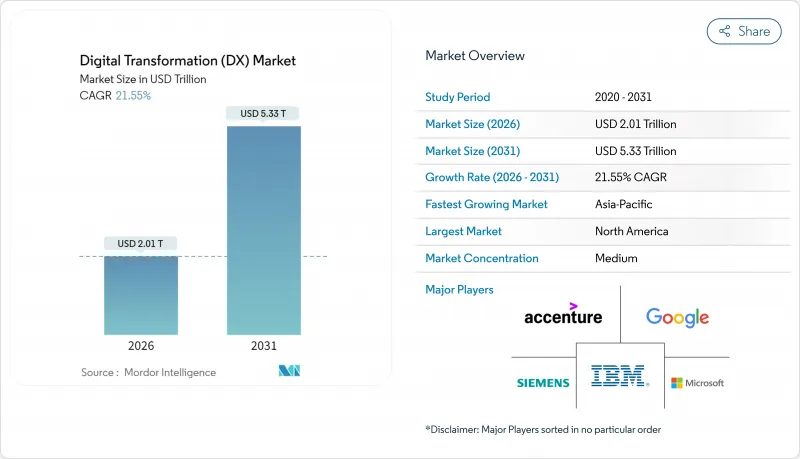
디지털 전환 시장은 2025년 1조 6,500억 달러에서 2026년 2조 100억 달러로 성장하며 2026년에서 2031년에 걸쳐 CAGR 21.55%를 나타낼 전망입니다. 2031년까지 5조 3,300억 달러에 달할 것으로 예측됩니다.
이러한 탄탄한 성장은 기업의 AI 도입, 클라우드 우선 지출 정책 및 업무 디지털화를 조직에 의무화하는 규제 요건에 기인합니다. 주권 AI 정책은 기업의 컴퓨팅 지역화를 촉진하고 5G 네트워크는 제조업과 의료 분야에서 실시간 이용 사례를 개척하고 있습니다. 로우코드 플랫폼은 애플리케이션 개발을 IT 부서의 범위를 넘어 확장하고 ESG 보고 규칙은 데이터 중심의 컴플라이언스 투자를 가속화합니다. 기업은 혁신 목표와 레거시 시스템의 비용 압력 간의 균형을 맞추고 있으며, 단계적 현대화 전략이 지지를 받고 있습니다. 경쟁의 치열성은 중간 정도로 남아 있는데, 이는 기업이 록인 회피를 위해 멀티 벤더의 클라우드 AI 전략을 추구하고 있기 때문입니다. 그러나 하이퍼스케일 제공업체의 설비투자는 디지털 전환 시장에서 규모의 경제성을 재정의하고 있습니다.
세계의 디지털 전환 시장 동향과 인사이트
클라우드 우선으로 기업 IT 지출 급증
조직은 On-Premise 하드웨어에서 AI 워크로드 및 하이브리드 워크 모델을 지원하는 클라우드 네이티브 플랫폼으로 예산을 재분배합니다. 예를 들어 Amazon Web Services는 AI 어시스턴트 Amazon Q를 통해 100만 건 이상의 사내 개발자 질문을 해결하여 45만 시간의 수작업을 줄였습니다. 클라우드의 경제성은 조달주기를 단축하고 지출을 자본 예산에서 운영 예산으로 이전함으로써 보다 신속한 실험을 가능하게 합니다. Microsoft와 코카콜라의 제휴와 같은 전략적 계약은 생성형 AI 서비스가 확장 가능한 클라우드 기반 위에 구축됨을 보여줍니다. 기업이 클라우드 인프라를 필수로 파악하는 동안 벤더는 주권 데이터 규칙을 준수하기 위해 지역 데이터센터를 확장하고 있습니다.
업무 기능 횡단적인 AI/ML 통합의 진전
AI는 시험 운용에서 대규모 프로덕션 환경으로 전환하고 있습니다. 골드만 색소폰은 여러 부서에 AI 어시스턴트를 도입하고, 유나이티드 헬스 그룹은 청구 처리 및 임상 판단을 자동화하는 1,000개 이상의 AI 이용 사례를 관리하고 있습니다. 방위, 산업, 소매 리더 기업도 유사한 패턴을 재현하여 설계, 유지보수, 고객 경험 워크플로우에 생성 모델을 통합하고 있습니다. 직원의 기술 향상과 데이터 거버넌스의 틀이 동시에 성숙하고 AI는 실험적인 추가 기능이 아닌 핵심적인 능력이 되고 있습니다.
레거시 기술 부채로 인한 록인
기업은 여전히 IT 예산의 최대 80%를 수십년전부터 존재하는 시스템 유지에 충분하고 혁신에 대한 자금이 감소하고 있습니다. 서비스 나우의 조사에 따르면 노후화된 용도는 시스템당 연간 4만 달러의 비용이 발생하고, 직원의 노동 시간을 주 17시간 낭비하고 있습니다. 정부 기관은 이 문제를 현저하게 보여주며, 1,000억 달러 규모의 IT 지출의 대부분을 레거시 자산에 지출하고 있습니다. 결과적인 기술적 부채는 구식 소프트웨어가 현대적인 제어 기능을 제공하지 않기 때문에 사이버 보안 위험을 증가시키고 있습니다.
부문 분석
2025년 AI와 ML은 디지털 전환 시장 점유율의 28.05%를 차지했으며, 이 부문은 23.9%의 연평균 복합 성장률(CAGR)을 나타낼 것으로 예측되며 데이터 구동 자동화가 전략적 차별화 요인임을 확인했습니다. 디지털 전환 시장 규모의이 부분은 챗봇, 추천 엔진, 예지 보전 모델을 확장하는 기업에 의해 추진되고 있습니다. 골드만 색소폰과 록히드 마틴의 생산 도입은 파일럿에서 미션 크리티컬 시스템으로의 전환을 보여줍니다. 증강현실 도구는 산업 종업원의 연수 정착률을 275% 향상시키지만, 월마트의 식품 추적성 네트워크와 같은 블록체인 솔루션은 원산지 점검을 7일에서 2.2초로 단축합니다.
병렬로, 엣지 컴퓨팅 클러스터의 파도는 클라우드의 지연으로 인한 페널티를 피하기 위해 센서 근처에서 데이터를 처리합니다. 디지털 트윈과 동기화된 산업용 로봇은 자동차 및 전자 장비 공장에서 지속적인 공정 최적화를 가능하게 합니다. 적층 성형 라인은 공구 부품의 실시간 인쇄를 사용하여 다운타임을 단축합니다. 이러한 기술이 결합되어 중공업 전체에서 디지털 전환 시장 침투가 깊어지고 있습니다.
클라우드 솔루션은 2025년에 디지털 전환 시장 점유율의 62.65%를 차지했고 2031년까지 연평균 복합 성장률(CAGR) 22.1%를 나타낼 전망입니다. 이 시장 규모의 점유율은 하이퍼스케일러에 의한 수십억 달러 규모의 데이터센터 건설과 상관관계에 있습니다. AWS의 'Project Rainier'는 Trainium 2 칩을 클러스터링하여 세계에서 가장 강력한 AI 교육 컴퓨터를 구축하고 있습니다. Microsoft의 800억 달러 규모의 인프라 투자는 가속화되는 투자 사이클을 뒷받침하고 있습니다. 기업은 규제 대상 워크로드에 대해 On-Premise 노드를 유지하면서 하이브리드 아키텍처가 보급되고 있습니다. Oracle과 Google Cloud의 제휴를 통해 저지연 양방향 연결은 에그레스 요금 없이 실현됩니다.
클라우드의 경제성은 서버 도입 자본 예산이 부족한 중소기업에도 매력적입니다. 종량 과금 모델은 비용을 실제 사용량과 연동시키고 지역별 가용 영역은 데이터 거주 규정을 충족합니다. 시간이 지남에 따라 플랫폼에 대한 의존 우려로 인해 많은 기업들이 마이크로서비스를 여러 클라우드에 분산시켜 크로스플레인 오케스트레이션 도구에 대한 수요가 생겨나고 있습니다.
디지털 전환 시장은 기술(AI·머신러닝, 증강현실(VR/AR) 등), 도입 모델(클라우드, On-Premise, 하이브리드), 조직 규모(대기업, 중소기업(SME)), 업종(금융 및 보험·증권(BFSI), 의료 및 생명과학, 제조·산업 등) 및 지역별로 분류됩니다. 시장 예측은 금액(달러) 기준으로 제공됩니다.
지역별 분석
북미는 2025년에 디지털 전환 시장 점유율의 31.95%를 차지했으며, 풍부한 벤처 캐피탈 자금과 하이퍼스케일 클라우드 본사의 근접성이 기반이 되고 있습니다. 텍사스 단독으로 NVIDIA의 슈퍼컴퓨터를 갖춘 5,000억 달러 규모의 데이터센터 확장 프로젝트 외에도 텍사스 기기의 300억 달러 규모의 칩 공장이 수천 개의 기술 관련 고용을 창출하고 있습니다. 연방 및 주 정부 기관은 '한프리'와 같은 AI 어시스턴트를 도입하여 관리 업무의 자동화를 추진하고 있으며, 이는 수요를 더욱 뒷받침하고 있습니다. USMCA(미국·멕시코·캐나다 협정)에 근거한 국경을 넘은 대처에 의해 캐나다와 멕시코 전역에서의 제조업의 디지털화가 지원되고 있습니다.
아시아태평양은 정부 주도 인프라 정비 계획과 모바일 퍼스트 소비자 행동으로 22.0%의 연평균 복합 성장률(CAGR)로 가장 빠른 성장을 이루고 있습니다. 전자상거래 결제의 약 70%를 디지털 월렛이 차지하고, 이 지역의 비약적인 보급 곡선이 현저합니다. 인도, 일본, 한국은 각각 국가 AI 전략을 수립했으며 호주 퀸즐랜드는 소블린 클라우드 서비스에 12억 달러(8억 달러)를 기록했습니다. 이러한 움직임이 함께 디지털 변혁의 잠재 시장이 확대되고 있습니다.
유럽에서는 eIDAS 2.0에 기반한 디지털 주권을 중시하고 2027년까지 유럽 디지털 ID 월렛의 보편적 수용을 의무화하고 있습니다. 독일 EuroStack 프로그램은 2035년까지 컴퓨팅 스택의 현지화를 위한 3,000억 유로의 투자를 예측합니다. 슈레스비히-홀슈타인 주가 독점 소프트웨어로부터의 전환을 추진하는 자세는 주권 철학의 실천적 구현을 보여줍니다. 남미, 중동, 아프리카는 선행 지역에 뒤처지고 있지만, 광섬유 기간망, 클라우드 지역, 5G 전개에 대한 해외 투자가 증가하고 있으며, 새로운 서비스 기회가 열리고 있습니다.
기타 혜택 :
- 엑셀 형식 시장 예측(ME) 시트
- 애널리스트 지원(3개월간)
자주 묻는 질문
목차
제1장 서론
- 조사 전제조건 및 시장 정의
- 조사 범위
제2장 조사 방법
제3장 주요 요약
제4장 시장 상황
- 시장 개요
- 시장 성장 촉진요인
- 클라우드 퍼스트에 의한 기업 IT 지출의 급증
- 비즈니스 기능 전체에서 AI/ML 통합의 진전
- 5G를 활용한 실시간 데이터 이용 사례
- ESG 보고의 디지털화 의무화
- 「디지털 주권」공공 부문 자금 조달 동향
- 로우코드/노코드 플랫폼에 의한 DX의 민주화
- 시장 성장 억제요인
- 레거시 기술 부채에 의한 록인
- 사이버 인재 부족과 임금 상승 압력
- 디지털 신원 규제의 단편화
- ESG 감사의 범위 3 데이터 품질의 갭
- 공급망 분석
- 규제 상황
- 기술 전망
- Porter's Five Forces
- 신규 참가업체의 위협
- 공급기업의 협상력
- 구매자의 협상력
- 대체품의 위협
- 경쟁 기업 간 경쟁 관계
- 업계 생태계 분석
- 시장에 대한 거시경제 요인의 평가
제5장 시장 규모와 성장 예측
- 기술별
- AI 및 머신러닝
- 확장현실(VR/AR)
- 사물인터넷(IoT)
- 산업용 로봇
- 블록체인
- 디지털 트윈
- 적층 조형 및 산업용 3D 프린팅
- 엣지 컴퓨팅
- 기타
- 배포 모델별
- 클라우드
- On-Premise
- 하이브리드
- 조직 규모별
- 대기업
- 중소기업(SME)
- 업계별
- BFSI
- 헬스케어 및 생명과학
- 제조 및 산업
- 소매 및 전자상거래
- 에너지 및 유틸리티
- 자동차 및 운송
- 정부 및 공공 부문
- 기타(미디어, 교육 등)
- 지역별
- 북미
- 미국
- 캐나다
- 멕시코
- 남미
- 브라질
- 아르헨티나
- 기타 남미
- 유럽
- 독일
- 영국
- 프랑스
- 이탈리아
- 스페인
- 기타 유럽
- 아시아태평양
- 중국
- 일본
- 인도
- 한국
- 동남아시아
- 기타 아시아태평양
- 중동 및 아프리카
- 중동
- 사우디아라비아
- 아랍에미리트(UAE)
- 튀르키예
- 기타 중동
- 아프리카
- 남아프리카
- 나이지리아
- 이집트
- 기타 아프리카
- 중동
- 북미
제6장 경쟁 구도
- 시장 집중도
- 전략적 동향
- 시장 점유율 분석
- 기업 프로파일
- Accenture
- Microsoft
- IBM
- Google (Alphabet)
- AWS(Amazon)
- SAP
- Oracle
- Adobe
- Salesforce
- Cisco Systems
- Dell Technologies
- Siemens
- Hewlett Packard Enterprise
- Cognex
- Apple
- ServiceNow
- Infosys
- Capgemini
- Wipro
- Schneider Electric
- Honeywell
- Hitachi
- Fujitsu
- Huawei
제7장 시장 기회와 향후 전망
KTH 26.01.22The digital transformation market is expected to grow from USD 1.65 trillion in 2025 to USD 2.01 trillion in 2026 and is forecast to reach USD 5.33 trillion by 2031 at 21.55% CAGR over 2026-2031.
Strong growth stems from enterprise AI adoption, cloud-first spending priorities, and regulatory mandates that compel organizations to digitize operations. Sovereign-AI policies push companies to localize computing, while 5G networks open real-time use cases in manufacturing and healthcare. Low-code platforms extend application development beyond IT departments, and ESG reporting rules accelerate data-driven compliance investments. Incremental modernization strategies gain favor as enterprises balance innovation goals with legacy-system cost pressures. Competitive intensity remains moderate because businesses pursue multi-vendor cloud and AI strategies to avoid lock-in, yet hyperscale-provider capital expenditure is redefining scale economics in the digital transformation market.
Global Digital Transformation (DX) Market Trends and Insights
Cloud-first enterprise IT spending boom
Organizations are reallocating budgets from on-premise hardware toward cloud-native platforms that support AI workloads and hybrid work models. For example, Amazon Web Services resolved more than 1 million internal developer questions with its AI assistant Amazon Q, saving 450,000 hours of manual effort. Cloud economics shorten procurement cycles and shift spending from capital to operating budgets, allowing faster experimentation. Strategic deals, such as Microsoft's partnership with Coca-Cola, show how generative-AI services ride atop scalable cloud foundations. As enterprises view cloud infrastructure as essential, vendors expand regional data centers to comply with sovereign-data rules.
Rising AI/ML integration across business functions
AI moves from pilots to production at scale. Goldman Sachs rolled out AI assistants across multiple departments, and UnitedHealth Group manages more than 1,000 AI use cases that automate claims and clinical decisions. Defense, industrial, and retail leaders replicate the pattern, embedding generative models in design, maintenance, and customer-experience workflows. Workforce upskilling and data-governance frameworks mature in tandem, making AI a core competency rather than an experimental add-on.
Legacy technical-debt lock-ins
Enterprises still devote up to 80% of IT budgets to maintain decades-old systems, reducing funds for innovation. ServiceNow found that aging applications cost USD 40,000 annually per system and drain 17 employee hours weekly.Government agencies illustrate the problem, spending the majority of their USD 100 billion IT outlay on legacy assets. The resulting technical debt inflates cybersecurity risk because outdated software lacks modern controls.
Other drivers and restraints analyzed in the detailed report include:
- 5G-enabled real-time data use-cases
- Mandatory ESG reporting digitisation
- Cyber-talent scarcity and wage inflation
For complete list of drivers and restraints, kindly check the Table Of Contents.
Segment Analysis
AI and ML claimed 28.05% of digital transformation market share in 2025, and the segment is expected to grow at 23.9% CAGR, reinforcing that data-driven automation is a strategic differentiator. This portion of the digital transformation market size is fueled by enterprises scaling chatbots, recommendation engines, and predictive-maintenance models. Production deployments at Goldman Sachs and Lockheed Martin exemplify the shift from pilots to mission-critical systems. Extended-Reality tools deliver 275% training-retention gains for industrial employees, while blockchain solutions such as Walmart's food-traceability network cut provenance checks from 7 days to 2.2 seconds.
A parallel wave of edge-computing clusters processes data near sensors to avoid cloud-latency penalties. Industrial robotics synchronized with digital twins allow continuous process optimization in automotive and electronics plants. Additive-manufacturing lines use real-time prints of tooling components to shrink downtime. Together these technologies deepen the digital transformation market penetration across heavy industries.
Cloud solutions owned 62.65% of digital transformation market share in 2025 and will expand at 22.1% CAGR through 2031. This share of the digital transformation market size correlates with hyperscalers' multi-billion-dollar data-center builds. AWS's Project Rainier clusters Trainium 2 chips into the world's most powerful AI training computer. Microsoft's USD 80 billion infrastructure spend underscores escalating investment cycles. Enterprises retain on-premises nodes for regulated workloads, yet hybrid architectures flourish; Oracle's pact with Google Cloud allows bidirectional low-latency links with no egress fees.
Cloud economics also attract small businesses that lack capital budgets for servers. Pay-as-you-go models align costs with usage, and regional availability zones satisfy data-residency regulations. Over time, platform lock-in concerns lead many firms to distribute microservices across multiple clouds, creating demand for cross-plane orchestration tools.
Digital Transformation Market is Segmented by Technology (AI and ML, Extended Reality (VR/AR), and More), Deployment Model (Cloud, On-Premises, Hybrid), Organization Size (Large Enterprises, Small and Medium Enterprises (SMEs)), Industry Vertical (BFSI, Healthcare and Life-Sciences, Manufacturing and Industrial, and More), and by Geography. The Market Forecasts are Provided in Terms of Value (USD).
Geography Analysis
North America secured 31.95% of digital transformation market share in 2025, anchored by deep venture capital pools and proximity to hyperscale-cloud headquarters. Texas alone hosts a USD 500 billion data-center expansion featuring NVIDIA supercomputers, plus Texas Instruments' USD 30 billion chip plant that adds thousands of tech jobs. Federal and state agencies adopt AI assistants like "Humphrey" to automate administrative tasks, further boosting demand. Cross-border initiatives under USMCA support manufacturing digitisation throughout Canada and Mexico.
Asia-Pacific delivers the fastest growth at 22.0% CAGR due to extensive government infrastructure programs and mobile-first consumer behavior. Digital wallets account for nearly 70% of e-commerce checkouts, highlighting the region's leapfrog adoption curves. India, Japan, and South Korea each articulate national AI strategies, while Australia's Queensland earmarked AUD 1.2 billion (USD 800 million) for sovereign-cloud services. Combined, these moves expand the addressable digital transformation market.
Europe emphasizes digital sovereignty under eIDAS 2.0, mandating universal acceptance of European Digital Identity Wallets by 2027. Germany's EuroStack program predicts EUR 300 billion investment to localize compute stacks by 2035. Schleswig-Holstein's migration away from proprietary software shows practical implementation of sovereignty ideals. South America and the Middle East and Africa trail the leading regions but experience rising foreign investment in fiber backbones, cloud regions, and 5G rollouts, unlocking new service opportunities.
- Accenture
- Microsoft
- IBM
- Google (Alphabet)
- AWS (Amazon)
- SAP
- Oracle
- Adobe
- Salesforce
- Cisco Systems
- Dell Technologies
- Siemens
- Hewlett Packard Enterprise
- Cognex
- Apple
- ServiceNow
- Infosys
- Capgemini
- Wipro
- Schneider Electric
- Honeywell
- Hitachi
- Fujitsu
- Huawei
Additional Benefits:
- The market estimate (ME) sheet in Excel format
- 3 months of analyst support
TABLE OF CONTENTS
1 INTRODUCTION
- 1.1 Study Assumptions and Market Definition
- 1.2 Scope of the Study
2 RESEARCH METHODOLOGY
3 EXECUTIVE SUMMARY
4 MARKET LANDSCAPE
- 4.1 Market Overview
- 4.2 Market Drivers
- 4.2.1 Cloud-first enterprise IT spending boom
- 4.2.2 Rising AI/ML integration across business functions
- 4.2.3 5G-enabled real-time data use-cases
- 4.2.4 Mandatory ESG reporting digitisation
- 4.2.5 "Digital-sovereignty" public-sector funding waves
- 4.2.6 Low-code / no-code platforms democratising DX
- 4.3 Market Restraints
- 4.3.1 Legacy technical-debt lock-ins
- 4.3.2 Cyber-talent scarcity and wage inflation
- 4.3.3 Digital-identity regulatory fragmentation
- 4.3.4 Scope-3 data-quality gaps for ESG audits
- 4.4 Supply-Chain Analysis
- 4.5 Regulatory Landscape
- 4.6 Technological Outlook
- 4.7 Porter's Five Forces
- 4.7.1 Threat of New Entrants
- 4.7.2 Bargaining Power of Suppliers
- 4.7.3 Bargaining Power of Buyers
- 4.7.4 Threat of Substitutes
- 4.7.5 Competitive Rivalry
- 4.8 Industry Ecosystem Analysis
- 4.9 Assesment of Macroeconomic Factors on the market
5 MARKET SIZE AND GROWTH FORECASTS (VALUE)
- 5.1 By Technology
- 5.1.1 AI and ML
- 5.1.2 Extended Reality (VR/AR)
- 5.1.3 Internet of Things (IoT)
- 5.1.4 Industrial Robotics
- 5.1.5 Blockchain
- 5.1.6 Digital Twin
- 5.1.7 Additive Manufacturing / Industrial 3-D Printing
- 5.1.8 Edge Computing
- 5.1.9 Others
- 5.2 By Deployment Model
- 5.2.1 Cloud
- 5.2.2 On-Premise
- 5.2.3 Hybrid
- 5.3 By Organization Size
- 5.3.1 Large Enterprises
- 5.3.2 Small and Medium Enterprises (SMEs)
- 5.4 By Industry Vertical
- 5.4.1 BFSI
- 5.4.2 Healthcare and Life-Sciences
- 5.4.3 Manufacturing and Industrial
- 5.4.4 Retail and E-commerce
- 5.4.5 Energy and Utilities
- 5.4.6 Automotive and Transportation
- 5.4.7 Government and Public Sector
- 5.4.8 Others (Media, Education, etc.)
- 5.5 By Geography
- 5.5.1 North America
- 5.5.1.1 United States
- 5.5.1.2 Canada
- 5.5.1.3 Mexico
- 5.5.2 South America
- 5.5.2.1 Brazil
- 5.5.2.2 Argentina
- 5.5.2.3 Rest of South America
- 5.5.3 Europe
- 5.5.3.1 Germany
- 5.5.3.2 United Kingdom
- 5.5.3.3 France
- 5.5.3.4 Italy
- 5.5.3.5 Spain
- 5.5.3.6 Rest of Europe
- 5.5.4 Asia-Pacific
- 5.5.4.1 China
- 5.5.4.2 Japan
- 5.5.4.3 India
- 5.5.4.4 South Korea
- 5.5.4.5 Southeast Asia
- 5.5.4.6 Rest of Asia-Pacific
- 5.5.5 Middle East and Africa
- 5.5.5.1 Middle East
- 5.5.5.1.1 Saudi Arabia
- 5.5.5.1.2 United Arab Emirates
- 5.5.5.1.3 Turkey
- 5.5.5.1.4 Rest of Middle East
- 5.5.5.2 Africa
- 5.5.5.2.1 South Africa
- 5.5.5.2.2 Nigeria
- 5.5.5.2.3 Egypt
- 5.5.5.2.4 Rest of Africa
- 5.5.5.1 Middle East
- 5.5.1 North America
6 COMPETITIVE LANDSCAPE
- 6.1 Market Concentration
- 6.2 Strategic Moves
- 6.3 Market Share Analysis
- 6.4 Company Profiles {(includes Global level Overview, Market level overview, Core Segments, Financials as available, Strategic Information, Market Rank/Share for key companies, Products and Services, and Recent Developments)}
- 6.4.1 Accenture
- 6.4.2 Microsoft
- 6.4.3 IBM
- 6.4.4 Google (Alphabet)
- 6.4.5 AWS (Amazon)
- 6.4.6 SAP
- 6.4.7 Oracle
- 6.4.8 Adobe
- 6.4.9 Salesforce
- 6.4.10 Cisco Systems
- 6.4.11 Dell Technologies
- 6.4.12 Siemens
- 6.4.13 Hewlett Packard Enterprise
- 6.4.14 Cognex
- 6.4.15 Apple
- 6.4.16 ServiceNow
- 6.4.17 Infosys
- 6.4.18 Capgemini
- 6.4.19 Wipro
- 6.4.20 Schneider Electric
- 6.4.21 Honeywell
- 6.4.22 Hitachi
- 6.4.23 Fujitsu
- 6.4.24 Huawei
7 MARKET OPPORTUNITIES AND FUTURE OUTLOOK
- 7.1 White-space and Unmet-need Assessment