
|
시장보고서
상품코드
1851651
엣지 애널리틱스 시장 : 시장 점유율 분석, 산업 동향, 통계, 성장 예측(2025-2030년)Edge Analytics - Market Share Analysis, Industry Trends & Statistics, Growth Forecasts (2025 - 2030) |
||||||
 Mordor Intelligence
엣지 애널리틱스 시장 규모는 2025년 173억 달러로 추정되고, 2030년 520억 4,000만 달러에 이를 전망이며, CAGR 24.64%로 성장할 것으로 예측됩니다.
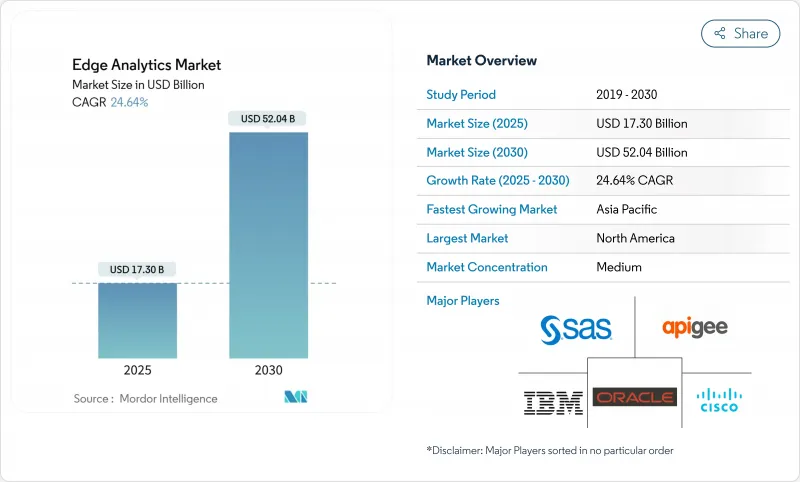
성장을 뒷받침하는 것은 IoT 엔드포인트의 급속한 확장, 저지연 데이터 경로를 지원하는 5G 커버리지 확대, 추론 엔진을 네트워크 엣지에 배치하는 AI 대응 실리콘의 지속적인 진보입니다. 공급업체는 견고한 마이크로 데이터센터, 액체 냉각 설계 및 기밀 데이터를 로컬로 유지하면서 세계 모델을 학습하는 협력 학습 프레임워크를 선호합니다. 또한 기업은 클라우드 네이티브 오케스트레이션 도구를 통합하여 수천 개의 엣지 노드에 걸친 애플리케이션 전개를 표준화하여 전개 주기를 단축하고 ROI 기대치를 높입니다. 엣지 애널리틱스 시장은 특히 실시간 의사결정 지원과 엄격한 개인정보 보호 의무를 공존해야 하는 의료 및 금융에서 데이터 소블린 아키텍처를 위한 규제 추진에 의해 더욱 영향을 받습니다.
세계의 엣지 애널리틱스 시장 동향 및 인사이트
IoT 엔드포인트 급증
세계 기기 기반은 매일 3억 2,877만 TB의 데이터를 생성하며 대역폭을 절약하고 실시간으로 인사이트를 얻기 위해, 애널리틱스는 로컬 처리로 전환해야 합니다. 산업 플랜트에서는 현재 수백만 개의 센서에서 진동 및 온도 메트릭이 스트리밍되고 최적화된 모델을 실행하는 엣지 가속기가 10밀리초 이하의 대기 시간으로 이 유입을 처리하고 있습니다. 예지보전 점검이 중장비에서 의료용 웨어러블까지 확대됨에 따라 엣지 애널리틱스 시장은 운영 상의 실적를 확대하여 기업 데이터 전략에 필수적인 레이어가 됩니다.
초저지연 애널리틱스 수요
자율 로봇, 원격 수술 장비, 충돌 회피 시스템은 5ms 이내의 의사 결정이 필요합니다. 엣지 애널리틱스는 50-150ms의 라운드트립을 제거하여 미션 크리티컬 장애의 위험을 줄입니다. 결함 감지 알고리즘을 지역 데이터센터에서 현장 노드로 옮긴 제조업체는 2자리 수율 향상을 보고하고 분산 인텔리전스의 비즈니스 사례를 강화하고 있습니다.
지속적인 데이터 보안 및 주권 위험
각 엣지 게이트웨이는 물리적 액세스 및 패치 미적용 펌웨어를 통해 적이 악용할 수 있는 공격 대상 영역을 제공합니다. 또한 헬스케어 사업자는 위치 기반 데이터 거주 의무를 준수해야 하며 트래픽을 엔드 투 엔드로 암호화하는 신뢰할 수 있는 실행 환경 및 제로 트러스트 오버레이를 채택하도록 촉구하고 있습니다.
부문 분석
처방적 엔진은 엣지 애널리틱스 시장에서 가장 빠르게 성장하는 계층이며 CAGR 25%로 성장하고 있습니다. 이 레이어는 기본적인 기술적 가시성에 의사 결정 자동화를 추가하고 이상이 감지될 때 차선책을 권장합니다. 2024년에는 기술적인 모듈이 여전히 매출의 39%를 차지였지만, 사용자 수요는 출력을 높이고 위험을 최소화하는 고차원 인사이트로 분명히 변화하고 있습니다. 엣지 디바이스는 현재 로봇 공학의 파칭을 현장에서 최적화하는 컴팩트한 강화 학습 에이전트를 호스팅하고 있으며, 이 전환 뒤에 상업적인 견인력을 보여주고 있습니다.
예측 알고리즘은 현재 대시보드와 완전 자동화 사이의 브리지 역할을 계속하고 있습니다. 온도 스파이크와 트래픽 급증을 상관시켜 유지보수 창과 재고 요구 사항을 예측할 수 있습니다. 진단 분석은 규모가 작지만 재발을 막는 근본 원인을 명확히 합니다. 이러한 스택을 결합하여 공급업체는 진입점으로 설명적인 대시보드를 통합하고 프리미엄 가입자를 위한 처방전적인 추가 기능을 중첩하여 계층화된 서비스를 패키징할 수 있습니다. 그 결과, 엣지 애널리틱스 업계는 성과 기반 계약을 향해 계속 성숙하고 있습니다.
2024년 엣지 애널리틱스 시장 규모의 56%는 온프레미스 노드가 차지했습니다. 온프레미스 노드는 개인 식별 정보나 국가 안보 정보를 내보낼 수 없는 데이터 기밀성이 높은 분야를 위한 첫 번째 옵션입니다. 예를 들어, 병원 네트워크는 방사선 기술자가 외부 링크를 거치지 않고 스캔 이미지에 액세스할 수 있도록 이미지 서버를 내부적으로 관리합니다. 그러나 클라우드 관리 엣지는 공급자가 거주 규칙을 충족하는 지역 영역을 시작함에 따라 2030년까지 연평균 복합 성장률(CAGR) 27.5%로 성장하는 등 급속히 확대될 전망입니다.
장기적으로 하이브리드 토폴로지가 주류가 되고 있습니다. 민감한 워크로드는 로컬에서 추론을 수행하고 배치 동향 분석은 중앙 집중식 클라우드에서 밤새 수행됩니다. 중앙 콘솔이 컨테이너 업데이트를 푸시하고, 정책을 조화시키며, 경영진의 대시보드에 대해 집계된 인사이트를 수집하여 민첩성을 희생하지 않고 제어를 실현합니다. 인프라의 중복을 줄이고 데이터 오리진 근처에서 컴퓨팅을 유지함으로써 예산 및 규정 준수 목표에 부합합니다.
엣지 애널리틱스 시장 보고서는 업계를 전개 모드별(온프레미스, 클라우드), 컴포넌트별(솔루션, 서비스), 기술별(기술 분석, 진단 분석, 예측 분석, 처방 분석), 최종 사용자 업계별(은행, 금융서비스 및 보험(BFSI), IT 및 통신, 제조, 의료, 소매 등) 및 지역별로 분류합니다.
지역 분석
북미는 성숙한 하이퍼스케일 데이터센터의 실적 및 초기 5G 수익화 전략으로 2024년 매출 43%로 선두를 유지했습니다. 이동통신사는 2차 도시 지역까지 커버리지를 확장했으며, 소매업체는 마이크로데이터센터를 교외 상점 근처에 설치할 수 있게 되었습니다. 정부의 우대 조치로 제조업체는 스마트 팩토리 프로그램을 채택하여 AI 주도의 프로세스 제어를 라인 엣지에 통합하게 되었습니다. 암호화 및 감사 추적이 업계 표준에 부합한다면 개인 정보 보호에 대한 결정은 여전히 혁신에 관대합니다. 정책의 명확화는 조달 주기를 단축하고 헬스케어, 소매 및 에너지 분야에서 안정적인 수요를 지원합니다.
아시아태평양은 가장 빠르게 성장하고 있으며 2025-2030년 CAGR 27%로 성장이 예측됩니다. 중국은 스마트 신호기 및 산업용 로봇의 센서 피드를 캡처하는 지역 엣지 시설의 규모를 확대하고 있습니다. 일본의 자동차 대기업은 재작업 비용을 절감하는 예측 품질 루프를 도입하고, 인도의 휴대폰 사업자는 새로운 주파수대를 활용해 물류 파크용 프라이빗 5G 캠퍼스를 시작합니다. 국경을 넘어서는 데이터의 흐름에 관한 규제의 입장은 다양하고, 다국적 기업은 벤더의 둘러싸기를 피하기 위해 오픈소스의 스택을 사용하는 경우가 많으며, 현지화된 전개를 향하고 있습니다. 국내 반도체 공장에 대한 투자는 지역의 자립적 공급망을 더욱 지원하고 엣지 프로젝트에 탄력성을 통합합니다.
유럽에서는 GDPR(EU 개인정보보호규정)과 AI 책임법의 제안에 유도하면서 견조하면서도 신중한 섭취를 볼 수 있습니다. 독일은 OPC UA 게이트웨이와 컨테이너화된 추론으로 전통적인 공장을 개조하는 Industrie 4.0 프로젝트의 선구자이자 혁신과 리스크 거버넌스의 균형을 맞추고 있습니다. 프랑스에서는 스마트 트랜스포트 파일럿을 주도해, 노측기의 실시간 비디오 해석에 의해 공공 안전에 대한 대응 시간을 개선합니다. 북유럽 사업자는 ESG 지령을 존중하기 위해 환경 친화적인 수소 에너지에 의한 엣지 사이트를 우선시합니다. 표준화 단체는 보안 부팅, 원격 인증 및 데이터 교환 프레임워크에서 협력하여 보다 넓은 엣지 애널리틱스 시장에 이익을 주는 상호 운용성 철학을 키우고 있습니다.
기타 혜택 :
- 엑셀 형식 시장 예측(ME) 시트
- 3개월간의 애널리스트 서포트
목차
제1장 서론
- 조사의 전제조건 및 시장 정의
- 조사 범위
제2장 조사 방법
제3장 주요 요약
제4장 시장 상황
- 시장 개요
- 시장 성장 촉진요인
- IoT 엔드포인트의 보급
- 초저지연 분석에 대한 수요
- 엣지의 이용 사례를 해방하는 급속한 5G 전개
- 엣지 전개를 간소화하는 클라우드 네이티브 툴체인
- 데이터 프라이버시를 강화하는 온 디바이스 연계 학습
- 열밀도가 높은 AI를 실현하는 액냉 마이크로 데이터센터
- 시장 성장 억제요인
- 지속적인 데이터 보안 및 주권 위험
- 브라운필드 OT 시스템과의 통합 복잡성
- 극소 ML 및 엣지 AI 엔지니어링 인재의 희소성
- 분산 컴퓨팅 노드에서 ESG 주도 전력 상한 규제
- 중요한 규제 프레임워크의 평가
- 밸류체인 분석
- 기술의 전망
- Porter's Five Forces
- 공급기업의 협상력
- 구매자의 협상력
- 신규 참가업체의 위협
- 대체품의 위협
- 경쟁 기업 간 경쟁 관계
- 주요 이해관계자의 영향 평가
- 주요 이용 사례 및 사례 연구
- 시장의 거시경제 요인에 미치는 영향
- 투자 분석
제5장 시장 세분화
- 전개 모드별
- 온프레미스
- 클라우드
- 컴포넌트별
- 솔루션
- 서비스
- 최종 사용자 업계별
- BFSI
- IT 및 통신
- 제조업
- 헬스케어
- 소매
- 기타
- 기술별
- 기술적 분석
- 진단 분석
- 예측 분석
- 처방적 분석
- 지역별
- 북미
- 미국
- 캐나다
- 멕시코
- 남미
- 브라질
- 아르헨티나
- 기타 남미
- 유럽
- 영국
- 독일
- 프랑스
- 이탈리아
- 스페인
- 북유럽 국가
- 기타 유럽
- 중동 및 아프리카
- 중동
- 사우디아라비아
- 아랍에미리트(UAE)
- 튀르키예
- 기타 중동
- 아프리카
- 남아프리카
- 이집트
- 나이지리아
- 기타 아프리카
- 아시아태평양
- 중국
- 인도
- 일본
- 한국
- ASEAN
- 호주
- 뉴질랜드
- 기타 아시아태평양
- 북미
제6장 경쟁 구도
- 시장 집중도
- 전략적 동향
- 시장 점유율 분석
- 기업 프로파일
- Cisco Systems Inc.
- IBM Corporation
- Microsoft Corporation
- Apigee Corporation
- Dell Technologies Inc.
- Intel Corporation
- Oracle Corporation
- SAS Institute Inc.
- Amazon Web Services Inc.
- Google Cloud Platform
- Hewlett Packard Enterprise
- Schneider Electric SE
- Huawei Technologies Co.
- SAP SE
- Siemens AG
- GE Digital
- Foghorn Systems
- Edge Impulse Inc.
- Greenwave Systems
- Predixion Software
- AGT International Inc.
제7장 시장 기회 및 향후 전망
AJY 25.11.24The edge analytics market size stands at USD 17.30 billion in 2025 and is on track to reach USD 52.04 billion by 2030, reflecting a 24.64% CAGR.
Growth is propelled by the rapid expansion of IoT end-points, wider 5G coverage that supports low-latency data paths, and ongoing advances in AI-enabled silicon that places inference engines at the network edge. Vendors are prioritizing ruggedized micro-data centers, liquid-cooling designs, and federated learning frameworks that keep sensitive data local while still training global models. Enterprises are also integrating cloud-native orchestration tools to standardize application delivery across thousands of edge nodes, thereby compressing deployment cycles and raising ROI expectations. The edge analytics market is further influenced by regulatory drives toward data-sovereign architectures, especially in healthcare and finance where real-time decision support must coexist with strict privacy mandates.
Global Edge Analytics Market Trends and Insights
Proliferation of IoT end-points
The global device base is generating 328.77 million TB of data every day, forcing analytics to migrate toward local processing so that bandwidth is conserved and insights arrive in real time. Industrial plants now stream vibration and temperature metrics from millions of sensors, and edge accelerators running optimized models handle this influx with sub-10 ms latency. As predictive maintenance checks extend from heavy machinery to medical wearables, the edge analytics market gains a larger operational footprint and becomes an indispensable layer in enterprise data strategy.
Demand for ultra-low-latency analytics
Autonomous robots, tele-surgery rigs, and collision-avoidance systems need decisions within 5 ms, a target unattainable when packets traverse distant clouds. Edge analytics eliminates the 50-150 ms round-trip and lowers the risk of mission-critical failures. Manufacturers that moved defect-detection algorithms from regional data centers to on-site nodes report double-digit yield improvements, reinforcing the business case for distributed intelligence.
Persistent data-security & sovereignty risks
Each edge gateway introduces an attack surface that adversaries can exploit through physical access or unpatched firmware. Finance and healthcare operators must also align with location-based data residency mandates, prompting adoption of trusted execution environments and zero-trust overlays that encrypt traffic end-to-end.
Other drivers and restraints analyzed in the detailed report include:
- Rapid 5G roll-out unlocking edge use-cases
- Cloud-native toolchains simplifying edge deployments
- Integration complexity with brownfield OT systems
For complete list of drivers and restraints, kindly check the Table Of Contents.
Segment Analysis
Prescriptive engines are the fastest-advancing layer in the edge analytics market, growing at a 25% CAGR. They add decision automation to basic descriptive visibility, recommending the next best action once anomalies are detected. In 2024, descriptive modules still held 39% of revenue, but user demand has clearly pivoted toward higher-order insights that lift output and minimize risk. Edge devices now host compact reinforcement-learning agents that optimize robotics pathing on the fly, illustrating the commercial pull behind the transition.
Predictive algorithms remain a bridge between current dashboards and full automation. They enable forecast maintenance windows and inventory needs by correlating temperature spikes or traffic surges. Diagnostic analytics, though smaller, supplies root-cause clarity that prevents recurrence. Together these stacks help vendors package tiered offerings, embedding descriptive dashboards as entry points and layering prescriptive add-ons for premium subscribers. In turn, the edge analytics industry continues to mature toward outcome-based contracting.
On-premises nodes accounted for 56% of the edge analytics market size in 2024. They remain the first choice for data-sensitive sectors that cannot export personally identifiable or national-security information. Hospital networks, for instance, maintain imaging servers in-house so radiologists access scans without traversing external links. However, cloud-managed edges are scaling quicker, charting a 27.5% CAGR to 2030 as providers launch regional zones that meet residency rules.
Hybrid topology is emerging as the long-term norm. Sensitive workloads infer locally while batch trend analytics run in centralized clouds overnight. Central consoles push container updates, harmonize policy, and collect aggregated insights for executive dashboards, thereby delivering control without sacrificing agility. The arrangement reduces infrastructure duplication and keeps compute near data origin, aligning with both budget and compliance targets.
The Edge Analytics Market Report Segments the Industry Into by Deployment Type (On-Premises, and Cloud), Component (Solutions, and Services), Technology (Descriptive Analytics, Diagnostic Analytics, Predictive Analytics, and Prescriptive Analytics), End User Industry (BFSI, IT and Telecommunication, Manufacturing, Healthcare, Retail, and Others), and Geography.
Geography Analysis
North America retained leadership with 43% revenue in 2024 thanks to a mature hyperscale data-center footprint and early 5G monetization strategies. Telcos widened coverage to secondary metros, letting retailers place micro-data centers closer to suburban stores. Government incentives encouraged manufacturers to adopt smart-factory programs, embedding AI-driven process control at the line edge. Privacy rulings remain receptive to innovation provided encryption and audit trails meet industry norms. Policy clarity shortens procurement cycles and underpins steady demand across healthcare, retail, and energy domains.
Asia Pacific is the fastest-growing territory, forecast to log a 27% CAGR during 2025-2030. China scales provincial edge facilities that ingest sensor feeds from smart traffic lights and industrial robotics. Japan's automotive majors deploy predictive quality loops that slice rework costs, while India's mobile operators leverage new spectrum to launch private 5G campuses for logistics parks. Diverse regulatory positions on cross-border data flows push multinationals toward localized deployments, often using open-source stacks to avoid vendor lock-in. Investments in domestic semiconductor fabs further support a self-sustaining regional supply chain and embed resilience into edge projects.
Europe shows robust but measured uptake, guided by GDPR and proposed AI liability laws. Germany pioneers Industrie 4.0 projects that retrofit heritage plants with OPC UA gateways and containerized inference, balancing innovation with risk governance. France leads smart-transport pilots where real-time video analytics on roadside units improve public-safety response times. Nordic operators prioritize green hydrogen-powered edge sites to respect ESG mandates. Standard-setting bodies collaborate on secure boot, remote attestation, and data-exchange frameworks, fostering an interoperability ethos that benefits the wider edge analytics market.
- Cisco Systems Inc.
- IBM Corporation
- Microsoft Corporation
- Apigee Corporation
- Dell Technologies Inc.
- Intel Corporation
- Oracle Corporation
- SAS Institute Inc.
- Amazon Web Services Inc.
- Google Cloud Platform
- Hewlett Packard Enterprise
- Schneider Electric SE
- Huawei Technologies Co.
- SAP SE
- Siemens AG
- GE Digital
- Foghorn Systems
- Edge Impulse Inc.
- Greenwave Systems
- Predixion Software
- AGT International Inc.
Additional Benefits:
- The market estimate (ME) sheet in Excel format
- 3 months of analyst support
TABLE OF CONTENTS
1 INTRODUCTION
- 1.1 Study Assumptions and Market Definition
- 1.2 Scope of the Study
2 RESEARCH METHODOLOGY
3 EXECUTIVE SUMMARY
4 MARKET LANDSCAPE
- 4.1 Market Overview
- 4.2 Market Drivers
- 4.2.1 Proliferation of IoT end-points
- 4.2.2 Demand for ultra-low-latency analytics
- 4.2.3 Rapid 5G roll-out unlocking edge use-cases
- 4.2.4 Cloud-native toolchains simplifying edge deployments
- 4.2.5 On-device federated learning enhancing data privacy
- 4.2.6 Liquid-cooling micro-data-centres enabling thermal-dense AI
- 4.3 Market Restraints
- 4.3.1 Persistent data-security & sovereignty risks
- 4.3.2 Integration complexity with brownfield OT systems
- 4.3.3 Scarcity of tiny-ML / edge-AI engineering talent
- 4.3.4 ESG-driven power-cap caps on distributed compute nodes
- 4.4 Evaluation of Critical Regulatory Framework
- 4.5 Value Chain Analysis
- 4.6 Technological Outlook
- 4.7 Porter's Five Forces
- 4.7.1 Bargaining Power of Suppliers
- 4.7.2 Bargaining Power of Buyers
- 4.7.3 Threat of New Entrants
- 4.7.4 Threat of Substitutes
- 4.7.5 Competitive Rivalry
- 4.8 Impact Assessment of Key Stakeholders
- 4.9 Key Use Cases and Case Studies
- 4.10 Impact on Macroeconomic Factors of the Market
- 4.11 Investment Analysis
5 MARKET SEGMENTATION
- 5.1 By Deployment Type
- 5.1.1 On-Premises
- 5.1.2 Cloud
- 5.2 By Component
- 5.2.1 Solutions
- 5.2.2 Services
- 5.3 By End-User Industry
- 5.3.1 BFSI
- 5.3.2 IT & Telecommunication
- 5.3.3 Manufacturing
- 5.3.4 Healthcare
- 5.3.5 Retail
- 5.3.6 Others
- 5.4 By Technology
- 5.4.1 Descriptive Analytics
- 5.4.2 Diagnostic Analytics
- 5.4.3 Predictive Analytics
- 5.4.4 Prescriptive Analytics
- 5.5 By Geography
- 5.5.1 North America
- 5.5.1.1 United States
- 5.5.1.2 Canada
- 5.5.1.3 Mexico
- 5.5.2 South America
- 5.5.2.1 Brazil
- 5.5.2.2 Argentina
- 5.5.2.3 Rest of South America
- 5.5.3 Europe
- 5.5.3.1 United Kingdom
- 5.5.3.2 Germany
- 5.5.3.3 France
- 5.5.3.4 Italy
- 5.5.3.5 Spain
- 5.5.3.6 Nordics
- 5.5.3.7 Rest of Europe
- 5.5.4 Middle East and Africa
- 5.5.4.1 Middle East
- 5.5.4.1.1 Saudi Arabia
- 5.5.4.1.2 United Arab Emirates
- 5.5.4.1.3 Turkey
- 5.5.4.1.4 Rest of Middle East
- 5.5.4.2 Africa
- 5.5.4.2.1 South Africa
- 5.5.4.2.2 Egypt
- 5.5.4.2.3 Nigeria
- 5.5.4.2.4 Rest of Africa
- 5.5.5 Asia-Pacific
- 5.5.5.1 China
- 5.5.5.2 India
- 5.5.5.3 Japan
- 5.5.5.4 South Korea
- 5.5.5.5 ASEAN
- 5.5.5.6 Australia
- 5.5.5.7 New Zealand
- 5.5.5.8 Rest of Asia-Pacific
- 5.5.1 North America
6 COMPETITIVE LANDSCAPE
- 6.1 Market Concentration
- 6.2 Strategic Moves
- 6.3 Market Share Analysis
- 6.4 Company Profiles (includes Global level Overview, Market level overview, Core Segments, Financials as available, Strategic Information, Market Rank/Share for key companies, Products and Services, and Recent Developments)
- 6.4.1 Cisco Systems Inc.
- 6.4.2 IBM Corporation
- 6.4.3 Microsoft Corporation
- 6.4.4 Apigee Corporation
- 6.4.5 Dell Technologies Inc.
- 6.4.6 Intel Corporation
- 6.4.7 Oracle Corporation
- 6.4.8 SAS Institute Inc.
- 6.4.9 Amazon Web Services Inc.
- 6.4.10 Google Cloud Platform
- 6.4.11 Hewlett Packard Enterprise
- 6.4.12 Schneider Electric SE
- 6.4.13 Huawei Technologies Co.
- 6.4.14 SAP SE
- 6.4.15 Siemens AG
- 6.4.16 GE Digital
- 6.4.17 Foghorn Systems
- 6.4.18 Edge Impulse Inc.
- 6.4.19 Greenwave Systems
- 6.4.20 Predixion Software
- 6.4.21 AGT International Inc.
7 MARKET OPPORTUNITIES AND FUTURE OUTLOOK
- 7.1 White-space and Unmet-need Assessment