|
시장보고서
상품코드
1851827
전선 및 케이블 시장 : 점유율 분석, 산업 동향, 통계, 성장 예측(2025-2030년)Wire And Cable - Market Share Analysis, Industry Trends & Statistics, Growth Forecasts (2025 - 2030) |
||||||
 Mordor Intelligence
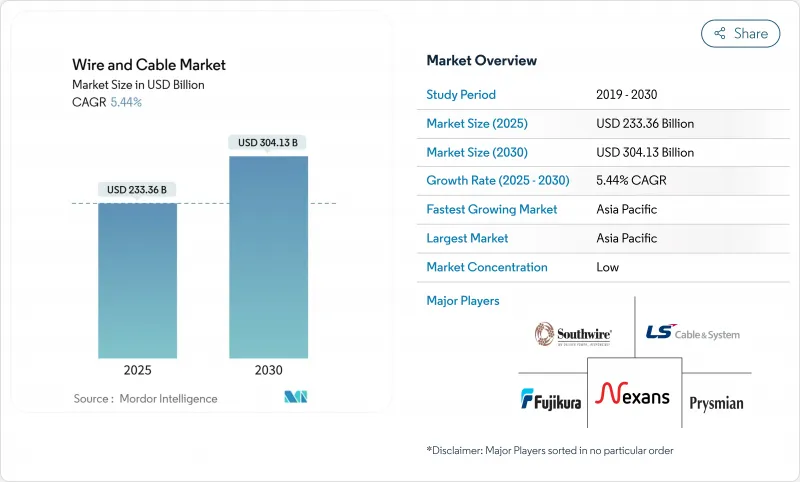
세계의 전선 및 케이블 시장 규모는 2025년 2,333억 6,000만 달러로 추정되며, 2030년까지 3,041억 3,000만 달러에 이를 것으로 예측되며, 예측 기간 중(2025-2030년) CAGR은 5.44%로 예상됩니다.
전력망이 분산형 발전으로 중심을 옮겨 AI 대응 데이터센터와 5G 백본을 지원하는 디지털 인프라가 확대됨에 따라 수요가 가속화되고 있습니다. 해상 풍력발전용 해저 수출 링크, 인구가 많은 경제권에서의 파이버 투 더 홈(FTTH)의 전개, 수송의 전화에 의해 제품 구성, 제조 실적, 조달 사이클이 재구축되고 있습니다. 한편으로는 가교 폴리에틸렌(XLPE) 컴파운드 공급 부족, 한편으로는 기록적인 구리 가격의 급등이 프로젝트 예산을 부풀리고 있습니다. 경쟁 우위는 원료 계약을 확보하고 고전압 생산 능력을 강화하며 성장 지역에서 생산을 현지화할 수 있는 기업에 끌려가고 있습니다.
세계 전선 및 케이블 시장 동향 및 통찰
북해와 동아시아에서 급증하는 해상풍력 HV 케이블 수요
기록적인 해상 풍력발전의 입찰량에 의해 2020년 이후 고압 해저 케이블의 연간 수주량은 배증하고 있습니다. 낙찰된 길이는 2016년 759km에서 2022년에는 약 2,000km로 급증했고, 리드 타임은 12-18개월에서 2025년 계약에서는 24-30개월로 증가했습니다. 북해만으로도 2030년까지 8,000km 이상의 수출 링크가 필요하며, 동아시아에서는 2033년까지 146GW의 용량이 추가됩니다. 시장 리더는 계속 확대되고 있습니다. Prysmian은 독일 프로젝트에서 50억 달러를 계약하고 NKT는 칼스 크로나 공장의 생산량을 두배로 늘리고 Nexans는 두 번째 노르웨이 케이블 부설선을 증설하고 있습니다. 현재 800kV/4GW DC 케이블의 생산 자격을 갖춘 세계 공급업체는 불과 6개 회사이며 생산 능력 부족이 심각 해지고 있습니다.
인도와 ASEAN에서 파이버 투 홈 전개가 가속
인도의 BharatNet 예산은 2025년에 238% 증가한 22,000캐롤 루피가 되어, 12,000개의 신규 FTTH 회선과 692,676km의 광섬유가 가능하게 됩니다. 터미네이션된 어셈블리와 마이크로트렌치는 현지 전개 비용을 30% 낮추고 설치 시간을 단축했습니다. ASEAN 정부는 2030년까지 가구의 40%에 1Gbps의 소비자 플랜을 제공하는 것을 목표로 하고 있으며, 동선으로부터의 전환을 가속하고 있습니다. 그 결과, 광섬유의 인입률은 케이블 제조업체가 설비 투자를 이익률이 낮은 LAN용 구리선에서 광유리 프리폼, 리본, 마이크로덕트 제품으로 이동하도록 촉구하고 있습니다.
XLPE 수지 공급 병목 현상이 EHV 생산량 제한
가교 폴리에틸렌의 부족으로 특별 고압 케이블의 리드 타임은 2022년 수준에 비해 30-40% 증가하고 있습니다. 표면 결함의 연구에 따르면, 흠집은 전계 응력을 1.6배로 증가시키고 절연 파괴 전압을 129.6kV에서 59.1kV로 낮출 수 있으며, 공장 시험에서 더 많은 불량품이 발생합니다. 텍사스 주와 싱가포르에서 계획된 확장 공사는 2026년 후반이 되지 않으면 정격 용량에 도달하지 않기 때문에 생산량 제한이 길어집니다. 송전망 사업자는 현재 공급 갭을 메우기 위해 가스 절연 버스 덕트와 한정적인 케이블 부설을 조합한 하이브리드 패키지를 입찰하고 있습니다.
부문 분석
저전압 케이블은 주택건설과 소비자용 전자기기에 지지되어 2024년 매출의 54%를 유지했습니다. 초고전압 케이블은 해상 풍력 발전소와 장거리 재생에너지가 상호 연결 프로젝트를 추진하기 때문에 수량은 적지만 CAGR은 7.9%가 될 것으로 예측됩니다. 이러한 궤적에서 고압 제품의 전선 및 케이블 시장 점유율은 2030년까지 지속적으로 상승합니다. 탄소 중립 송전망을 목표로 하는 국가 에너지 정책 목표는 -525kV HVDC 링크의 대량 조달을 촉진하고, 납품 사이클을 단축하고, OEM의 생산 프레임을 수년간까지 고정합니다.
2025년부터 2027년까지의 송전망 확장 예산은 총 500억 유로를 넘습니다. 고압 송전선의 전선 및 케이블 시장 규모는 신재생에너지 통합 회랑의 규제의 신속화에 의해 지원되고 있습니다. 제조업체는 연속 가황 라인의 대형화, 온라인 부분 방전 모니터링, 절연 압출의 로봇화 등으로 대응해, 생산량의 향상과 불량률의 저감을 도모하고 있습니다.
전력 케이블은 2024년 매출의 61%를 차지하며, 송전망에 대한 지출과 산업 전기화를 반영하고 있습니다. 광섬유 매출은 작지만 정부가 범용 광대역에 자금을 공급하고 클라우드 하이퍼스케일러가 지연에 민감한 백본을 구축하기 때문에 2030년까지 매년 8.6% 성장할 것으로 예측되고 있습니다. 이 차이는 광섬유가 더 넓은 전선 및 케이블 시장에서 주요 성장 엔진임을 나타냅니다. 굴곡에 둔감한 리본과 작은 직경의 마이크로 케이블에 대한 수요가 증가함에 따라 유리 프리폼 공급업체의 사업 확대와 수소 프리 프로세스의 온라인화에 박차가 가고 있습니다.
광섬유는 통신의 범위를 넘어 공장 자동화, 스마트 빌딩 및 가혹한 환경에서의 감지에 침투합니다. 다심 광케이블은 현재 로봇 공학에서 기존의 구리선 시리얼 케이블을 대체하여 EMI 내성과 경량화를 실현하고 있습니다. FTTH의 보급이 깊어짐에 따라, 광유리 클러스터에 기인하는 전선 및 케이블 시장 규모는 10년 후까지는 실내 Cat6량을 추월할 것으로 예측되고 있습니다.
전선 및 케이블 시장 보고서는 전압별(특별 고압, 중압, 기타), 케이블 유형별(전력 케이블, 광섬유 케이블, 기타), 도체 재료별(구리, 알루미늄, 광유리 및 폴리머), 설치별(가공, 기타), 최종 사용자별(건설-주택, 건설-상업, 기타), 지역별로 분류되어 있습니다. 시장 예측은 금액(달러)으로 제공됩니다.
지역 분석
아시아태평양은 2024년 세계 매출의 54%를 차지했고 2030년까지 연평균 복합 성장률(CAGR)은 6.1%로 확대됩니다. 중국의 초고압 송전망과 폴리머 컴파운드의 우위성이 지역 규모의 경제성을 확보하는 한편, 인도의 BharatNet과 스마트 미터의 목표가 국내의 케이블 공장을 파이버와 공중 번들 도체에 향하게 합니다. 동남아시아 정부는 신재생자원과의 균형을 맞추기 위해 해저전력 상호연결을 진행하고 있으며, 지역 플랜트의 조달범위를 확대하고 있습니다.
북미는 재생 가능 자원의 통합과 탄력성을 중시하고 있습니다. 미국 대서양 연안의 해상 풍력발전지대는 2030년까지 10GW의 수출용량을 필요로 하고 있으며, 바이든 정권의 BEAD 프로그램은 연방정부의 보조금을 지방의 섬유건설에 돌리기 위해 루스 튜브와 완전 전원자립형(ADSS) 송전선의 국내 수요를 끌어올리고 있습니다. 캐나다의 미국 북동부 및 중서부로의 수력 수출 링크는 알프스의 극단적인 온도에도 견딜 수 있는 525kV HVDC 케이블을 요구합니다.
유럽의 탈탄소화 경로는 상호 연결된 송전망에 달려 있습니다. 독일만으로도 HVDC 회랑에 213억 유로를 기록, LS 케이블과 여러 패키지를 계약했습니다. EU의 Trans-European Networks for Energy 체계는 국경을 넘어 인증을 가속화하고 대응 가능한 전선 및 케이블 시장을 확대합니다. 북유럽 국가들은 환경 친화적인 수소 수출에 주력하고 있으며, 해저 케이블 개발자들은 미래의 수소 파이프라인을 따라 전력과 데이터의 양용 백본을 고려할 필요가 있습니다.
사하라 이남의 아프리카는 아직 충분한 서비스를 받지 못한 성장 프론티어입니다. 중전압 미션 300과 양자간 기후 변화 대출 공약은 전기를 위해 400억 달러를 동원하여 33kV의 중고압 피더, 절연 가공 케이블, 배전 변압기의 기회를 확대합니다. 개발 은행 입찰에는 현지화 조항이 설치되어 합작투자가 장려되고 세계 OEM은 지역 노동력의 스킬 업과 품질 보증 프로토콜의 이전을 촉구하고 있습니다.
기타 혜택:
- 엑셀 형식 시장 예측(ME) 시트
- 3개월간의 애널리스트 서포트
목차
제1장 서론
- 조사의 전제조건과 시장의 정의
- 조사 범위
제2장 조사 방법
제3장 주요 요약
제4장 시장 상황
- 시장 개요
- 시장 성장 촉진요인
- 북해와 동아시아에서 급증하는 해상풍력 HV 케이블 수요
- 인도와 ASEAN에서 가속하는 파이버 투더 홈 전개
- EV 플랫폼용 자동차 하네스의 전기화
- 다자간 자금을 활용한 사하라 이남의 송전망 상호 접속 프로젝트
- 시장 성장 억제요인
- EHV 생산량을 제한하는 XLPE 수지 공급의 병목
- 구리 가격의 난고하가 중동 및 북아프리카 업자의 마진을 압박
- 가치/공급망 분석
- 규제 전망
- 기술의 전망
- Porter's Five Forces 분석
- 공급기업의 협상력
- 구매자의 협상력
- 신규 참가업체의 위협
- 대체품의 위협
- 경쟁 기업간 경쟁 관계
- 거시 경제 영향 평가
- 투자 분석
제5장 시장 규모와 성장 예측
- 전압별
- 특고압(35kV 이상)
- 중전압(1-35 kV)
- 저전압(1kV 미만)
- 케이블 유형별
- 전력 케이블
- 광섬유 케이블
- 신호 및 제어 케이블
- 동축 및 데이터 케이블
- 도체 재료별
- 구리
- 알루미늄
- 광학 유리 및 폴리머
- 설비별
- 가상
- 지중
- 해중
- 업계별
- 건설-주택
- 건설-상업
- 전력 인프라(유틸리티 및 재생에너지)
- 통신 및 데이터센터
- 석유, 가스 및 석유화학
- 자동차 및 이동성
- 공업 생산
- 지역별
- 북미
- 미국
- 캐나다
- 멕시코
- 남미
- 브라질
- 아르헨티나
- 기타 남미
- 유럽
- 영국
- 독일
- 프랑스
- 이탈리아
- 기타 유럽
- 중동 및 아프리카
- 사우디아라비아
- 아랍에미리트(UAE)
- 남아프리카
- 기타 중동 및 아프리카
- 아시아태평양
- 중국
- 일본
- 인도
- 한국
- 기타 아시아태평양
- 북미
제6장 경쟁 구도
- 시장 집중도
- 전략적 동향
- 시장 점유율 분석
- 기업 프로파일
- Prysmian Group
- Nexans
- Sumitomo Electric Industries, Ltd.
- LS Cable and System Ltd.
- Southwire Company, LLC
- Fujikura Ltd.
- Furukawa Electric Co., Ltd.
- NKT A/S
- Belden Inc.
- CommScope Holding Co., Inc.
- TE Connectivity Ltd.
- Corning Incorporated
- Leoni AG
- Amphenol Corporation
- HELUKABEL GmbH
- Jiangsu Zhongtian Technology Co., Ltd.
- Heng Tong Optic-Electric Co., Ltd.
- Riyadh Cables Group
- Polycab India Ltd.
- KEI Industries Ltd.
- ZTT Group
제7장 시장 기회와 장래의 전망
JHS 25.11.25The Wire And Cable Market size is estimated at USD 233.36 billion in 2025, and is expected to reach USD 304.13 billion by 2030, at a CAGR of 5.44% during the forecast period (2025-2030).
Demand accelerates as power grids pivot toward distributed generation and as digital infrastructure scales to support AI-enabled data centers and 5G backbones. Submarine export links for offshore wind, fiber-to-the-home (FTTH) roll-outs in populous economies, and the electrification of transport are reshaping product mixes, manufacturing footprints, and procurement cycles. Short supply of cross-linked polyethylene (XLPE) compounds on one side and record-high copper prices on the other are inflating project budgets, yet policy-backed capital flows into clean-energy and digital-inclusion programs offset these pressures. Competitive advantage is gravitating toward firms that can secure raw-material contracts, ramp high-voltage capacity, and localize production in growth regions.
Global Wire And Cable Market Trends and Insights
Surging Offshore Wind HV Cable Demand in North Sea & East Asia
Record auction volumes for offshore wind have doubled annual high-voltage submarine cable orders since 2020. Awarded lengths jumped from 759 km in 2016 to almost 2,000 km in 2022, pushing lead times from 12-18 months to 24-30 months for 2025 contracts. The North Sea alone will require over 8,000 km of export links by 2030, while East Asia adds 146 GW of capacity by 2033. Market leaders are expanding: Prysmian signed USD 5 billion of German projects, NKT is doubling its Karlskrona plant output, and Nexans is adding a second Norwegian cable-lay vessel. Only six global suppliers now qualify for +-800 kV/4 GW DC cables, intensifying a capacity crunch.
Accelerated Fiber-to-Home Roll-outs in India & ASEAN
India's BharatNet budget rose 238% to INR 22,000 crore in 2025, enabling 12 lakh new FTTH lines and 692,676 km of optical fiber. Pre-terminated assemblies and micro-trenching have lowered rural deployment costs by 30% and cut installation time. ASEAN governments are targeting 1 Gbps consumer plans for 40% of households by 2030, accelerating copper switch-off timetables. Consequently, fiber take-rates are nudging cable makers to shift capex from low-margin LAN copper to optical glass preform, ribbon, and micro-duct products.
XLPE Resin Supply Bottlenecks Limiting EHV Output
Cross-linked polyethylene shortages have stretched lead times for extra-high-voltage cable by 30-40% compared with 2022 levels. Surface-defect studies show scratches can raise electric-field stress 1.6X and cut breakdown voltage from 129.6 kV to 59.1 kV, forcing more rejects at factory tests. Planned expansions in Texas and Singapore will not reach nameplate capacity until late 2026, prolonging tightness. Grid operators now tender hybrid packages that combine gas-insulated bus ducts and limited cable runs to bridge the supply gap.
Other drivers and restraints analyzed in the detailed report include:
- Electrification of Automotive Harnesses for EV Platforms
- Sub-Saharan Grid Interconnect Projects Unlocking Multilateral Funding
- Copper Price Volatility Squeezing Contractor Margins in MENA
For complete list of drivers and restraints, kindly check the Table Of Contents.
Segment Analysis
Low-Voltage cables retained 54% revenue in 2024, anchored by residential build-outs and consumer electronics. Extra- & High-Voltage lines, though smaller in volume, are forecast to post a 7.9% CAGR as offshore wind farms and long-haul renewables drive interconnector projects. Owing to this trajectory, the wire and cable market share of high-voltage products is set to climb steadily through 2030. National Energy Policy targets for carbon-neutral grids stimulate bulk procurement of +-525 kV HVDC links, compressing delivery cycles and locking OEM production slots years ahead.
Investment momentum is most evident in Europe, where combined grid-expansion budgets exceed EUR 50 billion for 2025-2027, and in China's West-to-East transmission corridors. The wire and cable market size for high-voltage lines is supported by regulatory fast-tracking of renewable-integration corridors. Manufacturers are responding with larger continuous vulcanization lines, on-line partial-discharge monitoring, and robotized insulation extrusion to lift output and cut defect rates.
Power cables delivered 61% of the 2024 turnover, reflecting grid spending and industrial electrification. Fiber-optic revenue, while smaller, is projected to grow 8.6% annually to 2030 as governments fund universal broadband and cloud hyperscalers build latency-sensitive backbones. This differential positions fiber as the chief growth engine inside the broader wire and cable market. Rising demand for bend-insensitive ribbon and reduced-diameter micro-cables spurs glass-preform suppliers to expand and bring more hydrogen-free processes online.
Beyond telecoms, fiber penetrates factory automation, smart buildings, and harsh-environment sensing. Multi-core optical cables now replace legacy serial copper in robotics, offering EMI immunity and weight savings. As FTTH penetration deepens, the wire and cable market size attributed to optical glass clusters is forecast to overtake indoor Cat6 volumes by the decade's end.
The Wire and Cable Market Report Segmented by Voltage (Extra- and High-Voltage, Medium-Voltage, and More), Cable Type (Power Cable, Fiber-Optic Cable, and More), Conductor Material (Copper, Aluminum, Optical Glass / Polymer), Installation (Overhead, and More), End-User Vertical (Construction-Residential, Construction-Commercial, and More), and Geography. The Market Forecasts are Provided in Terms of Value (USD).
Geography Analysis
Asia Pacific anchored 54% of global 2024 revenue and is set to expand at a 6.1% CAGR to 2030. China's ultra-high-voltage grid corridors and its dominance in polymer compounding secure regional-scale economics, while India's BharatNet and Smart Metering goals redirect domestic cable factories toward fiber and aerial bundled conductors. Southeast Asian governments are rolling out undersea power interconnections to balance renewable resources, enlarging procurement lots for regional plants.
North America emphasizes renewable integration and resilience. U.S. offshore wind zones along the Atlantic require 10 GW of export capacity by 2030, and the Biden administration's BEAD program channels federal grants toward rural fiber builds, lifting domestic demand for loose-tube and all-dielectric self-supporting (ADSS) lines. Canada's hydro-export links to the U.S. Northeast and Midwest seek 525 kV HVDC cables rated for extreme Alpine temperatures.
Europe's decarbonization pathway hinges on interconnected grids; Germany alone earmarked EUR 21.3 billion for HVDC corridors, contracting LS Cable for multiple packages. The EU Trans-European Networks for Energy scheme accelerates cross-border approvals, enlarging the addressable wire and cable market. Nordic nations' focus on green hydrogen export compels subsea cable developers to consider dual-use power and data backbones along future hydrogen pipelines.
Sub-Saharan Africa remains the underserved growth frontier. Mission 300 and bilateral climate-finance pledges mobilize USD 40 billion for electrification and extend opportunities in 33-kV medium-voltage feeders, insulated overhead cables, and distribution transformers. Localization clauses within Development Bank tenders encourage joint ventures, nudging global OEMs to upskill regional workforces and transfer quality-assurance protocols.
- Prysmian Group
- Nexans
- Sumitomo Electric Industries, Ltd.
- LS Cable and System Ltd.
- Southwire Company, LLC
- Fujikura Ltd.
- Furukawa Electric Co., Ltd.
- NKT A/S
- Belden Inc.
- CommScope Holding Co., Inc.
- TE Connectivity Ltd.
- Corning Incorporated
- Leoni AG
- Amphenol Corporation
- HELUKABEL GmbH
- Jiangsu Zhongtian Technology Co., Ltd.
- Heng Tong Optic-Electric Co., Ltd.
- Riyadh Cables Group
- Polycab India Ltd.
- KEI Industries Ltd.
- ZTT Group
Additional Benefits:
- The market estimate (ME) sheet in Excel format
- 3 months of analyst support
TABLE OF CONTENTS
1 INTRODUCTION
- 1.1 Study Assumptions and Market Definition
- 1.2 Scope of the Study
2 RESEARCH METHODOLOGY
3 EXECUTIVE SUMMARY
4 MARKET LANDSCAPE
- 4.1 Market Overview
- 4.2 Market Drivers
- 4.2.1 Surging Offshore Wind HV Cable Demand in North Sea and East Asia
- 4.2.2 Accelerated Fiber-to-the-Home Roll-outs in India and ASEAN
- 4.2.3 Electrification of Automotive Harnesses for EV Platforms
- 4.2.4 Sub-Saharan Grid Interconnect Projects Unlocking Multilateral Funding
- 4.3 Market Restraints
- 4.3.1 XLPE Resin Supply Bottlenecks Limiting EHV Output
- 4.3.2 Copper Price Volatility Squeezing Contractor Margins in MENA
- 4.4 Value / Supply-Chain Analysis
- 4.5 Regulatory Outlook
- 4.6 Technological Outlook
- 4.7 Porter's Five Forces Analysis
- 4.7.1 Bargaining Power of Suppliers
- 4.7.2 Bargaining Power of Buyers
- 4.7.3 Threat of New Entrants
- 4.7.4 Threat of Substitutes
- 4.7.5 Intensity of Competitive Rivalry
- 4.8 Macroeconomic Impact Assessment
- 4.9 Investment Analysis
5 MARKET SIZE AND GROWTH FORECASTS (VALUE)
- 5.1 By Voltage
- 5.1.1 Extra- and High-Voltage (Greater Than 35 kV)
- 5.1.2 Medium-Voltage (1-35 kV)
- 5.1.3 Low-Voltage (Less Than 1 kV)
- 5.2 By Cable Type
- 5.2.1 Power Cable
- 5.2.2 Fiber-Optic Cable
- 5.2.3 Signal and Control Cable
- 5.2.4 Coaxial and Data Cable
- 5.3 By Conductor Material
- 5.3.1 Copper
- 5.3.2 Aluminum
- 5.3.3 Optical Glass / Polymer
- 5.4 By Installation
- 5.4.1 Overhead
- 5.4.2 Underground
- 5.4.3 Submarine
- 5.5 By End-User Vertical
- 5.5.1 Construction - Residential
- 5.5.2 Construction - Commercial
- 5.5.3 Power Infrastructure (Utilities and Renewables)
- 5.5.4 Telecommunications and Data Centers
- 5.5.5 Oil and Gas and Petrochemicals
- 5.5.6 Automotive and Mobility
- 5.5.7 Industrial Manufacturing
- 5.6 By Geography
- 5.6.1 North America
- 5.6.1.1 United States
- 5.6.1.2 Canada
- 5.6.1.3 Mexico
- 5.6.2 South America
- 5.6.2.1 Brazil
- 5.6.2.2 Argentina
- 5.6.2.3 Rest of South America
- 5.6.3 Europe
- 5.6.3.1 United Kingdom
- 5.6.3.2 Germany
- 5.6.3.3 France
- 5.6.3.4 Italy
- 5.6.3.5 Rest of Europe
- 5.6.4 Middle East and Africa
- 5.6.4.1 Saudi Arabia
- 5.6.4.2 UAE
- 5.6.4.3 South Africa
- 5.6.4.4 Rest of Middle East and Africa
- 5.6.5 Asia-Pacific
- 5.6.5.1 China
- 5.6.5.2 Japan
- 5.6.5.3 India
- 5.6.5.4 South Korea
- 5.6.5.5 Rest of Asia-Pacific
- 5.6.1 North America
6 COMPETITIVE LANDSCAPE
- 6.1 Market Concentration
- 6.2 Strategic Moves
- 6.3 Market Share Analysis
- 6.4 Company Profiles (includes Global level Overview, Market level overview, Core Segments, Financials as available, Strategic Information, Market Rank/Share for key companies, Products and Services, and Recent Developments)
- 6.4.1 Prysmian Group
- 6.4.2 Nexans
- 6.4.3 Sumitomo Electric Industries, Ltd.
- 6.4.4 LS Cable and System Ltd.
- 6.4.5 Southwire Company, LLC
- 6.4.6 Fujikura Ltd.
- 6.4.7 Furukawa Electric Co., Ltd.
- 6.4.8 NKT A/S
- 6.4.9 Belden Inc.
- 6.4.10 CommScope Holding Co., Inc.
- 6.4.11 TE Connectivity Ltd.
- 6.4.12 Corning Incorporated
- 6.4.13 Leoni AG
- 6.4.14 Amphenol Corporation
- 6.4.15 HELUKABEL GmbH
- 6.4.16 Jiangsu Zhongtian Technology Co., Ltd.
- 6.4.17 Heng Tong Optic-Electric Co., Ltd.
- 6.4.18 Riyadh Cables Group
- 6.4.19 Polycab India Ltd.
- 6.4.20 KEI Industries Ltd.
- 6.4.21 ZTT Group
7 MARKET OPPORTUNITIES AND FUTURE OUTLOOK
- 7.1 White-space and Unmet-need Assessment