|
시장보고서
상품코드
1906020
휴대용 초음파 기기 : 시장 점유율 분석, 업계 동향과 통계, 성장 예측(2026-2031년)Portable Ultrasound Devices - Market Share Analysis, Industry Trends & Statistics, Growth Forecasts (2026 - 2031) |
||||||
 Mordor Intelligence
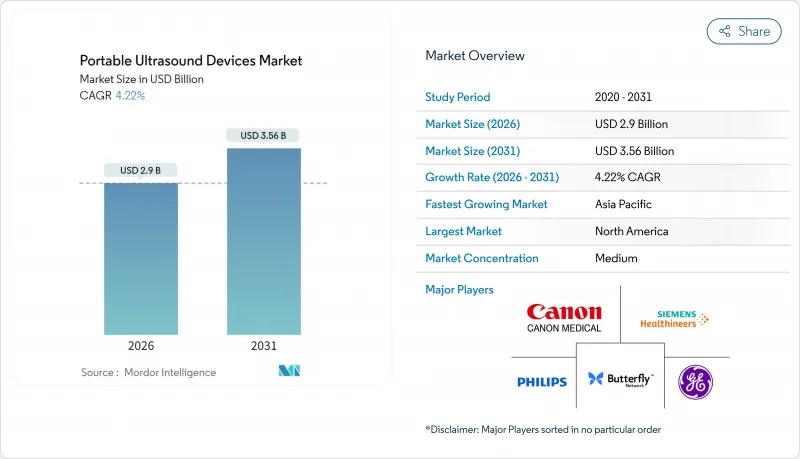
휴대용 초음파 기기 시장 규모는 2026년 29억 달러로 평가되었고, 2025년 27억 8,000만 달러에서 성장할 것으로 예측됩니다.
2031년 예측은 35억 6,000만 달러에 이르고, 2026-2031년에 걸쳐 연평균 복합 성장률(CAGR) 4.22%로 성장할 전망입니다.
진료 현장 영상 촬영이 방사선실부터 병상, 가정 환경 및 외래 진료 현장으로 이동함에 따라 수요가 가속화되고 있습니다. 영상 품질, 배터리 수명 및 가격을 균형 있게 갖춘 휴대용 스캐너는 이제 응급실에서 기본 선택이 되었으며, 웨어러블 트랜스듀서와 AI 기반 애플리케이션은 전체 성장률을 앞지르는 두 자릿수 확장 기회를 창출하고 있습니다. 아시아태평양 지역의 연간 11.28% 급성장은 기존 및 신흥 브랜드 간 가격 경쟁과 현지화 전략을 심화시키고 있습니다. 동시에 원격의료 플랫폼과의 통합으로 원격 진단이 가능해지고 있으나, 분산된 보험급여 체계와 운영자 교육 부족이 도입 속도를 저해하고 있습니다. 하드웨어, AI 소프트웨어, 클라우드 연결성을 결합한 업계 참여자들이 휴대용 초음파 장치 시장의 차세대 가치 창출 기회를 선점할 최적의 위치에 있습니다.
세계의 휴대용 초음파 기기 시장 동향 및 인사이트
응급 및 1차 진료 환경 전반에 걸친 현장 진료 영상 수요 증가
병상 초음파는 eFAST와 같은 프로토콜이 5분 이내에 흉부 및 복부 외상을 시각화하기 때문에 신속한 분류를 위한 기존 방사선 촬영을 대체하고 있습니다. 폐 초음파는 흉부 X선보다 폐렴을 더 민감하게 검출하고 치료 지연을 줄여 혼잡한 응급실에서의 생존 가능성을 높입니다. 일차 진료 의사들도 초기 진단을 정밀화하고 의뢰 절차를 단축하기 위해 휴대용 프로브를 도입하고 있습니다. 고령 입원 환자에 대한 비교 연구에서 휴대용 장비가 근감소증(sarcopenia)을 정확히 선별한다는 점이 확인되어 영상실 외부에서의 임상적 유용성이 부각되었습니다. 이러한 이점은 입원 기간 단축 및 영상 검사 비용 절감으로 이어져 휴대용 초음파 장치 시장에 대한 수요를 강화하고 있습니다.
휴대형 초음파의 응용 범위 확대
초음파 국소화 현미경과 같은 혁신 기술은 CT 혈관조영술이 포착하지 못하는 심근 미세혈관 구조를 시각화하여 심혈관 분야 적용 사례를 확장합니다. GE 헬스케어의 캡션 헬스 인수가 보여주듯, AI 기반 가이드 기술로 비전문가가 진단 등급의 심장 영상을 획득할 수 있게 되었습니다. 마취학에서 비뇨기과에 이르는 전문 분야에서도 신경 차단 및 결석 특성 분석을 위해 휴대용 스캐너를 도입하며 추가 수익원을 창출하고 있습니다. 갑상선 검사를 자동화하는 로봇 스캐닝 시스템은 조작자 독립적 영상화 기술의 진전을 보여줍니다. 이러한 확대되는 적응증은 휴대용 초음파 장치 시장의 중기 성장 동력을 뒷받침합니다.
병원 외부 초음파 시술에 대한 제한적 보험 적용 범위
메디케어 및 기타 보험사들은 국가 및 지역별 보험 적용 결정(NCD/LCD)을 혼합하여 적용함으로써, 일차 진료 및 가정 환경에서의 휴대용 스캔 활용을 저해하는 공백을 남기고 있습니다. 혈관 접근용 CPT 코드 76937은 시간 소모적인 문서 작업이 필요해 소규모 진료소의 행정 비용을 증가시킵니다. 2025년 예상되는 3-4%의 방사선학 보험급여 삭감은 특히 비용에 민감한 지역 병원들의 신규 장비 예산을 제약할 수 있습니다. 명확한 지불 경로가 마련되지 않으면 의료 제공자들이 도입을 미루게 되어 휴대용 초음파 장치 시장의 단기 성장이 위축될 수 있습니다
부문 분석
휴대용 시스템은 균형 잡힌 인체공학적 설계와 응급 및 중환자 치료 워크플로우에 적합한 다중 연결성 덕분에 2025년 휴대용 초음파 장치 시장 점유율의 56.55%를 차지하며 가장 큰 매출을 창출했습니다. Butterfly iQ3의 빠른 데이터 전송 및 네이티브 3D 재구성과 같은 지속적인 업그레이드는 임상적 다용도성을 심화시키고 있습니다. 반면, 센서 소형화로 24시간 생리학적 추적이 가능해짐에 따라 웨어러블 휴대용 초음파 장치 시장 규모는 2031년까지 연평균 13.28%의 성장률을 보일 것으로 예상됩니다.
성능 차이는 브랜드 경쟁을 더욱 치열하게 만들고 있습니다. 9개 기기 공급업체치마크 연구에서 Vscan Air와 SonoEye는 종합 활용도 부문 최고 점수를 획득했으며, Clarius C3HD3는 B-모드 영상에서 탁월한 성능을 보였습니다. 대형 디스플레이가 필요한 고위험 병동에서는 여전히 카트 기반 장비가 주류를 이루지만, 휴대용 프로브가 과거 카트 시스템에서만 가능했던 화질에 근접하면서 상대적 점유율은 감소하고 있습니다. FARUS와 같은 자율 로봇 플랫폼은 휴대성 장점을 유지하면서 자동 스캐닝으로 조작자 의존도를 줄이는 미래를 예고합니다.
2차원 영상은 확립된 워크플로우와 낮은 구입 비용으로 의료진의 신뢰를 얻어 2025년 휴대용 초음파 장치 시장의 49.10% 점유율로 여전히 핵심을 이루고 있습니다. 그러나 볼륨 렌더링 기술이 산부인과, 심혈관 및 근골격계 평가를 개선함에 따라 3D/4D 모달리티는 12.08%의 연평균 성장률(CAGR)을 기록할 것으로 전망됩니다.
컬러 도플러와 스펙트럼 도플러는 혈관 연구에서 여전히 필수적인 역할을 수행하며, GE의 Voluson Signature 20에 탑재된 Radiantflow 시각화 같은 혁신 기술은 혈역학 분석을 정교화합니다. Frontiers에 발표된 딥러닝 빔포머는 스펙클 노이즈를 감소시켜 소형 프로브의 진단 신뢰도를 높입니다. 이러한 혁신들은 종합적으로 구형 스캐너 교체 의향을 증가시켜 휴대용 초음파 장치 시장을 강화하고 있습니다.
지역별 분석
북미는 성숙한 보험급여 체계와 FDA의 신속한 AI 승인 절차로 2025년 32.60% 점유율로 선두를 차지했습니다. Voluson Expert 시리즈는 2025년 AI 업그레이드를 획득하여 고위험 임신 평가의 정밀도를 높였습니다. 예상되는 3-4%의 방사선학 수수료 인하는 역풍으로 작용할 수 있으나, 응급 진료 처리량에서 입증된 비용 상쇄 효과로 병원 교체 주기가 중단될 가능성은 낮습니다.
유럽은 강력한 공공 보건 시스템과 2025년 EU 작업 프로그램 하의 규제 개선을 통해 견고한 입지를 유지하고 있습니다. 이 프로그램은 혁신적 스캐너에 대한 인증기관 협력을 간소화합니다. 고령화 인구는 만성 질환 모니터링을 위한 병상 진단 수요를 촉진하고 있으며, 국경 간 원격의료 시범 사업은 농촌 지역 접근을 위해 휴대용 프로브를 활용하고 있습니다.
아시아태평양 지역은 성장 엔진으로, 중국과 일본이 AI 기반 진단 및 초점 초음파 종양학 스타트업에 투자를 집중하며 연평균 10.98% 성장률을 기록 중입니다. 민드레이(Mindray), 뉴스프트(Neusoft) 등 현지 강자들은 가격과 애프터서비스에서 공격적으로 경쟁하며 다국적 기업들이 지역 맞춤형 제품 제공을 강요받고 있습니다. 인도, 인도네시아, 태국의 정부 원격의료 정책은 도시-농촌 간 의료 격차를 해소하는 휴대용 프로브 수요를 촉진하고 있습니다. 이러한 역학은 휴대용 초음파 장치 시장의 장기적 상승 가능성을 종합적으로 강화합니다.
기타 혜택 :
- 엑셀 형식 시장 예측(ME) 시트
- 애널리스트의 3개월간 지원
자주 묻는 질문
목차
제1장 서론
- 조사의 전제조건과 시장의 정의
- 조사 범위
제2장 조사 방법
제3장 주요 요약
제4장 시장 상황
- 시장 개요
- 시장 성장 촉진요인
- 응급 및 1차 진료 환경 전반에 걸친 현장진료 영상진단에 대한 세계의 수요 증가
- 휴대용 초음파 기기 용도 범위 확대
- 침상 진단 필요성을 높이는 고령 인구 증가 및 만성 질환 부담
- 원격 상담을 위한 휴대용 초음파와 원격의료 플랫폼의 통합
- AI 지원 영상 진단의 기술적 진보
- 재택치료 분야의 도입 확대
- 시장 성장 억제요인
- 병원 외부 초음파 시술에 대한 제한된 보험 적용 범위
- 숙련된 운영자 및 체계적인 교육 프로그램 부족(특히 신흥 시장)
- 휴대용 모델의 배터리 수명과 영상 해상도 간의 상충 관계
- 세계 시장 진입에 영향을 미치는 규제 변동성
- 규제 상황
- 기술의 전망
- Porter's Five Forces 분석
- 신규 참가업체의 위협
- 구매자의 협상력
- 공급기업의 협상력
- 대체품의 위협
- 경쟁 기업간 경쟁 관계
제5장 시장 규모와 성장 예측(금액)
- 기기 유형별
- 휴대용
- 모바일/카트 기반
- 웨어러블 및 태블릿 기반
- 기술별
- 2D 초음파 검사
- 3D/4D 초음파 검사
- 도플러 영상 진단
- 용도별
- 산부인과
- 순환기
- 비뇨기과 및 신장과
- 근골격계
- 마취학 및 집중 치료
- 응급 의료 및 외상
- 복부 및 일반 이미지
- 최종 사용자별
- 병원
- 외래수술센터(ASC)
- 진단 이미지 센터
- 산과 센터 및 불임 치료 클리닉
- 재택치료 및 원격 의료
- 지역별
- 북미
- 미국
- 캐나다
- 멕시코
- 유럽
- 독일
- 영국
- 프랑스
- 이탈리아
- 스페인
- 기타 유럽
- 아시아태평양
- 중국
- 일본
- 인도
- 호주
- 한국
- 기타 아시아태평양
- 중동 및 아프리카
- GCC
- 남아프리카
- 기타 중동 및 아프리카
- 남미
- 브라질
- 아르헨티나
- 기타 남미
- 북미
제6장 경쟁 구도
- 시장 집중도
- 시장 점유율 분석
- 기업 프로파일
- GE Healthcare
- Koninklijke Philips NV
- Fujifilm SonoSite Inc.
- Canon Medical Systems Corp.
- Siemens Healthineers
- Shenzhen Mindray Bio-Medical Electronics Co., Ltd.
- Samsung Medison Co., Ltd.
- Butterfly Network Inc.
- Clarius Mobile Health Corp.
- Esaote SpA
- Terason Corporation
- Konica Minolta Healthcare
- Sonoscape Medical Corp.
- Fukuda Denshi Co., Ltd.
- VaveHealth
- Edan Instruments Inc.
- EchoNous Inc.
- Beijing Konted Medical Technology Co.
- Promed Technology Co., Ltd.
- EchoNous, Inc.
제7장 시장 기회와 장래의 전망
HBR 26.01.26Portable Ultrasound Devices Market size in 2026 is estimated at USD 2.9 billion, growing from 2025 value of USD 2.78 billion with 2031 projections showing USD 3.56 billion, growing at 4.22% CAGR over 2026-2031.
Demand is accelerating as point-of-care imaging migrates from radiology suites to bedsides, home settings and ambulatory sites. Handheld scanners that balance image quality, battery life and price are now the default choice in emergency rooms, while wearable transducers and AI-guided applications are opening double-digit expansion pockets that outpace overall growth. Asia-Pacific's rapid 11.28% annual rise is intensifying price competition and localization strategies among incumbent and emerging brands. Simultaneously, integration with telehealth platforms is unlocking remote diagnostics, yet fragmented reimbursement frameworks and operator-training deficits are tempering uptake. Industry participants that combine hardware, AI software and cloud connectivity are best positioned to capture the next wave of value creation in the portable ultrasound devices market.
Global Portable Ultrasound Devices Market Trends and Insights
Growing Global Demand for Point-of-Care Imaging Across Emergency & Primary Care Settings
Bedside ultrasound is replacing conventional radiography for rapid triage because protocols such as eFAST visualize thoracic and abdominal trauma in under five minutes. Lung ultrasound detects pneumonia more sensitively than chest X-ray and lowers treatment delays, which improves survival odds in overcrowded emergency departments. Primary-care physicians are also adopting handheld probes to refine initial diagnoses and cut referral loops. Comparative studies on older inpatients confirmed that handheld devices accurately screen for sarcopenia, highlighting their clinical utility outside imaging suites. These benefits translate into shorter hospital stays and lower imaging costs, reinforcing the pull for the portable ultrasound devices market.
Increasing Spectrum of Applications of Portable Ultrasound
Innovations such as ultrasound localization microscopy visualize myocardial microvasculature that CT angiography cannot capture, broadening cardiovascular use cases. AI-powered guidance now lets non-sonographers acquire diagnostic-grade cardiac clips, as GE HealthCare's acquisition of Caption Health demonstrates. Specialty fields ranging from anesthesiology to urology are adopting portable scanners for nerve blocks and stone characterization, creating incremental revenue streams. Robotic scanning systems that automate thyroid exams illustrate the march toward operator-independent imaging. These widening indications underpin the medium-term growth momentum of the portable ultrasound devices market.
Limited Reimbursement Coverage for Out-of-Hospital Ultrasound Procedures
Medicare and other insurers use a patchwork of National and Local Coverage Determinations, leaving gaps that discourage portable scans in primary-care and home environments. CPT code 76937 for vascular access demands time-consuming documentation, raising administrative costs for small practices. The projected 3-4% radiology reimbursement cut for 2025 could constrain budgets for new devices, especially in cost-sensitive community hospitals. Without clearer payment pathways, providers may defer adoption, dampening short-term growth in the portable ultrasound devices market
Other drivers and restraints analyzed in the detailed report include:
- Rising Geriatric Population and Chronic Disease Burden Necessitating Bedside Diagnostics
- Integration of Portable Ultrasound with Telehealth Platforms for Remote Consultations
- Shortage of Skilled Operators and Structured Training Programs
For complete list of drivers and restraints, kindly check the Table Of Contents.
Segment Analysis
Handheld systems generated the largest revenue, holding 56.55% of portable ultrasound devices market share in 2025, thanks to balanced ergonomics and multipoint connectivity that fit emergency and critical-care workflows. Continuous upgrades-such as faster data transfer and native 3D reconstruction in the Butterfly iQ3-are deepening clinical versatility. In contrast, the portable ultrasound devices market size for wearables is projected to climb at a 13.28% CAGR through 2031 as sensor miniaturization enables round-the-clock physiology tracking.
Performance differentials are sharpening brand competition. A nine-device benchmark study awarded top scores to Vscan Air and SonoEye for overall utility, while Clarius C3HD3 excelled in B-mode imaging. Cart-based units still anchor high-acuity wards that demand larger displays, yet their relative share is eroding as handheld probes match image clarity once reserved for trolley systems. Autonomous robotic platforms like FARUS hint at a future where automated scanning cuts operator dependency while preserving portability advantages.
Two-dimensional imaging remained foundational with 49.10% share of the portable ultrasound devices market in 2025 because clinicians trust its established workflows and lower acquisition cost. However, 3D/4D modalities are forecast to deliver a 12.08% CAGR, as volume rendering improves obstetric, cardiovascular and musculoskeletal assessments.
Color Doppler and spectral Doppler maintain indispensable roles in vascular studies, and innovations such as Radiantflow visualization in GE's Voluson Signature 20 refine hemodynamic analysis. Deep-learning beamformers published in Frontiers reduce speckle noise, elevating the diagnostic confidence of compact probes. Collectively, these breakthroughs are increasing willingness to replace older scanners, reinforcing the portable ultrasound devices market.
The Portable Ultrasound Devices Market Report is Segmented by Device Type (Handheld, Mobile/Cart-based, Wearable & Tablet-Based), Technology (2D Ultrasound, 3D/4D Ultrasound, Doppler Imaging), Application (Obstetrics & Gynecology, Cardiovascular, and More), End-User (Hospitals, and More), and Geography (North America, Europe, Asia-Pacific, and More). The Market Forecasts are Provided in Terms of Value (USD).
Geography Analysis
North America led with 32.60% share in 2025, reflecting mature reimbursement frameworks and rapid AI clearances by the FDA. The Voluson Expert Series obtained AI upgrades in 2025, enabling more precise high-risk pregnancy assessments. Anticipated 3-4% radiology fee reductions pose headwinds but are unlikely to derail hospital replacement cycles given proven cost offsets in emergency throughput.
Europe retains a solid position through strong public health systems and regulatory refinements under the 2025 EU Work Program that streamline notified-body coordination for innovative scanners. An aging population is spurring bedside diagnostics for chronic disease monitoring, and cross-border telehealth pilots leverage portable probes for rural outreach.
Asia-Pacific is the growth engine, advancing at an 10.98% CAGR as China and Japan pour investment into AI-enabled diagnostics and focused ultrasound oncology startups. Local champions such as Mindray and Neusoft compete aggressively on price and after-sales service, forcing multinationals to tailor regional offerings. Government telemedicine policies in India, Indonesia and Thailand are catalyzing demand for handheld probes that bridge urban-rural care gaps. These dynamics collectively reinforce long-term upside for the portable ultrasound devices market.
- GE Healthcare
- Koninklijke Philips
- FUJIFILM
- Canon
- Siemens Healthineers
- Mindray
- Samsung Group
- Butterfly Network Inc.
- Clarius Mobile Health Corp.
- Esaote
- Terason Corporation
- Konica Minolta Healthcare
- Sonoscape Medical Corp.
- Fukuda Denshi Co., Ltd.
- VaveHealth
- Edan Instruments Inc.
- EchoNous Inc.
- Beijing Konted Medical Technology Co.
- Promed Technology Co., Ltd.
- EchoNous, Inc.
Additional Benefits:
- The market estimate (ME) sheet in Excel format
- 3 months of analyst support
TABLE OF CONTENTS
1 Introduction
- 1.1 Study Assumptions & Market Definition
- 1.2 Scope of the Study
2 Research Methodology
3 Executive Summary
4 Market Landscape
- 4.1 Market Overview
- 4.2 Market Drivers
- 4.2.1 Growing Global Demand for Point-of-Care Imaging Across Emergency & Primary Care Settings
- 4.2.2 Increasing Spectrum of Applications of Portable Ultrasound
- 4.2.3 Rising Geriatric Population and Chronic Disease Burden Necessitating Bedside Diagnostics
- 4.2.4 Integration of Portable Ultrasound with Telehealth Platforms for Remote Consultations
- 4.2.5 Technological Advancements in AI-Assisted Image Interpretation
- 4.2.6 Increased Adoption in Home Healthcare Segments
- 4.3 Market Restraints
- 4.3.1 Limited Reimbursement Coverage for Out-of-Hospital Ultrasound Procedures
- 4.3.2 Shortage of Skilled Operators and Structured Training Programs, Especially in Emerging Markets
- 4.3.3 Battery Life and Imaging Resolution Trade-offs in Portable Models
- 4.3.4 Regulatory Variability Affecting Global Market Entry
- 4.4 Regulatory Landscape
- 4.5 Technological Outlook
- 4.6 Porter's Five Forces Analysis
- 4.6.1 Threat of New Entrants
- 4.6.2 Bargaining Power of Buyers
- 4.6.3 Bargaining Power of Suppliers
- 4.6.4 Threat of Substitute Products
- 4.6.5 Intensity of Competitive Rivalry
5 Market Size & Growth Forecasts (Value in USD)
- 5.1 By Device Type
- 5.1.1 Handheld
- 5.1.2 Mobile/Cart-based
- 5.1.3 Wearable & Tablet-based
- 5.2 By Technology
- 5.2.1 2D Ultrasound
- 5.2.2 3D/4D Ultrasound
- 5.2.3 Doppler Imaging
- 5.3 By Application
- 5.3.1 Obstetrics & Gynecology
- 5.3.2 Cardiovascular
- 5.3.3 Urology & Renal
- 5.3.4 Musculoskeletal
- 5.3.5 Anesthesiology & Critical Care
- 5.3.6 Emergency Medicine & Trauma
- 5.3.7 Abdominal & General Imaging
- 5.4 By End User
- 5.4.1 Hospitals
- 5.4.2 Ambulatory Surgical Centers
- 5.4.3 Diagnostic Imaging Centers
- 5.4.4 Maternity Centers & Fertility Clinics
- 5.4.5 Home Care & Telehealth
- 5.5 By Geography
- 5.5.1 North America
- 5.5.1.1 United States
- 5.5.1.2 Canada
- 5.5.1.3 Mexico
- 5.5.2 Europe
- 5.5.2.1 Germany
- 5.5.2.2 United Kingdom
- 5.5.2.3 France
- 5.5.2.4 Italy
- 5.5.2.5 Spain
- 5.5.2.6 Rest of Europe
- 5.5.3 Asia-Pacific
- 5.5.3.1 China
- 5.5.3.2 Japan
- 5.5.3.3 India
- 5.5.3.4 Australia
- 5.5.3.5 South Korea
- 5.5.3.6 Rest of Asia-Pacific
- 5.5.4 Middle East & Africa
- 5.5.4.1 GCC
- 5.5.4.2 South Africa
- 5.5.4.3 Rest of Middle East & Africa
- 5.5.5 South America
- 5.5.5.1 Brazil
- 5.5.5.2 Argentina
- 5.5.5.3 Rest of South America
- 5.5.1 North America
6 Competitive Landscape
- 6.1 Market Concentration
- 6.2 Market Share Analysis
- 6.3 Company Profiles (includes Global level Overview, Market level overview, Core Segments, Financials as available, Strategic Information, Market Rank/Share for key companies, Products & Services, and Recent Developments)
- 6.3.1 GE Healthcare
- 6.3.2 Koninklijke Philips N.V.
- 6.3.3 Fujifilm SonoSite Inc.
- 6.3.4 Canon Medical Systems Corp.
- 6.3.5 Siemens Healthineers
- 6.3.6 Shenzhen Mindray Bio-Medical Electronics Co., Ltd.
- 6.3.7 Samsung Medison Co., Ltd.
- 6.3.8 Butterfly Network Inc.
- 6.3.9 Clarius Mobile Health Corp.
- 6.3.10 Esaote SpA
- 6.3.11 Terason Corporation
- 6.3.12 Konica Minolta Healthcare
- 6.3.13 Sonoscape Medical Corp.
- 6.3.14 Fukuda Denshi Co., Ltd.
- 6.3.15 VaveHealth
- 6.3.16 Edan Instruments Inc.
- 6.3.17 EchoNous Inc.
- 6.3.18 Beijing Konted Medical Technology Co.
- 6.3.19 Promed Technology Co., Ltd.
- 6.3.20 EchoNous, Inc.
7 Market Opportunities & Future Outlook
- 7.1 White-space & Unmet-Need Assessment