
|
시장보고서
상품코드
1906111
에듀테인먼트 시장 : 점유율 분석, 업계 동향 및 통계, 성장 예측(2026-2031년)Edutainment - Market Share Analysis, Industry Trends & Statistics, Growth Forecasts (2026 - 2031) |
||||||
 Mordor Intelligence
에듀테인먼트 시장은 2025년 53억 7,000만 달러로 평가되었고, 2026년 58억 7,000만 달러에서 2031년까지 91억 2,000만 달러에 이를 것으로 예측됩니다.
예측기간(2026-2031년)의 CAGR은 9.22%로 예상됩니다.
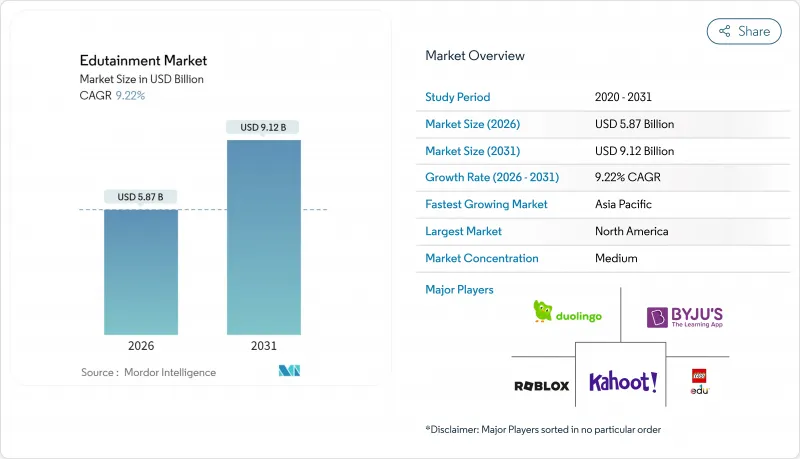
꾸준한 성장은 확립된 플랫폼이 사용자 기반을 강화하는 한편, 5G 및 증강현실(AR)과 같은 신기술이 컨텐츠 전달 방식을 변화시키는 성숙한 시장 환경을 반영합니다. 대화형 제품은 여전히 최대 일일 활성 사용자 수를 유지하지만, 게임 메커니즘과 체계적인 지도를 결합한 하이브리드 형식이 빠르게 확대되고 있습니다. 모바일 앱은 실시간 멀티기업 학습 세션을 가능하게 하는 세계적인 5G 배포를 통해 유통을 지배합니다. 한편 기업 구매 부문은 몰입형 소프트 스킬 향상 모듈에 대한 지출을 확대하고 있습니다. 에듀테인먼트 시장은 아동의 데이터 프라이버시에 대한 규제 감시의 강화에도 영향을 받고 있으며, 참여와 컴플라이언스의 균형을 맞추는 기업이 유리한 지위를 획득합니다. 또한 생성형 AI 제작 도구로 컨텐츠 제작 비용이 낮아치면서 틈새 공급자와 지역 전문 기업의 진입 경로가 넓어지고 있습니다.
세계의 에듀테인먼트 시장의 동향 및 인사이트
5G를 통한 모바일 마이크로 학습의 급성장
초저지연 네트워크는 전통적인 데스크톱 컴퓨터의 처리 능력을 필요로 하는 실시간 공동체험을 가능하게 하고 교육 컨텐츠 전달을 변화시키고 있습니다. 2024년에는 주요 도시권에서의 5G 인프라의 전개가 인구의 85%를 커버하게 되었으며, 몰입형 학습 세션을 제한한 온디맨드 컨텐츠의 버퍼링 지연 현상을 줄였습니다. 이 기술의 영향은 다운로드 속도의 향상에 그치지 않고, 물리 환경에 문맥 정보를 거듭하는 증강현실(AR) 용도를 지원해, 박물관, 소매점포, 옥외 환경에서의 위치 정보 연동형 학습 기회를 창출하고 있습니다. 기업 연수 프로그램에서는 5G 대응 모바일 단말기를 활용한 '저스트 인 타임'형 기술 개발이 확대되고 있습니다. 직원은 별도의 교육 세션이 아니라 실제 업무 수행 중에 절차 지침에 액세스할 수 있습니다. 이 '환경학습' 통합으로의 전환은 예정된 교육 활동에서 일상 업무 흐름에 통합된 지속적인 기술 향상으로 근본적인 전환을 보여줍니다.
게이미피케이션 언어 학습 앱의 급속한 보급
행동심리학 연구에 따르면, 게임 애플리케이션의 변동 보상 일정은 기존 교육 소프트웨어보다 높은 사용자 정착률로 이어집니다. 경쟁 요소와 소셜 기능을 통합한 결과 일일 활성 이용률이 40-60% 증가했습니다. Duolingo의 연속 학습 기록 시스템과 리그 경쟁 기능은 2024년 일일 활성 사용자를 51% 증가시켰고, 게임 디자인 원칙이 초기의 참신한 시기 후에도 장기적인 참여를 유지하는 방법을 입증했습니다. 언어 학습 앱의 성공으로 수학과 과학 교육 분야에서도 유사한 진도 시스템, 달성 배지, 피어 비교 기능의 도입이 진행되는 등, 다른 분야로의 응용 기회가 발생하고 있습니다. 이 참여 패턴은 수익 모델에도 긍정적인 영향을 미치며 지속적인 일일 이용이 무료에서 유료 구독으로 전환율을 향상시키는 동시에 추가 수익원이 되는 인벤토리를 창출하는 데도 기여합니다.
단편화된 커리큘럼 기준이 조달 지연
교육 컨텐츠는 다양한 주, 지방, 국가의 커리큘럼 프레임워크와 적합해야 하며, 지리적 시장 확대에 따라 개발 비용이 지수적으로 증가합니다. 미국에서는 공통 핵심기준 도입의 차이 이외에 50개의 다른 주 교육기준이 존재하는 한편, 유럽연합 국가에서는 27개의 서로 다른 국가 커리큘럼이 실시되어 조화가 어려운 상황에 있습니다. 컨텐츠의 현지화 요구사항은 언어 번역을 넘어 지역 교육 철학을 반영하는 문화적 참조, 역사적 관점 및 교육적 접근을 포함합니다. 이 단편화는 컨텐츠 제작에서의 규모의 경제를 저해하고, 기업은 범용 소재에 의한 광범위한 시장 커버리지, 맞춤 제공에 의한 깊은 시장 침투(확장 가능성이 제한됨)의 선택을 요구받습니다.
부문 분석
대화형 제품은 2025년에 47.05% 시장 점유율을 유지하였으며, 이는 오락 메커니즘과 교육 목표를 융합한 게이미피케이션 학습 체험에 대한 지속적인 수요를 반영합니다. 하이브리드 솔루션은 2031년까지 연평균 복합 성장률(CAGR) 18.11%로 가장 빠른 성장을 보이고 있으며, 컨텐츠 제작자는 대화형 요소와 기존의 지도용 동영상 및 평가 툴을 조합하여 다양한 학습 선호도를 충족하는 노력을 극대화하고 있습니다. 하이브리드 방식은 스크린타임 제한에 관한 교육 기관의 우려에 대응하면서 조심스럽게 균형을 맞춘 컨텐츠 구성으로 게임 기반 학습의 동기 부여 효과를 유지합니다. 비대화형 제품은 커리큘럼 준수를 위해 구조화된 정보 제시가 요구되는 공식 교육 환경에서 여전히 유용하지만, 정적 특성으로 인해 동적 대안에 비해 사용자 참여를 제한합니다.
탐험형 제품은 새로운 기회를 제시하고 있으며, 가상 여행과 시뮬레이션 기반 학습은 물류 제약없이 실제 경험 학습을 추구하는 교육자들 사이에서 받아들여지고 있습니다. COVID-19 팬데믹은 가상 실험실 체험 및 유적 관광 도입을 가속화하고 물리적 제약을 초월하는 몰입형 교육 컨텐츠의 선례를 낳았습니다. 생성형 AI 툴은 서로 다른 상호작용 모드 간의 컨텐츠 적응을 자동화하고 다양한 학습 환경에서 교육적 효과를 유지하면서 제작 비용을 절감함으로써 하이브리드 제품 개발을 점점 뒷받침하고 있습니다.
지역별 분석
북미는 2025년 시점에서 33.10% 시장 점유율을 유지하였으며, 확립된 교육기술 인프라와 직원 교육에 대한 투자를 우선시하는 기업 연수 예산에 뒷받침되고 있습니다. 아시아태평양은 10.21%의 연평균 복합 성장률(CAGR)로 가장 급속한 성장을 보이고 있으며, 정부 주도의 디지털화 시책, 확대하는 중산층 인구, 기존의 컴퓨팅 인프라를 우회하는 모바일 퍼스트 기술 도입 패턴이 성장을 견인하고 있습니다. 유럽 시장에서는 데이터 프라이버시 컴플라이언스와 교육 연구에 의한 실증이 중시되고 진입 장벽은 높아지지만, 엄격한 규제 요건을 충족하는 솔루션에는 프리미엄 가격 설정의 기회도 발생하고 있습니다.
중동 및 아프리카에서는 인터넷 연결 환경 개선과 정부 교육 투자 증가로 새로운 성장 기회가 탄생했습니다. 그러나 경제의 변동성과 인프라 제약으로 인해 단기적인 성장 가능성이 제한됩니다. 남미에서는 세계적인 플랫폼에 의한 스페인어 및 포르투갈어 컨텐츠의 현지화가 진행되고 있는 한편, 지역의 컨텐츠 제작자는 현지의 커리큘럼 요건이나 학습 기호에 맞는 문화적으로 적절한 교재를 개발하고 있습니다. 이 지리적 분포는 시장 규모의 고유한 한계가 아니라 디지털 전환의 단계적 차이를 반영하며, 신흥 경제국의 인프라 정비가 진행됨에 따라 수렴 가능성을 시사합니다.
기타 혜택
- 시장 예측(ME) 엑셀 시트
- 3개월 애널리스트 서포트
자주 묻는 질문
목차
제1장 서론
- 조사 전제조건 및 시장 정의
- 조사 범위
제2장 조사 방법
제3장 주요 요약
제4장 시장 상황
- 시장 개요
- 촉진요인
- 5G 대응 모바일 마이크로러닝의 급성장
- 게이미피케이션형 어학 학습 앱의 급속한 보급
- 정부에 의한 K-12 커리큘럼에서의 STEM 교육 의무화
- 몰입형 소프트 스킬 연수를 위한 기업의 스킬 개발 예산 배정
- 엔터테인먼트 스튜디오에 의한 에듀테인먼트 지적 재산권의 확장
- 생성형 AI 툴에 의한 컨텐츠 제작 비용의 대폭 절감
- 억제요인
- 커리큘럼 기준의 단편화로 조달 지연
- 건강에 미치는 스크린타임의 영향에 대한 우려로 규제 당국의 감시 강화
- 신흥 시장에서의 AR 및 VR 하드웨어의 높은 초기 비용
- 대화형 교육법에 대한 교원 연수 부족
- 가치 및 공급망 분석
- 규제 상황
- 기술 전망
- Porter's Five Forces
- 신규 참가업체의 위협
- 공급자의 협상력
- 구매자의 협상력
- 대체품의 위협
- 경쟁 기업 간 경쟁 관계
제5장 시장 규모 및 성장 예측
- 제품 유형별
- 대화형
- 비대화형
- 하이브리드
- 탐험형
- 최종 용도별 연령층
- 아동
- 십대
- 청소년
- 성인
- 플랫폼별
- 모바일 앱
- PC 및 콘솔
- 웹 기반
- AR 및 VR
- TV 및 스트리밍
- 지역별
- 북미
- 미국
- 캐나다
- 멕시코
- 남미
- 브라질
- 페루
- 칠레
- 아르헨티나
- 기타 남미
- 유럽
- 영국
- 독일
- 프랑스
- 스페인
- 이탈리아
- 베네룩스
- 벨기에
- 네덜란드
- 룩셈부르크
- 북유럽 국가
- 덴마크
- 핀란드
- 아이슬란드
- 노르웨이
- 스웨덴
- 기타 유럽
- 아시아태평양
- 인도
- 중국
- 일본
- 호주
- 한국
- 동남아시아
- 싱가포르
- 말레이시아
- 태국
- 인도네시아
- 베트남
- 필리핀
- 기타 아시아태평양
- 중동 및 아프리카
- 아랍에미리트(UAE)
- 사우디아라비아
- 남아프리카
- 나이지리아
- 기타 중동 및 아프리카
- 북미
제6장 경쟁 구도
- 시장 집중도
- 전략적 동향
- 시장 점유율 분석
- 기업 프로파일
- Duolingo
- BYJU'S
- Kahoot!
- Roblox Corporation
- LEGO Education
- Coursera
- Osmo(Tangible Play)
- Adventure Academy(Age of Learning)
- Code.org
- Prodigy Education
- BBC Bitesize
- Sesame Workshop
- KidZania
- Disney Imagicademy
- Quizizz
- Kahoot DragonBox
- Labster
- Google for Education
- Microsoft Minecraft Education
- GooseChase
제7장 시장 기회 및 미래 전망
CSM 26.01.21The edutainment market was valued at USD 5.37 billion in 2025 and estimated to grow from USD 5.87 billion in 2026 to reach USD 9.12 billion by 2031, at a CAGR of 9.22% during the forecast period (2026-2031).
This measured growth reflects a maturing landscape in which established platforms consolidate user bases while emerging technologies such as 5G and augmented reality transform content delivery. Interactive products continue to attract the largest daily active user pools, yet hybrid formats that meld game mechanics with structured instruction are scaling rapidly. Mobile apps dominate distribution thanks to global 5G roll-outs that enable real-time, multiplayer learning sessions, while corporate purchasers expand spending on immersive soft-skill up-skilling modules. The edutainment market is also shaped by intensifying regulatory scrutiny over children's data privacy, favoring companies that can balance engagement with compliance. Meanwhile, falling content-production costs from generative-AI authoring tools widen entry paths for niche providers and regional specialists.
Global Edutainment Market Trends and Insights
5G-Enabled Mobile Micro-Learning Boom
Ultra-low latency networks transform educational content delivery by enabling real-time collaborative experiences that previously required desktop computing power. 5G infrastructure deployment reached 85% population coverage across major metropolitan areas in 2024, reducing content buffering delays that historically disrupted immersive learning sessions . The technology's impact extends beyond faster downloads to support augmented reality applications that overlay contextual information onto physical environments, creating location-based learning opportunities in museums, retail spaces, and outdoor settings. Corporate training programs increasingly leverage 5G-enabled mobile devices for just-in-time skill development, allowing employees to access procedural guidance during actual work tasks rather than separate training sessions. This shift toward ambient learning integration represents a fundamental departure from scheduled educational activities toward continuous capability enhancement embedded within daily workflows.
Rapid Adoption of Gamified Language-Learning Apps
Behavioral psychology research demonstrates that variable reward schedules in gamified applications generate higher user retention rates than traditional educational software, with daily active usage increasing 40-60% when competitive elements and social features are integrated. Duolingo's streak mechanics and league competitions drove 51% growth in daily active users during 2024, demonstrating how game design principles sustain long-term engagement beyond initial novelty periods . The success of language learning applications creates template opportunities for other subject areas, as mathematics and science educators adopt similar progression systems, achievement badges, and peer comparison features. Revenue models benefit from this engagement pattern, as sustained daily usage increases conversion rates from free to premium subscriptions while generating advertising inventory for supplementary monetization streams.
Fragmented Curriculum Standards Slowing Procurement
Educational content must align with diverse state, provincial, and national curriculum frameworks, creating development costs that scale exponentially with geographic market expansion. The United States maintains 50 different state education standards alongside Common Core adoption variations, while European Union countries implement 27 distinct national curricula that resist harmonization efforts. Content localization requirements extend beyond language translation to encompass cultural references, historical perspectives, and pedagogical approaches that reflect regional educational philosophies. This fragmentation prevents economies of scale in content production and forces companies to choose between broad market coverage with generic materials or deep market penetration with customized offerings that limit scalability potential.
Other drivers and restraints analyzed in the detailed report include:
- Government STEM Mandates in K-12 Curricula
- Corporate Up-Skilling Budgets for Immersive Soft-Skills
- High Upfront AR/VR Hardware Costs in Emerging Markets
For complete list of drivers and restraints, kindly check the Table Of Contents.
Segment Analysis
Interactive products maintain a 47.05% market share in 2025, reflecting sustained demand for gamified learning experiences that combine entertainment mechanics with educational objectives. Hybrid solutions demonstrate the fastest growth at 18.11% CAGR through 2031, as content creators blend interactive elements with traditional instructional videos and assessment tools to maximize engagement across diverse learning preferences. The hybrid approach addresses institutional concerns about screen time limitations while preserving the motivational benefits of game-based learning through carefully balanced content portfolios. Non-interactive products retain relevance in formal educational settings where curriculum compliance requires structured presentation of information, though their static nature limits user engagement compared to dynamic alternatives.
Explorative products represent emerging opportunities as virtual field trips and simulation-based learning gain acceptance among educators seeking authentic experiential learning without logistical constraints. The COVID-19 pandemic accelerated the adoption of virtual laboratory experiences and historical site tours, creating precedents for immersive educational content that transcends physical limitations. Generative AI tools increasingly support hybrid product development by automating content adaptation across different interaction modes, reducing production costs while maintaining pedagogical effectiveness across varied learning contexts.
The Edutainment Market Report is Segmented by Product Type (Interactive, Non-Interactive, Hybrid, Explorative), End-Use Age Group (Children, Teenagers, Young Adults, Adults), Platform (Mobile Apps, PC/Console, Web-Based, AR/VR, TV/Streaming), and Geography (North America, South America, Europe, Asia-Pacific, Middle East and Africa). The Market Forecasts are Provided in Terms of Value (USD).
Geography Analysis
North America maintains 33.10% market share in 2025, supported by established educational technology infrastructure and corporate training budgets that prioritize employee development investments. Asia-Pacific demonstrates the fastest regional growth at 10.21% CAGR, driven by government digitization initiatives, expanding middle-class populations, and mobile-first technology adoption patterns that bypass traditional computing infrastructure. European markets emphasize data privacy compliance and pedagogical research validation, creating higher barriers to entry but also premium pricing opportunities for solutions that meet stringent regulatory requirements.
Middle East and Africa represent emerging opportunities as internet connectivity improves and government education investments increase, though economic volatility and infrastructure limitations constrain near-term growth potential. South America benefits from Spanish and Portuguese language content localization efforts by global platforms, while regional content creators develop culturally relevant educational materials that address local curriculum requirements and learning preferences. The geographic distribution reflects varying stages of digital transformation rather than inherent market size limitations, suggesting convergence potential as infrastructure development progresses across emerging economies.
- Duolingo
- BYJU'S
- Kahoot!
- Roblox Corporation
- LEGO Education
- Coursera
- Osmo (Tangible Play)
- Adventure Academy (Age of Learning)
- Code.org
- Prodigy Education
- BBC Bitesize
- Sesame Workshop
- KidZania
- Disney Imagicademy
- Quizizz
- Kahoot DragonBox
- Labster
- Google for Education
- Microsoft Minecraft Education
- GooseChase
Additional Benefits:
- The market estimate (ME) sheet in Excel format
- 3 months of analyst support
TABLE OF CONTENTS
1 Introduction
- 1.1 Study Assumptions & Market Definition
- 1.2 Scope of the Study
2 Research Methodology
3 Executive Summary
4 Market Landscape
- 4.1 Market Overview
- 4.2 Market Drivers
- 4.2.1 5G-enabled mobile micro-learning boom
- 4.2.2 Rapid adoption of gamified language-learning apps
- 4.2.3 Government STEM mandates in K-12 curricula
- 4.2.4 Corporate up-skilling budgets for immersive soft-skills
- 4.2.5 Edutainment IP extensions by global entertainment studios
- 4.2.6 Generative-AI tools slashing content-production costs
- 4.3 Market Restraints
- 4.3.1 Fragmented curriculum standards slowing procurement
- 4.3.2 Screen-time health concerns prompting regulatory scrutiny
- 4.3.3 High upfront AR/VR hardware costs in emerging markets
- 4.3.4 Teacher training gaps for interactive pedagogy
- 4.4 Value / Supply-Chain Analysis
- 4.5 Regulatory Landscape
- 4.6 Technological Outlook
- 4.7 Porter's Five Forces
- 4.7.1 Threat of New Entrants
- 4.7.2 Bargaining Power of Suppliers
- 4.7.3 Bargaining Power of Buyers
- 4.7.4 Threat of Substitute Products
- 4.7.5 Competitive Rivalry
5 Market Size & Growth Forecasts
- 5.1 By Product Type
- 5.1.1 Interactive
- 5.1.2 Non-Interactive
- 5.1.3 Hybrid
- 5.1.4 Explorative
- 5.2 By End-Use Age Group
- 5.2.1 Children
- 5.2.2 Teenagers
- 5.2.3 Young Adults
- 5.2.4 Adults
- 5.3 By Platform
- 5.3.1 Mobile Apps
- 5.3.2 PC / Console
- 5.3.3 Web-based
- 5.3.4 AR / VR
- 5.3.5 TV / Streaming
- 5.4 By Geography
- 5.4.1 North America
- 5.4.1.1 United States
- 5.4.1.2 Canada
- 5.4.1.3 Mexico
- 5.4.2 South America
- 5.4.2.1 Brazil
- 5.4.2.2 Peru
- 5.4.2.3 Chile
- 5.4.2.4 Argentina
- 5.4.2.5 Rest of South America
- 5.4.3 Europe
- 5.4.3.1 United Kingdom
- 5.4.3.2 Germany
- 5.4.3.3 France
- 5.4.3.4 Spain
- 5.4.3.5 Italy
- 5.4.3.6 BENELUX
- 5.4.3.6.1 Belgium
- 5.4.3.6.2 Netherlands
- 5.4.3.6.3 Luxembourg
- 5.4.3.7 NORDICS
- 5.4.3.7.1 Denmark
- 5.4.3.7.2 Finland
- 5.4.3.7.3 Iceland
- 5.4.3.7.4 Norway
- 5.4.3.7.5 Sweden
- 5.4.3.8 Rest of Europe
- 5.4.4 Asia-Pacific
- 5.4.4.1 India
- 5.4.4.2 China
- 5.4.4.3 Japan
- 5.4.4.4 Australia
- 5.4.4.5 South Korea
- 5.4.4.6 South East Asia
- 5.4.4.6.1 Singapore
- 5.4.4.6.2 Malaysia
- 5.4.4.6.3 Thailand
- 5.4.4.6.4 Indonesia
- 5.4.4.6.5 Vietnam
- 5.4.4.6.6 Philippines
- 5.4.4.7 Rest of Asia-Pacific
- 5.4.5 Middle East and Africa
- 5.4.5.1 United Arab Emirates
- 5.4.5.2 Saudi Arabia
- 5.4.5.3 South Africa
- 5.4.5.4 Nigeria
- 5.4.5.5 Rest of Middle East and Africa
- 5.4.1 North America
6 Competitive Landscape
- 6.1 Market Concentration
- 6.2 Strategic Moves
- 6.3 Market Share Analysis
- 6.4 Company Profiles (includes Global level Overview, Market level overview, Core Segments, Financials as available, Strategic Information, Market Rank/Share for key companies, Products & Services, and Recent Developments)
- 6.4.1 Duolingo
- 6.4.2 BYJU'S
- 6.4.3 Kahoot!
- 6.4.4 Roblox Corporation
- 6.4.5 LEGO Education
- 6.4.6 Coursera
- 6.4.7 Osmo (Tangible Play)
- 6.4.8 Adventure Academy (Age of Learning)
- 6.4.9 Code.org
- 6.4.10 Prodigy Education
- 6.4.11 BBC Bitesize
- 6.4.12 Sesame Workshop
- 6.4.13 KidZania
- 6.4.14 Disney Imagicademy
- 6.4.15 Quizizz
- 6.4.16 Kahoot DragonBox
- 6.4.17 Labster
- 6.4.18 Google for Education
- 6.4.19 Microsoft Minecraft Education
- 6.4.20 GooseChase
7 Market Opportunities & Future Outlook
- 7.1 AI-generated adaptive story-worlds for language immersion
- 7.2 Location-based XR learning arcs in shopping-mall FECs