|
시장보고서
상품코드
1906281
인도의 의료기기 시장 : 점유율 분석, 업계 동향 및 통계, 성장 예측(2026-2031년)India Medical Devices - Market Share Analysis, Industry Trends & Statistics, Growth Forecasts (2026 - 2031) |
||||||
 Mordor Intelligence
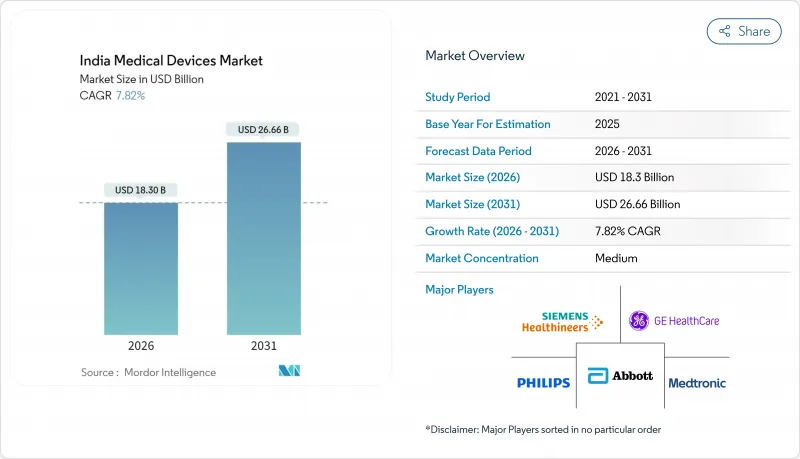
인도의 의료기기 시장은 2025년 169억 7,000만 달러로 평가되었고, 2026년 183억 달러에서 2031년까지 266억 6,000만 달러에 이를 것으로 예측됩니다.
예측기간(2026-2031년) 동안의 CAGR은 7.82%로 전망되고 있습니다.
견고한 정책 지원, 만성 질환 유병률에 대한 인구 역학 변화, 민간 부문의 투자가 성장 궤도를 뒷받침하는 핵심 요소입니다. 국내 제조 인센티브에 의해 인도의 수입 의존도(기존 80-85%)는 서서히 저하되고 있는 한편, 비용 효율적인 기술을 활용한 의료 환경에 대한 수요가 기존 기기와 커넥티드 기기 모두에 대한 고객 기반을 확대하고 있습니다. 지역별 성장 패턴에는 편차가 있습니다. 수익 측면에서 남인도는 주도적 입장에 있는 반면 동인도와 북동인도는 가장 빠르게 성장하고 있으며 인프라 정비의 진전이 인도의 의료기기 시장의 잠재적 성장 영역을 재정의하고 있음을 보여줍니다. 경쟁의 격렬함은 여전히 높은 수준에 있으며, 단편화된 애프터서비스 체제나 예측 곤란한 승인 프로세스가 일부 제조업체를 동남아시아 지역으로 유도하는 한편, 생산 연동형 장려금(PLI) 제도가 인도 국내에 새로운 투자를 유치하는 움직임도 나타나고 있습니다.
인도의 의료기기 시장의 동향 및 인사이트
만성 질환 및 생활 습관병 증가 추세
비감염성 질환은 현재 인도의 질병 부담의 대부분을 차지하고 있으며, 장기적인 상태를 검출, 모니터링, 치료하기 위한 첨단 장비에 대한 지속적인 수요를 창출하고 있습니다. 당뇨병 환자 수는 2025년 7,700만 명에서 2045년까지 1억 3,420만 명으로 급증할 것으로 예측되고 있으며, 혈당 모니터, 인슐린 펌프, 원격 텔레메트리 솔루션에 대한 수요를 확대하고 있습니다. 마찬가지로 심혈관 질환의 발생률도 증가하고 있으며, 고처리량 진단 영상 시스템과 인터벤셔널 심장병 제품의 도입 확대가 촉진되고 있습니다. 비활동적인 생활 습관과 식생활의 변화를 특징으로 하는 도시형 라이프스타일은 비만, 고혈압 및 관련 합병증을 가속화하고 있으며, 모두 병원 밖에서 지속적인 생명 징후를 추적해야 합니다. 동시에, 고령화가 진행됨으로써 치료 사이클이 장기화해, 내구성이 뛰어난 재택 치료기기의 상업적인 매력이 높아지고 있습니다. 이러한 추세가 더하여 인도의 의료기기 시장의 성장 궤도는 일반적인 의료 지출 사이클을 훨씬 넘어서 인도의 의료기기 시장에서 보다 광범위한 기세를 강화하고 있습니다.
정부의 생산 연동형 장려 제도(PLI)
PLI 제도는 2020-21년도부터 2027-28년도에 걸쳐 의료기기용으로 3,420캐롤 루피를 할당하여 32개의 승인 프로젝트를 뒷받침하고 있습니다. 이로 인해 39개 기기 부문에서 국내 제조에 총 14조 6,000억 루피의 투자가 발생합니다. 13개의 신규 그린필드 공장에서는 이미 MRI나 CT 시스템과 같은 복잡한 제품을 생산하고 있으며, 이들은 기존에는 완전 수입품이었지만, 통화 변동이나 지정학적 긴장에 의한 공급망 리스크가 줄어들고 있습니다. 본 프로그램에 근거한 기술 이전 계약에 의해 고부가가치 부품의 현지화가 진행되고, 인도의 바이어용 리드 타임이 단축됨과 동시에 선진 제조 분야에서의 국내 인재 기반이 확대되고 있습니다. 비용 절감 효과가 병원 그룹의 구매 예산에 반영됨에 따라 조달 정책은 '메이드 인 인디아'제품을 점점 우선시하고 있으며 인도의 의료기기 시장 전체에서 국산 브랜드의 침투가 가속화되고 있습니다.
엄격한 규제 승인 일정
중앙의약품 표준관리기구(CDSCO)에 의한 클래스C 및 클래스D 의료기기의 심사는 최장 12개월을 필요로 하는 경우가 있으며, 발매 시기의 불확실성이 중소 혁신기업을 망설이게 하는 요인이 되고 있습니다. 장기간 조회 및 추가 서류 요청으로 컴플라이언스 비용이 증가하고 일부 제조업체는 승인이 신속한 베트남 및 말레이시아로 최종 조립 부문을 이전합니다. 디지털화 시책에 의해 신청 효율화가 도모되고 있지만, 현재의 지연이 시장 투입 속도를 제약하여 자본 회전을 둔화시키고 있기 때문에 인도의 의료기기 시장의 단기적인 성장은 억제되고 있습니다.
부문 분석
치료기기는 2025년 수익의 35.21%를 차지하였으며 이는 인도의 치료 중심 의료 모델을 반영합니다. 병원에서는 자본 예산을 즉시 개입을 허용하는 장비에 우선적으로 배분하는 경향이 있습니다. 수익 집중은 예방적 스크리닝보다 치료 연동형 청구를 선호하는 환급 관행과 일치합니다. 대조적으로, 만성 질환 부담에 대한 대응으로 원격 환자 관리 프로그램이 확대되는 가운데, 모니터링 장비는 8.18%의 연평균 복합 성장률(CAGR)을 나타낼 전망입니다. 진단용 영상기기는 안정적인 상승을 유지하고 있으며, 이는 대도시권 이외에도 다기능 방사선과 설비를 제공하는 민간 병원 간의 경쟁을 반영하고 있습니다.
인도의 의료기기 시장에서의 치료기기의 주도권은 고부가가치 수입품에서 생산 연동형 보조금 제도(PLI) 하에서 국내 생산으로의 이행이 진행되는 파이프라인에 달려 있습니다. AIIMS에서 개발된 국산 MRI 프로토타입 기계는 산학 협력이 수입 지출을 국내 공급업체로 회귀시킬 가능성을 시사합니다. 한편, 치과나 내시경 검사 등의 틈새 분야에서는 보험 적용 범위의 확대나 전문 의료를 요구하는 의료 관광의 유입을 배경으로 소규모이면서도 꾸준한 도입이 진행되고 있습니다.
비용 효율적인 전기기계식 및 일회용 기기는 2025년 매출의 61.88%를 차지하였으며, 이는 병원이 신뢰성과 낮은 유지보수성을 우선시하고 있음을 보여줍니다. 그러나 외과 부문이 정밀도 향상을 목표로 하는 가운데, 증강현실 및 가상현실 트레이닝 시뮬레이터나 수술 중 오버레이는 CAGR 9.92%로 급속히 확대하고 있습니다. 웨어러블 장치와 원격 센서는 모니터링을 환자의 집으로 옮기는 만성 질환 관리 경로에 적합하며, 연결된 장치의 보급이 인도의 의료기기 시장에 더욱 침투하고 있습니다.
로봇 수술 시스템은 지역 암센터 등 공립병원이 주력 기종을 도입함으로써 가속화하는 하이엔드 기술의 도입을 상징하고 있습니다. 아유쉬만 바라트 디지털 목표에 의해 지원되는 원격 의료 플랫폼의 병렬 성장은 m-Health 주변기기의 대응 가능한 엔드포인트를 확대합니다. 3D 프린팅 임플란트와 나노기술은 여전히 초기 단계이지만, 정형외과 외상 분야에서의 파일럿 연구는 장기적인 파괴적 잠재력을 시사합니다.
기타 혜택
- 시장 예측(ME) 엑셀 시트
- 3개월 애널리스트 서포트
자주 묻는 질문
목차
제1장 서론
- 조사 전제조건 및 시장 정의
- 조사 범위
제2장 조사 방법
제3장 주요 요약
제4장 시장 상황
- 시장 개요
- 촉진요인
- 만성 질환 및 생활 습관병 증가 추세
- 정부의 생산 연동형 인센티브 제도
- 민간 병원 네트워크의 확대
- 국내 의료 기술 스타트업에 의한 저비용 기술 혁신의 활용
- 신종 코로나바이러스 감염증 종식 후 재택 진단 검사 수요 급증
- 의료 관광에서 하이엔드 의료기기에 대한 수요 증가
- 억제요인
- 엄격한 규제 승인 스케줄
- 스텐트 및 임플란트에 대한 가격 상한 규제
- 인도 국내에서의 부품 공급체인의 제약
- 분단된 애프터서비스 체제
- 공급망 분석
- 규제 상황
- 기술 전망
- Porter's Five Forces 분석
- 신규 참가업체의 위협
- 구매자의 협상력
- 공급자의 협상력
- 대체품의 위협
- 경쟁 기업 간 경쟁 관계
제5장 시장 세분화
- 기기 유형별
- 진단용 영상기기
- 치료기기
- 외과수술용 의료기기
- 모니터링 기기
- 체외 진단 기기
- 보조구 및 이동 보조구
- 치과용 기기
- 내시경 장치
- 기타 기기
- 기술 플랫폼별
- 기존 전기기계식 및 일회용 디바이스
- 웨어러블 및 원격 모니터링
- 원격 의료 및 m-Health
- 로봇 수술
- 3D 프린팅
- 증강현실 및 가상현실(AR 및 VR)
- 나노기술
- 기타
- 치료 용도별
- 심장병학
- 정형외과
- 신경학
- 안과
- 일반 외과
- 기타
- 최종 사용자별
- 병원
- 진료소
- 재택 의료 환경
- 기타 최종 사용자
- 지역별
- 북인도
- 남인도
- 서인도 및 중앙인도
- 동인도 및 동북인도
제6장 경쟁 구도
- 시장 집중도
- 시장 점유율 분석
- 기업 프로파일
- Abbott Laboratories
- Allengers Medical Systems
- Boston Scientific Corporation
- BPL Medical Technologies
- Cardinal Health
- F. Hoffmann-La Roche Ltd.
- GE Healthcare
- Hindustan Syringes & Medical Devices
- Johnson & Johnson
- Koninklijke Philips NV
- Medtronic plc
- Omron Corporation
- Opto Circuits(India) Ltd.
- Poly Medicure Ltd.
- Sahajanand Medical Technologies
- Siemens Healthineers
- Smith & Nephew
- Solventum Corporation
- Stryker Corporation
- Trivitron Healthcare
제7장 시장 기회 및 미래 전망
CSM 26.01.21The India Medical Devices Market was valued at USD 16.97 billion in 2025 and estimated to grow from USD 18.3 billion in 2026 to reach USD 26.66 billion by 2031, at a CAGR of 7.82% during the forecast period (2026-2031).
Robust policy support, the country's demographic shift toward chronic-disease prevalence, and private-sector investments are the central forces sustaining this trajectory. Domestic manufacturing incentives are gradually lowering India's historic 80-85% import dependence, while demand for cost-effective, technology-enabled care settings is broadening the customer base for both conventional and connected devices. Regional growth patterns are uneven: South India leads by revenue, yet East & North-East India grows fastest, showing how infrastructure roll-outs are redefining addressable pockets of the India medical devices market. Competitive intensity remains high because fragmented after-sales ecosystems and unpredictable approval timelines are nudging some producers toward Southeast Asian locations, even as the Production-Linked Incentive (PLI) scheme lures fresh investments back to Indian soil.
India Medical Devices Market Trends and Insights
Rising Prevalence of Chronic & Lifestyle Diseases
Non-communicable disorders now dominate India's disease burden, creating a continuous pull for sophisticated equipment to detect, monitor, and treat long-term conditions. Diabetes cases are projected to jump from 77 million in 2025 to 134.2 million by 2045, magnifying demand for glucose monitors, insulin pumps, and remote telemetry solutions. Incidence of cardiovascular conditions is likewise increasing, encouraging wider deployment of high-throughput diagnostic imaging systems and interventional cardiology products. Urban lifestyles-marked by sedentary habits and dietary shifts-are accelerating obesity, hypertension, and related morbidities, all of which call for continuous vital-sign tracking outside hospital walls. At the same time, an aging demographic is lengthening care cycles, making durable home-care devices commercially attractive. These trends collectively extend the growth runway for the India medical devices market well past typical health-spending cycles, reinforcing broader momentum in the india medical devices market.
Government Production-Linked Incentive Scheme
The PLI scheme earmarks INR 3,420 crore for medical devices from 2020-21 to 2027-28, supporting 32 approved projects that collectively bring INR 1.46 lakh crore investment into local manufacturing of 39 device categories. Thirteen new greenfield plants already produce complex products such as MRI and CT systems, once fully imported, reducing supply-chain risk from currency swings and geopolitical tensions. Technology transfer agreements under the program are localizing high-value components, shrinking lead times for Indian buyers and widening the domestic talent base in advanced manufacturing. As cost savings flow through purchasing budgets of hospital groups, procurement policies increasingly favor "Made in India" offerings, accelerating penetration for homegrown brands across the India medical devices market.
Stringent Regulatory Approval Timelines
Central Drugs Standard Control Organisation (CDSCO) reviews for Class C and Class D devices can extend to 12 months, introducing launch uncertainty that deters smaller innovators. Lengthy queries and additional dossier requests inflate compliance costs, prompting certain manufacturers to shift final assembly to Vietnam or Malaysia, where approvals are faster. While digitization initiatives aim to streamline filings, the current lag constrains speed-to-market and slows capital rotation, clipping near-term growth of the India medical devices market.
Other drivers and restraints analyzed in the detailed report include:
- Expansion of Private Hospital Networks
- Domestic Med-Tech Start-Ups Leveraging Frugal Innovation
- Price-Cap Regulations on Stents & Implants
For complete list of drivers and restraints, kindly check the Table Of Contents.
Segment Analysis
Therapeutic devices generated 35.21% of 2025 revenue, emphasizing India's treatment-oriented care model, where hospitals direct capital budgets toward devices that deliver immediate interventions. Revenue concentration aligns with reimbursement practices that favor procedure-linked billing over preventive screening. Monitoring devices, in contrast, post an 8.18% CAGR as remote patient management programs expand in response to chronic disease loads. Diagnostic imaging maintains a stable uptick, reflecting private-hospital competition to offer multi-modality radiology suites beyond metros.
The leadership of therapeutic devices in the India medical devices market hinges on a pipeline of high-end imports gradually giving way to local production under PLI. Indigenous MRI prototypes developed at AIIMS illustrate how academic-industry collaboration can repatriate spending from imports to domestic suppliers. Meanwhile, niche areas like dental and endoscopy continue steady but smaller-scale adoption, aided by rising insurance coverage and medical tourism inflows seeking specialty services.
Cost-effective electro-mechanical and disposable devices account for 61.88% of 2025 sales, highlighting hospitals' prioritization of reliability and low maintenance. Yet augmented/virtual-reality training simulators and intra-operative overlays are scaling quickly at 9.92% CAGR as surgical departments aim for higher precision. Wearables and remote sensors resonate with chronic-care pathways that shift monitoring to patients' homes, pushing connected-device penetration deeper into the India medical devices market.
Robotic surgery systems exemplify premium-tech adoption that accelerates when public hospitals like the Regional Cancer Centre install flagship units. Parallel growth in tele-health platforms, supported by the Ayushman Bharat Digital Mission, expands addressable endpoints for mHealth peripherals. Although 3D-printed implants and nanotech remain embryonic, research pilots in orthopedic trauma indicate long-term disruptive potential.
The India Medical Devices Market Report is Segmented by Device Type (Diagnostic Imaging, Therapeutic, and More), Technology Platform (Conventional Electro-Mechanical & Disposable, Wearable & Remote Monitoring, and More), Therapeutic Application (Cardiology, Orthopedics, and More), End-User (Hospitals, Clinics, and More), and Geography (North India, South India, and More). The Market Forecasts are Provided in Terms of Value (USD).
List of Companies Covered in this Report:
- Abbott Laboratories
- Allengers Medical Systems
- Boston Scientific
- BPL
- Cardinal Health
- Roche
- GE Healthcare
- Hindustan Syringes & Medical Devices
- Johnson & Johnson
- Koninklijke Philips
- Medtronic
- OMRON
- Opto Circuits (India) Ltd.
- Poly Medicure Ltd.
- Sahajanand Medical Technologies
- Siemens Healthineers
- Smiths Group
- Solventum Corporation
- Stryker
- Trivitron Healthcare
Additional Benefits:
- The market estimate (ME) sheet in Excel format
- 3 months of analyst support
TABLE OF CONTENTS
1 Introduction
- 1.1 Study Assumptions & Market Definition
- 1.2 Scope of the Study
2 Research Methodology
3 Executive Summary
4 Market Landscape
- 4.1 Market Overview
- 4.2 Market Drivers
- 4.2.1 Rising Prevalence of Chronic & Lifestyle Diseases
- 4.2.2 Government Production-Linked Incentive Scheme
- 4.2.3 Expansion of Private Hospital Networks
- 4.2.4 Domestic Med-Tech Start-Ups Leveraging Frugal Innovation
- 4.2.5 Surge in Home-Based Diagnostic Testing Demand Post-Covid
- 4.2.6 Growing Medical Tourism Demand for High-End Devices
- 4.3 Market Restraints
- 4.3.1 Stringent Regulatory Approval Timelines
- 4.3.2 Price-Cap Regulations on Stents & Implants
- 4.3.3 Limited Component-Level Supply Chain within India
- 4.3.4 Fragmented After-Sales Service Infrastructure
- 4.4 Supply Chain Analysis
- 4.5 Regulatory Landscape
- 4.6 Technological Outlook
- 4.7 Porter's Five Forces Analysis
- 4.7.1 Threat of New Entrants
- 4.7.2 Bargaining Power of Buyers
- 4.7.3 Bargaining Power of Suppliers
- 4.7.4 Threat of Substitutes
- 4.7.5 Competitive Rivalry
5 Market Segmentation (Value)
- 5.1 By Device Type
- 5.1.1 Diagnostic Imaging Devices
- 5.1.2 Therapeutic Devices
- 5.1.3 Surgical Devices
- 5.1.4 Monitoring Devices
- 5.1.5 In-Vitro Diagnostics
- 5.1.6 Assistive & Mobility Aids
- 5.1.7 Dental Devices
- 5.1.8 Endoscopy Devices
- 5.1.9 Other Devices
- 5.2 By Technology Platform
- 5.2.1 Conventional Electro-mechanical & Disposable Devices
- 5.2.2 Wearable & Remote Monitoring
- 5.2.3 Telehealth & mHealth
- 5.2.4 Robotic Surgery
- 5.2.5 3D Printing
- 5.2.6 Augmented / Virtual Reality (AR / VR)
- 5.2.7 Nanotechnology
- 5.2.8 Others
- 5.3 By Therapeutic Application
- 5.3.1 Cardiology
- 5.3.2 Orthopedics
- 5.3.3 Neurology
- 5.3.4 Ophthalmology
- 5.3.5 General Surgery
- 5.3.6 Others
- 5.4 By End-User
- 5.4.1 Hospitals
- 5.4.2 Clinics
- 5.4.3 Home-Care Settings
- 5.4.4 Other End-Users
- 5.5 By Region
- 5.5.1 North India
- 5.5.2 South India
- 5.5.3 West & Central India
- 5.5.4 East & North-East India
6 Competitive Landscape
- 6.1 Market Concentration
- 6.2 Market Share Analysis
- 6.3 Company Profiles (includes Global level Overview, Market level overview, Core Segments, Financials as available, Strategic Information, Market Rank/Share for key companies, Products & Services, and Recent Developments)
- 6.3.1 Abbott Laboratories
- 6.3.2 Allengers Medical Systems
- 6.3.3 Boston Scientific Corporation
- 6.3.4 BPL Medical Technologies
- 6.3.5 Cardinal Health
- 6.3.6 F. Hoffmann-La Roche Ltd.
- 6.3.7 GE Healthcare
- 6.3.8 Hindustan Syringes & Medical Devices
- 6.3.9 Johnson & Johnson
- 6.3.10 Koninklijke Philips N.V.
- 6.3.11 Medtronic plc
- 6.3.12 Omron Corporation
- 6.3.13 Opto Circuits (India) Ltd.
- 6.3.14 Poly Medicure Ltd.
- 6.3.15 Sahajanand Medical Technologies
- 6.3.16 Siemens Healthineers
- 6.3.17 Smith & Nephew
- 6.3.18 Solventum Corporation
- 6.3.19 Stryker Corporation
- 6.3.20 Trivitron Healthcare
7 Market Opportunities & Future Outlook
- 7.1 White-space & Unmet-Need Assessment