
|
시장보고서
상품코드
1906988
북미의 작물 보호 화학제품 : 시장 점유율 분석, 업계 동향, 통계, 성장 예측(2026-2031년)North America Crop Protection Chemicals - Market Share Analysis, Industry Trends & Statistics, Growth Forecasts (2026 - 2031) |
||||||
 Mordor Intelligence
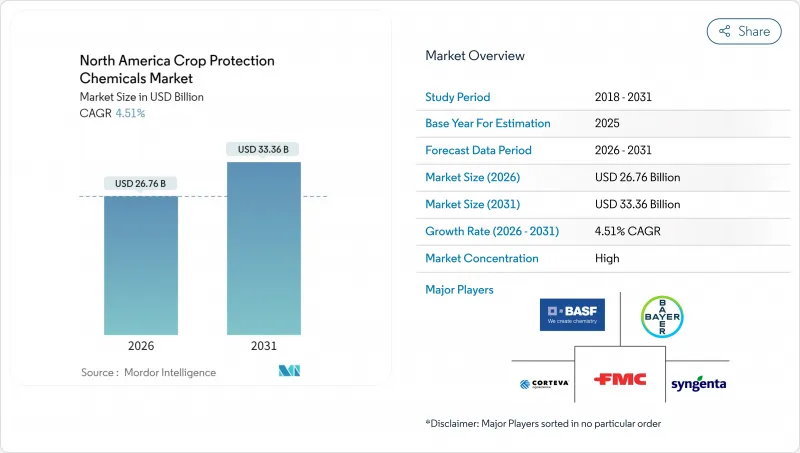
북미의 작물 보호 화학제품 시장 규모는 2026년 267억 6,000만 달러로 추정되며, 2025년 256억 달러에서 성장할 것으로 예상됩니다.
2031년 예측은 333억 6,000만 달러에 이르고, 2026년부터 2031년까지 연평균 복합 성장률(CAGR) 4.51%를 나타낼 전망입니다.
잡초의 내성화, 진균병의 급증, 저위험 활성 성분에 대한 규제상의 선호 확대가 화학약품 수요를 뒷받침하고 있습니다. 한편, 정밀 농업 도구에 의한 낭비의 삭감이 진행되고 있습니다. 생산자들은 광대한 농지에서의 효율성으로 인해 합성 제초제를 여전히 선호하고 있지만, 미국 환경보호청(EPA)의 신속 승인 프로세스로 생물학적 및 생물학적 합리성을 바탕으로 한 제품이 급속히 확대되고 있습니다. 이 지역의 대규모 곡물 생산기반, 미국·멕시코·캐나다 협정(USMCA)에 근거한 안정된 수출 루트, 보전 경작에 대한 탄소 크레딧 우대 조치 등이, 기존 화학물질을 둘러싼 소송에도 불구하고 지출을 지속시키고 있습니다. 주요 기업이 종자·화학제품·디지털농학을 통합하여 고객 점유율을 획득하는 동시에 엄격화하는 잔류기준치에 대한 대응을 진행하는 가운데 경쟁의 치열함은 여전히 높은 수준에 있습니다.
북미의 작물 보호 화학제품 시장 동향과 인사이트
제초제 내성 형질의 채용 가속
제초제 내성 대두의 채용률은 주요 생산지역에서 95%를 넘고, 옥수수는 89%에 달했습니다. 이러한 형질은 보다 넓은 발아 후처리의 적용 기간을 가능하게 하고, 계절적인 제초제 사용량을 증가시키면서 윤작의 유연성을 확대합니다. 글리포세이트 내성 잡초(팔머 아마란서스 등)가 심각화하는 가운데, EPA에 의한 디캄바 및 2,4-D 기반의 플랫폼 인가는 새로운 작용기전을 가져왔습니다. 코르테바의 엔리스트 E3와 바이엘의 익스텐드 플렉스와 같은 복합 기술은 프리미엄 가격의 형성을 촉진하고 화학제품과 종자의 번들 패키지를 뒷받침하고 있습니다. 통합된 가변성 분산 기술은 지역별 용량을 최적화하고 이러한 특성을 현대 농학에 추가로 정착시킵니다. 유전자 기술과 정밀 장비의 시너지 효과로 인해 제네릭 제품의 가격 압력에도 불구하고 선택성 제초제에 대한 수요가 지속되고 있습니다.
정밀 분산 장치로 에이커 당 비용 절감
존디어사의 'See and Spray' 시연시험에서 알 수 있듯이, 컴퓨터 비전이 탑재된 살포기는 잡초를 개별적으로 식별하고 방제 효과를 유지하면서 약 사용량을 최대 77% 절감합니다. 미국 농무부(USDA)의 FARMER 보조금에 의한 공적 지원은 설비 비용을 상쇄함으로써 보급을 가속화하고 있습니다. 탑재 센서가 살포량을 실시간으로 조정하고, 중복 살포나 드리프트를 최소한으로 억제함으로써 투입 비용을 삭감하는 것과 동시에, 대상외로의 이동에 관한 규제 당국의 감시에도 대응합니다. 보충 작업 시간 단축과 노동력 절감은 수천 에이커를 관리하는 대규모 농장의 운영 효율성을 향상시킵니다. 장비 대리점은 현재 데이터 분석 서비스 구독을 번들로 제공하고 있으며 생산자가 절약 효과를 확인할 수 있으므로 호환되는 약물의 지속적인 구매를 촉진하고 있습니다.
캐나다에서 제안한 잔류 기준치(MRL) 인하가 수출 제한
캐나다 보건부는 해외 구매자가 엄격한 기준을 채택한 경우 수출 위험이 발생하는 농산물에 대해 2,4-D 등 여러 유효성분의 MRL(최대 잔류 기준치)을 반감시킬 것을 제안하고 있습니다. 기준 차이로 인해 생산자는 최소 기준을 충족해야 하며 분석 시험 비용이 증가하고 잔류량이 적은 농약으로의 전환이 촉진됩니다. 수출 의존도가 높은 브리티시컬럼비아주 및 온타리오주 생산자는 출하기간 단축화와 컴플라이언스 문서 증가를 전망하고 있습니다. 화학제조업체는 잔류연구 및 표시수정에 추가예산을 할당하고 있으며 신제품 투자회수기간이 장기화될 전망입니다.
부문 분석
제초제는 2025년 북미의 작물 보호 화학제품 시장 수익의 51.65%를 차지했습니다. 이는 1억 8,000만 에이커에 달하는 옥수수와 콩밭에서 화학적 잡초 방제에 대한 광범위한 의존을 반영합니다. 정밀 살포 기술과 형질 구동형 선택성은 생육 기간을 통한 수율 잠재력을 보호하는 발아 후처리 제품에 대한 생산자의 지속적인 선호를 지원하고 있습니다. 저항성 관리에는 복수의 작용기전이 필요하고, 보전경작에 의한 제초제 사용량 증가도 함께, 본 부문은 2031년까지 연평균 복합 성장률(CAGR)4.88%를 나타낼 것으로 예측됩니다. 동시에 타르반병이나 대두녹슬병의 발생 지역 확대에 의해 살균제의 사용이 가속화되어 전체적인 지출의 다양화가 진행되고 있습니다. 살충제는 생물학적 경쟁 제품과 꽃가루 매개자 보호 규제의 강화에 의한 압력에 직면하고 있지만, 서부 옥수수 뿌리의 산발적 발생에 대한 통합 방제 프로그램에서 여전히 필수적입니다.
특히 잔류 기준치가 부과되는 과수·야채 재배 면적에 있어서, 스택 가능한 생물학적 제초제로의 이행이 진행되고 있습니다. 주요기업은 합성활성성분과 미생물활성성분을 조합한 마이크로캡슐제제를 출시하여 환경기준을 충족하면서 효과 지속기간을 연장하고 있습니다. 제품 관리 이니셔티브에서는 저항성 발생 억제를 위해 화학물질의 로테이션이나 피복 작물의 도입에 대해 생산자에게 계발 활동을 실시중입니다. 이러한 동향이 함께 제초제는 전반적인 약제 구성이 변화하는 가운데 시장의 요지로 자리를 유지하고 있습니다.
북미의 작물 보호 화학제품 시장 보고서는 기능별(살균제, 제초제, 살충제 등), 적용 방법별(화학 관개, 잎면 살포, 훈증, 종자 처리 등), 작물 종별(상업 작물, 과수·야채, 곡류 등), 지역별(캐나다, 멕시코 등)로 분류되고 있습니다. 시장 예측은 금액(달러)과 수량(메트릭톤)의 관점에서 제공됩니다.
기타 혜택 :
- 엑셀 형식 시장 예측(ME) 시트
- 애널리스트 지원(3개월간)
자주 묻는 질문
목차
제1장 서론
- 조사 전제조건 및 시장 정의
- 조사 범위
- 조사 방법
제2장 보고서 제공
제3장 주요 요약 및 주요 조사 결과
제4장 주요 산업 동향
- 1헥타르당 농약 소비량
- 유효성분의 가격 분석
- 규제 프레임워크
- 캐나다
- 멕시코
- 미국
- 밸류체인 및 유통채널 분석
- 시장 성장 촉진요인
- 제초제 내성 형질의 채용 가속
- 정밀 살포 기기에 의한 1에이커당 비용 절감
- 대두 녹병 및 타르반병의 발생 급증
- 미국 환경보호청(EPA)에 의한 생물학적 활성 성분의 신속 승인
- 저경기를 장려하는 탄소배출권 제도
- 멕시코 정부에 의한 IPM 툴에 대한 보조금
- 시장 성장 억제요인
- 글리포서트 소송에 수반하는 소매점에서의 취급 중지
- 캐나다의 잔류 기준치(MRL) 인하안이 수출을 제한
- 생물학적 대체품 증가에 의한 합성 농약의 이익률 압박
- 서해안 항만의 혼잡에 의한 투입 자재 가격의 상승
제5장 시장 규모와 성장 예측(금액 및 수량)
- 기능별
- 살균제
- 제초제
- 살충제
- 연체동물살충제
- 선충살충제
- 적용 방법별
- 화학비료살포
- 엽면살포
- 훈증
- 종자처리
- 토양처리
- 작물 유형별
- 상업 작물
- 과일 및 채소
- 곡물 및 잡곡
- 콩류 및 유채종자
- 잔디 및 관상용 식물
- 지역별
- 캐나다
- 멕시코
- 미국
- 기타 북미
제6장 경쟁 구도
- 주요 전략적 움직임
- 시장 점유율 분석
- 기업 동향
- 기업 프로파일
- Corteva Agriscience
- Syngenta Group
- Bayer AG
- BASF SE
- FMC Corporation
- Sumitomo Chemical Co. Ltd.
- UPL Limited
- Nufarm Ltd.
- Albaugh LLC
- American Vanguard Corp.
- Bioceres Crop Solutions
- Gowan Company LLC
- Atticus LLC
- Helm Agro US Inc.
- Certis Biologicals
제7장 CEO에 대한 주요 전략적 질문
KTH 26.01.20The North America crop protection chemicals market size in 2026 is estimated at USD 26.76 billion, growing from 2025 value of USD 25.6 billion with 2031 projections showing USD 33.36 billion, growing at 4.51% CAGR over 2026-2031.
Rising weed resistance, surging fungal outbreaks, and the widening regulatory preference for reduced-risk actives are reinforcing chemical demand even as precision-agriculture tools curb waste. Growers continue to favor synthetic herbicides for broad-acre efficiency, yet biological and biorational products are scaling rapidly under the United States Environmental Protection Agency (EPA) fast-track pathway. The region's large grain footprint, stable export channels under the United States-Mexico-Canada Agreement, and carbon-credit incentives for conservation tillage all sustain spending despite litigation over legacy chemistries. Competitive intensity remains high as leading firms bundle seeds, chemistry, and digital agronomy to capture wallet share while navigating tightening residue thresholds.
North America Crop Protection Chemicals Market Trends and Insights
Accelerated herbicide-tolerant trait adoption
Adoption rates of herbicide-tolerant soybeans now exceed 95% while corn reaches 89% across principal production areas. These traits allow wider post-emergence windows that lift seasonal herbicide volumes and expand rotational flexibility. The EPA clearance of dicamba- and 2,4-D-based platforms delivers new modes of action just as glyphosate-resistant weeds such as Palmer amaranth intensify. Stacked technologies like Corteva Enlist E3 and Bayer XtendFlex foster premium pricing and encourage bundled chemistry-seed packages. Integrated variable-rate spraying optimizes dose by zone, further embedding these traits into modern agronomy. The resulting synergy between genetics and precision hardware sustains demand for selective herbicides despite price pressure from generics.
Precision-spraying equipment lowering cost per acre
Computer-vision sprayers identify individual weeds and reduce chemical volumes by up to 77% while maintaining control levels, as field trials of John Deere See and Spray demonstrate. Public support through the United States Department of Agriculture (USDA) FARMER grants accelerates adoption by offsetting equipment costs. On-board sensors adjust rates in real time, minimizing overlaps and drift, which lowers input spend and addresses regulatory scrutiny of off-target movement. The time saved on refills and the labor reductions boost operational efficiency for large farms that manage thousands of acres. Equipment dealers now bundle data analytics subscriptions that help growers verify savings, reinforcing repeat purchases of compatible chemistries.
Canada's proposed MRL cutbacks limiting exports
Health Canada proposes halving MRLs for several actives, such as 2,4-D, in agricultural exports at risk if foreign buyers adopt stricter thresholds. Divergent standards compel growers to meet the lowest common denominator, adding analytical testing costs and encouraging shifts toward lower-residue actives. Export-dependent producers in British Columbia and Ontario foresee tighter shipment windows and higher compliance documentation. Chemical firms allocate extra budget to residue studies and label amendments, elongating return-on-investment timelines for new products.
Other drivers and restraints analyzed in the detailed report include:
- Surge in soybean rust and tar spot outbreaks
- U.S. EPA fast-track approvals for biorational actives
- Rising biological alternatives squeezing synthetic margins
For complete list of drivers and restraints, kindly check the Table Of Contents.
Segment Analysis
Herbicides generated 51.65% of the North America crop protection chemicals market revenue in 2025, reflecting widespread reliance on chemical weed control across 180 million corn and soybean acres. Precision application and trait-driven selectivity support continuous grower preference for post-emergence products that safeguard season-long yield potential. The segment is projected to expand at a 4.88% CAGR through 2031 as resistance management requires multiple modes of action and as conservation tillage increases herbicide intensity. At the same time, fungicide usage accelerates due to expanding tar spot and soybean rust zones, further diversifying overall spending. Insecticides face pressure from biological competitors and tightened pollinator safety rules, yet remain essential in integrated programs for sporadic outbreaks of Western corn rootworm.
A shift toward stackable biological herbicides is emerging, particularly in fruit and vegetable acreage where buyers impose residue caps. Leading firms launch micro-encapsulated formulations that combine synthetic and microbial actives to prolong efficacy while meeting environmental standards. Product stewardship initiatives now educate growers on rotating chemistries and incorporating cover crops to slow resistance. Collectively these trends ensure that herbicides remain market linchpins even as the broader mix evolves.
The North America Crop Protection Chemicals Market Report is Segmented by Function (Fungicide, Herbicide, Insecticide, and More), Application Mode (Chemigation, Foliar, Fumigation, Seed Treatment and More), Crop Type (Commercial Crops, Fruits and Vegetables, Grains and Cereals, and More), and Geography (Canada, Mexico, and More). The Market Forecasts are Provided in Terms of Both Value (USD) and Volume (Metric Tons).
List of Companies Covered in this Report:
- Corteva Agriscience
- Syngenta Group
- Bayer AG
- BASF SE
- FMC Corporation
- Sumitomo Chemical Co. Ltd.
- UPL Limited
- Nufarm Ltd.
- Albaugh LLC
- American Vanguard Corp.
- Bioceres Crop Solutions
- Gowan Company LLC
- Atticus LLC
- Helm Agro US Inc.
- Certis Biologicals
Additional Benefits:
- The market estimate (ME) sheet in Excel format
- 3 months of analyst support
TABLE OF CONTENTS
1 INTRODUCTION
- 1.1 Study Assumptions and Market Definition
- 1.2 Scope of the Study
- 1.3 Research Methodology
2 REPORT OFFERS
3 EXECUTIVE SUMMARY AND KEY FINDINGS
4 KEY INDUSTRY TRENDS
- 4.1 Consumption of Pesticide Per Hectare
- 4.2 Pricing Analysis For Active Ingredients
- 4.3 Regulatory Framework
- 4.3.1 Canada
- 4.3.2 Mexico
- 4.3.3 United States
- 4.4 Value Chain and Distribution Channel Analysis
- 4.5 Market Drivers
- 4.5.1 Accelerated herbicide-tolerant trait adoption
- 4.5.2 Precision-spraying equipment lowering cost per acre
- 4.5.3 Surge in soybean rust and tar spot outbreaks
- 4.5.4 U.S. EPA fast-track approvals for biorational actives
- 4.5.5 Carbon-credit programs rewarding reduced tillage
- 4.5.6 Mexican government subsidies for IPM tools
- 4.6 Market Restraints
- 4.6.1 Glyphosate litigation-driven retailer delisting
- 4.6.2 Canada's proposed MRL cutbacks limiting exports
- 4.6.3 Rising biological alternatives squeezing synthetic margins
- 4.6.4 West Coast port congestion inflating input prices
5 MARKET SIZE AND GROWTH FORECASTS (VALUE AND VOLUME)
- 5.1 Function
- 5.1.1 Fungicide
- 5.1.2 Herbicide
- 5.1.3 Insecticide
- 5.1.4 Molluscicide
- 5.1.5 Nematicide
- 5.2 Application Mode
- 5.2.1 Chemigation
- 5.2.2 Foliar
- 5.2.3 Fumigation
- 5.2.4 Seed Treatment
- 5.2.5 Soil Treatment
- 5.3 Crop Type
- 5.3.1 Commercial Crops
- 5.3.2 Fruits and Vegetables
- 5.3.3 Grains and Cereals
- 5.3.4 Pulses and Oilseeds
- 5.3.5 Turf and Ornamental
- 5.4 Geography
- 5.4.1 Canada
- 5.4.2 Mexico
- 5.4.3 United States
- 5.4.4 Rest of North America
6 COMPETITIVE LANDSCAPE
- 6.1 Key Strategic Moves
- 6.2 Market Share Analysis
- 6.3 Company Landscape
- 6.4 Company Profiles (Includes Global level Overview, Market level overview, Core Segments, Financials as available, Strategic Information, Market Rank/Share, Products and Services, and Recent Developments)
- 6.4.1 Corteva Agriscience
- 6.4.2 Syngenta Group
- 6.4.3 Bayer AG
- 6.4.4 BASF SE
- 6.4.5 FMC Corporation
- 6.4.6 Sumitomo Chemical Co. Ltd.
- 6.4.7 UPL Limited
- 6.4.8 Nufarm Ltd.
- 6.4.9 Albaugh LLC
- 6.4.10 American Vanguard Corp.
- 6.4.11 Bioceres Crop Solutions
- 6.4.12 Gowan Company LLC
- 6.4.13 Atticus LLC
- 6.4.14 Helm Agro US Inc.
- 6.4.15 Certis Biologicals