
|
시장보고서
상품코드
1907340
폴리카보네이트(PC) : 시장 점유율 분석, 업계 동향과 통계, 성장 예측(2026-2031년)Polycarbonate (PC) - Market Share Analysis, Industry Trends & Statistics, Growth Forecasts (2026 - 2031) |
||||||
 Mordor Intelligence
폴리카보네이트(PC) 시장은 2025년 628만 톤에서 2026년에는 661만 톤으로 성장할 것으로 보입니다. 2026-2031년에 걸쳐 CAGR 5.26%로 성장할 것으로 예상되며, 2031년까지 854만 톤에 달할 것으로 예측되고 있습니다.
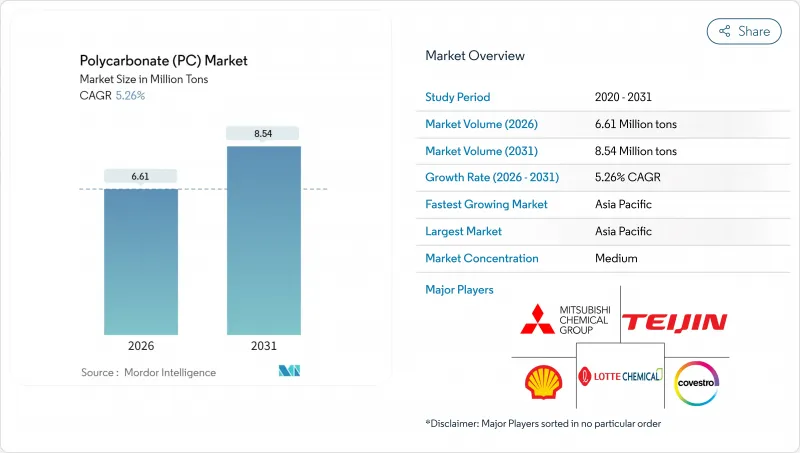
폴리카보네이트가 전기차, 5G 인프라, 미니 LED 디스플레이 분야에서 무겁거나 내구성이 낮은 소재를 대체하면서 수요가 가속화되고 있으며, 내충격성, 광학 투명도, 열안정성 덕분에 경제 변동에 대한 회복탄력성을 유지하고 있습니다. SABIC-SINOPEC의 중국 내 연간 26만 톤 합작 투자 및 롯데케미칼의 39억 달러 규모 실레곤 단지와 같은 투자는 아시아 지역의 공급 안정성을 높이고 물류 비용을 절감합니다. 북미와 유럽은 규제 주도형 구매자로 뒤를 잇습니다. EU 건축 제품 규정은 폴리카보네이트의 내재적 내화성을 선호하는 난연성 외장을 요구합니다. 원자재 가격 변동과 비스페놀 A에 대한 우려에도 불구하고, 기술 업그레이드, 재생 가능 원료 등급, 후방 통합은 생산자 마진을 보호하고 성장을 지속시킵니다.
세계의 폴리카보네이트(PC) 시장 동향과 전망
자동차용 유리의 주류 EV 수요
전기차의 급속한 보급은 폴리카보네이트 시장을 견인하고 있습니다. OEM 업체들이 무게를 40-50% 줄이고 주행 거리를 연장하는 경량 투명 패널로 유리를 대체하고 있기 때문입니다. 코베스트로의 자외선 안정 등급은 10년 이상 투명도를 유지하여 기존 황변 문제를 해결하고 파노라마 루프 통합을 촉진합니다. 테슬라 모델 S 플레이드는 폴리카보네이트 루프 패널로 15kg의 무게 감량 효과를 보여줍니다. 자율 주행 캐빈으로의 디자인 진화는 유리 표면적을 증가시켜 구조적 강도를 유지하면서 안테나, 히터, 센서를 수용할 수 있는 소재 수요를 확대합니다. 500km 주행 거리를 목표로 하는 아시아 배터리 전기차 플랫폼은 차량당 최대 6m²의 폴리카보네이트 유리 사용을 지정하며, 이로 인해 해당 부문이 전체 폴리카보네이트 시장 규모에 미치는 영향력이 강화되고 있습니다.
소비자 가전용 미니 LED 확산 렌즈
미니 LED 패널은 화면당 수천 개의 렌즈릿을 필요로 하며, 각 렌즈릿은 200μm 미만 픽셀 전체에 걸쳐 균일한 휘도를 유지하기 위해 폴리카보네이트로 정밀 성형됩니다. 삼성의 2025년 플래그십 TV는 기존 LED 백라이트 대비 광 추출률을 12% 향상시키는 텍스처 처리된 폴리카보네이트 광학 부품을 사용합니다. 애플 맥북 프로의 채택은 크로스 디바이스 수용을 시사하며, 65인치 디스플레이당 약 25,000개의 렌즈릿이 소모되어 폴리카보네이트 시장에 상당한 증분 물량을 창출합니다. -20°C-85°C의 열적 안정성은 굴절률 일관성을 보장하며, 고충진 캐비티 성형은 공정 시간과 폐기물을 절감합니다. 부품 소형화 활동은 한국, 대만, 중국 본토에 집중되어 있으나, 북미 공장들도 지역 공급 안정성 확보를 위해 규모를 확대 중입니다.
비스페놀 A의 규제 동향
유럽 식품안전청(EFSA)의 2024년 지침은 BPA 일일 허용 섭취량을 대폭 축소하여 대부분의 직접 식품 접촉 제품에서 폴리카보네이트 사용을 배제했습니다. 캘리포니아의 제65호 법안(Proposition 65) 라벨링은 소비자 인식을 확대하여 소매업체가 BPA 무함유 대안을 선호하도록 유도하고 있습니다. 의료기기 입찰에서는 이제 BPA 무함유 인증을 요구하여 특수 등급의 제형 비용을 증가시키지만, 인증 획득 시 프리미엄 마진을 보호합니다. 포장재 시장 감소로 폴리카보네이트 시장 성장세가 둔화되었으나, 생분해성 비스페놀 대체재 및 탈중합 재활용 기술 개발을 통해 식품 등급 시장 재진출을 가속화 중입니다.
부문 분석
전기 및 전자 부문은 2025년 폴리카보네이트 시장 점유율의 36.32%를 차지했으며, 2031년까지 연평균 6.75%의 성장률을 기록할 것으로 예상됩니다. 이는 해당 부문이 양적 기반이자 혁신 중심지로서의 위치를 반영합니다. 반도체 클린룸에는 저가스 방출 부품이 필요하며, 미니 LED 광학 부품과 5G 트랜시버 본체는 내열성과 RF 투과성을 요구합니다. 520억 달러 규모의 CHIPS 법안 자금은 신규 웨이퍼 팹 건설을 촉진하며, 각 팹은 수천 개의 PC 필터 하우징 및 공구 커버를 필요로 합니다.
자동차 부문은 전기화 플랫폼이 경량 적정 크기 글레이징 및 배터리 인클로저를 채택함에 따라 2위를 차지합니다. OEM 업체들은 첨단 운전자 보조 시스템(ADAS)용 센서 호환성 측면에서 폴리카보네이트를 높이 평가합니다. 건축 및 건설 부문은 EU 건설제품규정(CPR)이 난연성 패널을 선호함에 따라 꾸준한 수요 증가를 보이고 있습니다. 포장 분야는 BPA 규제 지역 외에서는 틈새 시장으로 남아 있으며, 5갤런 물병과 전자레인지용 용기에 집중되고 있습니다. 산업 기계, 항공우주, 의료 기기 분야가 다양한 수요를 보완하여 폴리카보네이트 시장이 단일 다운스트림 산업에 의존하지 않도록 합니다.
폴리카보네이트 시장 보고서는 최종 사용자 산업별(항공우주, 자동차, 건축 및 건설, 전기 및 전자, 산업, 기계, 포장, 기타), 제품 유형별(시트, 필름, 기타 제품 유형), 지역별(아시아태평양, 북미, 유럽, 남미, 중동 및 아프리카)으로 분류되어 있습니다. 시장 예측은 금액(달러) 및 수량(톤)으로 제공됩니다.
지역별 분석
아시아태평양 지역은 2025년 폴리카보네이트 시장의 64.10%를 점유했으며, 2031년까지 연평균 5.61%의 성장률을 보일 것으로 예상됩니다. 중국 양쯔강 및 주강 삼각주 지역의 전자 산업 클러스터는 특수 등급을 소비하는 반면, 롱성(Rongsheng)과 같은 국내 생산자들은 수입을 상쇄하기 위해 연간 52만 톤의 생산 능력을 추가하고 있습니다. 일본은 카메라 렌즈용 광학 등급 배합을 선도하고 있으며, 한국은 스마트폰 및 전기차 배터리 대기업들의 수요를 흡수하고 있습니다. 인도의 생산 연계 인센티브(PLI) 제도는 LED 조명기구 및 백색 가전 제품의 현지 생산을 촉진하여 지역 소비를 증가시키고 있습니다.
북미는 중서부 전기차 생산과 애리조나·텍사스 신규 반도체 공장 건설로 2위를 차지합니다. 코베스트로는 오하이오에 수억 유로를 투자해 충전소 및 5G 모듈용 열전도성 등급 복합재를 생산 중입니다. 멕시코는 가전 및 자동차 전선 하네스 공급업체의 아시아 이탈로 근거리 조달 혜택을 본다.
유럽은 고급 차량, 의료기기, 난연성 외장 패널용 폴리카보네이트를 구매합니다. 독일이 생산량에서 선두를 달리고 있으며, 프랑스와 이탈리아는 스마트 미터 케이스에 얇은 벽면 폴리카보네이트를 채택하고 있습니다. EU의 CPR 규정은 가연성 플라스틱을 자가 소화 등급으로 대체하도록 장려합니다. 남미와 중동 및 아프리카는 규모는 작지만 전략적 중요성을 유지하고 있습니다. 브라질의 자동차 시장 회복과 리야드 및 두바이의 걸프 지역 메가 프로젝트는 향후 수지 창고나 컴파운딩 라인 설치를 정당화할 수 있는 성장 기회를 제공합니다.
기타 혜택 :
- 엑셀 형식 시장 예측(ME) 시트
- 3개월간의 애널리스트 지원
자주 묻는 질문
목차
제1장 서론
- 조사의 전제조건과 시장 정의
- 조사 범위
제2장 조사 방법
제3장 주요 요약
제4장 시장 상황
- 시장 개요
- 시장 성장 촉진요인
- 자동차 유리 시장의 주류 전기차 수요
- 소비자 가전용 미니 LED 확산 렌즈
- 5G 인프라용 레이돔 및 안테나 커버
- 에너지 절약형 LED 조명 광학계의 도입 가속
- EU CPR 규정 의무화 난연성 외장재
- 시장 성장 억제요인
- 비스페놀 A의 규제 감시
- 휘발성 페놀-아세톤 원료 가격 변동성
- 바이오 공중합 폴리에스터로의 OEM 대체
- 밸류체인 분석
- 규제 상황
- 수출입 분석
- 가격 동향
- Porter's Five Forces 분석
- 공급기업의 협상력
- 구매자의 협상력
- 대체품의 위협
- 경쟁 기업간 경쟁 관계
- 신규 참가업체의 위협
- 최종 용도 부문 동향
- 항공우주(항공우주부품 생산수익)
- 자동차(자동차 생산)
- 건축 및 건설(신축상 지역)
- 전기 및 전자 기기(전기 및 전자 기기 생산 수익)
- 포장(플라스틱 포장 수량)
- 재활용 개요
제5장 시장 규모와 성장 예측(금액 및 수량 기준)
- 최종 사용자 산업별
- 항공우주
- 자동차
- 건축 및 건설
- 전기 및 전자 기기
- 산업, 기계
- 포장
- 기타 최종 사용자 산업
- 제품 유형별
- 시트
- 필름
- 기타 제품 유형
- 지역별
- 아시아태평양
- 중국
- 일본
- 인도
- 한국
- 호주
- 말레이시아
- 기타 아시아태평양
- 북미
- 캐나다
- 멕시코
- 미국
- 유럽
- 독일
- 프랑스
- 이탈리아
- 영국
- 러시아
- 기타 유럽
- 남미
- 브라질
- 아르헨티나
- 기타 남미
- 중동 및 아프리카
- 사우디아라비아
- 아랍에미리트(UAE)
- 나이지리아
- 남아프리카
- 기타 중동 및 아프리카
- 아시아태평양
제6장 경쟁 구도
- 시장 집중도
- 전략적 동향
- 시장 점유율**(%)/순위 분석
- 기업 프로파일
- Axxicon BV
- CHIMEI
- Covestro AG
- Formosa Chemicals & Fibre Corp.
- Idemitsu Kosan Co., Ltd.
- LG Chem
- LOTTE Chemical Corporation
- Luxi Chemical Group
- Mitsubishi Chemical Group Corporation
- RTP Company
- SABIC
- Samtion Chemical
- Samyang Corporation
- TEIJIN LIMITED
- Trinseo PLC
제7장 시장 기회와 장래의 전망
제8장 CEO를 위한 주요 전략적 과제
HBR 26.02.04The Polycarbonate Market is expected to grow from 6.28 million tons in 2025 to 6.61 million tons in 2026 and is forecast to reach 8.54 million tons by 2031 at 5.26% CAGR over 2026-2031.
Demand accelerates as polycarbonate replaces heavier or less durable materials in electric vehicles, 5G infrastructure, and mini-LED displays, while remaining resilient to economic fluctuations due to its impact resistance, optical clarity, and thermal stability. Investments such as SABIC-SINOPEC's 260,000 tpa joint venture in China and Lotte Chemical's USD 3.9 billion Cilegon complex add supply security and lower logistics costs in Asia. North America and Europe follow as regulation-driven buyers; the EU Construction Products Regulation requires flame-retardant facades that favor polycarbonate's inherent fire resistance. Despite raw material cost swings and scrutiny of bisphenol-A, technology upgrades, renewable feedstock grades, and backward integration protect producer margins and sustain growth.
Global Polycarbonate (PC) Market Trends and Insights
Mainstream EV Demand in Automotive Glazing
Rapid electric-vehicle adoption is lifting the polycarbonate market as OEMs replace glass with lightweight transparent panels that cut 40-50% mass and extend driving range. Covestro's UV-stable grades maintain clarity for over a decade, which resolves earlier yellowing issues and encourages panoramic roof integration. Tesla's Model S Plaid illustrates the benefit with a 15 kg weight reduction from polycarbonate roof panels. Design evolution toward autonomous cabins increases glazed surface area, escalating demand for materials that host antennas, heaters, and sensors without losing structural strength. Asian battery-electric platforms targeting 500 km range now specify up to 6 m2 of polycarbonate glazing per vehicle, reinforcing the segment's pull on overall polycarbonate market volumes.
Consumer Electronics Mini-LED Diffusion Lenses
Mini-LED panels require thousands of lenslets per screen, each precision-molded in polycarbonate to maintain uniform luminance across sub-200 µm pixels. Samsung's 2025 flagship televisions use textured polycarbonate optics that raise light extraction by 12% versus legacy LED backlights. Apple's MacBook Pro adoption signals cross-device acceptance, and every 65-inch display consumes roughly 25,000 lenslets, creating large incremental tonnage for the polycarbonate market. Thermal stability from -20 °C to 85 °C ensures refractive-index consistency, while high-fill cavity molding cuts takt time and waste. Component miniaturization centers activity in Korea, Taiwan, and mainland China, but North American fabs are scaling to secure regional supply resilience.
Bisphenol-A Regulatory Scrutiny
The European Food Safety Authority's 2024 guidance slashed tolerable daily BPA intake, excluding polycarbonate from most direct food-contact products. California's Proposition 65 labels broaden consumer awareness, pushing retailers to favor BPA-free alternatives. Medical-device tenders now request BPA-free certification, raising formulation costs for specialty grades yet protecting premium margins once certified. Packaging losses temper overall polycarbonate market growth, but producers are accelerating bio-based bisphenol substitutes and depolymerization recycling to regain food-grade channels.
Other drivers and restraints analyzed in the detailed report include:
- 5G Infrastructure Radomes and Antenna Covers
- Accelerating Adoption of Energy-Efficient LED Lighting Optics
- Volatile Phenol-Acetone Feedstock Pricing
For complete list of drivers and restraints, kindly check the Table Of Contents.
Segment Analysis
Electrical and Electronics held 36.32% of the polycarbonate market share in 2025 and is forecast to log a 6.75% CAGR through 2031, reflecting its position as both volume anchor and innovation hub. Semiconductor cleanrooms need low-outgassing parts, while mini-LED optics and 5G transceiver bodies demand heat tolerance and RF transparency. The CHIPS Act funds of USD 52 billion stimulate the construction of new wafer fabs, each requiring thousands of PC filtration housings and tooling covers.
Automotive ranks second as electrified platforms adopt lightweight right-size glazing and battery enclosures. OEMs value polycarbonate's sensor compatibility for advanced driver assistance systems. The building and Construction Sector shows steady uptake because the EU CPR favors flame-retardant panels. Packaging remains niche outside BPA-restricted regions, with a focus on five-gallon water bottles and microwave-safe containers. Industrial machinery, aerospace, and medical devices complement diversified demand, ensuring that the polycarbonate market is not reliant on a single downstream sector.
The Polycarbonate Market Report is Segmented by End-User Industry (Aerospace, Automotive, Building and Construction, Electrical and Electronics, Industrial and Machinery, Packaging, and Others), Product Type (Sheet, Film, and Other Product Types), and Geography (Asia-Pacific, North America, Europe, South America, and Middle East and Africa). The Market Forecasts are Provided in Terms of Value (USD) and Volume (Tons).
Geography Analysis
Asia-Pacific controlled 64.10% of the polycarbonate market in 2025 and is projected to expand at a 5.61% CAGR to 2031. China's electronics clusters in the Yangtze and Pearl River Deltas consume specialty grades, while domestic producers such as Rongsheng add 520,000 tpa capacity to balance imports. Japan pioneers optical-grade formulations for camera lenses, and South Korea channels demand from smartphone and EV battery giants. India's Production-Linked Incentive scheme spurs the localized production of LED luminaires and white goods, thereby increasing regional consumption.
North America ranks second, driven by EV production in the Midwest and the construction of new chip fabs in Arizona and Texas. Covestro invested a low triple-digit million euros in Ohio to compound thermally conductive grades for charging stations and 5G modules. Mexico benefits from near-shoring as appliance and auto wire-harness suppliers migrate from Asia.
Europe buys polycarbonate for premium vehicles, medical devices, and flame-retardant facade panels. Germany leads volume, while France and Italy adopt thin-wall PC for smart-meter enclosures. EU CPR rules encourage replacement of combustible plastics with self-extinguishing grades. South America and the Middle East & Africa remain small but strategic; Brazil's automotive rebound and Gulf mega-projects in Riyadh and Dubai present pockets of growth that may justify future resin warehouses or compounding lines.
- Axxicon B.V.
- CHIMEI
- Covestro AG
- Formosa Chemicals & Fibre Corp.
- Idemitsu Kosan Co., Ltd.
- LG Chem
- LOTTE Chemical Corporation
- Luxi Chemical Group
- Mitsubishi Chemical Group Corporation
- RTP Company
- SABIC
- Samtion Chemical
- Samyang Corporation
- TEIJIN LIMITED
- Trinseo PLC
Additional Benefits:
- The market estimate (ME) sheet in Excel format
- 3 months of analyst support
TABLE OF CONTENTS
1 Introduction
- 1.1 Study Assumptions and Market Definition
- 1.2 Scope of the Study
2 Research Methodology
3 Executive Summary
4 Market Landscape
- 4.1 Market Overview
- 4.2 Market Drivers
- 4.2.1 Mainstream EV demand in automotive glazing
- 4.2.2 Consumer-electronics mini-LED diffusion lenses
- 4.2.3 5G infrastructure radomes and antenna covers
- 4.2.4 Accelerating adoption of energy-efficient LED lighting optics
- 4.2.5 EU CPR-mandated flame-retardant facades
- 4.3 Market Restraints
- 4.3.1 Bisphenol-A regulatory scrutiny
- 4.3.2 Volatile phenol-acetone feedstock pricing
- 4.3.3 OEM substitution toward bio-based copolyesters
- 4.4 Value Chain Analysis
- 4.5 Regulatory Landscape
- 4.6 Import and Export Analysis
- 4.7 Price Trends
- 4.8 Porter's Five Forces Analysis
- 4.8.1 Bargaining Power of Suppliers
- 4.8.2 Bargaining Power of Buyers
- 4.8.3 Threat of Substitutes
- 4.8.4 Competitive Rivalry
- 4.8.5 Threat of New Entrants
- 4.9 End-use Sector Trends
- 4.9.1 Aerospace (Aerospace Component Production Revenue)
- 4.9.2 Automotive (Automobile Production)
- 4.9.3 Building and Construction (New Construction Floor Area)
- 4.9.4 Electrical and Electronics (Electrical and Electronics Production Revenue)
- 4.9.5 Packaging(Plastic Packaging Volume)
- 4.10 Recycling Overview
5 Market Size and Growth Forecasts (Value and Volume)
- 5.1 By End-user Industry
- 5.1.1 Aerospace
- 5.1.2 Automotive
- 5.1.3 Building and Construction
- 5.1.4 Electrical and Electronics
- 5.1.5 Industrial and Machinery
- 5.1.6 Packaging
- 5.1.7 Other End-user Industries
- 5.2 By Product Type
- 5.2.1 Sheet
- 5.2.2 Film
- 5.2.3 Other Product Types
- 5.3 By Geography
- 5.3.1 Asia-Pacific
- 5.3.1.1 China
- 5.3.1.2 Japan
- 5.3.1.3 India
- 5.3.1.4 South Korea
- 5.3.1.5 Australia
- 5.3.1.6 Malaysia
- 5.3.1.7 Rest of Asia-Pacific
- 5.3.2 North America
- 5.3.2.1 Canada
- 5.3.2.2 Mexico
- 5.3.2.3 United States
- 5.3.3 Europe
- 5.3.3.1 Germany
- 5.3.3.2 France
- 5.3.3.3 Italy
- 5.3.3.4 United Kingdom
- 5.3.3.5 Russia
- 5.3.3.6 Rest of Europe
- 5.3.4 South America
- 5.3.4.1 Brazil
- 5.3.4.2 Argentina
- 5.3.4.3 Rest of South America
- 5.3.5 Middle East and Africa
- 5.3.5.1 Saudi Arabia
- 5.3.5.2 United Arab Emirates
- 5.3.5.3 Nigeria
- 5.3.5.4 South Africa
- 5.3.5.5 Rest of Middle East and Africa
- 5.3.1 Asia-Pacific
6 Competitive Landscape
- 6.1 Market Concentration
- 6.2 Strategic Moves
- 6.3 Market Share** (%)/Ranking Analysis
- 6.4 Company Profiles (includes Global Level Overview, Market Level Overview, Core Segments, Financials as available, Strategic Information, Market Rank/Share for key companies, Products and Services, and Recent Developments)
- 6.4.1 Axxicon B.V.
- 6.4.2 CHIMEI
- 6.4.3 Covestro AG
- 6.4.4 Formosa Chemicals & Fibre Corp.
- 6.4.5 Idemitsu Kosan Co., Ltd.
- 6.4.6 LG Chem
- 6.4.7 LOTTE Chemical Corporation
- 6.4.8 Luxi Chemical Group
- 6.4.9 Mitsubishi Chemical Group Corporation
- 6.4.10 RTP Company
- 6.4.11 SABIC
- 6.4.12 Samtion Chemical
- 6.4.13 Samyang Corporation
- 6.4.14 TEIJIN LIMITED
- 6.4.15 Trinseo PLC
7 Market Opportunities and Future Outlook
- 7.1 White-space and Unmet-Need Assessment