
|
시장보고서
상품코드
1907349
환자 포털 시장 : 시장 점유율 분석, 업계 동향 및 통계, 성장 예측(2026-2031년)Patient Portal - Market Share Analysis, Industry Trends & Statistics, Growth Forecasts (2026 - 2031) |
||||||
 Mordor Intelligence
환자 포털 시장은 2025년에 65억 6,000만 달러로 평가되었고, 2026년 77억 7,000만 달러에서 2031년까지 181억 8,000만 달러에 이를 것으로 예측됩니다.
예측 기간(2026-2031년) CAGR은 18.52%로 성장이 전망됩니다.
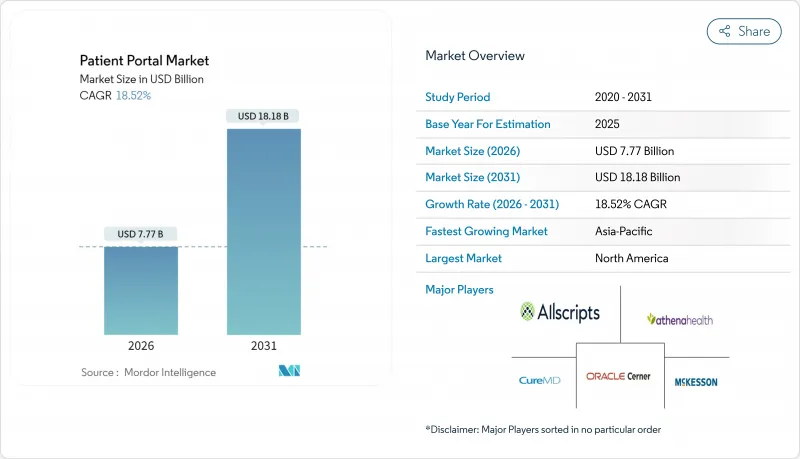
이러한 급성장은 연방 정부의 FHIR 기반 데이터 공유 의무화, 급속한 클라우드 마이그레이션 및 셀프 서비스 액세스에 대한 소비자의 강한 수요가 결합되어 환자 포털 시장이 디지털 건강 전략의 중요한 기둥이 되었음을 보여줍니다. 통합 포털은 엔터프라이즈 전자 건강 기록(EHR)과 원활하게 동기화되므로 대규모 의료 시스템의 기본 옵션입니다. 한편 클라우드 제공은 의료 제공업체와 지불자 모두가 점점 더 요구하는 탄력적인 컴퓨팅과 임베디드 AI를 실현합니다. 아시아태평양의 벤처 자금 증가, FHIR 플러그인 마켓플레이스의 상승, 가치 기반 상환 인센티브의 확대가 도입을 더욱 가속화하고 있습니다. 한편, 주목받는 사이버 공격, 노인의 디지털 리터러시에서의 지속적인 격차, 의료 종사자의 수신함 업무량의 급증 등의 과제는 환자 포털 시장이 기세를 유지하기 위해서는 기술 공급자가 경감해야 할 현실적인 장벽이 되고 있습니다.
세계의 환자 포털 시장 동향 및 인사이트
연방 상호 운용성 및 유의의 이용 의무화
공인 API 개발자는 2024년 12월 31일까지 기본 FHIR URL을 공개해야 하며, 환자는 특별한 번거로움 없이 자신의 데이터에 직접 전자 액세스할 수 있게 되었습니다. 2025년 메디케어 의사 보상 일정에서는 인센티브 결제가 측정 가능한 포털 사용 상황에 연동되어 컴플라이언스가 의료 제공업체의 수익원으로 전환됩니다. 반면, 연방기관은 2026년까지 통합된 FHIR 생태계를 구축하기로 약속하고 있으며, 이로 인해 시스템 간 데이터 교환이 효율화되고 사용자의 기대치가 높아집니다. 미국의 의료 정보 교환 기관의 90%가 CDA 파일을 전송하고 있는 것, USCDI 요건에 준거하는 것은 40% 미만이며, 표준화에 의한 개선의 여지는 여전히 큰 상황입니다. 벌칙이 강화되고 보너스 풀이 확대되는 가운데 병원은 감사 대응을 충족하고 품질 보너스를 획득할 수 있는 통합 솔루션을 우선적으로 도입하여 환자 포털 시장 성장을 가속하고 있습니다.
디지털 프론트 도어에 대한 소비자 수요 증가
전국 조사에 따르면 2022년 포털을 이용한 성인은 61.3%에 달했고 팬데믹 전 수준에서 크게 증가했습니다. 환자의 4분의 3은 디지털 도구가 의료 경험을 향상시킬 것이라고 인식하고 있으며, 의료 기관은 채팅봇, 자체 예약 기능, 개인화된 컨텐츠를 플랫폼에 통합하는 움직임을 가속화하고 있습니다. 약국 조사에서는 고객의 81%가 디지털 채널을 이용하고, 90%가 원활한 경험이 의료의 질을 높인다고 응답했습니다. 2025년까지 이러한 기대에 부응할 수 없는 경우 환자 충성도가 위협되기 때문에 고급 포털 기능이 환자 포털 시장에서 경쟁 우위의 핵심이 될 것입니다.
사이버 보안 및 개인 정보 유출
2024년 체인지 헬스케어사에 대한 사이버 공격은 1억 명의 개인 정보가 유출되어 2,200만 달러의 몸값 지불을 강요받아, 타사 청구 플랫폼의 취약성이 노출되었습니다. MOVEit 소프트웨어를 통해 95만 건 가까이 기록에 영향을 미친 CMS 데이터 유출은 공급망 위험을 부각시켰습니다. 2025년까지 의료 제공업체의 40%가 AI 기반의 위협 인텔리전스를 도입할 전망이지만, 새로운 침해가 발생하면 프라이버시를 중시하는 사용자의 채용 의욕을 식힐 가능성이 있습니다. 데이터 엔드포인트의 보호는 환자 포털 시장의 지속적인 확장에서 장벽 요인으로 계속되고 있습니다.
부문 분석
통합 솔루션은 2025년 환자 포털 시장 규모의 62.78%를 차지했습니다. 이는 의료 기관이 인터페이스의 복잡성을 최소화하는 단일 공급업체 생태계로 전환했기 때문입니다. 에픽이 연간 176개 시설 및 29,399층을 확대한 사례가 이 경향을 여실히 보여줍니다. 한편, 독립형 포털은 규모가 작고 행동 의료 워크플로우와 소비자를 위한 직접 텔레컨설팅 허브 등 전문적인 요구를 충족시켜 견조한 19.63%의 연평균 복합 성장률(CAGR)을 기록하고 있습니다. 향후 5년간, 통합형 기존 벤더는 AI 기능의 심화를 도모하는 한편, 독립형은 민첩한 도입 및 틈새 모듈을 강조해 환자 포털 시장 내에서 병행한 수요의 흐름을 유지해 나갈 것입니다.
대규모 대학 병원은 엄격한 상호 운용성 감사를 충족하기 위해 통합 포털에 의존하는 반면, 지역 클리닉은 비용이 많이 드는 전환을 피하기 위해 모듈형 독립형 솔루션을 채택하는 경향이 있습니다. 이 양극화가 건전한 경쟁을 촉진하고 양층의 신속한 기능 갱신을 추진함으로써 환자 포털 시장 전체에서 기능 개발 속도가 유지될 전망입니다.
지역별 분석
북미의 이점은 상호 운용성에 대한 의무적 규제, 높은 스마트폰 보급률, 견고한 클라우드 연결성에 의해 지원되며, 2025년에는 환자 포털 시장 점유율의 45.87%를 차지했습니다. 특히 미국에서는 메디케어의 '선진 1차 케어 지불 제도'가 포털 이용 기록을 재정적으로 보상함으로써 도입을 가속화하고 있습니다. 캐나다와 멕시코는 국가 차원의 전자 의료 전략과 국경을 넘어 벤더 협력을 통해 통합 도입을 확대하고 지역 성장을 보완하고 있습니다. 에픽이 음성 어시스턴트 기능을 강화하고 Oracle이 클라우드 크레딧을 번들해 의료 시스템을 유치하는 등 경쟁 기업간 경쟁 관계는 격화하고 있지만, 경량으로 특화된 포털을 제공하는 틈새 기업이 전문 클리닉을 획득하는 사례도 여전히 볼 수 있습니다.
아시아태평양은 정부의 디지털화 보조금, 높아지는 중산 계급의 기대, 적극적인 모바일 네트워크 확충을 배경으로 예측 CAGR 20.08%로 가장 빠른 성장을 이룰 것입니다. 인도네시아, 태국, 베트남에서는 현저한 민간 자금 조달(Halodoc은 2024년에 1억 달러, Doctor Anywhere는 4,080만 달러를 조달)에 의해 지역 특화형 프런트 도어 앱이 구축되고 있습니다. 중국에서는 국가 건강 정보 플랫폼이 성립 병원과 AI 채팅 트리아지를 연계시켜 인도의 '아유슈만 바랏 디지털 미션'은 민간 포털과 원활하게 통합되는 개인 건강 ID를 발행하고 있습니다. 이러한 노력이 강력한 개발 기반을 형성하고 지방부의 인프라 격차가 있음에도 불구하고 대륙 전체의 환자 포털 시장을 밀어 올리고 있습니다.
유럽에서는 GDPR(EU 개인정보보호규정) 준수 동의 메커니즘이 디지털 데이터 교환에 대한 환자 신뢰를 높이고 꾸준한 성장을 기록하고 있습니다. 독일의 전자 환자 기록, 영국의 NHS 앱 확충, 프랑스의 Mon Espace Sante 모두 다언어 컨텐츠와 통합 약국 서비스를 특징으로 하는 포털 업그레이드를 위한 예산 배분을 집중시키고 있습니다. 남미 시장은 뒤쳐져 있지만 브라질과 아르헨티나에서 원격 의료 관련 법률 확대의 혜택을 누리고 있습니다. 한편, 중동, 특히 GCC 국가에서는 2개 언어 대응 포털을 갖춘 클라우드 대응 병원 캠퍼스에 소블린 펀드를 할당하고 있습니다. 이러한 세계의 모자이크 구조는 단일 정책 혼란이 환자 포털 시장 전체의 궤도를 미치지 않도록 보장합니다.
기타 혜택 :
- 엑셀 형식 시장 예측(ME) 시트
- 애널리스트에 의한 3개월간의 지원
자주 묻는 질문
목차
제1장 서론
- 조사의 전제조건 및 시장 정의
- 조사 범위
제2장 조사 방법
제3장 주요 요약
제4장 시장 상황
- 시장 개요
- 시장 성장 촉진요인
- 연방 정부의 상호운용성 및 유의의 이용 의무화
- 디지털 프론트 도어 액세스에 대한 소비자 수요 증가
- 클라우드 호스팅 전자 건강 기록(EHR) 생태계로의 급속한 전환
- 가치 기반 의료 모델에 대한 상환 인센티브
- AI를 활용한 초개별화 교육 모듈
- FHIR 대응 '플러그인' 앱 마켓플레이스의 기세
- 시장 성장 억제요인
- 사이버 보안 및 프라이버시 침해
- 고령층에서의 낮은 디지털 리터러시 및 건강 리터러시
- 의료 종사자의 메시지 과다에 의한 불타는 증후군
- 비동기 진료에 대한 부적절한 보상 체계
- 밸류체인 및 공급망 분석
- 규제 상황
- 기술의 전망
- Porter's Five Forces
- 신규 참가업체의 위협
- 공급기업의 협상력
- 구매자의 협상력
- 대체품의 위협
- 경쟁 기업 간 경쟁 관계
제5장 시장 규모 및 성장 예측(금액)
- 포털 유형별
- 통합 포털
- 독립형 포털
- 전개 모드별
- 웹 및 온프레미스
- 클라우드 기반
- 최종 사용자별
- 의료 제공업체(병원, 진료소, 통합 의료 네트워크)
- 지불자
- 약국 및 소매 의료
- 개인 및 기타
- 지역별
- 북미
- 미국
- 캐나다
- 멕시코
- 유럽
- 독일
- 영국
- 프랑스
- 이탈리아
- 스페인
- 기타 유럽
- 아시아태평양
- 중국
- 인도
- 일본
- 한국
- 호주
- 기타 아시아태평양
- 남미
- 브라질
- 아르헨티나
- 기타 남미
- 중동 및 아프리카
- GCC
- 남아프리카
- 기타 중동 및 아프리카
- 북미
제6장 경쟁 구도
- 시장 집중도
- 시장 점유율 분석
- 기업 프로파일
- Epic Systems Corp.
- Oracle Health(Cerner)
- athenahealth Inc.
- Allscripts Healthcare Solutions
- MEDITECH
- NextGen Healthcare
- eClinicalWorks
- Greenway Health
- InteliChart
- McKesson Corp.
- GE HealthCare
- Philips Healthcare
- Teladoc Health
- Luma Health
- GetWellNetwork
- Phreesia
- Cedar
- Weave Communications
- Omada Health
- MyHealthONE(HCA Healthcare)
제7장 시장 기회 및 장래 전망
AJY 26.01.22The patient portal market was valued at USD 6.56 billion in 2025 and estimated to grow from USD 7.77 billion in 2026 to reach USD 18.18 billion by 2031, at a CAGR of 18.52% during the forecast period (2026-2031).
That steep climb signals how federal FHIR-based data-sharing mandates, rapid cloud migration, and strong consumer appetite for self-service access have converged to make the patient portal market an essential pillar of digital health strategy. Integrated portals remain the default choice for large health systems because they synchronize seamlessly with enterprise electronic health records (EHRs), while cloud delivery unlocks elastic computing and embedded AI that both providers and payers increasingly demand. Heightened venture funding in Asia-Pacific, the rise of FHIR plug-in marketplaces, and mounting value-based reimbursement incentives further accelerate adoption. On the downside, headline-grabbing cyberattacks, persistent gaps in older-adult digital literacy, and soaring clinician inbox workloads pose real obstacles that technology suppliers must mitigate if the patient portal market is to sustain momentum.
Global Patient Portal Market Trends and Insights
Federal Interoperability & Meaningful-Use Mandates
Certified API developers were required to publish base FHIR URLs by 31 December 2024, granting patients direct electronic access to their data without special effort. The 2025 Medicare Physician Fee Schedule ties incentive payments to measurable portal engagement, turning compliance into a revenue lever for providers. Meanwhile, federal agencies have committed to a unified FHIR ecosystem by 2026 that will streamline cross-system data exchange and heighten user expectations. Although 90% of U.S. health information exchanges transmit CDA files, fewer than 40% align with USCDI requirements, leaving ample room for standardization gains. As penalties tighten and bonus pools expand, hospitals are prioritizing integrated solutions that satisfy auditors and unlock quality bonuses, reinforcing growth in the patient portal market.
Rising Consumer Demand for Digital Front-Door Access
A national survey showed that 61.3% of adults accessed a portal in 2022, up sharply from pre-pandemic levels. Three-quarters of patients now believe digital tools improve their care experience, prompting providers to embed chatbots, self-scheduling, and personalized content into their platforms. Pharmacy research found 81% of customers use digital channels and 90% feel connected experiences raise care quality. In 2025, inability to match these expectations threatens patient loyalty, placing advanced portals at the center of competitive positioning within the patient portal market.
Cyber-Security & Privacy Breaches
The 2024 Change Healthcare cyberattack compromised 100 million individuals and forced a USD 22 million ransom payment, exposing vulnerabilities in third-party billing platforms. A CMS data leak affecting nearly 950,000 records via MOVEit software underscored supply-chain risk. Forty percent of providers are deploying AI-based threat intelligence by 2025, but any fresh breach can chill adoption among privacy-conscious users. Securing data endpoints remains a gating factor for sustained expansion of the patient portal market.
Other drivers and restraints analyzed in the detailed report include:
- Rapid Shift to Cloud-Hosted EHR Ecosystems
- Reimbursement Incentives for Value-Based Care Models
- Low Digital/Health Literacy in Elderly Cohorts
For complete list of drivers and restraints, kindly check the Table Of Contents.
Segment Analysis
Integrated offerings captured a 62.78% slice of the patient portal market size in 2025 as health systems gravitated toward single-vendor ecosystems that minimize interface headaches. Epic's expansion by 176 facilities and 29,399 beds during the year exemplifies that gravitational pull. Stand-alone portals, while smaller in footprint, post a robust 19.63% CAGR by filling specialized needs such as behavioral-health workflows and direct-to-consumer tele-consult hubs. Over the next five years, integrated incumbents will deepen AI functionality, whereas stand-alones will emphasize nimble deployments and niche modules, sustaining parallel demand streams inside the patient portal market.
Large academic medical centers lean on integrated portals to satisfy stringent interoperability audits, whereas community clinics often adopt modular stand-alone solutions to avoid costly migrations. That bifurcation encourages healthy competition, pushing both tiers to iterate quickly and ensuring that feature velocity remains high across the patient portal market.
The Patient Portal Market Report is Segmented by Portal Type (Integrated Portals, Stand-Alone Portals), Deployment Mode (Web/On-premise, Cloud-Based), End User (Providers, Payers, Pharmacies & Retail Health, Individuals/Others), and Geography (North America, Europe, Asia-Pacific, South America, Middle East and Africa). The Market Forecasts are Provided in Terms of Value (USD).
Geography Analysis
North America's dominance springs from mandatory interoperability rules, high smartphone usage, and robust cloud connectivity, supporting 45.87% patient portal market share in 2025. The United States specifically turbocharges adoption through Medicare's Advanced Primary Care payments that financially reward documented portal engagement. Canada and Mexico complement regional growth with national e-health strategies and cross-border vendor partnerships that expand integrated deployments. Competitive rivalry stays intense as Epic strengthens voice-assistant functions and Oracle bundles cloud credits to lure health systems, yet niche players still win specialist clinics by offering lightweight, focused portals.
Asia-Pacific is the fastest climber with a forecast 20.08% CAGR, underpinned by government digitization grants, climbing middle-class expectations, and aggressive mobile-network expansion. Indonesia, Thailand, and Vietnam secure notable private funding-Halodoc attracted USD 100 million and Doctor Anywhere raised USD 40.8 million in 2024-to build region-specific front-door apps. China's national health-information platform links provincial hospitals to AI chat triage, while India's Ayushman Bharat Digital Mission issues personal health IDs that integrate seamlessly with private-sector portals. These initiatives feed a robust development funnel that elevates the patient portal market across the continent despite infrastructure gaps in rural pockets.
Europe records steady growth bolstered by GDPR-aligned consent mechanisms that enhance patient trust in digital data exchange. Germany's electronic patient record, the UK's NHS App expansion, and France's Mon Espace Sante all funnel budget allocations toward portal upgrades featuring multilingual content and integrated pharmacy services. South American markets trail but benefit from expanding telehealth legislation in Brazil and Argentina, while the Middle East-particularly GCC states-allocates sovereign funds to cloud-ready hospital campuses with bilingual portals. Collectively, the global mosaic ensures that no single policy disruption can derail the broader patient portal market trajectory.
- Epic Systems Corp.
- Oracle Health (Cerner)
- Athenahealth
- Allscripts
- Meditech
- NextGen Healthcare
- eClinicalWorks
- Greenway Health
- InteliChart
- McKesson Corp.
- GE Healthcare
- Koninklijke Philips
- Teladoc Health
- Luma Health
- GetWellNetwork
- Phreesia
- Cedar
- Weave Communications
- Omada Health
- MyHealthONE (HCA Healthcare)
Additional Benefits:
- The market estimate (ME) sheet in Excel format
- 3 months of analyst support
TABLE OF CONTENTS
1 Introduction
- 1.1 Study Assumptions & Market Definition
- 1.2 Scope of the Study
2 Research Methodology
3 Executive Summary
4 Market Landscape
- 4.1 Market Overview
- 4.2 Market Drivers
- 4.2.1 Federal interoperability & Meaningful-Use mandates
- 4.2.2 Rising consumer demand for digital front-door access
- 4.2.3 Rapid shift to cloud-hosted EHR ecosystems
- 4.2.4 Reimbursement incentives for value-based care models
- 4.2.5 AI-driven hyper-personalized education modules
- 4.2.6 FHIR-enabled "plug-in" app marketplace momentum
- 4.3 Market Restraints
- 4.3.1 Cyber-security & privacy breaches
- 4.3.2 Low digital/health literacy in elderly cohorts
- 4.3.3 Clinician message-overload burnout
- 4.3.4 Misaligned reimbursement for asynchronous visits
- 4.4 Value / Supply-Chain Analysis
- 4.5 Regulatory Landscape
- 4.6 Technological Outlook
- 4.7 Porter's Five Forces
- 4.7.1 Threat of New Entrants
- 4.7.2 Bargaining Power of Suppliers
- 4.7.3 Bargaining Power of Buyers
- 4.7.4 Threat of Substitute Products
- 4.7.5 Competitive Rivalry
5 Market Size & Growth Forecasts (Value, USD bn)
- 5.1 By Portal Type
- 5.1.1 Integrated Portals
- 5.1.2 Stand-Alone Portals
- 5.2 By Deployment Mode
- 5.2.1 Web / On-premise
- 5.2.2 Cloud-based
- 5.3 By End User
- 5.3.1 Providers (Hospitals, Clinics, IDNs)
- 5.3.2 Payers
- 5.3.3 Pharmacies & Retail Health
- 5.3.4 Individuals / Others
- 5.4 By Geography
- 5.4.1 North America
- 5.4.1.1 United States
- 5.4.1.2 Canada
- 5.4.1.3 Mexico
- 5.4.2 Europe
- 5.4.2.1 Germany
- 5.4.2.2 United Kingdom
- 5.4.2.3 France
- 5.4.2.4 Italy
- 5.4.2.5 Spain
- 5.4.2.6 Rest of Europe
- 5.4.3 Asia-Pacific
- 5.4.3.1 China
- 5.4.3.2 India
- 5.4.3.3 Japan
- 5.4.3.4 South Korea
- 5.4.3.5 Australia
- 5.4.3.6 Rest of Asia-Pacific
- 5.4.4 South America
- 5.4.4.1 Brazil
- 5.4.4.2 Argentina
- 5.4.4.3 Rest of South America
- 5.4.5 Middle East and Africa
- 5.4.5.1 GCC
- 5.4.5.2 South Africa
- 5.4.5.3 Rest of Middle East and Africa
- 5.4.1 North America
6 Competitive Landscape
- 6.1 Market Concentration
- 6.2 Market Share Analysis
- 6.3 Company Profiles (includes Global level Overview, Market level overview, Core Segments, Financials as available, Strategic Information, Market Rank/Share for key companies, Products & Services, and Recent Developments)
- 6.3.1 Epic Systems Corp.
- 6.3.2 Oracle Health (Cerner)
- 6.3.3 athenahealth Inc.
- 6.3.4 Allscripts Healthcare Solutions
- 6.3.5 MEDITECH
- 6.3.6 NextGen Healthcare
- 6.3.7 eClinicalWorks
- 6.3.8 Greenway Health
- 6.3.9 InteliChart
- 6.3.10 McKesson Corp.
- 6.3.11 GE HealthCare
- 6.3.12 Philips Healthcare
- 6.3.13 Teladoc Health
- 6.3.14 Luma Health
- 6.3.15 GetWellNetwork
- 6.3.16 Phreesia
- 6.3.17 Cedar
- 6.3.18 Weave Communications
- 6.3.19 Omada Health
- 6.3.20 MyHealthONE (HCA Healthcare)
7 Market Opportunities & Future Outlook
- 7.1 White-space & Unmet-Need Assessment