|
시장보고서
상품코드
1910532
주차 관리 : 시장 점유율 분석, 업계 동향 및 통계, 성장 예측(2026-2031년)Parking Management - Market Share Analysis, Industry Trends & Statistics, Growth Forecasts (2026 - 2031) |
||||||
 Mordor Intelligence
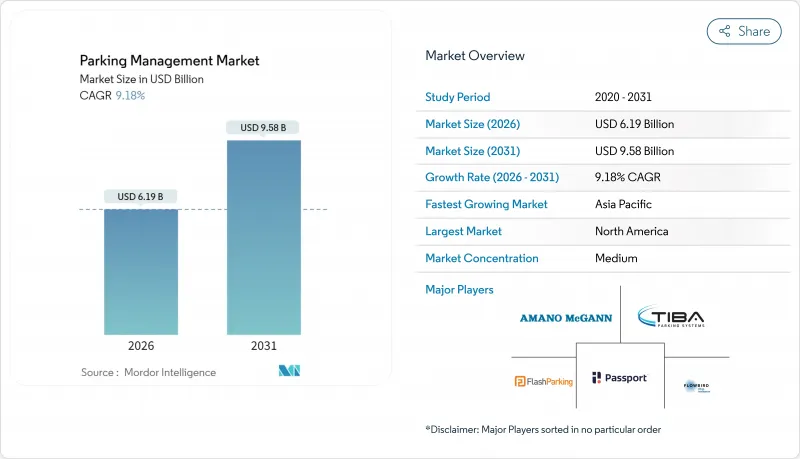
주차 관리 시장은 2025년 56억 7,000만 달러로 평가되었으며, 2026년 61억 9,000만 달러에서 2031년까지 95억 8,000만 달러에 이를 것으로 전망됩니다.
예측 기간(2026-2031년)의 CAGR은 9.18%를 나타낼 것으로 예상됩니다.
도시의 밀집화, 스마트 시티용 전용 자금, 데이터 풍부한 클라우드 베이스 플랫폼으로의 이행이, 도시·공항·민간 사업자가 노상 주차 공간을 수익화 및 규제하는 수법을 변화시키고 있습니다. 북미의 지자체 디지털화 의무화, 아시아태평양의 국가 스마트 시티 계획, 진화하는 EU의 지속가능성 목표가 함께, 번호판 인식·동적 가격 설정·MaaS(모빌리티·아즈·아·서비스) 기능을 통합한 솔루션 수요를 뒷받침하고 있습니다. 하드웨어는 여전히 가장 큰 수익원이지만 현재 가장 빠르게 가치를 창출하는 것은 점유 데이터를 운영 인텔리전스로 변환하는 분석 및 관리 서비스입니다. 인프라 기존 사업자가 기존 기반을 지키는 한편, AI 네이티브의 신규 참가 기업이, 많은 경우 주목을 끄는 인수를 통해 복수 사이트의 포트폴리오를 집약하는 가운데, 경쟁 환경은 변화하고 있습니다.
세계의 주차 관리 시장 동향과 인사이트
도시 지역의 교통 정체 완화
동적 연석 관리 프로그램은 주차 공간이 차량 주행 주행과 온실 가스 배출을 줄이는 실증 사례입니다. 샌프란시스코의 'SF Park'는 6주마다 요금을 재조정하여 85%의 가동률을 유지, 시험 구역 내에서 검색 교통량을 30% 삭감한 실적이 있습니다. 포틀랜드와 호보켄의 유사한 센서 기반 도입은 자체 조사 자원이 없는 중규모 도시를 위한 적용 가능한 기술을 보여줍니다. 지자체 기관은 현재 주차 API를 대중 교통 정보와 연동시켜 네비게이션 앱이 드라이버를 실시간으로 최저 주차 공간으로 유도할 수 있도록 하고 있습니다. 이 접근법은 주차 요금이 고정 과세에서 피크 시간 부하를 재조정하는 행동 변화 수단으로 위치를 재구성합니다. 로스앤젤레스와 싱가포르에서 제안한 새로운 정체 요금 제도는 주차 데이터를 집행 기반으로 더욱 중요한 역할로 승화시킵니다.
지능형 교통 시스템을 위한 스마트 시티 자금
연방 정부 및 초국가 기관의 전용 보조금은 자금 부족의 지자체의 도입 위험을 완화합니다. 미국에서는 연방 고속도로국이 2026년까지 5G대응 도로·주차 시스템에 23억 달러를 예산화해 오픈 아키텍처와 사이버 보안 준거를 조건으로 교부하고 있습니다. 유럽도시에서는 호라이즌·유럽기금을 활용해 자동주차 유도와 조합한 노측 EV충전의 시험운용을 진행하고 있습니다. 장기 자본은 주차 점유율, 신호 타이밍, 대중 교통 도착 데이터를 단일 도시 이동성 대시보드에 통합하는 여러 기관 프로젝트를 실현합니다. 상호 운용성이 적격 기준이기 때문에 표준화된 API를 지원하는 공급업체는 입찰 평가에서 구조적 이점을 얻습니다.
사이버 보안 및 데이터 프라이버시 취약점
2024년 4월 이후 PCI-DSS 4.0으로의 전환 의무화로 인해 10년 전 컨트롤러를 실행하는 시설의 보안 결함이 노출되었습니다. 캘리포니아와 네덜란드에서 번호판 데이터베이스의 침해 사건은 여론의 감시를 강화하고 규제 당국이 감사 범위를 익명화 프로토콜까지 확대하는 계기가 되었습니다. 대형 플랫폼은 제로 트러스트 아키텍처의 임베디드 및 전문 보안 기업과의 제휴로 대응했지만, 소규모 주차장 사업자는 지속적인 침입 테스트의 자금 조달을 고민하고 있습니다. EU가 도로 어깨 관리 데이터를 '고위험 AI 처리'로 분류하는 제안은 알고리즘의 투명성 요구 사항을 추가하고 컴플라이언스 예산을 더욱 압박할 수 있습니다.
부문 분석
On-Premise형 주차 관리 시장 규모는 2025년 32억 9,000만 달러에 이르렀으며 수익 점유율 58.02%를 차지했습니다. 지하층의 휴대전화 전파가 불안정한 중요 게이트웨이에서는 사업자가 On-Premise 제어를 중시하고 있습니다. 그래도 대도시권의 Wi-Fi나 프라이빗 LTE 백본이 성숙한 가운데 클라우드 네이티브형 솔루션은 CAGR 11.12%로 확대 중입니다. 크로스사이트 대시보드를 통해 포트폴리오 소유자는 단일 규칙 세트로 요금 체계를 세계로 조정할 수 있어 자동화된 재해 복구 프로토콜이 다운타임 위험을 최소화합니다.
클라우드 배포는 공급업체의 지속적인 수익 가시성을 향상시키고 자산 소유자에게는 일괄 자본 지출(CAPEX)이 아닌 정기적인 운영 지출(OPEX)을 통한 구독 모델에서 현금 흐름을 안정화합니다. 소프트웨어 패치가 중앙 집중식으로 배포되므로 취약성 창이 축소되고 PCI-DSS 4.0 감사 사이클과의 무결성이 보장됩니다. 클라우드 아키텍처는 MaaS 통합도 간소화하여 타사 앱이 주차장 네트워크를 노출시키지 않고 토큰화된 예약을 실행할 수 있도록 합니다. 그 결과 주차 관리 시장에서는 로컬 게이트웨이가 트랜잭션을 캐시하면서 클라우드 분석과 동기화되는 하이브리드 배포의 점진적인 융합이 진행되고 있습니다.
2025년 오프 스트리트 시설은 공항·병원·복합 상업시설에서의 안정적인 수요를 배경으로 34억 9,000만 달러의 수익을 창출해 주차 관리 시장 점유율의 61.57%를 차지했습니다. 한편, 온 스트리트 전개는 버밍엄과 겔프시에서의 디지털 연석 관리 조례를 뒤쫓아 11.28%의 연평균 복합 성장률(CAGR)로 뛰어난 성장률을 나타내고 있습니다.
거리 주차 관리의 진전은 연석 공간을 다중 모달 자산으로 취급하는 정책 전환을 반영합니다. 실시간 대시보드는 센서가 시간 초과를 감지한 경우에만 단속 순찰을 파견하여 시간외 근무 비용을 18% 절감합니다. 비접촉식 미터 및 번호판 인증 앱은 현금 취급의 보안 위험을 줄이고, 변동 요금제는 회전율을 향상시키고 주변 소매점 방문객 수를 증가시킵니다. 통합 위반 티켓 발급 워크플로우와 개방형 데이터 피드를 제공하는 공급업체는 엔드 투 엔드 투명성을 요구하는 계획 담당자의 지원을 받았습니다.
지역별 분석
북미는 2025년 시점에서 세계 수익의 38.96%를 차지했으며, 성숙한 디지털화 정책과 동적 가격 설정의 조기 도입이 반영되었습니다. 지자체는 오픈 데이터 정책을 활용하고 벤더에게 점유 상황 API의 공개를 의무화함으로써 네비게이션과 길어깨 배송 루트의 제3자에 의한 혁신을 촉진하고 있습니다. PCI-DSS 4.0 시행과 캘리포니아 소비자 프라이버시 법 개정은 변조 방지 아키텍처에 대한 수요를 증가시키고 있습니다. 사업자는 AI 비전을 도입하고 게이트를 철폐함으로써 평균 입장 시간을 40% 단축하여 사용자 만족도 점수를 향상시키고 있습니다.
아시아태평양은 다른 궤도를 추적하고 지역별로 가장 빠른 CAGR 9.78%를 나타낼 전망입니다. 중국·일본·한국에 있어서 급속한 도시화가 심각한 토지 이용 압력을 낳고, 효율적인 노상 주차 스페이스의 배분이 정책상의 필수 과제가 됩니다. 국가 수준의 스마트 시티 개념은 센서 네트워크와 5G 백본을 구축하여 클라우드 지침 지연을 줄입니다. 자동차 제조업체는 Parkopedia의 정보를 대시보드에 통합하고 슈퍼 앱에 내장된 QR 결제에 의해 지방 도시에서도 비접촉형 주차가 보급되고 있습니다. 이 지역의 소비자 기술 리터러시의 높이는 도입 곡선을 가속화하고, 파일럿 솔루션의 스케일 업까지의 시간을 단축하고 있습니다.
유럽에서는 데이터 프라이버시의 엄격성과 지속가능성 목표 간의 균형을 맞추고 있습니다. 2025년에 개정된 GDPR(EU 개인정보보호규정)의 경계 이전 조항은 데이터 현지화 또는 승인된 계약 메커니즘을 요구하며, 많은 사업자가 지역 클라우드 영역을 선택하게 되었습니다. EU 그린딜법은 커브 정책을 모달 시프트 목표와 연동시켜 마이크로모빌리티 도크 및 EV 충전 전용 공간 확보를 촉진하고 있습니다. 스톡홀름과 마드리드에서 역동적 인 가격 테스트 운용은 수수료를 배출 등급으로 연동시켜 차량 정리를 촉진합니다. 시장 성장은 완만하지만 규제의 명확화는 공급업체의 투자 확실성을 지원합니다.
남미, 중동, 아프리카는 신흥 시장이면서 확대 로드맵에서 존재감을 늘리고 있습니다. 상파울루에서는 주차 센서와 홍수 경보 네트워크를 연계시켜, 몬순시의 교통 우회를 실현. 두바이는 '페이퍼리스 정부' 전략의 일환으로 스마트 주차 사업의 컨세션을 추진하고 있습니다. 프로젝트 수는 적은 것으로, 신규 개발지에서는 레거시 제약 없이 클라우드 아키텍처로 직접 이행하는 비약적 발전이 가능합니다.
기타 혜택 :
- 엑셀 형식 시장 예측(ME) 시트
- 애널리스트 지원(3개월간)
자주 묻는 질문
목차
제1장 서론
- 조사 전제조건 및 시장 정의
- 조사 범위
제2장 조사 방법
제3장 주요 요약
제4장 시장 상황
- 시장 개요
- 시장 성장 촉진요인
- 도시의 교통 정체 완화
- 지능형 교통 시스템용 스마트 시티 자금 조달
- 클라우드 네이티브형 parking-as-a-service의 도입 상황
- 모바일 결제 및 디지털 티켓의 보급률
- MaaS 주도의 동적로 어깨 요금 통합
- 부동산 REIT에 의한 주차장 자산의 자금화
- 시장 성장 억제요인
- 사이버 보안 및 데이터 프라이버시 취약성
- 고액의 설비 투자와 레거시 시스템 통합의 복잡성
- 다이나믹 프라이싱에 대한 공정성에 반발
- 상호 운용성 기준의 부족(벤더 락 인)
- 규제 상황
- 기술 전망
- Porter's Five Forces 분석
- 신규 참가업체의 위협
- 구매자의 협상력
- 공급기업의 협상력
- 대체품의 위협
- 경쟁 기업 간 경쟁 관계
- 거시경제 요인이 시장에 미치는 영향
- 투자분석
제5장 시장 규모와 성장 예측
- 배포 모델별
- On-Premise
- 클라우드 기반
- 주차 사이트별
- 도로 외 주차
- 도로 내 주차
- 솔루션 구성 요소별
- 하드웨어(미터기, 센서, 카메라, 번호판 인식 시스템, 키오스크)
- 소프트웨어 플랫폼
- 서비스(설치, 관리형, 컨설팅)
- 최종 사용자 업계별
- 지자체 및 정부
- 상업용 도로 외 주차 운영사
- 대중교통 및 공항
- 접객 및 소매
- 의료 및 대학
- 기타 최종 사용자 업계
- 기술별
- 센서 베이스(초음파, 자력계)
- 카메라 및 LPR 기반
- 모바일 앱 및 블루투스
- RFID 및 NFC
- 지역
- 북미
- 미국
- 캐나다
- 멕시코
- 유럽
- 영국
- 독일
- 프랑스
- 이탈리아
- 기타 유럽
- 아시아태평양
- 중국
- 인도
- 일본
- 한국
- 기타 아시아태평양
- 남미
- 브라질
- 아르헨티나
- 기타 남미
- 중동 및 아프리카
- 중동
- 아랍에미리트(UAE)
- 사우디아라비아
- 튀르키예
- 기타 중동
- 아프리카
- 남아프리카
- 이집트
- 기타 아프리카
- 중동
- 북미
제6장 경쟁 구도
- 시장 집중도
- 전략적 동향
- 시장 점유율 분석
- 기업 프로파일
- Amano McGann Inc.
- Conduent Transportation Solutions Inc.
- SKIDATA GmbH
- Flowbird Group SAS
- TIBA Parking Systems(FAAC SpA)
- FlashParking Inc.
- Passport Labs Inc.
- Q-Free ASA
- Siemens AG(Intelligent Traffic Systems)
- Bosch Security and Safety Systems(Robert Bosch GmbH)
- Indigo Park Services UK Ltd.
- LAZ Parking Ltd. LLC
- Cleverciti Systems GmbH
- IPS Group Inc.
- ParkMobile LLC
- EasyPark Group AB
- SenSen Networks Ltd.
- Parkopedia Ltd.
- Streetline Inc.
- ParkHelp Technologies SL
- ParkPlus Inc.
제7장 시장 기회와 향후 전망
KTH 26.01.22The parking management market was valued at USD 5.67 billion in 2025 and estimated to grow from USD 6.19 billion in 2026 to reach USD 9.58 billion by 2031, at a CAGR of 9.18% during the forecast period (2026-2031).
Urban densification, dedicated smart-city funding, and the migration toward data-rich, cloud-based platforms are reshaping how cities, airports, and private operators monetize and regulate curb space. Municipal digitization mandates in North America, national smart-city programs in Asia Pacific, and evolving EU sustainability targets collectively fuel demand for integrated solutions that pair license-plate recognition, dynamic pricing, and mobility-as-a-service (MaaS) capabilities. Hardware remains the largest revenue contributor, yet the fastest value creation now comes from analytics and managed services that turn occupancy data into operational intelligence. Competitive dynamics are shifting as infrastructure incumbents defend installed bases while AI-native entrants aggregate multi-site portfolios, often through high-profile acquisitions.
Global Parking Management Market Trends and Insights
Urban Traffic Congestion Mitigation
Dynamic curb management programs demonstrate how parking can reduce vehicle circling and greenhouse-gas emissions. San Francisco's SF Park recalibrates rates every six weeks to maintain 85% occupancy, producing documented 30% reductions in search traffic within pilot zones. Similar sensor-based deployments in Portland and Hoboken showcase transferable playbooks for mid-sized cities that lack the resources for bespoke research. Municipal agencies now position parking APIs alongside transit feeds, allowing navigation apps to direct drivers to the lowest-cost bay in real time. The approach reframes parking fees from static taxes to behavior-modifying levers that re-balance peak-hour loads. Emerging congestion-pricing proposals in Los Angeles and Singapore further elevate the role of parking data as an enforcement backbone.
Smart-City Funding for Intelligent Transport Systems
Dedicated federal and supra-national grants are lowering adoption risk for cash-strapped municipalities. In the United States, the Federal Highway Administration earmarked USD 2.3 billion through 2026 for 5G-enabled roadway and parking systems, with disbursements contingent on open-architecture and cybersecurity compliance. European cities tap into Horizon Europe funds to pilot curb-side EV-charging combined with automated parking guidance. Long-cycle capital unlocks multi-agency projects that fuse parking occupancy, traffic-signal timing, and public-transit arrival data into a single urban-mobility dashboard. Because eligibility criteria require interoperability, vendors that support standardized APIs gain a structural advantage when bids are scored.
Cyber-Security and Data-Privacy Vulnerabilities
Mandatory migration to PCI-DSS 4.0 after April 2024 exposed security gaps at facilities still running decade-old controllers. Breaches of license-plate databases in California and the Netherlands amplified public scrutiny, prompting regulators to widen audit scopes to include anonymization protocols. Large platforms responded by embedding zero-trust architectures and partnering with specialist security firms, but smaller garages struggle to fund continual penetration testing. EU proposals to classify curb-management data as "high-risk AI processing" may add algorithmic-transparency requirements that further stretch compliance budgets.
Other drivers and restraints analyzed in the detailed report include:
- Cloud-Native Parking-as-a-Service Adoption
- Mobile Payment and Digital Ticketing Penetration
- High CAPEX and Legacy-System Integration Complexity
For complete list of drivers and restraints, kindly check the Table Of Contents.
Segment Analysis
The parking management market size for on-premise systems reached USD 3.29 billion in 2025, translating into a 58.02% revenue share. Operators value on-premise control for mission-critical gateways where sub-basement cellular signals remain unreliable. Even so, cloud-native offerings are expanding at an 11.12% CAGR as metropolitan Wi-Fi and private-LTE backbones mature. Cross-site dashboards allow portfolio owners to adjust tariffs globally with a single rule set, and automated disaster-recovery protocols minimize downtime risk.
Cloud adoption strengthens recurring-revenue visibility for vendors and stabilizes cash flows for asset owners via subscription OPEX rather than lumpy CAPEX. Because software patches roll out centrally, vulnerability windows shrink, aligning with PCI-DSS 4.0 audit cycles. Cloud architectures also simplify MaaS integrations, letting third-party apps conduct tokenized reservations without exposing garage networks. As a result, the parking management market sees a progressive blending of hybrid deployments where local gateways cache transactions but sync to cloud analytics.
Off-street facilities generated USD 3.49 billion in revenue in 2025, underpinned by stable demand at airports, hospitals, and multi-tenant retail complexes. This accounted for 61.57% of the parking management market share. Yet on-street deployments show superior expansion, rising at an 11.28% CAGR on the back of digital curb-management ordinances in cities such as Birmingham and Guelph.
The on-street advance reflects a policy pivot that treats curb space as a multimodal asset. Real-time dashboards dispatch enforcement patrols only when sensors flag overstays, cutting overtime costs by 18%. Contactless meters and pay-by-plate apps lower cash-handling security risks, while variable rates raise turnover, boosting surrounding retail footfall. Vendors that offer integrated citation workflows and open-data feeds gain mindshare among planners seeking end-to-end transparency.
The Parking Management Market Report is Segmented by Deployment Model (On-Premises and Cloud-Based), Parking Site (Off-Street, On-Street), Solution Component (Hardware, Software Platform, Services), End-User Vertical (Municipal and Government, Commercial Off-Street Operators, and More), Technology (Sensor-Based, Camera/LPR-based, and More), and Geography. The Market Forecasts are Provided in Terms of Value (USD).
Geography Analysis
North America retained 38.96% of global revenue in 2025, reflecting mature digitization mandates and early adoption of dynamic pricing. Municipalities leverage open-data policies that compel vendors to expose occupancy APIs, spurring third-party innovation in navigation and curb-delivery routing. PCI-DSS 4.0 enforcement and California Consumer Privacy Act amendments drive demand for tamper-resistant architectures. Operators deploy AI vision to remove gates, cutting average ingress times by 40% and elevating user satisfaction scores.
Asia Pacific follows a different trajectory, posting the fastest regional CAGR at 9.78%. Rapid urbanization in China, Japan, and South Korea creates acute land-use pressures, making efficient curb allocation a policy imperative. National smart-city blueprints fund sensor grids and 5G backbones that lower latency for cloud guidance. Automakers integrate Parkopedia feeds into dashboards, and QR payments embedded in super-apps normalize contactless parking even in tier-three cities. The region's consumer tech literacy accelerates adoption curves, compressing time-to-scale for pilot solutions.
Europe balances data-privacy rigor with sustainability objectives. Revised GDPR cross-border transfer clauses in 2025 require data-localization or approved contractual mechanisms, leading many operators to choose regional cloud zones. EU Green Deal legislation links curb policy to modal-shift targets, incentivizing spaces reserved for micro-mobility docks and EV charging. Dynamic-pricing pilots in Stockholm and Madrid tie tariffs to emission classes, nudging fleets toward cleaner vehicles. While market growth is moderate, regulatory clarity supports vendor investment certainty.
South America and the Middle East and Africa remain emergent but increasingly visible in expansion roadmaps. Sao Paulo integrates parking sensors with flood-alert networks to reroute traffic during monsoon events, while Dubai positions smart-parking concessions as part of a "paperless government" strategy. Although project counts are lower, greenfield builds allow leapfrogging directly to cloud architectures without legacy constraints.
- Amano McGann Inc.
- Conduent Transportation Solutions Inc.
- SKIDATA GmbH
- Flowbird Group SAS
- TIBA Parking Systems (FAAC SpA)
- FlashParking Inc.
- Passport Labs Inc.
- Q-Free ASA
- Siemens AG (Intelligent Traffic Systems)
- Bosch Security and Safety Systems (Robert Bosch GmbH)
- Indigo Park Services UK Ltd.
- LAZ Parking Ltd. LLC
- Cleverciti Systems GmbH
- IPS Group Inc.
- ParkMobile LLC
- EasyPark Group AB
- SenSen Networks Ltd.
- Parkopedia Ltd.
- Streetline Inc.
- ParkHelp Technologies S.L.
- ParkPlus Inc.
Additional Benefits:
- The market estimate (ME) sheet in Excel format
- 3 months of analyst support
TABLE OF CONTENTS
1 INTRODUCTION
- 1.1 Study Assumptions and Market Definition
- 1.2 Scope of the Study
2 RESEARCH METHODOLOGY
3 EXECUTIVE SUMMARY
4 MARKET LANDSCAPE
- 4.1 Market Overview
- 4.2 Market Drivers
- 4.2.1 Urban traffic congestion mitigation
- 4.2.2 Smart-city funding for intelligent transport systems
- 4.2.3 Cloud-native parking-as-a-service adoption
- 4.2.4 Mobile payment and digital ticketing penetration
- 4.2.5 MaaS-driven dynamic curb-pricing integration
- 4.2.6 Real-estate REIT monetisation of parking assets
- 4.3 Market Restraints
- 4.3.1 Cyber-security and data-privacy vulnerabilities
- 4.3.2 High CAPEX and legacy-system integration complexity
- 4.3.3 Equity backlash against dynamic pricing
- 4.3.4 Lack of interoperability standards (vendor lock-in)
- 4.4 Regulatory Landscape
- 4.5 Technological Outlook
- 4.6 Porter's Five Forces Analysis
- 4.6.1 Threat of New Entrants
- 4.6.2 Bargaining Power of Buyers
- 4.6.3 Bargaining Power of Suppliers
- 4.6.4 Threat of Substitutes
- 4.6.5 Competitive Rivalry
- 4.7 Impact of Macroeconomic Factors on the Market
- 4.8 Investment Analysis
5 MARKET SIZE AND GROWTH FORECASTS (VALUE)
- 5.1 By Deployment Model
- 5.1.1 On-premises
- 5.1.2 Cloud-based
- 5.2 By Parking Site
- 5.2.1 Off-street
- 5.2.2 On-street
- 5.3 By Solution Component
- 5.3.1 Hardware (Meters, Sensors, Cameras, LPR, Kiosks)
- 5.3.2 Software Platform
- 5.3.3 Services (Installation, Managed, Consulting)
- 5.4 By End-User Vertical
- 5.4.1 Municipal and Government
- 5.4.2 Commercial Off-street Operators
- 5.4.3 Transit and Airports
- 5.4.4 Hospitality and Retail
- 5.4.5 Healthcare and Universities
- 5.4.6 Other End-User Verticals
- 5.5 By Technology
- 5.5.1 Sensor-based (ultrasonic, magnetometer)
- 5.5.2 Camera / LPR-based
- 5.5.3 Mobile-app and Bluetooth
- 5.5.4 RFID and NFC
- 5.6 Geography
- 5.6.1 North America
- 5.6.1.1 United States
- 5.6.1.2 Canada
- 5.6.1.3 Mexico
- 5.6.2 Europe
- 5.6.2.1 United Kingdom
- 5.6.2.2 Germany
- 5.6.2.3 France
- 5.6.2.4 Italy
- 5.6.2.5 Rest of Europe
- 5.6.3 Asia Pacific
- 5.6.3.1 China
- 5.6.3.2 India
- 5.6.3.3 Japan
- 5.6.3.4 South Korea
- 5.6.3.5 Rest of Asia Pacific
- 5.6.4 South America
- 5.6.4.1 Brazil
- 5.6.4.2 Argentina
- 5.6.4.3 Rest of South America
- 5.6.5 Middle East and Africa
- 5.6.5.1 Middle East
- 5.6.5.1.1 United Arab Emirates
- 5.6.5.1.2 Saudi Arabia
- 5.6.5.1.3 Turkey
- 5.6.5.1.4 Rest of Middle East
- 5.6.5.2 Africa
- 5.6.5.2.1 South Africa
- 5.6.5.2.2 Egypt
- 5.6.5.2.3 Rest of Africa
- 5.6.5.1 Middle East
- 5.6.1 North America
6 COMPETITIVE LANDSCAPE
- 6.1 Market Concentration
- 6.2 Strategic Moves
- 6.3 Market Share Analysis
- 6.4 Company Profiles (includes Global level Overview, Market level overview, Core Segments, Financials as available, Strategic Information, Market Rank/Share for key companies, Products and Services, and Recent Developments)
- 6.4.1 Amano McGann Inc.
- 6.4.2 Conduent Transportation Solutions Inc.
- 6.4.3 SKIDATA GmbH
- 6.4.4 Flowbird Group SAS
- 6.4.5 TIBA Parking Systems (FAAC SpA)
- 6.4.6 FlashParking Inc.
- 6.4.7 Passport Labs Inc.
- 6.4.8 Q-Free ASA
- 6.4.9 Siemens AG (Intelligent Traffic Systems)
- 6.4.10 Bosch Security and Safety Systems (Robert Bosch GmbH)
- 6.4.11 Indigo Park Services UK Ltd.
- 6.4.12 LAZ Parking Ltd. LLC
- 6.4.13 Cleverciti Systems GmbH
- 6.4.14 IPS Group Inc.
- 6.4.15 ParkMobile LLC
- 6.4.16 EasyPark Group AB
- 6.4.17 SenSen Networks Ltd.
- 6.4.18 Parkopedia Ltd.
- 6.4.19 Streetline Inc.
- 6.4.20 ParkHelp Technologies S.L.
- 6.4.21 ParkPlus Inc.
7 MARKET OPPORTUNITIES AND FUTURE OUTLOOK
- 7.1 White-space and Unmet-Need Assessment