|
시장보고서
상품코드
1910679
산업용 고무 시장 : 점유율 분석, 업계 동향 및 통계, 성장 예측(2026-2031년)Industrial Rubber - Market Share Analysis, Industry Trends & Statistics, Growth Forecasts (2026 - 2031) |
||||||
 Mordor Intelligence
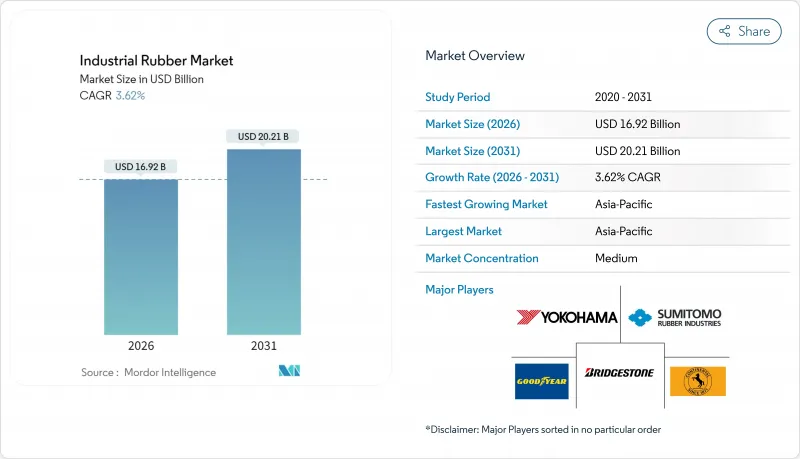
세계의 산업용 고무 시장은 2025년 163억 3,000만 달러에서 2026년까지 169억 2,000만 달러로 성장하고, 2026년부터 2031년까지는 CAGR 3.62%로 성장을 지속하여 202억 1,000만 달러에 달할 전망입니다.
수요는 자동차, 건설, 광업, 일반 산업 공급망에 견조하게 지원되고 있으며, 합성 등급이 안정적인 품질과 규모의 우위를 제공합니다. 컨베이어 시스템, 트랜스미터, 고압 호스 어셈블리는 계속해서 대량 수요를 견인하는 반면, 바이오 베이스 및 재생 고무의 대체품이 꾸준히 잠재 수요를 확대하고 있습니다. 공급면의 회복력은 원유 유래 원료의 가격 변동과 천연 고무 부족에 의해 형성되고, 원료의 선택지와 재활용 능력의 밸런스를 취하는 생산자는 수익의 변동을 억제하고 있습니다. 아시아태평양은 압도적 다수 점유율을 차지하며 업스트림 원료 기반과 다운스트림 제조 거점의 집적이라는 이점을 누리고 있습니다. 한편, 북미와 유럽은 특수 고무 등급과 규제 대응의 리더십으로 차별화를 도모하고 있습니다.
세계의 산업용 고무 시장 동향과 통찰
컨베이어 및 전송 벨트 용도 확대
컨베이어 및 전동 시스템은 운영 비용 절감, 사고 빈도 감소, 에너지 효율 향상을 실현하는 자동화 자재 이송 전략의 기반이 됩니다. 경암 광산, 벌크 화물 항만, 소포 구분 허브에서는 200℃ 이상의 온도 환경에서도 마모 가속을 일으키지 않는 다층 구조의 난연성 벨트가 지정되어 있습니다. 니트릴 배합이나 아라미드 강화 등 개량된 고무 컴파운드는 기존품에 비해 벨트 수명을 최대 25% 연장합니다. 주요 제조업체는 벨트 카카스에 스마트 센서 어레이의 통합을 가속화하고 있으며 예지 보전 프로그램으로 예정되지 않은 다운타임을 약 35% 절감하고 있습니다. 아시아태평양의 광산 및 건축자재 공급업체가 최대 고객층을 차지하고 있지만, 북미의 창고 붐과 유럽의 재활용 시설에서 부가가치 수요가 높아지고 있습니다.
고압 호스 수요 증가
화학, 석유 및 가스, 첨단 제조업 확대에 수반해, 극한 압력, 고속 굴곡 및 부식성 매체에 견디는 호스 수요가 높아지고 있습니다. 주요 공급업체는 300 PSI 이상의 내압성과 다화학물질 노출을 견디면서 FDA 및 EU의 식품 접촉 규제를 충족하는 불소 고무, EPDM, 수소화 니트릴 블렌드를 개발하고 있습니다. 제조업체 각사는 조립 시간 단축과 임펄스 사이클 수명의 향상을 실현하는 크림프 커플링 기술의 개발에 의해 컴파운드 개발을 보완하고 있습니다. Bridgestone이 2024년 Cline Hose & Hydraulics 인수와 같은 전략적 인수는 제품 및 서비스 모두에 대한 비즈니스 기반을 수립하려는 움직임을 보여줍니다. 맞춤형 설계 어셈블리, 배송 즉납 모델, 현지 인증 센터는 이 다품종 소량 생산 분야에서 경쟁 우위를 더욱 강화하고 있습니다.
엄격한 환경 규제
미국 환경보호청(EPA)은 타이어 및 혼합 고무 가공에서 유해 대기 오염물질의 국가 배출 기준을 강화하고, 휘발성 유기 화합물을 1톤당 64그램으로 제한함과 동시에 2027년까지 공장 개수를 의무화했습니다. 유럽의 삼림 파괴 방지 규정은 천연 고무 수입품의 완전한 추적성을 의무화하고 있으며, 조달 비용과 문서화 부담을 증가시키고 있습니다. 캘리포니아의 6PPD 타이어 첨가제 조사는 내구성에 대한 우려로 인해 화합물 재배합에 대한 논의를 촉구하고 있습니다. 한편, PFAS의 단계적 폐지를 위한 세계의 제안은 불소 엘라스토머의 연구개발 파이프라인을 추진하고 있습니다. 컴플라이언스 지원 비용은 중소 컴파운더에게 어려움이 있지만, 청정 용매, 폐쇄 루프 세척 시스템 및 바이오 원료를 조기에 채택한 기업에게는 이익을 제공합니다.
부문 분석
합성 등급(주로 스티렌-부타디엔계)은 자동차 제조업체, 기계 OEM, 인프라 건설업자에 의한 광범위한 온도 범위에서의 안정된 성능 요구로, 2025년에도 공업용 고무 시장의 70.54%라는 압도적 점유율을 유지했습니다. 촉매와 공정의 대폭적인 혁신으로 인장 강도, 내마모성, 내유성이 향상되어 엄격한 OEM 사양에 적합한 특성을 실현하고 있습니다. 재생 고무는 사용한 타이어와 버핑에서 회수되어, 버진 원료에 비해 30-50%의 비용 절감과 순환형 경제의 요구 고조를 배경으로, CAGR 4.78%로 확대하고 있습니다. 컴파운더는 가황 속도를 손상시키지 않고 최대 25%의 재생고무 함량에 대응하도록 배합을 재설계하여 전체 폐기물 감축에 기여하고 있습니다. 천연 고무 공급은 승용 타이어의 탄력성과 대형 오프로드 차량의 그립 성능에 여전히 중요하지만, 동남아시아에서는 병해로 인한 수율 저하가 생산자를 괴롭히고 있습니다. 식물 유래 당류에서 생산되는 바이오 합성 고무(특히 바이오 부타디엔과 폴리 이소프렌)는 자원 압박 완화와 탄소 발자국 감소를 약속하는 파일럿 규모 시험을 추진 중입니다.
압출 성형은 2025년 시점에서 공업용 고무 시장 규모의 44.70%를 차지하며, 치수 정밀도와 낮은 스크랩율이 중요한 호스 프로파일 씰 스트립의 연속 생산에 선호되고 있습니다. 최신 스크류 설계에 의해 처리량이 15% 향상되어, 실시간 점도 감시 시스템에 의한 공정 전환 시간의 단축을 실현하고 있습니다. 사출 성형 및 압축 성형은 다공동 금형과 자동 탈형 로봇의 혜택을 받아 대량 생산되는 자동차용 부시 및 방진 장치에서 중요한 역할을 유지하고 있습니다. 적층 조형은 신기술이면서 항공우주 및 방위, 의료 분야에서 경량이고 복잡한 형상을 실현하는 3D 프린팅 열가소성 폴리우레탄 래티스를 활용해 4.05%라는 가장 빠른 CAGR을 기록하고 있습니다. 광중합성 이소프렌 수지의 진보에 의해 파단 신장률 200% 이상의 엘라스토머 부품이 실현되어, 기능성 프로토타입의 제작 기간이 수주에서 수일로 단축되었습니다. 정밀 롤 시스템에 의한 미세한 두께 제어로 캘린더 가공은 특수 시트 시장, 지붕용 방수 시트, 탱크 내장재, 다이어프램 시트 수요를 계속 지원하고 있습니다.
지역별 분석
아시아태평양은 2025년 시점에서 공업용 고무 시장의 58.60% 점유율을 유지하고 4.00%의 연평균 복합 성장률(CAGR)로 성장을 계속하고 있습니다. 이는 농장에서 컴파운드까지의 통합 공급망, 대규모 타이어 생산 능력 및 방대한 인프라 계획에 의해 지원됩니다. 중국에서는 신차 판매의 약 3분의 1에 달하는 전기자동차 보급률이 수요를 견인해 특수 타이어 및 씰용 컴파운드 수요 증가를 촉진하고 있습니다. 태국과 인도네시아는 세계 천연고무 생산량의 60% 이상을 차지하지만, 병해 발생이나 노동력 부족으로 인한 수량 압박을 받고 정부는 기계화에 의한 수액 채취와 다운스트림 가공의 현대화를 지원하고 있습니다. 인도는 국내 혼합 공장의 확충과 재생 고무 회수 네트워크의 촉진에 의해 수출입 밸런스를 개선 중입니다.
북미에서는 항공우주, 셰일 에너지, 물류 인프라 건설을 기반으로 연률 5% 전후의 성장을 유지하고 있습니다. 미국은 천연고무 수요의 약 90%를 수입에 의존하고 있으며, 공급의 탄력 강화를 위한 국내 과유 재배에 관한 정책 논의가 활발해지고 있습니다. 캐나다에서는 중요한 광물 채굴 확대가 컨베이어 벨트와 호스 수요를 견인하고 멕시코는 공급망을 미국 소비지대에 근접시키는 OEM 투자를 모으고 있습니다.
유럽 수요 구조는 엄격한 환경 규제와 바이오 소재의 급속한 상업화에 의해 형성됩니다. EU 산림 파괴 방지 규칙은 고무 수입품의 추적성을 의무화하고 거래자 간의 디지털 대장 도입을 촉진하고 있습니다. 독일과 프랑스에서는 민들레 유래 천연 고무의 파일럿 농장이 선구적으로 도입되어 동남아산에 비해 운송시 배출량을 삭감하고 있습니다. 동유럽의 타이어 공장에는 대형 림 EV 타이어의 국내 생산을 위한 다액의 자본 주입이 이루어져 운송 불안정화 속에서의 아시아 수입 의존도 저감을 도모하고 있습니다.
라틴아메리카, 중동 및 아프리카는 인프라 프로젝트에 의해 새로운 수요의 회랑이 태어나는 것으로, 그 비율은 작지만 꾸준히 증가하고 있습니다. 브라질은 교량 리노베이션과 항만 확장을 중심으로 유틸리티 지출을 재개하여 고무 베어링과 호스 어셈블리에 대한 수요가 증가하고 있습니다. 걸프 협력 회의(GCC)는 탄화수소 이외의 산업의 다양화를 가속화하고 있으며, 석유화학 콤비나트는 사워 가스에 내성이 있는 EPDM 씰과 니트릴 호스를 지정하고 있습니다. 사하라 이남의 아프리카에서 구리와 리튬 채굴의 전망은 컨베이어 벨트 수요를 지원하지만, 프로젝트의 전개는 정치적 안정과 자금 조달에 대한 접근에 달려 있습니다.
기타 혜택:
- 엑셀 형식 시장 예측(ME) 시트
- 3개월간의 애널리스트 서포트
자주 묻는 질문
목차
제1장 서론
- 조사의 전제조건과 시장의 정의
- 조사 범위
제2장 조사 방법
제3장 주요 요약
제4장 시장 상황
- 시장 개요
- 시장 성장 촉진요인
- 컨베이어 벨트 및 전동 벨트 용도 확대
- 고압호스 수요 증가
- EV 주도에 의한 자동차 경량 부품 수요 증가
- 신흥국에서 인프라 정비 진전
- 바이오 베이스 합성 고무로의 이행
- 시장 성장 억제요인
- 엄격한 환경 규제
- 원유 가격 연동의 원료 가격의 변동성
- 재생 고무의 급속한 보급으로 신규 수요 흡수
- 밸류체인 분석
- Porter's Five Forces
- 공급기업의 협상력
- 구매자의 협상력
- 신규 참가업체의 위협
- 대체품의 위협
- 경쟁도
제5장 시장 규모와 성장 예측
- 고무유형별
- 천연 고무
- 합성 고무
- 재생 고무
- 프로세스별
- 압출 성형
- 성형 및 주조
- 캘린더링
- 3D 프린팅 및 적층 조형
- 용도별
- 컨베이어 벨트
- 전동 벨트
- 고압 호스
- 기타 용도(지붕재, 튜브, 롤 등)
- 최종 사용 산업별
- 자동차 및 운송
- 건설 및 인프라
- 광업 및 금속
- 산업기계 및 설비
- 화학제품 및 석유화학제품
- 항공우주 및 방위
- 전기 및 전자 기기
- 기타
- 지역별
- 아시아태평양
- 중국
- 인도
- 일본
- 한국
- 태국
- 인도네시아
- 베트남
- 말레이시아
- 필리핀
- 기타 아시아태평양
- 북미
- 미국
- 캐나다
- 멕시코
- 유럽
- 독일
- 영국
- 프랑스
- 이탈리아
- 스페인
- 러시아
- 북유럽 국가
- 튀르키예
- 기타 유럽
- 남미
- 브라질
- 아르헨티나
- 콜롬비아
- 기타 남미
- 중동 및 아프리카
- 사우디아라비아
- 아랍에미리트(UAE)
- 카타르
- 남아프리카
- 나이지리아
- 이집트
- 기타 중동 및 아프리카
- 아시아태평양
제6장 경쟁 구도
- 시장 집중도
- 전략적 동향
- 시장 점유율(%)/랭킹 분석
- 기업 프로파일
- Bando Chemical Industries, LTD.
- Bridgestone Industrial
- China Petrochemical Corporation(Sinopec)
- ContiTech Deutschland GmbH
- Denka Company Limited
- ENEOS Materials Corporation
- Parker Hannifin Corp
- SIBUR Holding PJSC
- Sumitomo Rubber Industries, Ltd.
- The Goodyear Tire & Rubber Company
- THE YOKOHAMA RUBBER CO., LTD.
- Trelleborg AB
- Trinseo
- TSRC
- UBE Corporation
제7장 시장 기회와 미래 전망
SHW 26.01.26The industrial rubber market is expected to grow from USD 16.33 billion in 2025 to USD 16.92 billion in 2026 and is forecast to reach USD 20.21 billion by 2031 at 3.62% CAGR over 2026-2031.
Demand remains firmly anchored in automotive, construction, mining and general-industrial supply chains, with synthetic grades supplying consistent quality and scale advantages. Conveyor systems, transmission equipment and high-pressure hose assemblies continue to pull large volumes, while bio-based and reclaimed alternatives steadily widen addressable demand. Supply-side resilience is shaped by volatile crude-derived feedstocks and natural-rubber shortages; producers that balance raw-material optionality with recycling capabilities reduce earnings volatility. Asia-Pacific, holding a decisive majority share, benefits from integrated upstream raw-material bases and downstream manufacturing density, whereas North America and Europe differentiate through specialty rubber grades and regulatory compliance leadership.
Global Industrial Rubber Market Trends and Insights
Increasing application as conveyor & transmission belts
Conveyor and transmission systems underpin automated material-handling strategies that lower operating costs, cut accident frequency and boost energy efficiency. Hard-rock mining, bulk-cargo ports and parcel-sorting hubs specify multi-ply, flame-retardant belts that handle temperatures exceeding 200 °C without accelerated abrasion. Upgraded rubber compounds, often nitrile-blended or aramid-reinforced, extend belt life by up to 25% compared with conventional compounds. Major producers increasingly integrate smart-sensor arrays into belt carcasses, enabling predictive-maintenance programs that reduce unscheduled downtime by nearly 35%. Asia-Pacific miners and construction material suppliers represent the largest customer pool, but value-added demand is rising in North America's warehousing boom and Europe's recycling facilities.
Growing demand for high-pressure hoses
Expanding chemical, oil-and-gas and advanced-manufacturing activity elevates the need for hoses that tolerate extreme pressure, rapid flexing and aggressive media. Leading suppliers formulate fluoroelastomer, EPDM and hydrogenated nitrile blends to withstand over 300 PSI and multi-chemical exposure while meeting FDA and EU food-contact regulations. Producers complement compound development with crimp-coupling innovations that shorten assembly times and improve impulse-cycle life. Strategic acquisitions-such as Bridgestone's 2024 purchase of Cline Hose & Hydraulics-illustrate the push to own both product and service footprints. Custom-engineered assemblies, ship-to-stock delivery models and local certification centers round out competitive advantages in this high-mix application space.
Stringent environmental regulations
The U.S. EPA tightened National Emission Standards for Hazardous Air Pollutants in tire and mixed-rubber processing, capping volatile organics at 64 g per tonne and compelling plant retrofits by 2027. Europe's Deforestation Regulation obliges full traceability for natural-rubber imports, raising procurement costs and documentation burdens. California's investigation into 6PPD tire additives forces compound reformulation discussions amid durability concerns, while global proposals to phase out PFAS push fluoroelastomer R&D pipelines. Compliance outlays challenge smaller compounders but reward early adopters of cleaner solvents, closed-loop wash systems and bio-based feedstocks.
Other drivers and restraints analyzed in the detailed report include:
- EV-led boom in lightweight automotive components
- Infrastructure build-out in emerging economies
- Volatile crude-oil-linked feedstock prices
For complete list of drivers and restraints, kindly check the Table Of Contents.
Segment Analysis
Synthetic grades, dominated by styrene-butadiene, retained a commanding 70.54% share of the industrial rubber market in 2025 as automakers, machinery OEMs and infrastructure builders demanded consistent performance across broad temperature windows. Extensive catalyst and process innovations boost tensile strength, abrasion resistance and oil tolerance, aligning properties with stringent OEM specifications. Reclaimed rubber, harvested from devulcanized end-of-life tires and buffings, expands at a 4.78% CAGR on the back of 30-50% cost savings versus virgin feedstocks and mounting circular-economy mandates. Compounders re-engineer formulations to accommodate reclaimed content of up to 25% without compromising cure kinetics, thereby moderating overall scrap. Natural-rubber supply remains central to passenger-tire elasticity and heavy-haul off-road grip, yet producers wrestle with disease-related yield drops in Southeast Asia. Bio-based synthetic routes, particularly bio-butadiene and polyisoprene from plant sugars, advance pilot-scale trials that promise to ease resource pressures while shrinking carbon footprints.
Extrusion held 44.70% share of the industrial rubber market size in 2025, favored for continuous production of hoses, profiles and sealing strips where dimensional accuracy and low scrap rates are critical. State-of-the-art screw designs increase throughput 15% and support real-time viscosity monitoring systems that cut change-over time. Injection and compression molding retain vital roles for high-volume automotive bushings and vibration isolators, benefitting from multi-cavity tooling and automated demolding robotics. Additive manufacturing, while only emerging, records the fastest 4.05% CAGR as aerospace, defense and medical users exploit 3D-printed thermoplastic polyurethane lattices for lightweight, complex geometries. Advances in photopolymerizable isoprene resins yield elastomeric parts with elongation at break surpassing 200%, bringing functional prototypes within days rather than weeks. Calendaring sustains specialty sheet markets, roofing membranes, tank linings and diaphragm sheets, thanks to microscopic gauge control afforded by precision-roll systems.
The Industrial Rubber Market Report is Segmented by Rubber Type (Natural Rubber, Synthetic Rubber, and More), Process (Extrusion, Molding and Casting, and More), Application (Conveyor Belts, Transmission Belts, and More), End-User Industry (Automotive and Transportation, Construction and Infrastructure, and More), and Geography (Asia-Pacific, North America, and More). The Market Forecasts are Provided in Terms of Value (USD).
Geography Analysis
Asia-Pacific retained 58.60% share of the industrial rubber market in 2025 and is advancing at a 4.00% CAGR, underscored by its integrated plantation-to-compound supply chains, large-scale tire capacities, and vast infrastructure programs. China drives demand through EV adoption rates approaching one-third of new car sales, heightening traction for specialty tire and sealing compounds. Thailand and Indonesia together account for more than 60% of global natural-rubber output, but yields are strained by disease incidence and labor shortages, prompting government support for mechanized tapping and downstream processing upgrades. India tightens its import-export balance by expanding domestic mixing houses and encouraging reclaimed-rubber collection networks.
North America sustains mid-single-digit growth anchored in aerospace, shale-energy and logistics construction. The U.S. imports roughly 90% of its natural-rubber needs, sparking policy discourse around domestic guayule cultivation to improve supply resilience. Canada's mining expansion in critical minerals feeds conveyor-belt and hose demand, while Mexico captures OEM investments relocating supply chains closer to U.S. consumer bases.
Europe's demand profile is shaped by strict environmental regulations and rapid commercialization of bio-based materials. The EU Deforestation Regulation compels traceability for rubber imports, catalyzing digital ledger adoption among traders. Germany and France pioneer dandelion-based natural-rubber pilot farms that lower transport emissions compared with Southeast-Asian supply. Eastern European tire plants receive significant capital infusions to produce larger-rim EV tires domestically, reducing reliance on Asian imports amid shipping volatility.
Latin America and Middle East & Africa collectively contribute a modest but rising share as infrastructure projects launch new demand corridors. Brazil restarts public-works spending focused on bridge retrofits and port expansion, increasing calls for rubber bearings and hose assemblies. The Gulf Cooperation Council accelerates industrial diversification beyond hydrocarbons, with petrochemical complexes specifying EPDM seals and nitrile hoses resistant to sour gas exposure. Sub-Saharan African mining prospects in copper and lithium underpin conveyor-belt demand, yet project rollouts hinge on political stability and financing access.
- Bando Chemical Industries, LTD.
- Bridgestone Industrial
- China Petrochemical Corporation (Sinopec)
- ContiTech Deutschland GmbH
- Denka Company Limited
- ENEOS Materials Corporation
- Parker Hannifin Corp
- SIBUR Holding PJSC
- Sumitomo Rubber Industries, Ltd.
- The Goodyear Tire & Rubber Company
- THE YOKOHAMA RUBBER CO., LTD.
- Trelleborg AB
- Trinseo
- TSRC
- UBE Corporation
Additional Benefits:
- The market estimate (ME) sheet in Excel format
- 3 months of analyst support
TABLE OF CONTENTS
1 Introduction
- 1.1 Study Assumptions & Market Definition
- 1.2 Scope of the Study
2 Research Methodology
3 Executive Summary
4 Market Landscape
- 4.1 Market Overview
- 4.2 Market Drivers
- 4.2.1 Increasing application as conveyor & transmission belts
- 4.2.2 Growing demand for high-pressure hoses
- 4.2.3 EV-led boom in lightweight automotive components
- 4.2.4 Infrastructure build-out in emerging economies
- 4.2.5 Shift to bio-based synthetic rubbers
- 4.3 Market Restraints
- 4.3.1 Stringent environmental regulations
- 4.3.2 Volatile crude-oil-linked feedstock prices
- 4.3.3 Rapid uptake of reclaimed rubber cannibalising virgin demand
- 4.4 Value Chain Analysis
- 4.5 Porter's Five Forces
- 4.5.1 Bargaining Power of Suppliers
- 4.5.2 Bargaining Power of Buyers
- 4.5.3 Threat of New Entrants
- 4.5.4 Threat of Substitutes
- 4.5.5 Degree of Competition
5 Market Size & Growth Forecasts (Value)
- 5.1 By Rubber Type
- 5.1.1 Natural Rubber
- 5.1.2 Synthetic Rubber
- 5.1.3 Reclaimed Rubber
- 5.2 By Process
- 5.2.1 Extrusion
- 5.2.2 Molding and Casting
- 5.2.3 Calendaring
- 5.2.4 3-D Printing / Additive Manufacturing
- 5.3 By Application
- 5.3.1 Conveyor Belts
- 5.3.2 Transmission Belts
- 5.3.3 Pressure Hoses
- 5.3.4 Other Application (Roofing, Tubes, Rolls, etc.)
- 5.4 By End-User Industry
- 5.4.1 Automotive and Transportation
- 5.4.2 Construction and Infrastructure
- 5.4.3 Mining and Metals
- 5.4.4 Industrial Machinery and Equipment
- 5.4.5 Chemical and Petrochemical
- 5.4.6 Aerospace and Defence
- 5.4.7 Electrical and Electronics
- 5.4.8 Others
- 5.5 By Geography
- 5.5.1 Asia-Pacific
- 5.5.1.1 China
- 5.5.1.2 India
- 5.5.1.3 Japan
- 5.5.1.4 South Korea
- 5.5.1.5 Thailand
- 5.5.1.6 Indonesia
- 5.5.1.7 Vietnam
- 5.5.1.8 Malaysia
- 5.5.1.9 Philippines
- 5.5.1.10 Rest of Asia-Pacific
- 5.5.2 North America
- 5.5.2.1 United States
- 5.5.2.2 Canada
- 5.5.2.3 Mexico
- 5.5.3 Europe
- 5.5.3.1 Germany
- 5.5.3.2 United Kingdom
- 5.5.3.3 France
- 5.5.3.4 Italy
- 5.5.3.5 Spain
- 5.5.3.6 Russia
- 5.5.3.7 NORDIC Countries
- 5.5.3.8 Turkey
- 5.5.3.9 Rest of Europe
- 5.5.4 South America
- 5.5.4.1 Brazil
- 5.5.4.2 Argentina
- 5.5.4.3 Colombia
- 5.5.4.4 Rest of South America
- 5.5.5 Middle East and Africa
- 5.5.5.1 Saudi Arabia
- 5.5.5.2 United Arab Emirates
- 5.5.5.3 Qatar
- 5.5.5.4 South Africa
- 5.5.5.5 Nigeria
- 5.5.5.6 Egypt
- 5.5.5.7 Rest of Middle East and Africa
- 5.5.1 Asia-Pacific
6 Competitive Landscape
- 6.1 Market Concentration
- 6.2 Strategic Moves
- 6.3 Market Share(%)/Ranking Analysis
- 6.4 Company Profiles (includes Global level Overview, Market level overview, Core Segments, Financials as available, Strategic Information, Market Rank/Share for key companies, Products & Services, and Recent Developments)
- 6.4.1 Bando Chemical Industries, LTD.
- 6.4.2 Bridgestone Industrial
- 6.4.3 China Petrochemical Corporation (Sinopec)
- 6.4.4 ContiTech Deutschland GmbH
- 6.4.5 Denka Company Limited
- 6.4.6 ENEOS Materials Corporation
- 6.4.7 Parker Hannifin Corp
- 6.4.8 SIBUR Holding PJSC
- 6.4.9 Sumitomo Rubber Industries, Ltd.
- 6.4.10 The Goodyear Tire & Rubber Company
- 6.4.11 THE YOKOHAMA RUBBER CO., LTD.
- 6.4.12 Trelleborg AB
- 6.4.13 Trinseo
- 6.4.14 TSRC
- 6.4.15 UBE Corporation
7 Market Opportunities & Future Outlook
- 7.1 White-space & unmet-needs assessment
- 7.2 Introducing New Manufacturing Techniques to Reduce Hazardous Waste