|
시장보고서
상품코드
1910809
폴리이소부틸렌(PIB) 시장 : 점유율 분석, 업계 동향 및 통계, 성장 예측(2026-2031년)Polyisobutylene (PIB) - Market Share Analysis, Industry Trends & Statistics, Growth Forecasts (2026 - 2031) |
||||||
 Mordor Intelligence
폴리이소부틸렌 시장의 규모는 2026년에는 112만톤에 달할 것으로 예측되고 있습니다.
이는 2025년 108만톤에서 성장한 수치이며, 2031년에는 132만톤에 이를 것으로 전망되고 있습니다. 2026년부터 2031년까지 연평균 복합 성장률(CAGR)은 3.35%로 예측되고 있습니다.
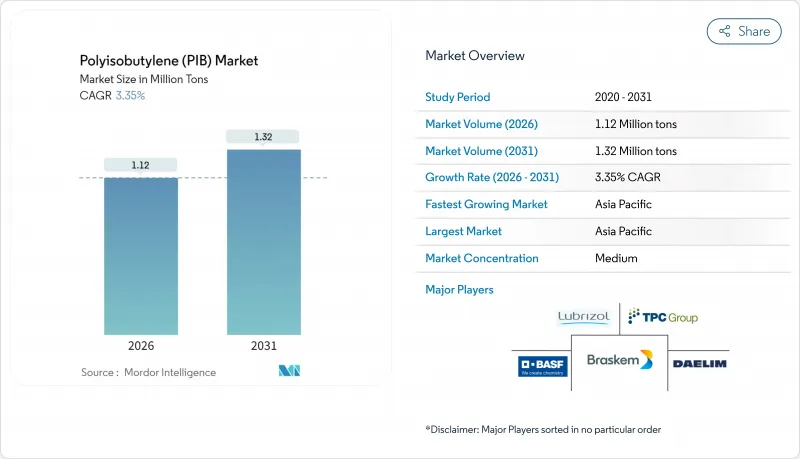
수요는 고성능 윤활유 첨가제, 접착제 시스템, 튜브리스 타이어 컴파운드를 중심으로 유지되고 있으며, 이들 모두는 폴리머가 원래 보유한 가스 불투과성, 열안정성, 화학적 불활성성에 의존하고 있습니다. 차량의 전동화가 진행됨에 따라 엔진 오일, 구동계 유체, 배터리 냉각제의 성능 요건이 확대되어 점도 조정 등급 폴리이소부틸렌에 대한 수요가 높아지고 있습니다. 동시에 건축재료의 휘발성 유기화합물(VOC) 배출규제 강화로 실란트 제조업체는 배합 변경의 트레이드오프 없이 규제 적합성을 실현하는 PIB 기반 솔루션으로 전환하고 있습니다. 아시아태평양에서는 특히 중국과 인도의 통합 프로젝트를 중심으로 한 생산 능력의 확대로 지역 공급 축소를 완화하는 동시에 세계의 폴리이소부틸렌 시장에서 지역의 비용 우위를 강화할 것으로 예측됩니다.
세계의 폴리이소부틸렌(PIB) 시장의 동향 및 전망
접착제 및 실란트 분야 수요 증가
활발한 건설 활동과 자동차 경량화 프로그램을 통해 이소시아네이트 및 기타 휘발성 성분을 제거한 PIB 기반 접착 시스템이 계속 배합 설계자에게 채택되고 있습니다. 유럽연합(EU)에서 새로 발표한 디이소시아네이트 함유량 0.1% 초과 기준은 비폴리우레탄계 구조용 접착제로의 이행을 가속화하고 있으며, 저독성과 다양한 기재에 대한 우수한 습윤성을 갖춘 PIB 화학제품이 현재 선호되고 있습니다. PIB 실란트는 또한 지속적인 내후성을 제공하기 때문에 커튼월 유리, 지붕 방수 시트, 태양광 발전 마운트 시스템에 이상적입니다. 용매계 대체품에 불리한 지속가능성 목표가 성장 전망을 뒷받침하면서 폴리이소부틸렌 시장이 환경에 적합한 재료로 향하는 궤도를 강화하고 있습니다.
이너 라이너 및 튜브리스 타이어 컴파운드의 수요 증가
승용차 및 상용차의 튜브리스 타이어는 타이어의 수명 기간 동안 공기압을 유지하기 위해 PIB 유래 이소부틸렌 이소프렌 고무에 의존합니다. 전기자동차 플랫폼은 굴곡저항의 감소와 안전성의 향상을 추구함으로써 이 요구를 더욱 강화하고 있으며, 이는 아시아태평양의 타이어 제조 거점에서 고분자 등급의 수요를 높이고 있습니다. 클로로부틸 및 브로모부틸과 같은 화학 변형 PIB는 낮은 가스 투과성을 유지하면서 동시 가황 능력을 확장하여 폴리이소부틸렌 시장에서 고성능 지향 프리미엄 등급에 대한 강한 수요를 유지하고 있습니다.
고가의 안정제를 필요로 하는 고유한 UV 불안정성
PIB는 산화 방지제나 자외선 흡수제 없이 햇빛에 노출되면 표면 균열이나 변색을 일으킵니다. 그러므로 옥외용도에는 추가 첨가제가 필요하며, 본질적으로 자외선 안정성을 가진 대체품에 비해 배합 비용이 증가합니다. 힌더드아민계 광안정제의 진보에 의해 처리율은 낮아졌지만, 지붕용 방수 시트나 외장용 실란트의 비용 민감성에 의해 특정 가격 제약 지역에서는 여전히 도입이 제한되고 있습니다.
부문 분석
윤활유는 2025년 폴리이소부틸렌 시장에서 점유율 43.72%를 차지하였고, 멀티그레이드 엔진 오일, 드라이브 라인액, 유압유에서 점도 지수 향상제에 대한 의존도가 높아지는 가운데, 2031년까지 연평균 복합 성장률(CAGR) 3.66%로 확대가 전망됩니다. 경쟁 관계에 있는 올레핀계 공중합체가 있음에도 불구하고, PIB의 증점 효율, 저온 용해성, 전단 안정성이 지속적인 우위성을 뒷받침하고 있습니다. 연료 첨가제 분야는 규모가 작고 전략적인 틈새 시장이며, PIB 숙신이미드계 제품은 세제로서 기능하여 점화식 및 압축 점화식 엔진의 고압 연료 분사 장치를 깨끗하게 유지합니다.
광범위한 용도 개발로 폴리이소부틸렌 시장은 단일 부문의 경기 순환에 영향을 받기 어려운 특성을 가지고 있습니다. 접착제 및 실란트 분야에서는 저VOC 재료를 권장하는 그린 빌딩 기준의 보급에 따라 수요가 확대되고 있으며, PIB 실란트는 습기 이동이 매우 적기 때문에 복층 유리의 수명 연장에 기여하고 있습니다. 안전 규제와 전기자동차(EV)의 수가 증가함에 따라 튜브리스 타이어 및 런플랫 타이어용 이너 라이너 컴파운드에 대한 수요는 견조합니다. 가소제, 전기절연재, 특수화학용도가 수요를 보완하는 증분 수량을 공급하고 있으며, 윤활유가 수요의 기축이 되는 한편 세계 공급업체의 리스크를 분산시키고 있습니다.
폴리이소부틸렌 시장 보고서는 용도별(타이어 튜브, 접착제 및 실란트, 윤활유, 가소제, 연료 첨가제 등), 최종 이용 산업별(자동차 및 운송, 산업기계, 건설 및 건설재, 식품, 의약품 및 퍼스널케어, 전기 및 전자기기), 지역별(아시아태평양, 북미, 유럽, 남미, 중동 및 아프리카)로 분류됩니다.
지역별 분석
아시아태평양은 2025년 폴리이소부틸렌 시장에서 점유율 39.20%를 차지하였고 생산 능력 증강과 다운스트림 타이어, 윤활유, 접착제 산업에서의 지속적인 성장을 배경으로 2031년까지 연평균 복합 성장률(CAGR) 3.98%로 확대될 전망입니다. 중국은 세계 최대의 자동차 생산국이며, 배터리 제조의 선도국 지위에 의해 지역 수요를 뒷받침하고 있습니다. 인도는 급격히 차이를 줄이고 있으며, 루브리졸의 2억 달러 규모 아우랑가바드 공장은 완공 후 의료 등급 및 고성능 화학제품용 폴리이소부틸렌(PIB)을 공급할 예정입니다. 이는 현지 시장의 성장 매력과 중동 및 아프리카로의 수출 가능성을 보여줍니다.
북미에는 통합형 C4 복합시설을 운영하는 기업이 거점을 두고 셰일 유래 원료의 경제성으로부터 혜택을 받고 있습니다. 미국 멕시코 걸프에서 생산되는 PIB는 중서부 및 멕시코의 자동차 산업 기지에 공급되는 동시에 특수 등급 제품은 동서 양해안의 윤활유 블렌더에 제공됩니다. 유럽은 REACH 규정을 준수하는 고부가가치 접착제, 분산제 및 HR-PIB 유도체에 대한 PIB의 활용에 계속 기술적 중점을 두고 있습니다. VOC와 탄소 실적의 감소에 관한 법적 의무에 따라, 배합자는 첨가제의 총 사용량을 줄일 수 있는 고성능 PIB 화학물질로의 전환을 추진하고 있습니다.
남미, 중동 및 아프리카는 폴리이소부틸렌 시장에서 점유율은 낮지만 꾸준히 확대되고 있습니다. 라틴아메리카의 타이어 제조업체와 건설 부문이 지역적 수요를 자극하고 있는 반면, 걸프협력회의(GCC)는 정유소 스트림과 특수 화학물질의 부가가치를 통합하기 위한 PIB 프로젝트를 추진하고 있습니다. 아프리카의 산업화와 자동차 조립에 대한 투자는 2030년까지 인프라의 현대화가 가속화됨에 따라 PIB의 새로운 판매 경로를 개척할 것으로 기대됩니다.
기타 혜택
- 시장 예측(ME) 엑셀 시트
- 3개월 애널리스트 서포트
자주 묻는 질문
목차
제1장 서론
- 조사의 전제조건 및 시장의 정의
- 조사 범위
제2장 조사 방법
제3장 주요 요약
제4장 시장 상황
- 시장 개요
- 촉진요인
- 접착제 및 실란트 분야에서의 수요 증가
- 이너 라이너 및 튜브리스 타이어 컴파운드의 수요 증가
- 차세대 윤활유에서 점도 조정제로서의 용도 확대
- 연료 및 윤활유 첨가제용 고반응성 PIB로의 이행
- 고실리콘 함유 리튬 이온 배터리 음극용 PIB계 바인더
- 억제요인
- 원료 이소부틸렌의 가격 변동성
- 고가의 안정제를 필요로 하는 고유의 자외선 불안정성
- 용제계 PIB 제품에 대한 VOC 및 REACH 규제 강화
- 밸류체인 분석
- Porter's Five Forces
- 공급자의 협상력
- 구매자의 협상력
- 신규 참가업체의 위협
- 대체품의 위협
- 경쟁도
제5장 시장 규모 및 성장 예측
- 용도별
- 타이어 튜브
- 접착제 및 실란트
- 윤활유
- 가소제
- 연료 첨가제
- 전기 절연
- 기타 용도
- 최종 이용 산업별
- 자동차 및 운송
- 산업기계
- 건설 및 건축자재
- 식품, 의약품 및 퍼스널케어
- 전기 및 전자기기
- 지역
- 아시아태평양
- 중국
- 인도
- 일본
- 한국
- 말레이시아
- 태국
- 인도네시아
- 베트남
- 기타 아시아태평양
- 북미
- 미국
- 캐나다
- 멕시코
- 유럽
- 독일
- 영국
- 이탈리아
- 프랑스
- 러시아
- 스페인
- 튀르키예
- 북유럽 국가
- 기타 유럽
- 남미
- 브라질
- 아르헨티나
- 콜롬비아
- 기타 남미
- 중동 및 아프리카
- 사우디아라비아
- 아랍에미리트(UAE)
- 카타르
- 이집트
- 나이지리아
- 남아프리카
- 기타 중동 및 아프리카
- 아시아태평양
제6장 경쟁 구도
- 시장 집중도
- 전략적 동향
- 시장 점유율(%) 및 순위 분석
- 기업 프로파일
- AO GC Titan
- BASF
- Braskem
- Chevron Oronite LLC
- Daelim Co., Ltd
- Dowpol Corporation
- ENEOS Corporation
- Infineum International Limited
- INOES
- Kemipex
- Lubrizol Corporation
- TPC Group
- Zhejiang Shunda New Material Co.
제7장 시장 기회 및 미래 전망
CSM 26.02.09Polyisobutylene Market size in 2026 is estimated at 1.12 million tons, growing from 2025 value of 1.08 million tons with 2031 projections showing 1.32 million tons, growing at 3.35% CAGR over 2026-2031.
Demand continues to coalesce around high-performance lubricant additives, adhesive systems, and tubeless tire compounds, all of which rely on the polymer's inherent gas impermeability, thermal stability, and chemical inertness. Intensifying electrification of vehicles is widening the performance envelope for engine oils, driveline fluids, and battery-coolant formulations, deepening the need for viscosity-modifying grades of polyisobutylene. At the same time, regulatory pressure on volatile organic compound emissions in construction materials is steering sealant producers toward PIB-based solutions that offer compliance without reformulation trade-offs. Capacity expansions in Asia-Pacific, especially integrated projects in China and India, are expected to relieve localized supply tightness while reinforcing the region's cost advantage in the global polyisobutylene market.
Global Polyisobutylene (PIB) Market Trends and Insights
Growing Demand from Adhesives and Sealants
Robust construction activity and vehicle-lightweighting programs continue to push formulators toward PIB-based bonding systems that eliminate isocyanates and other volatile components. New European Union restrictions on diisocyanate content above 0.1% have accelerated the move to non-PU structural adhesives, with PIB chemistries now favored for their low toxicity profile and excellent wet-out on diverse substrates. PIB sealants also provide lasting weather resistance, making them attractive for curtain-wall glazing, rooftop membranes and photovoltaic mounting systems. Growth prospects are underpinned by sustainability targets that penalize solvent-borne alternatives, reinforcing the trajectory of the polyisobutylene market toward eco-compliant materials.
Rising Demand for Inner-Liner and Tubeless Tire Compounds
Tubeless passenger-car and commercial-vehicle tires rely on isobutylene-isoprene rubber derived from PIB to maintain inflation pressure over the service life of the tire. Electric-vehicle platforms intensify this requirement by targeting lower rolling resistance and augmented safety, which in turn lifts polymer grade demand in Asia-Pacific's tire manufacturing clusters. Chemically modified PIBs such as chlorobutyl and bromobutyl extend co-vulcanization capability while preserving low gas permeability, sustaining a strong pull for premium, performance-oriented grades in the polyisobutylene market.
Intrinsic UV Instability Requiring Costly Stabilizers
Without antioxidants and UV absorbers, PIB undergoes surface cracking and discoloration when exposed to sunlight. Outdoor applications therefore impose additional additive packages, raising formulation costs relative to inherently UV-stable alternatives. Advances in hindered-amine light stabilizers have trimmed treat-rates, but cost sensitivity in roofing membranes and exterior sealants still limits adoption in certain price-constrained regions.
Other drivers and restraints analyzed in the detailed report include:
- Expanding Use as Viscosity Modifier in Next-Gen Lubricants
- Shift Toward Highly-Reactive PIB for Fuel and Lube Additives
- Tightening VOC/REACH Rules on Solvent-Borne PIB Products
For complete list of drivers and restraints, kindly check the Table Of Contents.
Segment Analysis
Lubricants represented 43.72% of the polyisobutylene market size in 2025 while advancing at 3.66% CAGR through 2031 as multi-grade engine oils, driveline fluids and hydraulic oils intensify reliance on viscosity-index improvers. PIB's thickening efficiency, low-temperature solvency, and shear-stability underpin its continued dominance despite competing olefin copolymers. Fuel additives form a smaller yet strategic niche where PIB succinimides act as detergents, safeguarding high-pressure fuel-injector cleanliness in both spark-ignition and compression-ignition engines.
The broader application slate keeps the polyisobutylene market insulated from single-sector cyclicality. Adhesives and sealants gain momentum from green-building codes favoring low-VOC materials, with PIB sealants displaying negligible moisture migration that extends the service life of insulating-glass units. Inner-liner compounds for tubeless and run-flat tires remain robust thanks to safety regulations and growing electric-vehicle (EV) volumes. Plasticizer, electrical-insulation, and specialty-chemical outlets provide incremental tonnage that rounds out demand, making lubricants the lodestar while diversifying risk exposure for global suppliers.
The Polyisobutylene Report is Segmented by Application (Tire Tubes, Adhesive and Sealants, Lubricants, Plasticizers, Fuel Additives, and More), End-Use Industry (Automotive and Transportation, Industrial Machinery, Construction and Building Materials, Food/Pharma/Personal-Care, and Electrical and Electronics), and Geography (Asia-Pacific, North America, Europe, South America, and Middle-East and Africa).
Geography Analysis
Asia-Pacific accounted for 39.20% of polyisobutylene market share in 2025 and is expanding at a 3.98% CAGR to 2031 on the back of capacity additions and relentless growth in downstream tire, lubricant and adhesive industries. China anchors regional demand through its status as the world's largest vehicle producer and a front-runner in battery manufacturing. India is quickly narrowing the gap; Lubrizol's USD 200 million Aurangabad plant will deliver medical-grade and performance-chemical PIB variants once completed, demonstrating the draw of local market growth as well as export potential into the Middle East and Africa.
North America houses integrated C4 complex operators and benefits from shale-derived feedstock economics. PIB produced in the U.S. Gulf Coast supplies automotive hubs in the Midwest and Mexico, while specialty grades serve lubricant blenders on both coasts. Europe remains technology-focused, channeling PIB into high-value adhesives, dispersants, and HR-PIB derivatives that comply with REACH. Legislative mandates for lower VOC and carbon footprints are nudging formulators toward highly functional PIB chemistries that can reduce overall additive treat rates.
South America, the Middle East and Africa collectively absorb a modest yet rising share of polyisobutylene market volume. Latin American tire producers and construction sectors stimulate regional pull, whereas the Gulf Cooperation Council pursues PIB projects aimed at integrating refinery streams with specialty-chemical value addition. Africa's nascent industrialization and automotive assembly investments are expected to open new PIB sales corridors as infrastructure modernization accelerates through 2030.
- AO GC Titan
- BASF
- Braskem
- Chevron Oronite LLC
- Daelim Co., Ltd
- Dowpol Corporation
- ENEOS Corporation
- Infineum International Limited
- INOES
- Kemipex
- Lubrizol Corporation
- TPC Group
- Zhejiang Shunda New Material Co.
Additional Benefits:
- The market estimate (ME) sheet in Excel format
- 3 months of analyst support
TABLE OF CONTENTS
1 Introduction
- 1.1 Study Assumptions and Market Definition
- 1.2 Scope of the Study
2 Research Methodology
3 Executive Summary
4 Market Landscape
- 4.1 Market Overview
- 4.2 Market Drivers
- 4.2.1 Growing Demand from Adhesives and Sealants
- 4.2.2 Rising Demand for Inner-Liner and Tubeless Tire Compounds
- 4.2.3 Expanding Use as Viscosity Modifier in Next-Gen Lubricants
- 4.2.4 Shift Toward Highly-Reactive PIB for Fuel and Lube Additives
- 4.2.5 PIB-Based Binders for Si-Rich Li-Ion Battery Anodes
- 4.3 Market Restraints
- 4.3.1 Feedstock Isobutylene Price Volatility
- 4.3.2 Intrinsic UV Instability Requiring Costly Stabilizers
- 4.3.3 Tightening VOC/REACH Rules on Solvent-Borne PIB Products
- 4.4 Value Chain Analysis
- 4.5 Porter's Five Forces
- 4.5.1 Bargaining Power of Suppliers
- 4.5.2 Bargaining Power of Buyers
- 4.5.3 Threat of New Entrants
- 4.5.4 Threat of Substitutes
- 4.5.5 Degree of Competition
5 Market Size and Growth Forecasts (Volume)
- 5.1 By Application
- 5.1.1 Tire Tubes
- 5.1.2 Adhesive and Sealants
- 5.1.3 Lubricants
- 5.1.4 Plasticizers
- 5.1.5 Fuel Additives
- 5.1.6 Electrical Insulation
- 5.1.7 Other Applications
- 5.2 By End-Use Industry
- 5.2.1 Automotive and Transportation
- 5.2.2 Industrial Machinery
- 5.2.3 Construction and Building Materials
- 5.2.4 Food, Pharma and Personal-Care
- 5.2.5 Electrical and Electronics
- 5.3 Geography
- 5.3.1 Asia-Pacific
- 5.3.1.1 China
- 5.3.1.2 India
- 5.3.1.3 Japan
- 5.3.1.4 South Korea
- 5.3.1.5 Malaysia
- 5.3.1.6 Thailand
- 5.3.1.7 Indonesia
- 5.3.1.8 Vietnam
- 5.3.1.9 Rest of Asia-Pacific
- 5.3.2 North America
- 5.3.2.1 United States
- 5.3.2.2 Canada
- 5.3.2.3 Mexico
- 5.3.3 Europe
- 5.3.3.1 Germany
- 5.3.3.2 United Kingdom
- 5.3.3.3 Italy
- 5.3.3.4 France
- 5.3.3.5 Russia
- 5.3.3.6 Spain
- 5.3.3.7 Turkey
- 5.3.3.8 NORDIC Countries
- 5.3.3.9 Rest of Europe
- 5.3.4 South America
- 5.3.4.1 Brazil
- 5.3.4.2 Argentina
- 5.3.4.3 Colombia
- 5.3.4.4 Rest of South America
- 5.3.5 Middle-East and Africa
- 5.3.5.1 Saudi Arabia
- 5.3.5.2 United Arab Emirates
- 5.3.5.3 Qatar
- 5.3.5.4 Egypt
- 5.3.5.5 Nigeria
- 5.3.5.6 South Africa
- 5.3.5.7 Rest of Middle-East and Africa
- 5.3.1 Asia-Pacific
6 Competitive Landscape
- 6.1 Market Concentration
- 6.2 Strategic Moves
- 6.3 Market Share (%)/Ranking Analysis
- 6.4 Company Profiles (includes Global-level Overview, Market-level Overview, Core Segments, Financials as available, Strategic Information, Market Rank/Share, Products and Services, Recent Developments)
- 6.4.1 AO GC Titan
- 6.4.2 BASF
- 6.4.3 Braskem
- 6.4.4 Chevron Oronite LLC
- 6.4.5 Daelim Co., Ltd
- 6.4.6 Dowpol Corporation
- 6.4.7 ENEOS Corporation
- 6.4.8 Infineum International Limited
- 6.4.9 INOES
- 6.4.10 Kemipex
- 6.4.11 Lubrizol Corporation
- 6.4.12 TPC Group
- 6.4.13 Zhejiang Shunda New Material Co.
7 Market Opportunities and Future Outlook
- 7.1 PIB as substitute for wool-fat in leather stuffing agents
- 7.2 PIB-based binder technologies for next-gen battery anodes
- 7.3 White-space and Unmet-Need Assessment