
|
시장보고서
상품코드
1910851
유럽의 텔레매틱스 시장 : 점유율 분석, 업계 동향 및 통계, 성장 예측(2026-2031년)Europe Telematics - Market Share Analysis, Industry Trends & Statistics, Growth Forecasts (2026 - 2031) |
||||||
 Mordor Intelligence
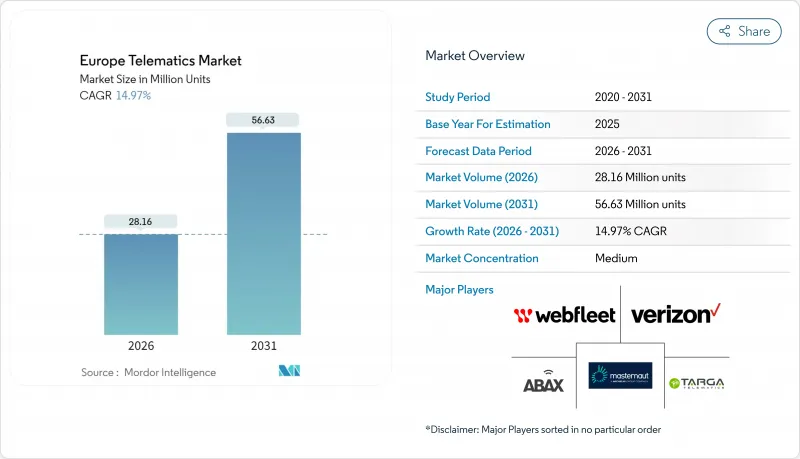
유럽의 텔레매틱스 시장은 2025년 설치 대수 2,449만대에서 2026년에는 2,816만대로 성장하고 2026-2031년에 걸쳐 CAGR 14.97%로 성장을 지속하여, 2031년까지 5,663만대에 달할 것으로 예측되고 있습니다.
이러한 성장은 유럽연합(EU)의 통일된 규제, OEM 연결 전략, 텔레매틱스를 임의의 추가 기능에서 핵심 이동성 인프라 계층으로 끌어올리는 급속한 플릿 디지털화 프로그램에 의해 뒷받침됩니다. 승용차에 보급되는 임베디드 연결 기능, 물류 수요의 지속적인 확대, 2G/3G에서 4G/5G로의 규제 이행이 더하여 유럽의 텔레매틱스 시장의 견고한 기반을 형성하고 있습니다. 한편, 센서 비용의 저하로 대규모 플릿 이외의 부문에서도 도입이 확대되고 있습니다. 경쟁 환경은 Volkswagen 그룹과 Linefit의 제휴가 보여주는 것처럼 OEM 직결 데이터 파이프를 축으로 재구성되고 있습니다. 이에 비해 애프터마켓 전문기업은 플릿 횡단형 분석을 무기로 점유율 보호를 도모하고 있습니다. 데이터 프라이버시의 의무화와 개입의 복잡성이 도입 속도를 억제하지만, 기술 및 규제면의 비즈니스 케이스의 시너지 효과에 의해 유럽 전체에서 견조한 성장 기조가 지속되고 있습니다.
유럽의 텔레매틱스 시장의 동향 및 인사이트
EU eCall과 스마트 타코그래프 의무화 일정
유럽의 텔레매틱스 시장은 2.5톤 이상의 밴에 대한 차세대 eCall 대응과 스마트 타코그래프 2의 탑재를 의무화하는 EU 지침의 동기화에 의해 직접적인 뒷받침을 받고 있습니다. 하드웨어 업데이트 주기는 2026년 7월로 예정되어 있는 타코그래프 도입 기한과 2027년 1월의 4G/5G eCall 전환 시기에 집중되어 있어 공급자는 확실한 수요 가시성을 얻는 동시에 컴플라이언스 모듈을 고수익 분석 서비스와 번들할 수 있습니다. 사업자가 이러한 변경이 불가능한 목표 달성을 위한 조달을 통합함에 따라 솔루션 공급업체는 이해관계자의 반대 의견이 줄어들고 예산 승인이 명확해지는 이점을 누릴 수 있습니다. 이를 통해 유럽의 텔레매틱스 시장 전반에 걸쳐 장기적인 판매 프로세스가 단축되고 단위 판매 속도가 가속화됩니다.
OEM의 임베디드 연결 플랫폼으로의 급속한 전환
자동차 제조업체는 현재 커넥티드 자동차 데이터를 고객의 평생 가치를 극대화하는 전략적 자산으로 자리매김하고 있습니다. 타르가 텔레매틱스와 Volkswagen 그룹의 제휴는 구조적 전환을 보여줍니다. 차량에 표준으로 장착된 모듈은 플릿 도입을 효율화하고, 주간 기능 업데이트를 가능하게 하여 애프터마켓 기기의 고장에 기인하는 지원 문의를 줄입니다. 임베디드 채널은 자체 진단 기능, 무선 업데이트(OTA), 에너지 관리 제어를 실현하여 초기 판매 후에도 장기적인 수익원을 확대합니다. 그 결과 유럽의 텔레매틱스 시장에서는 OEM 데이터 수집과 대규모 분석 강화를 습득한 공급자에 대한 평가가 높아지고 있습니다.
혼합 플릿의 높은 개조 및 통합 비용
유럽의 플릿은 균일한 차량 로트를 구입하는 것은 드물며 연식, 제조업체 및 엔진 기술은 크게 다릅니다. 서로 다른 블랙박스 장치를 설치하면 데이터 사일로화와 지원 혼란을 초래하며 특히 소규모로 운영하는 소유자에게 부담이 됩니다. 통합 비용은 하드웨어, 드라이버 교육, 펌웨어 업데이트, 레거시 CAN 버스의 특이성 등 다양하게 제한된 운전 자금을 소비합니다. 그 결과, 소규모 플릿은 도입을 연기하거나 규제를 최소한으로 준수하는 배치에 머물러 유럽의 텔레매틱스 시장의 잠재적인 CAGR 성장률을 하락시킬 수 있습니다.
부문 분석
상용차는 2025년 시점에서 유럽의 텔레매틱스 시장 점유율의 64.21%를 차지하면서 연료 절약, 경로 준수 및 운전 행동 개선을 통한 예측 가능한 투자 이익률(ROI)을 실현하고 있습니다. 규제 보고가 유럽 전역의 운송 용량 확대와 연동하는 가운데 수요는 견조하며 유럽의 텔레매틱스 시장 규모는 안정된 대형 차량 기반에 의해 뒷받침되고 있습니다. 버스 및 장거리 버스는 전동화 대중교통 차량이 배터리 충전 상태 모니터링이나 차고 충전의 조정을 필요로 하기 때문에 기존의 운임 시스템에서는 대응할 수 없는 업무로 추가 수익을 가져옵니다.
승용차는 현재 규모는 작지만 임베디드 SIM의 보급과 사용량 기반 보험(UBI)이 소비자 부문을 개발해 2031년까지 16.79%의 연평균 복합 성장률(CAGR)로 가장 높은 성장속도를 기록할 전망입니다. 활성 UBI 계약수는 2023년의 1,300만건에서 2028년에는 1,760만건으로 증가할 전망이며 안전 운전을 구체적인 보험료 할인으로 보상하는 보험 수리 모델에 새로운 데이터량을 공급합니다. 소형상용차(LCV)는 두 부문을 연결하며 승용차용 전자기기의 수요와 업무용 물류지표를 충족하면서 예측기간을 통해 두 자릿수의 도입률을 유지합니다.
플릿 관리 및 자산 추적 플랫폼은 2025년 유럽의 텔레매틱스 시장에서 37.12%의 점유율을 차지하였으며 이는 연료비, 유지보수 계획, 안전 의무사항 준수 등 성숙한 가치 증명을 반영합니다. 기능의 지속적인 확장, 영상 기반 운전자 지도, 화물 온도 검증, 멀티모달 대시보드의 집약으로 대규모 물류 사업자의 업데이트율은 높은 수준을 유지하고 있습니다.
반면 보험 및 사용량 기반 텔레매틱스는 계리 모델이 정적 인구통계에서 실시간 행동 점수로 전환하는 가운데 15.61%의 연평균 복합 성장률(CAGR)을 기록했습니다. 이탈리아에서만 950만 건의 보험 텔레매틱스 계약이 실시되고 있으며, 모범 사례가 독일, 영국, 프랑스로 파급되고 있습니다. 안전보안부문은 eCall의 의무화를 원동력으로 성장하고 있으며 OEM이 예지코드 라이브러리를 타사 개발자에게 공개함에 따라 원격 진단이 보급되고 있습니다. 이로 인해 유럽의 텔레매틱스 시장 전반에 걸친 솔루션의 선택이 확산되고 있습니다.
기타 혜택
- 시장 예측(ME) 엑셀 시트
- 3개월 애널리스트 서포트
자주 묻는 질문
목차
제1장 서론
- 조사 전제조건 및 시장 정의
- 조사 범위
제2장 조사 방법
제3장 주요 요약
제4장 시장 상황
- 시장 개요
- 촉진요인
- EU eCall과 스마트 타코그래프 의무화 스케줄
- OEM의 임베디드 연결 플랫폼으로의 급속한 이행
- 전자상거래와 라스트마일 물류의 최적화 추진
- 플릿 소유자의 연결성과 센서 비용 저하
- 차세대(4G/5G) eCall 이행 의무화
- HDV CO2 모니터링 규제가 에코 드라이브 분석을 촉진
- 억제요인
- 혼합 플릿에서의 높은 개조 및 통합 비용
- 데이터 프라이버시와 GDPR(EU 개인정보보호규정)에 의한 벤더 책임 리스크
- 2G/3G의 서비스 종료에 의한 조기 하드웨어 교환의 필요성
- 텔레매틱스 데이터 사이언스 인력의 부족
- 규제 상황
- 기술 전망
- Porter's Five Forces 분석
- 공급자의 협상력
- 구매자의 협상력
- 신규 참가업체의 위협
- 대체품의 위협
- 경쟁 기업 간 경쟁 관계
- 거시경제 요인이 시장에 미치는 영향
제5장 시장 규모 및 성장 예측(대수)
- 차종별
- 상용차(LCV, MCV, HCV, 버스)
- 승용차
- 솔루션 유형별
- 플릿 관리 및 자산 추적
- 안전보안(eCall, SVT)
- 보험 및 사용량 기반 텔레매틱스
- 인포테인먼트 빈 내비게이션
- 원격 진단 및 예지보전
- 기술별
- 임베디드
- 유선 연결형 및 스마트폰 통합형
- 애프터마켓용 블랙박스
- 전개 모드별
- OEM LINE-FIT 플랫폼
- 애프터마켓 서비스 제공업체
- 국가별
- 영국
- 독일
- 프랑스
- 이탈리아
- 스페인
- 네덜란드
- 스웨덴
- 노르웨이
- 덴마크
- 핀란드
- 폴란드
- 러시아
- 기타 유럽
제6장 경쟁 구도
- 시장 집중도
- 전략적 동향
- 시장 점유율 분석
- 기업 프로파일
- Webfleet Solutions BV
- Targa Telematics SpA
- Verizon Communications Inc.(Verizon Connect)
- ABAX UK Ltd.
- Masternaut Limited
- Gurtam Inc.
- MiX Telematics Limited
- Mercedes-Benz Group AG
- Volvo Group
- Scania AB
- MAN Truck and Bus SE
- DAF Trucks NV
- Robert Bosch GmbH
- Continental AG
- Trimble Inc.
- CalAmp Corp.
- Geotab Inc.
- Teletrac Navman Group Ltd.
- AddSecure AB
- Microlise Group PLC
- Trakm8 Holdings PLC
- OCTO Telematics SpA
- Transics International BVBA
제7장 시장 기회 및 미래 전망
CSM 26.02.04The Europe telematics market is expected to grow from 24.49 million installed units in 2025 to 28.16 million installed units in 2026 and is forecast to reach 56.63 million installed units by 2031 at 14.97% CAGR over 2026-2031.
Growth is underpinned by synchronized European Union (EU) mandates, original-equipment-manufacturer (OEM) connectivity strategies, and fast-moving fleet-digitization programs that pull telematics from a discretionary add-on to a core mobility infrastructure layer. Rising embedded connectivity in passenger cars, the ongoing logistics boom, and the regulatory migration from 2G/3G to 4G/5G collectively set a robust baseline for the Europe telematics market, while declining sensor costs broaden adoption beyond large fleets. Competitive intensity is reshaping around direct OEM data pipes, evidenced by Volkswagen Group's line-fit partnerships, even as aftermarket specialists position themselves with cross-fleet analytics to defend share. Data privacy obligations and retrofit complexity temper rollout speed, but overall momentum remains firmly positive thanks to overlapping technology, regulatory, and business case catalysts across the continent.
Europe Telematics Market Trends and Insights
EU eCall and Smart Tachograph Compliance Timeline
The Europe telematics market receives a direct uplift from synchronized EU directives that stipulate Next Generation eCall readiness and Smart Tachograph 2 installation across vans above 2.5 tonnes. Hardware refresh cycles concentrate around the July 2026 tachograph deadline and the January 2027 4G/5G eCall cut-over, giving providers reliable demand visibility while allowing bundling of compliance modules with higher-margin analytics services. As operators consolidate procurement to meet these immovable milestones, solution vendors benefit from fewer stakeholder objections and clearer budget approvals, effectively flattening lengthy sales funnels and accelerating unit run-rates across the Europe telematics market.
Rapid OEM Shift to Embedded Connectivity Platforms
OEMs now view connected-vehicle data as a strategic asset for lifetime customer monetization. Partnerships such as Targa Telematics and Volkswagen Group demonstrate a structural pivot: line-fit modules ship with the vehicle, streamlining fleet onboarding, enabling weekly feature drops, and reducing support queries tied to aftermarket device faults. Embedded channels also unlock proprietary diagnostics, over-the-air (OTA) updates, and energy-management controls, extending revenue streams long after initial sale. Consequently, the Europe telematics market increasingly rewards providers that master OEM data ingestion and analytic enrichment at scale.
High Retrofit and Integration Costs for Mixed Fleets
European fleets seldom buy homogenous vehicle batches; age, make, and engine technology vary widely. Installing disparate black-box devices leads to data silos and support churn, especially for owner-operators juggling thin profit margins. Integration expenses roll beyond hardware, driver onboarding, firmware updates, and legacy CAN-bus quirks consume scarce operating capital. Consequently, smaller fleets defer deployments or restrict rollouts to regulatory minimums, shaving a potential rate off the Europe telematics market CAGR in the near term.
Other drivers and restraints analyzed in the detailed report include:
- E-commerce and Last-Mile Logistics Optimization Push
- Falling Connectivity and Sensor Costs for Fleet Owners
- Data-Privacy and GDPR-Driven Vendor Liability Risk
For complete list of drivers and restraints, kindly check the Table Of Contents.
Segment Analysis
Commercial vehicles accounted for 64.21% of the Europe telematics market share in 2025, delivering predictable ROI through fuel saving, route adherence, and driver-behavior improvements. Demand stays resilient as regulatory reporting aligns with freight-capacity expansion across pan-European corridors, anchoring the Europe telematics market size to a stable, heavy-duty foundation. Buses and coaches add incremental revenue as electrified public-transport fleets require battery-state-of-charge monitoring and depot-charging orchestration, tasks unserved by legacy ticketing systems.
Passenger cars, while smaller today, post the highest growth pace at a 16.79% CAGR to 2031 as embedded SIM penetration and usage-based insurance (UBI) unlock consumer segments. Active UBI policies are set to climb from 13.0 million in 2023 to 17.6 million in 2028, funneling fresh data volumes into actuarial models that reward safe driving with tangible premium discounts. Light commercial vehicles (LCVs) bridge both worlds, absorbing passenger-car electronics while satisfying business-grade logistics metrics, ensuring sustained double-digit adoption rates throughout the forecast window.
Fleet-management and asset-tracking platforms held 37.12% of the Europe telematics market size in 2025, reflecting mature value proofs around fuel costs, maintenance scheduling, and duty-of-care compliance. Continuous feature enrichment, video-based driver coaching, cargo-temperature validation, and multi-modal dashboard aggregation, keeps renewal rates high among large logistics operators.
Insurance and usage-based telematics, however, top the growth chart at a 15.61% CAGR as actuarial models migrate from static demographics to real-time behavioral scoring. Italy alone hosts 9.5 million active insurance-telematics policies, propagating best practices to Germany, the UK, and France. Safety-and-security sub-verticals ride mandatory eCall adoption, while remote diagnostics gain traction as OEMs expose prognostic code libraries to third-party developers, widening the solutions funnel across the Europe telematics market.
The Europe Telematics Market Report is Segmented by Vehicle Type (Commercial Vehicles and Passenger Cars), Solution Type (Fleet Management and Asset Tracking, and More), Technology (Embedded, Tethered/Smartphone-Integrated, and Aftermarket Black-Box), Deployment Mode (OEM Line-Fit Platforms and Aftermarket Service Providers), and Geography. The Market Forecasts are Provided in Terms of Volume (Units).
List of Companies Covered in this Report:
- Webfleet Solutions B.V.
- Targa Telematics S.p.A.
- Verizon Communications Inc. (Verizon Connect)
- ABAX UK Ltd.
- Masternaut Limited
- Gurtam Inc.
- MiX Telematics Limited
- Mercedes-Benz Group AG
- Volvo Group
- Scania AB
- MAN Truck and Bus SE
- DAF Trucks N.V.
- Robert Bosch GmbH
- Continental AG
- Trimble Inc.
- CalAmp Corp.
- Geotab Inc.
- Teletrac Navman Group Ltd.
- AddSecure AB
- Microlise Group PLC
- Trakm8 Holdings PLC
- OCTO Telematics S.p.A.
- Transics International BVBA
Additional Benefits:
- The market estimate (ME) sheet in Excel format
- 3 months of analyst support
TABLE OF CONTENTS
1 INTRODUCTION
- 1.1 Study Assumptions and Market Definition
- 1.2 Scope of the Study
2 RESEARCH METHODOLOGY
3 EXECUTIVE SUMMARY
4 MARKET LANDSCAPE
- 4.1 Market Overview
- 4.2 Market Drivers
- 4.2.1 EU eCall and Smart Tachograph compliance timeline
- 4.2.2 Rapid OEM shift to embedded connectivity platforms
- 4.2.3 E-commerce and last-mile logistics optimisation push
- 4.2.4 Falling connectivity and sensor costs for fleet owners
- 4.2.5 Next-Gen (4G/5G) eCall migration mandate
- 4.2.6 HDV CO2 monitoring rules nudging eco-driving analytics
- 4.3 Market Restraints
- 4.3.1 High retrofit and integration costs for mixed fleets
- 4.3.2 Data-privacy and GDPR-driven vendor liability risk
- 4.3.3 2G/3G sunset forcing premature hardware replacement
- 4.3.4 Shortage of telematics data-science talent
- 4.4 Regulatory Landscape
- 4.5 Technological Outlook
- 4.6 Porter's Five Forces Analysis
- 4.6.1 Bargaining Power of Suppliers
- 4.6.2 Bargaining Power of Buyers
- 4.6.3 Threat of New Entrants
- 4.6.4 Threat of Substitute Products
- 4.6.5 Intensity of Competitive Rivalry
- 4.7 Impact of Macroeconomic Factors on the Market
5 MARKET SIZE AND GROWTH FORECASTS (UNITS)
- 5.1 By Vehicle Type
- 5.1.1 Commercial Vehicles (LCV, MCV, HCV, Buses)
- 5.1.2 Passenger Cars
- 5.2 By Solution Type
- 5.2.1 Fleet Management and Asset Tracking
- 5.2.2 Safety and Security (eCall, SVT)
- 5.2.3 Insurance / Usage-Based Telematics
- 5.2.4 Infotainment and Navigation
- 5.2.5 Remote Diagnostics and Predictive Maintenance
- 5.3 By Technology
- 5.3.1 Embedded
- 5.3.2 Tethered / Smartphone-Integrated
- 5.3.3 Aftermarket Black-Box
- 5.4 By Deployment Mode
- 5.4.1 OEM Line-Fit Platforms
- 5.4.2 Aftermarket Service Providers
- 5.5 By Country
- 5.5.1 United Kingdom
- 5.5.2 Germany
- 5.5.3 France
- 5.5.4 Italy
- 5.5.5 Spain
- 5.5.6 Netherlands
- 5.5.7 Sweden
- 5.5.8 Norway
- 5.5.9 Denmark
- 5.5.10 Finland
- 5.5.11 Poland
- 5.5.12 Russia
- 5.5.13 Rest of Europe
6 COMPETITIVE LANDSCAPE
- 6.1 Market Concentration
- 6.2 Strategic Moves
- 6.3 Market Share Analysis
- 6.4 Company Profiles (includes Global level Overview, Market level overview, Core Segments, Financials as available, Strategic Information, Market Rank/Share for key companies, Products and Services, and Recent Developments)
- 6.4.1 Webfleet Solutions B.V.
- 6.4.2 Targa Telematics S.p.A.
- 6.4.3 Verizon Communications Inc. (Verizon Connect)
- 6.4.4 ABAX UK Ltd.
- 6.4.5 Masternaut Limited
- 6.4.6 Gurtam Inc.
- 6.4.7 MiX Telematics Limited
- 6.4.8 Mercedes-Benz Group AG
- 6.4.9 Volvo Group
- 6.4.10 Scania AB
- 6.4.11 MAN Truck and Bus SE
- 6.4.12 DAF Trucks N.V.
- 6.4.13 Robert Bosch GmbH
- 6.4.14 Continental AG
- 6.4.15 Trimble Inc.
- 6.4.16 CalAmp Corp.
- 6.4.17 Geotab Inc.
- 6.4.18 Teletrac Navman Group Ltd.
- 6.4.19 AddSecure AB
- 6.4.20 Microlise Group PLC
- 6.4.21 Trakm8 Holdings PLC
- 6.4.22 OCTO Telematics S.p.A.
- 6.4.23 Transics International BVBA
7 MARKET OPPORTUNITIES AND FUTURE OUTLOOK
- 7.1 White-space and Unmet-Need Assessment