|
시장보고서
상품코드
1934659
3D Printing In Aerospace And Defense : 시장 점유율 분석, 업계 동향과 통계, 성장 예측(2026-2031년)3D Printing In Aerospace And Defense - Market Share Analysis, Industry Trends & Statistics, Growth Forecasts (2026 - 2031) |
||||||
 Mordor Intelligence
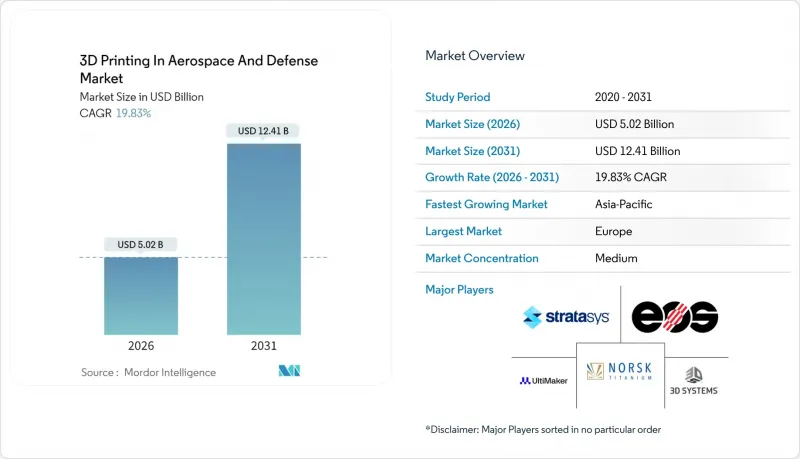
항공우주 및 방위 분야 3D 프린팅 시장 규모는 2026년에 50억 2,000만 달러로 추정되고 있습니다.
이는 2025년 41억 9,000만 달러에서 성장한 수치이며, 2031년에는 124억 1,000만 달러에 달할 것으로 예측됩니다. 2026년부터 2031년까지 연평균 복합 성장률(CAGR) 19.83%를 나타낼 것으로 예측됩니다.
연비 규제의 급속한 강화, 강력한 공급망의 필요성, 차세대 제조 플랫폼의 성숙으로 인해 민간, 국방 및 우주 프로그램 전반에 걸쳐 채택이 촉진되고 있습니다. 무게에 민감한 추진 시스템, 객실 및 구조 부품의 양산화, 인공지능(AI)을 통한 신속한 인증 프로세스가 결합되어 시장 출시 시간을 단축하고 개발 비용을 압축하고 있습니다. 미국 공군 연구소의 2024년 적층제조(AM) 기술 혁신을 위한 2억 3,500만 달러의 공적 자금과 NASA의 아르테미스 계획으로 인한 수요 창출 등 탄탄한 공적 자금이 북미의 선도적 지위 유지를 뒷받침하고 있습니다. 티타늄, 니켈, 알루미늄 분말을 중심으로 한 재료 공급 계약이 생태계의 안정성을 뒷받침하고, 프린터 가격 하락으로 수백 개의 Tier 2, Tier 3 공급업체가 진입할 수 있게 되었습니다. 니콘의 SLM 솔루션즈(SLM Solutions) 6억 2,200만 달러 인수를 비롯한 전략적 설비 통합은 시제품 제작 단계에서 양산 체제로의 전환을 의미합니다.
항공우주 및 국방 분야 세계 3D 프린팅 시장 동향과 인사이트
연료 효율이 높은 기체군을 위한 경량화 요구
국제민간항공기구(ICAO)의 CORSIA(탄소배출량 조정제도)와 유럽연합(EU)의 'Fit for 55' 패키지로 인해 항공업계는 탄소배출량 감축 목표 강화에 직면해 있으며, 제조업체들은 가능한 한 기체 중량을 줄여야 하는 상황에 직면해 있습니다. GE 에어로스페이스의 LEAP 연료 노즐에서 알 수 있듯이, 적층제조기술(AM)은 여러 부품의 통합을 통해 40-60%의 경량화를 실현합니다. 20개의 부품을 하나로 통합하여 질량을 25% 줄였습니다. 보잉 787 프로그램에서는 이미 300개 이상의 적층 가공 부품이 비행에 투입되어 이전 세대 와이드바디 항공기 대비 20%의 연료 소비 개선이 이루어졌습니다. 기존 방식으로는 가공이 불가능했던 복잡한 격자 구조와 내부 냉각 채널도 엄격한 정적 테스트와 피로 테스트를 통과하여 OEM 제조업체는 안전성을 유지하면서 무게 목표를 달성할 수 있습니다. 군용 프로그램에서는 경량화를 통해 항속거리와 체공시간을 연장하여 차세대 전투기 및 장거리 무인항공기에 매우 중요한 전술적 우위를 확보할 수 있습니다.
금속 3D 프린터 및 분말 가격 하락
생산용 금속 3D 프린터의 평균 판매 가격은 경쟁 심화와 규모의 경제 효과로 인해 2022년부터 2024년까지 25-30% 하락했습니다. Desktop Metal의 'Shop System'은 42만 달러로 2023년 동급 모델 대비 약 40% 저렴하면서도 철강, 니켈, 티타늄 부품에서 AS9100 규격의 재현성을 유지합니다. 분말 재활용 기술의 병행 발전으로 재사용률이 95-98%에 달하고, 재료비를 두 자릿수 비율로 절감하고 있습니다. 호가나스 AB의 스웨덴 생산능력 확장(2024년 말부터 가동)은 연간 수천 미터톤의 항공우주 등급 티타늄 분말을 추가로 공급하여 현물 가격의 변동폭을 줄일 수 있습니다. 자본금 요건이 낮아짐에 따라 소규모 공급업체도 소량 다품종 계약에 대한 AM 투자를 정당화할 수 있게 되었습니다. 특히 부품의 다양성이 높고 생산 로트가 작은 UAV 분야에서 두드러집니다.
생산 등급 금속 AM의 높은 자본 비용 및 분말 비용
가격 조정 후에도 항공기 부품의 공차에 대응할 수 있는 턴키 시스템은 여전히 50만-200만 달러의 비용이 소요됩니다. 반면, 항공우주용 티타늄과 니켈 분말은 1kg당 150-300달러로 산업용보다 약 30% 더 비쌉니다. 클린룸 보관, 불활성 가스 처리, 열간 등방성 프레스(HIP)는 설비와 후처리를 포함하면 가격이 두 배로 올라갑니다. 남미, 동남아시아, 아프리카공급업체들은 자금 조달 옵션이 제한적이라는 점이 장벽으로 작용하고 있습니다. 이러한 비용 부담은 경쟁력 있는 노동력과 기체 최종 조립 라인에 근접한 이점을 가진 지역에서의 사업 확장을 억제하여 항공우주 3D 프린팅 시장의 성장을 둔화시키고 있습니다.
부문 분석
항공기 응용 분야는 2025년 항공우주 3D 프린팅 시장 수익의 64.95%를 차지할 것으로 예상되며, 이는 객실 브래킷, 환경 제어 덕트, 엔진 서브 어셈블리에 대한 깊은 침투를 반영하고 있습니다. 민항기에서는 무게 1kg을 줄이면 연료 소비량이 약 0.03% 감소하기 때문에 강도 마진을 유지하면서 두 자릿수 경량화를 실현하는 부품이 운항사로부터 환영받고 있습니다. 단항기월생산량이 70대를 넘어섰고, 와이드바디 항공기 프로그램이 회복되면서 항공기 부품용 항공우주 3D 프린팅 시장 규모는 18.2%의 연평균 복합 성장률(CAGR)로 확대될 것으로 전망됩니다. 또한, 후방 개보수 기회도 풍부합니다. 3D 프린팅 대체 부품은 기존 제품과 형상을 일치시키면서 크게 경량화할 수 있기 때문에 대규모 재인증이 필요 없고, 현역 기종의 수명을 연장할 수 있습니다. 항공사들은 예비 부품 재고를 최소화하기 위해 3D 프린팅 객실 부품의 대량 주문을 늘리고 있습니다. 이 방식은 물리적 재고가 아닌 CAD 파일을 보관하는 분산형 디지털 창고를 통해 가능합니다.
무인항공기(UAV)는 유인 플랫폼을 능가하는 성장세를 보이며 2031년까지 연평균 26.10%의 성장률을 보일 것으로 예측됩니다. 이는 국방부가 분쟁 환경을 위한 소모성 플랫폼을 요구하고 있기 때문입니다. 개발 주기가 짧은 분야에서는 여러 개의 소량 생산에 금형 투자를 하는 것이 비경제적이기 때문에 AM이 유리합니다. 물류 및 항공 점검에 민간 UAV를 도입하는 것도 그 혜택을 누리고 있습니다. 인쇄된 기체 구조는 센서 탑재부 및 화물칸의 신속한 커스터마이징을 가능하게 합니다. 이러한 요인들이 결합되어 2026년부터 2031년까지 전체 항공우주 3D 프린팅 시장에서 UAV가 가장 큰 증분 수익을 창출할 것으로 예측됩니다.
금속 합금은 2025년 매출에서 60.05%를 차지하여 연소실 라이너 및 터빈 블레이드와 같은 고온 영역에서 티타늄의 중요성을 뒷받침합니다. AM 기술은 티타늄의 "구매에서 비행까지의 비율"을 15:1에서 거의 1:1로 감소시켜 원자재 폐기 및 부품 비용을 줄입니다. 이는 kg당 20달러가 넘는 금속에서 타의 추종을 불허하는 우위입니다. 엄격한 기계적 요구 사항과 성숙한 인증 데이터 세트가 금속 합금의 항공우주 3D 프린팅 시장 점유율을 뒷받침하고 있습니다. 인코넬 718과 같은 니켈계 초합금은 1,000℃에서의 내크리프성이 필수적인 배기 노즐 및 극초음속 항공기 부품용으로 꾸준히 성장하고 있습니다.
니오브 C103, 탄탈륨 합금, 레늄 혼합물 등 특수금속 및 내화금속은 차세대 로켓 엔진과 스크램블 제트 엔진이 1,500℃ 이상의 내열성을 요구함에 따라 24.95%의 연평균 복합 성장률(CAGR)이 예상됩니다. 난연성, 연기 발생량, 독성 관련 규제 대응을 위해 PEEK, PEI와 같은 고성능 폴리머는 비부하 내장 부품에서 여전히 중요성이 유지되고 있습니다. 그러나 연속적인 하중과 열 사이클에 노출되는 영역에서는 여전히 금속이 주류를 이루고 있습니다. 알루미늄과 세라믹 나노상을 결합한 복합 분말은 가까운 미래의 전망으로 존재하지만, 피로 데이터에 대한 보다 광범위한 검증이 이루어지기 전까지는 항공우주 분야의 3D 프린팅 시장 규모에서 극히 일부만 차지할 것으로 예측됩니다.
지역별 분석
2025년 북미는 보잉, 록히드마틴, GE의 존재와 독보적인 방산 자금력에 힘입어 전 세계 매출의 43.10%를 차지할 것으로 예측됩니다. FAA 권고통보 AC 20-170A는 일부 파괴시험을 대신하여 공정 시뮬레이션을 허용함으로써 인증의 큰 병목현상을 해소하였습니다. 캐나다의 봄바디어(Bombardier)는 리어젯과 챌린저의 캐빈을 경쟁력 있게 만들기 위해 인쇄된 인테리어 부품을 활용하고 있습니다. 멕시코의 바하 캘리포니아 클러스터는 비용 효율적인 노동력을 활용하여 브래킷 제조를 위한 분말층 용융라인을 운영하고 있습니다. 미국 국방부의 AM Forward 프로그램은 국내 공급업체가 초기 개발 위험을 흡수하여 항공우주 3D 프린팅 시장에서 지역 리더십을 확고히 할 수 있도록 보장합니다.
유럽은 에어버스, 롤스로이스, 사프란, 그리고 독일과 스웨덴을 중심으로 한 활발한 재료과학 커뮤니티에 힘입어 2위를 차지하고 있습니다. 유럽의 항공우주 3D 프린팅 시장은 환경 목표를 항공기 중량에 연동하는 EU 그린딜(Green Deal)의 수혜를 받고 있으며, 사실상 AM 도입에 보조금을 지급하고 있습니다. 유럽항공안전청(EASA)의 디지털 스레드 개념은 구조 승인 기간을 단축하고, 릴리움 및 버티컬 에어로스페이스가 eVTOL 기체 구조물 프린팅을 추진하는 데 큰 도움이 되었습니다. 프랑스 툴루즈 클러스터는 연구개발 세제혜택을 중심으로 뭉쳐 고온합금 관련 스타트업 기업을 육성하고 있습니다. 한편, 독일 프라운호퍼 연구소는 멀티 레이저 교정 프로토콜을 개척하여 세계 PBF 기술 표준을 확립할 수 있는 잠재력을 가지고 있습니다.
아시아태평양은 CAGR 25.95%로 가장 빠르게 성장하고 있으며, 중국의 C919 양산 확대, 인도의 국산화 추진, 일본의 야금 기술의 깊이가 원동력이 되고 있습니다. EOS와 Godrej의 항공우주 합작회사는 수출용 엔진용 비행 인증 연료 매니폴드를 적층 가공하여 수출용 엔진에 적용했습니다. 중국의 국가 계획은 2030년까지 차세대 터보 팬 부품의 70%에 적층 가공 라인을 할당하여 강력한 국내 공급망을 구축할 것입니다. 미쓰비시중공업은 5축 가공기에 DED 헤드를 설치하여 벌크헤드 수리에 적층조형과 절삭가공을 융합했습니다. 한국의 KF-21 전투기에는 구조 중량 절감을 위해 3D 프린팅으로 제작된 티타늄 벌크헤드를 채택하고 있습니다. 이러한 움직임으로 아시아태평양은 항공우주 3D 프린팅 시장에서 중요한 수요처로서 입지를 확고히 하고 있습니다.
기타 특전:
- 엑셀 형식 시장 예측(ME) 시트
- 애널리스트의 3개월간 지원
자주 묻는 질문
목차
제1장 서론
제2장 조사 방법
제3장 주요 요약
제4장 시장 구도
제5장 시장 규모와 성장 예측
제6장 경쟁 구도
제7장 시장 기회와 향후 전망
LSH 26.03.033D printing in aerospace and defense market size in 2026 is estimated at USD 5.02 billion, growing from 2025 value of USD 4.19 billion with 2031 projections showing USD 12.41 billion, growing at 19.83% CAGR over 2026-2031.
Rapid escalation in fuel-efficiency mandates, the need for resilient supply chains, and the maturation of next-generation manufacturing platforms propel adoption across civil, defense, and space programs. Weight-sensitive propulsion systems, serial production of cabin and structural parts, and faster qualification pathways enabled by artificial intelligence (AI) now converge to shorten time-to-market and compress development costs. Robust public funding, exemplified by the US Air Force Research Laboratory's USD 235 million additive manufacturing (AM) innovation tranche in 2024 and NASA's Artemis demand pull to keep North America in a leadership position. Material supply agreements focused on titanium, nickel, and aluminum powders underpin ecosystem stability, while falling printer prices open participation to hundreds of tier-2 and tier-3 suppliers. Strategic equipment mergers, notably Nikon's USD 622 million purchase of SLM Solutions, signal a shift from prototyping toward high-volume production readiness.
Global 3D Printing In Aerospace And Defense Market Trends and Insights
Weight-Reduction Mandate for Fuel-Efficient Fleets
Global aviation faces intensifying carbon goals under ICAO's CORSIA and the European Union's (EU's) Fit for 55 package, spurring manufacturers to cut airframe mass wherever possible. AM enables 40-60% weight reduction while consolidating multipart assemblies, as evidenced by GE Aerospace's LEAP fuel nozzle, which merges 20 pieces into one and trims 25% of the mass. The B787 program already flies over 300 printed parts, supporting a 20% fuel-burn improvement relative to previous-generation widebodies. Complex lattice structures and internal cooling channels, impossible to machine conventionally, now pass stringent static and fatigue tests, allowing OEMs to push weight targets without compromising safety. Military programs add a tactical dimension because lighter aircraft extend range and loiter time, which is critical for next-generation fighters and long-endurance UAVs.
Falling Metal-Printer and Powder Prices
Average selling prices for production-grade metal printers fell 25-30% between 2022 and 2024, driven by competitive intensity and scaling benefits. Desktop Metal's Shop System, priced at USD 420,000, comes roughly 40% below 2023 equivalents yet maintains AS9100-ready repeatability for steel, nickel, and titanium parts. Parallel gains in powder recycling push reuse rates to 95-98%, slicing material spend by double-digit percentages. Hoganas AB's Swedish capacity expansion, online since late 2024, adds thousands of metric tons of aerospace-grade titanium powder per year and narrows spot-price volatility. Lower capital thresholds enable smaller suppliers to justify AM investments for low-volume, high-mix contracts, especially in the UAV arena, where component variety is high and production runs remain modest.
High Capital and Powder Costs for Production-Grade Metal AM
Even after price rationalization, turnkey systems capable of flight-hardware tolerances still cost USD 500,000-2 million, while aerospace-grade titanium or nickel powders run USD 150-300 per kg, about 30% above industrial varieties. Clean-room storage, inert-gas handling, and hot isostatic pressing double the sticker price once facilities and post-processing are counted. For suppliers in South America, Southeast Asia, and Africa, scarce financing options magnify the hurdle. The cost burden curbs expansion in regions that otherwise offer competitive labor and proximity to airframe final assembly lines, moderating the growth of the aerospace 3D printing market.
Other drivers and restraints analyzed in the detailed report include:
- Defense AM-Forward Funding Lifts SME Adoption
- AI-Driven Qualification Slashes Certification Lead-Times
- Stringent Aerospace Qualification Timelines
For complete list of drivers and restraints, kindly check the Table Of Contents.
Segment Analysis
Aircraft applications generated 64.95% of the aerospace 3D printing market revenue in 2025, reflecting deep penetration into cabin brackets, environmental-control ducting, and engine subassemblies. In civil fleets, every kilogram saved cuts fuel burn by roughly 0.03%, so operators welcome components that deliver double-digit weight relief while holding strength margins. The aerospace 3D printing market size for aircraft parts is projected to climb at 18.2% CAGR as single-aisle production rises above 70 aircraft per month and wide-body programs rebound. Retrofit opportunities also abound because printed replacements can match legacy form factors yet weigh considerably less, extending the lifespan of in-service fleets without extensive recertification. Airlines increasingly contract large quantities of printed cabin parts to minimize spares inventory, a practice enabled by distributed digital warehouses that store CAD files rather than physical stock.
UAVs will outpace manned platforms, expanding 26.10% annually through 2031 as defense ministries seek attritable platforms for contested environments. Short development cycles favor AM because tooling investments across several small production batches are uneconomical. Civil UAV adoption for logistics and aerial inspection also benefits; printed airframes allow rapid customization for sensor payloads or cargo bays. Together, these drivers push UAVs to deliver the most incremental revenue across the aerospace 3D printing market between 2026 and 2031.
Metal alloys held 60.05% of 2025 revenue, underscoring titanium's essential role in high-temperature zones such as combustor liners and turbine blades. AM slashes titanium buy-to-fly ratios from 15:1 to nearly 1:1, cutting raw-material waste and part cost, an unmatched advantage in metals that trade above USD 20 per kg. Stringent mechanical demands and mature qualification data sets defend the aerospace 3D printing market share for metal alloys. Nickel-based superalloys like Inconel 718 grow steadily for exhaust nozzles and hypersonic vehicle parts where creep resistance at 1,000 °C is mandatory.
Specialty and refractory metals, including niobium C103, tantalum alloys, and rhenium blends, will post a 24.95% CAGR as next-generation rocket engines and scramjets require temperature ceilings above 1,500 °C. Due to flame-smoke-toxicity compliance, high-performance polymers such as PEEK and PEI retain relevance for non-load-bearing interior parts. Still, metals dominate in any zone exposed to continuous loads or thermal cycles. Composite powders that combine aluminum with ceramic nanophases are on the horizon, yet remain a tiny share of the aerospace 3D printing market size, pending broader fatigue-data validation.
The 3D Printing in Aerospace and Defense Market Report is Segmented by Application (Aircraft, Unmanned Aerial Vehicles, and Spacecraft and Launch Vehicles), Material (Metal Alloys, Specialty and Refractory Metals, and More), Printer Technology (Powder-Bed Fusion, and More), End Product (Engine Components, and More), and Geography (North America, Europe, and More). The Market Forecasts are Provided in Terms of Value (USD).
Geography Analysis
North America controlled 43.10% of global revenue in 2025, buoyed by the presence of Boeing, Lockheed Martin, GE, and an unrivaled pipeline of defense funding. FAA Advisory Circular AC 20-170A now recognizes process simulation instead of some destructive tests, removing a major certification bottleneck. Canada's Bombardier exploits printed interior parts to keep Learjet and Challenger cabins competitive. Mexico's Baja California cluster leverages cost-effective labor to run powder-bed fusion lines for bracket production. US Defense AM Forward programs ensure domestic suppliers absorb early development risk, cementing regional leadership in the aerospace 3D printing market.
Europe ranks second, energized by Airbus, Rolls-Royce, Safran, and a vibrant materials-science community centered in Germany and Sweden. Europe's aerospace 3D printing market benefits from the EU Green Deal, which ties environmental targets to aircraft weight, effectively subsidizing AM adoption. EASA's digital-thread initiatives shorten structural approvals, encouraging Lilium and Vertical Aerospace to print eVTOL airframes. France's Toulouse cluster rallies around the R&D tax credit, seeding start-ups tackling high-temperature alloys. Meanwhile, Germany's Fraunhofer institutes pioneer multi-laser calibration protocols that could set global PBF benchmarks.
Asia-Pacific is the fastest-growing geography at 25.95% CAGR, powered by China's C919 ramp-up, India's indigenization push, and Japan's metallurgical depth. The EOS-Godrej aerospace joint venture has printed flight-qualified fuel manifolds for export-grade engines. China's state plan earmarks AM lines for 70% of its next-generation turbofan components by 2030, establishing a formidable domestic supply chain. Mitsubishi Heavy Industries installs DED heads on five-axis mills, blending additive and subtractive steps for bulkhead repairs. South Korea's KF-21 fighter features printed titanium bulkheads to shave structural mass. These moves anchor Asia-Pacific as a critical engine of demand in the aerospace 3D printing market.
- Stratasys Ltd.
- 3D Systems Corporation
- General Electric Company
- EOS GmbH
- Renishaw plc
- Velo3D, Inc.
- Desktop Metal, Inc.
- Nikon SLM Solutions AG (Nikon Corporation)
- MATERIALISE NV
- TRUMPF SE + Co. KG.
- Norsk Titanium AS
- Ultimaker B.V.
- OC Oerlikon Corporation AG
- Hoganas AB
- AddUp SAS
- GKN Aerospace Services Limited (Melrose Industries plc)
- Rocket Lab Corporation
Additional Benefits:
- The market estimate (ME) sheet in Excel format
- 3 months of analyst support
TABLE OF CONTENTS
1 INTRODUCTION
- 1.1 Study Assumptions and Market Definition
- 1.2 Scope of the Study
2 RESEARCH METHODOLOGY
3 EXECUTIVE SUMMARY
4 MARKET LANDSCAPE
- 4.1 Market Overview
- 4.2 Market Drivers
- 4.2.1 Weight-reduction mandate for fuel-efficient fleets
- 4.2.2 Falling metal-printer and powder prices
- 4.2.3 Defense AM-Forward funding lifts SME adoption
- 4.2.4 AI-driven qualification slashes certification lead-times
- 4.2.5 In-orbital printing demand for military space assets
- 4.2.6 Sustainability mandates driving engine retrofits
- 4.3 Market Restraints
- 4.3.1 High capital and powder costs for production-grade metal AM
- 4.3.2 Stringent aerospace qualification timelines
- 4.3.3 Titanium-powder supply-chain disruptions
- 4.3.4 Cyber/IP risks from weapon-system build files
- 4.4 Value Chain Analysis
- 4.5 Regulatory Landscape
- 4.6 Technological Outlook
- 4.7 Porter's Five Forces Analysis
- 4.7.1 Threat of New Entrants
- 4.7.2 Bargaining Power of Suppliers
- 4.7.3 Bargaining Power of Buyers
- 4.7.4 Threat of Substitutes
- 4.7.5 Intensity of Competitive Rivalry
5 MARKET SIZE AND GROWTH FORECASTS (VALUE)
- 5.1 By Application
- 5.1.1 Aircraft
- 5.1.2 Unmanned Aerial Vehicles (UAVs)
- 5.1.3 Spacecraft and Launch Vehicles
- 5.2 By Material
- 5.2.1 Metal Alloys (Ti, Ni, Al)
- 5.2.2 Specialty and Refractory Metals
- 5.2.3 High-performance Polymers and Composites
- 5.3 By Printer Technology
- 5.3.1 Powder Bed Fusion
- 5.3.2 Directed Energy Deposition
- 5.3.3 Material Extrusion
- 5.3.4 Others
- 5.4 By End Product
- 5.4.1 Engine Components
- 5.4.2 Structural Components
- 5.4.3 Others
- 5.5 By Geography
- 5.5.1 North America
- 5.5.1.1 United States
- 5.5.1.2 Canada
- 5.5.1.3 Mexico
- 5.5.2 Europe
- 5.5.2.1 United Kingdom
- 5.5.2.2 France
- 5.5.2.3 Germany
- 5.5.2.4 Russia
- 5.5.2.5 Rest of Europe
- 5.5.3 Asia-Pacific
- 5.5.3.1 China
- 5.5.3.2 India
- 5.5.3.3 Japan
- 5.5.3.4 South Korea
- 5.5.3.5 Rest of Asia-Pacific
- 5.5.4 South America
- 5.5.4.1 Brazil
- 5.5.4.2 Rest of South America
- 5.5.5 Middle East and Africa
- 5.5.5.1 Middle East
- 5.5.5.1.1 Saudi Arabia
- 5.5.5.1.2 Israel
- 5.5.5.1.3 United Arab Emirates
- 5.5.5.1.4 Rest of Middle East
- 5.5.5.2 Africa
- 5.5.5.2.1 South Africa
- 5.5.5.2.2 Rest of Africa
- 5.5.5.1 Middle East
- 5.5.1 North America
6 COMPETITIVE LANDSCAPE
- 6.1 Market Concentration
- 6.2 Strategic Moves
- 6.3 Market Share Analysis
- 6.4 Company Profiles (includes Global level Overview, Market level overview, Core Segments, Financials as available, Strategic Information, Market Rank/Share for key companies, Products and Services, and Recent Developments)
- 6.4.1 Stratasys Ltd.
- 6.4.2 3D Systems Corporation
- 6.4.3 General Electric Company
- 6.4.4 EOS GmbH
- 6.4.5 Renishaw plc
- 6.4.6 Velo3D, Inc.
- 6.4.7 Desktop Metal, Inc.
- 6.4.8 Nikon SLM Solutions AG (Nikon Corporation)
- 6.4.9 MATERIALISE NV
- 6.4.10 TRUMPF SE + Co. KG.
- 6.4.11 Norsk Titanium AS
- 6.4.12 Ultimaker B.V.
- 6.4.13 OC Oerlikon Corporation AG
- 6.4.14 Hoganas AB
- 6.4.15 AddUp SAS
- 6.4.16 GKN Aerospace Services Limited (Melrose Industries plc)
- 6.4.17 Rocket Lab Corporation
7 MARKET OPPORTUNITIES AND FUTURE OUTLOOK
- 7.1 White-space and Unmet-Need Assessment