|
시장보고서
상품코드
1934772
동남아시아의 골판지 포장 : 시장 점유율 분석, 업계 동향과 통계, 성장 예측(2026-2031년)South East Asia Corrugated Packaging - Market Share Analysis, Industry Trends & Statistics, Growth Forecasts (2026 - 2031) |
||||||
 Mordor Intelligence
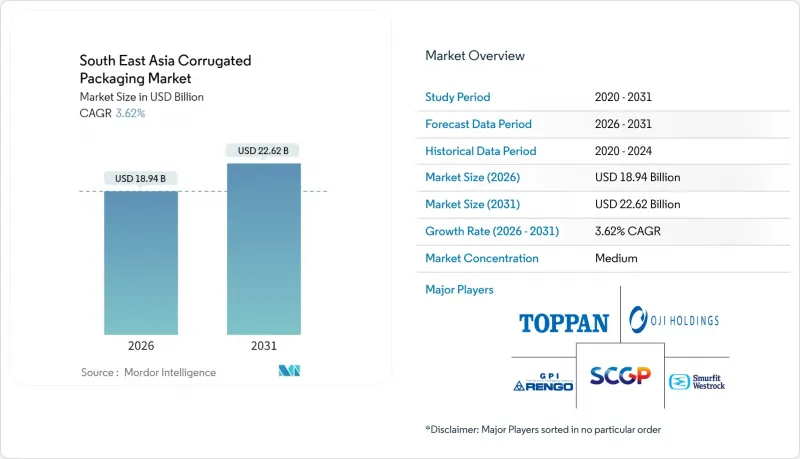
동남아시아의 골판지 포장 시장은 2025년 182억 8,000만 달러에서 2026년에는 189억 4,000만 달러로 성장하며, 2026-2031년에 CAGR 3.62%로 추이하며, 2031년까지 226억 2,000만 달러에 달할 것으로 예측됩니다.
E-Commerce 플랫폼의 택배 물량 급증, 식품 배달 생태계의 부상, 일회용 플라스틱에 대한 규제 압력으로 인해 조달 예산은 계속해서 섬유 기반 형식으로 향하고 있습니다. 인도네시아의 통합 공급망, 베트남의 수출 지향적 제조거점, 태국의 식품 가공 클러스터가 지역적 모멘텀을 주도하는 한편, 고속 디지털 플 렉소 라인에 대한 투자로 인해 과거 지역 컨버터를 방해했던 리드 타임이 단축되고 있습니다. 크라프트 라이너 및 재생 OCC 공급으로 인한 재료비 변동성이 여전히 주요 이익률의 역풍으로 작용하고 있지만, 플랜테이션 유래 속건성 섬유 등급과 AI 기반 설계 소프트웨어는 투입 비용 절감과 수율 효율 향상을 통해 이러한 압박을 일부 상쇄하고 있습니다. 컨버터 업체들이 음식배달 플랫폼 및 3PL 사업자와의 장기 계약을 추구하는 가운데, 경쟁은 가격 경쟁이 아닌 기술 도입을 중심으로 전개되고 있습니다.
동남아시아 골판지 포장 시장 동향과 인사이트
폭발적으로 증가하는 B2C E-Commerce 소포 물량에 대응할 수 있는 적절한 크기의 배송 박스 수요
E-Commerce 물류의 변화는 부피 무게의 최적화와 표준화된 포장 요구 사항을 통해 골판지 수요를 주도하고 있습니다. PT Pos Indonesia는 2024년에 28억 개 이상의 소포를 처리하여 전년 대비 15%의 성장을 기록했습니다. 골판지 포장은 전체 소포의 약 65%를 차지했습니다. 국영 우편 사업자는 자카르타, 수라바야, 메단에 자동 분류 시설을 갖추고 골판지 솔루션에 유리한 표준화된 포장 사양을 확립하고 있습니다. Shopee, Lazada와 같은 플랫폼을 통한 크로스보더 EC는 다양한 포장 요구사항이 발생하지만, 3PL(Third Party Logistics) 사업자들은 창고 공간과 배송 비용 최적화를 위해 박스 크기를 표준화하고 있습니다. 지방 배송 네트워크, 열대 기후 조건, 장거리 운송 시간과 같은 지역 인프라의 문제로 인해 물류 주기 동안 구조적 무결성을 유지하는 견고한 골판지 등급과 내습성 처리가 선호되는 경향이 있습니다.
Shopee Indonesia는 2024년 포장 표준화 프로그램을 실시하여 풀필먼트 네트워크 전체에 걸쳐 47가지의 다양한 상자 크기를 12가지의 표준 치수로 줄였습니다. 이를 통해 포장재 사용량이 23% 감소하고, 트럭 적재 효율이 18% 향상되었습니다. EC 플랫폼이 순수한 물량 증가가 아닌 업무 최적화를 통해 골판지 수요를 견인하는 실례를 보여주고 있습니다.
식품 배송 시장의 급격한 성장으로 누수 방지 골판지 식사 용기에 대한 수요 증가 가속화
베트남의 음식 배달 시장은 2024년 18억 달러 규모로 확대되어 26%의 성장률을 보일 것으로 예측됩니다. 이는 이 지역의 전문 식품 포장 솔루션에 대한 수요가 가속화되고 있음을 상징하며, 골판지 식사 상자는 중량 기준으로 포장량의 약 40%를 차지합니다. Grab Holdings는 2024년 동남아시아 전역에서 24억 건의 음식 배달 주문을 보고했으며, 베트남과 인도네시아가 전체 주문량의 67%를 차지했습니다. 이로 인해 표준화된 골판지 식사 용기에 대한 엄청난 수요가 창출되고 있습니다. 주요 플랫폼에서 대폭적인 할인에서 지속가능한 성장 모델로의 전환은 업무 효율화를 위한 노력을 강조하는 추세이며, 내습성 처리, 내유성 코팅, 스택형 설계 등 긴 배송 주기 동안 식품의 안전성을 유지하는 솔루션을 제공하는 골판지 공급업체에게 기회를 제공합니다. 골판지 공급업체에게 기회를 창출하고 있습니다.
고젝은 2024년 인도네시아 골판지 제조업체 PT Fajar Surya Wisesa와 손잡고 내유성을 강화한 생분해성 식사용 박스를 개발했습니다. 이 협업을 통해 포장 관련 고객 클레임이 30% 감소하고, 배송 중 식품 온도 유지율이 15% 향상되었으며, 최적화된 박스 설계와 현지 조달을 통해 자재 비용을 8% 절감하는 데 성공했습니다.
크라프트 라이너와 재생 OCC의 가격 변동으로 컨버터 마진 압박
2025년 초, 크라프트지 공장의 생산 중단과 가격 변동이 지역 공급망에 영향을 미쳐 원자재 비용 압박이 심화되었습니다. 인도네시아 펄프 및 제지 협회에 따르면 2024년 4분기 크라프트 라이너의 평균 가격은 3분기 대비 18% 상승했고, 재생 OCC 가격은 톤당 180-240달러로 변동하여 다운스트림 컨버터 기업의 이윤을 압박했습니다. PT Fajar Surya Wisesa는 주요 고객에 대한 동적 가격 책정 메커니즘을 도입했음에도 불구하고 원자재 비용 변동으로 인해 2024년 EBITDA 마진이 2.3% 감소했다고 보고했습니다.
이러한 변동성은 지역 수요의 연간 4.2% 성장이 생산능력의 2.8% 증가를 상회하는 수급 불균형에 기인하며, 공급 장애시 가격 변동성을 확대시키는 구조적 압박을 야기하고 있습니다. 컨버터 기업의 수익성은 고정 가격 조항의 연간 계약을 유지하는 주요 식품 배송 플랫폼 및 EC 사업자와의 가격 결정력 부족으로 인해 더욱 압박을 받고 있습니다.
부문 분석
식품 및 음료 용도는 동남아시아의 푸드서비스 산업 확대와 콜드체인 인프라 구축의 진전에 힘입어 2025년 이 지역 골판지 포장 시장 점유율의 34.62%를 차지할 것으로 예측됩니다. 2025년 식품 및 음료 용도 시장 규모는 63억 3,000만 달러에 달할 것으로 예상되며, 특히 베트남과 인도네시아의 식품 배송 플랫폼이 특수 포장 솔루션에 대한 지속적인 수요를 창출하면서 성장이 가속화될 것으로 예측됩니다. E-Commerce 포장은 Shopee, Lazada, 지역 우편 서비스 등 주요 사업자의 플랫폼 통합 및 표준화 요구사항에 힘입어 2031년까지 연평균 복합 성장률(CAGR) 5.17%로 가장 빠르게 성장하는 부문으로 부상하고 있습니다.
네슬레 인도네시아는 2024년 즉석면 제품에 새로운 골판지 포장 사양을 도입하여 포장재 사용량을 12% 절감하고, 방습 성능을 향상시켜 보관 안정성을 개선했습니다. 이러한 최적화를 통해 인도네시아의 다양한 기후대에서 제품 보호 기준을 유지하면서 연간 320만 달러의 비용 절감을 실현했습니다. 전기 및 전자기기 포장은 말레이시아, 태국을 중심으로 한 지역 제조 거점에 공급하고 있습니다. 수출 지향적 생산에서는 국제 운송 중 부품 보호를 위해 견고한 골판지 솔루션이 필요합니다.
의료 및 제약 분야에서는 규정 준수 요구 사항과 콜드체인 무결성 보장에 대한 요구가 증가하고 있으며, 항균 코팅 및 내열성을 갖춘 특수 골판지 설계가 채택되고 있습니다. 화장품 및 퍼스널케어 포장은 지역 전체의 가처분 소득 증가와 도시화 추세를 반영하고 있습니다. 자동차 및 산업 분야는 제조 다각화 및 공급망 지역화 정책의 혜택을 받고 있습니다. 음식 배달 시장의 성장과 E-Commerce의 확대는 다양한 용도에 맞는 솔루션을 제공하는 컨버터 기업에게 다양한 분야의 비즈니스 기회를 창출하고 있습니다. 디지털 인쇄 기술을 통해 다양한 최종사용자 요구 사항에 따라 신속한 커스터마이징이 가능합니다.
2025년 동남아시아 골판지 포장 시장에서 단층 골판지는 38.64%의 점유율을 유지했습니다. 이는 중하중 운송 용도 및 식품 배송 포장의 경우, 라스트 마일 물류 효율화를 위한 중량 최적화가 여전히 중요하므로 비용 대비 효율성이 높다는 것을 반영합니다. 동남아시아의 단층 골판지 포장 시장 규모는 2025년 70억 6,000만 달러에 달할 것으로 예상되며, 식품 배송 및 E-Commerce 부문이 안정적인 수요를 주도하고 있습니다. 삼중벽 구조는 4.36%의 연평균 복합 성장률(CAGR)로 가장 빠르게 성장하고 있으며, 강화된 내압성과 적재성이 경쟁 우위를 가져다주는 중공업용 및 수출용 포장에 대한 수요가 이를 지원하고 있습니다.
이중벽판은 전자제품 포장, 소매용 디스플레이 등 중간 용도에 사용되며, 단면 골판지는 보호 포장 및 완충재 솔루션과 같은 틈새 용도에 활용되고 있습니다. 첨단 골판지 제조 장비의 도입으로 지역 가공업체들은 정밀한 플루트 성형과 접착제 도포가 가능한 안정적인 삼중벽 제품을 생산할 수 있게 되었습니다. 태국 컨테이너 그룹의 고속 골판지 제조 설비 투자는 우수한 포장 성능을 요구하는 까다로운 수출 시장에 대응하기 위해 제조업체가 생산 능력을 향상시키는 좋은 예입니다.
미쓰비시자동차 베트남은 2024년 수출 포장 사양을 개정하여 자동차 부품의 해상 운송시 손상률을 줄이기 위해 이중벽에서 삼중벽 골판지 용기로 전환했습니다. 이 변경으로 포장 비용은 23% 증가했으나, 제품 손상 클레임은 67% 감소하여 연간 180만 달러의 순절감 효과를 가져왔습니다. 삼중벽 채택 추세는 지역 생산기지를 설립하는 다국적 제조업체의 품질 요구가 높아지는 것을 반영하고 있으며, 첨단 제조 능력을 갖춘 컨버터 기업에게 기회를 창출하고 있습니다.
동남아시아 골판지 포장 시장 보고서는 최종사용자 산업별(식품 및 음료, 전자기기, 퍼스널케어, 헬스케어, 자동차 등), 판지 유형별(단면, 단층, 이중층, 삼중층), 플루트 유형별(A, B, C, E, F 플루트, 마이크로플루트), 인쇄 기술별(플렉소 인쇄, 디지털 인쇄, 리소라미네이션 등), 국가별로 구분하여 분석했습니다. 디지털 인쇄, 리소라미네이션 등), 국가별로 분류되어 있습니다. 시장 예측은 금액 기준(USD)으로 제시됩니다.
기타 특전:
- 엑셀 형식 시장 예측(ME) 시트
- 애널리스트의 3개월간 지원
자주 묻는 질문
목차
제1장 서론
제2장 조사 방법
제3장 개요
제4장 시장 구도
제5장 시장 규모와 성장 예측
제6장 경쟁 구도
제7장 시장 기회와 향후 전망
The South-East Asia corrugated packaging market is expected to grow from USD 18.28 billion in 2025 to USD 18.94 billion in 2026 and is forecast to reach USD 22.62 billion by 2031 at 3.62% CAGR over 2026-2031.
Escalating parcel volumes from e-commerce platforms, the rise of food-delivery ecosystems, and regulatory pressure on single-use plastics continue to steer procurement budgets toward fiber-based formats. Indonesia's integrated supply chains, Vietnam's export-oriented manufacturing base, and Thailand's food-processing clusters drive geographic momentum, while investments in high-speed digital flexo lines compress lead times that once hampered regional converters. Material cost volatility linked to kraft liner and recycled OCC supplies remains the primary margin headwind, yet plantation-based fast-growing fiber grades and AI-enabled design software offset part of the squeeze through lower input costs and higher yield efficiencies. Competition centers on technology adoption rather than price warfare as converters chase long-term contracts with food-delivery platforms and 3PL operators.
South East Asia Corrugated Packaging Market Trends and Insights
Explosive B2C E-commerce Parcel Volumes Demanding Right-Sized Shipping Boxes
E-commerce logistics transformation drives corrugated demand through dimensional weight optimization and standardized packaging requirements. PT Pos Indonesia processed over 2.8 billion parcels in 2024, representing 15% year-over-year growth, with corrugated packaging comprising approximately 65% of total parcel volume. The state postal service has invested in automated sorting facilities across Jakarta, Surabaya, and Medan, creating standardized packaging specifications that favor corrugated solutions. Cross-border e-commerce through platforms like Shopee and Lazada generates varied packaging requirements, with 3PLs standardizing box sizes to optimize warehouse space and shipping costs. Regional infrastructure challenges including rural delivery networks, tropical climate conditions, and extended transit times increase preference for robust corrugated grades and moisture-resistant treatments that maintain structural integrity during logistics cycles.
Shopee Indonesia implemented a packaging standardization program in 2024, reducing box size variations from 47 to 12 standard dimensions across its fulfillment network. This initiative resulted in 23% reduction in packaging material usage and 18% improvement in truck loading efficiency, demonstrating how e-commerce platforms drive corrugated demand through operational optimization rather than pure volume growth.
Food-Delivery Boom Accelerating Need for Leak-Resistant Corrugated Meal Boxes
Vietnam's food delivery market expansion to USD 1.8 billion in 2024 with 26% growth exemplifies regional demand acceleration for specialized food packaging solutions, with corrugated meal boxes representing approximately 40% of packaging volume by weight. Grab Holdings reported 2.4 billion food delivery orders across Southeast Asia in 2024, with Vietnam and Indonesia accounting for 67% of total volume, creating massive demand for standardized corrugated meal containers. The shift from heavy discounting to sustainable growth models among major platforms emphasizes operational efficiency initiatives, creating opportunities for corrugated suppliers offering moisture-resistant treatments, grease-proof coatings, and stackable designs that maintain food safety during extended delivery cycles.
Gojek partnered with Indonesian corrugated manufacturer PT Fajar Surya Wisesa in 2024 to develop biodegradable meal boxes with enhanced grease resistance. The collaboration resulted in 30% reduction in packaging-related customer complaints and 15% improvement in food temperature retention during delivery, while reducing material costs by 8% through optimized box design and local sourcing
Kraft Liner and Recycled OCC Price Volatility Squeezing Converter Margins
Raw material cost pressures intensified in early 2025 with kraft paper mills experiencing production disruptions and price volatility affecting regional supply chains. The Indonesian Pulp and Paper Association reported average kraft liner prices increased 18% in Q4 2024 compared to Q3, while recycled OCC prices fluctuated between USD 180-240 per tonne, creating margin compression for downstream converters. PT Fajar Surya Wisesa reported EBITDA margin compression of 2.3 percentage points in 2024 due to raw material cost volatility, despite implementing dynamic pricing mechanisms for major customers.
The volatility stems from supply-demand imbalances as regional demand growth of 4.2% annually outpaces capacity additions of 2.8%, creating structural tightness that amplifies price swings during supply disruptions. Converter profitability faces additional pressure from limited pricing power with major food delivery platforms and e-commerce operators who maintain annual contracts with fixed pricing terms.
Other drivers and restraints analyzed in the detailed report include:
- Mandated Phase-Out of Single-Use Plastics in Indonesia, Vietnam and Thailand
- Installation of High-Speed Digital Flexo Lines Slashing Lead-Times for SMEs
- Inferior Humidity Resistance During Monsoon Logistics Cycles
For complete list of drivers and restraints, kindly check the Table Of Contents.
Segment Analysis
Food and beverage applications commanded 34.62% of the South-East Asia corrugated packaging market share in 2025, benefiting from the region's expanding food service sector and cold chain infrastructure development. The South-East Asia corrugated packaging market size for food and beverage applications reached USD 6.33 billion in 2025, with growth accelerating in Vietnam and Indonesia where food delivery platforms generate consistent demand for specialized packaging solutions. E-commerce packaging emerges as the fastest-growing segment with 5.17% CAGR through 2031, driven by platform consolidation and standardization requirements from major operators including Shopee, Lazada, and regional postal services.
Nestle Indonesia implemented new corrugated packaging specifications in 2024 for its instant noodle products, reducing packaging material usage by 12% while improving shelf stability through enhanced moisture barrier properties. The optimization resulted in annual cost savings of USD 3.2 million while maintaining product protection standards across Indonesia's diverse climate zones. Electrical and electronics packaging serves regional manufacturing hubs, particularly in Malaysia and Thailand, where export-oriented production requires robust corrugated solutions for component protection during international shipping.
Healthcare and pharmaceutical applications gain momentum from regulatory compliance requirements and cold chain integrity demands, with specialized corrugated designs incorporating antimicrobial coatings and temperature-resistant properties. Cosmetics and personal care packaging reflects rising disposable incomes and urbanization trends across the region, while automotive and industrial segments benefit from manufacturing diversification and supply chain regionalization initiatives. The convergence of food delivery growth and e-commerce expansion creates cross-segment opportunities for converters offering multi-application solutions, with digital printing technologies enabling rapid customization across diverse end-user requirements.
Single wall corrugated boards maintained 38.64% of the South-East Asia corrugated packaging market share in 2025, reflecting cost-effectiveness for medium-duty shipping applications and food delivery packaging where weight optimization remains critical for last-mile logistics efficiency. The South-East Asia corrugated packaging market size for single wall applications reached USD 7.06 billion in 2025, with food delivery and e-commerce segments driving consistent demand. Triple wall configurations experience the fastest growth at 4.36% CAGR, driven by heavy-duty industrial applications and export packaging requirements where enhanced crush resistance and stackability provide competitive advantages.
Double wall boards serve intermediate applications including electronics packaging and retail displays, while single face corrugated finds niche applications in protective wrapping and void fill solutions. Advanced corrugator installations enable regional converters to produce consistent triple wall products with precise flute formation and adhesive application. Thai Containers Group's investment in high-speed corrugating equipment demonstrates how manufacturers upgrade capabilities to serve demanding export markets requiring superior packaging performance.
Mitsubishi Motors Vietnam upgraded its export packaging specifications in 2024, transitioning from double wall to triple wall corrugated containers for automotive parts shipments to reduce damage rates during ocean transport. The change increased packaging costs by 23% but reduced product damage claims by 67%, resulting in net savings of USD 1.8 million annually. The trend toward triple wall adoption reflects increasing quality requirements from multinational manufacturers establishing regional production facilities, creating opportunities for converters with advanced manufacturing capabilities.
The South-East Asia Corrugated Packaging Market Report is Segmented by End-User Industry (Food and Beverage, Electronics, Personal Care, Healthcare, Automotive, and More), Board Type (Single Face, Single Wall, Double Wall, and Triple Wall), Flute Type (A, B, C, E, and F-Flute and Micro-Flutes), Printing Technology (Flexographic, Digital, Litho-Lamination, and More), and Country. Market Forecasts in Value (USD).
List of Companies Covered in this Report:
- SCG Packaging Public Company Limited
- Rengo Co., Ltd.
- Oji Holdings Corporation
- Toppan Inc.
- Smurfit WestRock
- International Paper Company
- Amcor plc
- Huhtamaki Oyj
- Bobst Group SA
- Thai Packaging & Printing Public Company Limited
- Sarnti Packaging Co., Ltd.
- Thai Containers Group Co., Ltd.
- PT Pura Barutama
- Harta Packaging Industries (Selangor) Sdn Bhd
- Trio Paper Mills Sdn. Bhd.
- Vina Kraft Paper Co., Ltd.
- New Asia Industries Co., Ltd.
- Nine Dragons Paper (Holdings) Limited
Additional Benefits:
- The market estimate (ME) sheet in Excel format
- 3 months of analyst support
TABLE OF CONTENTS
1 INTRODUCTION
- 1.1 Study Assumptions and Market Definition
- 1.2 Scope of the Study
2 RESEARCH METHODOLOGY
3 EXECUTIVE SUMMARY
4 MARKET LANDSCAPE
- 4.1 Market Overview
- 4.2 Market Drivers
- 4.2.1 Explosive B2C e-commerce parcel volumes demanding right-sized shipping boxes
- 4.2.2 Food-delivery boom accelerating need for leak-resistant corrugated meal boxes
- 4.2.3 Mandated phase-out of single-use plastics in Indonesia, Vietnam and Thailand
- 4.2.4 Installation of high-speed digital flexo lines slashing lead-times for SMEs
- 4.2.5 Adoption of AI-enabled box-design software reducing trim waste
- 4.2.6 Region-wide shift to plantation-based fast-growing fibre grades
- 4.3 Market Restraints
- 4.3.1 Kraft liner and recycled OCC price volatility squeezing converter margins
- 4.3.2 Inferior humidity resistance during monsoon logistics cycles
- 4.3.3 Fragmented panel-board logistics inflating back-haul empty-run costs
- 4.3.4 Skilled-operator shortage for Industry-4.0 corrugators
- 4.4 Industry Value Chain Analysis
- 4.5 Regulatory Landscape
- 4.6 Technological Outlook
- 4.7 Impact of Macroeconomic Factors on the Market
- 4.8 Porter's Five Forces Analysis
- 4.8.1 Bargaining Power of Suppliers
- 4.8.2 Bargaining Power of Buyers/Consumers
- 4.8.3 Threat of New Entrants
- 4.8.4 Threat of Substitute Products
- 4.8.5 Intensity of Competitive Rivalry
5 MARKET SIZE AND GROWTH FORECASTS (VALUE)
- 5.1 By End-User Industry
- 5.1.1 Food and Beverage
- 5.1.2 Electrical and Electronics
- 5.1.3 Cosmetics and Personal Care
- 5.1.4 Healthcare and Pharmaceutical
- 5.1.5 Automotive and Industrial
- 5.1.6 Other End-User Industries
- 5.2 By Board Type
- 5.2.1 Single Face
- 5.2.2 Single Wall
- 5.2.3 Double Wall
- 5.2.4 Triple Wall
- 5.3 By Flute Type
- 5.3.1 A-Flute
- 5.3.2 B-Flute
- 5.3.3 C-Flute
- 5.3.4 E-Flute
- 5.3.5 F-Flute and Micro-Flutes
- 5.4 By Printing Technology
- 5.4.1 Flexographic
- 5.4.2 Digital (Inkjet)
- 5.4.3 Litho-lamination
- 5.4.4 Other Printing Technologies
- 5.5 By Country
- 5.5.1 Indonesia
- 5.5.2 Thailand
- 5.5.3 Malaysia
- 5.5.4 Vietnam
- 5.5.5 Philippines
- 5.5.6 Singapore
- 5.5.7 Rest of South-East Asia
6 COMPETITIVE LANDSCAPE
- 6.1 Market Concentration
- 6.2 Strategic Moves
- 6.3 Market Share Analysis
- 6.4 Company Profiles (includes Global level Overview, Market level overview, Core Segments, Financials as available, Strategic Information, Market Rank/Share for key companies, Products and Services, and Recent Developments)
- 6.4.1 SCG Packaging Public Company Limited
- 6.4.2 Rengo Co., Ltd.
- 6.4.3 Oji Holdings Corporation
- 6.4.4 Toppan Inc.
- 6.4.5 Smurfit WestRock
- 6.4.6 International Paper Company
- 6.4.7 Amcor plc
- 6.4.8 Huhtamaki Oyj
- 6.4.9 Bobst Group SA
- 6.4.10 Thai Packaging & Printing Public Company Limited
- 6.4.11 Sarnti Packaging Co., Ltd.
- 6.4.12 Thai Containers Group Co., Ltd.
- 6.4.13 PT Pura Barutama
- 6.4.14 Harta Packaging Industries (Selangor) Sdn Bhd
- 6.4.15 Trio Paper Mills Sdn. Bhd.
- 6.4.16 Vina Kraft Paper Co., Ltd.
- 6.4.17 New Asia Industries Co., Ltd.
- 6.4.18 Nine Dragons Paper (Holdings) Limited
7 MARKET OPPORTUNITIES AND FUTURE OUTLOOK
- 7.1 White-space and Unmet-need Assessment