|
시장보고서
상품코드
1934797
자궁근종 치료 : 시장 점유율 분석, 업계 동향과 통계, 성장 예측(2026-2031년)Uterine Fibroids Treatment - Market Share Analysis, Industry Trends & Statistics, Growth Forecasts (2026 - 2031) |
||||||
 Mordor Intelligence
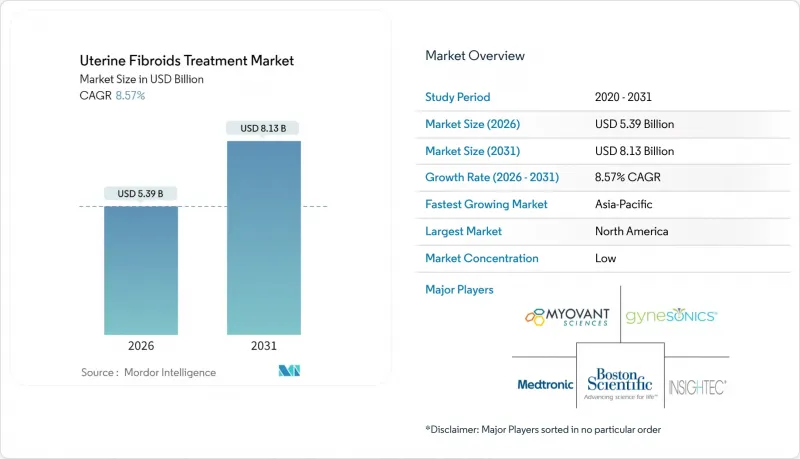
자궁근종 치료 시장은 2025년에 49억 6,000만 달러로 평가되며, 2026년 53억 9,000만 달러에서 2031년까지 81억 3,000만 달러에 달할 것으로 예측됩니다.
예측 기간(2026-2031년)의 CAGR은 8.57%로 예상됩니다.
50세까지 최대 80%의 여성이 증상을 동반한 자궁근종의 영향을 받는다는 점, 흑인 여성의 발병률이 높고 발병 연령이 빠르다는 점에서 수요는 가속화되고 있습니다. 환자들이 임신 능력 유지와 회복 기간 단축을 원함에 따라 저침습 및 비침습적 치료법의 채택이 가속화되고 있습니다. 고소득 국가들의 풍부한 보험 적용과 경구용 GnRH 길항제의 신속한 승인으로 치료 옵션이 확대되면서 자궁근종 치료 시장이 확대되고 있습니다. 의료기기 제조업체는 수술 계획에 인공지능(AI)을 통합하여 성장을 보장하고, 제약사는 병용요법 및 추가 요법을 통해 제품수명주기를 연장하고 있습니다. 희토류 색전 입자 및 HIFU(고밀도 집속형 초음파) 부품공급망 복원력은 수술 건수를 지속적으로 확보하는 데 있으며, 여전히 매우 중요합니다.
자궁근종 치료 세계 시장 동향과 인사이트
증상을 동반한 근종의 유병률 상승
임상 연구를 통해 흑인 여성의 자궁근종 발병률이 다른 집단에 비해 3배 이상 높고 발병 연령이 빠르다는 사실이 확인되어 다양한 인구를 가진 의료 시스템에서 집중적인 수요를 창출하고 있습니다. 고해상도 초음파 검사 및 MRI의 보급으로 조기 발견이 가능해져 심각한 증상을 가진 환자군을 넘어 잠재적 치료 대상자가 확대되고 있습니다. 미치료 자궁근종이 불임 위험을 높인다는 인식이 높아지면서 조기 검진을 유도하고, 자궁 보존 요법으로 환자를 유도하고 있습니다. 이러한 요인들이 복합적으로 작용하여 자궁근종 치료 시장을 지원하는 지속적인 수요를 창출하고 있습니다.
저침습적, 비침습적 치료법으로의 전환
경관적 고주파 소작술과 같은 절개하지 않는 치료법은 2024년 8월까지 1만 명 이상의 환자를 치료하며 빠른 보급이 입증되고 있습니다. 비교조사에서 자궁파열 없는 근종절제술의 생존분만율이 72.2%로 기존 근종절제술보다 더 높은 것으로 나타났습니다. 2024년에 도입된 카테고리 1 CPT 코드는 상환의 모호함을 없애고 사무적 장벽을 낮추었습니다. 고밀도집속초음파 치료는 비만 환자의 합병증 발생률이 9.33%로 복강경 수술의 절반 이하로 낮습니다. 이러한 임상적, 경제적 이점이 결합되어 의사와 환자의 선택이 자궁 보존 요법으로 기울어지면서 자궁근종 치료 시장이 확대되고 있습니다.
첨단 기기 및 시술의 고비용
차세대 자궁근종 치료기술의 개발 및 상용화를 위해서는 막대한 자금이 필요하며, 홀로직의 Gynesonics 3.5억 달러 인수는 이러한 투자 규모를 여실히 보여주고 있습니다. 신흥 국가의 현지 생산 부족으로 인해 수입 비용이 상승하고, 보험에 가입하지 않은 환자들은 고가의 치료법을 감당할 수 없는 상황에 처해 있습니다. 팬데믹 기간 중 의료기기 부족은 특히 지방 시설에서 공급 충격이 가격 상승 압력을 증폭시킬 수 있다는 점을 부각시켰습니다. 고소득 시장에서도 치료 과정에서 환자의 자부담이 2만 5,000달러를 초과하는 경우가 있으며, 치료 지연을 초래하고 자궁근종 치료 시장의 확대를 제한하고 있습니다.
부문 분석
2025년 자궁근종 치료 시장 점유율의 42.88%는 수술이 차지할 것으로 예상되며, 이는 수술의 확립된 임상적 역할을 반영합니다. 그러나 비침습적 치료법은 CAGR 8.88%로 성장하여 2031년까지 자궁근종 치료 시장 규모에 13억 3,000만 달러를 추가할 것으로 예측됩니다. MRI 유도하 집속초음파 치료의 장기 추적관찰 결과, 7년간 33.1%의 재시술률이 확인되었으며, 44세 이상의 여성에서는 재시술의 필요성이 낮은 경향을 보였습니다. 고주파열 소작요법은 비만 환자의 적응증을 확대하고, 합병증 위험을 감소시켜 미충족 수요를 충족시키고 있습니다.
약물 치료의 발전은 의료기기의 성장을 보완합니다. 경구용 GnRH 길항제는 지속적이고 가역적인 증상 완화를 제공하여 환자가 수술을 연기하거나 피할 수 있도록 합니다. 급여 명확화로 인해 최소침습적 치료의 수가 증가하고 있으며, 경부 경관 소작술의 카테고리 1 CPT 지정은 이러한 증가의 촉매제 역할을 하고 있습니다. AI 계획 소프트웨어는 MR-gFUS 워크플로우를 가속화하고, 자율 에이전트는 매우 높은 수준의 전문가 수용도를 달성하고 있습니다. 이러한 임상적, 경제적, 기술적 요소들이 결합하여 저침습적, 비침습적 치료의 흐름을 강화하며 자궁근종 치료 시장을 재편하고 있습니다.
지역별 분석
북미는 2025년 자궁근종 치료 시장의 41.86%를 차지할 것으로 예상되며, 안정적인 상환 제도, 높은 진단 인지도, 의료기기 개발 기업과의 지역적 근접성이 이를 지원하고 있습니다. FDA의 획기적인 의료기기 경로를 통해 상업화 주기를 단축하고 임상 현장에 빠르게 도입할 수 있습니다. 메디케어의 자궁동맥 색전술에 대한 정액 지불은 예측 가능한 이익률을 보장하고, 민간 보험사들은 경관 및 MR 유도하 기술에 대한 보험 적용을 확대하고 있습니다. 그러나 지방 병원에서는 중재적 영상의학 부문의 인력 확보가 어려워 시술 가능 여부의 편차가 발생하고 있으며, 지역적 격차가 전체 성장을 저해하는 요인으로 작용하고 있습니다.
아시아태평양은 의료 인프라 정비와 가처분 소득 증가를 배경으로 2031년까지 9.94%의 가장 높은 CAGR을 나타낼 것으로 예측됩니다. 중국은 주요 의료기기 제조기지로서의 지위를 통해 조달비용을 절감하고 국내 보급을 가속화하고 있습니다. 일본과 한국은 MR 유도하 집속초음파 치료의 도입을 선도하고 있으며, 이는 성숙한 영상 진단 기술과 고령화 인구를 반영하고 있습니다. 인도는 잠재적 환자 수가 방대하므로 향후 수요 증가 요인이 될 수 있지만, 전문인력 양성과 여성 의료에 대한 민관 투자가 전제되어야 합니다.
유럽에서는 통일된 규제 프레임워크와 광범위한 보험 적용으로 인해 꾸준한 확장을 보이고 있습니다. 조화로운 임상 가이드라인은 복잡한 사례의 국경을 넘나드는 의뢰를 촉진하고, 엄격한 증거 기준은 치료 시설 간의 일관된 품질을 보장합니다. 최근 경구용 GnRH 길항제의 급여 승인은 증상이 있는 여성에게 수술의 대안을 제공하고, 약물 치료의 사용 패턴을 개선하고 있습니다. 그러나 지역적 성장은 국가 예산의 제약과 인재 육성 속도에 여전히 민감합니다.
기타 특전:
- 엑셀 형식 시장 예측(ME) 시트
- 애널리스트의 3개월간 지원
자주 묻는 질문
목차
제1장 서론
제2장 조사 방법
제3장 개요
제4장 시장 구도
제5장 시장 규모와 성장 예측(금액 기반,2025-2030년)
제6장 경쟁 구도
제7장 시장 기회와 향후 전망
The Uterine Fibroids Treatment Market was valued at USD 4.96 billion in 2025 and estimated to grow from USD 5.39 billion in 2026 to reach USD 8.13 billion by 2031, at a CAGR of 8.57% during the forecast period (2026-2031).
Demand accelerates as symptomatic fibroids affect up to 80% of women by age 50, with elevated prevalence and earlier onset among Black women. Adoption of minimally invasive and non-invasive options gains pace as patients seek fertility preservation and shorter recovery. Robust reimbursement in high-income nations, paired with faster approvals for oral GnRH antagonists, widens therapeutic choice and expands the uterine fibroids treatment market. Device makers secure growth by integrating artificial intelligence (AI) into procedure planning, while pharmaceutical sponsors extend product life cycles through combination regimens and add-back therapy. Supply-chain resilience around rare-earth embolization particles and HIFU components remains pivotal for uninterrupted procedure volumes.
Global Uterine Fibroids Treatment Market Trends and Insights
Rising Prevalence of Symptomatic Fibroids
Clinical studies confirm that Black women experience three-fold higher fibroid prevalence and earlier onset than other groups, driving concentrated demand in health systems serving diverse populations. Broader use of high-resolution ultrasound and MRI enables earlier detection, swelling the addressable pool beyond those with severe symptoms. Heightened awareness of fertility impairment linked to untreated fibroids encourages earlier consultation, channeling patients toward uterus-sparing solutions. Together, these factors create durable demand that underpins the uterine fibroids treatment market.
Shift Toward Minimally & Non-Invasive Procedures
Incision-free options such as transcervical radiofrequency ablation treated more than 10,000 patients by August 2024, evidencing rapid adoption. Comparative research shows radiofrequency ablation generated 72.2% live-birth rates without uterine rupture, outperforming conventional myomectomy. Category 1 CPT codes introduced in 2024 removed reimbursement ambiguity and lowered administrative hurdles. High-intensity focused ultrasound records a 9.33% complication rate in overweight patients, less than half that of laparoscopic surgery. Collectively, these clinical and economic benefits tilt physician and patient preference toward uterine-preserving modalities, expanding the uterine fibroids treatment market.
High Cost of Advanced Devices & Procedures
Developing and commercializing next-generation fibroid technologies carries significant capital needs; Hologic's USD 350 million purchase of Gynesonics underscores these investment levels. Limited local manufacturing in emerging economies inflates import costs, placing premium procedures out of reach for uninsured patients. Pandemic-era device shortages highlighted how supply shocks amplify price pressures, especially for rural facilities. Even in high-income markets, out-of-pocket patient costs can exceed USD 25,000 across a treatment journey, prompting delayed care and limiting the uterine fibroids treatment market.
Other drivers and restraints analyzed in the detailed report include:
- Favorable Reimbursement in High-Income Nations
- Launch of Oral GnRH Antagonists
- Shortage of Skilled IR Specialists in Emerging Markets
For complete list of drivers and restraints, kindly check the Table Of Contents.
Segment Analysis
Surgical procedures accounted for 42.88% of the uterine fibroids treatment market share in 2025, reflecting their entrenched clinical role. However, non-invasive options are forecast to grow at a 8.88% CAGR, adding USD 1.33 billion to the uterine fibroids treatment market size by 2031. Long-term follow-up of MR-guided focused ultrasound reveals a 33.1% re-intervention rate over seven years, with women over 44 years of age requiring fewer repeat procedures. Radiofrequency ablation expands indications for overweight patients, meeting an unmet need with lower complication risk.
Pharmacological therapy advances complement device growth. Oral GnRH antagonists provide durable, reversible symptom relief, allowing patients to postpone or avoid surgery. Reimbursement clarity boosts minimally invasive volumes; the Category 1 CPT designation for transcervical ablation is a notable catalyst for this increase. AI planning software accelerates the MR-gFUS workflow, with autonomous agents achieving very high levels of expert acceptance. Collectively, these clinical, economic, and technological elements reinforce momentum toward minimally invasive and non-invasive care, reshaping the uterine fibroids treatment market.
The Uterine Fibroids Treatment Market Report is Segmented by Type (Subserosal Fibroids, Intramural Fibroids, Submucosal Fibroids, Pedunculated Fibroids), Treatment (Drugs, and Surgical Techniques), and Geography (North America, Europe, Asia-Pacific, Middle East and Africa, and South America). The Report Offers the Value (USD Million) for the Above Segments.
Geography Analysis
North America accounted for 41.86% uterine fibroids treatment market share in 2025, underpinned by consistent reimbursement, high diagnostic awareness, and proximity to device innovators. FDA breakthrough device pathways expedite commercialization cycles, enabling rapid clinical adoption. Medicare's fixed payment for uterine artery embolization secures predictable margins, while commercial insurers expand coverage for transcervical and MR-guided techniques. Nonetheless, procedure availability varies, as rural hospitals struggle to maintain interventional radiology staff, prompting regional disparities that temper overall growth.
Asia-Pacific is projected to record the highest 9.94% CAGR through 2031, propelled by healthcare infrastructure upgrades and rising disposable income. China's status as a leading medical-device manufacturing hub lowers procurement costs and accelerates domestic adoption. Japan and South Korea lead in MR-guided focused ultrasound deployment, reflecting mature imaging capabilities and aging demographics. India's large addressable population positions it as a future volume driver, contingent on specialist training and public-private investment in women's health.
Europe demonstrates steady expansion, supported by cohesive regulatory frameworks and widespread insurance coverage. Harmonized clinical guidelines facilitate cross-border referral for complex cases, while rigorous evidence standards ensure consistent quality across treatment centers. Recent reimbursement approvals for oral GnRH antagonists improve medical-therapy utilization patterns, offering alternatives to surgery for symptomatic women. Regional growth, however, remains sensitive to national budget constraints and the pace of workforce development.
- Abbvie
- Pfizer
- Bayer
- Sumitomo Pharma Co., Ltd. (Myovant)
- Hologic
- Boston Scientific
- Merit Medical Systems
- Terumo Corp.
- Insightec Ltd.
- EDAP TMS SA
- Intuitive Surgical
- Cook Group
- Varian Medical Systems (Siemens Healthineers)
- 8Spheres Medical Co.
- Gynesonics Inc.
- ObsEva SA
- Profound Medical
- LiNA Medical ApS
- AngioDynamics
- Cook Siemens Partnership (TGA)
Additional Benefits:
- The market estimate (ME) sheet in Excel format
- 3 months of analyst support
TABLE OF CONTENTS
1 Introduction
- 1.1 Study Assumptions & Market Definition
- 1.2 Scope of the Study
2 Research Methodology
3 Executive Summary
4 Market Landscape
- 4.1 Market Overview
- 4.2 Market Drivers
- 4.2.1 Rising prevalence of symptomatic fibroids
- 4.2.2 Shift toward minimally & non-invasive procedures
- 4.2.3 Favorable reimbursement in high-income nations
- 4.2.4 Launch of oral GnRH antagonists
- 4.2.5 AI-enabled imaging & robotics adoption (under-reported)
- 4.2.6 Biomarker-driven precision medicine (under-reported)
- 4.3 Market Restraints
- 4.3.1 High cost of advanced devices & procedures
- 4.3.2 Shortage of skilled IR specialists in emerging markets
- 4.3.3 Rare-earth supply risk for embolization/HIFU parts (under-reported)
- 4.3.4 Limited long-term fertility data for new ablation tech (under-reported)
- 4.4 Value / Supply-Chain Analysis
- 4.5 Regulatory Landscape
- 4.6 Technological Outlook
- 4.7 Porter's Five Forces
- 4.7.1 Threat of New Entrants
- 4.7.2 Bargaining Power of Suppliers
- 4.7.3 Bargaining Power of Buyers
- 4.7.4 Threat of Substitutes
- 4.7.5 Competitive Rivalry
5 Market Size & Growth Forecasts (Value, 2025-2030)
- 5.1 By Treatment Method
- 5.1.1 Pharmacological Therapy
- 5.1.1.1 Hormonal (GnRH antagonists, SPRMs, COCs)
- 5.1.1.2 Non-hormonal (NSAIDs, Tranexamic Acid)
- 5.1.2 Surgical Procedures
- 5.1.2.1 Hysterectomy
- 5.1.2.2 Myomectomy (Hysteroscopic * Laparoscopic * Open)
- 5.1.3 Minimally-Invasive Procedures
- 5.1.3.1 Uterine Artery Embolization
- 5.1.3.2 Radiofrequency Ablation (e.g., Acessa)
- 5.1.4 Non-Invasive Procedures
- 5.1.4.1 MR-guided HIFU
- 5.1.4.2 Transcervical Fibroid Ablation (Sonata)
- 5.1.1 Pharmacological Therapy
- 5.2 By End User
- 5.2.1 Hospitals
- 5.2.2 Ambulatory Surgical Centers
- 5.2.3 Specialty Gynecology Clinics
- 5.3 By Geography
- 5.3.1 North America
- 5.3.1.1 United States
- 5.3.1.2 Canada
- 5.3.1.3 Mexico
- 5.3.2 Europe
- 5.3.2.1 Germany
- 5.3.2.2 United Kingdom
- 5.3.2.3 France
- 5.3.2.4 Italy
- 5.3.2.5 Spain
- 5.3.2.6 Rest of Europe
- 5.3.3 Asia-Pacific
- 5.3.3.1 China
- 5.3.3.2 India
- 5.3.3.3 Japan
- 5.3.3.4 South Korea
- 5.3.3.5 Australia
- 5.3.3.6 Rest of Asia-Pacific
- 5.3.4 South America
- 5.3.4.1 Brazil
- 5.3.4.2 Argentina
- 5.3.4.3 Rest of South America
- 5.3.5 Middle East and Africa
- 5.3.5.1 GCC
- 5.3.5.2 South Africa
- 5.3.5.3 Rest of Middle East and Africa
- 5.3.1 North America
6 Competitive Landscape
- 6.1 Market Concentration
- 6.2 Market Share Analysis
- 6.3 Company Profiles {(includes Global level Overview, Market level overview, Core Segments, Financials as available, Strategic Information, Market Rank/Share for key companies, Products & Services, and Recent Developments)}
- 6.3.1 AbbVie Inc.
- 6.3.2 Pfizer Inc.
- 6.3.3 Bayer AG
- 6.3.4 Sumitomo Pharma Co., Ltd. (Myovant)
- 6.3.5 Hologic Inc.
- 6.3.6 Boston Scientific Corp.
- 6.3.7 Merit Medical Systems Inc.
- 6.3.8 Terumo Corp.
- 6.3.9 Insightec Ltd.
- 6.3.10 EDAP TMS SA
- 6.3.11 Intuitive Surgical Inc.
- 6.3.12 Cook Medical LLC
- 6.3.13 Varian Medical Systems (Siemens Healthineers)
- 6.3.14 8Spheres Medical Co.
- 6.3.15 Gynesonics Inc.
- 6.3.16 ObsEva SA
- 6.3.17 Profound Medical Corp.
- 6.3.18 LiNA Medical ApS
- 6.3.19 AngioDynamics Inc.
- 6.3.20 Cook Siemens Partnership (TGA)
7 Market Opportunities & Future Outlook
- 7.1 White-space & unmet-need assessment