

|
시장보고서
상품코드
1934879
보틀 블로우 성형기 : 시장 점유율 분석, 업계 동향과 통계, 성장 예측(2026-2031년)Bottle Blowing Machine - Market Share Analysis, Industry Trends & Statistics, Growth Forecasts (2026 - 2031) |
||||||
 Mordor Intelligence
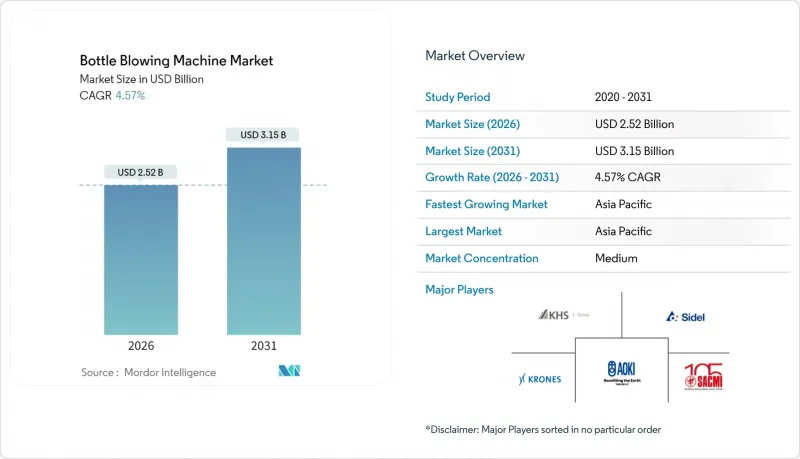
보틀 블로우 성형기 시장은 2025년에 24억 1,000만 달러로 평가되며, 2026년 25억 2,000만 달러에서 2031년까지 31억 5,000만 달러에 달할 것으로 예측됩니다.
예측 기간(2026-2031년)의 CAGR은 4.57%로 예상됩니다.
음료, 의약품, 소비재 분야의 지속적인 수요와 더불어 에너지 절약형 전기 시스템의 급속한 발전과 재생 PET의 사용 확대가 이러한 성장을 지원하고 있습니다. 스트레치 블로우 성형은 탄산음료 대량 생산의 주력 기술로서 지위를 유지하는 한편, 사출 블로우 성형은 의약품 소용량 용기 분야에서 점유율을 확대하고 있습니다. 제조업체들은 가동률 향상, 공정 전환 시간 단축, 에너지 소비 절감을 목적으로 디지털 트윈 제어 및 예측 분석 기술 도입을 추진하고 있습니다. 경쟁의 초점은 현재 경량화 능력, 재활용 소재 처리 기술, 엔드투엔드 자동화로 옮겨가고 있으며, 주요 업체들은 포트폴리오 확장을 위해 인수를 추진하고 있습니다. PET 가격의 변동성, 업계 전반의 인력 부족, 높은 자본 집약도는 여전히 역풍이지만, 에너지 절약형 생산 라인에 대한 정부의 세제 혜택과 현장 마이크로 공장의 병 생산의 부상은 새로운 성장 기회를 제공합니다.
세계 병 블로우 성형기 시장 동향 및 인사이트
탄산음료 부문에서 경량 PET병 수요 급증
탄산음료 브랜드는 수지 비용과 배출량 감소를 위해 용기 경량화를 추진하고 있습니다. 코카콜라의 2024년 디자인 변경으로 20온스 병의 무게가 21g에서 18.5g으로 줄었습니다. 이에 따라 8억 병 분량의 재료를 줄이면서도 탄산 유지 성능을 유지하기 위해 보다 정밀한 가열 기능을 갖춘 블로우 성형기가 요구되고 있습니다. 인도에서 동시 출시되는 제품은 100% 재생 PET를 사용하여 경량화와 순환경제의 메시지를 연결하고 있습니다. 이러한 변화로 인해 설비 제조업체들은 벽 두께의 편차나 바닥의 변형 없이 더 얇은 프리폼에 대응할 수 있는 스트레치 블로잉 시스템을 제공해야 하며, 첨단 적외선 가열, 서보 스트레치로드, 금형내 압력 제어에 대한 수요가 고정화되어 있습니다.
1회용 의약품 병의 보급 확대
규제 당국과 제약사들은 환자의 복약 순응도를 높이기 위해 1회용 용기로의 전환을 추진하고 있으며, 이는 의약품 등급의 표면 마감 처리된 5ml-100ml 용기에 대한 지속적인 수요를 창출하고 있습니다. 사출 블로우 성형은 치수 정밀도와 낮은 입자 발생으로 평가되는 주류 제조 공정입니다. 장비 공급업체는 현재 층류 인클로저, HEPA 필터가있는 에어 나이프, 캐비티별 전체 중량 측정 시스템을 통합하여 FDA의 엄격한 추적성 규정을 충족합니다. 스마트 캡과 임베디드 RFID의 보급은 배리어 성능과 무균성을 손상시키지 않고 전자 부품을 수용할 수 있는 성형 제조업체의 필요성을 더욱 강화하여, 무균 대응이 가능한 모든 전기 기계에 대한 조달을 촉진하고 있습니다.
대규모 스트레치 블로우 성형기의 고액 설비 투자
시간당 1만 병 이상의 회전식 스트레치 시스템은 라인당 400만 달러가 넘을 수 있으며, 신용이 제한된 시장에서 중견 음료 제조업체에게는 장벽이 될 수 있습니다. 수지 가격의 급등으로 이익률이 압박을 받고, 수요 예측이 불안정한 소비심리에 좌우될 경우, 투자 회수 기간은 더욱 길어질 것입니다. 공급업체는 캐비티, 히팅 뱅크, 블로우 스테이션을 단계적으로 추가하는 모듈식 업그레이드를 추진하여 도입 비용을 절감하고 감가상각을 여러 회계연도에 분산시켜 감가상각비를 절감하고 있습니다. 일부 공급업체는 금융 부문과 협력하여 임대 및 종량제 모델을 보장하고 있지만, 많은 소규모 사업자들은 여전히 확장을 미루고 있으며, 최고 속도 장비에 대한 단기적인 수요는 억제되고 있습니다.
부문 분석
압출 블로우 성형 부문은 2025년 시장의 52.98%를 차지할 것으로 예상되며, 내압성 및 투명 용기를 필요로 하는 음료 분야를 기반으로 스트레치 블로우 성형이 그 뒤를 이을 것으로 예측됩니다. 이 공정은 경량화에 탁월하며, 브랜드가 저탄소화 경쟁에서 중요한 강점입니다. 사출 블로우 성형은 CAGR로 틈새 시장이지만, 정밀한 목 마감과 무균 내부 표면을 요구하는 제약 분야에서 주목받고 있습니다. 압출 블로우 성형은 손잡이 달린 주전자 및 이형 세제병의 주력 기술입니다. 시간당 1만 3,000개를 생산할 수 있는 회전 압축 블로우 장치 등 사출성형의 정밀도와 연신성형의 생산성을 융합한 새로운 시스템이 등장하고 있습니다. 브랜드들이 기능성 음료와 프리미엄 주스로 포트폴리오를 다양화하면서 하이브리드 기술이 주목받고 있지만, 연신 블로우 성형의 기존 설비 기반과 금형 기술에 대한 숙련도가 병 블로우 성형기 시장의 핵심 기술로서의 지위를 유지하고 있습니다.
100ml 미만의 용량에서는 의약품 수준의 정밀도와 낮은 입자 수준이 사출 블로우 성형의 장점입니다. 어린이 저항성 주사기, 비강 점적기, 안약에 대한 수요가 증가함에 따라 구매자는 통합 누출 감지 기능을 갖춘 완전 전동식 8-12 캐비티 시스템을 선택하는 경향이 있습니다. 병 블로우 성형기 시장 전체에 대한 기여도는 낮지만, 이 부문은 높은 이익률을 유지하며 애프터마켓 금형 매출을 견인하고 있습니다. 턴키 방식의 클린룸 시스템, 밸리데이션 문서, GMP 교육을 패키지로 제공하는 벤더들은 맞춤형 치료를 확대하는 의약품 수탁제조(CMO) 업체들 사이에서 점유율을 높여가고 있습니다.
2025년, 인력 부족으로 인해 공장의 무인화가 진행되면서 자동 병 블로우 성형기 시장 점유율은 71.55%를 차지했습니다. 실시간 OEE 대시보드와 서보 구동 금형 교체로 주요 시스템에서 수작업이 80% 감소했습니다. 반자동 모델은 파일럿 라인, 특수 화장품, 연구개발 실험실에서 살아남고 있지만, CAGR 3.72%로 완전 자동화 모델보다 뒤쳐져 있습니다. 제조업체들은 현재 예지보전 구독을 번들로 묶어 AI가 이상을 감지한 경우에만 기술자를 파견할 수 있도록 함으로써 소유 비용을 절감하고 숙련된 인력 부족을 완화하고 있습니다.
스마트 제조에 대한 정부 지원책으로 생산 데이터를 핵심 업무 시스템 및 탄소배출 보고 플랫폼과 연계하는 커넥티드 기계에 대한 투자가 더욱 가속화되고 있습니다. 각 벤더들은 연결 준비가 완료된 OPC UA 인터페이스와 사이버 보안 인증 공개를 통해 차별화를 꾀하고 있으며, 기업의 IT 승인 프로세스를 원활하게 하고 있습니다. 에너지 가격 상승에 따라 브레이크 에너지를 회수하여 병당 kWh를 절감하는 전기 서보 블로워가 구매자의 지지를 받아 고사양 자동화로의 전환이 가속화되고 있습니다. 자동화 설비는 병 블로우 성형기 시장의 가치 핵심으로 확고한 입지를 구축하고 있습니다.
지역별 분석
아시아태평양은 2025년 39.55%의 매출 점유율로 1위를 차지하며 7.62%의 연평균 복합 성장률(CAGR)을 보일 것으로 예측됩니다. 이는 중국, 인도, 베트남의 가처분 소득 증가와 대규모 신규 음료 공장 건설이 주도하고 있습니다. 고효율 기계에 대한 정부의 우대정책과 확대되는 의약품 제조기반이 설비투자를 지원하고 있습니다. 파푸아뉴기니의 코카콜라 유로퍼시픽 파트너스의 시간당 3만 6,000병 PET 라인은 다국적 기업이 최첨단 스트레치 블로잉 기술을 신흥 시장에 깊숙이 침투한 좋은 사례입니다.
북미에서는 안정적인 갱신 수요를 보이고 있으며, 세제 혜택으로 인해 전 전기식 라인으로의 개조 및 마이크로 팩토리 설치가 가속화되고 있습니다. 유럽은 성숙한 시장이지만, 재생에너지 사용 의무화 및 에너지 절약 목표에 따른 설비 교체 수요가 발생하고 있습니다. 화학물질 재활용 정책의 불투명성으로 인해 장기적인 설비투자 계획에는 신중한 태도를 보이고 있습니다. 라틴아메리카, 중동, 아프리카은 5% 내외의 성장률을 보이고 있지만, 정치적 불안정성과 환율 변동이 자금조달에 어려움을 겪고 있습니다. 공급업체는 서비스센터 합작투자 및 현지 금형 개보수 거점 설치를 통해 리드타임 단축과 고객 정착을 도모하고, 리스크 감소를 위해 노력하고 있습니다.
디지털 트윈을 지원하는 기계의 도입 기반이 확대됨에 따라 소프트웨어 구독 및 AI 분석과 같은 애프터마켓 수입원이 창출되어 모든 지역의 다국적 기업에게 똑같이 매력적인 시장으로 부상하고 있습니다. 신규 진출기업은 물량 측면에서는 아시아태평양, 지속가능성 혁신 측면에서는 유럽, 프리미엄 기계 개조 측면에서는 북미를 염두에 두고 있으며, 세계 병 블로우 성형기 시장에서 지역별 우선순위의 차이를 확인할 수 있습니다.
기타 특전:
- 엑셀 형식 시장 예측(ME) 시트
- 애널리스트 지원(3개월)
자주 묻는 질문
목차
제1장 서론
제2장 조사 방법
제3장 개요
제4장 시장 구도
제5장 시장 규모와 성장 예측
제6장 경쟁 구도
제7장 시장 기회와 향후 전망
KSA 26.03.06The bottle blowing machine market was valued at USD 2.41 billion in 2025 and estimated to grow from USD 2.52 billion in 2026 to reach USD 3.15 billion by 2031, at a CAGR of 4.57% during the forecast period (2026-2031).
Continued beverage, pharmaceutical, and consumer-goods demand, coupled with rapid progress in energy-efficient electric systems and greater use of recycled PET, underpins this expansion. Stretch blow molding retains its role as the high-volume workhorse for carbonated soft drinks, while injection blow molding gains ground in pharmaceutical small-volume formats. Manufacturers are embedding digital-twin controls and predictive analytics to improve uptime, compress changeover windows, and reduce energy consumption. Competition now centers on lightweighting capability, recycled-content processing, and end-to-end automation, with leading vendors pursuing targeted acquisitions to broaden their portfolios. Volatile PET pricing, an industry-wide technical talent shortage, and high capital intensity remain headwinds, yet government tax credits for energy-saving production lines and the rise of on-site micro-factory bottle production offer new growth levers.
Global Bottle Blowing Machine Market Trends and Insights
Surging Demand for Lightweight PET Bottles in CSD Segment
Carbonated-soft-drink brands are stripping gram weight from containers to cut resin costs and emissions. Coca-Cola's 2024 redesign trimmed the 20-oz bottle from 21 g to 18.5 g, eliminating material equal to 800 million bottles while requiring blow molders with higher heating precision to maintain carbonation performance. Parallel launches in India employ 100% recycled PET, pairing lightweighting with circular-economy messaging. These shifts compel equipment makers to deliver stretch blow systems that tolerate thinner preforms without wall-thickness variance or base deformation, locking in demand for advanced infrared heating, servo stretch rods, and in-mold pressure control.
Growing Uptake of Single-Serve Pharma Bottles
Regulators and drug makers are converging on unit-dose formats to improve patient adherence, spawning sustained demand for 5 ml - 100 ml containers with a pharmaceutical-grade surface finish. Injection blow molding, prized for dimensional accuracy and low particulate generation, is the process of record. Equipment suppliers now integrate laminar-flow enclosures, HEPA-filtered air knives, and full cavity-by-cavity weighing systems to satisfy stringent FDA traceability rules. The rise of smart caps and embedded RFID further anchors the need for molders that can house electronics without compromising barrier integrity or sterility, steering procurement toward aseptic, all-electric machines.
High CAPEX for Large-Scale Stretch Blow Molders
Rotary stretch systems exceeding 10,000 bph can top USD 4 million per line, a hurdle for mid-tier beverage firms in markets with restricted credit availability. Payback periods stretch further when resin spikes erode margins and when demand forecasts hinge on volatile consumer sentiment. Suppliers promote modular upgrades-adding cavities, heating banks, or blow stations in phases-to lower the entry ticket and spread depreciation across multiple fiscal years. Some vendors partner with finance arms to underwrite leasing or pay-per-use models, yet many smaller players still defer expansion, tempering near-term demand for top-speed equipment.
Other drivers and restraints analyzed in the detailed report include:
- Shift Toward Fully-Electric, Energy-Efficient Machines
- Recycled-PET Preforms Optimized for Low IV Scatter
- Volatility in PET Resin Prices
For complete list of drivers and restraints, kindly check the Table Of Contents.
Segment Analysis
The extrusion blow molding segment captured 52.98% of the market, followed by stretch blow molding in 2025, anchored by beverages that require pressure-resistant, clear containers. The process excels at lightweighting, a key advantage as brands race for lower carbon footprints. Injection blow molding, though niche at CAGR, attracts pharmaceuticals needing precise neck finish and sterile interiors. Extrusion blow remains the go-to for handled jugs and odd-shaped detergent bottles. New systems, such as rotary compression-blow units producing up to 13,000 bph, merge injection precision with stretch throughput. As brands diversify portfolios into functional shots and premium juices, hybrid technologies gain attention, but stretch blow's installed base and tooling familiarity keep it the anchor of the bottle blowing machine market.
Pharmaceutical-grade accuracy and low particulate levels give injection blow an edge in volumes under 100 ml. Demand for child-resistant droppers, nasal sprays, and ophthalmic doses pulls buyers toward fully-electric eight-to-twelve-cavity systems with integrated leak detection. Although its contribution to the overall bottle blowing machine market size is modest, the segment commands higher margins and drives aftermarket mold revenue. Vendors that package turnkey cleanroom systems, validation documents, and GMP training capture share among drug-contract manufacturers scaling personalized therapies.
Automatic machines held 71.55% of the bottle blowing machine market share in 2025 as talent shortages pushed factories toward lights-out operations. Real-time OEE dashboards and servo-driven mold changes cut manual touches by 80% on leading systems. Semi-automatic models survive in pilot lines, specialty cosmetics, and R&D labs, but their 3.72% CAGR lags fully automated peers. Manufacturers now bundle predictive-maintenance subscriptions, allowing them to dispatch technicians only when AI-detected anomalies emerge, lowering ownership cost and mitigating the skilled labor deficit.
Government stimulus for smart manufacturing further tilts spending to connected machines that feed production data into enterprise resource planning and carbon-reporting platforms. Vendors differentiate by publishing ready-to-connect OPC UA interfaces and cybersecurity certifications, easing corporate IT approvals. As energy prices rise, buyers favor electric servo blowers that recover braking energy and cut kWh per bottle, reinforcing the shift to high-spec automation and cementing automatic equipment as the value core of the bottle blowing machine market.
The Bottle Blowing Machine Market Report is Segmented by Technology (Stretch Blow Molding, Extrusion Blow Molding, and Injection Blow Molding), Machine Type (Automatic, Semi-Automatic), Container Volume (Up To 2 L, 2-10 L, and Above 10 L), End-User Industry (Beverage, Food, Pharmaceuticals, Personal Care and Cosmetics, and More), and Geography. The Market Forecasts are Provided in Terms of Value (USD).
Geography Analysis
Asia-Pacific led with 39.55% revenue share in 2025 and is projected to clock 7.62% CAGR, driven by rising disposable income and large new beverage plants in China, India, and Vietnam. Government incentives for high-efficiency machinery and an expanding pharmaceutical manufacturing base sustain capital investment. Coca-Cola Europacific Partners' 36,000 bph PET line in Papua New Guinea exemplifies multinationals pushing state-of-the-art stretch blow capability deeper into developing markets.
North America shows stable replacement demand, with tax credits accelerating all-electric line retrofits and micro-factory installations. Europe, though mature, experiences equipment churn tied to recycled-content mandates and energy-efficiency targets; uncertainty over chemical-recycling policy tempers some long-horizon commitments. Latin America and the Middle East and Africa register mid-single-digit growth, but political volatility and foreign-exchange swings pose financing challenges. Suppliers mitigate risk by offering service-center joint ventures and local mold refurbishment hubs to shorten lead times and build customer stickiness.
A broadening installed base of digital-twin-enabled machines creates aftermarket revenue streams for software subscriptions and AI analytics, equally attractive to multinationals across all regions. Market entrants eye Asia-Pacific for volume, Europe for sustainability innovation, and North America for premium machinery retrofits - confirming differentiated regional priorities within the global bottle blowing machine market.
- Krones AG
- Sidel Group (Tetra Laval International S.A.)
- KHS GmbH
- Sacmi Imola S.C.
- AOKI Technical Laboratory, Inc.
- Nissei ASB Machine Co., Ltd.
- SIPA S.p.A.
- Zhejiang Tonva Plastics Machine Co., Ltd.
- Tech-Long Packaging Machinery Co., Ltd.
- Jagmohan Pla-Mach Pvt Ltd
- Jomar Corporation
- SMF Maschinenfabrik Germany GmbH
- Guangzhou Shine Plastic Machinery Co., Ltd.
- Meccanoplastica Srl
- Bekum Maschinenfabriken GmbH
- Magic MP S.p.A.
- Pet All Manufacturing Inc.
- Parker Plastic Machinery Co., Ltd.
- Chia Ming Machinery Co., Ltd.
- Uniloy Inc.
- Electra Form Industries, Inc.
- Kautex Maschinenbau GmbH
Additional Benefits:
- The market estimate (ME) sheet in Excel format
- 3 months of analyst support
TABLE OF CONTENTS
1 INTRODUCTION
- 1.1 Study Assumptions and Market Definition
- 1.2 Scope of the Study
2 RESEARCH METHODOLOGY
3 EXECUTIVE SUMMARY
4 MARKET LANDSCAPE
- 4.1 Market Overview
- 4.2 Market Drivers
- 4.2.1 Surging demand for lightweight PET bottles in CSD segment
- 4.2.2 Growing uptake of single-serve pharma bottles
- 4.2.3 Shift toward fully-electric, energy-efficient machines
- 4.2.4 Recycled-PET preforms optimized for low IV scatter
- 4.2.5 On-site container manufacturing at beverage micro-factories
- 4.2.6 Tax incentives for digital-twin-enabled rapid changeovers
- 4.3 Market Restraints
- 4.3.1 High CAPEX for large-scale stretch blow molders
- 4.3.2 Volatility in PET resin prices
- 4.3.3 Shortage of servo-hydraulic calibration technicians
- 4.3.4 EU chemical-recycling policy uncertainty
- 4.4 Supply-Chain Analysis
- 4.5 Regulatory Landscape
- 4.6 Technological Outlook
- 4.7 Porter's Five Forces Analysis
- 4.7.1 Threat of New Entrants
- 4.7.2 Bargaining Power of Suppliers
- 4.7.3 Bargaining Power of Buyers
- 4.7.4 Threat of Substitutes
- 4.7.5 Industry Rivalry
5 MARKET SIZE AND GROWTH FORECASTS (VALUE)
- 5.1 By Technology
- 5.1.1 Stretch Blow Molding
- 5.1.2 Extrusion Blow Molding
- 5.1.3 Injection Blow Molding
- 5.2 By Machine Type
- 5.2.1 Automatic
- 5.2.2 Semi-automatic
- 5.3 By Container Volume
- 5.3.1 Up to 2 L
- 5.3.2 2 - 10 L
- 5.3.3 Above 10 L
- 5.4 By End-user Industry
- 5.4.1 Beverage
- 5.4.2 Food
- 5.4.3 Pharmaceuticals
- 5.4.4 Personal Care and Cosmetics
- 5.4.5 Household Chemicals
- 5.4.6 Other End-user Industry
- 5.5 By Geography
- 5.5.1 North America
- 5.5.1.1 United States
- 5.5.1.2 Canada
- 5.5.1.3 Mexico
- 5.5.2 Europe
- 5.5.2.1 Germany
- 5.5.2.2 United Kingdom
- 5.5.2.3 France
- 5.5.2.4 Italy
- 5.5.2.5 Spain
- 5.5.2.6 Netherlands
- 5.5.2.7 Russia
- 5.5.2.8 Rest of Europe
- 5.5.3 Asia-Pacific
- 5.5.3.1 China
- 5.5.3.2 Japan
- 5.5.3.3 India
- 5.5.3.4 South Korea
- 5.5.3.5 Australia and New Zealand
- 5.5.3.6 ASEAN
- 5.5.3.7 Rest of Asia-Pacific
- 5.5.4 Middle East and Africa
- 5.5.4.1 Middle East
- 5.5.4.1.1 Saudi Arabia
- 5.5.4.1.2 United Arab Emirates
- 5.5.4.1.3 Turkey
- 5.5.4.1.4 Rest of Middle East
- 5.5.4.2 Africa
- 5.5.4.2.1 South Africa
- 5.5.4.2.2 Nigeria
- 5.5.4.2.3 Egypt
- 5.5.4.2.4 Rest of Africa
- 5.5.4.1 Middle East
- 5.5.5 South America
- 5.5.5.1 Brazil
- 5.5.5.2 Argentina
- 5.5.5.3 Rest of South America
- 5.5.1 North America
6 COMPETITIVE LANDSCAPE
- 6.1 Market Concentration
- 6.2 Strategic Moves
- 6.3 Market Share Analysis
- 6.4 Company Profiles (includes Global level Overview, Market level overview, Core Segments, Financials as available, Strategic Information, Market Rank/Share for key companies, Products and Services, and Recent Developments)
- 6.4.1 Krones AG
- 6.4.2 Sidel Group (Tetra Laval International S.A.)
- 6.4.3 KHS GmbH
- 6.4.4 Sacmi Imola S.C.
- 6.4.5 AOKI Technical Laboratory, Inc.
- 6.4.6 Nissei ASB Machine Co., Ltd.
- 6.4.7 SIPA S.p.A.
- 6.4.8 Zhejiang Tonva Plastics Machine Co., Ltd.
- 6.4.9 Tech-Long Packaging Machinery Co., Ltd.
- 6.4.10 Jagmohan Pla-Mach Pvt Ltd
- 6.4.11 Jomar Corporation
- 6.4.12 SMF Maschinenfabrik Germany GmbH
- 6.4.13 Guangzhou Shine Plastic Machinery Co., Ltd.
- 6.4.14 Meccanoplastica Srl
- 6.4.15 Bekum Maschinenfabriken GmbH
- 6.4.16 Magic MP S.p.A.
- 6.4.17 Pet All Manufacturing Inc.
- 6.4.18 Parker Plastic Machinery Co., Ltd.
- 6.4.19 Chia Ming Machinery Co., Ltd.
- 6.4.20 Uniloy Inc.
- 6.4.21 Electra Form Industries, Inc.
- 6.4.22 Kautex Maschinenbau GmbH
7 MARKET OPPORTUNITIES AND FUTURE OUTLOOK
- 7.1 White-space and Unmet-need Assessment


