|
시장보고서
상품코드
1937281
인도의 자동차 산업 : 시장 점유율 분석, 업계 동향과 통계, 성장 예측(2026-2031년)India Automobile Industry - Market Share Analysis, Industry Trends & Statistics, Growth Forecasts (2026 - 2031) |
||||||
 Mordor Intelligence
인도의 자동차 시장은 2025년 1,370억 6,000만 달러에서 2026년에는 1,475억 8,000만 달러에 이르고, 2026-2031년 CAGR 7.69%로 성장을 지속하여 2031년까지 2,137억 4,000만 달러에 달할 것으로 예측됩니다.
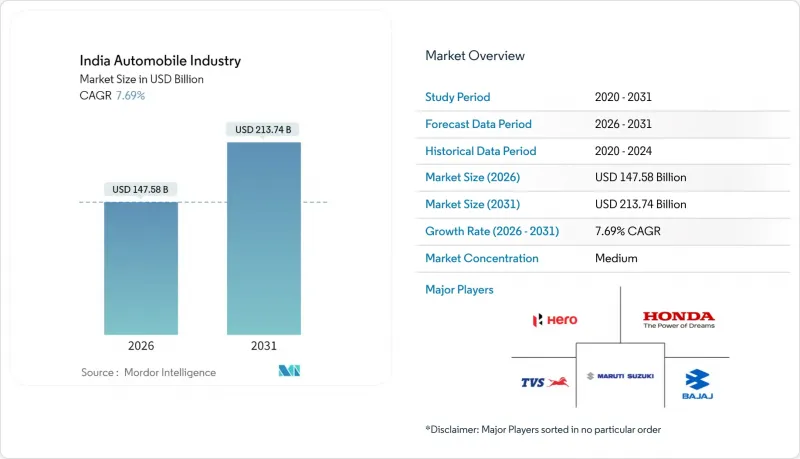
수요는 인구 증가에 따른 소비 확대, 가계 소득 증가, 정책적 지원에 따른 전동화 추진, 그리고 2024년 2,843만 대 생산 실적을 보유한 제조거점이 뒷받침하고 있습니다. 이륜차, 승용차, 상용차, 삼륜차의 지속적인 생산이 산업의 회복력을 유지하고 있으며, 프라단 만트리 그램 사닥 요자나(Pradhan Mantri Gram Sadak Yojana)와 같은 인프라 계획이 지리적 범위를 확장하고 있습니다. 경쟁 환경은 여전히 치열하지만, 전기차 모델, 구독형 소유권, 기업용 차량 탈탄소화에서 기회는 계속되고 있습니다. 반도체 자급률 향상, 지방 도로망 밀도 향상, 디지털 소매업은 향후 10년간 인도의 자동차 시장을 견인할 추가 동력이 될 것으로 예측됩니다.
인도의 자동차 산업 동향과 인사이트
가처분소득 증가와 급속한 도시화
소득 증가로 인해, 특히 토지 가용성이 높고 교통 체증이 적은 지방 도시(2, 3등급 도시)에서 자동차 소유의 매력이 높아지면서 인도의 자동차 시장의 소비자 기반이 확대되고 있습니다. 인구의 65%가 35세 미만이며, 소득이 가장 높아지는 시기와 첫 구매 시기가 일치합니다. 지방에서 이주하는 것은 이중 수요를 자극하고, 도시 구매자는 이동 수단을 찾고, 송금은 고향에서 환승 자금이 됩니다. 교외로의 고용 거점 분산은 대중교통에 대한 의존도를 낮추고, 이륜차 및 소형차 수요를 뒷받침하고 있습니다. 구독 프로그램은 고액의 계약금을 피함으로써 접근성을 확대하고 보급을 촉진하고 있습니다.
정부의 EV 및 FAME-II 인센티브
2019년에 시작된 인도의 FAME(하이브리드 및 전기자동차 보급 촉진 및 제조 촉진) 계획 2단계는 5년간 11,500억 루피(13억 1,000만 달러)의 막대한 예산이 투입됩니다. 이 시책은 전기 이륜차(e-2W), 전기 삼륜차(e-3W), 전기 사륜차(e-4W)를 포함한 전기자동차의 판매 촉진을 목적으로 하고 있습니다. 타밀나두와 구자라트 주 정부의 추가 보조금은 지역 간 격차를 확대시키고 있으며, 현재 계획 중인 FAME-III 개정안은 더 큰 규모의 부문에 대한 지원을 확대하는 것을 목표로 하고 있습니다. 이러한 혜택은 투자 회수 기간을 단축하고, 개인 구매자와 차량 사업자의 제로 에미션 모델로의 전환을 촉진하고 있습니다.
규제 변경, 안전 기준 및 GST(상품 및 서비스세) 전환
인도에서 BS-VII 표준을 도입하고 안전장비를 의무화하면서 중소 조립업체들은 고비용의 파워트레인 업그레이드와 인증에 어려움을 겪고 있으며, 모델 수익률이 압박을 받고 있습니다. 이러한 업그레이드는 규제 기준을 충족하기 위해 많은 연구개발 투자와 엄격한 테스트를 거쳐야 합니다. 한편, 부품에 대한 GST(물품 서비스세) 재조정은 가격 책정의 불확실성을 가져와 전체 제조업체의 비용 구조에 영향을 미치고 있습니다. 더 큰 문제는 각 주별 도로세 제도의 차이로 인해 컴플라이언스가 복잡해지고 있다는 점입니다. 제조업체는 지역마다 다른 세제에 대응해야 합니다. 이러한 요인으로 인해 소비자 가격이 눈에 띄게 상승하여 구매를 미루거나 인도의 자동차 시장의 즉각적인 수요 감소를 초래할 수 있습니다. 또한, 비용 증가는 제조업체들이 부품의 현지 조달과 같은 재정적 부담을 줄이기 위한 대체 전략을 모색하도록 유도할 수 있습니다.
부문 분석
인도의 자동차 시장에서 이륜차는 73.64%의 압도적인 점유율을 차지하고 있습니다. 저렴한 가격, 연비 효율성, 혼잡한 도심에서의 기동성 등 여러 요인으로 인해 인도 소비자들이 이륜차를 선호하는 경향이 두드러지게 나타나고 있습니다. 규모는 작지만, 승용차는 SUV와 크로스오버의 출시로 중산층의 열망에 부응하는 형태로 8.84%의 가장 높은 CAGR을 기록하고 있습니다. 스쿠터 판매량은 오토바이 부문의 10% 증가에 비해 21% 증가했으며, 도시 지역에서 자동 변속기와 사용 편의성에 대한 선호가 두드러졌습니다.
전기 이륜차가 주류 가격대에 진입하고 금융기관이 첫 구매자를 위한 장기 대출을 제공함에 따라 성장세는 계속되고 있습니다. 한편, 상용차는 인프라 예산과 산업 생산 주기에 따라 영향을 받지만, 현재 진행 중인 고속도로 정비의 혜택을 받고 있습니다. 세발자전거는 지방도시의 라스트 마일 화물 및 여객 운송에서 여전히 중요한 역할을 하고 있습니다. 배출가스 규제 강화로 인해 모듈형 플랫폼에 대한 투자가 집중되고 있으며, 인도의 자동차 시장에서 기존 기업의 규모의 경제가 향상될 것으로 예측됩니다.
2025년 기준 가솔린 엔진은 정유소 용량과 디젤 연료에 대한 구매 가격 우위로 인해 인도의 자동차 시장 점유율의 59.27%를 유지했습니다. 배터리 전기자동차(BEV)는 적은 수량, 세제 혜택, FAME-II 보조금, 리튬 이온 배터리 비용 하락으로 인해 10.02%의 연평균 복합 성장률(CAGR)로 성장하고 있습니다. 하이브리드 자동차는 항속거리 불안을 해소하고 새로운 에너지 인프라에 의존하지 않고도 효율을 향상시킬 수 있습니다.
국내 발전에 대한 정책적 노력과 강화되는 연비 기준에 따라 OEM 업체들의 제품 포트폴리오는 점차 전동화 구동 시스템으로 전환되고 있습니다. LPG/CNG 이용은 운영비 절감을 원하는 상용차 fleet에서 확대되고 있습니다. 한편, 연료전지 기술은 수소 공급 부족으로 인해 아직 시험 단계에 머물러 있습니다. 충전 네트워크 구축과 배터리 교체 시범사업이 보급 속도를 좌우하겠지만, 인도의 자동차 시장에서는 이미 모든 부문에서 소비자 수용이 가속화될 조짐을 보이고 있습니다.
기타 특전:
- 엑셀 형식 시장 예측(ME) 시트
- 애널리스트의 3개월간 지원
자주 묻는 질문
목차
제1장 서론
제2장 조사 방법
제3장 주요 요약
제4장 시장 구도
제5장 시장 규모와 성장 예측(금액)
제6장 경쟁 구도
제7장 시장 기회와 향후 전망
LSH 26.03.10The India automobile market is expected to grow from USD 137.06 billion in 2025 to USD 147.58 billion in 2026 and is forecast to reach USD 213.74 billion by 2031 at 7.69% CAGR over 2026-2031.
Demand is buoyed by population-led consumption, rising household incomes, policy-backed electrification, and a manufacturing base that produced 28.43 million vehicles in FY 2024. Sustained output across two-wheelers, passenger cars, commercial vehicles, and three-wheelers keeps the sector resilient, while infrastructure programs such as Pradhan Mantri Gram Sadak Yojana widen geographic reach. Competitive dynamics remain intense, yet opportunities persist in electric models, subscription ownership, and corporate fleet decarbonization. Semiconductor self-reliance, rural road density, and digital retail are additional levers set to lift the India automobile market through the decade.
India Automobile Industry Trends and Insights
Rising Disposable Incomes and Rapid Urbanization
Income growth is enlarging the consumer base for the Indian automobile market, especially in Tier-2 and Tier-3 cities, where land availability and lower congestion make vehicle ownership attractive. Sixty-five percent of the population is under 35, aligning prime earning years with first-time purchases. Migration from rural districts stimulates dual demand, urban buyers seek mobility, while remittances finance upgrades back home. The spread of suburban employment hubs reduces dependence on mass transit and supports two-wheelers and compact cars. Subscription programs extend access by sidestepping hefty down payments, further deepening penetration.
Government EV and FAME-II Incentives
India's FAME (Faster Adoption and Manufacturing of Hybrid & Electric Vehicles) Scheme Phase-II, launched in 2019, comes with a hefty budget of INR 11,500 crore (USD 1.31 billion), set to span five years. This initiative aims to boost the sales of electric vehicles, covering e-2Ws, e-3Ws, and e-4Ws. . State add-ons in Tamil Nadu and Gujarat enhance regional differentials, while the planned FAME-III revision aims to broaden support into heavier segments. These incentives shorten payback periods, encouraging personal buyers and fleet operators to pivot toward zero-emission models.
Regulatory Changes, Safety Standards and GST Shifts
As India implements BS-VII norms and mandates safety gear, small assemblers grapple with costly powertrain upgrades and validations, squeezing their model margins. These upgrades require significant research and development investments and rigorous testing to meet compliance standards. Meanwhile, GST realignments on components introduce pricing uncertainties, impacting the overall cost structure for manufacturers. Adding to the challenge, varying state road-tax regimes complicate compliance, as manufacturers must navigate differing tax policies across regions. These factors lead to noticeable price hikes for consumers, potentially delaying their purchases and dampening immediate demand in the Indian automobile market. Additionally, the increased costs may push manufacturers to explore alternative strategies, such as the localization of components, to mitigate the financial burden.
Other drivers and restraints analyzed in the detailed report include:
- Expansion of National Highway and Rural Road Network
- Subscription-Based Ownership and Leasing Models
- Global Semiconductor Supply-Chain Volatility
For complete list of drivers and restraints, kindly check the Table Of Contents.
Segment Analysis
In the Indian auto market, two-wheelers reign supreme, commanding a significant 73.64% share. This dominance highlights the preference for two-wheelers among Indian consumers, driven by factors such as affordability, fuel efficiency, and ease of navigation in congested urban areas. Although smaller, passenger cars are posting the swiftest 8.84% CAGR on the back of SUV and crossover launches tuned to aspirational middle-class tastes. Scooter sales climbed 21% versus the motorcycle segment's 10% gain, highlighting urban preference for automatic transmissions and ease of use.
Growth momentum continues as electric two-wheelers enter mainstream price points and as financiers extend longer tenures to first-time buyers. Conversely, commercial vehicles hinge on infrastructure budgets and industrial output cycles but benefit from ongoing highway upgrades. Three-wheelers retain relevance for last-mile goods and passenger movement in Tier-2 centers. Regulatory emission upgrades funnel investments toward modular platforms, potentially elevating scale efficiencies for incumbents in the Indian automobile market.
Petrol engines retained 59.27% of the India automobile market share in 2025, buoyed by refinery capacity and lower purchase prices relative to diesel. Battery electric vehicles, though smaller in volume, are advancing at a 10.02% CAGR thanks to tax rebates, FAME-II subsidies and falling lithium-ion cell costs. Hybrids bridge range-anxiety gaps, offering efficiency gains without new-energy infrastructure dependence.
Policy commitments to domestic power generation and stricter fuel-economy norms will gradually shift OEM portfolios toward electrified drivetrains. LPG/CNG use expands in commercial fleets seeking operating-cost relief. Meanwhile, fuel-cell technology remains exploratory due to hydrogen supply gaps. Charging-network rollouts and battery-swapping pilots dictate adoption pace but indicators already point to accelerating consumer acceptance across segments in the India automobile market.
The India Automobile Market Report is Segmented by Vehicle Type (Two-Wheelers, Three-Wheelers and More), Fuel Type (Petrol/Gasoline, Diesel, LPG/CNG, and More), Sales Channel (OEM-Authorized Dealers and Online), Ownership Type (Personal Use and Commercial Use), and by Region (North India, South India, East India, West India). The Market Forecasts are Provided in Terms of Value (USD).
List of Companies Covered in this Report:
- TVS Motor Company
- Hero MotoCorp
- Honda Motorcycle
- Royal Enfield
- Bajaj Auto
- Suzuki Motorcycle India
- Maruti Suzuki India
- Tata Motors
- Hyundai Motor India
- Mahindra & Mahindra
- MG Motor India
- Volkswagen India
- Renault-Nissan Alliance
- Honda Cars India
- BYD India
- BMW Group India
- Mercedes-Benz India
- Kia India
- Ashok Leyland
- Eicher Motors (VE Commercial)
- Atul Auto
- Piaggio Vehicles
- Kinetic Green
Additional Benefits:
- The market estimate (ME) sheet in Excel format
- 3 months of analyst support
TABLE OF CONTENTS
1 Introduction
- 1.1 Study Assumptions & Market Definition
- 1.2 Scope of the Study
2 Research Methodology
3 Executive Summary
4 Market Landscape
- 4.1 Market Overview
- 4.2 Market Drivers
- 4.2.1 Rising Disposable Incomes and Rapid Urbanization
- 4.2.2 Government EV and FAME-II Incentives
- 4.2.3 Expansion of National Highway and Rural Road Network
- 4.2.4 Subscription-Based Ownership and Leasing Models
- 4.2.5 Local Semiconductor Fabrication Investments
- 4.2.6 Corporate Fleet-Decarbonization Mandates
- 4.3 Market Restraints
- 4.3.1 Regulatory Changes, Safety Standards and GST Shifts
- 4.3.2 Global Semiconductor Supply-Chain Volatility
- 4.3.3 Urban Congestion-Driven Usage Restrictions
- 4.3.4 Rising Telematics-Linked Insurance Premiums
- 4.4 Value / Supply-Chain Analysis
- 4.5 Regulatory Landscape
- 4.6 Technological Outlook
- 4.7 Porter's Five Forces
- 4.7.1 Threat of New Entrants
- 4.7.2 Bargaining Power of Buyers
- 4.7.3 Bargaining Power of Suppliers
- 4.7.4 Threat of Substitutes
- 4.7.5 Intensity of Competitive Rivalry
5 Market Size & Growth Forecasts (Value, USD billion)
- 5.1 By Vehicle Type
- 5.1.1 Two-wheelers
- 5.1.2 Three-wheelers
- 5.1.3 Passenger Cars
- 5.1.4 Commercial Vehicles
- 5.2 By Fuel Type
- 5.2.1 Petrol / Gasoline
- 5.2.2 Diesel
- 5.2.3 LPG / CNG
- 5.2.4 Battery Electric Vehicles
- 5.2.5 Hybrid Electric Vehicles
- 5.2.6 Plug-in Hybrid Electric Vehicles
- 5.2.7 Fuel-Cell Electric Vehicles
- 5.3 By Sales Channel
- 5.3.1 OEM-Authorised Dealers
- 5.3.2 Online
- 5.4 By Ownership Type
- 5.4.1 Personal Use
- 5.4.2 Commercial Use
- 5.5 By Region
- 5.5.1 North India
- 5.5.2 South India
- 5.5.3 East India
- 5.5.4 West India
6 Competitive Landscape
- 6.1 Market Concentration
- 6.2 Strategic Moves
- 6.3 Market Share Analysis
- 6.4 Company Profiles (Includes Global level Overview, Market level overview, Core Segments, Financials as available, Strategic Information, Market Rank/Share for key companies, Products & Services, and Recent Developments)
- 6.4.1 TVS Motor Company
- 6.4.2 Hero MotoCorp
- 6.4.3 Honda Motorcycle
- 6.4.4 Royal Enfield
- 6.4.5 Bajaj Auto
- 6.4.6 Suzuki Motorcycle India
- 6.4.7 Maruti Suzuki India
- 6.4.8 Tata Motors
- 6.4.9 Hyundai Motor India
- 6.4.10 Mahindra & Mahindra
- 6.4.11 MG Motor India
- 6.4.12 Volkswagen India
- 6.4.13 Renault-Nissan Alliance
- 6.4.14 Honda Cars India
- 6.4.15 BYD India
- 6.4.16 BMW Group India
- 6.4.17 Mercedes-Benz India
- 6.4.18 Kia India
- 6.4.19 Ashok Leyland
- 6.4.20 Eicher Motors (VE Commercial)
- 6.4.21 Atul Auto
- 6.4.22 Piaggio Vehicles
- 6.4.23 Kinetic Green