|
시장보고서
상품코드
1937286
목재 펄프 : 시장 점유율 분석, 업계 동향과 통계, 성장 예측(2026-2031년)Wood Pulp - Market Share Analysis, Industry Trends & Statistics, Growth Forecasts (2026 - 2031) |
||||||
 Mordor Intelligence
목재 펄프 시장은 2025년 1,820억 달러에서 2026년에는 1,888억 1,000만 달러로 성장할 것으로 예상되며, 2026년부터 2031년까지 CAGR 3.74%를 기록하며 2031년까지 2,267억 9,000만 달러에 달할 것으로 예측됩니다.
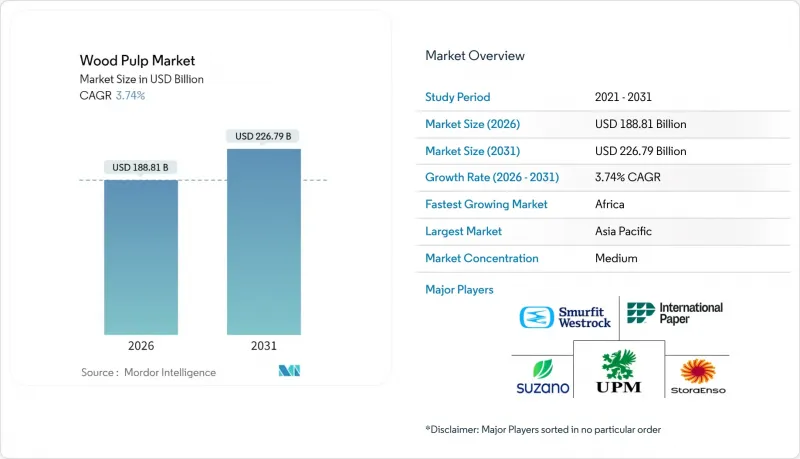
이러한 꾸준한 성장을 뒷받침하는 것은 인쇄용지에서 골판지 포장 및 흡수성 위생용품 등급으로 수요가 이동하고 있다는 점입니다. 생산자들은 전통적인 인쇄용지보다 높은 수익률을 가져다주는 E-Commerce 중심의 골판지 원지, 고급 티슈, 특수 펄프에 더욱 집중하고 있습니다. 제지공장의 지속적인 설비 업데이트, 바이오리파이너리와의 통합, AI를 활용한 공정관리로 원자재 가격 변동에도 불구하고 수익은 더욱 안정적입니다. 지역별 수요 패턴은 크게 다르며, 아시아태평양이 물량을 주도하고, 아프리카는 규모는 작지만 지속적으로 확대되고 있으며, 북미와 유럽은 부가가치가 높은 틈새 시장으로 이동하고 있습니다. 국경 간 관세, 특히 미국으로의 캐나다산 펄프 수입에 대한 관세는 기존의 무역 패턴을 방해하고, 생산자에게 마진 압박을 흡수하거나 아시아태평양의 대체 시장을 개척하도록 강요하고 있습니다.
세계 목재 펄프 시장 동향 및 인사이트
E-Commerce가 주도하는 골판지 포장 수요 급증
온라인 소매업의 성장과 함께 시장 펄프에서 생산되는 크래프트 라이너 및 중간재를 대량으로 사용하는 골판지 상자의 소비가 가속화되고 있습니다. 국제제지(International Paper)는 2024년 골판지 원지 수요가 2024년 EC 고객의 재고 보충으로 회복될 것으로 예상하고, 새로 설립된 스머핏 웨스트록(Smurfit Westlock)은 포장재 중심의 포트폴리오에서 2024년 47억 달러의 조정 후 EBITDA를 예상하고 있습니다. 예상하고 있습니다. 소비자 직배송을 위한 보호 운송 형태는 기존 소매업에 비해 포장 단위당 섬유 사용량을 증가시키고 있습니다. 이러한 추세는 중국, 인도, 미국에서 가장 두드러지게 나타나고 있으며, 대량의 소포 유통과 플라스틱보다 종이를 우선시하는 지속가능성 요구가 교차하고 있습니다. 제지공장은 대응책으로 그래픽용지 제조기를 골판지 원지 제조용으로 전환하고, 원료 공급량 증가를 통해 목재펄프 시장을 활성화하고 있습니다. 디지털 무역의 구조적 모멘텀은 거시경제 사이클의 변동에도 불구하고 장기적인 펄프 소비를 뒷받침하는 기반이 되고 있습니다.
신흥국에서의 티슈 및 위생용품 소비 증가
아시아태평양과 아프리카의 1인당 티슈 사용량은 여전히 유럽과 북미 지역보다 훨씬 낮은 수준입니다. 국제제지는 흡수성 펄프 수출의 약 90%를 이들 고성장 지역에 공급하고 있어, 수요 격차가 두드러지게 나타나고 있습니다. 가처분 소득의 증가, 도시화, 위생에 대한 인식이 높아지면서 고순도 펄프를 원료로 한 고급 티슈 및 기저귀 제품에 대한 수요가 확대되고 있습니다. 가정용 종이 수요는 경기 침체의 영향을 덜 받는 특성이 있기 때문에 이 수요 요인은 목재 펄프 시장에 안정적인 물량 성장을 가져와 보다 순환적인 포장 부문과 균형을 유지하고 있습니다. 신흥 시장에서는 공급이 소비를 따라잡지 못하기 때문에 펄프 펄프 생산능력을 갖춘 제조업체는 유리한 마진을 누리고 있습니다. 장기적인 인구통계학적 추세는 예측 기간을 훨씬 뛰어넘는 지속적인 확장을 시사하고 있습니다.
기후변화와 물류 장애에 연동된 펄프 가격의 변동성
2024년 태풍 피해, 가뭄, 운송 병목 현상으로 북유럽 펄프 가격은 사상 최고치를 기록했고, 빌레도는 마진 유지를 위해 제품 가격을 인상해야 했습니다. 북미에서도 비슷한 공급충격이 발생하여 극한의 기상조건에 취약한 트럭 및 철도 수송로에 대한 의존도가 드러났습니다. 가격 급등은 펄프 판매가격과 원재료 비용의 차익을 압축하고 제지공장의 임의 설비 갱신을 지연시키고 있습니다. 중소기업은 헤지 수단과 계약상의 협상력이 부족하여 도산 위험이 증가하고 있습니다. 장기적인 조림 프로젝트가 공급 부족을 완화시킬 수 있지만, 단기적인 가격 변동성은 여전히 목재 펄프 시장 성장의 주요 억제요인으로 남아 있습니다.
부문 분석
목재 펄프 시장 규모는 섬유 선호도 변화와 지속가능성 추세에 따라 형성되고 있습니다. 2025년 목재 펄프 시장 점유율의 47.25%는 침엽수 섬유가 차지했으며, 유칼립투스와 자작나무의 조림은 티슈, 인쇄, 경량 포장재에 중요한 단섬유 특성을 제공함으로써 이를 뒷받침하고 있습니다. 중국과 인도네시아의 아시아태평양 조림은 국내 가공업체와 수출 공장에 경쟁력 있는 가격의 활엽수 원료를 공급함으로써 이러한 우위를 강화하고 있습니다. 북유럽과 북미의 산림에서 추출한 침엽수 섬유는 컨테이너 보드, 봉지 등 장섬유 강도가 중요한 용도에 여전히 중요한 역할을 하고 있습니다. 그러나 생산자들은 성능 목표를 달성하면서도 원재료 비용을 억제하기 위해 경재와 침엽수의 혼합 비율을 미세하게 조정하는 경향이 증가하고 있습니다. 공장들이 배합을 최적화하는 가운데, 목재 펄프 시장 전체에서 조달 전략이 진화하는 가운데, 활엽수는 계속해서 생산량 기반을 유지하고 있습니다.
비목재 원료 대체재는 가장 빠른 성장이 예상되며, 지속가능성에 대한 요구가 자원 다변화를 촉진하면서 2026년부터 2031년까지 5.07%의 연평균 성장률을 보일 것으로 전망됩니다. 밀짚, 쌀겨, 사탕수수 바가스 등 농업 잔류물은 집약적 농업 지역에서 풍부한 섬유 공급원을 제공하며, 대나무는 환경 친화적인 브랜드와 규제 당국에 매력적인 빠른 재생 주기를 가지고 있습니다. UPM이 소드라와 리그닌 추출을 위해 제휴한 사례는 생산자들이 비목재 섬유의 활용을 보완할 수 있는 새로운 가치화 경로를 모색하고 있음을 보여줍니다.
지역별 분석
아시아태평양은 목재 펄프 시장의 48.05%를 차지하며 전 세계 수요를 견인하고 있습니다. 중국은 전 세계 골판지 원지 출하량의 3분의 1 이상을 소비하고 있으며, 인도에서는 티슈 페이퍼 시장이 두 자릿수 성장을 기록하고 있습니다. 브라질, 인도네시아, 베트남의 조림 임업은 중국 가공업체에 저가의 섬유를 공급하여 이 지역의 규모 우위를 강화하고 있습니다. 일본과 한국은 특수 용도의 고순도 펄프 수입에 의존하는 반면, 호주는 식림 유칼립투스 칩을 역내 제지 공장에 수출하고 있습니다. 기존 공장의 병목현상 해소 투자와 신규 단공정 대형 공장 건설로 아시아태평양의 공급 안정성과 세계 가격 영향력을 확보할 수 있습니다.
아프리카 목재 펄프 시장 규모는 상대적으로 작지만, 남아프리카공화국의 통합 임업 및 제지 자산은 아프리카 대륙에 전략적 기반을 제공하고 있습니다. 사피의 108억 랜드(6억 달러) 규모의 투자는 현대화 및 지역 연계를 가속화하고, 원료 공급망과 사회적 수용성을 향상시키고 있습니다. 더반항과 마푸토항의 물류 기능 강화를 통해 유럽 및 아시아 지역으로의 수출 리드타임 단축을 목표로 하고 있습니다. 신흥 북아프리카 생산자들은 유럽의 최종 소비지와의 근접성을 활용하여 2031년까지 대륙 전체 CAGR 5.55%를 견인할 것으로 예상됩니다.
북미와 유럽에서는 성숙한 수요 구조를 볼 수 있습니다. 미국은 섬유 원료의 공급 과잉을 유지하고 있지만, 관세 분쟁으로 인해 아시아로의 유통이 전환되는 도전에 직면해 있습니다. 캐나다 서부 생산자들은 관세 리스크를 줄이기 위해 미국 시장 외의 시장 다변화를 추진하고 있습니다. 유럽에서는 바이오리파이너리 사업과 플라스틱 대체를 우선시하며, 그래픽 용지 소비 감소에도 불구하고 특수지 등급의 성장세를 유지하고 있습니다. 환경 규제 강화는 컴플라이언스 비용을 증가시키지만, 목재 펄프 시장에서 프리미엄 제품 차별화를 촉진하는 혁신을 촉진하고 있습니다.
기타 특전:
- 엑셀 형식의 시장 예측(ME) 시트
- 애널리스트의 3개월 지원
자주 묻는 질문
목차
제1장 소개
- 조사 전제조건 및 시장의 정의
- 조사 범위
제2장 조사 방법
제3장 주요 요약
제4장 시장 구도
- 시장 개요
- 시장 촉진 요인
- 전자상거래 주도 골판지 포장재 수요 급증
- 신흥 경제국의 티슈 및 위생용품 소비 증가
- 지속가능성 의무화에 따른 플라스틱의 섬유 소재로의 대체
- 아시아 태평양 지역의 활엽수 크라프트 제지 공장의 생산 능력 증설
- 바이오 정제소 통합을 통한 리그닌 및 헤미셀룰로오스 수익 창출
- AI 기반 예측 유지보수를 통해 제분기 가동 시간 및 생산량 증대
- 시장 억제 요인
- 기후 및 물류 충격과 연관된 변동성이 큰 펄프용 목재 가격
- 폐수 및 화학물질 배출 규제 강화
- 숙련된 노동력 부족으로 신규 건설 및 리모델링 프로젝트 지연
- 국경을 넘은 관세가 펄프 무역의 흐름을 재구축
- 가치/공급망 분석
- 규제 상황
- 기술 전망
- Porter's Five Forces
- 신규 참가업체의 위협
- 공급기업의 협상력
- 구매자의 협상력
- 대체품의 위협
- 경쟁 기업간 경쟁 관계
제5장 시장 규모와 성장 예측
- 성분별
- 연목
- 활엽수
- 비목재 섬유
- 지역별
- 북미
- 미국
- 캐나다
- 기타 북미
- 남미
- 브라질
- 아르헨티나
- 기타 남미
- 유럽
- 독일
- 영국
- 프랑스
- 핀란드
- 러시아
- 기타 유럽
- 아시아태평양
- 중국
- 인도
- 일본
- 호주
- 한국
- 기타 아시아태평양
- 중동
- 사우디아라비아
- 아랍에미리트(UAE)
- 기타 중동
- 아프리카
- 남아프리카공화국
- 이집트
- 기타 아프리카
- 북미
제6장 경쟁 구도
- 시장 집중도
- 전략적 동향
- 시장 점유율 분석
- 기업 프로파일
- Suzano S.A.
- International Paper Company
- Stora Enso Oyj
- UPM-Kymmene Oyj
- Smurfit WestRock plc
- Metsaliitto Cooperative
- Sappi Limited
- Celulosa Arauco y Constitucion S.A.(Empresas Copec S.A.)
- Asia Pulp & Paper Co. Ltd.(Sinar Mas Group)
- Mercer International Inc.
- Canfor Pulp Products Inc.(Canfor Corporation)
- Paper Excellence B.V.
- Klabin S.A.
제7장 시장 기회와 향후 전망
KSM 26.03.05The wood pulp market is expected to grow from USD 182.00 billion in 2025 to USD 188.81 billion in 2026 and is forecast to reach USD 226.79 billion by 2031 at 3.74% CAGR over 2026-2031.
A shift away from graphic paper and toward corrugated packaging and absorbent hygiene grades underpins this steady advance. Producers deepen their focus on e-commerce-driven containerboard, premium tissue, and specialty pulps that carry higher margins than legacy printing grades. Continual mill upgrades, bio-refinery integration, and AI-enabled process control further stabilize earnings despite raw-material volatility. Geographic demand patterns diverge sharply as Asia-Pacific drives volume, Africa expands from a small base, and North America and Europe pivot to value-added niches. Cross-border tariffs, particularly duties imposed on Canadian pulp imports to the United States, disrupt established trade patterns and force producers to absorb margin compression or seek alternative markets in Asia-Pacific regions.
Global Wood Pulp Market Trends and Insights
E-commerce-driven Corrugated-packaging Demand Surge
Online retail growth intensifies the consumption of corrugated boxes that use high volumes of kraft liner and medium produced from market pulp. International Paper noted containerboard volume recovery in 2024 as e-commerce clients replenished stocks, and the newly formed Smurfit WestRock projects USD 4.7 billion in adjusted EBITDA for 2024 from its packaging-heavy portfolio. Protective shipping formats for direct-to-consumer deliveries raise fiber intensity per package versus traditional retail. The trend is most pronounced in China, India, and the United States, where high parcel volumes intersect with sustainability mandates that favor paper over plastic. Mill operators respond by converting graphic-paper machines to containerboard, boosting the wood pulp market through incremental furnish demand. Digital trade's structural momentum supports long-run pulp consumption even as macro cycles fluctuate.
Growth in Tissue and Hygiene Consumption in Emerging Economies
Per-capita tissue use in Asia-Pacific and Africa remains well below levels observed in Europe and North America. International Paper directs roughly 90% of absorbent pulp exports to these high-growth regions, underscoring the demand gap. Rising disposable incomes, urbanization, and heightened hygiene awareness lift uptake of premium tissue and diaper products that rely on high-purity pulps. Because household paper demand is relatively recession-resilient, this driver provides consistent volume growth for the wood pulp market, balancing more cyclical packaging segments. Producers with fluff-pulp capacity enjoy favorable margins as supply lags consumption in emerging markets. Long-term demographic trends point to sustained expansion well beyond the forecast horizon.
Volatile Pulpwood Prices Tied to Climate and Logistics Shocks
Storm damage, drought, and transport bottlenecks lifted Nordic pulpwood prices to record levels in 2024, forcing Billerud to raise product prices to preserve margins. Similar supply shocks in North America exposed dependence on truck and rail corridors vulnerable to extreme weather. Price spikes compress spreads between pulp realizations and fiber costs, delaying discretionary mill upgrades. Smaller firms lack hedging tools and contractual leverage, heightening bankruptcy risk. While long-term plantation projects may ease tightness, near-term volatility remains a key brake on wood pulp market growth.
Other drivers and restraints analyzed in the detailed report include:
- Plastic-to-fiber Substitution Prompted by Sustainability Mandates
- Capacity Additions of Hardwood Kraft Mills in Asia-Pacific
- Tightening Wastewater and Chemical-emissions Regulations
For complete list of drivers and restraints, kindly check the Table Of Contents.
Segment Analysis
Wood pulp market size is being shaped by shifting fiber preferences and sustainability trends. Hardwood fibers captured 47.25% of the wood pulp market share in 2025, supported by eucalyptus and birch plantations that deliver short-fiber characteristics prized in tissue, printing, and lightweight packaging applications. Asia-Pacific plantations in China and Indonesia reinforce this advantage by supplying domestic converters and export mills with competitively priced hardwood furnish. Softwood fibers from Nordic and North American forests retain relevance where long-fiber strength is critical, such as containerboard and sack paper, yet producers increasingly fine-tune hardwood-softwood blends to hit performance targets while curbing raw-material costs. As mills optimize recipes, hardwood continues to anchor volume even as procurement strategies evolve across the wood pulp market.
Non-wood alternatives are set to grow fastest, advancing at a 5.07% CAGR from 2026 to 2031 as sustainability mandates push the industry toward resource diversification. Agricultural residues such as wheat straw, rice husks, and sugarcane bagasse supply abundant fiber streams in intensive farming regions, while bamboo offers rapid regrowth cycles attractive to environmentally conscious brands and regulators. UPM's collaboration with Sodra on lignin extraction underlines how producers explore new valorization pathways that complement non-wood fiber utilization.
The Wood Pulp Market Report is Segmented by Fiber Source (Hardwood, Softwood, Non-Wood Fibers) and Geography (North America, Europe, Asia-Pacific, South America, Middle East, and Africa). The Market Forecasts are Provided in Terms of Value (USD).
Geography Analysis
Asia-Pacific's 48.05% wood pulp market share anchors global demand, with China consuming more than one-third of worldwide corrugated liner shipments and India recording double-digit tissue growth. Plantation forestry across Brazil, Indonesia, and Vietnam channels low-cost fiber into Chinese converters, reinforcing the region's scale advantage. Japan and South Korea rely on high-purity imports for specialty applications, while Australia exports plantation eucalyptus chips to regional mills. Investments in brownfield debottlenecking and new single-phase mega-mills safeguard Asia-Pacific's supply security and global price influence.
Africa's wood pulp market size remains comparatively modest, yet South Africa's integrated forestry and mill assets give the continent a strategic foothold. Sappi's R10.8 billion (USD 600 million) commitment accelerates modernization and community engagement, improving raw-material flows and social license to operate. Logistical upgrades at Durban and Maputo ports aim to cut export lead times to Europe and Asia. Emerging North African producers leverage proximity to European end-users, supporting the continent's 5.55% CAGR through 2031.
North America and Europe exhibit mature demand profiles. The United States maintains surplus fiber availability but wrestles with tariff disputes that redirect flows toward Asia. Canada's Western producers diversify beyond U.S. markets to offset duty exposure. Europe prioritizes bio-refinery projects and plastic substitution, sustaining specialty-grade growth despite shrinking graphic-paper consumption. Stricter environmental regulations raise compliance costs but also encourage innovation that differentiates premium offerings within the wood pulp market.
- Suzano S.A.
- International Paper Company
- Stora Enso Oyj
- UPM-Kymmene Oyj
- Smurfit WestRock plc
- Metsaliitto Cooperative
- Sappi Limited
- Celulosa Arauco y Constitucion S.A. (Empresas Copec S.A.)
- Asia Pulp & Paper Co. Ltd. (Sinar Mas Group)
- Mercer International Inc.
- Canfor Pulp Products Inc. (Canfor Corporation)
- Paper Excellence B.V.
- Klabin S.A.
Additional Benefits:
- The market estimate (ME) sheet in Excel format
- 3 months of analyst support
TABLE OF CONTENTS
1 Introduction
- 1.1 Study Assumptions and Market Definition
- 1.2 Scope of the Study
2 Research Methodology
3 Executive Summary
4 Market Landscape
- 4.1 Market Overview
- 4.2 Market Drivers
- 4.2.1 E-commerce driven corrugated-packaging demand surge
- 4.2.2 Growth in tissue and hygiene consumption in emerging economies
- 4.2.3 Plastic-to-fiber substitution prompted by sustainability mandates
- 4.2.4 Capacity additions of hardwood kraft mills in Asia-Pacific
- 4.2.5 Bio-refinery integration unlocking lignin and hemicellulose revenue streams
- 4.2.6 AI-enabled predictive maintenance boosting mill uptime and yield
- 4.3 Market Restraints
- 4.3.1 Volatile pulpwood prices tied to climate and logistics shocks
- 4.3.2 Tightening wastewater and chemical-emissions regulations
- 4.3.3 Skilled-labor shortages delaying greenfield and retrofit projects
- 4.3.4 Cross-border tariffs reshaping pulp trade flows
- 4.4 Regulatory Landscape
- 4.5 Technological Outlook
- 4.6 Porter's Five Forces Analysis
- 4.6.1 Threat of New Entrants
- 4.6.2 Bargaining Power of Suppliers
- 4.6.3 Bargaining Power of Buyers
- 4.6.4 Threat of Substitutes
- 4.6.5 Intensity of Competitive Rivalry
5 Market Size and Growth Forecasts (Value, USD)
- 5.1 By Fiber Source
- 5.1.1 Softwood
- 5.1.2 Hardwood
- 5.1.3 Non-wood Fibers
- 5.2 By Geography
- 5.2.1 North America
- 5.2.1.1 United States
- 5.2.1.2 Canada
- 5.2.1.3 Rest of North America
- 5.2.2 Europe
- 5.2.2.1 Germany
- 5.2.2.2 United Kingdom
- 5.2.2.3 France
- 5.2.2.4 Finland
- 5.2.2.5 Russia
- 5.2.2.6 Rest of Europe
- 5.2.3 Asia-Pacific
- 5.2.3.1 China
- 5.2.3.2 India
- 5.2.3.3 Japan
- 5.2.3.4 Australia
- 5.2.3.5 South Korea
- 5.2.3.6 Rest of Asia-Pacific
- 5.2.4 South America
- 5.2.4.1 Brazil
- 5.2.4.2 Argentina
- 5.2.4.3 Rest of South America
- 5.2.5 Middle East
- 5.2.5.1 Saudi Arabia
- 5.2.5.2 United Arab Emirates
- 5.2.5.3 Rest of Middle East
- 5.2.6 Africa
- 5.2.6.1 South Africa
- 5.2.6.2 Egypt
- 5.2.6.3 Rest of Africa
- 5.2.1 North America
6 Competitive Landscape
- 6.1 Market Concentration
- 6.2 Strategic Moves
- 6.3 Market Share Analysis
- 6.4 Company Profiles (Includes Global Level Overview, Market Level Overview, Core Segments, Financials as Available, Strategic Information, Market Rank/Share, Products and Services, Recent Developments)
- 6.4.1 Suzano S.A.
- 6.4.2 International Paper Company
- 6.4.3 Stora Enso Oyj
- 6.4.4 UPM-Kymmene Oyj
- 6.4.5 Smurfit WestRock plc
- 6.4.6 Metsaliitto Cooperative
- 6.4.7 Sappi Limited
- 6.4.8 Celulosa Arauco y Constitucion S.A. (Empresas Copec S.A.)
- 6.4.9 Asia Pulp & Paper Co. Ltd. (Sinar Mas Group)
- 6.4.10 Mercer International Inc.
- 6.4.11 Canfor Pulp Products Inc. (Canfor Corporation)
- 6.4.12 Paper Excellence B.V.
- 6.4.13 Klabin S.A.