
|
시장보고서
상품코드
1937399
미국의 통신 MNO : 시장 점유율 분석, 업계 동향과 통계, 성장 예측(2026-2031년)US Telecom MNO - Market Share Analysis, Industry Trends & Statistics, Growth Forecasts (2026 - 2031) |
||||||
 Mordor Intelligence
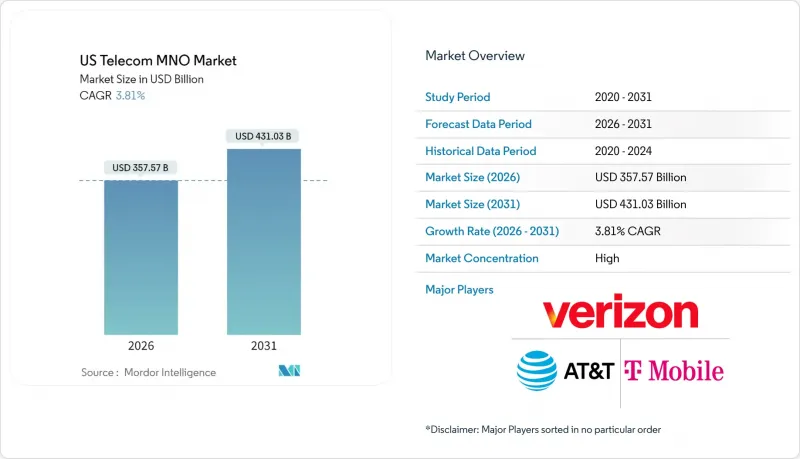
미국의 통신 MNO 시장 규모는 2026년에 3,575억 7,000만 달러로 추정되며, 2025년 3,444억 5,000만 달러에서 성장이 전망됩니다.
2031년에는 4,310억 3,000만 달러에 달할 것으로 예상되며, 2026년부터 2031년까지 CAGR 3.81%로 확대될 것으로 전망됩니다.
이러한 꾸준한 성장 궤적은 성숙한 시장 환경을 반영하고 있으며, 기존 음성 및 메시징 서비스는 축소되는 반면, 데이터 집약형 애플리케이션, 프라이빗 셀룰러 도입, 통합형 기업 플랫폼이 수익률을 확대하고 있습니다. 고비용 5G 자산의 수익화 강화가 성장의 핵심이며, 통신사들은 프리미엄 서비스 계층, 서비스형 네트워크(Network as a Service, NaaS) 제안, 저지연 에지 노드(Edge Node) 구축을 추진하고 있습니다. 지방 커버리지 향상을 위한 민관 보조금, 보유 스펙트럼 자원의 적극적인 수익화, AI 기반 네트워크 자동화를 통해 총 잠재 수익 풀은 지속적으로 확대되고 있습니다. 경쟁은 계속 억제된 상태로 유지되고 있습니다. 이는 전국 3개 통신사가 스펙트럼 깊이와 소매 유통망을 장악하고 있기 때문이며, 선불 계약 해지율이 상승하는 상황에서도 규율적인 가격 책정이 가능하기 때문입니다. 자본 규율, 에너지 최적화, 스펙트럼 재사용이 결합되어 사업자는 여유 현금 흐름을 크게 훼손하지 않고도 지속적인 네트워크 고밀도화에 투자할 수 있습니다.
미국 통신 MNO 시장 동향 및 인사이트
5G SA(Standalone) 코어 배포로 데이터 수익 창출 가속화
독립형(SA) 아키텍처로의 완전한 전환을 통해 통신사업자는 지연과 처리량을 보장하는 가상 슬라이스를 생성할 수 있으며, 기존 비독립형 구축에서는 실현할 수 없었던 서비스 차별화를 실현할 수 있습니다. T-Mobile은 공공안전용 슬라이스를 상용화하여 이미 연간 2억 달러의 지속적인 수익을 창출하고 있으며, Verizon은 SA를 활용하여 제조업용 로봇의 엣지 워크로드를 10밀리초 이내로 지원하고 있습니다. 기업용 계약에서는 API 공개를 번들로 제공하는 경우가 많으며, 개발자는 캐리어급 인증 및 과금 기능을 애플리케이션에 바로 적용할 수 있습니다. 이를 통해 2028년까지 약 200억 달러 규모의 플랫폼 수익 풀이 창출될 것으로 예상됩니다. 고부가가치 네트워크 슬라이스는 대중용 모바일 광대역 ARPU(사용자당 평균 수익)의 3-5배에 해당하며, 미국 통신 MNO 시장을 직접적으로 끌어올리고 있습니다.
고정 무선 액세스(FWA)가 기존 구리선을 대체합니다.
전국 FWA 계약 건수는 2024년 말까지 1,000만 건을 돌파할 것으로 예상됩니다. 이는 중대역 및 C밴드 스펙트럼을 통해 지방 클러스터에서 평균 300Mbps의 다운링크 속도를 달성했기 때문입니다. 이 제품은 구식 DSL 및 동축 케이블의 서비스 영역을 직접 대체하고, 광섬유의 커버리지 부족을 보완하여 통신 사업자의 5G 무선 설비 투자 회수를 가속화할 수 있습니다. FWA는 가정용 밴딩도 강화하여, 가정용 인터넷 계약이 있는 경우, 무선 사업자의 모바일 회선 부가요금제가 18% 더 높게 적용됩니다. 인구 밀집 교외의 용량 제약은 액티브 안테나의 확장 및 스펙트럼 공유 알고리즘의 도입을 촉진하지만, 경제성은 여전히 도랑 파기 공사에 비해 유리합니다. 고객 수의 급격한 성장으로 2027년까지 미국 통신 MNO 시장의 CAGR을 0.8%포인트 끌어올리는 효과를 가져옵니다.
인플레이션으로 인한 선불 ARPU에 대한 압력
에너지 및 인건비 상승으로 통신사들은 요금제 가격을 인상할 수밖에 없는 상황이지만, 선불 고객은월 청구액이 5달러 이상 상승하면 즉시 해지하는 경향이 있습니다. AT&T의 2025년 요금 개정으로 선불 해지율이 일시적으로 190bp 상승하여 대규모 고객 유지 크레딧과 마케팅 비용 증가를 초래했습니다. 현재 통신사들은 가입자 수 유지를 위해 종합적인 컨텐츠 번들, 대용량 데이터 할당, 후불제 단말기 할부금융을 제공하고 있으며, 이로 인해 단기적으로 EBITDA 마진이 40-60bp 축소되고 있습니다.
부문 분석
데이터 및 인터넷 부문은 2025년 매출의 53.12%를 차지하며 미국 통신 MNO 시장 규모에서 가장 큰 기여를 할 것으로 예상됩니다. 무제한 스마트폰 요금제, FWA(고정 무선 액세스) 계약, 기업 전용 액세스가 결합되어 사용자 1인당 모바일 데이터 트래픽은 전년 대비 7.8% 증가했습니다. 캐리어 애그리게이션을 활용한 프리미엄 요금제는 2025년 필드 테스트에서 실측 5.5Gbps의 처리량을 달성하며 속도 우위를 강화하는 한편, 가격 차이의 정당성을 입증했습니다. 음성통화와 SMS는 OTT(Over The Top) 서비스 대체에 따라 이용률이 두 자릿수 감소하여 매출 점유율이 10% 이하로 떨어졌습니다. 한편, IoT 및 M2M 서비스는 가장 빠른 성장세를 보였습니다. 3,000만 개의 추가 라이선스 셀룰러 단말기와 공장, 항만, 병원 내 사설 네트워크 도입 증가가 이를 뒷받침하고 있습니다. 이 하위 부문의 2031년까지 CAGR 3.92%는 장기적으로 전통적인 서비스의 쇠퇴를 상쇄하고 미국 통신 MNO 시장의 확장을 지속할 수 있는 장기적인 상승 효과를 가져올 것으로 예상됩니다.
기업용 데이터 계약에서는 SLA(서비스 수준 계약)에 따른 처리량 및 네트워크 슬라이스 분리가 점점 더 요구되고 있으며, 이는 소비자 회선보다 높은 수익률과 장기 계약을 가져오고 있습니다. 도매 로밍 및 가상 통신 사업자와의 제휴는 추가 수익을 가져다 주지만, 주로 오프 피크 시간대에 주파수 자산을 상각하는 것을 목적으로 합니다. 자가 최적화 네트워크에 내장된 고급 분석 기술을 통해 전력 소비를 약 15% 절감하고, 이를 통해 절감된 운영 비용을 스몰셀에 대한 추가 투자에 사용함으로써 미국 통신 MNO 시장 전체에서 데이터 중심적 입지를 더욱 강화할 수 있게 됩니다.
미국 통신 MNO 시장은 서비스 유형(음성 서비스, 데이터/인터넷 서비스, 메시징 서비스, IoT/M2M 서비스, OTT/유료 TV 서비스, 기타 서비스) 및 최종사용자(기업, 소비자)에 따라 시장 세분화됩니다. 시장 예측은 금액(달러) 및 수량(가입자 수)으로 제공됩니다.
기타 특전:
- 엑셀 형식의 시장 예측(ME) 시트
- 애널리스트의 3개월간 지원
자주 묻는 질문
목차
제1장 소개
제2장 조사 방법
제3장 주요 요약
제4장 시장 구도
제5장 시장 규모와 성장 예측
제6장 경쟁 구도
제7장 시장 기회와 향후 전망
KSM 26.03.09US Telecom MNO market size in 2026 is estimated at USD 357.57 billion, growing from 2025 value of USD 344.45 billion with 2031 projections showing USD 431.03 billion, growing at 3.81% CAGR over 2026-2031.
This steady trajectory reflects a mature arena in which legacy voice and messaging streams shrink while data-heavy applications, private cellular deployments, and integrated enterprise platforms expand margins. Heightened monetization of costly 5G assets is central to growth, with operators rolling out premium service tiers, network-as-a-service propositions, and low-latency edge nodes. Private and public sector subsidies for rural coverage, aggressive monetization of spectrum holdings, and AI-driven network automation continue to widen total addressable revenue pools. Competitive intensity remains contained because three national carriers dominate spectrum depth and retail distribution, allowing disciplined pricing even as prepaid churn rises. Capital discipline, energy optimization, and spectrum refarming collectively underpin operators' ability to fund continued densification without materially eroding free cash flow .
US Telecom MNO Market Trends and Insights
5G Stand-Alone Core Roll-outs Accelerating Data Monetization
Full migration to stand-alone (SA) architecture allows carriers to create virtual slices that guarantee latency and throughput, adding service differentiation unavailable on legacy non-stand-alone deployments. T-Mobile commercialized public-safety slices that already contribute USD 200 million in recurring annual revenue, while Verizon leverages SA to support sub-10 millisecond edge workloads for manufacturing robotics . Enterprise deals often bundle API exposure so developers can embed carrier-grade authentication and billing directly into applications, a pathway to an estimated USD 20 billion platform revenue pool by 2028 . Higher-value network slices translate into 3-5 times the ARPU of mass-market mobile broadband, directly lifting the US Telecom MNO market.
Fixed-Wireless Access (FWA) Displacing Legacy Copper
National FWA subscriptions crossed the 10 million mark by end-2024 as mid-band and C-band spectrum enabled 300 Mbps average downlink in rural clusters. The product directly cannibalizes outdated DSL and coax footprints, fills fiber coverage gaps, and accelerates operators' payback on 5G radios. FWA also strengthens household bundling, with wireless carriers attaching mobile lines at an 18% higher rate when a home internet account is present. Capacity constraints in dense suburbs trigger active-antenna expansions and spectrum-sharing algorithms, yet economics remain favorable relative to trenching. Rapid customer growth adds 0.8 percentage points to the US Telecom MNO market CAGR through 2027.
Inflation-Induced ARPU Pressure in Prepaid
Elevated energy and labor expenses compel carriers to raise plan prices, yet prepaid customers exhibit immediate churn when monthly bills climb by more than USD 5. AT&T's 2025 upward revisions triggered a temporary 190-basis-point increase in prepaid churn, forcing larger retention credits and marketing spend. Operators now extend inclusive content bundles, high-data allotments, and buy-now-pay-later device financing to defend subscriber counts, trimming EBITDA margin by 40-60 basis points over the near term.
Other drivers and restraints analyzed in the detailed report include:
- eSIM-Only Device Launches Simplifying Churn
- Federal BEAD and Middle-Mile Grants Stimulating Rural Build-outs
- Fiber Over-builds Eroding FWA Economics
For complete list of drivers and restraints, kindly check the Table Of Contents.
Segment Analysis
The data and internet category represented 53.12% of 2025 revenue, delivering the single-largest contribution to the US Telecom MNO market size. Unlimited smartphone plans, FWA subscriptions, and enterprise dedicated access collectively underpinned a 7.8% uplift in mobile data traffic per user year-on-year. Premium tiers exploiting carrier aggregation hit verified 5.5 Gbps throughput during 2025 field tests, reinforcing perceived speed leadership and justifying price differentials. Voice and SMS collectively fell below 10% revenue share as over-the-top substitutes drove double-digit usage declines. Meanwhile, IoT and M2M services posted the fastest trajectory, supported by 30 million incremental licensed cellular endpoints and a swelling pipeline of private network installs inside factories, ports, and hospitals. The sub-segment's 3.92% CAGR through 2031 adds a long-run lift that offsets eroding legacy lines, thereby sustaining expansion in the US Telecom MNO market.
Enterprise data contracts increasingly request SLA-backed throughput and network-slice isolation, commands that draw higher margins and longer-term commitments than consumer lines. Wholesale roaming and virtual operator partnerships add incremental revenue but primarily serve to amortize spectrum assets during off-peak hours. Advanced analytics embedded in self-optimizing networks slash power draw by around 15% and thereby release opex for reinvestment in additional small cells, further reinforcing data-centric positioning across the US Telecom MNO market.
The US Telecom MNO Market is Segmented by Service Type (Voice Services, Data and Internet Services, Messaging Services, Iot and M2M Services, OTT and PayTV Services, and Other Services), and End User (Enterprises, Consumer). The Market Forecasts are Provided in Terms of Value (USD) and Volume (Subscribers).
List of Companies Covered in this Report:
- Verizon Communications Inc.
- AT&T Inc.
- T-Mobile US, Inc.
Additional Benefits:
- The market estimate (ME) sheet in Excel format
- 3 months of analyst support
TABLE OF CONTENTS
1 INTRODUCTION
- 1.1 Study Assumptions and Market Definition
- 1.2 Scope of the Study
2 RESEARCH METHODOLOGY
3 EXECUTIVE SUMMARY
4 MARKET LANDSCAPE
- 4.1 Market Overview
- 4.2 Regulatory and Policy Framework
- 4.3 Spectrum Landscape and Competitive Holdings
- 4.4 Telecom Industry Ecosystem
- 4.5 Macroeconomic and External Drivers
- 4.6 Porter's Five Forces Analysis
- 4.6.1 Competitive Rivalry
- 4.6.2 Threat of New Entrants
- 4.6.3 Bargaining Power of Suppliers
- 4.6.4 Bargaining Power of Buyers
- 4.6.5 Threat of Substitutes
- 4.7 Key MNO KPIs (2020-2025)
- 4.7.1 Unique Mobile Subscribers and Penetration Rate
- 4.7.2 Mobile Internet Users and Penetration Rate
- 4.7.3 SIM Connections by Access Technology and Penetration
- 4.7.4 Cellular IoT / M2M Connections
- 4.7.5 Broadband Connections (Mobile and Fixed)
- 4.7.6 ARPU (Average Revenue Per User)
- 4.7.7 Average Data Usage per Subscription (GB/month)
- 4.8 Market Drivers
- 4.8.1 5G Stand-Alone Core Roll-outs Accelerating Data-Monetization
- 4.8.2 Fixed-Wireless Access (FWA) Displacing Legacy Copper
- 4.8.3 eSIM-Only Device Launches Simplifying Churn
- 4.8.4 Federal BEAD and Middle-Mile Grants Stimulating Rural Build-outs
- 4.8.5 Private-Cellular Demand from IIoT and Campus Networks
- 4.8.6 AI-Driven RAN Optimization Lowering OPEX
- 4.9 Market Restraints
- 4.9.1 Inflation-Induced ARPU Pressure in Pre-paid
- 4.9.2 Fiber Over-builds Eroding FWA Economics
- 4.9.3 C-Band Aviation Mitigation Costs
- 4.9.4 Heightened FCC Scrutiny on MandA
- 4.10 Technological Outlook
- 4.11 Analysis of key business models in Telecom Sector
- 4.12 Analysis of Pricing Models and Pricing
5 MARKET SIZE AND GROWTH FORECASTS (VALUE)
- 5.1 Overall Telecom Revenue and ARPU
- 5.2 Service Type
- 5.2.1 Voice Services
- 5.2.2 Data and Internet Services
- 5.2.3 Messaging Services
- 5.2.4 IoT and M2M Services
- 5.2.5 OTT and PayTV Services
- 5.2.6 Other Services (VAS, Roaming and International Services, Enterprise and Wholesale Services, etc.)
- 5.3 End-user
- 5.3.1 Enterprises
- 5.3.2 Consumer
6 COMPETITIVE LANDSCAPE
- 6.1 Market Concentration
- 6.2 Strategic Moves and Investments by key vendors, 2023-2025
- 6.3 Market share analysis for MNOs, 2024
- 6.4 Product Benchmarking Analysis for mobile network services
- 6.5 MNO snapshot (subscribers, churn rate, ARPU, etc.)
- 6.6 Company Profiles* of MNOs (Includes Business Overview | Service Portfolio | Financials | Business Strategy and Recent Developments | SWOT Analysis)
- 6.6.1 Verizon Communications Inc.
- 6.6.2 AT&T Inc.
- 6.6.3 T-Mobile US, Inc.
7 MARKET OPPORTUNITIES AND FUTURE OUTLOOK
- 7.1 White-space and Unmet-Need Assessment