|
시장보고서
상품코드
1939000
구연산 : 시장 점유율 분석, 업계 동향과 통계, 성장 예측(2026-2031년)Citric Acid - Market Share Analysis, Industry Trends & Statistics, Growth Forecasts (2026 - 2031) |
||||||
 Mordor Intelligence
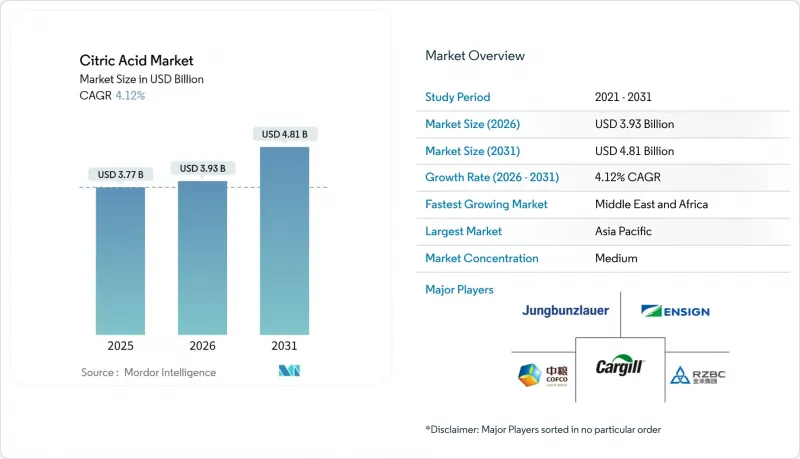
구연산 시장은 2025년 37억 7,000만 달러에서 2026년에는 39억 3,000만 달러로 성장하며, 2026-2031년에 CAGR 4.11%로 추이하며, 2031년까지 48억 1,000만 달러에 달할 것으로 예측되고 있습니다.
이러한 성장은 주로 클린 라벨 제품에 대한 소비자의 선호도 증가, 생명공학 공정의 발전, 식품 및 음료, 의약품, 세정제 등 다양한 산업 분야의 용도 다양화 등이 주요 성장 요인으로 작용하고 있습니다. 미국의 GRAS(일반적으로 안전하다고 인정되는 물질) 지위, 유럽연합(EU)의 quantum satis(양자 만족) 승인 등 규제 측면의 명확화가 진행되어 진입장벽이 계속 낮아지고 있습니다. 이를 통해 시장 접근이 용이해져 신규 시장 진출기업 증가가 예상됩니다. 그러나 중국산 수입품에 대한 반덤핑 관세 부과는 세계 조달 전략의 재구축을 촉진하고 있으며, 제조업체들은 공급망 리스크를 줄이기 위해 중국 이외의 지역으로 생산 능력을 확대하고 있습니다. 또한 공급망 전반에 걸친 수직적 통합과 에너지 효율적인 발효 기술의 혁신은 생산 효율성과 비용 효율성을 향상시키는 데 기여하고 있습니다. 청량음료, 생분해성 세정제, 발포성 의약품 및 기타 신흥 응용 분야에서 구연산에 대한 수요가 증가하면서 시장 범위가 더욱 확대되고 있습니다. 이러한 요인들이 결합되어 시장의 강력한 성장 잠재력과 진화하는 규제, 기술 및 소비자 중심의 동향에 적응할 수 있는 능력을 지원하고 있습니다.
세계 구연산 시장 동향 및 인사이트
탄산음료의 천연 산미료에 대한 소비자 선호도 증가
음료업계가 천연 산미료로 전환하면서 구연산 수요가 급증하고 있습니다. 이는 주로 클린 라벨 제품으로의 재배합에 대한 노력이 원동력이 되고 있습니다. 브라질에서는 규범 지침 211/2023에 따라 구연산이 첨가제로 승인되면서 규제 변경이 이러한 모멘텀을 촉진하고 있습니다. 이 규정은 음료에 대한 표준 첨가량을 0.1%에서 0.3%로 규정하여 제조업체들이 오랫동안 기다려온 가이드라인을 제공했습니다. 이러한 규제 명확화는 배합상의 불확실성을 해소할 뿐만 아니라, 브랜드가 천연 방부제로서의 신뢰성을 어필할 수 있는 기회도 창출하고 있습니다. 이러한 움직임은 원재료 표시의 투명성과 간결성을 요구하는 소비자의 요구에 부응하는 것입니다. 구연산의 중요성은 천연 산미료로서의 주요 역할을 넘어선다. pH 조절제 및 방부제로서의 추가 기능을 통해 제조업체는 제품의 안정성을 높이면서 원료 배합을 간소화할 수 있습니다. 이 전략은 규제 표준을 준수하고 클린 라벨 제품에 대한 소비자 요구에 부응하는 업계 전반의 목표와 일치합니다. 또한 일류 음료 제조업체는 현재 제약 등급의 구연산을 채택하는 경향이 있으며, 일관된 품질과 시장 규정 준수의 중요성을 강조하고 있습니다. 인증된 고품질 구연산에 대한 수요 증가는 인증된 공급업체에게 프리미엄 가격 책정의 길을 열어줄 뿐만 아니라 시장에서 경쟁과 혁신의 정신을 자극하고 있습니다.
레디 투 드링크 음료에 대한 구연산 수요 증가
즉석음료 시장은 견고한 성장세를 보이고 있으며, 다양한 용도의 구연산 수요를 크게 견인하고 있습니다. 구연산은 풍미 향상, 색상 안정화, 유통기한 연장 등 다기능성을 가진 중요한 원료로 제품의 품질과 매력을 유지하는 데 필수적인 요소입니다. 신흥 시장의 도시화 진전은 편의성을 중시하는 소비 습관의 확산을 가속화하고 있으며, 이는 바로 마실 수 있는 음료에 큰 성장 기회를 가져다주고 있습니다. 특히 과일 음료에서 구연산은 색조 유지제로서 매우 중요한 역할을 하며, 경쟁이 치열한 시장에서 시각적 매력, 소비자 선호도, 브랜드 차별화에 직접적인 영향을 미칩니다. 또한 발효 기술의 발전은 생산 능력을 변화시켰습니다. 제조업체는 현재 유전자 재조합 흑색 아스페르길루스 균주를 채택하여 기존 방식보다 크게 향상된 174g/L 이상의 구연산 수율을 달성하고 있습니다. 이러한 혁신을 통해 생산 효율성이 향상되고 운영 비용이 절감되며 공급망 신뢰성이 향상되었습니다. 그 결과, 공급업체들은 경쟁력 있는 가격을 유지하면서 증가하는 수요에 대응할 수 있는 태세를 갖추게 되었으며, 특히 가격에 민감한 신흥 시장에서 시장 확대를 촉진하고 있습니다.
신흥 국가의 원자재 가격 변동성
원재료 비용의 변동은 구연산 공급망 전반에 걸쳐 이익률을 크게 압박하는 요인으로 작용하고 있습니다. 특히 옥수수, 사탕수수 당밀, 기타 탄수화물 공급원과 같은 발효 기질이 영향을 받고 있습니다. 이러한 변동성은 신흥 시장에서 두드러지며, 농산물 가격은 예측 불가능한 기상 조건, 정책 개혁, 지정학적 긴장, 인프라 부족 등 외부 요인의 영향을 받기 쉽습니다. 원자재 가격 상승과 더불어 제조업체들은 환율 변동과 물류 비용 증가에 직면하고 있으며, 이는 비용 관리를 더욱 복잡하게 만들어 첨단 헤지 전략을 도입해야 합니다. 그러나 기판 활용 기술의 발전은 이 문제를 완화할 수 있는 유망한 경로를 제공합니다. 최근 연구에 따르면 사탕수수 바가스, 치즈 유청, 기타 제품별 등 농업 폐기물에서 구연산 생산에 성공한 사례가 보고되고 있습니다. 이러한 혁신은 1차 상품 시장에 대한 의존도를 낮출 뿐만 아니라 지속가능성 목표에 부합하고, 비용 효율적이고 환경 친화적인 대안을 제공함으로써 구연산 공급망의 탄력성을 강화합니다.
부문 분석
2025년에도 무수 구연산은 54.73%의 점유율로 시장을 계속 독점하고 있습니다. 이는 우수한 안정성, 장기 보존성, 다양한 최종 용도를 지원하는 확립된 공급망 인프라에 기인합니다. 그 결정 구조는 일관된 품질을 보장하며, 식품 제조업체와 제약회사에 선호되는 선택입니다. 산업용에서도 무수 형태는 용해 속도의 예측 가능성과 제조 공정에서 수분 관련 문제를 줄일 수 있다는 점에서 선호됩니다. 그러나 가공 효율이 중요한 요소로 떠오르면서 시장은 점차 변화하고 있습니다. Jungbunzlauer의 CITROCOAT N과 같은 직접 압축 가능한 구연산 변형은 제약 분야의 정제 제조에서 주목을 받고 있습니다. 이러한 변형은 정제 경도 향상, 가공 시간 단축, 특정 용도의 성능 강화를 통해 업계의 요구에 부응하고 있습니다.
액체 구연산 제제는 견고한 성장세를 보이고 있으며, 2031년까지 연평균 복합 성장률(CAGR) 6.61%를 나타낼 것으로 예측됩니다. 이러한 성장의 배경에는 제조업체들의 업무 효율성과 비용 최적화에 대한 관심이 높아지고 있는 것이 있습니다. 액체 형태는 용해 공정이 필요 없어 자동화 생산 시스템에서 정밀한 투약 제어가 가능하며, 제조 공정의 효율화를 실현할 수 있습니다. 이러한 추세는 음료 산업에서 특히 두드러지며, 액체 구연산은 시럽 제조 공정에 원활하게 통합되어 분말 취급과 관련된 오염 위험을 줄입니다. 또한 저장 및 운송 기술의 발전으로 기존의 안정성 문제가 완화되어 액체 형태의 실용성이 더욱 향상되었습니다. 이러한 개선으로 인해 기존에는 무수 형태가 주를 이루었던 응용 분야에서 액체 구연산의 채택이 확대되어 예측 기간 중 지속적인 성장이 예상됩니다.
구연산 시장 보고서는 형태별(무수 및 액체), 용도별(식품 및 음료, 제약, 퍼스널케어 및 화장품 등), 등급별(제약 등급, 식품 등급, 산업용 등급), 지역별(북미, 남미, 유럽, 아시아태평양, 중동 및 아프리카)로 업계를 세분화합니다. 각 부문 시장 규모 및 예측은 달러화 기준 금액에 기반한 것입니다.
지역별 분석
2025년 아시아태평양은 37.22% 시장 점유율을 차지할 것으로 예측됩니다. 이는 주로 중국의 탄탄한 생산 능력과 식품 가공 및 산업 분야의 국내 수요 급증에 기인합니다. 이 지역의 강점으로는 잘 구축된 발효 인프라, 경쟁력 있는 생산 비용, 옥수수와 사탕수수 유래 원료 등 주요 원재료에 대한 근접성을 들 수 있습니다. 그러나 무역 마찰과 반덤핑 조치가 지역 정세를 바꾸고 있습니다. 인도, 태국을 비롯한 동남아시아 국가들은 국내 수요와 수출 수요를 모두 충족시키기 위해 생산 능력을 확대하고 있습니다. 일본의 첨단 제약 및 식품 가공 산업은 유망한 시장 기회를 제공하고, 호주의 급성장하는 음료 산업은 지역 소비를 촉진하고 있습니다.
중동 및 아프리카은 2031년까지 연평균 복합 성장률(CAGR) 7.18%가 예상되는 주목할 만한 지역입니다. 이러한 성장은 주로 사우디아라비아, 아랍에미리트(UAE) 등의 식품 가공 산업의 급격한 성장과 인프라 투자에 기인합니다. 식량안보 강화와 산업 다각화를 위한 이 지역의 정부 정책은 구연산의 새로운 수요처를 창출하고 있습니다. NEOM이 리버레이션 랩스(Liberation Labs)와 제휴하여 정밀 발효 시설을 설립하려는 움직임은 이 지역이 첨단 바이오 제조 기술에 집중하고 있음을 보여줍니다. 반면, 북미와 유럽은 탄탄한 식품 및 의약품 산업을 배경으로 안정적인 수요를 유지하고 있지만, 시장 포화 상태와 엄격한 규제로 인해 성장률이 억제되고 있습니다.
유럽은 식품, 음료, 퍼스널케어 분야의 견고한 수요를 바탕으로 엄격한 품질 기준과 잘 구축된 가공 시설로 인해 안정적인 시장으로 존재감을 유지하고 있습니다. 북미는 즉석음료, 간편식, 의약품 수요 급증에 힘입어 꾸준한 성장세를 보이고 있습니다. 이 지역의 소비자들은 클린 라벨 원료를 선호하는 경향이 강해지고 있으며, 구연산은 천연 방부제 및 화학 조미료로 활용되고 있습니다. 남미, 특히 브라질, 아르헨티나와 같은 국가에서는 식품 가공 부문의 확대와 포장 식품에 대한 수요 증가로 인해 성장이 가속화되고 있습니다. 남미 제조업체들은 구연산 생산을 위한 풍부한 농업 원료와 수입 의존도 감소라는 두 가지 이점을 누리고 있습니다. 유럽, 북미, 남미 전역에서 천연 첨가제를 권장하는 규제 프레임워크가 구연산 시장 잠재력을 더욱 높이고 있으며, 이는 세계 기업과 지역 기업 모두에게 기회를 제공합니다.
기타 특전:
- 엑셀 형식 시장 예측(ME) 시트
- 애널리스트의 3개월간 지원
자주 묻는 질문
목차
제1장 서론
제2장 조사 방법
제3장 개요
제4장 시장 구도
제5장 시장 규모와 성장 예측
제6장 경쟁 구도
제7장 시장 기회와 향후 전망
KSA 26.03.05The Citric Acid market is expected to grow from USD 3.77 billion in 2025 to USD 3.93 billion in 2026 and is forecast to reach USD 4.81 billion by 2031 at 4.11% CAGR over 2026-2031.
The rising consumer preference for clean-label products, advancements in biotechnology processes, and the increasing diversification of applications across industries such as food and beverages, pharmaceuticals, and cleaning products primarily drive this growth. Regulatory clarity, including the GRAS status in the United States and quantum satis approval in the European Union, continues to lower entry barriers, fostering market accessibility and encouraging participation from new players. However, the imposition of anti-dumping duties on Chinese imports is reshaping global sourcing strategies, prompting manufacturers to expand production capacities in regions outside China to mitigate supply chain risks. Additionally, vertical integration across the supply chain and innovations in energy-efficient fermentation technologies are improving production efficiency and cost-effectiveness. The growing demand for citric acid in convenience beverages, biodegradable cleaning solutions, effervescent pharmaceuticals, and other emerging applications is further broadening its market scope. These factors collectively underscore the market's strong growth potential and its ability to adapt to evolving regulatory, technological, and consumer-driven trends.
Global Citric Acid Market Trends and Insights
Growing Consumer Shift to Natural Acidulants in Carbonated Soft Drinks
As the beverage industry pivots towards natural acidulants, citric acid is witnessing a surge in demand, largely fueled by a commitment to clean-label product reformulations. In Brazil, regulatory shifts have bolstered this momentum, with citric acid receiving the green light as an additive under Normative Instruction 211/2023. This regulation delineates typical dosages for beverages, set between 0.1% and 0.3%, offering manufacturers much-needed guidance. Such regulatory clarity not only dispels formulation uncertainties but also empowers brands to flaunt their natural preservation credentials. This move resonates with a growing consumer appetite for transparency and simplicity in ingredient lists. Citric acid's significance transcends its primary role as a natural acidulant. Its added functions as a pH regulator and preservative allow manufacturers to enhance product stability while streamlining ingredient formulations. This strategy dovetails with the industry's overarching objectives: adhering to regulatory benchmarks and aligning with consumer demands for clean-label offerings. Moreover, top-tier beverage manufacturers are now gravitating towards pharmaceutical-grade citric acid, underscoring the importance of consistent quality and market compliance. This heightened demand for certified, high-quality citric acid not only paves the way for premium pricing for certified suppliers but also ignites a spirit of competition and innovation in the market.
Increasing Demand for Citric Acid in Ready-to-drink Beverages
The ready-to-drink beverage market is experiencing robust growth, significantly driving the demand for citric acid across various applications. Citric acid is a key ingredient due to its multifunctional properties, including flavor enhancement, color stabilization, and shelf-life extension, which are critical for maintaining product quality and appeal. The increasing urbanization in emerging markets has accelerated the adoption of convenience-driven consumption habits, creating substantial growth opportunities for ready-to-drink beverages. In fruit-based beverages, citric acid's role as a color retention agent is particularly vital, as it directly influences visual appeal, consumer preferences, and brand differentiation in a competitive market. Additionally, advancements in fermentation technology have transformed production capabilities. Manufacturers are now employing engineered Aspergillus niger strains, achieving citric acid titers exceeding 174 g/L, a significant improvement over traditional methods. These innovations have enhanced production efficiency, reduced operational costs, and improved supply chain reliability. As a result, suppliers are well-positioned to meet the rising demand while maintaining competitive pricing, fostering market expansion, particularly in price-sensitive and emerging segments.
Price Volatility of Raw Materials in Emerging Countries
Fluctuations in raw material costs are exerting considerable margin pressures across the citric acid supply chain, with fermentation substrates such as corn, sugarcane molasses, and other carbohydrate sources being particularly impacted. This volatility is most evident in emerging markets, where agricultural commodity prices are highly susceptible to external factors, including unpredictable weather conditions, policy reforms, geopolitical tensions, and infrastructure deficiencies. Beyond the rising input costs, manufacturers are also grappling with currency fluctuations and increasing logistics expenses, which further complicate cost management and necessitate the adoption of sophisticated hedging strategies. However, advancements in substrate utilization technologies are providing a promising avenue for mitigation. Recent research highlights the successful production of citric acid from agricultural waste streams, such as sugarcane bagasse, cheese whey, and other by-products. These innovations not only reduce dependence on primary commodity markets but also align with sustainability goals, offering a cost-effective and environmentally friendly alternative that strengthens the resilience of the citric acid supply chain.
Other drivers and restraints analyzed in the detailed report include:
- Rising Adoption in Effervescent Pharmaceuticals
- Rise in Regulatory Push for Biodegradable Chelating Agents in Industrial Cleaners
- Rise in Anti-dumping Duties on Chinese Citric Acid
For complete list of drivers and restraints, kindly check the Table Of Contents.
Segment Analysis
In 2025, anhydrous citric acid continues to dominate the market with a 54.73% share, attributed to its superior stability, extended shelf life, and well-established supply chain infrastructure supporting diverse end-use applications. Its crystalline structure ensures consistent quality, making it a preferred choice for food manufacturers and pharmaceutical companies. Industrial applications also favor anhydrous forms due to their predictable dissolution rates and reduced moisture-related challenges during formulation processes. However, the market is gradually shifting as processing efficiency becomes a critical factor. Direct compressible citric acid variants, such as Jungbunzlauer's CITROCOAT N, are gaining traction in pharmaceutical tableting. These variants address industry needs by offering improved tablet hardness, faster processing times, and enhanced performance in specific applications.
Liquid citric acid formulations are witnessing robust growth, with a projected CAGR of 6.61% through 2031. This growth is driven by manufacturers' increasing focus on operational efficiency and cost optimization. The liquid form eliminates the need for dissolution steps, enabling precise dosing control in automated production systems and streamlining manufacturing processes. This trend is particularly prominent in the beverage industry, where liquid citric acid integrates seamlessly with syrup preparation processes, reducing contamination risks associated with powder handling. Additionally, advancements in storage and transportation technologies have mitigated traditional stability concerns, further enhancing the viability of liquid forms. These improvements are expanding the adoption of liquid citric acid in applications that were previously dominated by anhydrous variants, positioning the segment for sustained growth in the forecast period.
The Citric Acid Market Report Segments the Industry by Form (Anhydrous and Liquid); by Application (Food and Beverage, Pharmaceuticals, Personal Care and Cosmetics, and More); by Grade (Pharmaceutical Grade, Food Grade, and Industrial Grade); and by Geography (North America, South America, Europe, Asia-Pacific, and Middle East and Africa). For Each Segment, The Market Sizing and Forecasts Have Been Based On Values in USD.
Geography Analysis
In 2025, Asia-Pacific commands a 37.22% market share, largely due to China's robust production capabilities and its surging domestic appetite in food processing and industrial sectors. The region's advantages include a well-established fermentation infrastructure, competitive production costs, and close access to vital raw materials like corn and sugarcane derivatives. Yet, trade tensions and anti-dumping measures are altering the regional landscape. Countries like India, Thailand, and other Southeast Asian nations are ramping up production capacities to cater to both local and export demands. Japan's sophisticated pharmaceutical and food processing sectors present lucrative market prospects, while Australia's burgeoning beverage industry bolsters regional consumption.
Middle East and Africa is the region to watch, boasting a 7.18% CAGR through 2031. This growth is largely attributed to the burgeoning food processing sectors and infrastructural investments in nations such as Saudi Arabia and the UAE. Government initiatives in the region, aimed at bolstering food security and diversifying industries, are birthing new demand hubs for citric acid. NEOM's collaboration with Liberation Labs to set up precision fermentation facilities underscores the region's ambition in advanced biomanufacturing. Meanwhile, North America and Europe, with their entrenched food and pharmaceutical sectors, offer stable demand, albeit with tempered growth rates due to market saturation and regulatory consistency.
Europe, with its robust demand from the food, beverage, and personal care sectors, remains a stable player, bolstered by stringent quality standards and established processing facilities. North America's growth is steady, driven by a surge in ready-to-drink beverages, convenience foods, and pharmaceuticals. Consumers here increasingly lean towards clean-label ingredients, using citric acid as a natural preservative and flavor enhancer. South America, particularly in nations like Brazil and Argentina, is on the rise, thanks to its expanding food processing sectors and a growing appetite for packaged foods. South American manufacturers enjoy the dual advantage of abundant agricultural feedstocks for citric acid production and a reduced reliance on imports. Across Europe, North America, and South America, regulatory frameworks that favor natural additives further enhance citric acid's market potential, presenting opportunities for both global giants and local players.
- Shandong Ensign Industry Co., Ltd.
- Jungbunzlauer Suisse AG
- COFCO Corporation
- RZBC Group Co., Ltd.
- TTCA Co., Ltd.
- Archer Daniels Midland Company
- Cargill, Incorporated
- Gadot Biochemical Industries Ltd.
- Foodchem International Corporation
- Merck KGaA
- Hawkins, Inc.
- Citrique Belge NV
- BBCA Group (Anhui BBCA)
- FUSO Chemical Co., Ltd.
- Wang Pharmaceuticals and Chemicals
- Hemadri Chemicals
- Vinipul Inorganics India Pvt. Ltd
- Arihant Chemicals
- Anmol Chemicals Private Limited
- Innova Corporate
Additional Benefits:
- The market estimate (ME) sheet in Excel format
- 3 months of analyst support
TABLE OF CONTENTS
1 INTRODUCTION
- 1.1 Study Assumptions and Market Definition
- 1.2 Scope of the Study
2 RESEARCH METHODOLOGY
3 EXECUTIVE SUMMARY
4 MARKET LANDSCAPE
- 4.1 Market Overview
- 4.2 Market Drivers
- 4.2.1 Growing consumer shift to natural acidulants in carbonated soft drinks
- 4.2.2 Increasing demand for citric acid in ready-to-drink beverages
- 4.2.3 Rising adoption in effervescent pharmaceuticals
- 4.2.4 Rise in regulatory push for biodegradable chelating agents in industrial cleaners
- 4.2.5 Increasing need for sugar-reduction reformulation in confectionery
- 4.2.6 Innovations in production processes are improving yield and reducing costs.
- 4.3 Market Restraints
- 4.3.1 Price volatility of raw materials in emerging countries
- 4.3.2 Rise in anti-dumping duties on chinese citric acid
- 4.3.3 Competition from alternative acidulants.
- 4.3.4 Seasonal variations impacting citrus fruit availability.
- 4.4 Supply-Chain Analysis
- 4.5 Regulatory Outlook
- 4.6 Porter's Five Forces
- 4.6.1 Threat of New Entrants
- 4.6.2 Bargaining Power of Buyers/Consumers
- 4.6.3 Bargaining Power of Suppliers
- 4.6.4 Threat of Substitute Products
- 4.6.5 Intensity of Competitive Rivalry
5 MARKET SIZE AND GROWTH FORECASTS (VALUE)
- 5.1 By Form
- 5.1.1 Anhydrous
- 5.1.2 Liquid
- 5.2 By Application
- 5.2.1 Food and Beverage
- 5.2.1.1 Bakery
- 5.2.1.2 Confectionery
- 5.2.1.3 Dairy
- 5.2.1.4 Beverages
- 5.2.1.5 Savory and Snacks
- 5.2.1.6 Other Foods and Beverages
- 5.2.2 Pharmaceuticals
- 5.2.3 Personal Care and Cosmetics
- 5.2.4 Detergents and Household Cleaners
- 5.2.5 Others
- 5.2.1 Food and Beverage
- 5.3 By Grade
- 5.3.1 Pharmaceutical Grade
- 5.3.2 Food Grade
- 5.3.3 Industrial Grade
- 5.4 By Geography
- 5.4.1 North America
- 5.4.1.1 United States
- 5.4.1.2 Canada
- 5.4.1.3 Mexico
- 5.4.1.4 Rest of North America
- 5.4.2 South America
- 5.4.2.1 Brazil
- 5.4.2.2 Argentina
- 5.4.2.3 Colombia
- 5.4.2.4 Chile
- 5.4.2.5 Peru
- 5.4.2.6 Rest of South America
- 5.4.3 Europe
- 5.4.3.1 Germany
- 5.4.3.2 United Kingdom
- 5.4.3.3 Italy
- 5.4.3.4 France
- 5.4.3.5 Netherlands
- 5.4.3.6 Poland
- 5.4.3.7 Belgium
- 5.4.3.8 Sweden
- 5.4.3.9 Rest of Europe
- 5.4.4 Asia-Pacific
- 5.4.4.1 China
- 5.4.4.2 India
- 5.4.4.3 Japan
- 5.4.4.4 Australia
- 5.4.4.5 Indonesia
- 5.4.4.6 South Korea
- 5.4.4.7 Thailand
- 5.4.4.8 Singapore
- 5.4.4.9 Rest of Asia-Pacific
- 5.4.5 Middle East and Africa
- 5.4.5.1 South Africa
- 5.4.5.2 Saudi Arabia
- 5.4.5.3 United Arab Emirates
- 5.4.5.4 Nigeria
- 5.4.5.5 Egypt
- 5.4.5.6 Morocco
- 5.4.5.7 Turkey
- 5.4.5.8 Rest of Middle East and Africa
- 5.4.1 North America
6 COMPETITIVE LANDSCAPE
- 6.1 Market Concentration
- 6.2 Strategic Moves
- 6.3 Market Ranking Analysis
- 6.4 Company Profiles (includes Global level Overview, Market level overview, Core Segments, Financials as available, Strategic Information, Market Rank/Share for key companies, Products and Services, and Recent Developments)
- 6.4.1 Shandong Ensign Industry Co., Ltd.
- 6.4.2 Jungbunzlauer Suisse AG
- 6.4.3 COFCO Corporation
- 6.4.4 RZBC Group Co., Ltd.
- 6.4.5 TTCA Co., Ltd.
- 6.4.6 Archer Daniels Midland Company
- 6.4.7 Cargill, Incorporated
- 6.4.8 Gadot Biochemical Industries Ltd.
- 6.4.9 Foodchem International Corporation
- 6.4.10 Merck KGaA
- 6.4.11 Hawkins, Inc.
- 6.4.12 Citrique Belge NV
- 6.4.13 BBCA Group (Anhui BBCA)
- 6.4.14 FUSO Chemical Co., Ltd.
- 6.4.15 Wang Pharmaceuticals and Chemicals
- 6.4.16 Hemadri Chemicals
- 6.4.17 Vinipul Inorganics India Pvt. Ltd
- 6.4.18 Arihant Chemicals
- 6.4.19 Anmol Chemicals Private Limited
- 6.4.20 Innova Corporate