

|
시장보고서
상품코드
1939042
스칸듐 : 시장 점유율 분석, 업계 동향과 통계, 성장 예측(2026-2031년)Scandium - Market Share Analysis, Industry Trends & Statistics, Growth Forecasts (2026 - 2031) |
||||||
 Mordor Intelligence
2026년 스칸듐 시장 규모는 8억 8,000만 달러로 추정되며, 2025년 7억 7,000만 달러에서 성장이 전망됩니다.
2031년까지 17억 3,000만 달러에 달할 것으로 예상되며, 2026년부터 2031년까지 CAGR 14.5%로 확대될 것으로 전망됩니다.
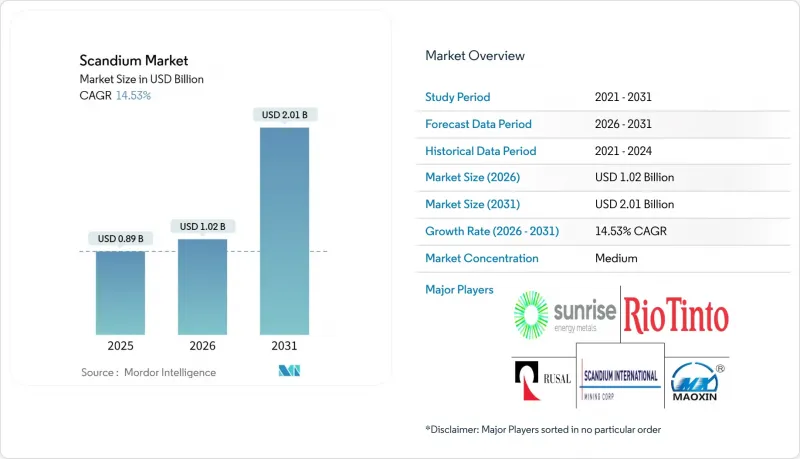
스칸듐 안정화 고체 산화물 연료전지(SOFC)의 수요 증가, 유럽 및 미국 국가의 중요 광물 정책 우대 조치, 차세대 항공우주 플랫폼의 알루미늄-스칸듐 합금 채택 가속화가 이러한 급격한 성장 궤도를 주도하고 있습니다. 2025년 4월 중국이 도입한 수출 허가 규정은 세계 무역의 흐름을 혼란스럽게 하고 공급망 리스크를 부각시켰습니다. 이에 따라 미국, 유럽연합, 호주에서는 대체 공급기지에 대한 정부 자금의 적극적인 투입이 진행되고 있습니다. 대규모 고순도 생산 기술을 습득한 기업은 스칸듐 시장이 실험실의 호기심 대상에서 전략적 소재로 전환하는 과정에서 유리한 위치를 점하고 있습니다.
세계 스칸듐 시장 동향 및 인사이트
고체 산화물형 연료전지(SOFC)의 채용 확대
스칸듐 안정화 지르코니아는 이온 전도성을 손상시키지 않고 고체 산화물형 연료전지(SOFC)의 작동 온도를 낮춰 스택 수명을 연장하고, 전체 플랜트 구성품 비용을 절감할 수 있습니다. 일본의 주택용 에네팜 도입과 유럽의 분산형 발전 보조금 제도가 산화스칸듐의 안정적인 수요를 뒷받침하고 있습니다. 미국 에너지부의 '2025년 수소샷' 로드맵은 SOFC를 장기적인 전력망 저장에 필수적인 요소로 규정하고, 장기적인 조달 전망을 수립하고 있습니다. 블룸에너지는 2025년 6N 등급 산화스칸듐계 전해질 양산에 성공하여, 비용적인 어려움 속에서도 상업적 타당성을 입증했습니다. 이산화티타늄 폐기물 스트림에서 스칸듐을 회수하는 기술의 획기적인 발전은 그동안 SOFC의 보급을 고급 시장에만 국한시켰던 가격 압박을 완화시킬 수 있습니다.
항공우주 및 국방 분야에서의 Al-Sc 합금 수요 증가
미 국방부의 극초음속 미사일 계획에는 열 사이클에서도 결정립 구조를 유지하는 알루미늄-스칸듐 주합금을 채택하고 있습니다. NioCorp가 2025년 국방생산법에 따라 주요 방산기업과 체결한 인증된 Al-Sc 합금 부품 공급 계약은 이 금속의 전략적 가치를 뒷받침하는 것입니다. 보잉과 에어버스는 현재 적층 가공을 통한 동체 프레임에 대한 10년간의 인증 프로그램을 진행 중입니다. 이 분야에서는 스칸듐의 용접 균열 저항성이 7xxx계 알루미늄을 능가합니다. 우주 발사 사업자들은 무게가 중요한 추진제 탱크에 스칸듐 합금을 채택하여 장기적인 수요를 강화하고 있습니다.
치솟는 재료비 및 가격 변동성
2025년 8월 6N 산화스칸듐 현물 가격은 632.95-715.23달러/kg, 정제 금속은 특별 주문으로 269달러/g에 달했습니다. 연간 공급량은 약 80톤인 반면, 2040년 잠재 수요는 1,970톤으로 예측되고 있어 공급 중단의 영향을 받기 쉽습니다. 대부분의 거래는 양자 간 계약이며, OEM 제조업체의 헤지 수단은 제한적입니다. 니켈 라테라이트나 TiO2의 제품별 스칸듐을 회수하는 생산자는 단위 경제성이 모재 가격 변동에 연동되기 때문에 경기 침체기에는 신규 투자가 억제됩니다.
부문 분석
2025년 기준, 스칸듐 시장 수요의 34.90%를 차지하는 합금 분야가 가장 큰 점유율을 차지했습니다. 이는 항공우주용 리벳, 자전거 프레임, 스포츠 용품 분야의 성숙을 반영합니다. IBC Advanced Alloys는 2025년 NioCorp사와 장기 공급 계약을 체결하고 마스터 합금 빌렛을 공급함으로써 북미 밸류체인 강화에 기여하고 있습니다. 산화물 카테고리는 고체 산화물형 연료전지(SOFC) 및 반도체 수요 증가로 인해 15.78%의 CAGR로 가장 빠르게 성장할 것으로 예상됩니다. 제품용 스칸듐 시장 규모에서 산화물 수요는 2031년까지 2억 1,000만 달러에 달할 것으로 예상됩니다. 불소 및 염화물 염은 틈새 전자 및 촉매 용도로 사용되며, 탄산염은 연구개발(R&D) 규모에서 뒤쳐져 있습니다. 부가 제조에 필수적인 고순도 스칸듐 금속 분말은 미래 성장 분야로 떠오르고 있지만, 상업적 생산량은 연간 5톤 미만에 불과합니다.
붉은 진흙과 이산화티타늄 폐기물을 침출하는 2세대 처리 플로우 시트로 인해 산화물 공급량이 증가하여 합금과의 가격 차이가 줄어들고 있습니다. 합금 제조업체들은 성능과 비용의 균형을 맞추기 위해 스칸듐 함량을 낮추는 실험(0.2-0.4 중량%)을 진행하고 있으며, 이러한 추세는 비용 중심의 자동차 및 드론 구조물에 대한 시장 침투에 기여할 수 있습니다. 그러나 고체 산화물형 연료전지(SOFC) 및 마이크로일렉트로닉스용 산화물 구매자들은 99.999% 순도를 요구하기 때문에 광범위한 스칸듐 시장 내에서 양극화된 가격 환경이 형성되고 있습니다.
지역별 분석
중국은 2025년 스칸듐 시장 점유율 39.45%를 유지했습니다. 이는 산화티타늄(TiO2) 및 희토류 통합 생산 공정에서 스칸듐 산화물을 병행 생산하는 체제가 기반이 되고 있습니다. 국내 수요는 SOFC 시제품, 5G 기지국용 세라믹, 드론 기체 등으로 확대되고 있습니다. 2025년 4월 수출허가제도 강화로 해상운송량이 제한됨에 따라 중국 외의 OEM(Original Equipment Manufacturer)은 공급처를 다변화해야 하는 상황입니다. 미국은 가장 빠르게 성장하는 소비국이며, 국방, 우주, 적층 가공 분야의 수요 확대로 2031년까지 CAGR 15.20%를 기록할 것으로 예상됩니다. 타이틀 III 자금과 수출입은행의 대출 한도 덕분에 NioCorp를 비롯한 신흥 생산업체들의 프로젝트 실현 가능성이 크게 개선되어 북미 스칸듐 공급망의 기반이 마련되고 있습니다.
러시아는 루사르사의 붉은 진흙 회수 라인으로 인해 여전히 세계 3대 생산국입니다. 정치적 리스크와 제재로 인해 유럽과 미국향 판매는 복잡해졌지만, 국내 항공우주 프로그램이 상당량을 흡수하고 있습니다. 필리핀 타가니토 HPAL 공장은 니켈 라테라이트에서 스칸듐을 회수하여 주로 일본의 고체 산화물형 연료전지(SOFC) 통합 제조업체에 산화물을 출하하고 있습니다. 호주는 세계 최대의 확인된 스칸듐 광물 자원을 보유하고 있습니다. 선라이즈에너지메탈의 시아스톤 광구는 2025년 9월에 자원량이 98% 상향 조정되어 아시아태평양의 공급 다변화의 기반이 될 수 있습니다. 유럽연합(EU)은 2025년 스칸듐을 전략 원자재로 지정하여 핀란드와 스페인에서 탐사를 촉진하고, 오세아니아 지역 프로젝트와의 장기 공급 계약 협상을 촉구했습니다. 브라질과 인도에서는 이산화티타늄과 라테라이트 미광의 스칸듐 함량에 대한 조사가 시작되어 향후 공급 측면에서 선택의 폭이 넓어질 조짐을 보이고 있습니다.
기타 특전:
- 엑셀 형식의 시장 예측(ME) 시트
- 애널리스트 지원(3개월)
자주 묻는 질문
목차
제1장 소개
제2장 조사 방법
제3장 주요 요약
제4장 시장 구도
제5장 시장 규모와 성장 예측
제6장 경쟁 구도
제7장 시장 기회와 향후 전망
KSM 26.03.09Scandium market size in 2026 is estimated at USD 0.88 billion, growing from 2025 value of USD 0.77 billion with 2031 projections showing USD 1.73 billion, growing at 14.5% CAGR over 2026-2031.
Rising demand for scandium-stabilized solid-oxide fuel cells (SOFCs), critical-mineral policy incentives in Western economies, and accelerating adoption of aluminum-scandium alloys in next-generation aerospace platforms are driving this steep growth trajectory. China's April 2025 export-licensing rules disrupted global trade flows and highlighted supply-chain risk, spurring active government funding for alternative supply hubs in the United States, the European Union, and Australia. Companies that master large-scale, high-purity production are well positioned as the scandium market pivots from laboratory curiosity to strategic material.
Global Scandium Market Trends and Insights
Growing adoption in solid-oxide fuel cells
Scandium-stabilized zirconia lowers SOFC (solid-oxide fuel cells) operating temperature without sacrificing ionic conductivity, extending stack life, and enabling cheaper balance-of-plant components. Japan's residential Ene-Farm rollout and Europe's distributed-generation subsidies fuel steady scandium oxide demand. The US Department of Energy's 2025 Hydrogen Shot roadmap designates SOFCs as critical for long-duration grid storage, anchoring long-term procurement visibility. Bloom Energy scaled production of 6N scandium oxide-based electrolytes in 2025, proving commercial viability despite cost headwinds. Processing breakthroughs that recover scandium from titanium-dioxide waste streams could ease pricing pressure that historically limited SOFC penetration to premium markets.
Rising demand for Al-Sc alloys in aerospace and defense
Pentagon hypersonic-missile programs rely on aluminum-scandium master alloys that maintain grain structure under thermal cycling. NioCorp's 2025 agreement with defense primes to supply qualified Al-Sc alloy components under the Defense Production Act underscores the metal's strategic value. Boeing and Airbus are midway through decade-long qualification programs for additive-manufactured fuselage frames, where scandium's weld-crack resistance outperforms 7xxx-series aluminum. Space-launch operators embraced scandium alloys for weight-critical propellant tanks, reinforcing long-run demand.
High material cost and price volatility
Spot prices for 6N scandium oxide swung between USD 632.95-715.23 kg in August 2025, while distilled metal touched USD 269 g on specialty orders. Annual supply is roughly 80 t against the potential 2040 demand of 1,970 t, amplifying outage sensitivity. Most deals remain bilateral, leaving OEMs with limited hedging options. Producers recovering scandium as a by-product of nickel laterite or TiO2 see unit economics tied to host-commodity cycles, deterring new investment during downturns.
Other drivers and restraints analyzed in the detailed report include:
- Critical-mineral policy incentives and funding
- Expansion of Sc-enabled additive manufacturing
- Supply concentration in a few countries
For complete list of drivers and restraints, kindly check the Table Of Contents.
Segment Analysis
Alloys captured the largest 2025 share at 34.90% of scandium market demand, reflecting maturation in aerospace rivets, bicycle frames, and sporting goods. IBC Advanced Alloys signed a long-term offtake with NioCorp in 2025 to supply master-alloy billets, reinforcing a North American value chain. The oxide category is the fastest-growing, projected to post a 15.78% CAGR on SOFC and semiconductor uptake. Within the scandium market size for products, oxide demand is forecast to reach USD 0.21 billion by 2031. Fluoride and chloride salts serve niche electronic and catalytic uses, while carbonate trails in R&D scale. High-purity scandium metal powder, essential for additive manufacturing, is emerging as a future growth pocket, though commercial volumes remain below 5 t per year.
Second-generation processing flowsheets that leach red mud or titanium-dioxide waste increase oxide availability, narrowing the price gap with alloys. Alloy producers are experimenting with lower scandium loadings (0.2-0.4 wt%) to balance performance and cost; this trend could help the scandium market penetrate cost-sensitive automotive and drone structures. However, oxide buyers in SOFC and microelectronics require 99.999% purity, creating a bifurcated price environment within the broader scandium market.
The Scandium Market Report is Segmented by Product Type (Oxide, Fluoride, Chloride, Iodide, Carbonate, and Other Product Types), End-User Industry (Aerospace and Defense, Solid Oxide Fuel Cells, Ceramics, Lighting, Electronics, Sporting Goods, and Other End-User Industries), and Geography (United States, China, Russia, Japan, Brazil, European Union, and Rest of the World). The Market Forecasts are Provided in Terms of Value (USD).
Geography Analysis
China retained 39.45% Scandium market share in 2025, underpinned by integrated TiO2 and rare-earth operations that co-recover scandium oxide. Domestic demand spans SOFC prototypes, 5G-base-station ceramics, and drone airframes. The April 2025 export-license framework tightened seaborne availability, prompting non-Chinese OEMs (original equipment manufacturers) to diversify supply. The United States is the fastest-growing consumer, forecast at 15.20% CAGR to 2031 on defense, space, and additive-manufacturing uptake. Title III funding and Ex-Im Bank facilities have materially improved project viability for NioCorp and other emerging producers, setting the stage for a North American scandium supply chain.
Russia remains a top-three producer via Rusal's red-mud-recovery lines. Political risk and sanctions complicate Western offtake, but domestic aerospace programs absorb meaningful volumes. The Philippines' Taganito HPAL plant recovers scandium from nickel laterite, primarily shipping oxide to Japanese SOFC integrators. Australia hosts the world's largest identified scandium mineral resources; Sunrise Energy Metals' Syerston deposit received a 98% resource upgrade in September 2025 and could anchor Asia-Pacific diversification. The European Union classified scandium as a strategic raw material in 2025, catalyzing exploration in Finland and Spain and prompting long-term offtake talks with Oceania projects. Brazil and India have begun mapping titanium-dioxide and laterite tailings for scandium prospects, signaling future supply-side optionality.
- Ardea Resources
- Guangxi Maoxin Technology Co., Ltd
- Henan Rongjia Scandium Vanadium Technology Co., Ltd
- Huizhou Top Metal Materials Co., Ltd.
- Hunan Oriental Scandium Co., Ltd.
- Hunan Rare Earth Metal Materials Research Institute Co. Ltd.
- JSC Dalur
- MCC Group
- Niocorp Development Ltd.
- Rio Tinto
- Rusal
- Scandium Canada Ltd.
- Scandium International Mining Corporation
- Stanford Advanced Materials
- Sumitomo Metal Mining Co., Ltd.
- Sunrise Energy Metals Limited
- Treibacher Industrie Ag
Additional Benefits:
- The market estimate (ME) sheet in Excel format
- 3 months of analyst support
TABLE OF CONTENTS
1 Introduction
- 1.1 Study Assumptions and Market Definition
- 1.2 Scope of the Study
2 Research Methodology
3 Executive Summary
4 Market Landscape
- 4.1 Market Overview
- 4.2 Market Drivers
- 4.2.1 Growing adoption in solid-oxide fuel cells
- 4.2.2 Rising demand for Al-Sc alloys in aerospace and defence
- 4.2.3 Critical-mineral policy incentives and funding
- 4.2.4 Expansion of Sc-enabled additive manufacturing
- 4.2.5 Breakthroughs in high-k Sc2O3 gate dielectrics
- 4.3 Market Restraints
- 4.3.1 High material cost and price volatility
- 4.3.2 Supply concentration in a few countries
- 4.3.3 ESG hurdles in red-mud / HPAL waste processing
- 4.3.4 Opaque pricing and lack of standards
- 4.4 Value Chain Analysis
- 4.5 Porter's Five Forces
- 4.5.1 Bargaining Power of Suppliers
- 4.5.2 Bargaining Power of Buyers
- 4.5.3 Threat of New Entrants
- 4.5.4 Threat of Substitutes
- 4.5.5 Degree of Competition
- 4.6 Environmental Impact Analysis
- 4.7 Price Analysis
5 Market Size and Growth Forecasts (Value)
- 5.1 By Product Type
- 5.1.1 Oxide
- 5.1.2 Flouride
- 5.1.3 Chloride
- 5.1.4 Nitrate
- 5.1.5 Iodide
- 5.1.6 Alloy
- 5.1.7 Carbonate and Other Product Types
- 5.2 By End-user Industry
- 5.2.1 Aerospace and Defense
- 5.2.2 Solid Oxide Fuel Cells (SOFCs)
- 5.2.3 Ceramics
- 5.2.4 Lighting
- 5.2.5 Electronics
- 5.2.6 3D Printing
- 5.2.7 Sporting Goods
- 5.2.8 Other End-User Industries
- 5.3 By Geography
- 5.3.1 Production Analysis
- 5.3.1.1 China
- 5.3.1.2 Russia
- 5.3.1.3 Philippines
- 5.3.1.4 Rest of the World
- 5.3.2 Consumption Analysis
- 5.3.2.1 United States
- 5.3.2.2 China
- 5.3.2.3 Russia
- 5.3.2.4 Japan
- 5.3.2.5 Brazil
- 5.3.2.6 European Union
- 5.3.2.7 Rest of the World
- 5.3.1 Production Analysis
6 Competitive Landscape
- 6.1 Market Concentration
- 6.2 Strategic Moves
- 6.3 Market Share (%)/Ranking Analysis
- 6.4 Company Profiles (includes Global level Overview, Market level overview, Core Segments, Financials as available, Strategic Information, Market Rank/Share, Products and Services, Recent Developments)
- 6.4.1 Ardea Resources
- 6.4.2 Guangxi Maoxin Technology Co., Ltd
- 6.4.3 Henan Rongjia Scandium Vanadium Technology Co., Ltd
- 6.4.4 Huizhou Top Metal Materials Co., Ltd.
- 6.4.5 Hunan Oriental Scandium Co., Ltd.
- 6.4.6 Hunan Rare Earth Metal Materials Research Institute Co. Ltd.
- 6.4.7 JSC Dalur
- 6.4.8 MCC Group
- 6.4.9 Niocorp Development Ltd.
- 6.4.10 Rio Tinto
- 6.4.11 Rusal
- 6.4.12 Scandium Canada Ltd.
- 6.4.13 Scandium International Mining Corporation
- 6.4.14 Stanford Advanced Materials
- 6.4.15 Sumitomo Metal Mining Co., Ltd.
- 6.4.16 Sunrise Energy Metals Limited
- 6.4.17 Treibacher Industrie Ag
7 Market Opportunities and Future Outlook
- 7.1 White-space and Unmet-Need Assessment


