|
시장보고서
상품코드
1939142
발포 폴리프로필렌(EPP) 폼 : 시장 점유율 분석, 업계 동향과 통계, 성장 예측(2026-2031년)Expanded Polypropylene (EPP) Foam - Market Share Analysis, Industry Trends & Statistics, Growth Forecasts (2026 - 2031) |
||||||
 Mordor Intelligence
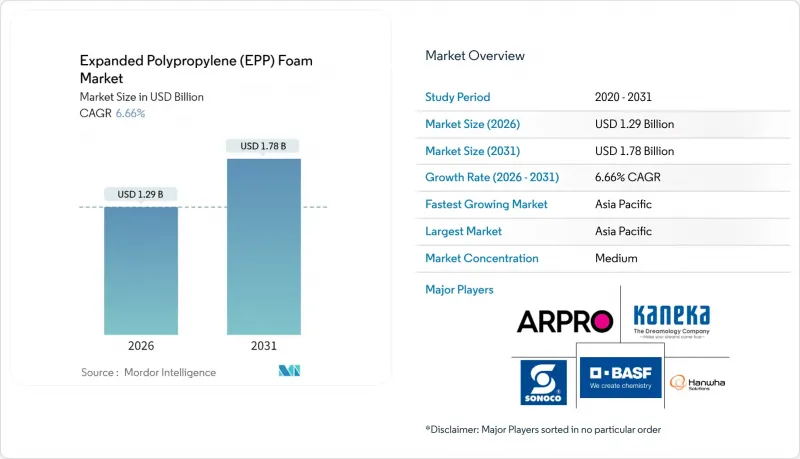
2026년 발포 폴리프로필렌(EPP) 폼 시장 규모는 12억 9,000만 달러로 추정되며, 2025년 12억 1,000만 달러에서 성장이 전망됩니다.
2031년까지의 예측에서는 17억 8,000만 달러에 달하며, 2026-2031년에 CAGR 6.66%로 확대할 전망입니다.
차량 중량에 대한 규제 강화, 물류 분야 기업의 넷제로 목표, 건축물의 에너지 절약형 개보수, 경량화 설계, 형상 복원성, 폐쇄 루프 재활용성을 평가하는 형태로 EPP의 적용 범위가 확대되고 있습니다. 미국의 2027년 이후 차량 평균 CO2 배출량 규제가 강화됨에 따라 범퍼 시스템에서 강철 및 알루미늄에서 에너지 흡수 폼으로의 전환이 가속화되고 있습니다. 한편, EU의 '지속가능한 제품을 위한 친환경 디자인 규정(ESPR)은 재활용성이 입증된 재사용 가능한 포장재를 요구하고 있습니다. 또한 E-Commerce의 성장과 함께 고속 물류 네트워크에 견딜 수 있는 다단계 충격 보호 용기에 대한 수요가 증가하고 있습니다. 한편, 유럽의 지역 열 공급망 확장에서는 에너지를 비용 효율적으로 저장하기 위해 EPP 단열 상변화 모듈이 활용되고 있습니다. 쿠나우프의 BASF 네오프렌 공장 인수로 대표되는 수직계열화 공급업체 간 통합은 규모, IATF 16949 인증, 재생재 함량 포트폴리오가 계약 체결의 결정적 요인이 되는 시장 동향을 보여주고 있습니다.
세계 발포 폴리프로필렌(EPP) 폼 시장 동향 및 인사이트
무독성 및 재활용 가능한 재료 특성
EPP는 FDA CFR Title 21 및 EU Regulation 10/2011을 준수하므로 추가적인 전환 테스트 없이 식품과 직접 접촉할 수 있으며, 식품 및 의약품 공급망에서 반복적으로 사용할 수 있는 용기를 사용할 수 있습니다. 드레스덴 공과대학의 2024GePart 프로젝트에서 성형 부품이 기계적 강도 저하 없이 70% 이상의 재생 소재 함유량을 달성할 수 있다는 것이 입증되었습니다. General Industries Deutschland는 2025년에 EPP Loop 프로그램을 시작하여 2030년까지 독일내 EPP 폐기물의 75%를 재활용하는 것을 목표로 하고 있습니다. 이를 통해 성형 제조업체의 수지 비용 절감으로 이어지는 국내 원료 공급이 가능해집니다. JSP의 ARPRO RE, RC, REvolution 등급은 거의 100% 소비 후 폴리프로필렌의 실용적인 활용을 입증하여 자동차 OEM의 Scope 3 요구 사항을 충족합니다. 이러한 노력과 함께 재활용 가능성은 단순한 평판상의 장점에서 조달의 전제조건으로 변화하고 있습니다.
자동차 경량화 및 안전성 요구
미국 환경보호청(EPA)의 2027년 이후 모델에 대한 규제로 인해 자동차 제조업체들은 범퍼 코어, 시트 패드, 트렁크 라이너에서 금속을 폴리머 폼으로 대체해야 하는 등 CO2를 대폭 감축해야 합니다. EPP는 여러 번의 충격에도 에너지 흡수 성능을 유지하며, CPSC 16 CFR Part 1203 시험에서 최대 300g의 피크 가속도를 상한으로 하는 시험에서 입증되었습니다. JSP는 자동차용 EPP의 세계 점유율 약 50%를 차지하고 있으며, 푸네(2024년 가동) 및 라모스 알리스페(2025년 가동)에 신공장을 건설 중이며, 현지에서 현대자동차, 폭스바겐, GM, 도요타의 각 프로그램에 공급할 예정입니다. 한화첨단소재는 112만 톤의 자체 폴리프로필렌 생산능력을 활용하여 변동이 심한 사이클에도 안정적인 수지 공급을 보장합니다. 이를 통해 헤드라이너와 트렁크 트림 분야에서 입지를 강화하고 있습니다. 독일 VDA 4560 표준은 문서화된 회수 루프가 존재하지 않는 한 일회용 EPP의 사용을 제한하고 있습니다. 이로 인해 RFID 태그가 장착된 재사용 가능한 운송 상자에 대한 수요가 더욱 증가하고 있습니다.
폴리프로필렌 가격 변동성
2024-2025년까지 프로파일렌 단독 가격은 15-20% 변동했습니다. 이는 중동 크래커의 불가항력적인 가동 중단과 중국의 수출 동향 변화로 인해 EPP 부품 가치의 약 70%를 차지하는 원재료 비용 상승이 원인으로 작용했습니다. 특수 비드 등급은 추가 프리미엄이 부과되며, BASF, LG화학, 한화, Braskem 등 소수의 수지 제조업체만이 공급하고 있으며, 자동차 출시로 수요가 급증할 경우 조달 병목현상이 발생할 수 있습니다. 계약 가격은 현물 시장 변동에 최대 60일 정도 늦게 반영되므로 성형업체는 고비용 재고를 보유하거나 추가 요금을 거부하는 OEM과 중기 계약을 재협상해야 하는 상황에 처하게 됩니다. 한화와 같은 수직계열화 그룹은 자체 수지를 활용하여 리스크를 줄일 수 있지만, 독립 제조업체는 이익률 압박에 직면하여 생산능력 확대가 둔화되고 있습니다.
부문 분석
2025년 발포 폴리프로필렌(EPP) 폼 시장 규모에서 합성 등급이 수요의 91.74%를 차지했습니다. 바이오 폴리프로필렌은 원료 부족과 화석 유래 폴리프로필렌의 3배에 달하는 가격으로 인해 전 세계 바이오플라스틱 생산량에서 차지하는 비중이 더 작습니다. 이 때문에 대시보드, 가전제품 케이스 등 고수익성 용도에 한정적으로 적용되고 있습니다. 따라서 발포 폴리프로필렌(EPP) 폼 시장은 여전히 원유 유래 프로파일렌의 경제성에 의존하고 있지만, 재생 이용률의 향상으로 그 의존도가 완화되고 있습니다.
JSP와 드레스덴 공과대학은 70% 산업폐기물 유래 PP를 사용한 부품의 효과를 입증하여 OEM(Original Equipment Manufacturer)가 바이오 프리미엄을 지불하지 않고도 탈탄소화 목표를 달성할 수 있음을 보여주었습니다. EPP Loop의 자발적 회수 계획을 통해 2030년까지 최대 55kg의 폐기물을 버진 원료 대체 스트림으로 전환할 수 있습니다. 성공한다면, 특히 ESPR의 디지털 제품 패스포트가 브랜드 소유자에게 재생 소재 함량을 가시화할 경우, 재생 합성 PP는 바이오 유래 PP를 능가하는 저탄소 수단으로 선택될 수 있을 것입니다.
지역별 분석
아시아태평양은 2025년 매출의 41.65%를 차지할 것으로 예상되며, 중국, 인도, 태국의 자동차 생산량 증가를 배경으로 2031년까지 연평균 7.15%의 성장률을 보일 것으로 전망됩니다. JSP의 푸네 공장은 비드 생산 능력을 14kg 증설하여 현대와 타타의 조립 라인에 대한 리드 타임을 단축했습니다. 한편, 멕시코 공장은 북미의 혼다와 GM에 공급하고 있습니다. 카네카의 Eperan PP 라인은 말레이시아와 중국에 전개되고 있으며, 모두 IATF 인증을 획득하여 포드, 폭스바겐, 닛산에 대한 지역 공급 기반을 더욱 강화하고 있습니다.
북미에서는 리쇼어링 조치와 USMCA 규정의 혜택을 받아 성형 EPP 부품이 앨라배마, 테네시, 온타리오의 조립 공장으로 순차적으로 출하되고 있습니다. 한화의 버지니아 및 멕시코 공장은 수지를 완제품에 통합하여 가격 변동을 완화하고 물류 배출량을 줄이고 있습니다. 조테폼즈는 2025년 2분기까지 켄튀르키예 주에 두 번째 저압 용기를 증설하여 엄격한 밀도 범위를 요구하는 항공우주 고객들을 위한 고성능 등급의 생산을 확대할 예정입니다.
유럽 수요는 유럽 지속가능 포장 규정(ESPR)과 독일 VDA 4560 표준에 의해 형성되고 있으며, 이는 일회용 포장의 단계적 폐지와 자동차 용기의 회수 의무를 공동으로 규정하고 있습니다. 2024년 쿠나우프사가 BASF의 네오폴렌 공장을 인수함으로써 유럽 전역 35개 거점에 자체 비드 공급을 확보하여 수지 운송 비용 상승에 따른 지역 자급자족으로의 전환을 예고하고 있습니다. EPP루프의 독일, 프랑스, 베네룩스 국가의 회수 거점 네트워크는 순환형 경제 실현을 더욱 지원합니다.
남미는 규모는 작지만 브라질 자동차 공장에 있으며, 전략적으로 중요한 지역입니다. 중동 및 아프리카에서는 의약품 콜드체인 유통에 새로운 움직임이 나타나고 있으며, 남아프리카공화국의 백신 접종 캠페인은 WHO 사전 인증을 받은 재사용 가능한 EPP 쿨러를 채택하고 있습니다.
기타 특전:
- 엑셀 형식 시장 예측(ME) 시트
- 애널리스트의 3개월간 지원
자주 묻는 질문
목차
제1장 서론
제2장 조사 방법
제3장 개요
제4장 시장 구도
제5장 시장 규모와 성장 예측
제6장 경쟁 구도
제7장 시장 기회와 향후 전망
KSA 26.03.06The expanded polypropylene foam market size in 2026 is estimated at USD 1.29 billion, growing from 2025 value of USD 1.21 billion with 2031 projections showing USD 1.78 billion, growing at 6.66% CAGR over 2026-2031.
Heightened regulatory pressure on vehicle mass, corporate net-zero agendas in logistics, and building efficiency retrofits are expanding the addressable scope for EPP by rewarding lightweight design, shape recovery, and closed-loop recyclability. U.S. fleet-average CO2 limits that tighten from Model Year 2027 onward are accelerating the shift from steel and aluminum to energy-absorbing foams in bumper systems, while the EU's Ecodesign for Sustainable Products Regulation (ESPR) requires reusable packaging with proven recyclability. E-commerce growth is amplifying the need for multi-impact protective containers that can withstand high-velocity fulfillment networks. Meanwhile, district-heating build-outs in Europe are utilizing EPP-insulated phase-change modules to store energy cost-effectively. Consolidation among vertically integrated suppliers-exemplified by Knauf's acquisition of BASF's Neopolen facility-signals a market where scale, IATF 16949 certification, and recycled-content portfolios are key factors in determining contract wins.
Global Expanded Polypropylene (EPP) Foam Market Trends and Insights
Non-Toxic and Recyclable Material Properties
EPP's compliance with FDA CFR Title 21 and EU Regulation 10/2011 permits direct food contact without additional migration tests, enabling the use of repeated-use containers in grocery and pharmaceutical supply chains. TU Dresden's 2024 GePart project demonstrated that molded parts can incorporate more than 70% recycled content without compromising their mechanical integrity. General Industries Deutschland launched the EPP Loop program in 2025 with a target to recycle 75% of German EPP waste by 2030, providing a domestic feedstock that reduces resin costs for molders. JSP's ARPRO RE, RC, and REvolution grades demonstrate the viable use of nearly 100% post-consumer polypropylene, meeting automotive OEM Scope 3 mandates. Collectively, these initiatives turn recyclability from a reputational perk into a procurement prerequisite.
Automotive Lightweighting and Safety Demand
The EPA's Model Year 2027-plus rules enforce steep CO2 reductions, pushing automakers to replace metal with polymer foams in bumper cores, seat pads, and trunk liners. EPP maintains energy absorption after multiple impacts, validated under CPSC 16 CFR Part 1203 tests that cap peak acceleration at 300 g. JSP holds about 50% global share of automotive-grade EPP and is commissioning plants in Pune (2024) and Ramos Arizpe (2025) to supply Hyundai, Volkswagen, GM, and Toyota programs locally. Hanwha Advanced Materials leverages 1.12 million t of captive polypropylene capacity to secure resin in volatile cycles, reinforcing its position on headliners and trunk trims. Germany's VDA 4560 now restricts single-use EPP unless a documented return loop exists, deepening demand for reusable transport boxes fitted with RFID tags.
Polypropylene Price Volatility
The propylene monomer price fluctuated by 15-20% during 2024-2025, following force-majeure outages at Middle East crackers and shifting Chinese export flows, which increased raw material costs that account for nearly 70% of the EPP part value. Specialty bead grades face extra premiums and are supplied by a handful of resin makers-BASF, LG Chem, Hanwha, and Braskem-creating procurement bottlenecks when auto launches spike demand. Contract prices lag behind spot market movements by up to 60 days, forcing molders to either hold costly inventory or renegotiate mid-term with OEMs that resist surcharges. Vertically integrated groups, such as Hanwha, mitigate exposure by utilizing in-house resin, whereas independents endure margin compression that slows capacity additions.
Other drivers and restraints analyzed in the detailed report include:
- Boom in E-Commerce Protective Packaging
- Thermal-Energy-Storage Use-Cases
- Competition from Cheaper EPS and Other Foams
For complete list of drivers and restraints, kindly check the Table Of Contents.
Segment Analysis
Synthetic grades accounted for 91.74% of the 2025 demand in the expanded polypropylene foam market size. Bio-based polypropylene accounted for a smaller portion of global bioplastics output, held back by feedstock scarcity and a price that can triple that of fossil-based polypropylene, limiting take-up to high-margin applications such as dashboards and consumer electronics housings. The expanded polypropylene foam market, therefore, remains tied to crude-derived propylene economics, although developments in recycled content are tempering that dependence.
JSP and TU Dresden have validated parts with 70% post-industrial PP, allowing OEMs to meet decarbonization goals without paying a bio-premium. EPP Loop's voluntary take-back scheme could redirect up to 55 kilotons of waste into virgin-replacement streams by 2030. If successful, recycled synthetic PP may outpace bio-PP as the preferred low-carbon lever, especially once ESPR's digital product passport makes recycled content transparent to brand owners.
The Epp Foam Market Report Segments the Industry Into Raw Material (Synthetic Polypropylene, Bio-Based Polypropylene), Foam (Fabricated EPP, Molded EPP, Other Foams), Application (Automotive, Dunnage, Furniture, Food Packaging, HVAC, Sports and Leisure, Other Applications), and Geography (Asia-Pacific, North America, Europe, South America, Middle-East and Africa).
Geography Analysis
Asia-Pacific delivered 41.65% of 2025 revenue and will grow 7.15% annually to 2031 on the back of rising vehicle output in China, India, and Thailand. JSP's Pune plant adds 14 kilotons of bead capacity, cutting lead times to Hyundai and Tata assembly lines, while its Mexican site supplies Honda and GM in North America. Kaneka's Eperan PP lines across Malaysia and China, all IATF-certified, further anchor regional supply for Ford, VW, and Nissan.
North America benefits from reshoring initiatives and USMCA rules, with molded EPP parts shipped in sequence to assembly plants in Alabama, Tennessee, and Ontario. Hanwha's sites in Virginia and Mexico integrate resin into finished parts, buffering price swings and trimming logistics emissions. Zotefoams will add a second low-pressure vessel in Kentucky by Q2 2025 to scale high-performance grades for aerospace customers demanding tight density windows.
Europe's demand is shaped by ESPR and Germany's VDA 4560, which collectively phase out single-use packaging and impose take-back on automotive containers. Knauf's 2024 pickup of BASF's Neopolen plant secures captive bead supply for 35 sites across the continent, signaling a pivot to regional self-sufficiency as resin freight costs rise. EPP Loop's network of collection depots in Germany, France, and Benelux further supports closed-loop ambitions.
South America remains small but strategically important for Brazilian auto plants. The Middle East and Africa are showing nascent traction in cold-chain pharmaceutical distribution, with South African vaccine campaigns adopting reusable EPP coolers approved under the WHO prequalification.
- ALPLA
- Armacell
- BASF
- BEWi (IZOBLOK)
- Clark Foam Products Corporation
- Foampartner
- Furukawa Electric Co., Ltd.
- Hanwha Solutions
- JSP
- K K Nag Pvt. Ltd
- Kaneka Corporation
- Knauf Industries
- Polyfoam Australia Pty Ltd
- Sekisui Plastics Co.
- Signode Industrial Group Llc
- Sonoco Products Company
- SSW PearlFoam GmbH
- Woodbridge
- Zotefoams Plc
Additional Benefits:
- The market estimate (ME) sheet in Excel format
- 3 months of analyst support
TABLE OF CONTENTS
1 Introduction
- 1.1 Study Assumptions and Market Definition
- 1.2 Scope of the Study
2 Research Methodology
3 Executive Summary
4 Market Landscape
- 4.1 Market Overview
- 4.2 Market Drivers
- 4.2.1 Non-toxic and recyclable material properties
- 4.2.2 Automotive lightweighting and safety demand
- 4.2.3 Boom in e-commerce protective packaging
- 4.2.4 Thermal-energy-storage use-cases
- 4.2.5 Reusable cold-chain medical packaging
- 4.3 Market Restraints
- 4.3.1 Polypropylene price volatility
- 4.3.2 Competition from cheaper EPS and other foams
- 4.3.3 Scarce bio-PP feedstock
- 4.4 Value Chain Analysis
- 4.5 Porter's Five Forces
- 4.5.1 Bargaining Power of Suppliers
- 4.5.2 Bargaining Power of Buyers
- 4.5.3 Threat of New Entrants
- 4.5.4 Threat of Substitutes
- 4.5.5 Degree of Competition
- 4.6 Price Analysis
5 Market Size and Growth Forecasts (Value)
- 5.1 By Raw Material
- 5.1.1 Synthetic Polypropylene
- 5.1.2 Bio-based Polypropylene
- 5.2 By Foam Type
- 5.2.1 Fabricated EPP
- 5.2.2 Molded EPP
- 5.2.3 Other Foams
- 5.3 By Application
- 5.3.1 Automotive
- 5.3.2 Dunnage/Industrial Packaging
- 5.3.3 Furniture
- 5.3.4 Food Packaging
- 5.3.5 HVAC
- 5.3.6 Sports and Leisure
- 5.3.7 Other Applications
- 5.4 By Geography
- 5.4.1 North America
- 5.4.1.1 United States
- 5.4.1.2 Canada
- 5.4.1.3 Mexico
- 5.4.2 South America
- 5.4.2.1 Brazil
- 5.4.2.2 Argentina
- 5.4.2.3 Rest of South America
- 5.4.3 Europe
- 5.4.3.1 Germany
- 5.4.3.2 United Kingdom
- 5.4.3.3 France
- 5.4.3.4 Italy
- 5.4.3.5 Spain
- 5.4.3.6 Russia
- 5.4.3.7 Rest of Europe
- 5.4.4 Asia-Pacific
- 5.4.4.1 China
- 5.4.4.2 India
- 5.4.4.3 Japan
- 5.4.4.4 South Korea
- 5.4.4.5 ASEAN Countries
- 5.4.4.6 Rest of Asia-Pacific
- 5.4.5 Middle-East and Africa
- 5.4.5.1 Saudi-Arabia
- 5.4.5.2 South Africa
- 5.4.5.3 Rest of Middle-East and Africa
- 5.4.1 North America
6 Competitive Landscape
- 6.1 Market Concentration
- 6.2 Strategic Moves
- 6.3 Market Share (%)/ Ranking Analysis
- 6.4 Company Profiles (includes Global level Overview, Market level overview, Core Segments, Financials as available, Strategic Information, Market Rank/Share, Products and Services, and Recent Developments)
- 6.4.1 ALPLA
- 6.4.2 Armacell
- 6.4.3 BASF
- 6.4.4 BEWi (IZOBLOK)
- 6.4.5 Clark Foam Products Corporation
- 6.4.6 Foampartner
- 6.4.7 Furukawa Electric Co., Ltd.
- 6.4.8 Hanwha Solutions
- 6.4.9 JSP
- 6.4.10 K K Nag Pvt. Ltd
- 6.4.11 Kaneka Corporation
- 6.4.12 Knauf Industries
- 6.4.13 Polyfoam Australia Pty Ltd
- 6.4.14 Sekisui Plastics Co.
- 6.4.15 Signode Industrial Group Llc
- 6.4.16 Sonoco Products Company
- 6.4.17 SSW PearlFoam GmbH
- 6.4.18 Woodbridge
- 6.4.19 Zotefoams Plc
7 Market Opportunities and Future Outlook
- 7.1 White-space and unmet-need assessment