|
시장보고서
상품코드
1939618
지오폴리머 : 시장 점유율 분석, 업계 동향과 통계, 성장 예측(2026-2031년)Geopolymer - Market Share Analysis, Industry Trends & Statistics, Growth Forecasts (2026 - 2031) |
||||||
 Mordor Intelligence
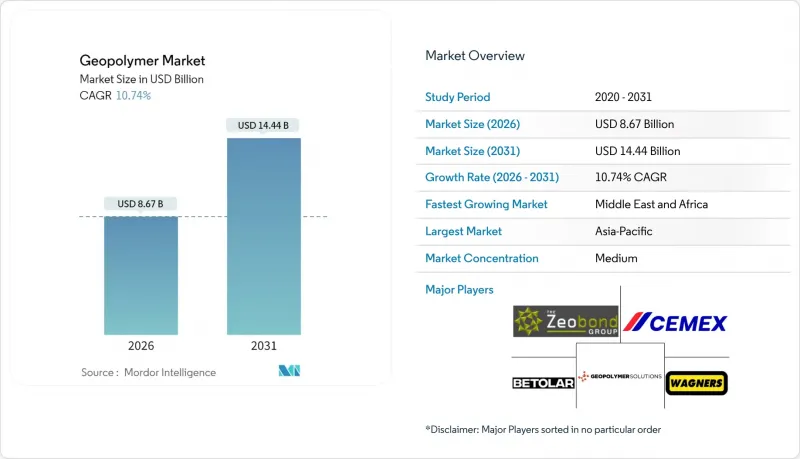
지오폴리머 시장 규모는 2026년에는 86억 7,000만 달러로 추정되고 있으며, 2025년 78억 3,000만 달러에서 성장이 전망됩니다.
2031년까지의 예측에 따르면 2031년까지 144억 4,000만 달러에 달할 것으로 예상되며, 2026-2031년 연평균 복합 성장률(CAGR) 10.74%로 확대될 것으로 전망됩니다.
건축법상 탄소함량 규제 강화, 안정적인 산업폐기물 원료 공급 확대, 1액형 배합의 성능 개선이 지속되면서 주요 건설 분야에서의 지오폴리머 수요가 증가하고 있습니다. 아시아태평양의 방대한 인프라 계획, 유럽의 탄소 가격 메커니즘, 북미의 그린 빌딩 인증 크레딧이 지속적인 물량 성장을 지원하는 한편, 중동의 메가 프로젝트는 첫 번째 채택을 통해 추가적인 성장 기회를 제공할 것입니다. 기존 시멘트 대기업은 기존 점유율을 지키기 위해 상업용 플랜트 규모 확대를 추진하고 있지만, 전문 스타트업 기업은 민첩한 연구개발을 통해 틈새 시장에서 고이익률의 제품을 출시하고 있습니다. 단기 매출은 알칼리 활성제의 가격 변동과 표준 승인 일정에 영향을 받기 쉽지만, 기술적 성숙도가 정책적 압력과 일치함에 따라 전체 시장의 성장 궤도는 견고하게 긍정적으로 유지되고 있습니다.
세계 지오폴리머 시장 동향과 인사이트
시멘트 산업에 대한 엄격한 CO2 배출 규제
의무적인 탄소 감축 정책으로 인해 공공 및 민간 건설 프로젝트의 자재 사양 기준이 재구성되고 있습니다. 캘리포니아주의 'Advanced Clean Car II 프로그램'은 저탄소 건축자재에 대한 조달 인센티브를 연계하여 건설업체들이 미래 지향적인 프로젝트 입찰에서 지오폴리머 콘크리트를 우선시하도록 유도하고 있습니다. 유럽에서는 2026년 도입 예정인 탄소 국경 조정 메커니즘으로 인해 탄소 관세가 부과되어 수입 포틀랜드 시멘트 다량 사용 제품의 비용 우위가 훼손될 것입니다. 개발자들이 증가하는 컴플라이언스 비용에 대한 확실성을 추구하면서 이러한 조치는 공급망 전체에 영향을 미치고 있습니다. 그 결과, 지자체 인프라, 상업용 부동산, 대형 산업용 창고에서 지오폴리머 프리캐스트 패널 및 현장 타설 혼합물의 수주가 확대되고 있습니다. 이에 다국적 시멘트 업체들은 알칼리 활성화 바인더 전용 파일럿 라인의 조기 가동에 박차를 가하고 있으며, 조기에 사양서 게재가 가능하도록 하고 있습니다. 규제 모멘텀은 수요를 자극하는 동시에 기존 포트폴리오의 다각화를 촉진하는 전략적 트리거로 작용하고 있습니다.
플라이 애시 및 슬래그 원료 공급 증가
석탄화력발전소 폐지에 따라 수십년간 저장되어 있던 플라이 애시가 배출되고 있습니다. 한편, 세계 철강 생산 능력의 통합으로 인해 슬래그의 품질이 표준화되고 있습니다. 아시아 전력회사들은 현재 순환경제 가이드라인에 따라 인증된 플라이 애시를 경매에 부치고 있으며, 중국에서는 2025년까지 90%의 이용률 달성을 의무화하고 있습니다. 인도와 한국에서도 유사한 정책이 시행되어 공급처가 확대되고 지오폴리머 배합 제조업체의 가격 안정화가 이루어지고 있습니다. 북미산 F급 플라이 애시의 수입은 기존에는 물류 측면에서 제약이 있었으나, 미국 서해안의 콘크리트 제조업체에 서비스를 제공하는 항만 기반 환적 허브를 통해 완화되고 있습니다. 그 결과, 원료 비용의 변동성이 감소하고 화학 성분의 일관성이 향상되어 보다 엄격한 품질관리가 가능해졌으며, 구조용 등급의 채용 범위가 확대되고 있습니다. 원료의 안정적 공급은 유틸리티 사업자와 지오폴리머 스타트업 간의 장기 공급 계약을 촉진하고, 환경적 책임의 경감과 새로운 수입원 창출을 동시에 달성할 수 있습니다.
통일된 설계 기준 및 규격의 부재
기술자들은 국가 설계 기준에서 완전히 다루지 않는 재료를 지정할 때 여전히 신중한 태도를 유지하고 있습니다. ASTM이 C595/C595M-24를 개정하여 더 광범위한 혼합 시멘트 카테고리를 도입하는 방향으로 나아가고 있으며, 지오폴리머 전용 장은 아직 초안 단계에 있습니다. 결정적인 장기 내구성 기준이 없기 때문에 중요 인프라 소유자는 종종 보수적인 안전 계수를 적용하거나 중복된 보호 계층을 요구하고, 그 결과 비용 경쟁력이 약화되는 경우가 많습니다. 보험사나 보증기관은 비규격화 결합재를 채택한 프로젝트에 대해 추가 보험료를 부과하는 경우가 많으며, 이로 인해 총 설치비용이 상승하는 경우가 많습니다. 개발도상국의 경우, 기후 정책이 저탄소 재료를 권장하는 경우에도 라이선스 기관이 외국에서 도입된 기존 표준에 의존하므로 현지 채택이 지연되는 추가적인 장벽에 직면해 있습니다.
부문 분석
2025년 기준 지오폴리머 시장 점유율에서 콘크리트 중심의 제품군이 52.20%를 차지했습니다. 이는 기존 설비군에 작업자의 재교육 없이 도입이 가능한 익숙한 형태에 대한 의존도가 높다는 것을 보여줍니다. 이러한 우위는 안정적인 매출 기반을 제공하는 동시에 프리스트레스트 교량 거더, 파사드 클래딩, 모듈러 벽체 유닛 등 관련 제품으로의 진출 경로를 개발하고 있습니다. 건설업체는 압축강도 발현, 경화시간, 작업성이 일반 포틀랜드 시멘트 혼합물과 동등하여 공정 리스크를 최소화할 수 있으므로 평평한 바닥공사, 대량 타설, 프리캐스트 부재로 지오폴리머 콘크리트를 채택하고 있습니다. 시장 선도 기업은 기술 지원, 배합 설계 컨설팅, 현장 품질 보증 서비스를 패키지화하여 전환에 대한 신뢰성을 강화함으로써 탄소 예산 준수를 목표로 하는 인프라 기관으로부터의 반복 주문을 확보하고 있습니다.
틈새 그라우트 바인더 분야는 자산 집약적 산업이 신속한 복구 솔루션을 우선시하는 가운데 2031년까지 연평균 복합 성장률(CAGR) 11.03%로 확대될 것으로 예측됩니다. 지오폴리머 그라우트는 가압 주입 장치와의 원활한 연계를 실현하고, 하수관로 복구, 정유소 봉쇄, 해양 파일 피복에 필수적인 높은 초기 강도, 저수축성, 내화학성을 제공합니다. 제품 차별화는 맞춤형 활성화제 패키지, 섬유 보강재, 머리 위 및 수직 설치를 가능하게 하는 요변성 첨가제에 따라 달라집니다. 126MPa 이상의 압축 강도를 가진 지오폴리머 모르타르와 같은 새로운 제품 라인은 대응 가능한 고응력 응용 분야를 확대하여 공급업체가 고부가가치 마진을 확보할 수 있는 기회를 창출합니다.
지오폴리머 시장 보고서는 제품 유형별(시멘트, 콘크리트/프리캐스트 패널, 그라우트 바인더, 그라우팅 바인더, 기타 제품 유형), 용도별(건축, 도로/포장, 활주로 배관/콘크리트 보수 등), 전구체/원료별(플라이 애시계, 슬래그계, 메타카올린계, 왕겨재/농업 폐기물계, 기타), 지역별(아시아태평양, 북미, 남미, 유럽, 중동 및 아프리카, 기타)로 구분하여 분석했습니다. 농업폐기물계, 기타), 지역별(아시아태평양, 북미, 유럽, 유럽, 남미, 중동/아프리카)로 분류되어 있습니다.
지역별 분석
아시아태평양은 통일된 정책 추진, 풍부한 원자재 공급, 세계 최대 규모의 인프라 예산을 배경으로 2025년 44.20%의 압도적인 점유율을 차지할 것으로 예측됩니다. 중국의 '산업 고형 폐기물 이용' 정책에 따라 제조업체는 2025년까지 플라이 애시와 슬래그의 90%를 유효하게 이용해야 하며, 이는 지오폴리머 생산업체에게 안정적인 원료 기반을 형성하고 있습니다. 인도의 스마트 시티 구상과 도시철도 확장은 안정적인 입찰 물량을 확보하고 있으며, 일본 연구 컨소시엄은 내진용 고내구성 배합을 개선하고 있습니다. 규모, 규제, 기술력의 융합으로 이 지역은 향후 10년간 주도적인 위치를 유지할 것으로 예측됩니다.
중동 및 아프리카은 CAGR 10.87%로 확대될 것으로 예상되며, 사우디아라비아의 NEOM, UAE의 마스다르 확장 등 대형 프로젝트에서 지오폴리머 솔루션의 기반 통합이 반영된 것으로 보입니다. 건조한 기후에서의 내구성 요구 사항은 황산염 및 열 사이클에 대한 지오폴리머의 내성을 유리하게 작용하여 자산 수명을 연장하고 양생시 물 수요를 줄입니다. 각국 정부는 건축 기준에 탄소 저감 조항을 포함시켜 수요의 탄력성을 높이고 있습니다. 공급업체는 현지 시멘트 기업과 합작회사를 설립하여 규제 인증의 신속화와 기존 유통망 활용을 도모합니다.
북미와 유럽에서는 기존 인프라에 대한 탄소 리트로핏 계획이 진행되면서 정책 주도의 안정적인 성장세를 보이고 있습니다. 미국 연방정부의 세액공제 및 유럽 그린딜을 통해 저탄소 소재 연구에 대한 보조금이 투입되어 교량 바닥판, 고속도로 램프, 공항 앞치마 등의 시범사업이 지원되고 있습니다. 대형 건설사들은 설계 시공 일괄 도급 제안서에 지오폴리머 옵션을 포함시켜 공공 입찰의 지속가능성 기준에서 높은 평가를 받고 있습니다. 남미 지역은 현재로서는 틈새 시장이지만, 왕겨재의 가용성과 환경 정책의 수렴으로 인해 수혜를 받을 것으로 예측됩니다. 단, 지역 기준과 공급망 정비가 전제조건입니다.
기타 특전:
- 엑셀 형식 시장 예측(ME) 시트
- 애널리스트의 3개월간 지원
자주 묻는 질문
목차
제1장 서론
제2장 조사 방법
제3장 개요
제4장 시장 구도
제5장 시장 규모와 성장 예측
제6장 경쟁 구도
제7장 시장 기회와 향후 전망
KSA 26.03.05Geopolymer market size in 2026 is estimated at USD 8.67 billion, growing from 2025 value of USD 7.83 billion with 2031 projections showing USD 14.44 billion, growing at 10.74% CAGR over 2026-2031.
Accelerating regulation of embodied-carbon across building codes, a widening supply of consistent industrial waste feedstocks, and continual performance gains in one-part formulations combine to lift demand for geopolymers across core construction segments. Asia-Pacific's vast infrastructure pipeline, Europe's carbon-pricing mechanisms, and North America's green-building certification credits together underpin sustained volume growth, while Middle East megaprojects provide incremental upside through first-build adoption. Established cement majors are scaling commercial plants to protect legacy share, even as specialized start-ups leverage agile R&D to launch niche high-margin products. Near-term earnings remain sensitive to alkali-activator price swings and code-approval timelines, yet the overall market's trajectory remains firmly positive as technical maturity aligns with policy pressure.
Global Geopolymer Market Trends and Insights
Stringent CO2-Emissions Regulations on Cement Industry
Mandatory carbon-reduction policies are reshaping material-specification protocols in public and private construction projects. California's Advanced Clean Cars II program ties procurement incentives to low-carbon building materials, prompting contractors to favor geopolymer concrete in their bids to future-proof their projects. In Europe, the Carbon Border Adjustment Mechanism scheduled for 2026 imposes embedded-carbon tariffs that erode the cost advantages of imported Portland-cement-intensive products. These measures cascade through supply chains as developers pursue certainty against rising compliance costs. Consequently, order books for geopolymer pre-cast panels and cast-in-place mixes are expanding in municipal infrastructure, commercial real estate, and large-format industrial warehousing. Multinational cement producers are responding by fast-tracking pilot lines dedicated to alkali-activated binders to secure early specification listings. Regulatory momentum therefore functions both as demand stimulus and as a strategic trigger for incumbent portfolio diversification.
Growing Availability of Fly-Ash and Slag Feedstocks
De-commissioning of coal-fired power plants is releasing decades of stockpiled fly ash, while global steel-capacity consolidation is standardizing slag quality. Asian utilities now auction certified fly-ash lots under circular-economy guidelines that mandate 90% utilization by 2025 in China. Comparable policies in India and South Korea widen supply pools and stabilize pricing for geopolymer formulators. North American Class-F fly ash imports, historically constrained by logistics, are easing through port-based trans-shipment hubs that service concrete producers on the U.S. West Coast. The net effect is a decrease in raw-material cost volatility and greater consistency in chemical composition, enabling tighter quality control and broader structural-grade adoption. Feedstock visibility also encourages long-term offtake contracts between utilities and geopolymer start-ups, aligning environmental-liability reduction with new revenue streams.
Lack of Uniform Design Codes and Standards
Engineers remain cautious when specifying materials not fully covered by national design codes. Although ASTM is revising C595/C595M-24 to introduce broader blended-cement categories, a geopolymer-specific chapter is still in the drafting stage. In the absence of definitive long-term durability benchmarks, critical infrastructure owners often impose conservative safety factors or require redundant protective layers, thereby eroding cost competitiveness. Insurers and bonding agencies frequently attach surcharge premiums to projects that incorporate non-codified binders, thereby raising the total installed costs. Developing nations face additional hurdles as professional-licensing bodies defer to legacy standards imported from foreign jurisdictions, delaying local adoption even when climate policies favor low-carbon materials.
Other drivers and restraints analyzed in the detailed report include:
- Demand for Green-Building Certification Materials
- One-Part Geopolymer Technology Uptake
- Price Volatility of Alkali Activators (NaOH/Na2SiO3)
For complete list of drivers and restraints, kindly check the Table Of Contents.
Segment Analysis
Concrete-centric offerings accounted for 52.20% of geopolymer market share in 2025, underscoring the sector's reliance on familiar form factors that slide into existing equipment fleets without retraining crews. This dominance provides a stable revenue floor and paves a gateway for adjacent products such as pre-stressed bridge beams, facade cladding, and modular wall units. Contractors embrace geopolymer concrete for flatwork, mass pours, and pre-cast elements because compressive-strength development, setting time, and workability now parallel ordinary Portland-cement mixes, minimizing scheduling risk. Market leaders bundle technical support, mix-design consultation, and on-site quality-assurance services to reinforce switching confidence, locking in repeat orders from infrastructure agencies seeking carbon-budget compliance.
The niche grout-and-binder segment is projected to deliver an 11.03% CAGR to 2031 as asset-intensive industries prioritize rapid-return repair solutions. Geopolymer grouts integrate seamlessly with pressure-injection equipment, offering high early strength, low shrinkage, and chemical resistance vital for sewer-line rehabilitation, refinery containment, and marine-pile encasements. Product differentiation hinges on tailored activator packages, fiber reinforcement, and thixotropic additives that enable overhead or vertical installation. Emerging product lines - such as geopolymer mortars exceeding 126 MPa compressive strength - broaden addressable high-stress applications and position suppliers to capture premium margins.
The Geopolymer Market Report is Segmented by Product Type (Cement, Concrete and Pre-Cast Panels, Grout and Binder, Other Product Types), Application (Building, Road and Pavement, Runway, Pipe and Concrete Repair, and More), Precursor/Raw-Material (Fly Ash Based, Slage Based, Metakaolin Based, Rice-Husk Ash and Agricultural Wastes, Others), and Geography (Asia-Pacific, North America, Europe, South America, Middle East and Africa).
Geography Analysis
Asia-Pacific posted a dominant 44.20% share in 2025, driven by synchronized policy mandates, abundant feedstock, and the world's largest infrastructure budgets. China's "Industrial Solid-Waste Utilization" policy obliges manufacturers to valorize 90% of fly ash and slag by 2025, creating a captive raw-material base for geopolymer producers. India's smart-city initiatives and urban-rail expansion add steady bid volumes, while Japanese research consortia refine high-durability formulations for seismic applications. The convergence of scale, regulation, and technological capability secures the region's leadership through the decade.
The Middle East and Africa region is forecast to grow at an 10.87% CAGR, reflecting ground-up integration of geopolymer solutions in megaprojects such as Saudi Arabia's NEOM and the UAE's Masdar expansion. Arid-climate durability requirements favor geopolymer's resistance to sulfates and thermal cycling, extending asset lifespans and reducing water demand for curing. Governments embed carbon-reduction clauses into construction codes, augmenting demand elasticity. Suppliers form joint ventures with local cement firms to fast-track regulatory certifications and leverage existing distribution networks.
North America and Europe exhibit stable, policy-driven growth as legacy infrastructure undergoes carbon-retrofit programs. Federal-level tax credits in the United States and the European Green Deal funnel grant funding toward low-carbon materials research, underwriting pilot bridge decks, highway ramps, and airport aprons. Construction majors integrate geopolymer options into design-build proposals to score higher on public-tender sustainability criteria. South America, although presently niche, stands to benefit from rice-husk-ash availability and environmental policy convergence, contingent on the development of regional standards and supply chains.
- Banah UK Ltd
- Betolar PLC
- CEMEX SAB de CV
- Ceskych Lupkovych Zavodech AS
- ClockSpring|NRI
- GCP Saint Gobain
- Geopolymer Solutions LLC
- Green 360 Technologies
- Heidelberg Materials
- IPR
- Murray & Roberts
- PCI Augsburg GmbH
- RENCA Inc
- Rocla Pty Limited
- Schlumberger Limited
- Wagners
- Zeobond Pty Ltd
Additional Benefits:
- The market estimate (ME) sheet in Excel format
- 3 months of analyst support
TABLE OF CONTENTS
1 Introduction
- 1.1 Study Assumptions and Market Definition
- 1.2 Scope of the Study
2 Research Methodology
3 Executive Summary
4 Market Landscape
- 4.1 Market Overview
- 4.2 Market Drivers
- 4.2.1 Stringent CO2-emissions regulations on cement industry
- 4.2.2 Growing availability of fly-ash and slag feedstocks
- 4.2.3 Demand for green-building certification materials
- 4.2.4 One-part geopolymer technology uptake
- 4.2.5 Emerging deep-sea energy and mining infrastructure uses
- 4.3 Market Restraints
- 4.3.1 Lack of uniform design codes and standards
- 4.3.2 Price volatility of alkali activators (NaOH/Na2SiO3)
- 4.3.3 Feedstock chem-variability impacting quality control
- 4.4 Value Chain Analysis
- 4.5 Porter's Five Forces
- 4.5.1 Bargaining Power of Suppliers
- 4.5.2 Bargaining Power of Buyers
- 4.5.3 Threat of New Entrants
- 4.5.4 Threat of Substitutes
- 4.5.5 Degree of Competition
5 Market Size and Growth Forecasts (Value)
- 5.1 By Product Type
- 5.1.1 Cement, Concrete and Pre-cast Panels
- 5.1.2 Grout and Binder
- 5.1.3 Other Product Types
- 5.2 By Application
- 5.2.1 Building
- 5.2.2 Road and Pavement
- 5.2.3 Runway
- 5.2.4 Pipe and Concrete Repair
- 5.2.5 Bridge
- 5.2.6 Tunnel Lining
- 5.2.7 Railroad Sleeper
- 5.2.8 Coating Application
- 5.2.9 Fireproofing
- 5.2.10 Nuclear Other Toxic Waste Immobilization
- 5.2.11 Specific Mold Products
- 5.3 By Precursor/Raw-Material
- 5.3.1 Fly Ash Based
- 5.3.2 Slage Based
- 5.3.3 Metakaolin Based
- 5.3.4 Rice-Husk Ash and Agricultural Wastes
- 5.3.5 Others (Red-Mud and Bauxite Residue and Waste Glass and Basalt Powders)
- 5.4 By Geography
- 5.4.1 Asia-Pacific
- 5.4.1.1 China
- 5.4.1.2 India
- 5.4.1.3 Japan
- 5.4.1.4 South Korea
- 5.4.1.5 ASEAN Countries
- 5.4.1.6 Rest of Asia-Pacific
- 5.4.2 North America
- 5.4.2.1 United States
- 5.4.2.2 Canada
- 5.4.2.3 Mexico
- 5.4.3 Europe
- 5.4.3.1 Germany
- 5.4.3.2 United Kingdom
- 5.4.3.3 France
- 5.4.3.4 Spain
- 5.4.3.5 Italy
- 5.4.3.6 Russia
- 5.4.3.7 Rest of Europe
- 5.4.4 South America
- 5.4.4.1 Brazil
- 5.4.4.2 Argentina
- 5.4.4.3 Rest of South America
- 5.4.5 Middle East and Africa
- 5.4.5.1 Saudi Arabia
- 5.4.5.2 United Arab Emirates
- 5.4.5.3 Rest of Middle East and Africa
- 5.4.1 Asia-Pacific
6 Competitive Landscape
- 6.1 Market Concentration
- 6.2 Strategic Moves
- 6.3 Market Share**/Ranking Analysis
- 6.4 Company Profiles (includes Global level Overview, Market level overview, Core Segments, Financials as available, Strategic Information, Market Rank/Share, Products and Services, Recent Developments)
- 6.4.1 Banah UK Ltd
- 6.4.2 Betolar PLC
- 6.4.3 CEMEX SAB de CV
- 6.4.4 Ceskych Lupkovych Zavodech AS
- 6.4.5 ClockSpring|NRI
- 6.4.6 GCP Saint Gobain
- 6.4.7 Geopolymer Solutions LLC
- 6.4.8 Green 360 Technologies
- 6.4.9 Heidelberg Materials
- 6.4.10 IPR
- 6.4.11 Murray & Roberts
- 6.4.12 PCI Augsburg GmbH
- 6.4.13 RENCA Inc
- 6.4.14 Rocla Pty Limited
- 6.4.15 Schlumberger Limited
- 6.4.16 Wagners
- 6.4.17 Zeobond Pty Ltd
7 Market Opportunities and Future Outlook
- 7.1 White-Space and Unmet-Need Assessment