|
시장보고서
상품코드
1939751
절단기 : 시장 점유율 분석, 업계 동향과 통계, 성장 예측(2026-2031년)Cutting Equipment - Market Share Analysis, Industry Trends & Statistics, Growth Forecasts (2026 - 2031) |
||||||
 Mordor Intelligence
절단기 시장은 2025년에 343억 2,000만 달러로 평가되며, 2026년 354억 9,000만 달러에서 2031년까지 419억 6,000만 달러에 달할 것으로 예측됩니다.
예측 기간(2026-2031년)의 CAGR은 3.41%로 예상됩니다.
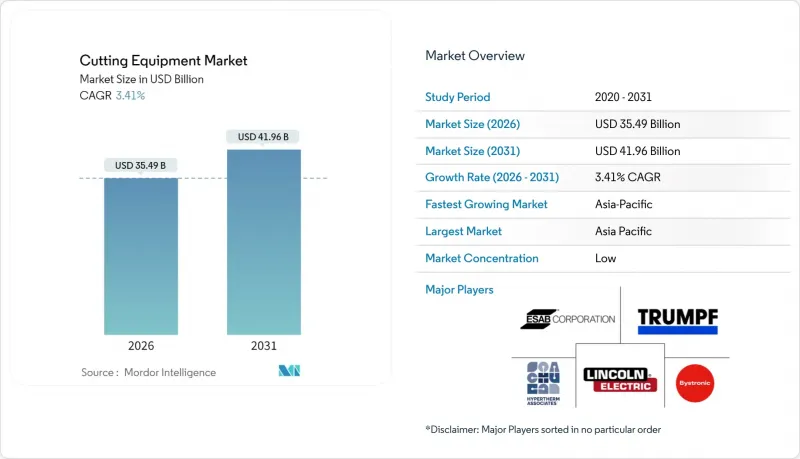
파이버 레이저 시스템에 대한 지속적인 투자, 자동화 보급 확대, 재료 포트폴리오의 확대는 시장 성숙에도 불구하고 꾸준한 성장을 지원하고 있습니다. 파이버 레이저 기술은 2024년 45.65%의 점유율로 이미 레이저 분야를 선도하고 있으며, 초음파 및 AI 지원 시스템이 경쟁 환경을 확장하고 있습니다. 아시아태평양 제조업의 급격한 성장이 전 세계 수요의 거의 절반을 지원하는 한편, 자동차 분야의 전동화 및 전자 분야의 정밀화 요구가 첨단 기계에 대한 투자를 주도하고 있습니다. 동시에 높은 자본 집약도와 숙련된 노동력 부족으로 인해 공급업체들은 이익률을 보호하고 대체 수요를 창출하기 위해 턴키 방식, 소프트웨어 강화형, 에너지 효율이 높은 제품 제공으로 전환하고 있습니다.
세계 절단기 시장 동향 및 인사이트
EV/ICE 자동차 및 항공우주 분야에서의 정밀 가공의 중요성
EV 배터리 하우징과 차세대 항공우주 부품의 설계 공차는 1mm 이하로, 열에 의한 왜곡을 피하기 위해 레이저, 워터젯, 초음파 가공을 채택하는 것이 공장에 요구되고 있습니다. 안드리츠 슐러의 레이저 블랭킹 라인은 분당 45개의 부품으로 고강도 강철을 절단하고, 지능형 네스팅을 통해 원자재 폐기물을 17% 절감합니다. 복합재 재활용에 있어서도 동일한 정밀도가 요구되며, 재생을 위해서는 풍력 터빈 섬유의 기계적 임계값을 충족하는 완벽한 상태가 요구됩니다. 복합재료 차체 구조에 대한 수요가 확대됨에 따라 적응형 절삭 파라미터와 인라인 품질관리의 필요성이 증가하고 있으며, 각 워크스테이션에 비전 시스템과 AI 분석의 통합이 진행되고 있습니다. 그 결과, 고사양 기계는 성숙된 공장에서도 지속적인 갱신 수요가 예상됩니다.
인더스트리 4.0이 주도하는 CNC/로봇 자동화의 급성장
제조업체들은 마모 자가진단, 유지보수 계획 수립, 공장 네트워크 전체에서 생산 데이터 공유를 가능하게 하는 센서 집적형 셀에 절단기를 연동하는 움직임을 가속화하고 있습니다. TRUMPF의 TruMatic 5000은 펀치 레이저 기술과 SheetMaster 핸들링 기술을 결합하여 부품의 적재, 절단 및 배출을 단일 폐쇄 루프에서 수행하여 유휴 시간과 노동력을 절감합니다. Miller Electric과 Novarc의 제휴 등 기존 자동화가 불가능했던 용접 접합부에 AI를 적용하여 숙련공 부족을 완화하고 있습니다. Bystronic과 NanoLock의 사이버 보안 솔루션은 연결된 레이저 장치를 랜섬웨어 공격으로부터 보호합니다. 이러한 혁신 기술을 통해 공장은 소수의 작업자로 다품종 소량 생산을 실현하고, 비용 구조를 재구성하는 동시에 절단기 시장에 로봇 기술의 보급을 가속화하고 있습니다.
높은 초기 투자 및 통합 비용
스마트 레이저, 로봇, 스토리지 타워를 도입하려면 기계 구입비 외에도 바닥 보강, 전력 보강, ERP 시스템 연동 등이 필요하며, 이 모든 것이 많은 중소형 공장의 예산 범위를 넘어서는 프로젝트 예산이 필요합니다. TRUMPF의 완전 자동화 셀은 레이저, 펀치 헤드, 시트 마스터 로더에 동기화된 라이선싱과 안전 펜스가 필요하며, 소량 생산 사용자의 경우 투자 회수 기간이 3년을 초과할 수 있다는 장벽을 보여줍니다. 공공 부문 보조금은 지출의 최대 50%까지 지원되지만, 신청 주기 및 매칭 펀드 규정에 따라 구매 결정이 지연될 수 있습니다. 한편, ISO 12100 기계 안전 표준을 준수하기 위해서는 가드 및 위험 평가가 의무화되어 있으며, 추가적인 비용 부담이 추가됩니다. 가격이 낮아지거나 리스 모델이 보급되기 전까지는 자본집약도가 높기 때문에 중소기업의 보급률은 한계에 봉착할 것입니다.
부문 분석
파이버 레이저는 2025년 매출의 45.12%를 차지하며 절단기 시장에서 가장 큰 점유율을 유지했습니다. 높은 전기광 변환 효율, 낮은 정비성, 좁은 절단 폭, 철 금속과 비철 금속 모두에 적합합니다. nLIGHT의 코로나 빔 성형 유닛은 이 분야의 진보를 보여주는 것으로, 광학계 교체 없이 후판과 박판용 링 모드를 실시간으로 전환할 수 있습니다. CO2 플랫폼은 여전히 두꺼운 스테인리스강 가공에 특화된 공장에서 사용되고 있지만, 소유 비용이 지속적으로 감소함에 따라 신규 판매는 파이버 레이저로 전환되고 있습니다.
레이저 수요는 대형 갠트리 시스템에서만 볼 수 있었던 kW급 출력을 단일 헤드 머신이 달성함에 따라 보다 효율적인 바닥 공간 활용의 혜택을 누리고 있습니다. 2026-2031년 초음파 및 하이브리드 레이저 및 플라즈마 장비는 4.98%의 가장 빠른 CAGR을 나타낼 것으로 예상되지만, 그 기반은 더 좁은 범위에서 시작될 것으로 예측됩니다. 공급업체의 로드맵에는 AI 비전, 자동 노즐 교체, 예측 렌즈 청소가 포함되어 있으며, 파이버 레이저가 절단기 시장에서의 입지를 더욱 공고히 하고 있습니다.
2025년 기준 반자동 장비는 절단기 시장 규모의 42.06%를 차지하고 있으며, 셔틀 테이블, 네스팅 소프트웨어, 작업자 보조 로딩의 보급을 반영하고 있습니다. 공장은 유연성을 누리면서 인력을 줄일 수 있으므로 반자동은 많은 중소기업의 진입점이 되고 있습니다. 그러나 갠트리 로더와 AGV를 통합한 완전 로봇 셀은 ISO 10218-2:2025가 협동 로봇의 도입을 용이하게 함에 따라 2031년까지 5.07%의 연평균 복합 성장률(CAGR)을 보일 것으로 예측됩니다.
디버링, 부품 선별 등 여러 주변 작업을 동일한 작업 셀에 통합하여 투자수익률을 높일 수 있습니다. TRUMPF의 센서는 흡착 컵의 진공 상태를 실시간으로 모니터링하여 절단 불량을 방지하고 무인 운전시 신뢰성을 높입니다. 한편, 15kg의 적재능력을 가진 저비용 협동로봇은 현재 3만 달러 미만으로 운영이 가능해져 소규모 가공공장에서도 무인 야간작업이 가능해졌습니다. 이러한 추세는 휴먼 인 더 루프(Human in the Loop) 워크플로우가 지속되는 가운데, 절삭 설비 시장에서 자동화의 점유율이 확대되고 있음을 시사합니다.
지역별 분석
아시아태평양은 2025년 매출의 48.62%를 차지할 것으로 예상되며, 중국, 인도, 아세안 지역의 생산 능력 증가에 힘입어 2031년까지 연평균 4.31%의 연평균 복합 성장률(CAGR)을 보일 것으로 전망됩니다. HSG 레이저가 6,830만 달러를 투자한 제남 캠퍼스는 그 규모를 보여주는 좋은 예이며, 연간 1만 대의 고출력 유닛 생산과 현지 바이어를 위한 리드타임 단축을 약속하고 있습니다. 전기자동차(EV), 항공우주, 조선 분야의 정책 추진으로 지속적인 수주가 예상되는 가운데, 국내 공구업체들은 수출 지원을 위해 해외 A/S 거점을 확대하고 있습니다.
북미는 탄탄한 기존 설비 기반을 보유하고 있으며, 갱신 비용을 절감할 수 있는 새로운 혜택의 혜택을 누리고 있습니다. 미국 에너지부가 2024년에 설정한 4,000만 달러의 보조금 한도는 38개 주에 걸쳐 219개 공장의 효율 개선을 지원하여 파이버 레이저 도입에 박차를 가하고 있습니다. 또한 7억 5,000만 달러 규모의 '첨단 에너지 제조 및 재활용 프로그램'은 석탄 산업 영향권 지역의 공장 개보수 자금을 지정하여 금속 가공 공장의 청정화 및 자동화 라인으로의 전환을 촉진하고 있습니다. 캐나다의 자동차 산업 클러스터와 멕시코의 니어쇼어링 붐이 지역 수요를 더욱 촉진하고 있습니다.
유럽은 정밀 엔지니어링의 전통과 엄격한 규제를 바탕으로 거시경제 성장 둔화 속에서도 판매를 유지하고 있습니다. 스위스 기술상을 수상한 바이스트로닉의 '지능형 커팅 프로세스' 자율 키트는 완전 무인 레이저 분야의 연구개발 리더십을 입증하고 있습니다. 독일은 DIN 위원회를 통해 국제 표준을 주도하고 있으며, 고사양 안전 아키텍처를 중시하는 ISO 규정 형성에 기여하고 있습니다. EU 환경지침도 복합재 재활용 공장에 대한 투자를 촉진하여 간접적으로 초음파-워터젯 수주를 견인하고 있습니다. 중동/아프리카, 남미에서는 2차 성장 거점이 형성되어 인프라 구축에 따라 중저가 플라즈마 절단기 및 산소연료 절단기의 첫 도입이 진행되고 있습니다.
기타 특전:
- 엑셀 형식 시장 예측(ME) 시트
- 애널리스트의 3개월간 지원
자주 묻는 질문
목차
제1장 서론
제2장 조사 방법
제3장 개요
제4장 시장 구도
제5장 시장 규모와 성장 예측(금액)
제6장 경쟁 구도
제7장 시장 기회와 향후 전망
KSA 26.03.06The cutting equipment market was valued at USD 34.32 billion in 2025 and estimated to grow from USD 35.49 billion in 2026 to reach USD 41.96 billion by 2031, at a CAGR of 3.41% during the forecast period (2026-2031).
Ongoing investments in fiber laser systems, rising automation adoption, and widening material portfolios sustain steady growth even as the marketplace matures. Fiber laser technology already leads the laser segment with a 45.65% share in 2024, and ultrasonic plus AI-enabled systems are broadening the competitive set. Asia-Pacific's manufacturing surge underpins nearly half the global demand, while electrification in automotive and precision needs in electronics pull advanced machinery spending. At the same time, high capital intensity and gaps in skilled labor temper expansion, pushing suppliers toward turnkey, software-rich, and energy-efficient offerings to defend margins and unlock replacement demand.
Global Cutting Equipment Market Trends and Insights
Precision-Critical Fabrication in EV/ICE Automotive & Aerospace
Design tolerances for EV battery housings and next-generation aerospace parts now fall below a millimeter, forcing plants to adopt lasers, water-jets, and ultrasonics that avoid heat-affected distortion. ANDRITZ Schuler's Laser Blanking Line cuts high-strength steel at 45 parts per minute and trims raw-material waste by 17% through intelligent nesting. Similar precision requirements extend to composite recycling, where reclaimed wind-turbine fibers must remain intact to meet mechanical thresholds for reuse. Demand for mixed-material body structures amplifies the need for adaptive cutting parameters and in-line quality control, pushing vendors to embed vision systems and AI analytics within every workstation. As a result, high-specification machinery sees durable replacement demand even in mature plants.
Industry 4.0 Driven CNC/Robotic Automation Surge
Manufacturers increasingly link cutting machines into sensor-rich cells that self-diagnose wear, schedule service, and share production data across the factory network. TRUMPF's TruMatic 5000 couples punch-laser tech with SheetMaster handling to load, cut, and unload parts in one closed loop, shrinking idle time and labor input. Partnerships such as Miller Electric-Novarc apply AI to weld joints previously impossible to automate, easing skilled-worker shortages. Cyber-security solutions from Bystronic and NanoLock now guard connected lasers against ransomware breaches. Collectively, these innovations let plants run small, high-mix batches with fewer operators, reshaping cost structures and accelerating the diffusion of robotics into the cutting equipment market.
High Upfront Capital & Integration Costs
Smart lasers, robots, and storage towers demand not only machine purchase but also reinforced floors, power upgrades, and ERP links, all of which raise project budgets beyond many smaller shops. TRUMPF's fully automated cells illustrate the hurdle: the laser, punch head, and SheetMaster loader require synchronized software licenses and safety fencing that push payback periods past three years for low-volume users. Public-sector grants cover up to 50% of outlays, yet application cycles and matching-fund rules can defer purchase decisions. Meanwhile, compliance with ISO 12100 machine-safety norms mandates guarding and risk assessments that add further cost layers. Until prices taper or leasing models proliferate, capital intensity will cap penetration rates among SMEs.
Other drivers and restraints analyzed in the detailed report include:
- Manufacturing Capacity Boom Across APAC
- Post-Pandemic Cap-Ex Incentives for Energy-Efficient Fiber Lasers
- Global Shortage of Skilled CNC/CAM Technicians
For complete list of drivers and restraints, kindly check the Table Of Contents.
Segment Analysis
Fiber lasers accounted for 45.12% of 2025 revenue, maintaining the largest slice of the cutting equipment market. Their high electrical-to-optical efficiency, lower service needs, and tight kerf widths suit both ferrous and non-ferrous metals. nLIGHT's Corona beam-shaping unit showcases the segment's pace, letting users toggle ring modes on the fly for thick or thin plates without optics swaps. CO2 platforms still survive in shops focused on thicker stainless edges, but incremental sales now gravitate toward fiber as ownership costs continue to compress.
Laser demand also benefits from tighter floor-space utilization, as single-head machines reach kilowatt ratings once reserved for large gantry systems. Over 2026-2031, ultrasonic and hybrid laser-plasma rigs are expected to post the fastest 4.98% CAGR, yet they start from a narrower base. Supplier roadmaps bundle AI vision, automated nozzle changeovers, and predictive lens cleaning, further cementing fiber's hold on the cutting equipment market.
Semi-automated setups held 42.06% of the cutting equipment market size in 2025, reflecting widespread use of shuttle tables, nesting software, and operator-assisted loading. Plants enjoy flexibility while trimming manpower, making semi-auto the entry point for many SMEs. Yet fully robotic cells, integrating gantry loaders and AGVs, look set for a 5.07% CAGR through 2031 as ISO 10218-2:2025 eases cobot adoption.
Return-on-investment improves when multiple peripheral tasks, such as deburring and part sorting, join the same work cell. TRUMPF's sensors check suction-cup vacuum in real time, avoiding crashed cuts and raising lights-out reliability. Meanwhile, low-cost cobots with 15 kg payloads now operate at under USD 30,000, putting unattended night shifts within reach for job shops. These trends point to automation's rising share of the cutting equipment market, even if human-in-the-loop workflows persist.
The Cutting Equipment Market Report is Segmented by Technology (Laser, Plasma, and More), by Automation Level (Manual, Semi-Automated, and Robotic/Fully-automated), by End-User Industry (Automotive, Aerospace & Defense, and More), by Material Type (Ferrous Metals, Non-Ferrous Metals, Composites, and More), and by Geography (North America, South America, Europe, and More). The Market Forecasts are Provided in Terms of Value (USD).
Geography Analysis
Asia-Pacific captured 48.62% of 2025 revenue and is on course for a 4.31% CAGR to 2031, buoyed by capacity additions across China, India, and the ASEAN corridor. HSG Laser's USD 68.3 million Jinan campus exemplifies the scale, promising 10,000 high-power units per year and shortening lead times for local buyers. Policy push for EVs, aerospace, and shipbuilding funnels continuous orders, while domestic toolmakers extend overseas after-sales centers to support exports.
North America holds a robust installed base and benefits from fresh incentives that defray upgrade costs. The Department of Energy's USD 40 million grant pool in 2024 subsidized efficiency retrofits for 219 factories across 38 states, accelerating fiber laser adoption. In addition, the USD 750 million Advanced Energy Manufacturing and Recycling program earmarks funds for plant rehabs in coal-impacted regions, nudging metal shops toward cleaner, automated lines. Canada's automotive cluster and Mexico's near-shoring boom further lift regional demand.
Europe leverages precision-engineering heritage and regulatory heft to sustain sales, even amid slower macro growth. Bystronic's Intelligent Cutting Process autonomy kit, winner of the Swiss Technology Award, underscores R&D leadership in fully unattended lasers. Germany drives global standards through DIN committees, shaping ISO rules that favor high-spec safety architectures. EU environmental directives also spur investments in composite recycling plants, indirectly pulling orders for ultrasonics and water-jets. Secondary growth pockets appear in the Middle East, Africa, and South America, where infrastructure build-outs prompt first-time purchases of mid-range plasma and oxy-fuel machines.
- TRUMPF SE + Co. KG
- Lincoln Electric Holdings, Inc.
- ESAB Corp. (ex-Colfax)
- Bystronic AG
- Hypertherm Associates
- IPG Photonics Corp.
- Mitsubishi Electric / Mazak Optonics
- Han's Laser Technology
- Messer Cutting Systems
- Flow International
- OMAX Corp.
- KMT Waterjet Systems
- Amada Miyachi
- Kennametal Inc.
- DAIHEN Corp.
- Koike Aronson, Inc.
- GCE Group
- Linde plc (Cutting gases)
- Prima Power
- Struers (sample-prep niche)
Additional Benefits:
- The market estimate (ME) sheet in Excel format
- 3 months of analyst support
TABLE OF CONTENTS
1 Introduction
- 1.1 Study Assumptions & Market Definition
- 1.2 Scope of the Study
2 Research Methodology
3 Executive Summary
4 Market Landscape
- 4.1 Market Overview
- 4.2 Market Drivers
- 4.2.1 Precision-critical fabrication in EV/ICE automotive & aerospace
- 4.2.2 Industry 4.0 driven CNC/robotic automation surge
- 4.2.3 Manufacturing capacity boom across APAC
- 4.2.4 Post-pandemic cap-ex incentives for energy-efficient fiber lasers
- 4.2.5 Recycling of advanced composites requiring cold-cutting processes
- 4.2.6 Lightweight battery-housing demand in e-mobility platforms
- 4.3 Market Restraints
- 4.3.1 High upfront capital & integration costs
- 4.3.2 Global shortage of skilled CNC / CAM technicians
- 4.3.3 Supply-chain volatility for critical electronic & optical components
- 4.3.4 Garnet-abrasive scarcity disrupting water-jet OPEX
- 4.4 Value / Supply-Chain Analysis
- 4.5 Regulatory Landscape
- 4.6 Technological Outlook
- 4.7 Industry Attractiveness - Porter's Five Forces Analysis
- 4.7.1 Bargaining Power of Suppliers
- 4.7.2 Bargaining Power of Buyers
- 4.7.3 Threat of New Entrants
- 4.7.4 Threat of Substitutes
- 4.7.5 Competitive Rivalry
- 4.8 Global Manufacturing-Sector Snapshot
- 4.9 Metalworking Industry Snapshot
5 Market Size & Growth Forecasts (Value, In USD Billion)
- 5.1 By Technology
- 5.1.1 Laser
- 5.1.1.1 Fiber
- 5.1.1.2 CO2
- 5.1.1.3 Solid-state / Other
- 5.1.2 Plasma
- 5.1.2.1 High-definition
- 5.1.2.2 Conventional
- 5.1.3 Water-Jet
- 5.1.3.1 Abrasive
- 5.1.3.2 Pure
- 5.1.4 Flame / Oxy-fuel
- 5.1.5 Ultrasonic & Emerging
- 5.1.1 Laser
- 5.2 By Automation Level
- 5.2.1 Manual
- 5.2.2 Semi-automated
- 5.2.3 Robotic / Fully-automated
- 5.3 By End-User Industry
- 5.3.1 Automotive
- 5.3.2 Aerospace & Defense
- 5.3.3 Electrical & Electronics
- 5.3.4 Construction & Infrastructure
- 5.3.5 Metal-Fabrication Job Shops
- 5.3.6 Shipbuilding
- 5.3.7 Energy & Power
- 5.3.8 Others (Medical Devices, etc.)
- 5.4 By Material Type
- 5.4.1 Ferrous Metals
- 5.4.2 Non-Ferrous Metals
- 5.4.3 Composites
- 5.4.4 Glass/Ceramics/Stone
- 5.4.5 Others (Polymers/Plastics/Wood, etc.)
- 5.5 By Geography
- 5.5.1 North America
- 5.5.1.1 United States
- 5.5.1.2 Canada
- 5.5.1.3 Mexico
- 5.5.2 South America
- 5.5.2.1 Brazil
- 5.5.2.2 Argentina
- 5.5.2.3 Rest of South America
- 5.5.3 Europe
- 5.5.3.1 United Kingdom
- 5.5.3.2 Germany
- 5.5.3.3 France
- 5.5.3.4 Italy
- 5.5.3.5 Spain
- 5.5.3.6 BENELUX (Belgium, Netherlands, and Luxembourg)
- 5.5.3.7 NORDICS (Denmark, Finland, Iceland, Norway, and Sweden)
- 5.5.3.8 Rest of Europe
- 5.5.4 Asia-Pacific
- 5.5.4.1 China
- 5.5.4.2 India
- 5.5.4.3 Japan
- 5.5.4.4 Australia
- 5.5.4.5 South Korea
- 5.5.4.6 ASEAN (Indonesia, Thailand, Philippines, Malaysia, Vietnam)
- 5.5.4.7 Rest of Asia-Pacific
- 5.5.5 Middle East and Africa
- 5.5.5.1 Saudi Arabia
- 5.5.5.2 United Arab Emirates
- 5.5.5.3 Qatar
- 5.5.5.4 Kuwait
- 5.5.5.5 Turkey
- 5.5.5.6 Egypt
- 5.5.5.7 South Africa
- 5.5.5.8 Nigeria
- 5.5.5.9 Rest of Middle East and Africa
- 5.5.1 North America
6 Competitive Landscape
- 6.1 Market Concentration
- 6.2 Strategic Moves
- 6.3 Market Share Analysis
- 6.4 Company Profiles (includes Global overview, Core segments, Financials, Strategic info, Products, Recent developments)
- 6.4.1 TRUMPF SE + Co. KG
- 6.4.2 Lincoln Electric Holdings, Inc.
- 6.4.3 ESAB Corp. (ex-Colfax)
- 6.4.4 Bystronic AG
- 6.4.5 Hypertherm Associates
- 6.4.6 IPG Photonics Corp.
- 6.4.7 Mitsubishi Electric / Mazak Optonics
- 6.4.8 Han's Laser Technology
- 6.4.9 Messer Cutting Systems
- 6.4.10 Flow International
- 6.4.11 OMAX Corp.
- 6.4.12 KMT Waterjet Systems
- 6.4.13 Amada Miyachi
- 6.4.14 Kennametal Inc.
- 6.4.15 DAIHEN Corp.
- 6.4.16 Koike Aronson, Inc.
- 6.4.17 GCE Group
- 6.4.18 Linde plc (Cutting gases)
- 6.4.19 Prima Power
- 6.4.20 Struers (sample-prep niche)
7 Market Opportunities & Future Outlook
- 7.1 White-space & Unmet-Need Assessment